A founder in Brickell signs a marketing retainer on a Tuesday, the agency starts posting and running ads by Thursday, and the work looks great by the end of the month. Then the first dispute lands in email. The client says the contract covered “ongoing support,” the agency says that meant light edits, and nobody can agree on when payment was due or whether the relationship could be ended without another invoice.
That's the kind of mess a service agreement is supposed to prevent. In South Florida, where deals move fast, people switch between English and Spanish, and teams often start work before the paperwork feels “finished,” a weak contract turns a business disagreement into a cash flow problem and, sometimes, a lawsuit.
Table of Contents
- Why Most Service Agreements Fail Before Work Begins
- The Six Clauses Every Service Agreement Must Include
- Drafting Mechanics That Turn Vague Promises Into Enforceable Terms
- Termination, Liability, and Dispute Resolution Without the Legalese
- The Shorter the Better and Why Most Boilerplate Backfires
- Negotiation Tactics and a Pre-Signing Checklist for Founders
- Next Steps for South Florida Founders
Why Most Service Agreements Fail Before Work Begins
A Wynwood creative studio signs a five-figure branding contract, delivers the work, and then learns the client thinks “ongoing support” includes unlimited revisions, social media help, and weekend responses. The agreement never defined those boundaries. The invoice says payment is due on completion, the client says completion meant approval, and the agency is now chasing money for work it already performed.
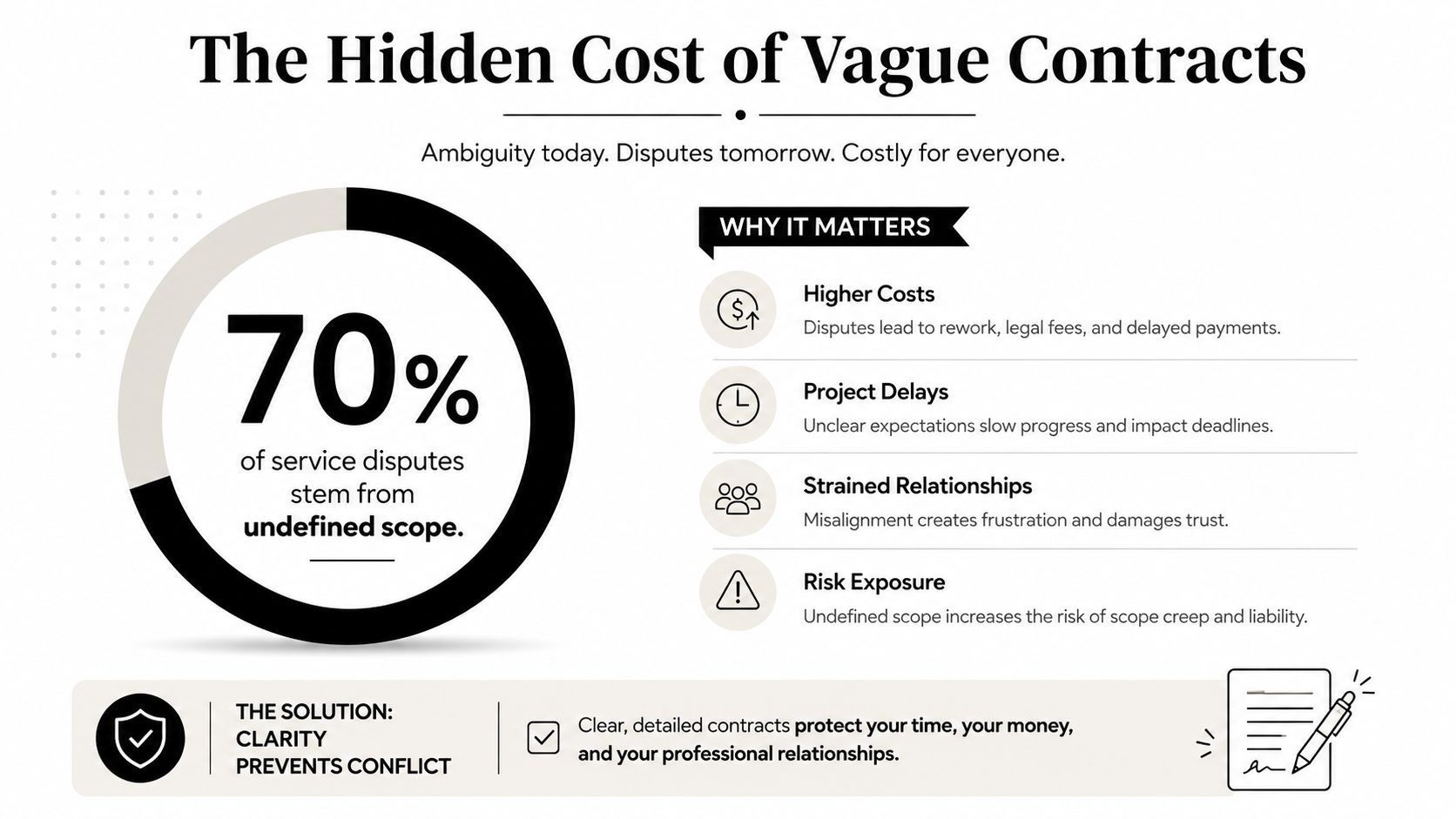
That kind of dispute usually doesn't happen because someone is dishonest. It happens because the document was treated like paperwork instead of a risk-control tool. Poorly drafted service agreements are where relationships turn sour, collections get delayed, and legal fees eat the margin that made the deal worthwhile in the first place.
What Vague Language Really Costs
The biggest mistake is assuming a friendly handshake can fill the gaps later. It can't, especially when the work becomes more expensive than either side expected or when the relationship turns adversarial. If the agreement doesn't spell out scope, payment triggers, termination rights, and who owns the work product, the parties are left arguing from memory instead of text.
That's why market data matters. By 2024, Common Paper reported that 90% of cloud service agreements included an automatic-renewal clause, 84% used a 30-day non-renewal notice period, 79% used a 1x-fees general liability cap, and 62% used net-30 payment terms Common Paper benchmark. Those numbers show how concentrated the drafting decisions are, renewal, payment, liability, and notice, not endless boilerplate.
A service agreement should answer the questions that create fights later, who does what, when is it done, when is it paid, and how does it end.
The practical shift is simple. Stop treating the contract as a formality you attach after the quote is accepted. Treat it as the document that defines the deal itself. In South Florida, where founders often move quickly to beat competitors, the businesses that slow down long enough to define the deal usually spend less time cleaning up a broken one.
What This Approach Changes
A strong agreement doesn't just prevent lawsuits. It makes collections cleaner, gives the team a common reference point, and helps the client understand what they're buying before work starts. That matters because many people still don't read service agreements carefully, and some businesses still don't get lawyer review before signing contract statistics roundup.
The better question isn't whether you need a service agreement. It's whether yours can survive the first disagreement without collapsing into ambiguity.
The Six Clauses Every Service Agreement Must Include
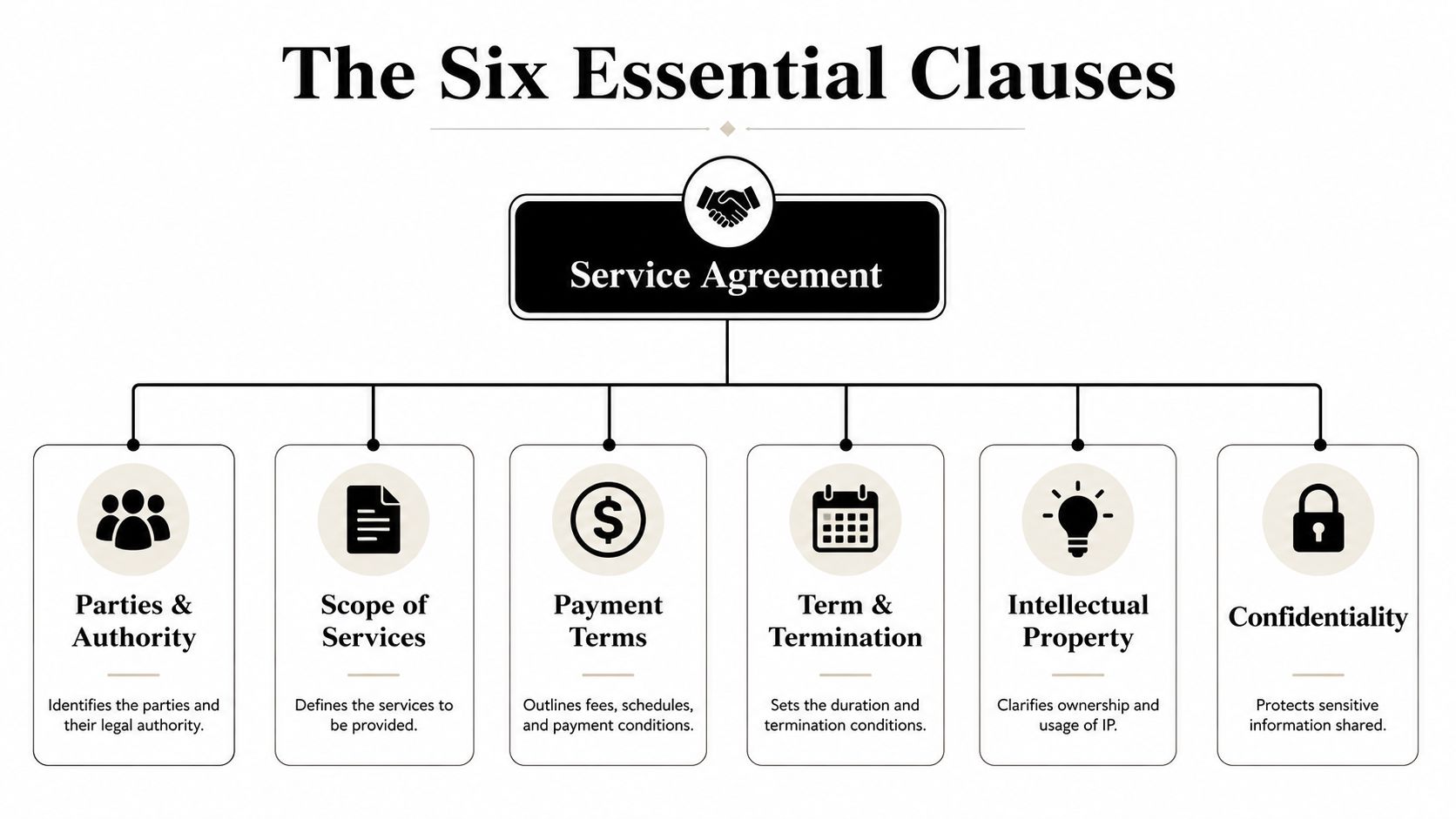
A workable service agreement isn't built out of ornament. It's built out of six clauses that do real work. If one of them is missing, the document may still look professional, but it won't answer the questions that matter when money, time, or ownership are on the line.
1. Parties and authority
Start with the exact legal names of the entities and the people signing for them. If the wrong company name is used, or if the signer doesn't have authority, enforcement gets messy fast. The point is to make sure the right legal person is bound before anyone starts work. See also common contract clauses in practice.
2. Scope of services
This is the clause that should read like a job description, not a vibe. It should say what gets delivered, what is excluded, and what counts as completion. Vague scope is the most common source of later fights because everyone thinks they agreed to something slightly different.
3. Payment terms
Payment language should answer when an invoice is triggered, how much is due, which payment methods are accepted, and what happens if payment is late. If you're selling a larger project, a deposit is often the right business choice, and market guidance commonly uses 25–50% upfront for larger jobs service agreement template guide.
4. Term and termination
Every founder needs to know how the relationship starts, how long it lasts, and how either side gets out. A contract that doesn't say how to end the deal can trap both parties in a bad arrangement or invite a fight over prepaid work.
5. Intellectual property
This clause decides who owns what after the work is done. If you're buying creative, software, design, or content services, the agreement should separate background IP from custom work product so there's no confusion over reuse or resale.
6. Confidentiality
A confidentiality clause protects business information, client lists, pricing, processes, and nonpublic strategy. It's most useful when the service relationship gives one side access to information the other side wouldn't want made public.
The reason these six clauses matter is that they cover the core decision points founders negotiate. A clean service agreement doesn't try to say everything. It says the right things clearly, in the right order, and with enough precision that the next person can read it without guessing. A plain-language draft with these clauses is easier to enforce, easier to revise, and easier to explain to the client when the deal changes.
Drafting Mechanics That Turn Vague Promises Into Enforceable Terms
A service agreement gets tested in the messy middle of a deal, when the scope shifts, the client delays access, or both sides remember the work differently. Good drafting closes those gaps. It names the parties correctly, describes the service in measurable terms, and ties payment to records you can point to. That is the difference between “we thought that was included” and a contract a Florida court or arbitrator can read without guessing.
Use measurable scope language
“Best efforts” sounds polished, but it is fuzzy. If the agreement instead says the provider will deliver three ad concepts, two revision rounds, and final files in specified formats, both sides can tell whether the work was completed. The same logic applies to acceptance. A clean clause gives the client a set window to reject deliverables and requires enough detail to explain the defect so the provider can fix it.
That matters even more in South Florida, where bilingual teams, remote vendors, and fast-moving founders often rely on quick messages to keep projects moving. Informal language creates room for later disagreement, especially after a deal goes sideways.
Tie milestones to client dependencies
One of the easiest ways to avoid blame-shifting is to spell out what the client has to provide and when. If the client delays approvals, assets, or access, the schedule should move with that delay. That makes the risk allocation honest instead of automatic, and it keeps a provider from being punished for a delay the client caused.
Make change orders mandatory
Scope creep usually starts with informal emails. A founder asks for “just one more thing,” the provider agrees in Slack, and suddenly the project has doubled without a pricing update. A written change-order clause stops that drift.
If the task was not in the original scope, it needs new written approval before the work starts.
Sample clause language founders can adapt
Deliverables. Provider will deliver the items listed in Exhibit A. Deliverables are complete when they match the specifications in Exhibit A and have been submitted in the agreed file format.
Additional work. Any work outside Exhibit A requires a written change order signed by both parties before Provider begins that work.
Payment. Client will pay the invoice within the agreed net term after receipt of an invoice triggered by the milestone described in this agreement.
For service businesses that sell standardized offers, it also helps to see how terms are presented in consumer-facing frameworks like terms for ecommerce merchants. The legal principle is the same. Narrow the deal to what the business can deliver, then make payment and acceptance track that delivery.
A few drafting habits matter almost as much as the clauses themselves. Use full legal names, include entity type, and keep technical details in exhibits or schedules when the main agreement would otherwise become unreadable. If your project includes custom deliverables, rate cards for out-of-scope work, or phased milestones, separate those items so the core contract stays clean. For a broader drafting framework before you finalize a service agreement, how to write a business contract is a useful reference point.
Termination, Liability, and Dispute Resolution Without the Legalese
A deal that looks fine on day one can turn into a mess the moment the work stalls, the invoice sits unpaid, or the client wants out early. Most founders spend their energy on scope and pricing, then treat the exit language as an afterthought. That creates avoidable risk. A service agreement that explains how the relationship ends often protects more value than one that only explains how it begins.
The exit terms you actually need
There are two basic ways to end a service agreement. Termination for convenience lets a party exit without claiming breach, usually after notice. Termination for cause applies when someone misses payment, fails to perform, or materially breaches the deal. In a fast-moving South Florida market, the notice period should match the pace of the work and the amount of cleanup the provider will need. A 30-day notice period is a common benchmark for non-renewal and orderly exit Common Paper benchmark.
The money terms matter just as much. A solid termination clause says what happens to prepaid fees, work in progress, and deliverables that have not yet been released. If the client ends the deal early, the contract should say whether any unused retainer is refundable and whether completed work remains payable. Without that language, both sides end up arguing over what counts as finished work and what counts as an earned fee.
Liability caps and indemnity
Liability limits are where business judgment shows up. In the SMB market, a 1x fees general liability cap is common in cloud service agreements Common Paper benchmark. That does not mean every deal should use it, but it gives founders a starting point for negotiation. Without a cap, a small project can expose a provider to claims that far exceed the size of the deal.
Indemnity should stay narrow enough to match the risk. If you are the service provider, indemnification usually makes sense when it is tied to your own misconduct, IP infringement, or a third-party claim caused by your work. It should not become a catchall for every business problem the customer brings to the table. In practice, broad indemnity language is often where a client tries to shift unrelated risk back to the provider.
| Clause | SMB Market Default | Negotiation Lever | Risk if Missing |
|---|---|---|---|
| Termination notice | 30-day notice is common | Shorten for smaller projects, lengthen for complex work | Surprise exits and unpaid closeout work |
| Liability cap | 1x fees is common | Carve out fraud, confidentiality breaches, or unpaid fees | Unlimited exposure |
| Prepaid fees | Often addressed on early termination | Tie refund to unearned work only | Collection fights over retainers |
| Dispute process | Often includes arbitration or venue clause | Choose Miami-Dade, Broward, or other forum deliberately | Time lost arguing where to sue |
Dispute resolution without drama
Mediation, arbitration, and litigation do different jobs. Mediation is a settlement conversation with a neutral third party. Arbitration is a private decision process that can move faster than court. Litigation is the public court route, with more procedure and more noise. In South Florida, many founders choose a private forum because speed and confidentiality matter when the relationship is already strained.
If the agreement uses arbitration, the clause needs to say the forum, the governing law, and whether the arbitrator can award attorneys' fees. It also needs to say who picks the arbitrator and where the hearing will sit, because those details matter once a dispute starts. For a closer look at how the clause works in practice, see what an arbitration clause does.
The Shorter the Better and Why Most Boilerplate Backfires
Long templates feel safe because they look complete. In practice, they often bury the terms that matter under filler, copied definitions, and clauses that do not fit the deal in front of you. A service agreement that tries to cover every possible scenario usually ends up weaker than a shorter one that addresses risks directly.
The worst drafting problems show up in integration clauses that say “this is the entire agreement” without explaining what happens if an SOW, exhibit, or change order conflicts with the main contract. A force majeure clause can also create trouble if it is drafted so broadly that it excuses ordinary delay instead of genuine disruption. When a deal goes sideways, each side will read the text in the light most favorable to its position, so weak structure turns into a dispute trigger fast.
What clean drafting looks like
A tighter agreement usually works better because it lets the parties find the operative terms quickly. Market benchmarks show that service agreements tend to concentrate around repeat issues like renewal, payment timing, liability allocation, and notice, which is exactly where the fights usually happen. The contract should focus on those few terms and make them easy to find.
The best contract is not the longest one. It is the one that makes the parties' actual business deal obvious.
The contrast with sloppy boilerplate is easy to see. A 30-page template from a generic generator may impress nobody and still miss the point. A five-page agreement with clear scope, defined payment triggers, and a sensible termination path is often easier to enforce because the text matches the transaction.
Strip bloat without losing protection
Cut duplicate definitions. Move technical instructions into exhibits. Remove legal phrases that sound formal but do not change the parties' obligations. Keep the clauses that allocate risk, then write them so a founder can explain them without a law degree. That is not dumbing the deal down. It is making the contract work in the world.
Negotiation Tactics and a Pre-Signing Checklist for Founders
The moment a contract lands in your inbox is not the moment to skim and sign. It's the moment to check who is taking the risk, how fast the money moves, and whether the scope can expand without a new signature. If the other side says it's their “standard form,” that's not a reason to relax. It's a reason to read more carefully.
The three clauses worth pushing on first
Payment triggers, IP ownership, and termination notice are the terms that usually matter most in a negotiation. If payment only happens after final acceptance with no clear acceptance window, collections can drag. If IP assigns everything to the client, you may lose rights to reusable methods or background materials. If termination can happen instantly with no cure period, the relationship can collapse before the provider gets paid for work already done.
If the scope changes, insist on a formal change order. Email chains are easy to lose and hard to prove. A signed change order gives you a clean record of what was added, what it costs, and whether the timeline moved.
Red flags that should trigger review
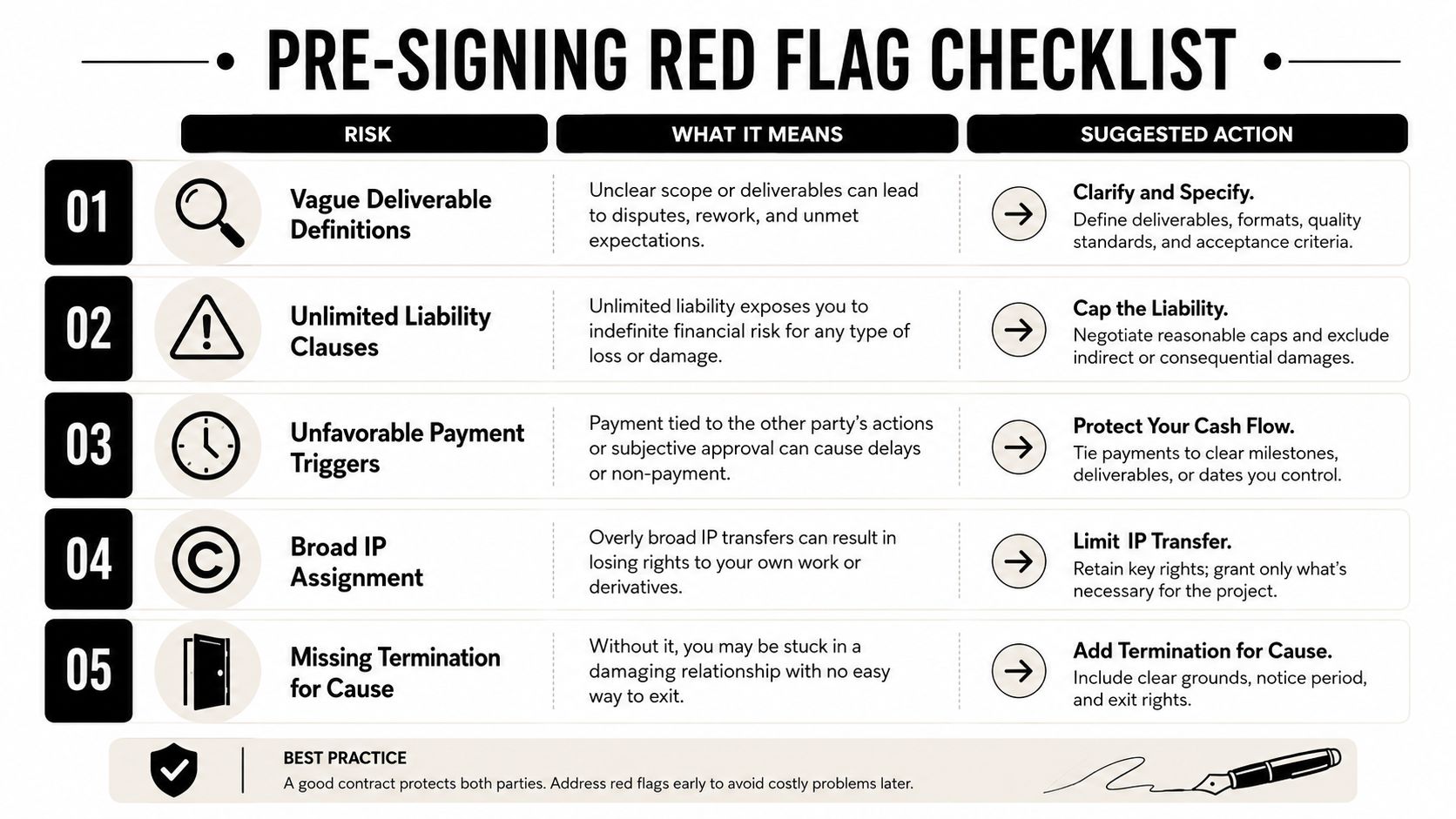
- Vague deliverable definitions. If you can't tell when the job is done, ask for measurable milestones and acceptance criteria.
- Unlimited liability clauses. Push for a cap tied to fees unless the business reason for broader exposure is real and documented.
- Unfavorable payment triggers. If the other side controls payment entirely, revise the trigger to a date, milestone, or invoice event you can prove.
- Broad IP assignment. Carve out preexisting materials, tools, templates, and know-how before you sign away more than you intended.
- Missing termination for cause. Add a cure period so a fixable breach doesn't instantly become a full-blown dispute.
Founder checklist before signing
- Authority confirmed. Make sure the signer can bind the entity.
- Deliverables defined. Check that the scope, format, and completion standard are measurable.
- Payment terms clear. Confirm deposit, invoice timing, late fees, and accepted payment methods.
- IP carve-outs written. Protect background materials and reuse rights where they matter.
- Confidentiality included. Make sure sensitive information has a real protection clause.
- Liability cap reviewed. Confirm the exposure fits the deal.
- Dispute venue identified. Governing law and forum should match the risk posture.
One practical tip matters more than people think. Ask for a redline, not a verbal promise. Then verify that the governing law matches the forum clause, because a mismatch creates needless friction when there's a dispute. If the contract involves a service-heavy relationship, a review from a South Florida business lawyer who drafts these documents every week can save a lot of rework, and a firm such as Coto & Waddington, Attorneys at Law is one option founders use for drafting and review.
Next Steps for South Florida Founders
The usual mistakes are easy to spot once you know what to look for. Vague scope, missing IP carve-outs, no termination mechanic, and an unchecked governing law clause are the issues that turn a simple service relationship into a billing fight. In a market as fast, bilingual, and relationship-driven as South Florida, the contract has to be clear enough to hold up when the conversation isn't.
If you're sending or signing service agreements this month, don't rely on a template you found in a rush. Get the document reviewed, mark up the scope before work starts, and make sure the exit terms are as deliberate as the deliverables. The cleanest deals are the ones that were written for the business, not for a generic internet scenario.
Coto & Waddington, Attorneys at Law helps South Florida founders draft, review, and negotiate service agreements with practical terms that match the deal on the table. If you need a redline, a full review, or a cleaner contract before work starts, visit Coto & Waddington, Attorneys at Law and set up a consultation.