Forming an LLC, creating a trust, or retitling a house won't automatically keep creditors away from your property. Those tools can help, but only when ownership, timing, solvency, insurance, contracts, and records all support the same story. If your paperwork says one thing and your bank statements, guarantees, and business conduct say another, a creditor will attack the facts, not admire the filing receipt.
For a South Florida founder or family business owner, the central question isn't how to protect assets from creditors. It's what protection survives after a creditor identifies your guarantees, challenges a transfer, or starts collection proceedings. The answer depends on planning before distress, maintaining separation, and documenting why each transaction made commercial sense.
Table of Contents
- Why an LLC Alone Does Not Protect Your Assets
- The Pre-Transfer Inventory and Solvency Check
- Choosing the Right Entity for Real Shielding
- Florida Exemptions Worth Knowing Cold
- The Personal Guarantee Problem Founders Miss
- Fraudulent Transfer Rules and Timing Traps
- Your Pre-Litigation Checklist and Next Step
Why an LLC Alone Does Not Protect Your Assets
The popular advice is simple: form an LLC and your personal assets are protected. That advice is incomplete enough to be dangerous.
An LLC generally shields assets owned by the company from claims against the owner, and it can separate business liabilities from personal wealth when the company operates as a genuine separate entity. It doesn't protect property the business never owned, personal assets covered by a guarantee, or assets moved into the structure after a creditor claim becomes foreseeable. A revocable trust also ordinarily changes title and estate administration without creating a lifetime liability shield for the person who controls the property, as explained in this guide to protecting assets from creditors from LifeBack Law Firm, P.A.
Three ways the shield breaks
First, commingling destroys credibility. A single-member LLC that uses one bank account for payroll, groceries, rent, company invoices, and personal investments gives a creditor evidence that the owner doesn't respect the separation. Courts may examine inadequate records, undercapitalization, personal use of company funds, and other facts when deciding whether to disregard the entity. Review the practical risks of this claim in piercing the corporate veil.
Second, timing can turn restructuring into a voidable transfer. Moving a brokerage account, real estate, or receivable into a new entity for less than reasonably equivalent value, while liabilities are mounting, can leave the transfer open to challenge. Proper signatures don't cure an insolvent transaction.
Third, a guarantee routes liability around the company. A lender or landlord can pursue the person who signed the guarantee even if the operating company was properly formed. That exposure can reach personal accounts and investment assets that the entity itself never owned.
Consider a two-year-old restaurant LLC with one operating account shared with its owner. The owner personally guaranteed a supplier contract, and the restaurant now faces a pending lawsuit. The LLC may still own the restaurant equipment and contractual rights, but the creditor has multiple arguments against the owner, including the guarantee and the blurred financial separation. The lawsuit won't be resolved by pointing to the formation certificate.
Practical rule: Asset protection is a history of disciplined ownership and documentation. It isn't an emergency filing made after the problem appears.
The Pre-Transfer Inventory and Solvency Check
Before funding a trust, creating a holding company, or transferring property between entities, build the file a creditor or bankruptcy trustee would expect to see. Start with a complete inventory of what you own, what you owe, and what could become payable.
Inventory the asset side
List every bank and brokerage account, vehicle, parcel of real property, business interest, receivable, intellectual-property right, digital asset, insurance cash value, and beneficial interest. Record the owner of each asset, the account or title information, liens, and a supportable fair-market value as of the proposed transfer date.
Don't rely on a spreadsheet populated from memory. Keep account statements, appraisals, comparable sales, vehicle valuation records, loan payoff information, and business financial statements with the inventory. The valuation must explain what the asset was worth when the transfer occurred, not what it became worth after the dispute.
Inventory the liability side
List mortgages, credit lines, tax obligations, vendor balances, lawsuits, demand letters, indemnities, leases, credit cards, and every personal guarantee. Include obligations that haven't matured if you reasonably expect them to become payable. A transfer can be challenged when the owner appears solvent on paper but has ignored a known claim or foreseeable obligation.
Test post-transfer solvency
The question isn't whether the asset moved into a beautifully drafted trust. The question is whether the owner still has enough assets and liquidity to pay reasonably foreseeable obligations as they mature. Compare the owner's post-transfer assets with liabilities, including contingent claims, and document the assumptions.
Take a consulting principal with substantial brokerage assets, two SBA-guaranteed loans, an active client dispute, and a proposed transfer into a Florida homestead and irrevocable trust. The transfer might serve legitimate planning goals, but proceeding without loan documents, a dispute valuation, liquidity analysis, and fair-value records creates a target for a creditor. The SBA guarantees and client claim can't be erased by changing title.
Create a dated solvency memorandum, updated balance sheet, valuation file, and written business rationale before signing. If the plan involves secured financing or a filing, coordinate the ownership records with the Florida UCC financing statement guidance so the public record matches the intended structure.
Choosing the Right Entity for Real Shielding
Entity selection should follow the liability you need to contain, not a slogan about the “best” business structure. An LLC, S corporation, and Florida or Delaware C corporation can all separate company obligations from personal assets in ordinary circumstances. None eliminates liability for a founder's own conduct, guarantee, fraudulent transfer, or failure to maintain separation.
An LLC is often useful for holding a rental property, investment, or distinct business line because the operating agreement can control distributions, transfers, management, and ownership changes. A multi-member structure may offer a charging-order remedy against an owner's interest, while a single-member structure can face greater pressure when the creditor argues that distributions won't satisfy the judgment. That distinction makes the operating agreement and ownership records important, not decorative.
An S corporation may work well for an operating business, but it isn't a magic creditor shield. Its protection depends on the company's separate assets and contracts. A founder who signs a lease or loan personally still carries that contractual exposure. A Florida corporation can separate the operating business from its owners, while a Delaware corporation may offer familiar corporate law and predictable dispute forums for companies with outside investors. Those benefits must be weighed against administrative and state-law obligations, not treated as automatic protection.
Compare the structure with the risk
| Entity | Best Against | Weak Against | Florida Cost |
|---|---|---|---|
| LLC | Claims against a properly separated business or investment asset | Personal guarantees, commingling, owner negligence, challenged transfers | Formation, annual filings, accounting, insurance, and administration |
| S corporation | Operating-company liabilities kept inside a maintained corporation | Founder guarantees, personal conduct, undocumented transactions | Formation, compliance, payroll, tax administration, and records |
| Florida C corporation | Business claims where corporate ownership and formalities are clear | Personal guarantees, undercapitalization, veil-piercing arguments | State filings, corporate administration, and ongoing compliance |
| Delaware C corporation | Investor-facing structures and disputes governed by established Delaware corporate law | Personal exposure that contracts place directly on the founder | Delaware obligations plus Florida operations and compliance |
The entity's state matters, but the documents matter more than the state label. Use separate accounts, properly approved contracts, documented capital contributions, insurance, and written restrictions on transfers. Keep high-risk activities in separate subsidiaries instead of placing every operation and asset in one company.
For a practical discussion of separating companies and maintaining reliable books, review this multi-entity accounting guide from Bookkeeping and Accounting of Florida Inc. Your accountant and lawyer should be working from the same ownership chart and transaction records.
Florida Exemptions Worth Knowing Cold
Florida exemptions can protect important assets, but they don't apply as a vague cloud over everything a family owns. The category, title, equity, claim type, and procedure all matter. A founder who knows an asset is “exempt” but misses the required filing deadline may still face an avoidable collection problem.
Florida's homestead protection is unusually powerful for qualifying primary residences. The verified comparison between Georgia and Florida shows the difference clearly. Georgia permits $5,000 of equity in qualifying residential real property, while Florida permits an unlimited homestead exemption for qualifying property, subject to the acreage limit of one-half acre in a municipality or 160 contiguous acres elsewhere. The protection has legal limits and doesn't erase every mortgage, tax, assessment, or other protected claim.
The exemption is only as useful as the procedure
Florida Statutes § 222.25(1) protects up to $5,000 of equity in one motor vehicle. The relevant figure is equity after valid liens, not just the vehicle's purchase price. The same statutory framework provides up to $4,000 of personal property for a debtor who doesn't claim or receive the state homestead exemption. That personal-property protection doesn't apply to child-support or spousal-support debts. See the Florida motor vehicle and personal-property exemption statute.
If a writ of execution, attachment, or garnishment levy occurs, Florida Statutes § 222.061 generally requires the debtor to file an inventory within 15 days after the levy date. The inventory must identify the property, state fair-market values, and include an affidavit certifying the list. Copies must go to the judgment creditor and sheriff. A creditor generally has five days after service to object. The inventory can't be filed before a levy occurs. Review the Florida exemption inventory procedure immediately if enforcement begins.
| Exemption Category | Florida Statute | Amount / Limit | Key Procedural Note |
|---|---|---|---|
| Homestead | Florida statutory framework and applicable constitutional rules | Unlimited value for qualifying property, limited to one-half acre in a municipality or 160 contiguous acres elsewhere | Review title, occupancy, acreage, liens, and claim exceptions before relying on it |
| Motor vehicle | § 222.25(1) | Up to $5,000 equity in one vehicle | Calculate equity after valid liens |
| Personal property | § 222.25(1) | Up to $4,000 when the debtor doesn't claim or receive homestead | Not available for child-support or spousal-support debts |
| Levied personal property | § 222.061 | Inventory required after levy | File within 15 days and serve the required parties |
| Retirement and other protected categories | Category-specific Florida and federal rules | Depends on the account and governing law | Confirm account type, ownership, beneficiaries, and tracing |
Don't assume a homestead or retirement account protects a business receivable, personally owned investment account, or property held for another purpose. A separate review of title, occupancy, marital interests, and source of funds should precede any ownership change. Florida's trust laws and planning considerations can help frame that review, but a trust document doesn't replace exemption analysis.
The Personal Guarantee Problem Founders Miss
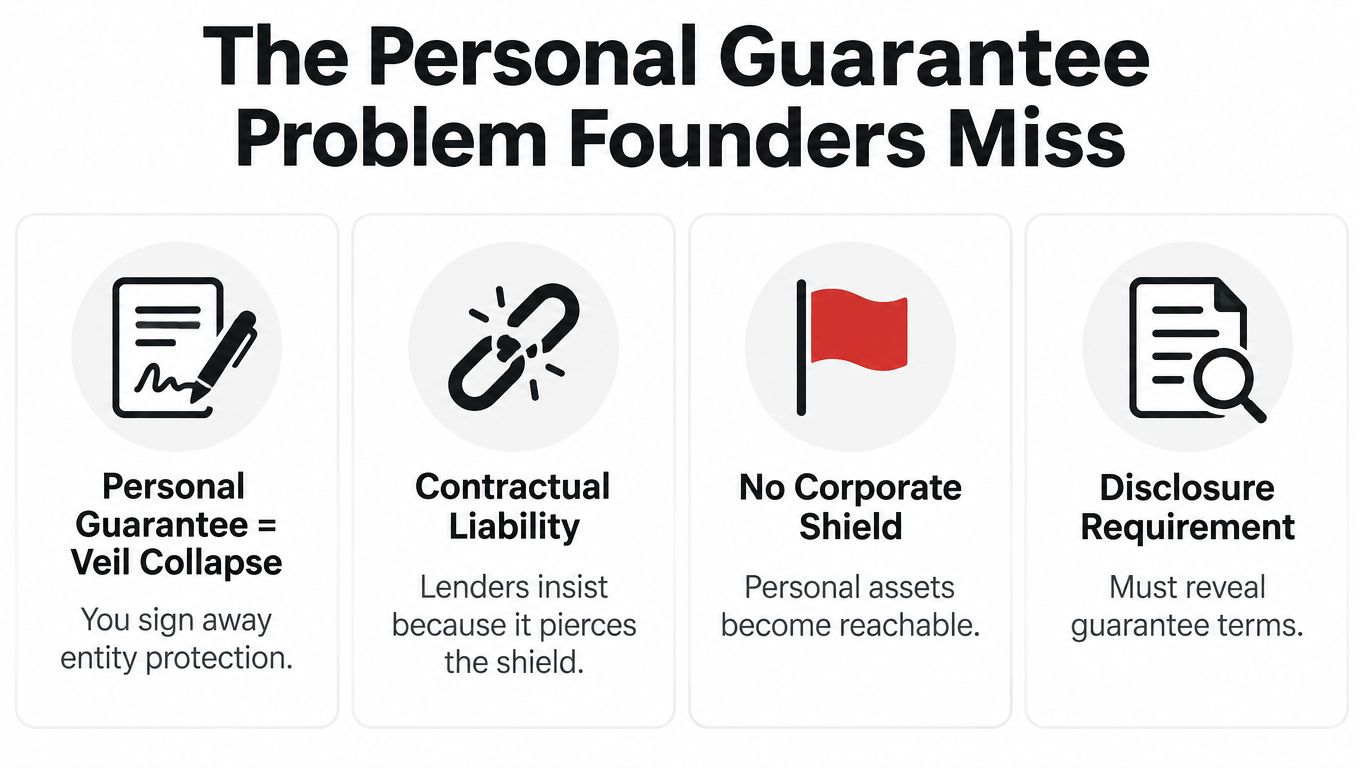
A personal guarantee is a contract in which you agree to answer for the company's obligation. The lender may sue the company first, but the guarantee gives the lender a contractual path to you. Your LLC can be valid, your corporate minutes can be current, and your personal exposure can still survive because you signed it.
Guarantees commonly appear in three places:
- Commercial leases: A landlord may require the founder to guarantee rent, restoration costs, or other lease obligations.
- SBA-backed loans: Government-backed financing can still require personal guarantees, leaving the founder responsible even though the business borrowed the money.
- Vendor terms: A supplier's credit application or online terms may include a guarantee hidden beneath a signature block or incorporated document.
Negotiate before you sign
Read every definition of “obligations,” “indebtedness,” “losses,” and “costs.” Ask for a written cap and a clear end date. A guarantee that covers every present and future obligation is not a minor formality.
Use this checklist during negotiations:
- Limit the amount. Tie liability to a stated dollar cap, rather than an open-ended balance that includes interest, fees, renewals, and future credit.
- Separate accrued and future obligations. If you leave the company or sell your interest, negotiate a release for obligations arising afterward and define what remains payable.
- Shorten survival. Require the guarantee to expire after a stated period of timely performance, or after the lender receives specified financial information.
- Preserve primary liability. Make the company the primary obligor and the founder a secondary guarantor, with no language converting the promise into a direct primary obligation.
- Define the trigger. Tie personal liability to a specific default, missed payment, or other defined event instead of every breach or operational dispute.
- Confirm the signature capacity. Don't sign “as guarantor” when you intended to sign only as an officer or authorized representative.
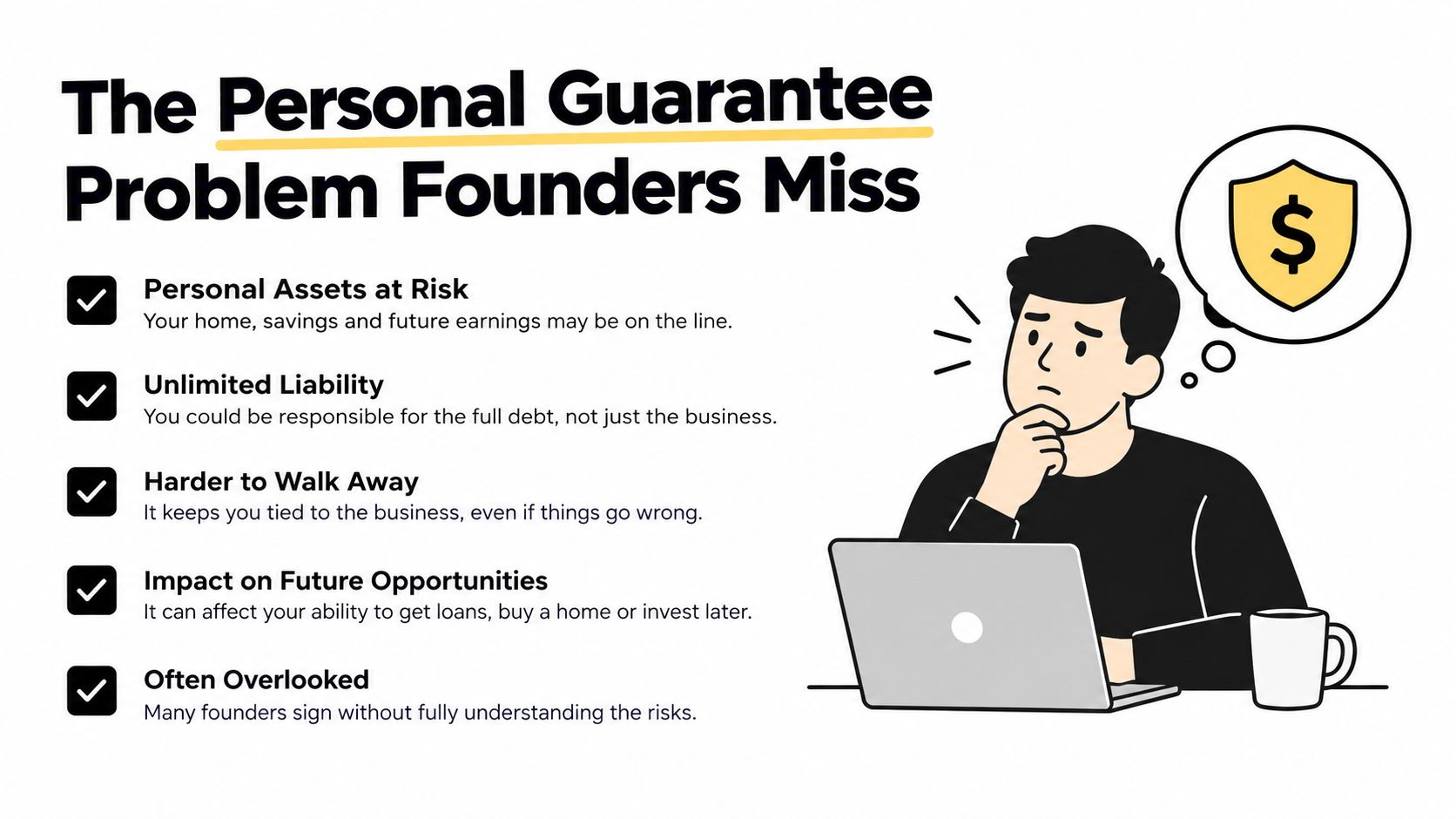
Some early-stage founders can't eliminate guarantees. That doesn't mean they should accept unlimited exposure. Caps, triggers, release mechanics, accurate signature blocks, and a complete copy of the signed terms are the practical tools that keep unavoidable financing from becoming a blank check against personal wealth.
Fraudulent Transfer Rules and Timing Traps
A transfer does not become defensible because someone recorded it, notarized it, or placed the asset in an irrevocable trust. Courts examine the transaction's economic substance, the debtor's financial condition, the people and entities involved, the consideration paid, and the purpose behind the transfer. A “protected” structure can fail when the timing and records show an effort to frustrate collection.
The legal framework has developed over time. The Uniform Fraudulent Conveyance Act originated in 1918, and the Uniform Law Commission issued the Uniform Fraudulent Transfer Act in 1984 to modernize and harmonize state law. As of 2026, the Uniform Voidable Transactions Act (the successor to the UFTA) has been adopted in all 50 states and the District of Columbia, creating a unified national framework for challenging transfers made to defeat creditors. The history and terminology are discussed in fraudulent transfer law and its terminology.
Actual intent and financial distress
A creditor may challenge a transfer made with actual intent to hinder, delay, or defraud. A transfer may also be attacked when the debtor receives less than reasonably equivalent value and the transaction leaves the debtor insolvent, undercapitalized, or unable to pay obligations.
Under 11 U.S.C. § 548, a bankruptcy trustee may avoid certain transfers made within two years before the bankruptcy petition date. The statute covers transfers made with actual intent and transfers for less than reasonably equivalent value under specified financial-distress conditions. Review the federal bankruptcy avoidance statute.
Courts commonly examine these indicators:
- Retained control: You transferred title but continued treating the asset as your own.
- Insider involvement: The recipient was a relative, business associate, or related entity.
- Concealment: The transfer did not appear in ordinary financial records.
- Weak consideration: The recipient paid nothing or an amount below fair value.
- Bad timing: The transaction followed a demand, default, lawsuit, or other known claim.
- Post-transfer distress: You could not pay foreseeable obligations after completing the transfer.
The cleanest transfer is one that would have made commercial sense even if no creditor had been watching.
A defensible timeline
Before transferring an asset, identify the business, estate, or risk-allocation purpose. Obtain an independent valuation and prepare a solvency analysis that accounts for existing and reasonably foreseeable obligations. Document fair consideration, approve the transaction through the proper governing body, and preserve minutes, financial statements, tax records, and independent legal advice.
Your records should show what the asset was worth, what the recipient gave in return, and why the transfer served a legitimate purpose. A solvency memo prepared after a creditor appears carries less weight than analysis created before the dispute.
In Florida, creditor remedies can include unwinding the transaction, recovering the asset or proceeds, attachment, injunctions, receivership, and other equitable relief. The general limitations period is commonly four years, subject to statutory variations. See the Florida analysis of the Uniform Voidable Transactions Act framework.
Plan while solvent and before a specific claim is imminent. A later transfer may have a legitimate purpose, but the evidentiary burden and litigation risk become much worse after a demand letter or judgment. Paperwork cannot rescue a transaction that leaves the debtor unable to pay reasonably foreseeable obligations. Timing, fair value, and contemporaneous solvency documentation determine whether the structure can withstand scrutiny.
Your Pre-Litigation Checklist and Next Step
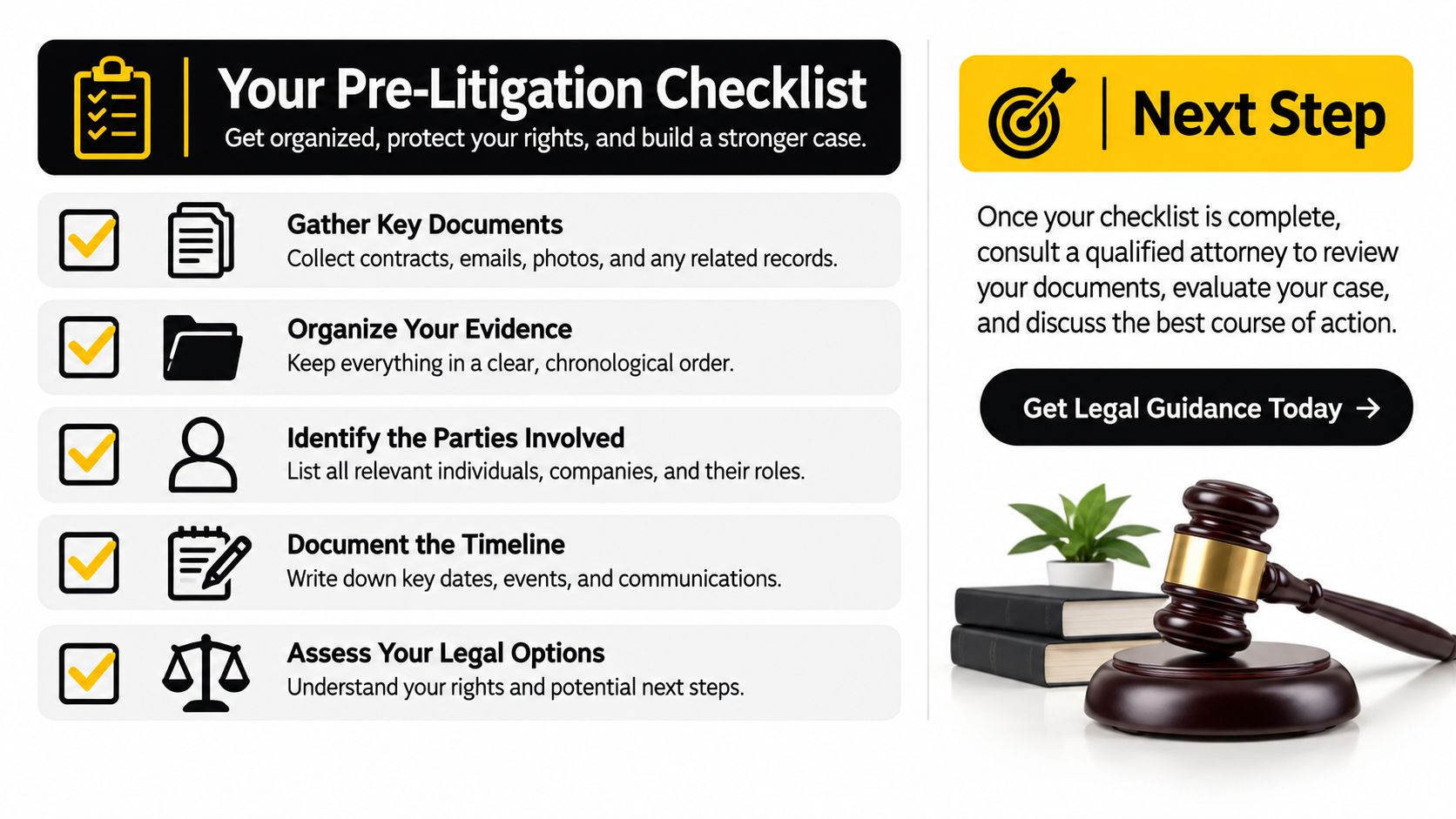
Run this checklist before a demand letter, lawsuit, levy, or refinancing decision forces you to work under pressure. The objective isn't to hide assets. It is to make ownership, solvency, insurance, and contractual exposure clear enough that lawful planning can withstand scrutiny.
Produce the file before the crisis
Inventory and value assets. Create a dated balance sheet with account statements, title records, appraisals, lien information, business interests, receivables, and beneficial interests. Record who owns each asset and whether the proposed structure would change legal or beneficial control.
Document solvency. Prepare a post-transaction balance sheet and liquidity analysis. Include guarantees, pending disputes, tax liabilities, leases, and other foreseeable obligations. Keep the assumptions and valuation support with the file.
Separate finances. Use dedicated business accounts, accounting systems, payment cards, and books. Document capital contributions and distributions. Don't pay personal expenses from company funds or business expenses from personal accounts without a recorded, properly classified transaction.
Cap personal guarantees. Produce a signed guarantee schedule that identifies the creditor, covered obligation, cap, trigger, expiration, collateral, and release conditions. Store the complete underlying lease, loan, or vendor agreement with it.
Review exempt assets. Confirm homestead status, vehicle equity, personal-property eligibility, retirement ownership, insurance coverage, and marital title. A homestead review should include occupancy, acreage, mortgages, tax status, and the source of funds before any title change.
Update entity records. Keep the operating agreement, shareholder or member ledger, resolutions, annual filings, insurance certificates, financial statements, and transfer documents current. If the company owns separate properties or business lines, identify them clearly in the books and contracts.
Insurance belongs in the same conversation. Review exclusions, additional insured status, underlying limits, professional coverage, property coverage, and umbrella protection with a qualified broker. This Florida asset-protection insurance guide from PTL Insurance Associates, Inc. is a useful starting point for identifying coverage gaps, but insurance won't fix a fraudulent transfer or a guarantee you already signed.
Get counsel involved when a claim is anticipated, litigation is pending, insolvency is a concern, or you plan to move a meaningful portion of your wealth. Don't wait until a sheriff's levy starts the clock. Florida's exemption procedure can require action within 15 days, so enforcement notices deserve immediate review.
Coto & Waddington, Attorneys at Law advises South Florida founders and families on entity structure, contracts, guarantees, trusts, exemption planning, and documented transfers. Visit Coto & Waddington, Attorneys at Law to schedule a confidential asset-protection review before you sign a guarantee, move an asset, or respond to a creditor demand.