Winning a commercial lease negotiation doesn't happen at the signing table. It's won weeks, or even months, before you ever sit down with a landlord. The real key is to build significant leverage by thoroughly defining your needs, knowing the market cold, and putting your expert team in place first. This prep work changes the entire conversation from you asking for a space to you choosing the right partner.
Building Your Negotiation Power Before You Talk to a Landlord

Walking into a lease negotiation unprepared is a surefire way to lose. A landlord’s job is to maximize their return on investment, and their standard lease is a finely tuned legal instrument designed to protect their bottom line—not yours. To flip that power dynamic, you have to show up with absolute clarity, confidence, and a strategy backed by hard data.
This is the phase where the deal is truly made. By putting in the time upfront, you arm yourself with the facts you need to make powerful counteroffers and lock in terms that will actually help your business grow, not hold it back.
Define Your Non-Negotiable Needs
Before you even start looking at listings, you need a crystal-clear picture of what your business absolutely requires to function and thrive. A vague wish list is a recipe for ending up in the wrong space. What you need is a detailed "needs analysis" that covers your operational must-haves.
Go beyond just square footage. Think about the nitty-gritty operational details.
- Space & Layout: Do you need an open floor plan for collaboration, private offices, a warehouse with a loading dock, a retail storefront with high visibility, or specialized ventilation?
- Operational Requirements: What are your specific power, plumbing, and data infrastructure needs? Does your business require special zoning, ADA compliance, or 24/7 building access for your team?
- Growth Potential: Where will your business be in two or three years? A good lease should give you options for expansion, not trap you in a space you'll outgrow.
Actionable Tip: Create a "deal-breaker" checklist based on your needs. If a property doesn't meet every single item on this list, discard it immediately. This ruthless filtering saves you from wasting time on dead-end tours and weak negotiations.
Conduct Sharp Market Research
Knowing the local commercial real estate market is your single greatest weapon. Without it, you’re flying blind. You have no objective way to know if a landlord's asking rent is fair, competitive, or completely out of line. For business owners in South Florida, that means digging into specific data for neighborhoods in Miami, Fort Lauderdale, or Palm Beach.
Your research needs to be focused on a few key metrics:
- Comparable Rents (Comps): What are similar businesses paying per square foot for comparable spaces in your target area?
- Vacancy Rates: High vacancy is a tenant's best friend. In a market with 15-20% vacancy, landlords are far more motivated to offer concessions to fill their empty spaces.
- Typical Concessions: Are landlords in the area commonly offering a few months of free rent, generous tenant improvement (TI) allowances, or other perks to land good tenants?
Assemble Your Expert Team
Trying to negotiate a commercial lease on your own is a massive, and unnecessary, risk. Landlords have brokers, property managers, and lawyers working for them. You should, too. A solid team can spot hidden risks in a lease document, analyze the financial impact of its terms, and protect your interests.
And before you even sign a lease, it's critical to have your business structured correctly. Our guide on starting a Florida LLC can help you make sure your company is set up for success from day one.
Your essential team should include:
- A Commercial Real Estate Broker: A good broker brings more than just listings. They have access to proprietary market data, a deep network of contacts, and can help you benchmark any offer you receive against what's truly happening in the market.
- An Experienced Business Attorney: A lawyer who specializes in commercial real estate, like the team at Coto & Waddington, will dissect the legal jargon, identify clauses that create liability, and negotiate protective terms on your behalf. This is not a place to cut corners.
When you walk into a negotiation with this level of preparation, you’re no longer just a potential tenant. You’re a savvy business operator who can't be pushed around. You’re ready to secure a lease that serves as a launchpad for growth, not a financial anchor.
Ready to protect your business? A well-negotiated lease starts with expert legal guidance. Contact Coto & Waddington for a consultation today.
Decoding the Lease: Key Clauses You Must Negotiate

A commercial lease is not a friendly agreement. It's a financial instrument designed to protect the landlord and shift nearly all financial risk onto you, the tenant. To negotiate effectively, you have to think like a lawyer and scrutinize what each clause really means for your business's cash flow.
Too many business owners get fixated on the monthly rent. The real financial damage, however, often comes from the fine print governing the lease term, renewal rights, and hidden cost escalations. Learning to spot and challenge these provisions is the only way to secure a lease that supports your growth instead of siphoning your revenue.
The Foundation: Rent, Term, and Renewals
Your base rent is just the beginning. The lease term—how long you’re locked in—is equally critical. Landlords will almost always push for longer terms of 5-10 years because it guarantees their income. But for your business, a shorter term with renewal options provides vital flexibility.
Negotiating those renewal options is non-negotiable. An option gives you the right, but not the obligation, to extend your lease. You must fight to pre-negotiate the terms of that renewal now, so the landlord can’t hold you hostage when your initial term is up.
Actionable Tip: Fight for at least one renewal option where the future rent is set by either a "fair market value" clause or a fixed, pre-negotiated percentage increase. This prevents the landlord from demanding an astronomical rent hike when it's time to renew.
The Hidden Cost of Rent Escalation Clauses
Rent escalation clauses are standard, but the method they use to increase your rent can have a staggering impact on your bottom line. These clauses automatically raise your rent over the lease term.
There are two main types of escalators you’ll encounter:
- Fixed Increases: Your rent goes up by a set percentage (like 3% annually) or a specific dollar amount. This gives you predictable costs, which is a huge advantage for budgeting.
- CPI-Based Increases: Your rent is tied to the Consumer Price Index (CPI), a government measure of inflation. This is a gamble. A sudden spike in inflation, like we saw recently, can cause your rent to skyrocket without warning.
Think about it this way. A startup founder in Miami eyes a perfect Fort Lauderdale office to scale their e-commerce brand. Before 2021, a standard lease might have a fixed 2-3% annual rent bump. But when the CPI shot up from 1.4% in January 2021 to a shocking 7.5% by January 2022, tenants with uncapped CPI clauses saw their costs explode.
Even with U.S. office vacancy rates at 19.7% in late 2025, landlords will still try to push these volatile terms. For a South Florida business where office rents average $45 per square foot, locking in a fixed 3% escalator instead of a CPI-based one can mean savings of 15-20% over a 10-year term.
Taming Common Area Maintenance (CAM) Charges
In nearly every commercial lease, especially a “triple net” (NNN) lease, you are on the hook for a share of the property’s operating costs. These are called Common Area Maintenance (CAM) charges. They cover everything from landscaping and parking lot repairs to lobby security and property management fees.
The danger here is that CAM is a black box of unpredictable costs. Without strict controls, landlords can pass through a massive range of expenses, including major capital improvements that should be their own responsibility. Before you get too deep, understanding key lease agreements from a real estate agent's viewpoint can offer some useful context for how these clauses are typically presented.
Here’s what you need to fight for:
- Negotiate a Cap: Insist on a "cap" that limits how much your CAM charges can increase annually. A 4-5% yearly cap is a reasonable and defensible target.
- Secure Audit Rights: Demand the right to audit the landlord’s CAM expense reports. This transparency is your only defense against being overcharged or billed for improper items.
- Exclude Capital Expenditures: The lease must explicitly state that you are not responsible for paying for the landlord’s capital investments. A new roof, HVAC system, or structural repairs are part of their asset, not your operating expense.
These clauses represent the financial core of your lease. Mastering their implications is just as important as understanding the legal framework of business agreements in general. For a broader look at contract principles, our guide on how to write a business contract can strengthen your foundational knowledge.
Actionable Tip: Always demand a detailed history of the property’s CAM charges for the last 2-3 years. This data provides a realistic baseline and helps you flag any unusual spikes or questionable expenses before you sign.
A well-negotiated lease is financial armor for your business. By scrutinizing these clauses, you protect your cash flow, create cost predictability, and build a stable foundation for the future.
Don't let a bad lease dictate your business's future. Contact Coto & Waddington to review your commercial lease with a business-focused attorney.
Securing the Flexibility Your Growing Business Needs
A commercial lease shouldn't be a financial cage. For a growing business, agility is survival, and a rigid lease can quickly become a dead weight, strangling your ability to pivot or expand. When we guide business owners through lease negotiations, we shift the focus from just the monthly rent to the long-term operational freedom your business will need.
These are the clauses that build a lifeline directly into your agreement. They give you room to evolve, protecting you when business booms or when you face unexpected headwinds.
Customize Your Space with a Tenant Improvement Allowance
Almost no commercial space is move-in ready. That’s where the Tenant Improvement (TI) Allowance comes into play. It’s a specific amount of money the landlord agrees to provide for you to customize the space—think new walls, specific flooring, electrical upgrades, or paint.
While a healthy TI allowance is critical, it isn't free money. Landlords almost always bake the cost into your rent over the lease term. Your job is to negotiate the highest possible allowance while making sure the build-out is done on your timeline and to your standards.
Actionable Tips for TI Allowances:
- Define the Scope Clearly: Don’t just ask for money. Present detailed construction bids to justify the amount you need. Vague requests get weak offers.
- Control the Process: Fight for the right to manage your own build-out with your own trusted contractors. This gives you far more control over the quality, cost, and speed of the work.
- Negotiate Disbursement Terms: Push for a portion of the allowance to be paid upfront. You'll need it for architect fees and initial contractor deposits.
Your Escape Hatch: Sublease and Assignment Rights
What happens if your business outgrows your space two years into a seven-year lease? Or what if you need to downsize to survive a market shift? Without the right to sublease or assign your lease, you’re stuck paying for a space you can no longer use. These clauses are your most important exit strategy.
- An assignment is when you transfer the entire lease to a new tenant, letting you walk away completely.
- A sublease is when you rent out a portion or all of your space to another business, but you remain the primary tenant responsible to the landlord.
Actionable Tip: Your goal is to water down the landlord's "sole discretion" to approve a sublease or assignment. Insist that the lease states their consent "shall not be unreasonably withheld, conditioned, or delayed." This simple phrase is your biggest protection.
A lease is a long-term financial commitment, and it's essential to understand exactly what you're signing. Before you put your business on the line, we've created a quick-reference table summarizing the key clauses you'll encounter and what your primary goal should be for each.
Key Lease Clauses and Your Negotiation Goals
| Lease Clause | What It Means | Your Primary Negotiation Goal |
|---|---|---|
| Tenant Improvement (TI) | Funds from the landlord to build out or customize the space. | Secure the highest possible allowance and gain the right to manage your own construction. |
| Sublease & Assignment | Your right to transfer the lease or rent the space to another tenant. | Ensure the landlord cannot "unreasonably" withhold consent for a new tenant. |
| Exclusivity | Prevents the landlord from leasing to your direct competitors in the same center. | Get the broadest possible definition of a "competitor" to protect your market share. |
| Early Termination | A pre-negotiated option to break the lease early for a set penalty fee. | Create a calculated escape route if your business model changes or fails. |
| Force Majeure ("Act of God") | Excuses non-performance due to events outside your control. | Broaden the clause to include modern issues like pandemics or government shutdowns. |
This table is a starting point. The specifics of each clause will depend on your business, your leverage, and market conditions, but these goals represent the ideal position for any tenant looking to protect their future flexibility.
Protecting Your Business with Critical Clauses
Beyond customizing your space and securing an exit plan, a few other clauses are vital for protecting your day-to-day operations. These terms can shield you from competitive threats and offer a lifeline during a true crisis.
These flexibility clauses are absolute game-changers, especially for startups and small businesses. In fact, early termination rights are now a central focus in 60% of all lease negotiations, a massive increase from just 20% before 2020. While landlords in today's high-rate environment are pushing hard for long 5-10 year terms, smart tenants are pushing back by securing strong subleasing rights. We’re seeing landlords approve subleases in over 70% of cases when the lease defines clear, objective standards for approval. You can read a deeper analysis of these commercial lease negotiation trends on SVN.com.
Key Protective Clauses to Fight For:
- Exclusivity Clause: This is a powerful tool. It stops the landlord from leasing another space in the same building or shopping center to one of your direct competitors. For a coffee shop in a South Florida plaza, this means ensuring another café can't open up right next door.
- Termination Options: You need a calculated escape plan. Negotiate an "early termination right" that allows you to break the lease after a certain point (e.g., three years into a five-year term) by paying a fixed, pre-agreed-upon penalty.
- Force Majeure Expansion: The old "Act of God" clause covering floods and fires is no longer enough. Make sure it’s expanded to include modern disruptions like government-mandated shutdowns, supply chain failures, or major construction delays that are out of your hands.
Building these terms into your lease isn’t just about legal nitpicking—it’s a direct investment in your business’s resilience. They provide the breathing room you need to adapt, grow, and navigate uncertainty with confidence.
Don't leave your business's future to chance. Schedule a consultation with Coto & Waddington to build a flexible lease that protects your growth.
Proven Tactics for a Successful Negotiation
Knowing what to ask for in a commercial lease is only half the battle. The other, more critical half is understanding how to ask for it. Effective negotiation is a delicate dance of data, timing, and psychology. Mastering it is what separates business owners who land favorable, flexible terms from those who get locked into a landlord-sided contract.
These aren't about aggression or ultimatums. The tactics that actually close deals are rooted in preparation, leverage, and maintaining a professional, collaborative tone. At the end of the day, landlords want to secure reliable, long-term tenants. Showing up as a prepared, serious partner is the best way to get them to the table for a real conversation.
The Ultimate Power Move: Start Early
Timing is the single most powerful tool you have. Starting the search and negotiation process 12 to 24 months before your current lease expires isn’t just a good idea—it’s the ultimate power move. This long runway gives you maximum leverage and completely shifts the dynamic in your favor.
When you're not in a rush, you have the freedom to:
- Thoroughly research the market: You can identify trends, tour multiple properties, and get a true feel for fair market value without pressure.
- Create real competition: Landlords know you have other options. They’re far more likely to offer concessions and better terms to win your business.
- Negotiate without desperation: You can hold your ground on key points and, most importantly, have the confidence to walk away from a bad deal.
This advanced planning immediately signals to landlords that you are a serious, organized operator. On the flip side, they can smell desperation a mile away and will exploit last-minute urgency by holding firm on high rates and refusing to budge on important clauses.
Anchor Your Offers with Real Market Data
Never pull a number out of thin air. The most effective way to start a negotiation is by anchoring your offer with real-world data. When you propose a lower rental rate or ask for a generous tenant improvement allowance, back it up with hard facts.
For example, you could say, "Based on our review of three comparable properties within a one-mile radius, the average asking rent for a Class B space like this is $38 per square foot. Our offer of $37.50 is right in line with the current market." This approach instantly transforms your request from a wish into a well-researched business position that is difficult for any landlord to dismiss out of hand.
This is especially true for family-owned businesses in South Florida planning an expansion. Starting the process 12-24 months early provides a huge advantage in the competitive Miami-Fort Lauderdale landscape, where office availability hit 15-20% in 2025. Landlords often exploit last-minute urgency by hiking terms by as much as 25%, but tenants who plan ahead maintain their leverage. We’ve seen them secure major concessions, like 2-3 months of free rent, simply by having other viable options.
Negotiate Multiple Points Simultaneously
A common mistake I see business owners make is negotiating one point at a time. This allows the landlord to corner you, trading a small win for a major concession elsewhere. For instance, they might agree to a minor paint job in exchange for you accepting a harsh annual rent escalation.
Actionable Tip: Always present your key negotiation points as a package deal. When you send your counteroffer, list all your requests at once—the rent, the TI allowance, renewal options, exclusivity, etc. This strategy gives you room to trade less important items for your non-negotiables.
This multi-faceted approach is about securing flexibility across the board. You need a lease that lets you customize your space, pivot if your business needs change, and protect your long-term interests.
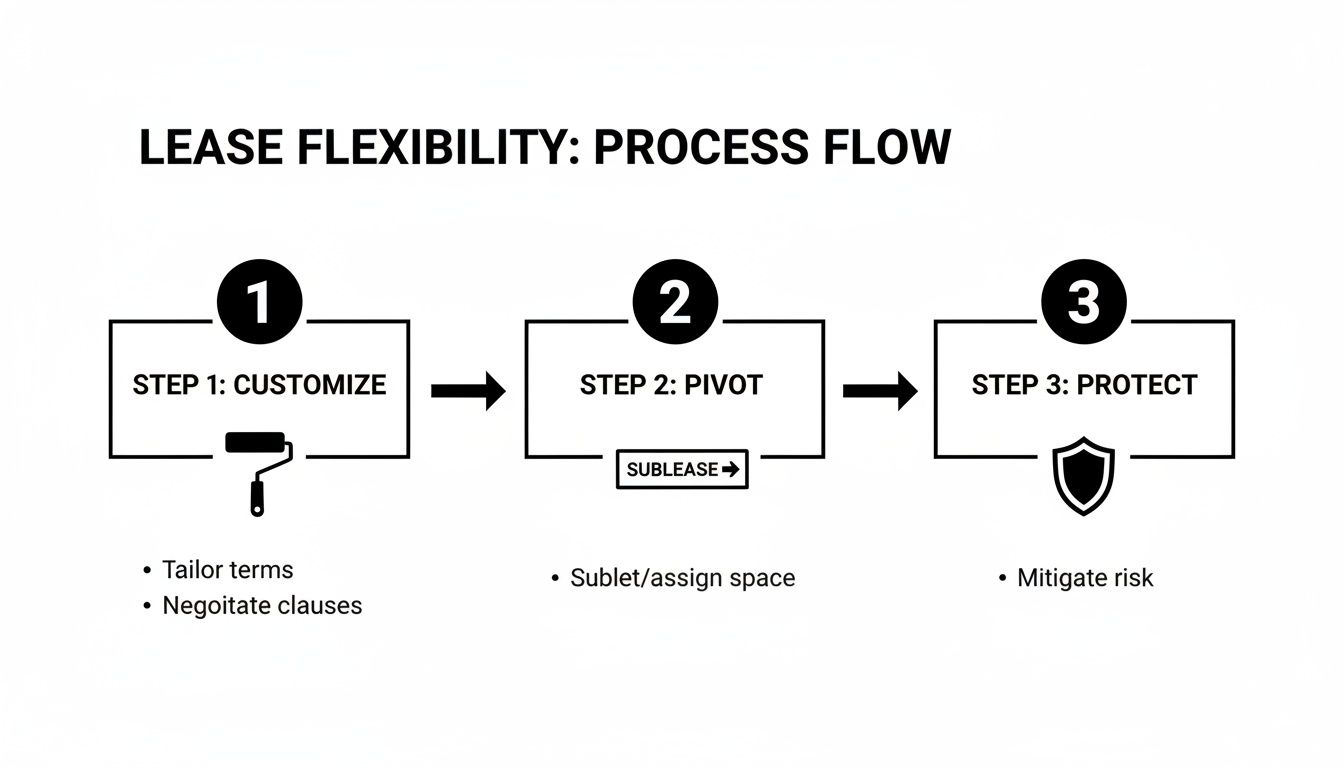
Throughout this all, remember to keep the relationship professional. You are entering what is essentially a multi-year business partnership, and an adversarial negotiation can poison the well from the start. Mastering effective contract negotiation strategies is the key to securing the terms you need while building a positive landlord-tenant relationship for the years ahead.
By combining early planning, data-driven offers, and strategic bundling, you can navigate the negotiation process from a position of strength and confidence.
Why an Expert Attorney Is Your Strongest Ally

Signing a commercial lease is one of the most serious financial commitments your business will ever make. That document wasn't written to be fair—it was drafted by the landlord’s attorney with a single goal: maximizing their profit and minimizing their risk.
Going into that negotiation alone is a gamble you simply cannot afford to take. An expert, business-minded attorney is your most valuable player in this high-stakes process. We do far more than just "review" a document; we become your strategic partner, sniffing out costly hidden risks and translating convoluted legalese into clear business outcomes.
A good lawyer doesn't just read the lease; they help you negotiate a better one.
Beyond Document Review: A Strategic Partnership
Thinking of a lawyer as a final "check" before signing is a common and costly mistake. The real value comes from involving counsel early. An experienced attorney who understands business operations can help you strategize from the very beginning, making sure your Letter of Intent (LOI) includes the core terms that will protect you down the line.
We see the long-term consequences of seemingly minor clauses every day. For instance, a standard "Restoration" clause might require you to return the space to its original "white box" condition. That sounds reasonable on the surface, until you realize it means tearing out tens of thousands of dollars in improvements you paid for. We fight to amend that language so you only have to remove your specific trade fixtures and repair any resulting damage, saving you from a massive, unexpected bill when your lease ends.
Client Story: We recently worked with a South Florida retailer whose landlord presented a lease with an unlimited personal guarantee. This meant if the business failed for any reason—even a market downturn—the landlord could seize our client's personal home, car, and savings. We successfully negotiated to limit the guarantee to the first 2 years of the lease, protecting our client's family and personal assets from a devastating risk.
Clarity and Predictability in a Complex Process
For business owners, especially in the diverse South Florida market, clarity is power. The negotiation process can feel opaque and unpredictable, but it doesn't have to be. As a bilingual firm, we ensure our English and Spanish-speaking clients fully understand every term and its financial impact, en inglés o en español.
Our flat-fee approach to lease reviews and negotiations also provides the cost predictability you need. You know exactly what your legal investment will be upfront, so you can budget effectively without worrying about surprise hourly bills. This transparency empowers you to make decisions based on what's best for your business, not on the fear of legal costs.
For a deeper dive into the specific benefits of legal review, you can read our guide on why you need a lawyer for reviewing commercial lease agreements.
Practical Tips for Working With Your Attorney
To get the most value out of your legal counsel, approach the relationship as a collaboration. Here are a few tips based on what we've seen work best.
- Engage Early: Bring your attorney in before you sign the Letter of Intent. The LOI sets the framework for the entire negotiation, and it's much harder to change major deal points once it's signed.
- Share Your Business Plan: Give your lawyer context. The more they understand your operational needs, growth plans, and exit strategies, the better they can tailor the lease to your specific situation.
- Prioritize Your "Wants" vs. "Needs": Be clear about your absolute deal-breakers versus the "nice-to-have" items. This helps your attorney focus their negotiation power where it matters most.
Engaging an expert attorney to help you negotiate a commercial lease isn't just another business expense. It is a critical investment in your company’s long-term security and financial health. It’s the difference between signing a contract that works against you and securing a space that serves as a foundation for your success.
Don't navigate this complex legal landscape alone. Contact Coto & Waddington today for a flat-fee consultation and let our business-focused attorneys protect your interests.
Common Questions on Lease Negotiations
When it comes to commercial leases, what you don't know can absolutely hurt you. Business owners in South Florida often come to us with the same handful of crucial questions, worried about getting locked into a bad deal.
Getting these answers right gives you the leverage to negotiate terms that protect your business, not just the landlord’s. Here are the insights we share with our clients.
What Is the Biggest Mistake to Avoid in a Commercial Lease Negotiation?
The single biggest mistake we see is waiting too long to start. Time is your greatest asset in a negotiation. When you’re up against a deadline, landlords know they have you over a barrel and will be far less willing to concede on important terms.
Actionable Tip: Start the search and negotiation process 12 to 24 months before your current lease expires or you need to be in the new space. This timeline gives you the breathing room to properly research the market, walk away from bad offers, and negotiate from a position of true strength. A rushed timeline almost always ends with you accepting unfavorable terms that can drain cash from your business for years to come.
Are CAM Charges and Personal Guarantees Really Negotiable?
Yes, absolutely. In fact, nearly every clause in a landlord's "standard" lease is on the table for negotiation. Don't ever let the boilerplate language intimidate you into thinking otherwise. These two items are among the most critical to push back on.
Here’s our advice on how to approach them:
- CAM Charges: Always demand a cap on annual increases. An uncapped CAM clause can lead to unpredictable and crippling hikes in your monthly costs. We typically aim for a 4-5% annual cap as a reasonable limit. It’s also vital to secure the right to audit the landlord’s CAM records to ensure they aren't passing on improper costs.
- Personal Guarantees: This is one of the highest-risk provisions for any business owner. You can, however, negotiate to limit your personal exposure. We often propose limiting the guarantee to the first two or three years of the lease or capping the total dollar amount you are personally on the hook for. Getting this right is where an experienced attorney earns their fee.
Actionable Tip: Never assume a clause is set in stone just because it’s in the first draft. A landlord’s initial lease is a wish list. The real negotiation begins with your counter-offer.
How Much Free Rent Can I Realistically Ask For?
The amount of free rent—known as rent abatement—you can get hinges on market conditions, the length of your lease, and your desirability as a tenant. In a tenant-friendly market with high vacancy, landlords are far more motivated to offer concessions to fill their spaces.
Actionable Tip: A solid starting point is to ask for one month of free rent for every year of the lease term. For a five-year lease, open with a request for five months of rent abatement. This free rent period typically applies at the beginning of the term, giving you a crucial cash flow cushion to handle moving expenses and build-out costs without also paying rent.
Your commercial broker is your best friend here. They should arm you with data on recent, comparable deals in the area, showing what other landlords have given to tenants like you. This data turns your request from a hopeful ask into a fair, market-based proposal.
Navigating the nuances of a commercial lease requires a strategic partner who understands both law and business. At Coto & Waddington, we provide flat-fee, bilingual legal counsel to help South Florida entrepreneurs secure leases that protect their assets and support their growth.
Don't sign a lease that leaves your business exposed. Contact Coto & Waddington today for a consultation.