
It's late Friday afternoon in Miami. Your operations lead calls because a payroll vendor has detected suspicious access, your IT provider is still investigating, and nobody can say which customer records were viewed or taken. The temptation is to wait for certainty before doing anything. That's the wrong instinct. Under Florida's breach-notification framework, the investigation, vendor handoff, record count, legal review, and notice process must move together.
Florida's modern rules are built around the Florida Information Protection Act, codified in Florida Statutes section 501.171. The statute took effect on July 1, 2014, replacing Florida's earlier breach law and shortening the consumer-notice deadline from 45 days to no later than 30 days after a breach is determined. That deadline affects more than the email you eventually send. It should shape your vendor contracts, incident-response plan, evidence retention, customer communications, and investor diligence file.
Table of Contents
- What a Breach Looks Like for a South Florida Business
- How Florida Defines a Breach and Personal Information
- Who Must Be Notified and on What Timeline
- The 10-Day Trap and Other Obligations Founders Miss
- Incident-Response Checklist and Sample Notice Language
- Where Florida Overlaps With Federal and Other State Laws
- Penalties, Enforcement, and When to Call Counsel
What a Breach Looks Like for a South Florida Business
A Miami startup learns that an employee entered credentials into a convincing phishing page. The attacker reached a cloud application containing customer names, contact information, and account records. An outsourced technology provider managed that application, and its first update is cautious: suspicious activity occurred, but the scope remains under review.
That single event creates several operational problems. The founder must preserve evidence without interfering with the investigation. The operations team needs a dependable list of affected Florida residents. Counsel must determine when the breach was determined, what information was involved, and which notices may apply. Customers, lenders, insurers, and prospective investors may also ask for a documented response process.
A hacker entering a system does not answer the legal question by itself. Florida law focuses on unauthorized access to electronic data containing personal information. The company must connect the technical event to the records involved, assess whether those records fall within the statute, and preserve the reasoning behind its timeline.

The founder's first decisions
Do not let a vendor's uncertainty stop your response. Request a written incident summary, identify the systems involved, preserve relevant logs and communications, and appoint one person to control the incident file.
Assign clear roles:
- One decision owner: The founder or designated executive approves business decisions and notices.
- One technical lead: Your MSP, cloud provider, or internal engineer coordinates containment and forensic work.
- One legal lead: Counsel directs the legal analysis, notification assessment, and communications strategy.
- One records owner: Someone builds the affected-resident list and records which data sources support it.
Practical rule: Treat every vendor handoff as a possible loss of time. Put the incident clock, contact list, and escalation process in writing before an emergency.
South Florida companies commonly depend on payroll providers, marketing platforms, managed service providers, software vendors, and payment processors. Outsourcing does not transfer the business's responsibility to understand the incident. Customers experience the event through your company, so your team must explain what happened, what information was involved, and what protective steps follow.
Create the response plan now. Include vendor contacts, evidence-preservation instructions, record-counting responsibilities, and approval authority for notices. Document each request, response, decision, and time stamp. If the Friday call arrives, your team will be executing a process rather than creating one under pressure.
How Florida Defines a Breach and Personal Information
Florida's statute uses a practical framework. A covered breach involves unauthorized access to electronic data containing personal information. That definition requires more than a vague cybersecurity concern. Your team must identify the electronic data, determine whether access was unauthorized, and evaluate whether the records contain information protected by the law.
Think of a covered entity as the building owner who controls the locks and decides who may enter. A third-party agent is the security company, cloud provider, payroll processor, or other service provider holding spare keys or maintaining records for that owner. The business may outsource the work, but it still needs visibility into the systems and contracts involved.
Start with the information, not the headline
A security alert can involve many kinds of data, but not every internal document or account record automatically creates a Florida notification obligation. The analysis turns on the specific information exposed and the circumstances of access or acquisition.
Your inventory should identify:
- Identity information: Records that can connect an individual to protected identifying data.
- Financial information: Account or payment-related information covered by the statute.
- Health information: Medical or insurance-related records that may trigger additional privacy rules.
- Authentication information: Credentials or combinations that could enable access to an account.
- Biometric information: Data used to identify an individual through biological characteristics.
The statute also addresses whether data was protected through encryption or other safeguards. Don't assume encryption ends the analysis. Counsel and technical personnel need to determine what was encrypted, whether the relevant key or credential was also exposed, and whether the attacker could use the information.

Scope determines the next move
Separate three questions in your incident file:
- What happened? Record the suspected entry point, affected system, access dates, and containment actions.
- What data was involved? Identify the fields, files, databases, and backups that may contain personal information.
- Whose information was involved? Match records to Florida residents and residents of other states.
That separation prevents a common mistake: treating the vendor's first technical description as the final legal conclusion. A provider might say that an account was accessed, while your legal review still needs to determine whether personal information was present and whether it was acquired.
The scope review should also identify whether your company is the controlling business or whether another organization controls the data and your company acts as a service provider. Contract language, system ownership, and the actual functions performed matter. Preserve both the agreement and the vendor's incident communications because they may explain who was expected to investigate, notify, and retain evidence.
Your immediate takeaway is simple. Determine whether the event involved unauthorized access to electronic data containing covered personal information. Once that answer develops, move quickly to the notification tree rather than waiting for every forensic question to be resolved.
Who Must Be Notified and on What Timeline
A Miami company may have several notice audiences after one incident. Florida residents whose information was affected come first. The Florida Department of Legal Affairs must be included once the resident threshold is reached. Nationwide consumer reporting agencies become another audience at the higher threshold. Build a dated decision record for each path, including the count, source records, and person who approved the conclusion.
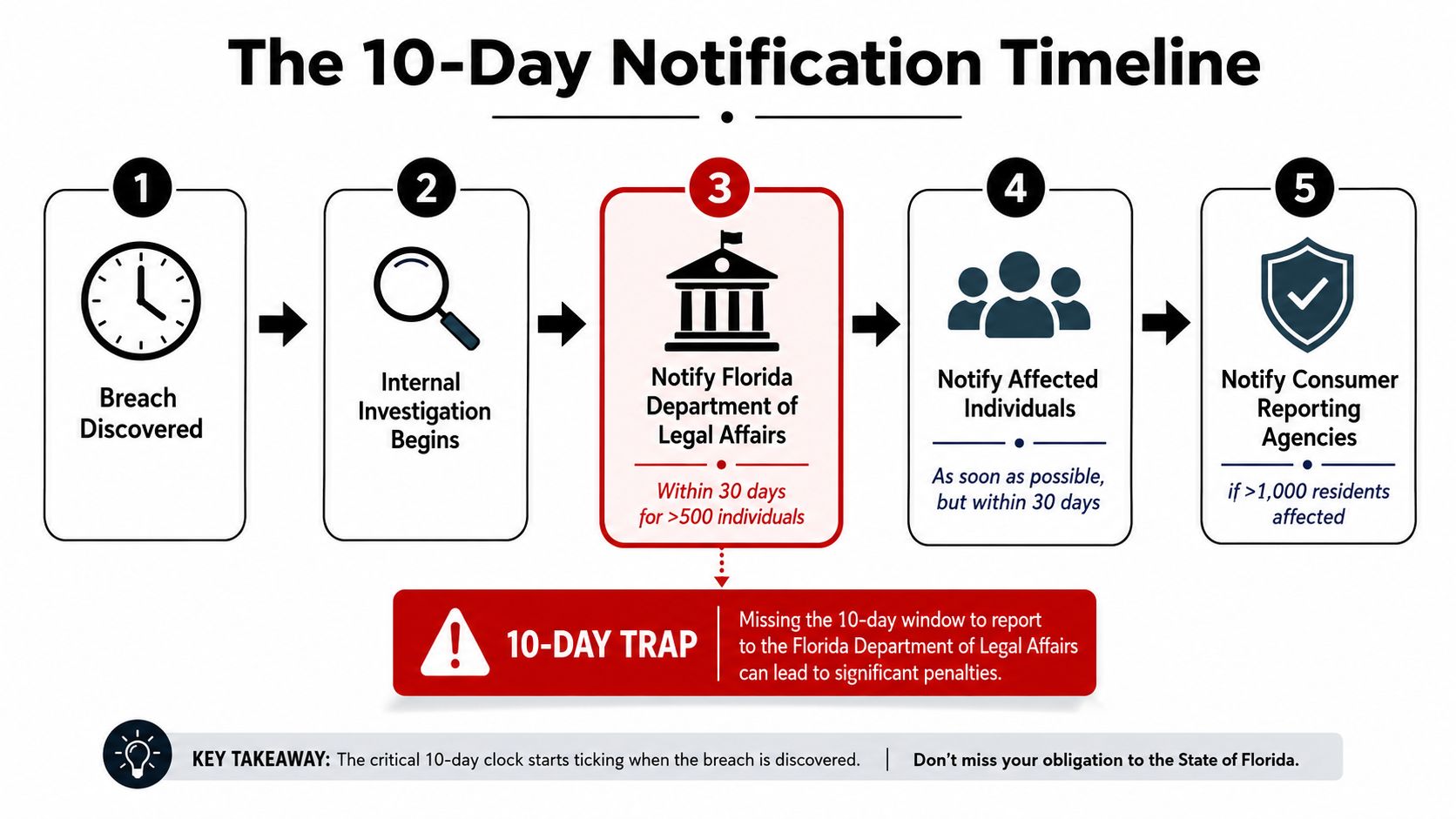
Consumer notice is due no later than 30 days after the breach is determined, under Florida Statutes section 501.171. A third-party agent that maintains personal data for a business must also report the breach to that business within 10 days after determining the breach. That upstream deadline can start before your team has finished sorting residents, systems, or affected records.
Build the notification tree before you need it
| Audience | Trigger | Deadline |
|---|---|---|
| Affected Florida residents | Covered breach involving their personal information | No later than 30 days after breach determination |
| Florida Department of Legal Affairs | 500 or more Florida residents affected | Within the statutory notice period tied to the breach determination |
| Nationwide consumer reporting agencies | 1,000 or more people affected | Add this reporting step when the threshold is reached |
The Florida Department of Legal Affairs threshold is 500 or more Florida residents. The consumer-reporting-agency threshold is 1,000 or more people affected, adding a reporting layer beyond individual and state notice. Treat the headcount as an evidence-backed legal calculation, not a loose vendor estimate.
What “determined” should mean in your file
Document when the company had a reasonable basis to conclude that a covered breach occurred. Keep the incident report, forensic findings, vendor notice, system review, data map, affected-record analysis, and counsel's assessment together. The file should identify what was known, what remained uncertain, who made the determination, and which evidence supported it.
Do not manipulate the date to create more breathing room. Do not postpone the determination just because a final forensic report is pending. A South Florida founder should be able to show the timeline to counsel, regulators, and affected customers without reconstructing it from scattered emails.
Your notice package should describe the incident, the types of personal information involved, the response taken, protective steps recipients can consider, and a contact route for questions. Record the delivery method and any substitute-notice analysis, especially if direct notice is impracticable.
Counting tip: Build a resident-by-resident notification spreadsheet with the source file, state, information category, review status, notice status, and approval date. Test the routing logic before a real incident exposes a gap.
Run a tabletop exercise built around a vendor-side incident. Give the team an incomplete record set, require a Florida count, and make one person explain when the breach was determined. If the process works only with clean data, it will fail during an actual handoff.
The 10-Day Trap and Other Obligations Founders Miss
Founders often focus on the consumer-facing 30-day deadline and overlook the vendor's earlier obligation. Florida requires a third-party agent maintaining personal data for a business to disclose a breach to the business entity within 10 days after determining the breach, as reflected in the Florida statutory framework for breach notification.
That is an upstream deadline. It governs the handoff from the processor or agent to the business, and it can consume valuable investigation time before your company even starts counting affected residents. A cloud provider that waits for a fully resolved forensic picture may create operational risk for the business that must evaluate notice.
Fix the handoff in the contract
Your vendor agreement should identify a named incident contact, an emergency escalation method, cooperation duties, evidence-preservation obligations, and the information the vendor must provide. The contract should also require prompt escalation to the business, not merely a general promise to comply with applicable law.
Review agreements with:
- Managed service providers: Confirm who receives alerts outside ordinary business hours and who can isolate an account.
- Cloud and software vendors: Require usable logs, access records, and a description of affected systems.
- Payroll and benefits providers: Clarify how the vendor will identify affected individuals and coordinate notices.
- Marketing and analytics platforms: Identify what customer fields they receive and how they handle suspected unauthorized access.
Florida's rules also make notice mechanics important. Direct notice may involve email, postal mail, or telephone, depending on the circumstances and available contact information. Substitute notice has its own conditions and content expectations, so don't publish a web notice as a shortcut without legal review.
Some incidents also require identity-theft protection services when specified information is exposed. That obligation depends on the data involved and the statutory conditions, so your team should analyze the actual fields rather than promise services automatically or omit them reflexively.
The business trade-off is straightforward. More contractual detail can increase vendor negotiation time and may produce additional service costs. The alternative is worse: a vendor controls the evidence, the first notification, and the timeline while your company carries the customer and regulatory consequences.
Audit your vendor contracts this week. Create a one-page escalation sheet showing who calls whom, what records must be preserved, and what information the vendor must deliver when a breach is suspected.
Incident-Response Checklist and Sample Notice Language
A breach response needs an owner, a clock, and a written record. Use this checklist as a working document, then have counsel adapt it to your systems, contracts, insurance requirements, and customer base.
Six actions to take immediately
Contain the event. Disable compromised credentials, isolate affected accounts, and preserve the system before making changes that could destroy evidence. Record who authorized each containment step and when it occurred.
Investigate the access. Ask the technical team or forensic provider to identify the entry point, affected systems, access activity, and known acquisition. Preserve vendor reports, logs, screenshots, and communications in the incident file.
Bring in legal review. Counsel should assess whether the event involves unauthorized access to electronic data containing personal information, whether another state or federal regime applies, and whether privilege or work-product protections are appropriate.
Determine the scope. Create the affected-person list by state and information category. Mark uncertain records separately, explain the assumptions used, and preserve the source files used for the count.
Prepare and send notices. Route notices to affected residents and, when the thresholds apply, the Florida Department of Legal Affairs and nationwide consumer reporting agencies. Keep the approved version, delivery method, mailing or transmission records, returned notices, and follow-up communications.
Document remediation. Record password resets, monitoring, security changes, vendor corrections, employee training, and management approvals. A response file should show not only what happened, but also what the company did afterward.
Write down the decision, not just the event. A dated explanation of why the company selected a notice path is more useful later than a folder full of undated technical files.
Adaptable notice language
Use plain language and avoid minimizing the incident:
We're writing to inform you about a security incident involving [company or service]. On [date], we identified unauthorized access to [system or account]. Our investigation determined that the incident involved [describe the nature of the breach] and may have involved [identify the categories of personal information].
We contained the incident, investigated the affected systems, and took steps including [describe corrective actions]. We recommend that you [describe protective measures, such as monitoring relevant accounts, changing affected credentials, or contacting the appropriate financial institution]. If you have questions, contact [name or department] at [telephone number, email address, and mailing address].
The final notice must match the facts. Don't include categories that weren't involved, promise protection services that haven't been arranged, or state that no misuse occurred unless the investigation supports that conclusion.
For broader preparation, review data security best practices for businesses and keep a notice template in your incident-response folder. If the incident exposes personal information that appears online, a resource on clearing your data after a breach can help affected people understand practical account and search-result cleanup steps.
Draft the template now, before the next alert. Your future response team shouldn't be writing the first version while the statutory clock is running.
Where Florida Overlaps With Federal and Other State Laws
Florida notification law rarely operates alone for a company serving customers across the country. A Miami health-tech company may face Florida rules plus HIPAA for protected health information. A financial services business may need to evaluate the Gramm-Leach-Bliley Act. An online service may also face the FTC Health Breach Notification Rule when its data practices fit that regime.
The key is to identify the data category and the people affected, then map every applicable jurisdiction. A Florida notice may not satisfy another state's requirements, and a federal rule may impose a different regulator, form, or timeline.
Use one disciplined process
| Data Type | Florida | Federal Regime |
|---|---|---|
| Health information | Evaluate Florida's personal-information definition and notice duties | HIPAA may apply to protected health information, while the FTC Health Breach Notification Rule may apply to certain health-data entities outside HIPAA |
| Financial information | Apply Florida's breach analysis to covered personal information | GLBA may apply to financial institutions and their customer information |
| Customer information across states | Florida notice rules apply to affected Florida residents | Other states may impose separate notice duties for their residents |
New York, Georgia, and other states can impose their own notification rules when their residents' information is involved. Don't assume the company's headquarters determines every obligation. The affected person's state, the information category, the company's role, and the applicable sector rule all matter.
A useful internal policy should set one conservative investigation and documentation process, then add jurisdiction-specific review. That approach costs less than maintaining disconnected state-by-state workflows that produce inconsistent records and contradictory customer communications.
Your privacy notices and website practices should also match the data you collect and share. Review privacy policy requirements for websites as part of the same compliance exercise, particularly if a breach reveals that the company's public disclosures don't match its vendor relationships.
Operational recommendation: Build one incident file and one fact pattern. Let counsel create the jurisdiction-specific notice matrix from that shared record.
Penalties, Enforcement, and When to Call Counsel
The Florida Department of Legal Affairs can investigate a company's breach response, including its security practices, notice decisions, timing, and documentation. The business may also face contractual claims, customer disputes, insurance complications, and reputational damage. If the incident affects many people or involves sensitive records, the company should assume that its written timeline may later matter as much as its technical report.
Call counsel during scope determination, before sending notice, and before making a payment, settlement, or public statement. Counsel can help preserve the investigation, coordinate the notice analysis, assess multi-state exposure, and prevent an inaccurate customer message from creating a second problem.
A startup founder can begin with Florida data privacy counsel for startups when the company needs a breach plan, vendor review, or Florida Information Protection Act analysis. Don't wait until the notice draft is already circulating.
Coto & Waddington, Attorneys at Law helps South Florida founders assess possible breaches, build notification timelines, document incident response, and strengthen vendor contracts before an emergency occurs. Visit Coto & Waddington, Attorneys at Law to schedule a practical compliance consultation for your company's breach-response plan.



