You've probably seen this happen already. A supplier sends over a distribution agreement template, asks for a quick signature, and everyone wants the deal moving before the next shipment lands. The problem is that a template like this is not a formality. It decides who can sell, where they can sell, what they can charge, how inventory moves, who owns the brand-facing materials, and what happens when the relationship starts to break.
For a founder in Miami, Fort Lauderdale, or anywhere cross-border with Latin America, that document is the control center of the relationship. The right template gives both sides a shared frame for territory, exclusivity, pricing, IP use, termination, and dispute resolution, which is exactly why the commercial choices inside it matter so much. In South Florida deals, the bilingual English/Spanish format is especially useful because it helps parties negotiate cleanly when one side is local and the other side is operating in Spanish-speaking markets or across borders.
Table of Contents
- Why a Distribution Agreement Template Matters Before You Sign
- Clause-by-Clause Walkthrough of the Template
- How to Customize the Template for Your Deal
- Making Exclusivity Conditional, Not Free
- Florida Versus Delaware Governing Law for Founders
- Risk, Termination, and When to Call Counsel
- Your Next Steps and How to Get the Template
Why a Distribution Agreement Template Matters Before You Sign
When a Miami founder gets handed a supplier's draft on a Thursday and asked to countersign by Friday, the pressure usually comes from urgency, not clarity. That's exactly when mistakes get made. A distribution agreement template is not just paperwork, it is the legal and commercial map for a supplier-distributor relationship, defining who may sell the products, where they may be sold, and under what conditions the deal lives or dies. Independent legal and contract-management guidance consistently treats the core clauses as scope of distribution, territory, pricing, payment terms, exclusivity, intellectual-property rights, termination, governing law, and dispute resolution. Zomentum
A useful template gives you a starting framework, not a finished deal. The bilingual EN/ES version offered by Coto & Waddington is designed for South Florida business realities, where the other side may be local, Latin American, or both. It helps parties work from the same commercial structure even when they're negotiating in different languages, but the words still need to match the deal on the ground.
What the document actually covers
The template should answer the practical questions first. Who is the distributor, what products are covered, what territory is permitted, and whether the relationship is exclusive, non-exclusive, or sole. If those points are vague, the rest of the contract gets shaky fast.
What it does not solve by itself
A template does not know your margins, your channel conflict, your warehousing realities, or your brand protection concerns. It also can't guess whether your distributor should lose exclusivity if it underperforms, which is why the commercial choices need to be made deliberately before anyone signs.
Practical rule: if the clause changes the economics or the exit risk, it's not boilerplate.
Clause-by-Clause Walkthrough of the Template
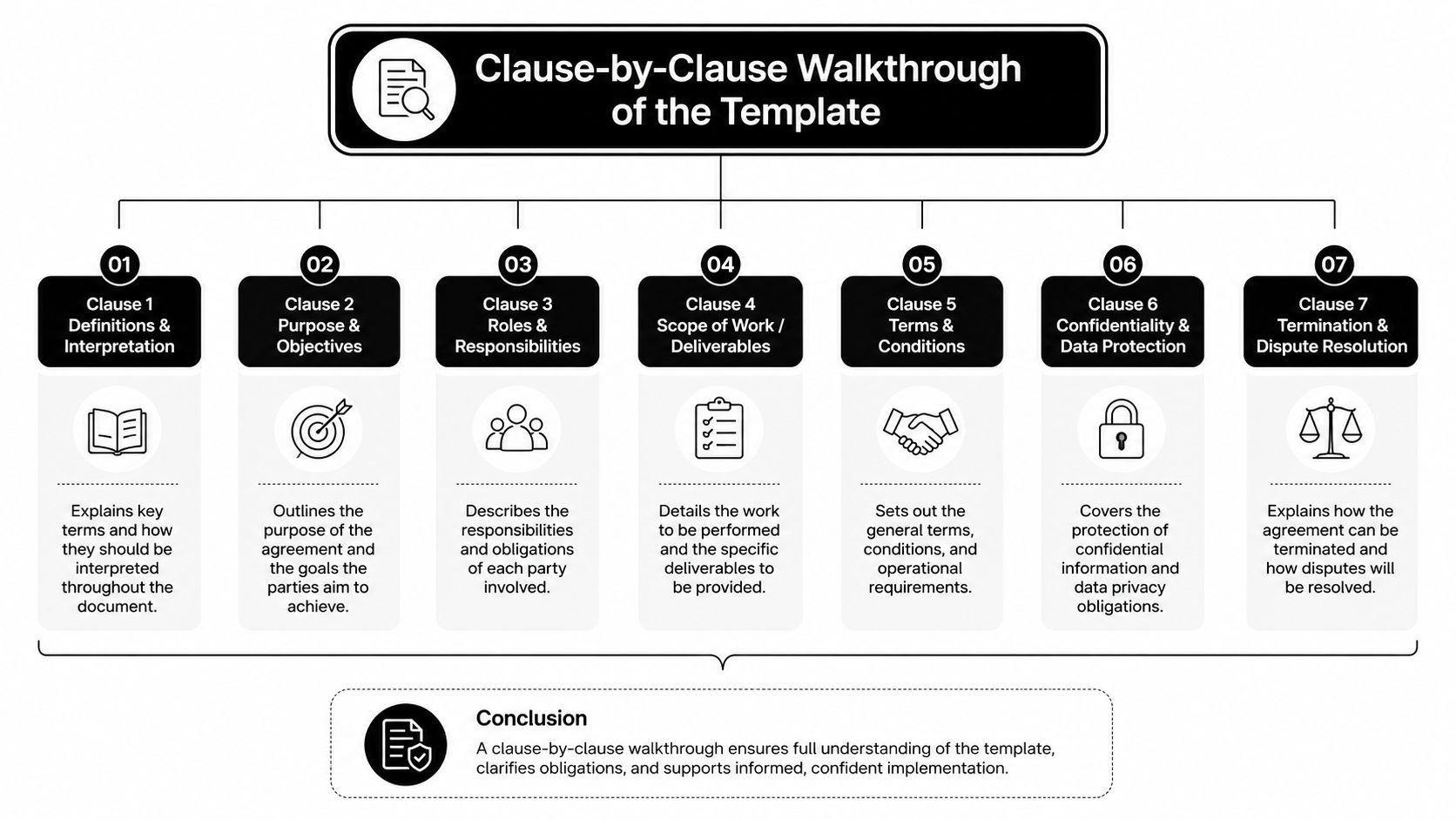
The safest way to read a distribution agreement template is in the order the deal operates, not the order a sales rep wants to close it. Start with the parties and the exact product scope, then move to territory and channels, then exclusivity, price, supply, marketing approvals, compliance, term, renewal, termination, and post-termination obligations. That sequence tracks how risk and control move through the relationship. Guidance on contract clauses also points readers to the same structure, because clarity in one clause depends on the ones around it. Clause structure guide
The core commercial clauses
Parties and product scope define who is bound and which SKUs or product lines are included. The common mistake is writing the scope too broadly, then arguing later over whether a new SKU or product family was covered.
Territory and channel boundaries tell the distributor where it can sell and through which channels. The drafting trap is leaving geography fuzzy, which invites overlap, unauthorized sales, and channel conflict.
Exclusivity type states whether the distributor is exclusive, non-exclusive, or sole. If the document says “exclusive” without performance language, you may end up locking in an underperforming partner.
Pricing and payment terms set the commercial math. A common error is leaving payment timing implied, which creates friction the first time an invoice goes late.
Supply and inventory allocate ordering, shipping, defects, warranties, and after-sales responsibility. If the contract is silent, each side tends to read the silence in its own favor.
Brand, compliance, and exit mechanics
Marketing and IP approval protect trademarks and advertising standards. The mistake here is assuming the distributor will naturally stay within brand guardrails without a written approval process.
Warranties and compliance should cover product condition, legal compliance, and any sector-specific requirements. Ambiguous duties around defects or support often make later enforcement messy.
Term and renewal control the life of the deal. If renewal is automatic, make sure notice timing is clear.
Termination triggers should spell out what ends the deal, not what one side hopes would end it. That includes breach, insolvency, change of control, and performance failure where applicable.
Post-termination obligations are where many deals unravel, especially on inventory, customer handoff, brand materials, and confidential information. These duties need to survive the signature date and the exit date.
Governing law and dispute resolution matter even more in cross-border relationships, because forum, arbitration, and applicable law can decide whether a problem is expensive or manageable.
Every commercial promise should be paired with an operational clause that makes it enforceable.
A drafting check before signature
- Scope precision: list the products and channels with enough detail that both sides can tell what is in and what is out.
- Operational fit: match pricing, shipping, and support obligations to the actual workflow.
- Exit clarity: define what happens when the relationship ends, not just how it starts.
How to Customize the Template for Your Deal

Customization starts with the business facts, not the legal markup. Gather the SKUs, the territory, the sales channel, the expected volume, the product launch timing, and the counterparty's exact legal name and entity type. If you're building a repeatable contract workflow, tools like the EDocGen contract template API can help automate data population, but the legal judgment still has to come from the deal team.
Then choose the exclusivity model that fits the relationship. If one distributor is going to carry a brand across a defined region, the contract should say whether that exclusivity is unconditional or tied to measurable performance. For a practical comparison on relationship structure, see the distinction between a license and a franchise, because founders often confuse distribution control with other channel models.
A simple South Florida example
A cosmetics founder in Brickell wants one distributor for Broward and Miami-Dade, with sales through independent beauty retailers and no online marketplace sales. The blank template becomes useful only after you specify the territory, prohibit unauthorized channels, and require brand approval for all ads and influencer materials. If the distributor also warehouses product locally, the shipping, defect, and inventory clauses need to track that reality, not a generic resale arrangement.
Bilingual execution choices that actually work
The EN/ES option can be handled in three practical ways. The parties can sign in English only if both sides are comfortable with that text, in Spanish only if that is the governing business language, or in a side-by-side version where the Spanish text is controlling. The controlling-language clause matters because bilingual drafting without a control rule creates avoidable fights over meaning.
If the parties will market in both languages, the approval clause should be reviewed against the actual ads, labels, and product pages before signature.
A field-by-field sequence that saves time
- Lock the commercial facts first, especially products, geography, and channels.
- Set the money terms second, including pricing and payment timing.
- Write the exit terms before signature, because renewal and termination are where leverage gets tested.
- Check the marketing and IP language last, but only after reviewing real promo plans.
For founders who need repeating templates across multiple counterparties, the primary goal is consistency. The legal team can still tailor the contract, but the underlying structure should stay disciplined.
Making Exclusivity Conditional, Not Free
Blanket exclusivity sounds clean in negotiation and expensive in practice. If a distributor gets exclusivity without any measurable threshold, the supplier can get trapped in a channel that underperforms while trying to unwind a relationship that's already baked into the contract. Template guidance itself flags minimum order requirements and performance targets as key drafting items, and that's the right instinct. AILawyer template guidance
Conditional exclusivity is the better commercial bargain
The smarter structure is simple. Tie exclusivity to objective triggers, then define what happens if the distributor misses them. Those triggers can be minimum purchases, inventory commitments, marketing activity, or new-account acquisition targets, as long as they are written clearly enough to measure without arguing.
| Clause | Blanket Exclusivity | Conditional Exclusivity |
|---|---|---|
| Term | Runs for the full term unless the whole contract is terminated | Can stay in place only while performance continues |
| Termination | Harder to justify because the distributor may claim broad protection | Easier to define if missed targets trigger loss of exclusivity or non-renewal |
| Remedies | Mostly reactive after a dispute starts | Built to convert underperformance into a defined business consequence |
What to say in the room
Founders should ask three direct questions before agreeing to exclusivity. What is the measurable threshold, how often is it tested, and what happens if the distributor misses it? If the answer is “we'll discuss it later,” exclusivity is not really conditional, and that is where negotiating power disappears.
The best negotiation posture is to make the threshold objective and the remedy pre-agreed. Loss of exclusivity, a cure period, a transition window, or simple non-renewal all work better than vague dissatisfaction language. The more concrete the trigger, the less room there is for a fight later.
Florida Versus Delaware Governing Law for Founders
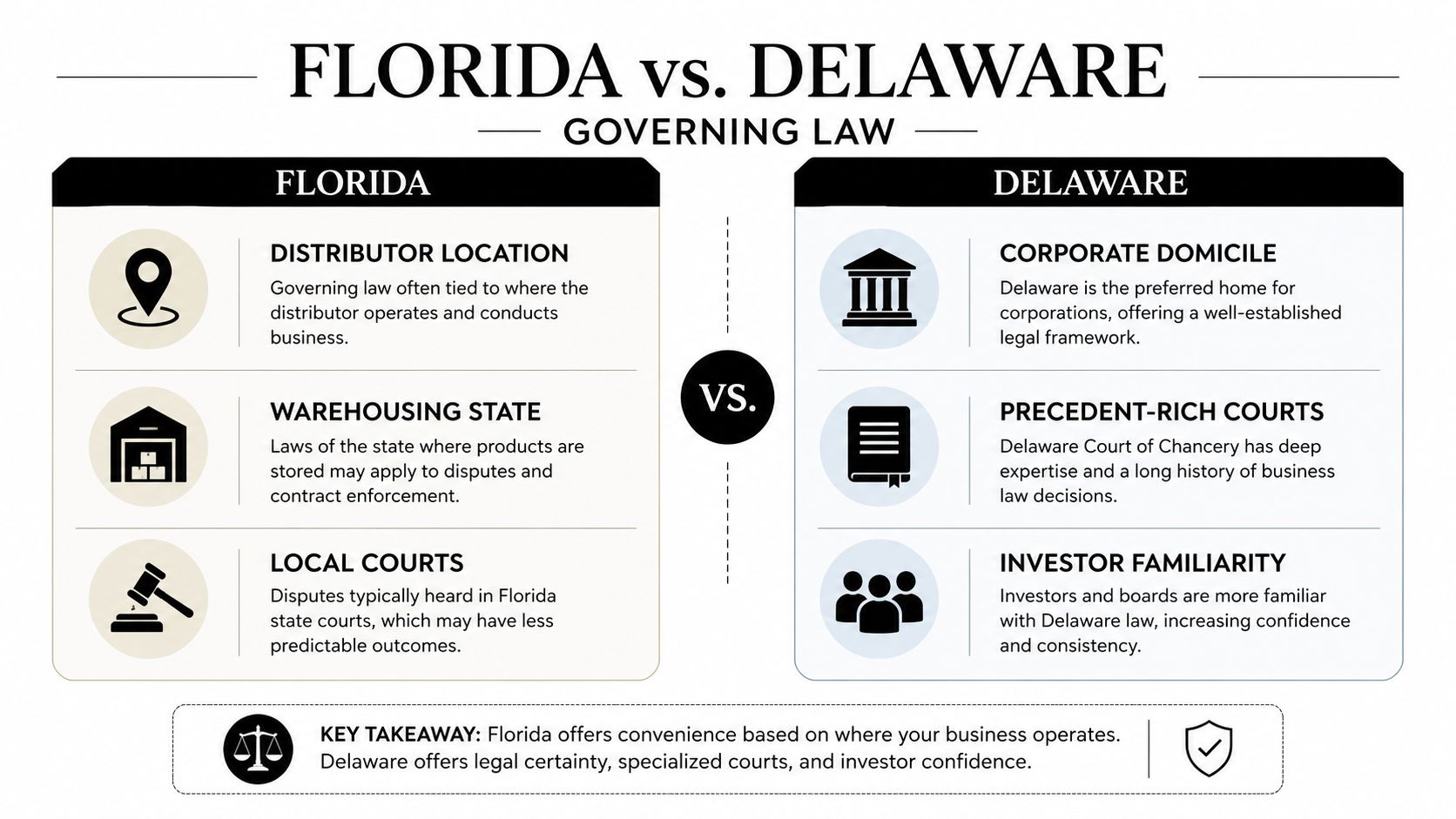
South Florida founders often hear “just use Delaware” as if it solves every contract question. It doesn't. The better choice depends on where the distributor sells, where the goods are warehoused, where the payment flow runs, and whether the deal reaches into Latin America. For entity-structure context, Delaware incorporation benefits are real in the corporate setting, but a distribution contract still has to fit the operating reality.
Florida and Delaware serve different needs
Florida law usually feels more familiar when the distributor, warehouse, or performance is centered in Florida. Delaware often appeals when the parties want precedent-rich courts and a jurisdiction that investors know well. For a contract that will be enforced in day-to-day operations, the practical question is not which state sounds more advanced, it's which law gives the parties a cleaner path if the deal breaks.
Florida also has its own interaction with local business rules, including the Florida Revised Limited Liability Company Act when the distributor is an LLC organized here, plus consumer-protection concerns if the products touch retail channels. Delaware can be attractive for corporate uniformity, but that doesn't erase the fact that the goods may never leave Florida shelves or Florida warehouses.
Cross-border deals change the equation
When the distributor is in Mexico, Colombia, or Brazil, neutral arbitration seats and more careful governing-law language become much more important. The contract should say where disputes are heard and what law applies, because cross-border enforcement gets complicated fast if the document is vague. In those deals, a founder should consider whether arbitration or local court litigation best supports the business relationship.
A practical selection framework
Use Florida when the operational center is here and the dispute is likely to be local. Use Delaware when the corporate structure and investor familiarity matter more than the place of performance. Use a neutral arbitration clause when the deal crosses borders and neither side wants to fight forum first, merits second.
Risk, Termination, and When to Call Counsel
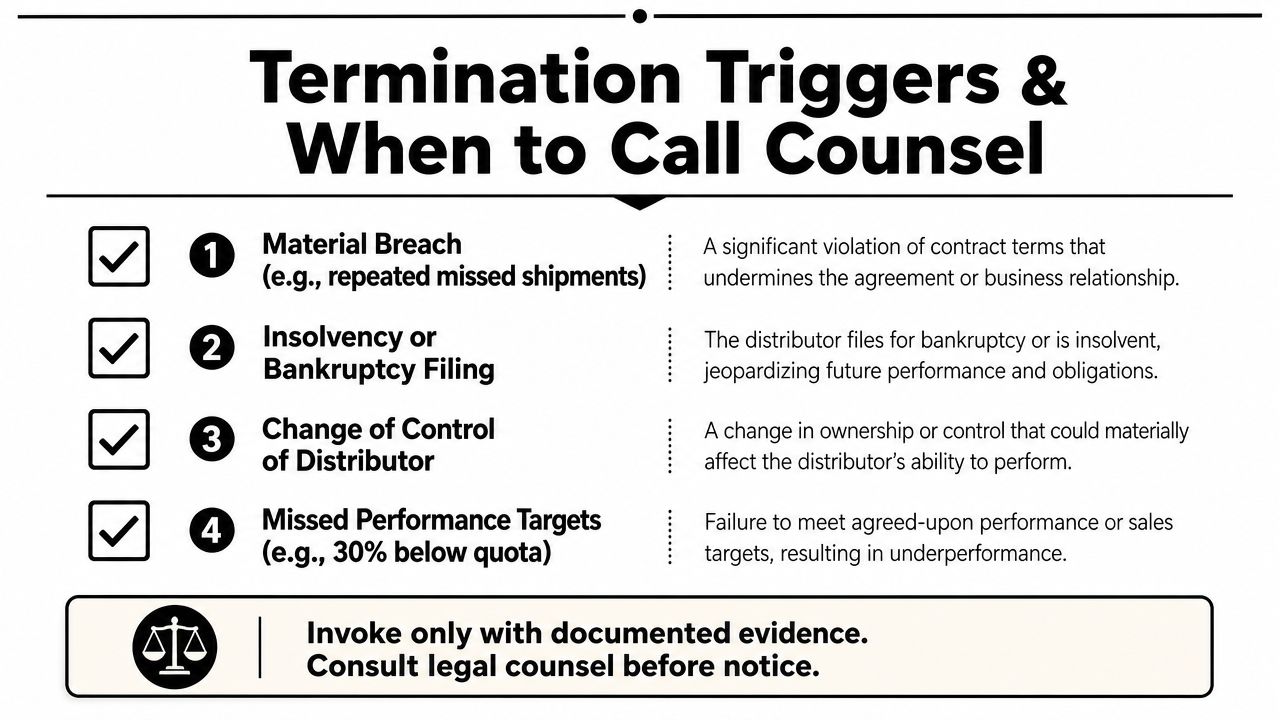
A template usually covers the classic termination triggers, but the trigger is only useful if the record supports it. Material breach needs documented failures, not a vague sense that the distributor is uncooperative. Insolvency or bankruptcy filing is a different event entirely, and the notice mechanics should match the contract language. Change of control matters because the identity of the distributor can change even when the entity name stays the same. Missed performance targets only work if the target was written clearly enough to measure.
The harder disputes usually start after termination. Inventory buyback or sell-off rights, customer transition, return of marketing materials, IP takedown, and confidentiality survival all need to be handled explicitly. If they're missing, the parties end up arguing over who owes what after the relationship is already over.
For distributors in the beverage space, the inventory issue can be especially sharp. ISU Insurance Services liability coverage may be part of a broader risk discussion, but contract language still has to say who holds the inventory burden, who pays storage, and how the wind-down works when product is sitting in a warehouse.
When the template stops being enough
Bring counsel in if the deal involves regulated products like food, supplements, alcohol, or cannabis-related goods. The same goes for equity-linked distribution, cross-border IP licensing, antitrust-sensitive exclusivity, or distributor-side financing. Those structures can change the legal risk enough that a fill-in-the-blanks template is no longer a safe move.
A bilingual firm like Coto & Waddington can review the agreement on a flat-fee basis or step in as fractional general counsel when the relationship becomes ongoing. That matters for founders who need fast answers in English or Spanish without turning every contract into a full-scale project.
Your Next Steps and How to Get the Template
Before you sign anything, make the checklist real. Download the bilingual EN/ES template, choose governing law before negotiation, tie exclusivity to measurable performance, confirm the IP and marketing approval flow, and document the termination triggers and post-termination transition. If any one of those items is fuzzy, the paper is not ready yet.
Use the template as a business tool, not a shortcut. It works best when the commercial facts are known, the channel structure is clear, and the exit rights are drafted before the relationship gets tense. That's the difference between a document that supports growth and one that becomes the source of the dispute.
If you need the free EN/ES distribution agreement template, get it from the resources box or the Coto & Waddington site, then have counsel review it before you ship product or promise exclusivity. That saves time later, especially when the deal crosses state lines or language lines.
Coto & Waddington, Attorneys at Law helps South Florida founders with contract drafting, template review, and bilingual business counsel for distribution deals that need to be enforceable in practice. If your agreement touches exclusivity, territory, termination, or cross-border sales, visit Coto & Waddington, Attorneys at Law to see how the firm handles practical contract work for growing businesses.