A founder signs the operating agreement in a rush, closes a vendor deal on a template, and moves on to product, hiring, and cash flow. Then the first real conflict hits. A co-founder wants more control than the documents allow. A developer misses deadlines and blames scope creep. A client refuses to pay the final invoice and points to language nobody reviewed closely enough.
At that point, most startups ask the wrong question. They ask who's right. The better question is which dispute resolution method gets this business to an acceptable outcome with the least damage.
That choice affects money, speed, strategic advantage, confidentiality, and whether you can keep working with the other side after the dispute ends. It also matters earlier than most founders think. The market for formal conflict resolution tools reflects that shift. The global conflict resolution solutions market is projected to grow from US$ 11.79 billion in 2026 to US$ 19.31 billion by 2033, reflecting a compound annual growth rate of 7.3% according to Coherent Market Insights' conflict resolution solutions market report. Businesses are planning for conflict more deliberately because litigation isn't always the smartest business move.
Table of Contents
- When Handshakes Falter A Startup's Guide to Disputes
- The Four Core Dispute Resolution Methods Compared
- Collaborative Solutions Mediation and Negotiation
- Binding Decisions Arbitration and Hybrid Models
- A Practical Checklist for Choosing Your Method
- Drafting an Effective Dispute Resolution Clause
- Protect Your Business Before Conflict Arises
When Handshakes Falter A Startup's Guide to Disputes
A startup dispute rarely starts as a lawsuit. It usually starts as a missed expectation. One founder thinks equity vests differently than the other. A sales partner promises deliverables your operations team never approved. A key vendor says change orders were implied. Everyone still thinks the relationship can be saved, until a payment gets withheld or access to accounts gets cut off.

What founders miss is that dispute resolution methods are part of company design. They belong in the same category as vesting schedules, IP assignment, payment terms, and approval rights. If your documents don't tell the parties how conflict gets handled, the conflict itself will decide. That usually means more cost, more delay, and worse behavior.
What a startup is really protecting
The legal issue matters, but the business consequences usually matter more:
- Cash position: A slow dispute can freeze revenue, delay fundraising, or force unwanted settlements.
- Leadership focus: Founders pulled into document fights stop selling, building, and hiring.
- Relationships: The right process can preserve a vendor, customer, or co-founder relationship. The wrong one can end it.
- Confidential information: Public court filings may expose terms you'd rather keep private.
Practical rule: If the contract is important enough to sign, it's important enough to include a dispute path that matches the deal.
Planning before conflict changes your leverage
A dispute clause isn't boilerplate. It's the distribution of power. It determines where a fight happens, who decides it, and whether the parties must first try to solve it privately. For a startup, that can be the difference between a manageable business problem and a distraction that drains the quarter.
Good planning doesn't guarantee peace. It does give you a playbook. That alone lowers friction when tempers rise.
The Four Core Dispute Resolution Methods Compared
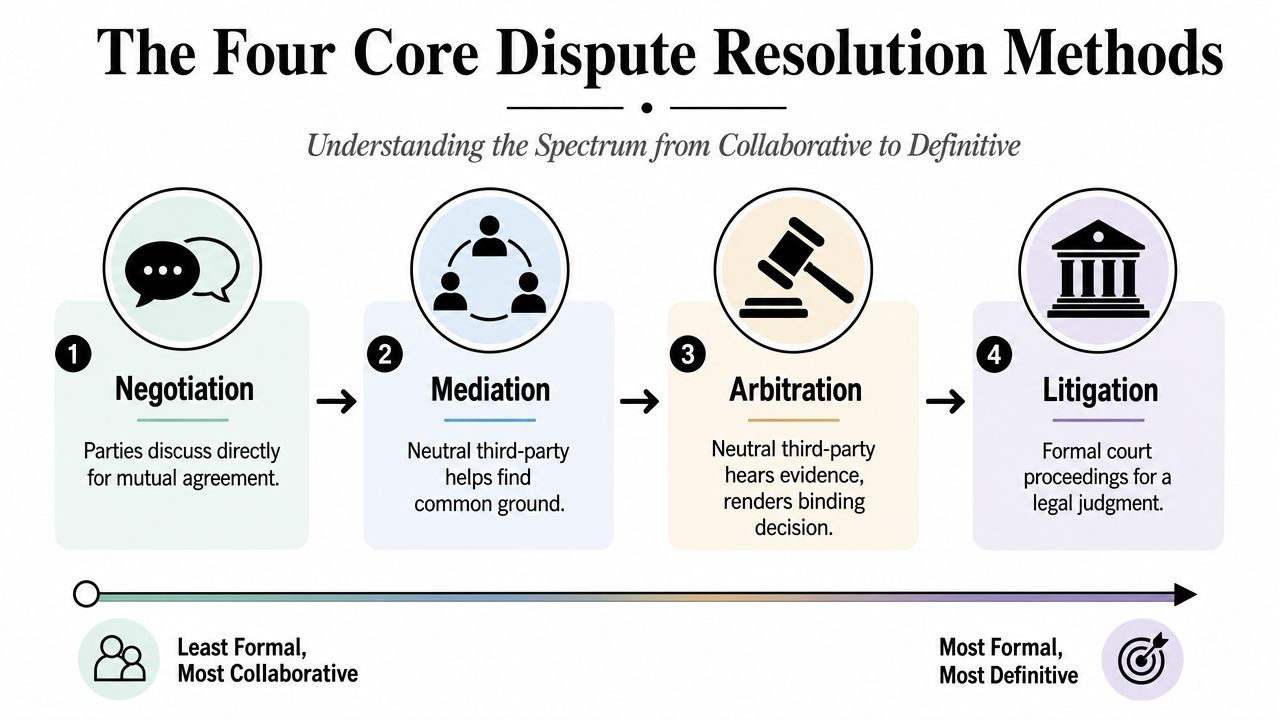
Founders should think of dispute resolution as a ladder of escalation. At the bottom, the parties keep maximum control. At the top, a judge imposes the result. Each rung trades flexibility for certainty.
Negotiation
Negotiation is the first rung. The parties, usually through founders, executives, or counsel, try to resolve the problem directly.
This works best when both sides want to preserve the deal and the facts are still developing. It's often the cheapest and fastest option because nobody pays a neutral to decide anything. But it only works if both parties are operating in good faith and have enough business overlap to care about compromise.
Mediation
Mediation brings in a neutral third party who helps the sides reach a voluntary agreement. The mediator doesn't impose a result.
For startups, mediation often fits disputes where the legal answer matters less than the practical outcome. Think milestone disputes, partnership friction, scope fights, or payment problems where both sides still want to avoid a scorched-earth result.
Arbitration
Arbitration looks more like a private trial. A neutral hears evidence and issues a decision that is typically binding if the contract says so.
This method makes sense when the parties need closure, want a private forum, or prefer a decision-maker with industry knowledge. A software licensing dispute, an earnout fight, or a shareholder disagreement over contractual rights may be better suited to arbitration than open-ended negotiation.
Litigation
Litigation is formal court process. It gives the parties access to judicial remedies and a public legal judgment.
Sometimes that's the right answer. If you need emergency court intervention, a precedent-setting ruling, or broad third-party discovery, litigation may be the stronger tool. It is also what you get by default when the contract says nothing useful.
Side by side trade-offs
| Method | Who controls the outcome | Formality | Best fit | Main weakness |
|---|---|---|---|---|
| Negotiation | The parties | Low | Early-stage disputes, business fixes | No neutral pressure if talks stall |
| Mediation | The parties, with neutral guidance | Low to moderate | Ongoing relationships, flexible settlements | No binding result unless agreement is signed |
| Arbitration | Arbitrator | Moderate to high | Contract interpretation, technical disputes, need for finality | Less room for creative compromise |
| Litigation | Judge or jury | High | Court orders, precedent, procedural tools | Public, rigid, and often disruptive |
Use the least formal method that can still solve the actual problem. Startups lose money when they over-lawyer a fixable disagreement, and they lose time when they under-engineer a dispute that needs a final ruling.
A quick founder lens
If your main concern is preserving a relationship, start low on the ladder. If your main concern is ending uncertainty, move higher. The mistake is treating every disagreement as either a handshake issue or a courthouse issue. Most disputes sit somewhere in between.
Collaborative Solutions Mediation and Negotiation
Negotiation and mediation are often the smartest opening move when the company still needs something from the other side. That could be continued performance, a payment plan, a revised scope, a return of data, or a cleaner exit.
A survey of Fortune 1,000 corporate counsel found that mediation has emerged as the preferred tool for resolving all kinds of disputes, with companies using mediated negotiation to reach settlements quickly and inexpensively, and that in most civil cases mediation fees are split evenly and sessions are generally day-long affairs according to the Wolters Kluwer discussion of the Fortune 1000 survey. For founders, that matters because mediation is not just a softer legal option. It's a business tool established companies already use to avoid waste.
How a useful negotiation starts
A bad negotiation opens with outrage. A useful one opens with a clear ask, a record, and a realistic fallback.
For a startup vendor dispute, that usually means gathering the contract, statements of work, invoices, timeline emails, and a short damages summary. Then define the business objective before the legal one. Do you want payment, performance, a narrowed scope, or a release and exit?
A practical sequence looks like this:
- State the breach clearly: Identify what obligation wasn't met.
- Make one business proposal: Revised delivery dates, partial refund, reduced balance, or mutual termination.
- Set a response window: Long enough to permit review, short enough to keep pressure on.
- Escalate only if needed: Bring in counsel or propose mediation when direct talks harden.
What to do before mediation day
Mediation rewards preparation. It does not reward dramatic speeches.
- Write a short position memo: Keep it factual. Include documents that matter.
- Decide your settlement range: Know what you can accept before the room gets tense.
- Choose the right attendee: Someone with authority must be present.
- Budget the day properly: Don't book other meetings. Day-long sessions work better when parties have time to work through resistance.
The best mediation outcomes usually happen when each side arrives with enough authority to solve the problem and enough humility to hear risk.
Why founders often get better outcomes in mediation
Mediation gives room for solutions a judge or arbitrator can't easily order. That includes revised service levels, staged payments, non-disparagement terms, future referrals, IP cleanup, and transition obligations.
It also helps when a contract is incomplete. Many startup agreements are written fast and revised late. If your team wants help tightening language before the next deal, this guide on how to write a business contract is a practical place to start.
When not to force collaboration
Negotiation and mediation lose value when one side needs a precedent, wants to delay, or is arguing from an irreconcilable legal position. In those disputes, a collaborative process can become a costly pause before the main fight begins.
Binding Decisions Arbitration and Hybrid Models
Some disputes don't need more conversation. They need a decision.
That usually happens when the parties disagree on what the contract means, what law applies, or whether someone had authority to act. In that setting, mediation can become a holding pattern. You spend time presenting positions, but nobody has the power to end the disagreement unless both sides voluntarily move.
When arbitration is the better business choice
Arbitration is useful when a startup needs a definitive answer without defaulting to full court litigation. That often includes disputes over equity rights, earnouts, license restrictions, founder exits, or high-stakes indemnity claims.
The business advantage is clarity. Once an arbitrator rules, the company can move forward. Investors, counterparties, and internal teams generally prefer a final answer to an endless unresolved conflict.
The case for bypassing mediation in legal interpretation fights
A common mistake is assuming mediation should always come first. It shouldn't.
Mediation can fail in 30 to 40% of cases involving contentious law due to its nonbinding nature, and med-arb clauses are an emerging standard for these situations, where a neutral first mediates and, if needed, then arbitrates to a binding decision, according to the Program on Negotiation at Harvard Law School discussion of mediation, arbitration, and litigation. If the dispute turns on a hard legal interpretation, not a business misunderstanding, founders should seriously consider a binding process from the start.
If both sides are asking, “Who is legally right?” rather than “What business deal can we live with?”, arbitration is often the cleaner route.
How med-arb works in practice
Med-arb combines two steps. The neutral first tries to mediate. If the case doesn't settle, that same person can shift roles and decide the dispute in arbitration. A concise explanation appears in this overview of what an arbitration clause is.
That structure can work well for startups because it gives one real chance to preserve the relationship without surrendering finality. It also limits the dead time between failed mediation and formal adjudication.
Still, med-arb requires careful drafting and informed consent. Some parties are uncomfortable sharing confidential settlement positions with a neutral who may later decide the case. In those matters, separate neutrals for mediation and arbitration may be the better design.
What works and what doesn't
Works well
- Technical contract disputes: A knowledgeable neutral can cut through jargon.
- Closed-party disputes: Where the conflict is mainly between signatories to one contract.
- Need for confidentiality: Especially around pricing, source code, cap table rights, or internal governance.
Usually works poorly
- Matters requiring immediate court orders: Such as some injunction scenarios.
- Disputes involving many outside actors: Arbitration can become awkward if key players aren't bound by the clause.
- Poorly drafted clauses: Ambiguity about forum, rules, or scope creates side disputes before the merits are even heard.
A Practical Checklist for Choosing Your Method
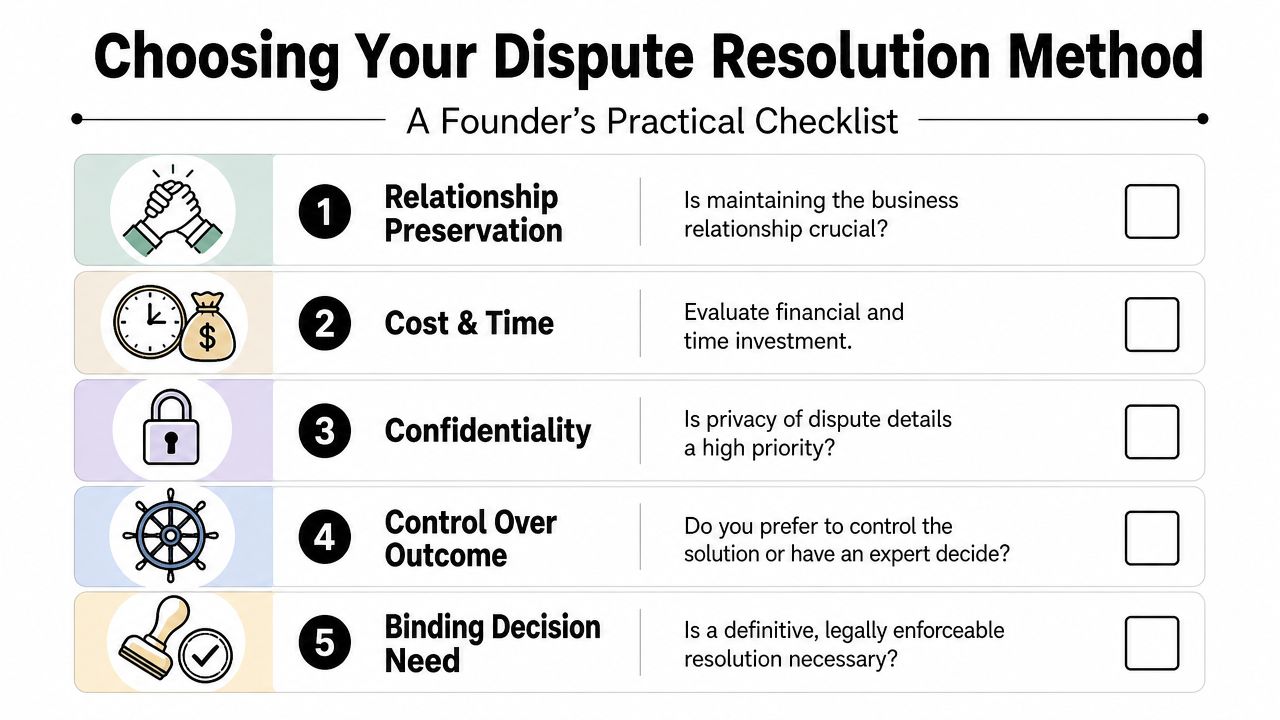
Founders don't need a theoretical framework in the middle of a dispute. They need a decision filter. Use this checklist to decide which of the core dispute resolution methods fits the problem in front of you.
Ask what the business must preserve
If you need to keep working together, start with negotiation or mediation. This is common with co-founders, key service providers, and channel partners where the commercial relationship still has value.
If the relationship is already broken and trust can't be restored, arbitration or litigation usually makes more sense.
Ask whether privacy matters
Some disputes should stay out of public filings. If the disagreement involves pricing, product roadmap, customer lists, source code, internal governance, or reputationally sensitive facts, private processes usually deserve more weight.
Court may still be necessary in some cases, but founders shouldn't sleepwalk into public process when confidentiality is a core business concern.
Ask who should decide
Use this simple guide:
- You want control over the solution: Negotiation or mediation.
- You want a neutral to impose a result: Arbitration or litigation.
- You want one real settlement attempt, then closure: Med-arb.
Founder shortcut: Choose the process that matches the decision-maker you actually need. If you still want to craft terms yourselves, stay collaborative. If you need someone else to end the debate, choose a binding forum.
Ask what kind of disagreement this is
Not every dispute is about the same kind of risk.
| Type of dispute | Usually points toward |
|---|---|
| Payment delay with room for compromise | Negotiation or mediation |
| Scope and deliverables dispute | Mediation, sometimes arbitration |
| Contract interpretation fight | Arbitration |
| Need for emergency judicial relief | Litigation |
| Internal founder fallout with salvageable relationship | Mediation |
| Governance deadlock with no workable path forward | Arbitration or litigation |
Ask what delay will cost the company
The legal bill is only one cost. Delay can hold up a financing, block a launch, distract leadership, or keep receivables uncollected. If prolonged uncertainty is the true threat, a method that ends the dispute may be cheaper in business terms than a method that feels cheaper at the start.
A final practical tip: write down your acceptable outcome before choosing the process. Founders often pick the forum first and define success later. That's backward.
Drafting an Effective Dispute Resolution Clause
A dispute clause should do three things. It should tell the parties where the fight happens, how it starts, and who decides it if they can't settle.
Drafting gets especially important for startups because many disputes happen inside ongoing working relationships. Data from 2025 indicates that 68% of startup disputes involve ongoing operational partnerships, while less than 15% of public content addresses how arbitration's binding nature may fracture those relationships compared with mediation's collaborative framework, according to MB Law's discussion of alternative dispute resolution methods. If the other side is a co-founder, agency, developer, operator, or long-term vendor, your clause shouldn't treat relationship fallout as an afterthought.
Sample clause for a Florida LLC
Use this style when the business and operations are centered in Florida and the parties may benefit from one real settlement effort before escalation:
Any dispute arising out of or relating to this Agreement shall first be submitted to confidential mediation in Miami-Dade County, Florida. If the dispute is not resolved through mediation within a reasonable period after demand, it shall be resolved by binding arbitration in Miami-Dade County, Florida, under mutually agreed procedures. Florida law governs this Agreement, without regard to conflict of law rules.
This kind of structure works well for service agreements, operating agreements, and founder documents where preserving a workable relationship still matters.
Sample clause for a Delaware corporation
A Delaware entity often wants predictability around governing law and a more definitive path for internal or investor-facing disputes:
Any dispute arising out of or relating to this Agreement shall be resolved by binding arbitration in a mutually agreed forum, and Delaware law shall govern this Agreement, without regard to conflict of law rules. Before arbitration begins, the parties may agree to participate in nonbinding mediation.
This version keeps flexibility while signaling that legal interpretation disputes won't stay open forever.
What to customize before you sign
Don't copy a clause without editing these parts:
- Venue: Choose a place your company can litigate or arbitrate from. For South Florida companies, Miami-Dade County is often the practical choice.
- Governing law: Florida may fit local operating businesses. Delaware often fits venture-backed corporations or investor-heavy structures.
- Scope: Define whether the clause covers all disputes arising out of or relating to the agreement.
- Pre-steps: Decide whether negotiation, mediation, or notice periods are mandatory.
- Interim relief: Clarify whether a party may still go to court for urgent injunctive relief.
- Fee language: Be careful. Aggressive fee clauses can distort settlement incentives.
If you review public-facing commercial documents to benchmark wording, reading real service terms can help you see how businesses structure dispute language in the broader market. For startup-specific drafting, this primer on clauses in a contract is also useful.
One practical note from the field: Coto & Waddington, Attorneys at Law handles startup formation, contracts, and dispute-related business counsel for Florida and Delaware entities, including founder agreements and operating documents where the dispute clause needs to match the company's actual risk profile.
Protect Your Business Before Conflict Arises
Most founders won't regret spending time on a dispute clause. They will regret not having one when the first serious disagreement lands.
The right choice among dispute resolution methods depends on the deal, the relationship, and the kind of answer the business needs. Negotiation and mediation can preserve value where collaboration is still possible. Arbitration and hybrid models can end legal ambiguity when compromise isn't realistic. Litigation still has a place when court power is necessary.
For internal team conflict, founder-manager friction, and day-to-day people issues, this roundup of effective workplace conflict resolution strategies is a helpful complement to contract-based planning.
The practical tip is simple. Review your operating agreement, founder agreements, vendor contracts, client terms, and equity documents before a dispute starts. If the clause is vague, missing, or copied from a bad template, fix it now.
If you're building in South Florida and want contracts that hold up under pressure, talk with Coto & Waddington, Attorneys at Law. The firm advises startups and small businesses on formation, founder agreements, contract drafting, and dispute planning so conflicts don't derail operations when the stakes are highest.