You're probably in one of two places right now. You heard “Florida Digital Bill of Rights” and assumed it's a Big Tech law that has nothing to do with your startup. Or you glanced at the name, thought it sounded broad and vague, and pushed it down the list behind fundraising, hiring, sales, and product work.
That reaction is understandable. It's also risky.
For most South Florida founders, the immediate legal answer is that the Florida Digital Bill of Rights doesn't directly regulate your company today. But the operational answer is different. If you collect customer emails, run Meta or Google ads, use analytics, store support tickets, or let vendors process user data, you're already making privacy decisions. The smart move is to treat this law as a blueprint for how Florida expects businesses to handle personal data.
Done right, that approach does more than reduce legal risk. It helps you close deals faster, answer customer questions cleanly, and avoid rebuilding your privacy practices under pressure later.
Table of Contents
- A New Law for Florida Businesses
- Understanding the Digital Bill of Rights Concept
- Key Provisions of the Florida Digital Bill of Rights
- Business Compliance and Risk Under the FDBR
- Proactive Steps for South Florida Startups
- Drafting Your Initial Compliance Policies
- Frequently Asked Questions About Florida's Digital Rights
- Does my small Miami ecommerce business have to comply with the FDBR
- What is the single most important privacy practice to implement today
- How is the FDBR different from the GDPR
- What should I do if a customer asks me to delete their data and I'm not legally required to honor the request
- Should I add an FAQ page about privacy
- What is a good first step for a founder with limited time
A New Law for Florida Businesses
A South Florida founder gets a diligence request from a potential enterprise customer. The customer is not asking whether the company technically falls under the Florida Digital Bill of Rights. It is asking for the privacy policy, the data retention schedule, the vendor list, and the process for handling deletion requests.
That is why this law matters.
On June 6, 2023, Governor Ron DeSantis signed Senate Bill 262, the Florida Digital Bill of Rights. It took effect on July 1, 2024, under Chapter 501 of the Florida Statutes. For many startups, the immediate answer to "does this law apply to us?" is still no. The statute is aimed at a narrow group of very large companies doing business in Florida, with more than $1 billion in global annual revenue and additional platform-related triggers.
Still, founders should not treat the FDBR as someone else's problem. It sets the direction of travel for regulators, customers, and counterparties. In practice, that means smaller companies will feel the pressure through contract review, procurement questionnaires, investor diligence, and customer trust long before they face direct statutory exposure.
Why startups should still care
For an early-stage company, privacy gaps usually show up as operational gaps first. The team cannot say with confidence what personal data it collects, where that data sits, which vendors receive it, or how a user can ask for access or deletion. That creates legal risk, but it also slows sales and financing.
Buyers and partners increasingly ask basic questions that a well-run startup should be able to answer:
- What personal data do you collect? Customer names, emails, device identifiers, support records, billing details, or other account data.
- Why do you collect it? Service delivery, security, analytics, marketing, fraud prevention, or internal reporting.
- Who can access it? Employees, contractors, cloud providers, payment processors, CRM tools, and ad or analytics vendors.
- How do you respond to user requests? Through account settings, a support channel, a webform, or a documented internal process.
A company that can answer those questions clearly looks prepared. A company that cannot usually has not mapped its own systems, and that problem tends to surface at the worst time.
Practical rule: If your team cannot explain your data flow on one whiteboard, fix that before you spend time polishing website language.
The key takeaway for founders
The FDBR is more than a compliance headline. It is a useful benchmark.
Even if your startup does not meet the law's revenue threshold, adopting FDBR-style privacy practices early can reduce friction with enterprise customers, make diligence cleaner, and lower the risk of scrambling after a complaint or contract demand. There is a trade-off, of course. Documenting data flows, tightening vendor controls, and setting retention rules takes time from product and sales. But in our experience, founders pay for that work one way or another. It is usually cheaper to do it on your own timeline.
Start with your actual systems, not your website footer. Review Stripe, HubSpot, Google Analytics, Shopify, QuickBooks, your help desk, and shared drives. Identify what personal data sits in each system, why it is there, who has access, and whether you still need it. That inventory gives you the first draft of a privacy program that is useful in practice, not just on paper.
Understanding the Digital Bill of Rights Concept
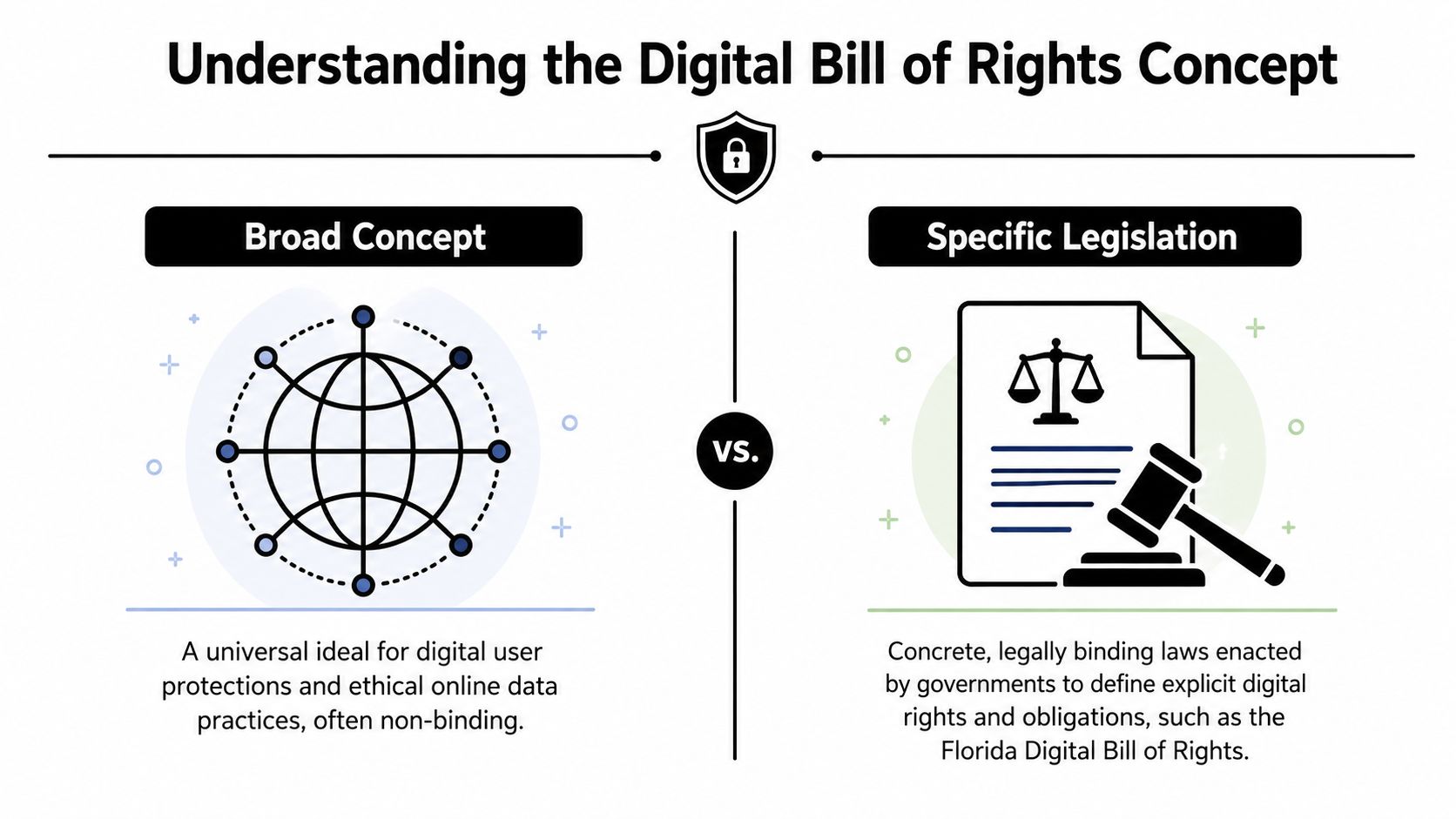
The phrase digital bill of rights sounds broader than it is. Sometimes people use it to describe a general principle: individuals should have meaningful protections online. In other settings, it refers to a specific law with enforceable obligations.
That distinction matters because businesses often mix together two very different conversations. One is about digital access and affordability. The other is about data privacy, notice, consent, and user control.
Broad concept versus legal reality
Here's the clearest explanation:
| Concept | What it usually means | Why it matters to a founder |
|---|---|---|
| Broad digital rights idea | Fair treatment online, ethical data practices, transparency, access | Shapes customer expectations and public debate |
| Specific digital rights law | Concrete legal duties, consumer rights, notice rules, enforcement exposure | Changes what your business must build, document, and honor |
That confusion shows up constantly in search results and public discussion. Most existing content on the term focuses on California's Digital Equity Bill of Rights, which is centered on infrastructure and affordability, while missing how the Florida Digital Bill of Rights, effective July 1, 2024, affects small business compliance, data privacy, and consumer opt-out rights for startups, as highlighted by the California Emerging Technology Fund's Digital Equity Bill of Rights page.
Florida's version is about data control
Florida's law is not an internet-access measure. It is a data protection law. Its core concern is whether consumers can control what businesses do with their personal data.
That means the practical questions shift fast:
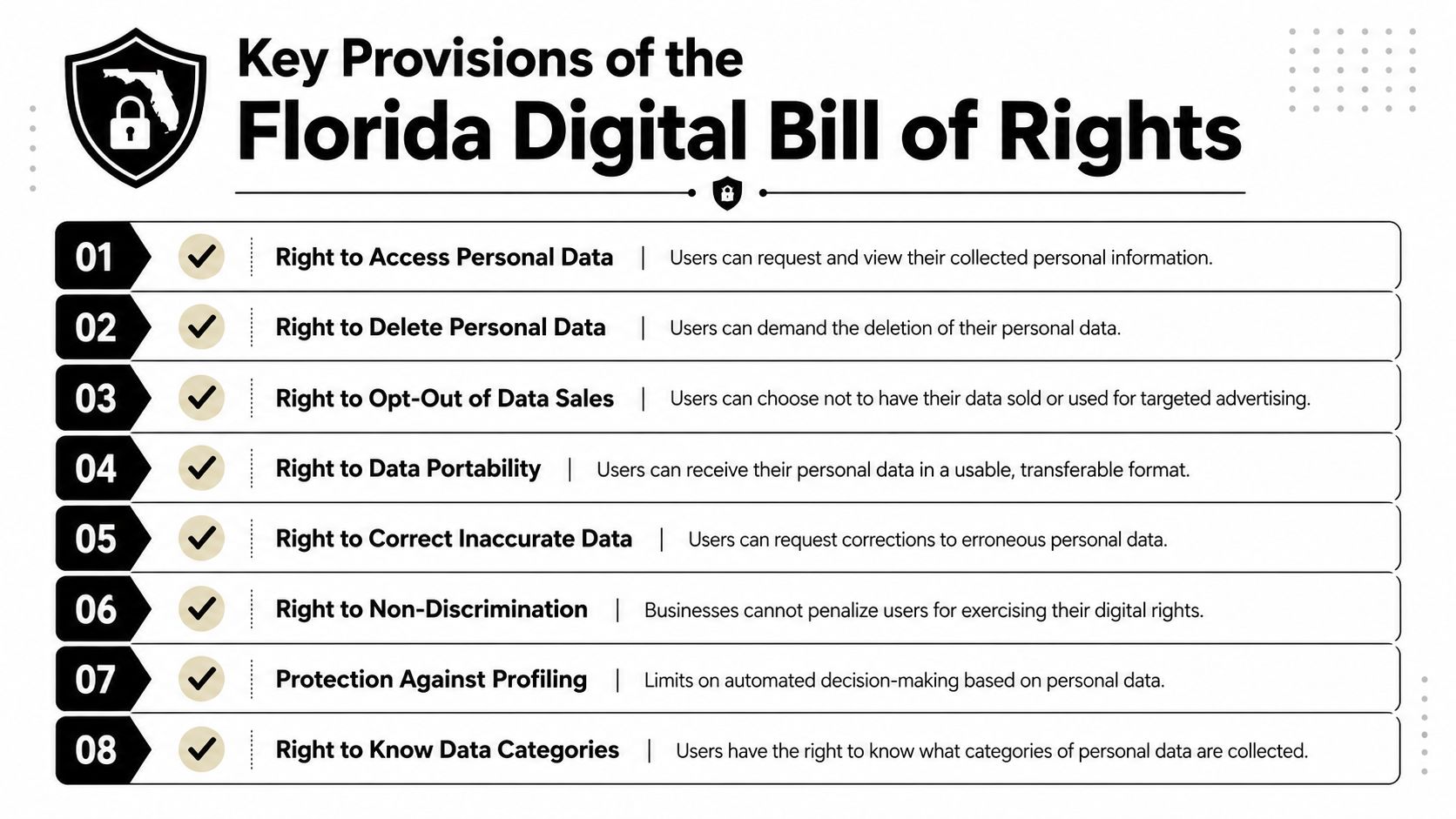
- Can a person access or correct data you hold?
- Can they ask you to delete it?
- Can they get a portable copy?
- Can they opt out of certain uses?
- Do you process sensitive information only after proper consent?
Those are operational questions, not branding questions.
A privacy law usually doesn't fail because a company lacked a mission statement. It fails because nobody owned the workflow.
Why founders should care about the terminology
If you misunderstand the term, you'll likely misbuild your compliance approach.
A startup that thinks “digital bill of rights” is just a policy slogan may spend time on broad statements about trust and inclusion while neglecting the mechanics that matter most: intake forms, vendor contracts, permission settings, retention habits, and response procedures for user requests.
A better tip is to separate your work into two buckets:
- Values-facing materials, such as customer messaging about trust and transparency.
- Legal-facing systems, such as data maps, consent records, deletion procedures, and privacy notices.
That distinction helps you avoid a common founder mistake. Writing polished language before you understand what your systems do.
Key Provisions of the Florida Digital Bill of Rights
A Miami startup launches a new app, closes a first enterprise deal, and then gets a customer email asking for a copy of all personal data on file and deletion of anything not needed. The founder assumes this is a problem for trillion-dollar platforms. The operational problem shows up much earlier. If your team cannot identify where data sits, who can access it, and how to delete it without breaking the product, you already have a privacy management issue.
Florida's Digital Bill of Rights matters because it turns consumer expectations into concrete business duties for a narrow set of very large companies. For everyone else, it provides a practical template. Startups that build around those rights early usually spend less time cleaning up data sprawl, less money rewriting vendor processes, and face fewer surprises in diligence, procurement, and incident response.
The law's core rights create operational duties
At a high level, the FDBR gives consumers rights to know whether a business is processing their personal data, access that data, correct inaccuracies, delete certain information, and obtain a portable copy. It also includes opt-out rights tied to targeted advertising, sales of personal data, and certain uses of sensitive technologies.
For a founder, those rights translate into a short compliance checklist:
- Know what personal data you collect and where it lives
- Assign an owner for access, correction, and deletion requests
- Set a process for exporting data in a usable format
- Review whether ad tech, analytics, or third-party tools create opt-out obligations
- Document how consent is obtained when sensitive data is involved
That is why even companies outside the statute's direct scope should treat these rights as design requirements. If you want a practical starting point, this is the same kind of work we handle in Florida startup privacy compliance counsel: data mapping, request workflows, vendor review, and policy drafting that matches actual operations.
Coverage is narrow, but the business signal is broader
The FDBR does not apply to every Florida business with a website or app. It is aimed at a limited group of very large controllers. That narrow scope leads some founders to ignore it altogether. I would not advise that approach.
Customers, enterprise buyers, and investors rarely care that a startup sits below a statutory threshold if the company still mishandles personal data. A startup that can answer basic privacy questions quickly has an advantage in sales and diligence. A startup that cannot will end up improvising under pressure.
Sensitive data needs tighter controls
The statute pays special attention to sensitive data. That should get a founder's attention even if the company is years away from direct FDBR coverage. If your product touches biometric data, precise geolocation, health-related information, government ID numbers, or data tied to minors, casual collection habits become legal and commercial risk.
The practical fix is simple. Collect less. Limit access. Keep a record of why the data is needed. Build consent language that matches the actual product flow, not a generic template copied from another company.
Age-related features deserve separate review. Social functionality, messaging, recommendation systems, and tracking tools can create added exposure when younger users are involved.
Consumer rights are only useful if your systems can support them
A privacy law becomes expensive when a company has no clean path from request to response. Founders should test this before they need it. Pick one user record and answer four questions: What data do we have, where did it come from, who can see it, and how would we delete or export it today?
That exercise often surfaces core issues. Duplicate records. Data sitting in support tools. Loose sharing with contractors. Retention periods that nobody set on purpose.
Teams using employee monitoring or productivity tools should review those practices too, especially if personal data is collected behind the scenes. This Guide for agencies on employee tracking is a useful example of how privacy concerns can show up in ordinary operations, not just consumer-facing apps.
The business takeaway is straightforward. The FDBR may be written for a narrow class of large companies, but the companies that prepare early are easier to diligence, easier to trust, and harder to disrupt when privacy questions arrive.
Business Compliance and Risk Under the FDBR
The companies directly covered by the FDBR face a compliance burden that is much more technical than many founders expect. This isn't just about posting a prettier privacy policy. It reaches into device storage, logging, access controls, and internal process discipline.
The law imposes strict technical data security mandates on qualified controllers, including encryption, audit controls that record activity, and safeguards against unauthorized access to personal data, as outlined in the TermsFeed review of FDBR compliance obligations.
Where legal risk turns into engineering work
For an operating business, privacy risk usually shows up in ordinary workflows:
| Business function | Common shortcut | Better practice |
|---|---|---|
| Customer support | Exporting user data into spreadsheets and sharing loosely | Restrict access and track who handles data |
| Mobile work | Storing customer files on unencrypted phones or laptops | Use encrypted devices and managed access |
| Marketing ops | Sending user lists across multiple vendors without discipline | Limit sharing and document why each vendor receives data |
| Internal reporting | Broad staff access to sensitive records | Apply role-based access and audit trails |
The important lesson for startups is that your biggest privacy weakness is often convenience. Teams move fast, use personal devices, duplicate files, and create shadow processes in Slack, email, Airtable, Notion, or shared folders.
Transparency is an operating function
The FDBR also expects privacy notices to be reviewed and updated annually, with clear disclosures around data categories, purposes, and third-party sharing. That means your legal documents can't drift away from what your product and team do.
If your website says one thing while your sales team, onboarding flow, and vendor stack do another, the problem won't stay on paper. It becomes evidence that the business lacks internal control.
For startups using employee monitoring or productivity analytics, privacy questions aren't limited to customer data. A balanced framework for internal tracking can help leadership avoid overcollection and poor notice practices. TimeTackle's guide for agencies on employee tracking is a useful operational reference on that point.
Start with the systems people actually use. Privacy failures usually come from routine habits, not dramatic misconduct.
One practical tip is to assign a single owner for privacy operations, even if that person isn't full-time. Someone needs responsibility for the data map, notice updates, vendor review, and request handling. If your startup needs a legal framework around that process, this Florida data privacy counsel resource for startups is a useful starting point.
Proactive Steps for South Florida Startups
A Miami founder closes a promising enterprise prospect. Then procurement sends over a privacy questionnaire, asks how the company handles deletion requests, and wants to know which vendors receive customer data. Startups that have those answers ready keep the deal moving. Startups that do not usually learn the same lesson under pressure, and at a higher cost.
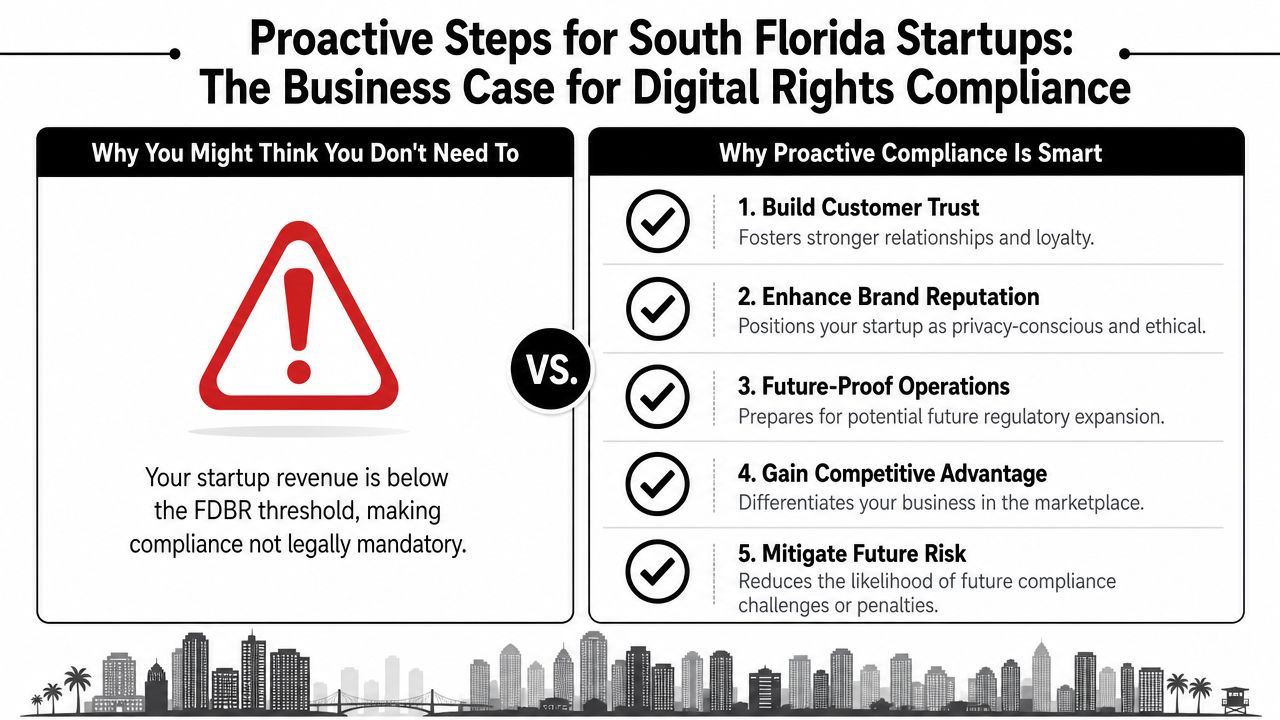
Many South Florida startups are outside the FDBR's direct scope because the law targets a narrow group of very large businesses, as noted earlier. That does not make privacy a Big Tech issue. It makes privacy a readiness issue. Buyers ask about it. Investors notice it during diligence. Regulators and plaintiffs' lawyers care whether your practices match your promises.
Why early privacy work gives startups an edge
Founders often treat privacy as a project to postpone until the company is larger. In practice, early discipline is cheaper and more useful when the product, team, and vendor stack are still manageable.
A startup that knows what data it collects, why it keeps it, and who can access it is easier to sell, easier to diligence, and easier to clean up after a product change. The trade-off is real. Teams spend some time documenting systems and tightening workflows now, instead of paying outside counsel, engineers, and leadership to fix avoidable problems later.
There is also a market advantage here. South Florida startups that can answer privacy questions clearly stand out against competitors that still rely on copied policies and vague internal habits.
Five practical steps to take now
Match your policy to your actual operations
A polished privacy policy is not useful if it describes a business you do not run. List the categories of data you collect, the reasons you use them, and the service providers that touch them. If your stack includes payment processors, analytics tools, CRM software, or marketing platforms, describe those functions accurately.Set up one clear path for privacy requests
Use a dedicated inbox, support form, or ticket category. Then decide who reviews requests, how identity gets verified, and how your team tracks deadlines. A simple process that gets used is better than a complicated one that no one follows.Cut data collection that lacks a business reason
Signup forms, demo requests, and onboarding flows often collect extra fields because nobody revisited the form after launch. Review each field and ask what decision it supports. If the team cannot answer that question, remove it.Reduce stored data before it becomes a problem
Old spreadsheets, exported contact lists, duplicate files, and dormant accounts create risk with little business value. Set retention rules for leads, applicants, users, and internal files. Then enforce them.Run a short privacy review every quarter
New vendors get added quickly in startup environments. So do new features, integrations, and ad tools. A quarterly review should confirm what changed, whether notices still match reality, and whether internal access is still appropriate. For a practical starting point on internal controls, review these data security best practices for Florida businesses.
A startup does not need a large legal budget to do this well. It needs an owner, a short checklist, and a willingness to fix mismatches early.
Practical point: Privacy work done before a customer complaint, diligence request, or security incident is cheaper, faster, and far more useful.
Drafting Your Initial Compliance Policies
A startup's first privacy documents don't need to be ornate. They need to be accurate, usable, and aligned with the way the business operates.
Under the FDBR, consumers have rights to access, correct, delete, and obtain portable copies of their data, privacy notices must be updated at least annually, and contractual waivers of those rights are void and unenforceable, according to the CCIA summary of the Florida Digital Bill of Rights.

What your privacy policy should say
A strong initial policy usually covers these points in plain language:
What you collect
Account details, payment-related information, site usage data, communications, and any other category that applies.Why you collect it
Order fulfillment, customer support, fraud prevention, analytics, marketing, platform maintenance.Who receives it
Payment processors, cloud hosting providers, analytics vendors, email tools, service providers.How users can contact you
Give a real method that your team monitors.What choices users have
Even if you voluntarily offer access, correction, or deletion rights, state the process clearly.
Model language that works better
Founders often overcomplicate policy drafting. Clear beats impressive.
Try language like this:
We collect personal information that is reasonably necessary to provide our services, process transactions, communicate with users, maintain account security, and improve site performance.
Or this:
If you would like to request access to, correction of, or deletion of your personal information, contact us using the method listed below. We may need to verify the request before acting on it.
Those examples are simple on purpose. They tell the user what matters without pretending your startup has an enterprise compliance team.
Terms, contracts, and internal policy alignment
Your privacy policy can't do all the work. Founders should also review:
| Document | What to check |
|---|---|
| Terms of service | Don't include language that conflicts with user privacy rights you intend to honor |
| Client contracts | Make sure service descriptions match actual data handling practices |
| Vendor agreements | Confirm what providers do with the data you share |
| Internal SOPs | Give staff a basic process for access, correction, and deletion requests |
Tip: don't promise “we never share data” if you use ordinary service providers to run the business. Promise precision, not absolutes.
For website-facing language, this privacy policy requirements guide for websites is a solid drafting reference. Then have counsel review the final version before publishing. Privacy documents fail most often when they are borrowed, not built.
Frequently Asked Questions About Florida's Digital Rights
Founders usually don't need more theory at this stage. They need direct answers.
Does my small Miami ecommerce business have to comply with the FDBR
Usually, no. Most small and midsize businesses won't fall inside the law's narrow controller definition. But customers, partners, and vendors may still expect privacy practices that resemble the FDBR standard. That's why it makes sense to adopt the parts that are operationally useful now.
What is the single most important privacy practice to implement today
Create a current data inventory.
If you don't know what you collect, where it sits, who can access it, and which vendors touch it, every other privacy step becomes guesswork. Start with your website forms, CRM, billing platform, help desk, cloud storage, email marketing tool, analytics stack, and team devices.
How is the FDBR different from the GDPR
At a practical level, the FDBR is narrower in who it directly covers. GDPR reaches a much broader set of businesses and is usually more demanding across the full lifecycle of data processing. For a Florida startup, the useful lesson isn't to compare statutes line by line. It's to notice that privacy expectations tend to spread outward from larger laws into contracts, procurement, and customer demands.
What should I do if a customer asks me to delete their data and I'm not legally required to honor the request
Don't dismiss it casually.
First, verify the identity of the requester. Then check what you hold, what must be retained for accounting, fraud prevention, tax, or operational reasons, and what can reasonably be deleted. Respond clearly and document what you did. Even when the law doesn't force the outcome, a disciplined response builds trust and reduces confusion later.
Should I add an FAQ page about privacy
Yes, if your site collects user information in any meaningful way.
A short, well-written FAQ can reduce support friction and make your privacy posture easier for users to understand. If you want that page to work for both visitors and AI-driven search experiences, Dokly's piece on optimizing website FAQs for AI offers practical formatting guidance.
What is a good first step for a founder with limited time
Set aside one working session and answer these questions:
- Which tools hold customer data
- Which team members can access it
- Which vendors receive it
- Which data fields are optional
- How a user would request deletion or correction today
If you can answer all five cleanly, you're ahead of many businesses. If you can't, that's your to-do list.
Final tip: don't wait for a complaint, a deal desk questionnaire, or a platform issue to force this work. Privacy is much cheaper when handled calmly and much more expensive when handled reactively.
If your South Florida business needs practical help translating privacy rules into contracts, policies, and operational steps, Coto & Waddington, Attorneys at Law advises founders and growing companies with business-first, modern counsel. A focused legal review now can help you tighten your privacy policy, align vendor relationships, and build a cleaner compliance foundation before privacy questions turn into business problems.