If you're a founder in Miami, Fort Lauderdale, or anywhere else in South Florida, you've probably heard the same advice from a friend, accountant, investor, or online formation service: form your LLC in Delaware.
Sometimes that advice is right. Often, it isn't.
The problem is that most Delaware content treats every business like a venture-backed startup with a national footprint. That isn't how most founders operate. A local agency in Brickell, an e-commerce brand run from Fort Lauderdale, a family-owned logistics company in Doral, and a software startup raising outside capital are not making the same entity decision. They shouldn't get the same answer.
Delaware does offer real advantages. Some are powerful. But Florida founders also face costs, duplicate filings, privacy changes under federal law, and practical headaches that generic guides skip. The right move depends on where you operate, how you plan to raise money, and how much complexity you're willing to carry.
Table of Contents
- Why Every Founder Hears About Forming in Delaware
- The Core Delaware LLC Formation Benefits Explained
- Delawares Premier Legal Shield Understanding Charging Order Protection
- The Hidden Costs for Florida Founders The Foreign Qualification Trap
- Delaware vs Florida A Head to Head Comparison for Your Startup
- A Decision Framework When to Choose Delaware vs Florida
- Your Next Steps Protecting Your Florida Based Venture
Why Every Founder Hears About Forming in Delaware
Delaware has become the default answer in startup circles because it signals sophistication. Founders hear that investors like it, lawyers know it, and the rules are business-friendly. For some companies, that's absolutely true.
A South Florida founder usually hears this advice early. It might come up when you're opening a Mercury account, reviewing Stripe Atlas-style setup options, or talking with someone who's been through a fundraising process before. The pitch sounds simple: if serious companies use Delaware, you should too.
That logic breaks down fast when the business is based in Florida.
If your team works here, your clients are here, your warehouse is here, or your daily operations happen here, forming in Delaware can create a second layer of compliance without giving you a matching operational benefit. For a lot of founders, the question isn't whether Delaware is good. It's whether Delaware is good for this business right now.
Most formation mistakes happen when founders copy a structure that fit someone else's company, cap table, and growth plan.
The strongest Delaware LLC formation benefits tend to matter most when the company expects advanced financing, multi-state activity, or a legal structure designed for scale from day one. If that's your path, Delaware deserves a hard look.
If you're building a Florida-first business, simplicity can be the better legal strategy.
A practical rule for South Florida founders is to start with three questions:
- Where do you operate: If the business lives in Florida, that matters more than startup folklore.
- Who will fund you: Institutional investors often care about legal standardization. Friends-and-family or self-funded businesses usually don't.
- How much admin can you tolerate: Two states means more moving parts, more deadlines, and more chances to miss something.
That's the frame that matters. Not hype, not prestige, and not boilerplate advice from a national formation site.
The Core Delaware LLC Formation Benefits Explained
A South Florida founder usually hears the Delaware pitch early. A co-founder read it on a startup forum. A national formation service pushes it. An investor-side lawyer says it is the standard setup. That advice is not wrong, but it is often incomplete for a company that will operate mainly in Florida.
Delaware keeps coming up because it offers a legal system and LLC statute that many startup lawyers, investors, and counterparties already know well. The Court of Chancery focuses on business disputes, and Delaware has a long record of written decisions that lawyers can use when drafting operating agreements or assessing risk. The Delaware Division of Corporations also highlights the state's business entity framework and filing system on its official LLC information page.
This visual captures the appeal at a glance:
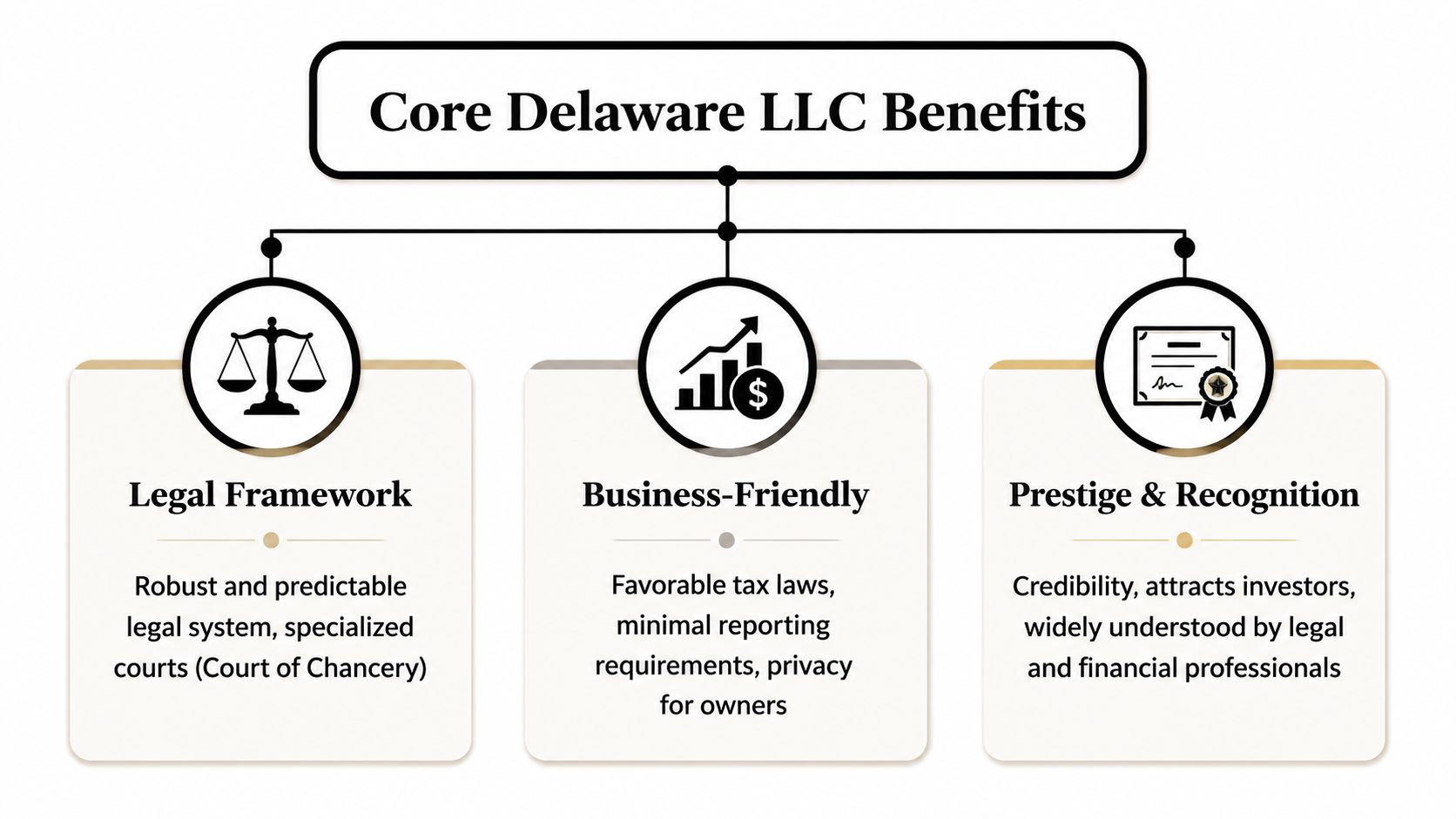
The practical LLC benefits founders care about
The first benefit is limited liability. In a properly formed and properly run LLC, the company is a separate legal entity, so members are generally not on the hook for business debts just because they own the company. Delaware's LLC statute sets that baseline, including the rule that a member or manager is not liable for LLC obligations solely by reason of being a member or manager, as stated in the Delaware Limited Liability Company Act.
That protection has limits, and founders miss this point all the time. Personal guarantees, sloppy bookkeeping, undercapitalization, and treating the company bank account like a personal wallet can still create problems. Forming in Delaware helps, but it does not clean up bad company hygiene.
Delaware also gives lawyers wide room to customize the operating agreement. That matters when there are unequal capital contributions, profits interests, complex vesting terms, manager-controlled decision rights, deadlock provisions, or transfer restrictions. For a single-member consulting business, that flexibility may not matter much. For a startup with several founders and changing economics, it can matter a lot.
Privacy is another reason some founders look at Delaware. The certificate of formation does not require the names of members or managers to appear in the public filing. That said, founders should be careful not to overstate this benefit. Banks, registered agents, tax authorities, and beneficial ownership reporting rules can still require disclosure to the right parties, so Delaware privacy is narrower than many formation sites suggest.
Tax treatment is often oversold. A key advantage is usually not some special Delaware tax break. Most LLCs are taxed as pass-through entities by default under federal tax rules, wherever they are formed, unless they elect corporate treatment. Delaware may not impose state income tax on income earned outside Delaware, but a Florida-based business still has to deal with the states where it is actually operating. The Internal Revenue Service explains the default federal classification rules for LLCs on its page about limited liability companies.
There are also compliance features founders like. Delaware has a predictable annual franchise tax for LLCs and does not require an annual report for the LLC itself. The filing process is straightforward, and the state is fast. For founders closing a deal on a deadline, speed and predictability have real value.
The practical takeaway is simple. Delaware's core benefits are legal predictability, contract flexibility, filing privacy at the state level, and a structure that many startup professionals already know how to handle. Those are real advantages. They are strongest when the company expects outside capital, multi-owner complexity, or a higher chance of disputes where clear legal precedent matters.
For a Florida-first business, those benefits need to be weighed against the extra filings and costs that come with operating in two states. That is where the Delaware pitch often gets much less attractive.
Delawares Premier Legal Shield Understanding Charging Order Protection
A founder in Miami forms a Delaware LLC with a co-founder, parks the software code and customer contracts inside the company, then gets dragged into a personal lawsuit after a failed real estate deal. The question is not whether Delaware sounds prestigious. The question is whether that personal creditor can interfere with the business.
What a charging order does
One reason lawyers still take Delaware LLCs seriously is the state's charging order framework. Under Delaware law, a judgment creditor of an LLC member is generally limited to a charging order against that member's LLC interest. Delaware's LLC Act addresses this remedy in 6 Del. C. § 18-703.
In plain English, the creditor may have a right to distributions that would otherwise go to the member. The creditor does not become a manager. The creditor does not vote. The creditor does not get direct control over company property just because one owner has a personal problem.
That matters most in closely held companies, where disruption can be more damaging than the underlying claim.
Why this can matter for South Florida founders
For a business that holds valuable IP, recurring contracts, or a sensitive client list, preserving control is often the primary objective. A personal creditor fight involving one member should not give creditors an advantage over the whole company. Delaware's framework is designed to reduce that risk.
I see the appeal for multi-member ventures with real value tied up in intangible assets. If the company owns software, trademarks, deal rights, or a proprietary process, keeping a creditor at the distribution level instead of the control level can prevent a messy secondary dispute among founders.
That said, founders should not oversell this point. Charging order protection is not a force field. The operating agreement still matters. The member's conduct still matters. Single-member LLCs can present harder facts in some jurisdictions, and the practical result often depends on how the company is run and documented.
A better way to analyze it is this:
- A creditor with only a charging order is in a weaker position than a creditor who can reach management rights.
- A well-drafted operating agreement strengthens the liability shield around internal governance.
- The benefit is strongest when the LLC has multiple members and meaningful assets worth protecting.
Florida founders should also ask a separate question before treating this as a Delaware-only advantage. If the company is operating from Florida, the formation choice needs to be weighed against Florida registration and compliance consequences, especially for owners who will still need Florida foreign LLC registration for an out-of-state entity doing business here.
This issue also intersects with people and process risk. Founders who are tightening internal controls should review this HR compliance guide for founders alongside their entity planning.
The practical takeaway is narrow but important. Delaware offers a real creditor-remedy advantage for some multi-owner businesses. For many South Florida companies, though, that advantage is not enough by itself to justify forming in Delaware if the business, the team, and the day-to-day operations all live in Florida.
The Hidden Costs for Florida Founders The Foreign Qualification Trap
What foreign qualification means in real life
For many Florida founders, the biggest mistake isn't misunderstanding Delaware's benefits. It's ignoring what happens after the Delaware filing goes through.
If you form in Delaware but conduct business in Florida, you will usually need to register the Delaware LLC as a foreign entity in Florida. That process is commonly called foreign qualification. For single-state operators, this is the hidden cost most formation marketing glosses over.
The core problem is simple. Forming in Delaware can mean doubling filing fees and annual taxes, while also creating more compliance work for a business that only really lives in one state, as discussed in this analysis of whether you should form your LLC in Delaware.
This infographic shows the sequence clearly:
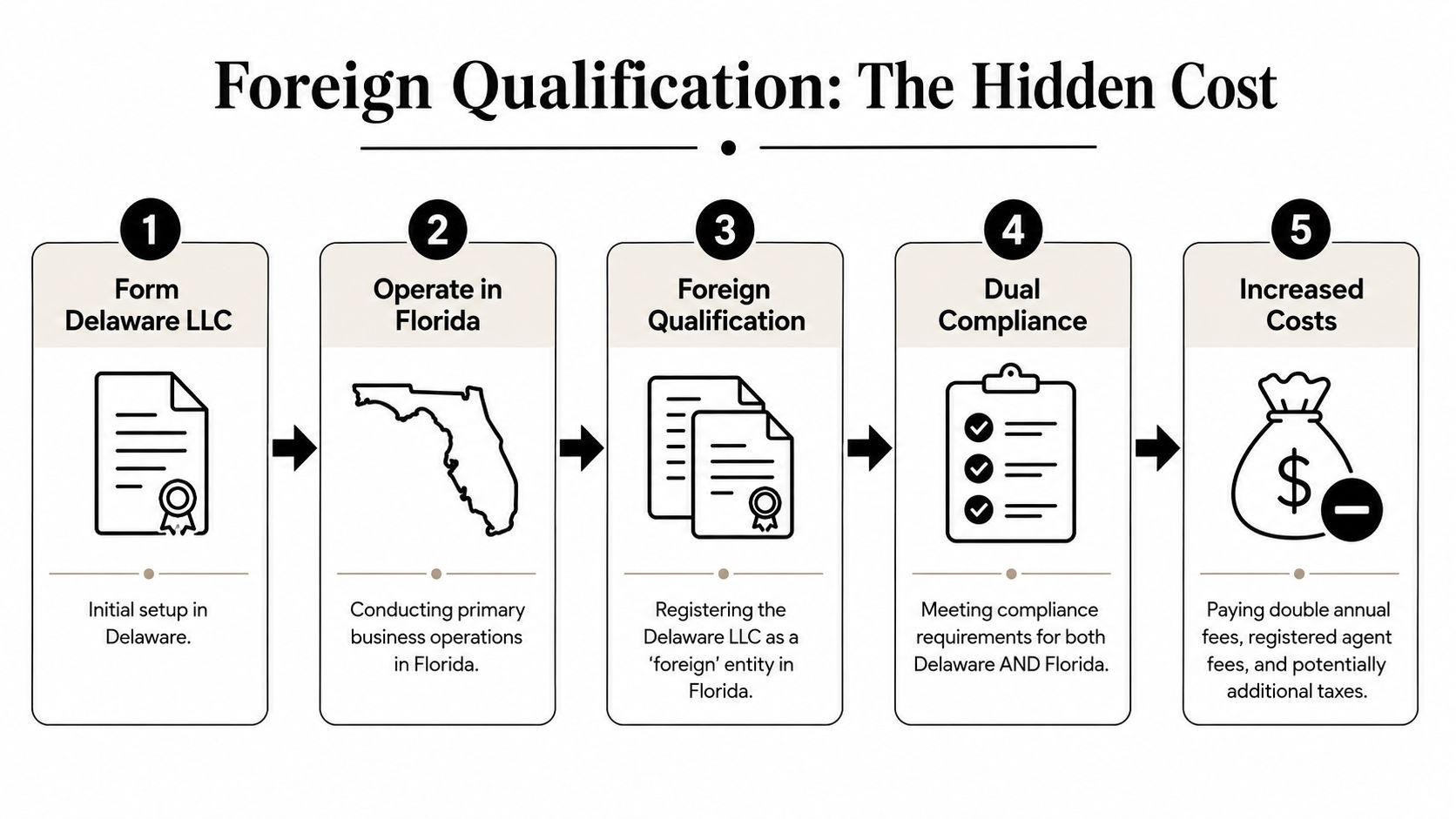
Where Florida founders get burned
The trap usually shows up in ordinary businesses. A Miami marketing agency forms in Delaware because it sounds more professional. Then it has to register in Florida anyway. It may need a registered agent in Delaware, state compliance in two places, and internal records that match across both jurisdictions.
That isn't just a legal filing issue. It spills into banking, payroll, insurance, vendor onboarding, and HR administration. If you're hiring, a practical companion resource is this HR compliance guide for founders, because entity mistakes often surface later when teams start layering on payroll and people operations.
Florida registration itself also needs to be handled correctly. If you're already operating here with a non-Florida entity, review the filing requirements for Florida foreign LLC registration before assuming your Delaware filing is enough.
A few tips can save founders real frustration:
- Check your operational footprint early: If your office, employees, inventory, or active management are in Florida, ask whether you will need foreign qualification before filing anything.
- Budget for dual compliance: Delaware may be simple on paper, but the combined Delaware-plus-Florida burden is what matters.
- Don't let branding drive legal structure: "Delaware sounds more startup" is not a legal strategy.
- Match the entity to the business model: A local services company usually values simplicity more than Delaware prestige.
For many Florida-based companies, the cleanest path is still forming where the business operates.
Delaware vs Florida A Head to Head Comparison for Your Startup
A Miami founder forms a Delaware LLC on Friday because it sounds investor-friendly. By Monday, the company is signing a Florida lease, hiring a Florida employee, and opening a Florida bank account. At that point, the comparison is no longer prestige. It is cost, privacy, liability protection, and how much extra administration the structure creates once the business is operating here.
Privacy is a good example. Delaware still offers less public disclosure at the state filing level than many founders expect from Florida. But the old sales pitch that Delaware gives broad anonymity is weaker than it used to be. Federal beneficial ownership reporting changed that analysis for many small companies, so founders should evaluate privacy based on the full compliance picture, not the formation filing alone.
For a broader corporate-structure discussion, see this guide to Delaware incorporation benefits.
Here is the comparison that matters for a Florida-based startup:
| Feature | Delaware LLC | Florida LLC |
|---|---|---|
| Initial filing cost | Lower filing fee on paper, but the headline number can mislead if the company will also need Florida registration | Single-state formation usually keeps setup simpler for a Florida-first business |
| Annual state-level recurring requirement | Delaware imposes an annual franchise tax on LLCs, and Florida operations may still trigger separate Florida compliance obligations | Florida requires its own annual maintenance filings, but the founder usually manages one home-state system instead of two |
| Privacy at state filing level | Delaware generally does not require member or manager names in the certificate of formation | Florida filings are less private at the state level |
| Privacy after federal reporting | Federal beneficial ownership rules reduce the practical advantage of state-level anonymity for many small LLCs | The same federal reporting rules apply here too |
| Tax treatment | Often favorable for companies not operating in Delaware, but that benefit is less meaningful when the business is earning revenue and operating in Florida | Usually more straightforward for a business with Florida operations, Florida owners, and Florida tax contacts |
| Asset protection posture | Delaware is often favored for charging order protection and internal governance flexibility | Florida can still be a strong choice, but the analysis depends on ownership structure and risk profile |
| Administrative burden for a Florida-based business | Higher if the company is managed, staffed, or doing business in Florida because compliance often ends up split across two states | Lower for many local startups because formation, reporting, and state records stay in one place |
| Best fit | Multi-state companies, businesses expecting sophisticated investors, and founders who need Delaware-specific governing flexibility | South Florida service businesses, local operators, and founders who want fewer filings and fewer chances for compliance mistakes |
The practical point is simple. Delaware can be the right call, but it is not the automatic winner.
For many South Florida founders, a Florida LLC is the better business decision because it reduces duplicate filings, lowers the odds of missed compliance, and matches where the company is operating. Delaware tends to make more sense when the company has a real financing reason, a multi-state footprint, or a governance issue that Delaware law handles better.
A Decision Framework When to Choose Delaware vs Florida
A good entity decision starts with the business you are building, not the business you might someday describe in a pitch deck.
This framework helps.
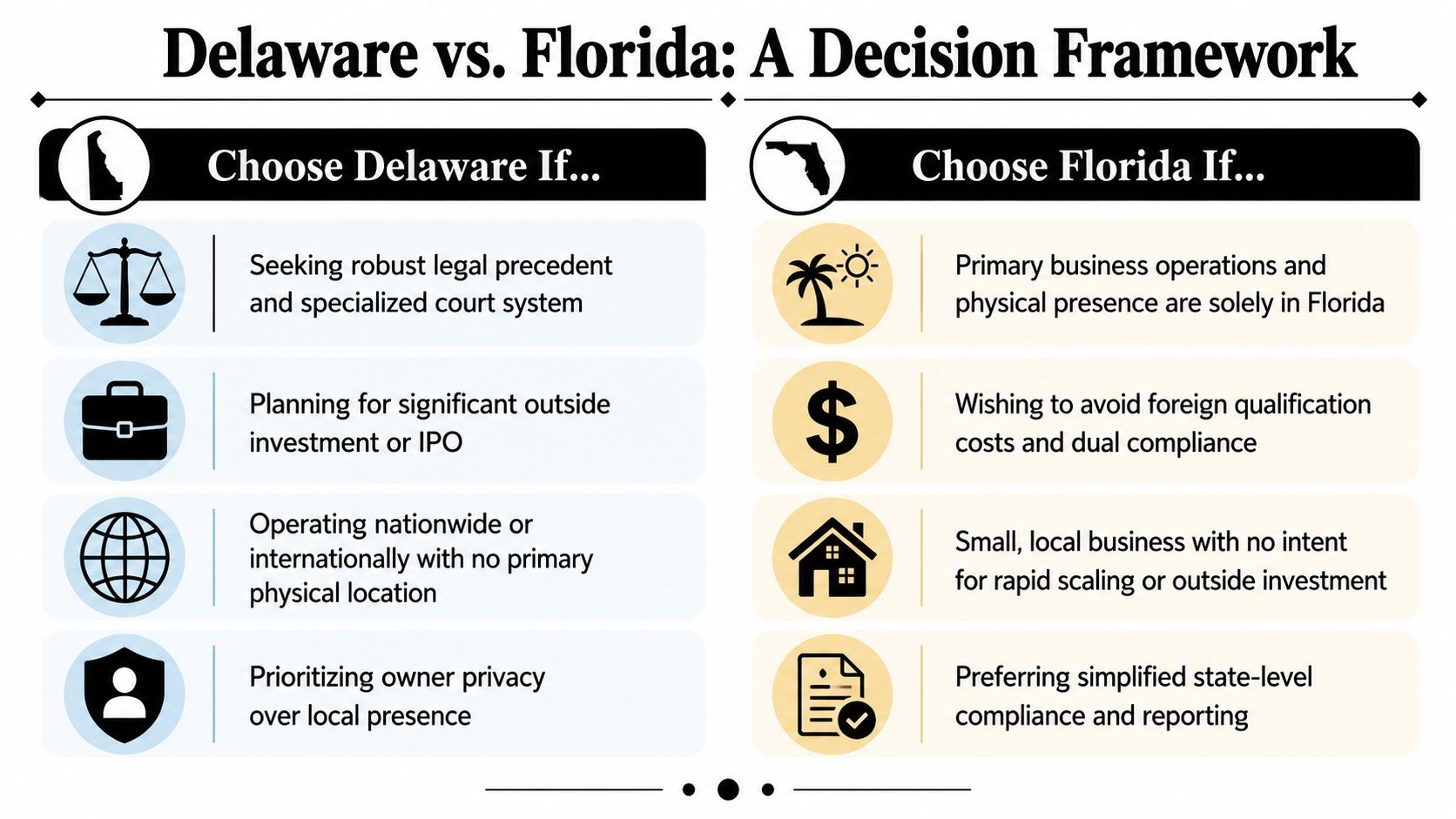
Choose Delaware in these scenarios
Delaware usually makes more sense when legal flexibility and future financing matter more than simplicity.
- You expect outside investment: If institutional investors or venture funds are likely to review your structure, Delaware familiarity can reduce friction.
- You operate across multiple states: A business without a single-state center of gravity often gets more value from Delaware's legal architecture.
- You hold valuable investment assets: Delaware LLCs are exempt from state income tax if the company doesn't operate within Delaware, the state imposes zero sales tax on in-state purchases regardless of physical location, and Delaware excludes gains from fixed-income or equity investments from taxation, according to this summary of Delaware LLC tax advantages and disadvantages.
- You need customized internal economics: Delaware is often attractive when the operating agreement needs highly specific allocation, governance, or exit terms.
Choose Florida in these scenarios
Florida is often the smarter answer for founders who want a lean structure that matches real operations.
- Your business is physically in South Florida: If the company is run from Miami-Dade, Broward, or Palm Beach, local formation often tracks operational reality better.
- You're self-funding or raising from your network: If there is no near-term institutional financing event, Delaware's premium legal features may never become operationally relevant.
- You want fewer compliance points: One state is easier to manage than two.
- You run a service, retail, family, or local trade business: In these businesses, legal simplicity often beats theoretical prestige.
A founder should earn complexity. If the business doesn't need a two-state structure yet, don't create one by habit.
Practical tips before you file
Before making the call, run through this short checklist:
- Map where revenue is produced: Not just where the LLC is filed, but where people work, contracts are performed, and customers are served.
- Ask what the next financing really looks like: A likely VC round is different from "maybe someday."
- Draft the operating agreement for the actual risks: Ownership disputes, vesting, deadlock, distributions, and exit rights matter more than the filing certificate.
- Review privacy expectations realistically: State-level privacy and federal disclosure are no longer the same conversation.
- Plan compliance before launch: Calendar filing dates, registered agent responsibilities, and BOI obligations from the start.
The best Delaware LLC formation benefits are real. They just aren't universal. For many Florida founders, a Florida LLC is not the lesser choice. It's the more disciplined one.
Your Next Steps Protecting Your Florida Based Venture
The entity decision should support the business, not complicate it.
For some founders, Delaware is the right call because the legal framework, investor expectations, or asset profile justify the extra structure. For many Florida-based businesses, though, forming in Florida is cleaner, cheaper to manage, and better aligned with how the company will operate.
That is especially true when the business is local, closely held, family-run, service-based, or self-funded. In those cases, the common online advice to "just form in Delaware" can create avoidable costs and duplicate compliance from day one.
A screenshot of the firm's business-law resources is below:

What to do before filing anything
Use a simple sequence.
- Confirm the operating state: Where the company does business usually drives the first legal answer.
- Choose the entity with your next stage in mind: A structure that works for today's launch and tomorrow's financing is better than one built for internet prestige.
- Don't treat the operating agreement as an afterthought: If you need a refresher, this guide on what an LLC operating agreement is is a useful place to start.
- Get legal advice before filing: Always consult with a qualified attorney before forming an LLC to ensure your specific business structure aligns with state laws and tax obligations.
The costly mistakes usually aren't dramatic. They're small decisions made too early, without enough context. Founders file in the wrong state, skip foreign qualification, misunderstand privacy, or use a generic operating agreement that doesn't fit the owners.
A short legal review at formation is far cheaper than fixing a broken structure after contracts are signed, partners fall out, or a lender starts diligence.
If you're deciding between Delaware and Florida, get advice specific to your actual business, not a generic checklist. Coto & Waddington, Attorneys at Law can help you choose the right formation strategy, protect your assets, and streamline compliance for a Florida or Delaware LLC.