A Miami founder posts a polished Reel on Friday afternoon, adds a trending song, and watches the metrics move. By Monday morning, the post is muted, the audio is gone, and the team is scrambling to figure out whether the problem was the clip length, the account type, or the fact that the song was never cleared for business use. That's the core issue with copyright music on Instagram. It usually feels like a creative decision until it turns into an account operations issue.
For startups, creators, and local brands, this isn't about being overly cautious. A recorded song contains two separate copyrights, and using music lawfully usually means clearing both the composition and the sound recording unless Instagram's own licensing covers the exact use. Business accounts sit in the tightest lane, personal and creator access is broader but still not a blanket pass for commercial activity, and repeated violations can lead to muting, removal, or even account restrictions. The point is simple. Music is part of the content stack, but it's also part of the risk stack.
Table of Contents
- When a Trending Sound Costs a Startup Its Reach
- How Music Copyright Actually Works
- Personal vs Business vs Creator Account Rules
- Practical Ways to Stay Compliant
- Common Shortcuts That Still Get You Flagged
- What to Do When Instagram Removes or Mutes a Post
- A South Florida Founder's Working Framework
- Quick Answers and Next Steps
When a Trending Sound Costs a Startup Its Reach
A Miami founder launches a product reel on a Friday night. The edit is sharp, the caption is tight, and the trending audio fits the brand perfectly. The post gets early traction, then the audio disappears and a copyright notice shows up before the weekend is over.
That outcome isn't bad luck. It's the normal result of using copyrighted music on Instagram for commercial content without the right permissions. Instagram's music deals allow some popular songs for personal, non-commercial posts, but those rights don't automatically extend to business posts, ads, or sponsored content. Once the post is meant to sell, promote, or boost a brand, the legal posture changes fast.
Why the risk keeps showing up
Most founders think the problem is length. They assume a short clip is safer, or that a song inside the app must be cleared for any use. That's the wrong frame. The issue is not just how much of the song you used, it's whether the use was authorized for that specific purpose.
Practical rule: if the Reel is supporting a business objective, treat the music like any other licensed asset, not like a sticker or a filter.
Instagram's own enforcement can be mechanical. Platforms commonly mute or remove posts that match copyrighted audio, and repeated violations can lead to account suspension or removal. For a startup, that means a music mistake can interrupt campaign momentum, ad sequencing, and even the consistency of a content calendar. The better question isn't “Can I get away with this clip?” It's “What happens if the post gets flagged after it starts working?”
There's also a timing issue. Songs can stay protected for decades, long after they feel culturally familiar. Under U.S. copyright rules, that means most commercially useful tracks are still owned by somebody, even if the song is old enough to feel like background noise in modern social feeds. That's why teams need a system, not just a vibe check.
How Music Copyright Actually Works
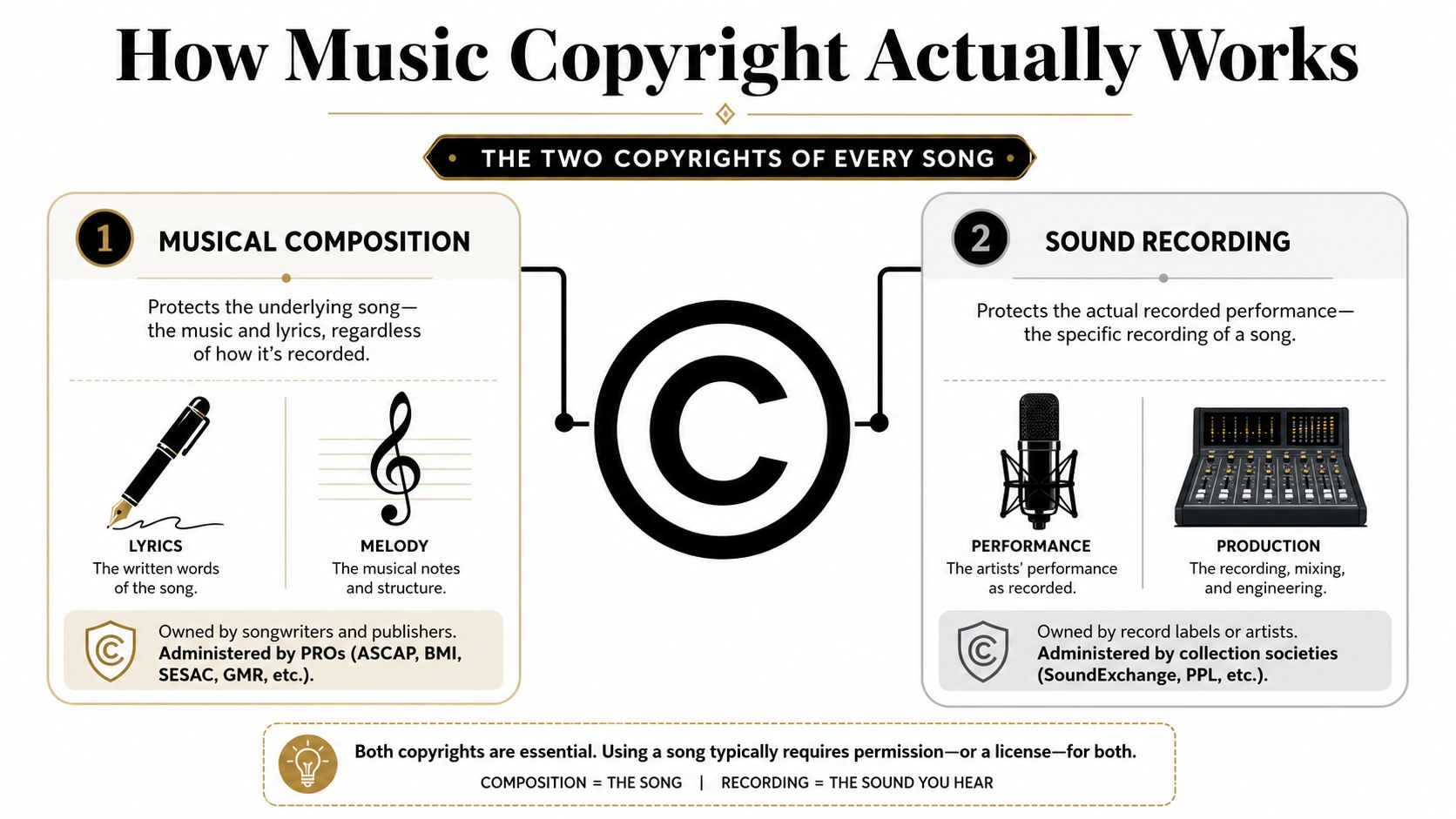
Think of a song like a coffee shop with two owners. One owns the recipe and the menu, that's the musical composition. The other owns the specific drink the barista pours, that's the sound recording. If you want to use the song in a Reel, you usually need permission for both parts.
The two rights you need to keep straight
The composition covers the melody and lyrics. The sound recording covers the exact recorded performance people hear on Spotify, Apple Music, or Instagram. Those are separate rights, and they're often held by different people. That's why “I gave credit” doesn't solve the problem, and why “it's only a few seconds” is not a legal shortcut.
When a brand wants to pair a commercial song with video, the usual permissions are a synchronization license for the composition and a master use license for the recording. If both aren't covered, the post can still be muted or taken down even if the clip is short. The short-clip myth survives because people think social platforms are built around informal reuse. They're not.
For a plain-English refresher on how royalties work in the music industry, the internal overview at what are royalties in the music industry helps explain why different people get paid for different layers of a track. That's the legal architecture behind the Instagram headache.
If you're trying to boost Reels with the right sounds, a practical discovery tool like boost Reels with right sounds can help you identify trends, but discovery is not clearance. A sound being popular doesn't mean it's licensed for your use. It just means the song is easy to find, and easy to misuse.
Personal vs Business vs Creator Account Rules
Instagram account type matters more than many teams realize. A personal account and a creator account usually get broader in-app access to trending and popular music for organic posts. A business account usually gets the narrower route, which is why teams often end up relying on Meta's Sound Collection or separately licensed audio.
| Music Access by Instagram Account Type | In-App Music Library | Trending Sounds | Ads and Boosted Posts | Sponsored Partnerships |
|---|---|---|---|---|
| Personal Account | Broad for organic, non-commercial posts | Often available for casual content | Not a safe assumption for paid use | Separate permissions still matter |
| Creator Account | Broad for organic, non-commercial posts | Often available for organic posts | Commercial use still needs caution | Broad access is not a blanket license |
| Business Account | Typically limited to Meta Sound Collection or licensed music | Usually constrained | Higher risk if music is not separately cleared | Sponsored work needs permission or licensing |
The trap is thinking creator access solves commercial risk. It doesn't. If a post is paid, boosted, cross-promoted, or tied to a sponsorship, the fact that the account is labeled “creator” doesn't magically convert the audio into cleared business use. That's where many startup teams get burned, because the workflow changes but the music policy doesn't.
For a deeper look at the ownership side, the browse the beat ownership guide is useful context when you're trying to understand why one account can use a track while another can't. The important takeaway is that access inside the app is not the same thing as a commercial license.
A useful internal test is this, if the post would still matter after someone pays to amplify it, don't assume the in-app library is enough.
If you're deciding where to publish, choose the account based on the intended use case. A personal handle may give you more music flexibility for organic content. A business page gives you cleaner brand separation, but less music latitude. A creator profile sits in the middle, yet it still doesn't replace separate permissions for ads or sponsored content.
Practical Ways to Stay Compliant
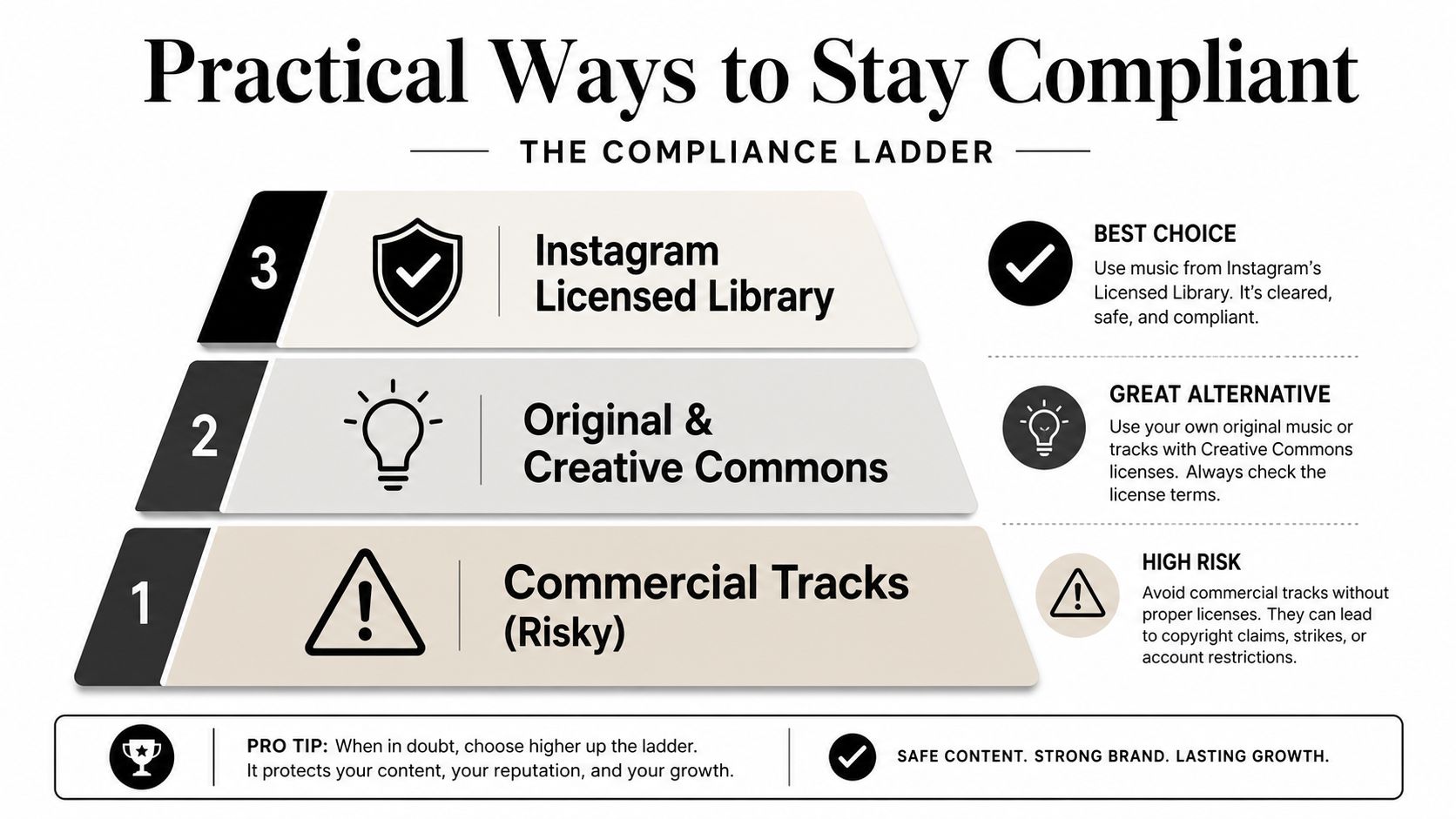
The safest path is to build music use the way you build legal docs, from the top down. Start with what's already cleared, then move to licensed options, then to custom music, and only after that consider a specific commercial song. That order keeps your content calendar moving without turning every post into a rights-clearance project.
The compliance ladder that actually works
Instagram licensed music and Meta Sound Collection are the first stop for everyday organic posts. They're the simplest answer when the content is promotional but not paid media, and they reduce the odds of a mute or takedown. They're not perfect, but they're the closest thing to an operational default.
A strong next layer is a royalty-free catalog from reputable libraries that explicitly cover social media and commercial use. That works well for recurring brand content, local service businesses, and teams that post frequently. It's easier to standardize, easier to brief contractors on, and easier to audit later.
Commissioned original music is the cleanest brand move when a company wants a recognizable sonic identity. You control the asset, the usage scope, and the risk profile, especially if the composer agreement and ownership paperwork are tight. An internal work-for-hire or ownership agreement matters here, and the template at work for hire agreement template is the kind of document families of founders should keep in the file cabinet, not in the “we'll fix it later” drawer.
If a specific song is essential, then the path is a synchronization license from the publisher and a master use license from the label. That's the expensive, deliberate route, but it's the right one when the music is central to the campaign. For a brand launching a signature product, that can be worth it.
If you're mapping promotion strategy, the guide to Instagram music promotion is helpful for thinking about how music and visibility work together without assuming every sound is free to use. The practical point is to match the music choice to the business purpose, not the trend cycle.
Best practice: use the cheapest cleared option that still fits the campaign. Save custom licensing for the moments when the song itself is part of the value proposition.
Common Shortcuts That Still Get You Flagged
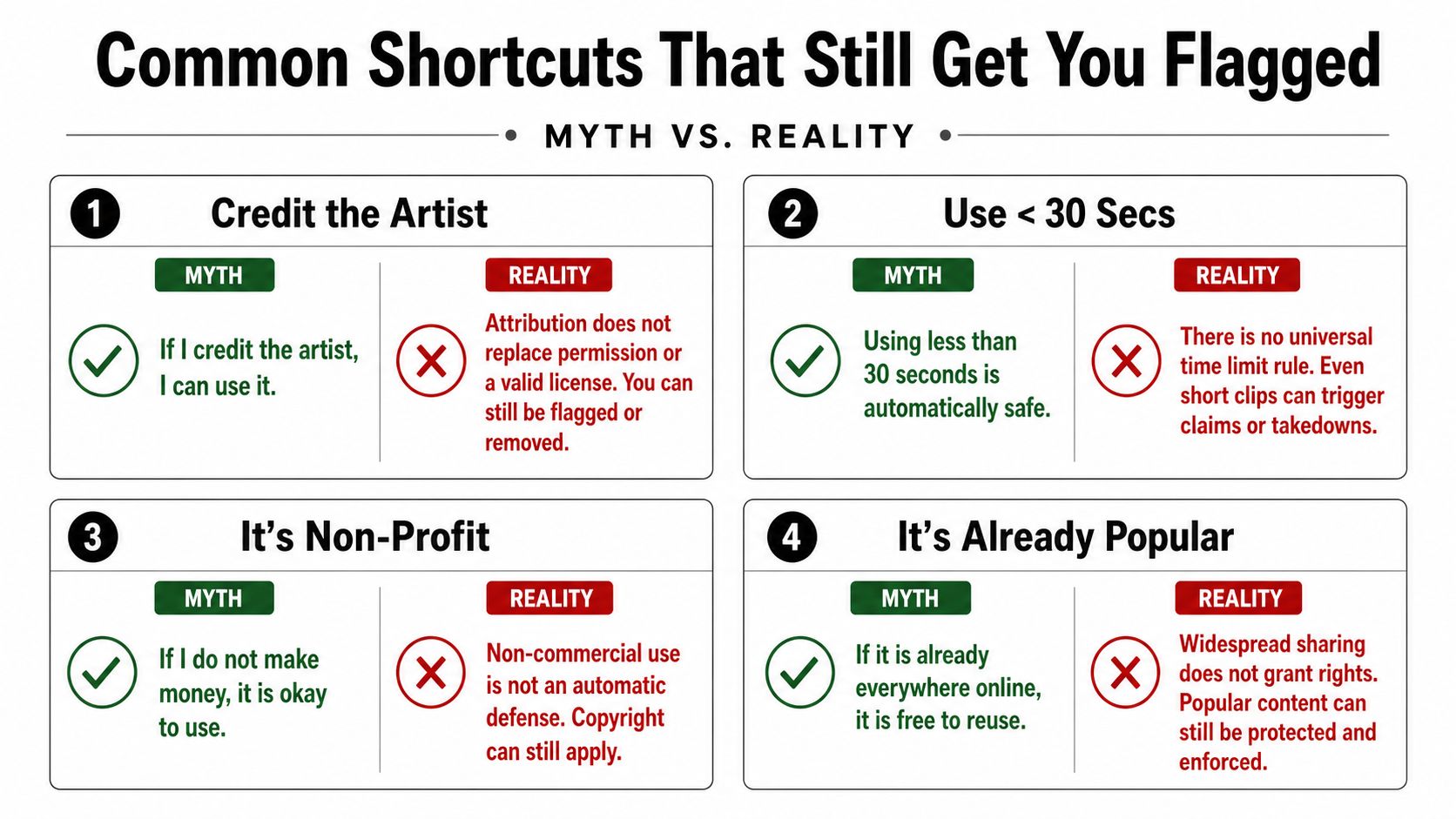
The same four shortcuts show up in almost every takedown dispute. They feel harmless on the front end and expensive on the back end. None of them creates a real license.
The myths founders rely on
Crediting the artist doesn't grant permission. It's courteous, and sometimes helpful for attribution norms, but it does not replace a license or a valid exception.
Using only a few seconds doesn't make the clip safe. Copyright infringement doesn't vanish because the snippet is short, and Instagram's enforcement tools don't need the whole song to recognize a match.
Adding a visual layer doesn't turn infringement into fair use. A branded caption, product shot, or kinetic text overlay doesn't solve the underlying rights issue when the song itself is unlicensed.
If it's already in the app, it must be fine is the most dangerous one for businesses. The platform may have negotiated limited rights for certain uses, but that doesn't automatically cover commercial posts, ads, or reposted content on behalf of a brand.
The practical fix is not to argue with the algorithm after the fact. It's to assume that anything supporting sales, sponsorship, or paid distribution needs its own review. That's especially true if a contractor, influencer, or agency is touching the edit.
If a team keeps posting with the same shortcuts, enforcement stops being an isolated event and starts looking like a pattern. That's when account-level restrictions become a real operational concern, not just a nuisance. At that point, the question isn't whether the brand likes the song. The question is whether the brand can afford to keep using it.
What to Do When Instagram Removes or Mutes a Post
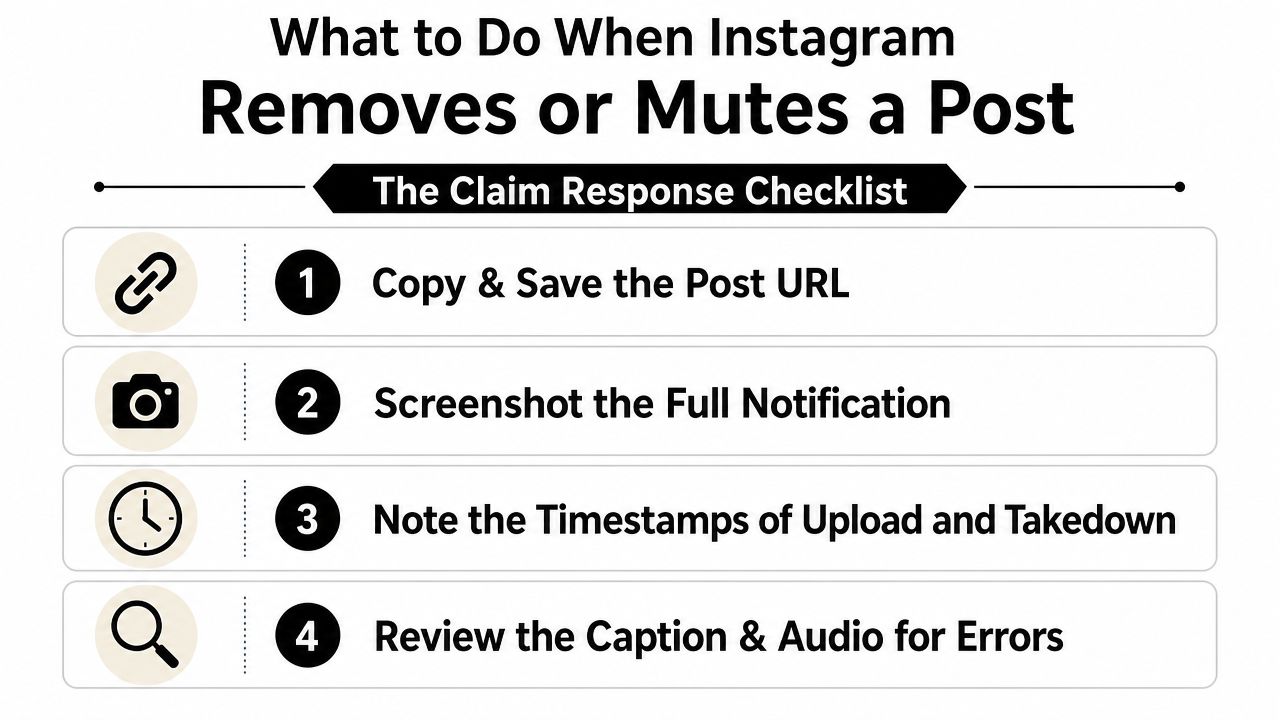
A takedown is an incident, not a verdict. The smartest teams treat it like a workflow problem, because you need proof, timing, and a clean record before you decide whether to swap audio, appeal, or re-upload. If the team waits until the post is gone from memory, the documentation is already compromised.
Build the file before you touch the post
Capture the URL, the handle, the full caption, all tags, partnership labels, and any paid or boosted indicators. Save timestamps for upload and takedown, and record a screen capture that shows the content, the audio, and the surrounding context before you make changes. That evidence matters if the dispute becomes a platform appeal or a rights conversation.
A written permission trail also matters. If someone said yes by text or email, save it. If the permission was oral, memorialize it immediately and identify the song title, version, and the person who gave approval. Instagram disputes become much easier to manage when the team can show exactly what was uploaded and why it was believed to be authorized.
From there, decide whether the post should be swapped, re-uploaded, or challenged. If the music error is obvious, replacing the audio may preserve the campaign better than starting a fight over a weak position. If the team has rights, a counter-notification may be appropriate, but only after the documentation is in order.
The reason speed matters is operational, not emotional. Repeated violations can lead to limits on new posts, reels, or stories, which turns a music problem into an account problem. The best incident response is boring, organized, and immediate.
A South Florida Founder's Working Framework
South Florida founders usually have three people touching one Reel, the founder, the marketing contractor, and the person who approves the paid boost. Each one can introduce music risk in a different way. The founder picks the trend, the contractor edits in a song from a personal account, and the ad team pushes the post into a paid lane where the original audio no longer fits the use.
Build the habit before the dispute
A pre-approved music library solves more problems than people expect. If the marketing team can choose only from cleared tracks, the edit moves faster and the legal review becomes lighter. A contractor clause that requires licensed sources does the same thing, because it shifts responsibility away from the vague “we assumed it was okay” zone.
Paid campaigns deserve a quick review before launch. That doesn't mean every post needs a memo, but it does mean the team should pause when a song is part of the pitch. For brands in Miami, Fort Lauderdale, and the rest of the South Florida market, this is especially useful because a lot of campaigns are small, fast, and image-driven. Those are exactly the campaigns that get published before anyone checks the rights file.
The bigger lesson is that repeat Instagram copyright issues usually point to a documentation gap, not a platform glitch. Someone didn't record the source of the audio, or the contractor wasn't told what counts as a cleared track, or the sponsored post was approved without anyone asking who owns the music. Fractional general counsel and ongoing contract work can clean that up, because the long-term fix is usually internal process, not another apology to Instagram.
A good rule for brand teams is this. If the song matters enough to notice, it matters enough to document.
Quick Answers and Next Steps
Can oral permission be enough? Sometimes it may be evidence, but it's a bad operating standard. Get it in writing, identify the song, and keep the approval trail with the post file. The earlier section on incident response shows how to preserve that record.
Does fair use usually cover branded Reels? Rarely. Once the post is tied to a product, service, or sponsorship, fair use gets much harder to defend. The visual overlay does not fix that problem.
What changes when a post is boosted or turned into an ad? The commercial risk goes up. A song that might have sat in an organic post can become a problem when the same content is used for paid distribution. That's why the account-type section matters so much.
How fast should a founder react after a counter-notification or mute? Immediately. Preserve the evidence first, then decide whether to replace the audio, re-upload, or challenge the claim. Waiting usually helps the platform, not the brand.
For founders who want a deeper legal baseline on ownership, licensing, and enforcement, the guide at Florida copyright lawyer for startups registration ownership licensing enforcement is a useful companion piece.
If your team posts on Instagram as part of a sales engine, now's the time to audit the music workflow, the contractor language, and the approval process before the next campaign goes live. Schedule a consultation with Coto & Waddington, Attorneys at Law, and get a practical review of the contracts and brand-protection habits that keep your content moving without avoidable takedowns.
A CTA for Coto & Waddington, Attorneys at Law.