
You're sitting in a Miami office with two term sheets in front of you. One says convertible promissory note. The other says Series Seed Stock Purchase Agreement. Both investors are ready to wire money, but the documents create very different obligations, dilution, and control outcomes.
The familiar early-stage default has changed. Y Combinator introduced the SAFE in 2013 as a simpler alternative to convertible notes and updated it with a post-money valuation cap form in 2018. On Carta, SAFEs represented about 83% of pre-seed investments in the first half of 2023 (Wyrick's history of SAFE financing). In Q2 2024, Carta reported that 88% of pre-seed deals used SAFEs and 12% used convertible notes, with 84% of SAFEs structured as post-money compared with 19% of convertible notes (the cited pre-seed market analysis).
That doesn't make a note obsolete. It means you need a reason to use one. For South Florida founders, the right answer depends on whether you need speed, debt protections, a bridge to a defined financing, immediate governance rights, or a cap table you can explain without a spreadsheet séance.
| Issue | Convertible Note | Priced Equity Round | SAFE |
|---|---|---|---|
| Legal nature | Debt that converts later | Immediate preferred stock | Contract for future equity |
| Valuation | Deferred | Negotiated before funding | Deferred |
| Interest | Typically accrues | None | None |
| Maturity date | Usually included | None | None |
| Ownership timing | At conversion | At closing | At conversion |
| Founder control | Usually preserved initially | Governance rights may begin immediately | Usually limited initially |
| Main risk | Repayment pressure and conversion dilution | Immediate dilution and negotiated control rights | Stacking and future dilution |
Table of Contents
- What a Convertible Note and Priced Equity Round Are
- How Each Deal Works From Term Sheet to Funding
- Cap Table Impact and Dilution You Can Model Today
- Pros and Cons for Founders and Investors
- Three South Florida Founder Scenarios Compared
- Legal and Tax Considerations Under Florida and Federal Law
- Why a Convertible Note Can Still Beat a Priced Round
- Decision Checklist and Next Steps With a Startup Lawyer
What a Convertible Note and Priced Equity Round Are
A convertible note is debt used to postpone an equity valuation. The company receives cash, promises repayment under the note, and typically agrees that principal plus accrued interest will convert into preferred stock after a qualifying financing. Notes commonly carry about 4% to 8% annual simple interest and maturity dates of 18 to 24 months (CRV's note comparison).
That classification shapes the investor's rights. Before conversion, the investor is generally a creditor, not an equity owner. The note may include a valuation cap, discount, security provisions, subordination language, conversion triggers, and a maturity remedy. If maturity arrives before conversion, the founder may face repayment, an extension negotiation, or a conversion negotiated under pressure.
A priced equity round sets the company's valuation before funding. The parties agree on the price per share, number of shares, preferred stock rights, and ownership allocation. The investor receives equity at closing, so the capitalization table changes immediately.
The documents create different business relationships
A priced investor may receive voting rights, information rights, a liquidation preference, pro-rata rights, protective provisions, and sometimes a board seat or observer role. These terms determine who participates in major decisions and who gets paid first in an exit.
A note postpones those negotiations, not the economic consequences. Its cap and discount can give the investor an advantage at conversion, while its debt status provides stronger protection before conversion. In the convertible note vs equity decision, start with the choice: sell ownership today, or borrow against a future financing?
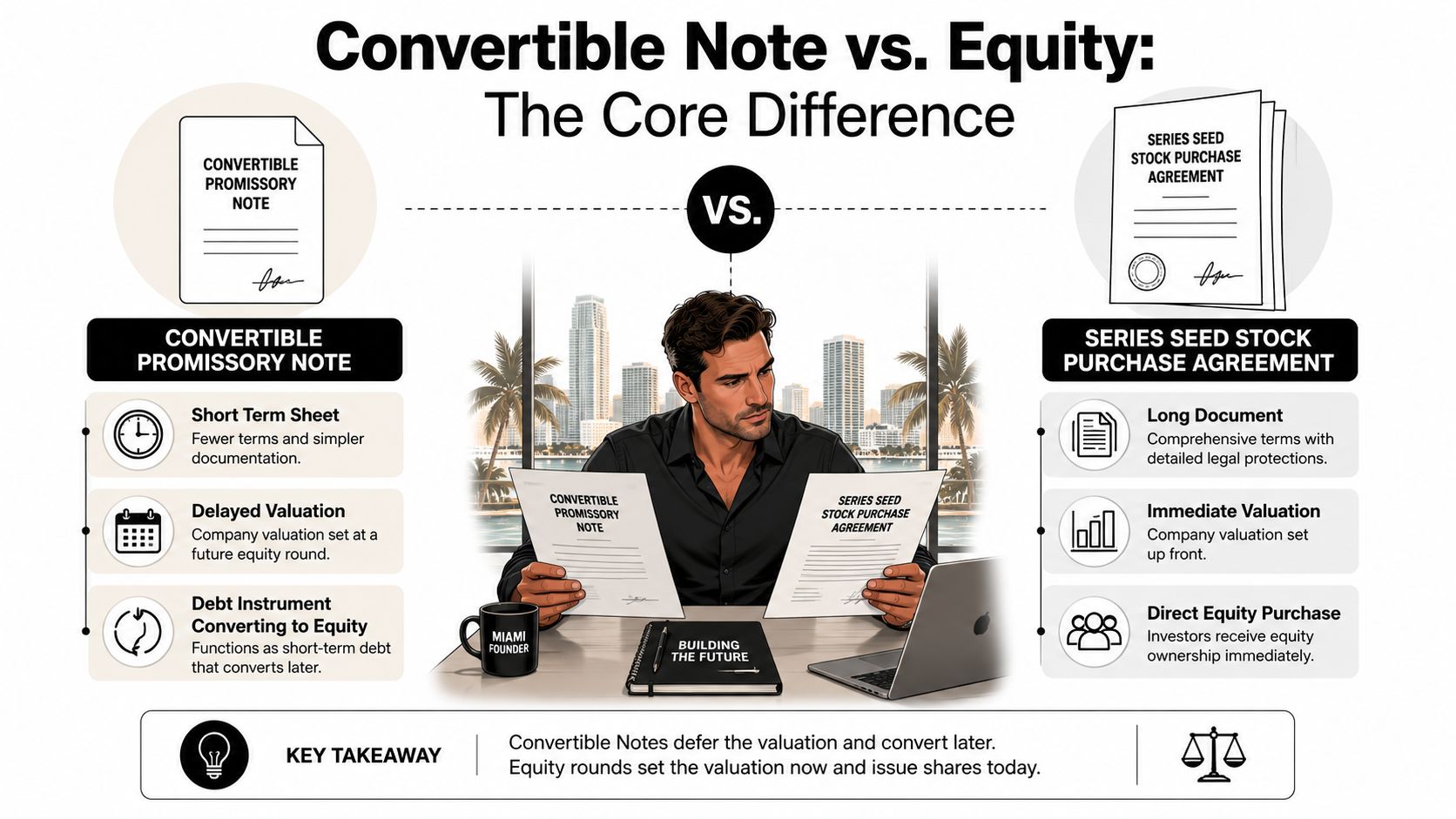
In the current 2024–2026 market, SAFEs often set the pre-seed default, but a convertible note can still fit a founder who needs debt protections or a bridge to a defined financing. A priced round makes more sense when investors require ownership and governance now. Founders should also separate investment ownership from other participation. For lawyer, operator, or partner arrangements, review understanding equity partner compensation before treating every equity promise as equivalent to invested capital.
How Each Deal Works From Term Sheet to Funding
A note closing is designed to be narrow. The term sheet usually identifies the principal, interest, maturity, valuation cap, discount, qualified financing threshold, conversion mechanics, and investor protections. Counsel then prepares the note purchase agreement and the promissory note, with the company's board approving the issuance through consent or written action.
The company may also negotiate a security interest, subordination provision, information covenant, or other debt-specific term. Once the documents are signed and conditions are satisfied, the investor wires funds. The company doesn't issue preferred shares at that moment. Conversion happens later under the terms already negotiated.
A priced round takes a different path:
- Term sheet: The parties negotiate valuation, price per share, liquidation preference, pro-rata rights, board composition, protective provisions, and other economics.
- Core financing documents: Counsel prepares the stock purchase agreement and related investor rights, voting, and right-of-first-refusal or co-sale agreements.
- Corporate approvals: The board approves the financing, and the company delivers capitalization representations, officer certificates, and other closing materials.
- Closing: Investors transfer funds, the company issues preferred shares, and the cap table changes immediately.
Speed isn't the only difference
A note can move quickly because the parties aren't negotiating the company's current valuation or a full governance package. A priced round takes longer because the investor is buying a defined security with rights that begin at closing.
South Florida counsel can compress either process, including counsel serving Miami-Dade and Broward companies, but no lawyer can remove the fundamental difference in document load. A founder who needs cash quickly should first prove traction before pitching, then choose the instrument that matches the investor's actual requirements.
Before a priced round, review the company's stock purchase agreement guidance so you understand why the document carries more than a simple promise to invest. The agreement establishes what stock is being sold, at what price, and with which rights.

My practical recommendation is simple. Use a note when the delay in valuation has a real purpose, such as a bridge to a defined round. Don't use one merely because the document looks shorter.
Cap Table Impact and Dilution You Can Model Today
A Broward founder raising $500,000 may expect dilution based on the check alone. That is the wrong calculation. A convertible note's cap, discount, and accrued interest can determine how many shares the investor receives when the next financing closes.
Use the note terms to build a model before signing. For a hypothetical Wynwood company, assume a $5 million valuation cap, 20% discount, 6% interest, and an 18-month term. If the next round sets a $4 million pre-money valuation, the cap may produce the lower conversion price. Interest also converts under the note, increasing the shares issued. The final ownership result depends on the fully diluted capitalization, cap definition, existing convertibles, option pool, and financing documents.
Your spreadsheet should include these formulas:
- Conversion price:
MIN(cap price, round price × (1 − discount)) - Interest-equivalent shares:
principal × interest rate × time ÷ conversion price - Investor ownership:
shares issued on conversion ÷ total shares outstanding after conversion
At 6% interest for 18 months, $500,000 produces $45,000 of interest before compounding or document-specific treatment. That amount converts alongside principal under the note terms. The dilution is real even though the founder did not receive an additional cash investment.
A practical comparison
| Metric | Convertible Note ($5M cap, 20% discount, 6% interest, 18 mo) | Priced Round at $5M pre-money | SAFE ($5M cap, no discount) |
|---|---|---|---|
| Valuation set at funding | No | Yes | No |
| Principal or investment modeled | $500,000 | $500,000 | $500,000 |
| Interest accrual | Yes, under note terms | No | No |
| Conversion or issuance | Later conversion | Immediate shares | Later conversion |
| Future dilution surprise | Possible, depending on conversion | Lower once ownership is issued | Possible, depending on cap mechanics |
| Governance rights | Usually deferred | Negotiated and effective at closing | Usually deferred |
The note example cannot produce a reliable universal dilution percentage without the company's actual denominator. Enter outstanding shares, the option pool, prior notes, SAFEs, the cap table treatment, and the new round price. In the current pre-seed market, where SAFEs often set the default and note terms are tightening, that model shows whether a note still gives the founder a useful bridge or merely postpones an expensive ownership calculation.
Investors may also receive rights to participate in later financings. That issue is separate from conversion math. Review this explanation of preemptive rights before accepting participation language that could limit future fundraising flexibility.
Pros and Cons for Founders and Investors
A note postpones the most uncomfortable negotiation, the company's valuation. That helps founders who have a credible plan but not enough operating history to defend a price. It also lets investors receive a discount or cap for taking early risk.
The tradeoff is deferred certainty. Founders don't know the exact ownership cost until conversion, and the note's interest increases the amount converting. A maturity date can also turn a financing tool into a creditor negotiation if the next round doesn't happen on schedule.
| Dimension | Convertible Note | Priced Equity Round |
|---|---|---|
| Founder valuation flexibility | High initially | Low after valuation is agreed |
| Ownership certainty | Deferred | Immediate |
| Investor downside protection | Debt status, interest, maturity, and possible security terms | Preferred rights, liquidation preference, and negotiated protections |
| Governance | Usually limited before conversion | Board, voting, information, and protective rights may begin at closing |
| Founder control | Often preserved temporarily | Shared or constrained according to the rights package |
| Main negotiation risk | Conversion and maturity | Valuation and control |
What founders give up
Founders often value the absence of a board seat during the earliest stage. They also avoid immediately negotiating liquidation preferences, protective provisions, and information rights. But carrying debt can make future investors ask harder questions about maturity, repayment, and the total amount that may convert.
A 2x non-participating preferred security feels very different from a 20% discount note. The first gives an equity investor a defined preference at exit. The second rewards an early noteholder through conversion economics and debt terms. Neither label tells you whether the deal is founder-friendly. The full documents do.
What investors receive
Investors may prefer a note because interest and maturity create pressure if the company delays or fails to raise. A priced round, however, gives them immediate ownership and a negotiated package of liquidation preference, anti-dilution protection, information rights, voting rights, and pro-rata participation.
Pro-rata rights may matter more at seed than at Series A because early investors need a contractual path to maintain their position as new capital enters. Founders should negotiate those rights with the future cap table in mind, not accept them as harmless boilerplate.
Deal-killer point: A note shifts risk to the next round. It doesn't eliminate the risk.
My recommendation is to treat maturity as a business deadline. If the company can't explain what financing or milestone the note is designed to reach, a priced round or SAFE may be more honest than creating debt without a clear landing point.
Three South Florida Founder Scenarios Compared
The Wynwood SaaS MVP
A Wynwood founder is building an MVP and raising $250,000 from friends and family. The investors know the founder personally, the company isn't ready for a defensible valuation, and the founder needs capital for product development rather than a complex governance relationship.
A SAFE or simple note is the better fit. Speed and low legal friction matter more than a full preferred stock package at this stage. I'd favor a post-money SAFE when investors accept it. I'd use a note only if the investors specifically want debt protections or the company needs a maturity-based bridge.
The Boca Raton healthtech bridge
A Boca Raton healthtech company closed a Series A 18 months ago and needs bridge capital to reach clinical or commercial milestones. A new priced round could reset the valuation discussion before the company has reached the milestone that justified the original financing.
A convertible note fits this situation, provided the documents identify the qualified financing, conversion price, maturity remedy, and investor rights clearly. The bridge should have a destination. Negotiate an automatic extension or conversion-at-maturity mechanism instead of assuming investors will accept a last-minute amendment.
The strategic corporate investor
A strategic investor wants board observation rights, information access, and a defined equity stake. The investor may also want a liquidation preference, approval rights over major transactions, or a clear allocation of shares.
A priced equity round is the right instrument. A note can postpone governance, but it can't provide the strategic investor with the immediate ownership clarity it is asking for. Trying to force a complex strategic relationship into a short-form note usually creates more negotiation later, not less.
The scenario matters more than the instrument's reputation. A founder shouldn't select a note because it sounds institutional or a SAFE because it is fashionable. Select the document that handles the investor's actual expectations without hiding the economic cost.
Legal and Tax Considerations Under Florida and Federal Law
Both convertible notes and equity issuances involve securities-law analysis. The company generally needs registration or a valid exemption, and common pathways include Rule 506(b), Rule 506(c), and Florida's intrastate offering exemption under Section 517.061. Those exemptions differ in areas such as investor qualification, verification, disclosure, and solicitation, so the company shouldn't assume that a familiar template solves compliance.
Florida has no state personal income tax, but that doesn't make financing tax-free. A priced equity round generally isn't taxable income to the company when investors purchase newly issued stock. A convertible note carries interest, and that interest may be deductible by the company under IRC Section 163, subject to applicable limitations and tax treatment.
Debt characterization changes the analysis
Original issue discount rules under Section 1273 can affect how portions of a note are characterized. Conversion is often structured as a nonrecognition event, but warrants, unusual conversion rights, discounted transfers, or other favorable terms can create issues that affect both the company and investors.
Founders also need to protect potential Section 1202 qualified small business stock treatment. The financing instrument, the corporation's status, the issuance mechanics, and the resulting shares can all matter. A note or SAFE that converts incorrectly may create questions at exit, especially if the company has built significant value between issuance and conversion.
Practical rule: Ask corporate counsel and a tax adviser to review the same financing documents. A lawyer focused only on closing mechanics may miss a tax consequence, while a tax adviser may not address governance or securities compliance.
A SAFE is not debt, but that doesn't make it regulation-free. Y Combinator's updates helped standardize the instrument, yet founders still need an offering exemption, proper records, investor disclosures, and tax advice suited to the company's facts.
Why a Convertible Note Can Still Beat a Priced Round
SAFEs dominate pre-seed fundraising, and that market reality makes them a strong default for many first-time raises. But a convertible note can still beat both a SAFE and a priced round when the financing has a specific job.
Current terms are more investor-friendly than many founders expect. Fenwick reported in Q1 2025 that interest rates on convertible notes rose by 200 to 300 basis points, while discount rates reached as high as 10.5 percentage points in larger deals (Fenwick's report on tightening terms). Wilson Sonsini reported that in 1H 2025, the median qualified financing threshold for post-seed notes was $15 million, and 39% of post-seed notes had interest rates below 8%, compared with 23% in 2024 (the cited market analysis). Founders should negotiate a note as a debt instrument, not treat it like a SAFE with an interest line added.
| Scenario | Best Instrument | Why It Wins Now | Typical Term |
|---|---|---|---|
| Bridge between priced rounds | Convertible note | Preserves the existing valuation framework while funding the next milestone | Cap, discount, maturity, and automatic conversion |
| Investor requires creditor protections | Convertible note | Interest, maturity, and debt remedies provide protections a SAFE doesn't | Subordination or security terms may apply |
| Milestone-based financing | Convertible note | Covenants can tie the financing to reporting or agreed milestones | Information and covenant package |
| Investor needs interest accrual | Convertible note | Interest supports the investor's accounting and return model | Stated annual interest |
| Founder needs a defined financing deadline | Convertible note | Maturity creates a date for conversion or renegotiation | Maturity and extension mechanics |
| Early pre-seed round without debt pressure | SAFE | No interest or repayment obligation | Post-money cap and optional rights |
Five situations where the note earns its place
First, bridge financings. If the company already has a priced round and expects another defined financing, a note can bridge the gap without reopening a full valuation.
Second, covenant-driven deals. Some investors want reporting, milestone, or use-of-proceeds commitments. Debt documents can express those obligations more directly than a basic SAFE.
Third, fund accounting requirements. Certain investors need an instrument that accrues interest or fits a debt mandate. The note may be the only structure they can approve.
Fourth, productive maturity pressure. A realistic maturity date forces the founder and investors to confront the next financing instead of leaving the bridge open indefinitely. That pressure only helps if the company also negotiates a workable extension or conversion remedy.
Fifth, sequencing of equity issuance. A founder may prefer to postpone issuing preferred equity until the priced round. That preference doesn't remove securities-law obligations, and it shouldn't be used to avoid required filings, but it can influence financing administration.
The right question isn't whether the market prefers SAFEs. It's whether the instrument matches the transaction. Use a note when debt terms solve a real problem. Otherwise, don't burden an early company with maturity pressure just to make a small raise look more advanced.
Decision Checklist and Next Steps With a Startup Lawyer
Run these questions before signing. A “yes” answer on the first group generally points toward a SAFE or simple note. A “yes” answer on the later questions may justify a priced round or a more negotiated note.
- Is the raise under $250,000? If yes, start with a SAFE or simple note unless the investor needs formal equity.
- Are all investors friends or family? If yes, keep the economics and disclosures simple, but still document the securities exemption.
- Do you need to close in under two weeks? If yes, a convertible instrument may fit better than a priced round.
- Is the cap table clean enough for the next institutional round? If no, pause and reconcile founder, option, SAFE, and note records first.
- Do investors require debt covenants or repayment rights? If yes, use a note and negotiate the remedies explicitly.
- Is your valuation undetermined? If yes, don't force a priced round merely to create an artificial number.
- Do investors want a board seat or observer role now? If yes, a priced round usually creates clearer governance.
- Does the company need a defined ownership percentage today? If yes, price the equity.
- Could the next financing be delayed beyond maturity? If yes, negotiate extension and conversion-at-maturity terms before accepting the note.
- Will multiple SAFEs or notes stack on different caps? If yes, model the fully diluted result before taking another check.
- Does the company expect a near-term sale or strategic transaction? If yes, review change-of-control treatment carefully.
- Has counsel confirmed the Florida and federal exemption? If no, don't accept funds yet.
Complete the closing deliberately
Prepare the financing documents, investor questionnaire, board consent, capitalization schedule, wire instructions, and securities filings. Update the cap table in Carta, Pulley, or another reliable system immediately after closing. Track principal, accrued interest, maturity, conversion triggers, notice requirements, and every side letter.
If you're comparing templates, treat a startup investor agreement template as a starting point for questions, not a substitute for reviewing the actual cap table and negotiated terms. The same form can produce a very different result depending on the cap, discount, capitalization definition, seniority, and conversion threshold.
Coto & Waddington can handle a flat-fee note or equity-round closing, including document preparation, negotiation, board approvals, securities compliance, and cap-table coordination. Bring your current cap table, proposed term sheet, investor list, prior SAFEs or notes, corporate records, and target closing date to the first consultation.
If you're weighing a convertible note against a priced equity round in Miami, Fort Lauderdale, Broward, or the surrounding South Florida market, contact Coto & Waddington, Attorneys at Law for a focused review of your term sheet, cap table, and financing goals. Schedule the consultation before accepting funds, so your documents and dilution model match the deal you intend to make.



