
You're incorporated, your co-founder is ready to sign, and an angel investor wants equity before the next meeting. The question sounds simple: common stock or preferred stock? In a startup, that choice affects voting control, exit proceeds, future fundraising, employee equity, and the legal documents you'll need to maintain for years.
The label on the certificate is only the beginning. The value sits in the rights attached to each class, including conversion, liquidation preference, dividends, redemption, and protective provisions. A clean cap table can become economically complicated when those terms aren't modeled together.
Table of Contents
- Understanding Common Stock and Preferred Stock
- How Voting Rights Shape Founder Control
- Dividend Priority and Liquidation Preferences Explained
- Cap Table Impact and Dilution Considerations
- Real-World Scenarios for Choosing Stock Type
- Term Sheet Provisions and Legal Considerations for Startups
- Making the Right Choice for Your Situation
Understanding Common Stock and Preferred Stock
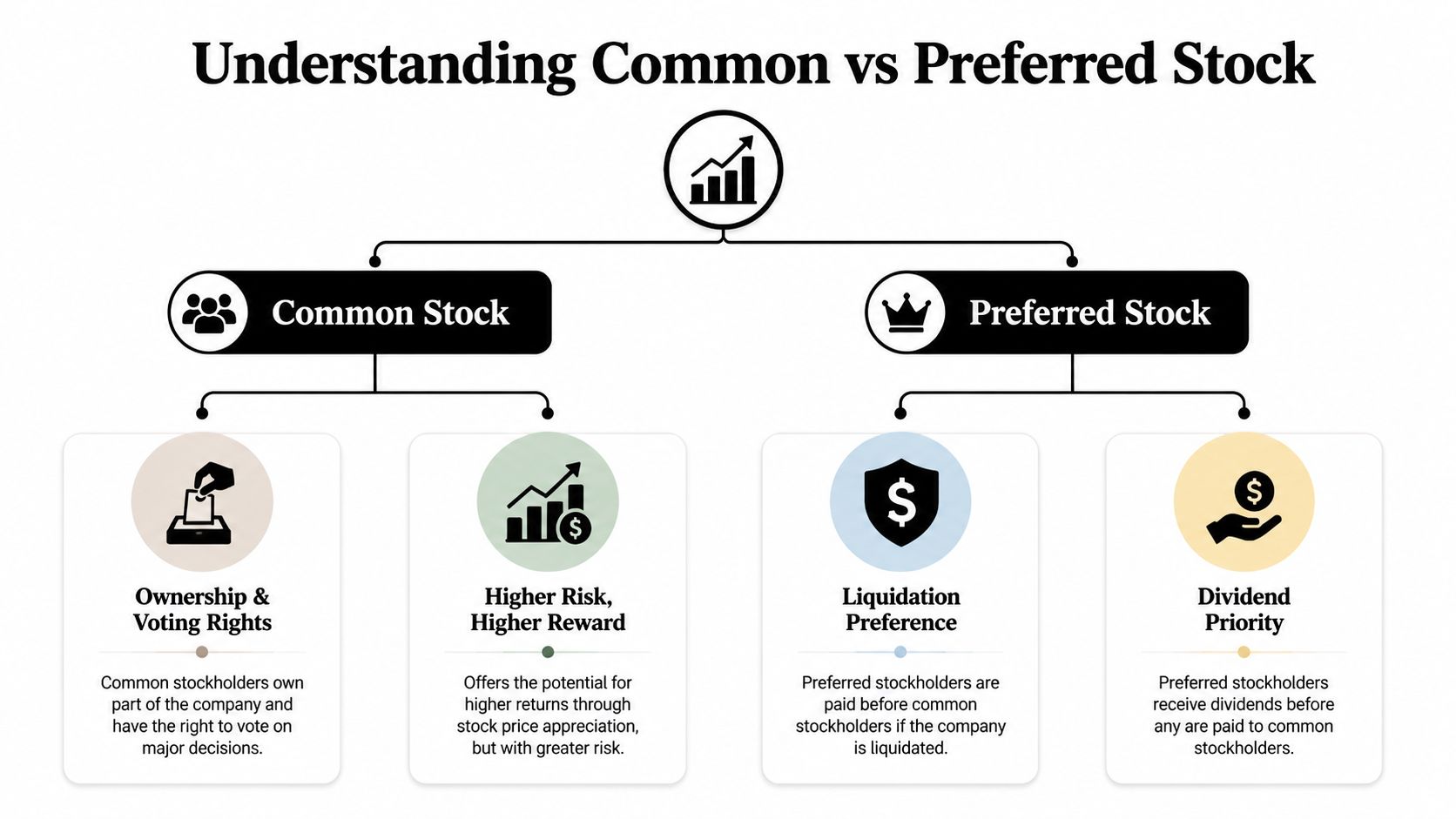
Common stock is usually the basic ownership class issued to founders, co-founders, and early employees. It normally carries voting rights and a residual claim on company assets and earnings. “Residual” means common holders receive what remains after creditors and any senior preferred claims are paid.
Preferred stock is an equity class with negotiated rights that rank ahead of common stock in specified situations. Those rights may include dividend priority, a liquidation preference, conversion into common stock, redemption rights, and approval rights over major corporate actions. In a startup financing, preferred stock functions less like plain ownership and more like a negotiated financing instrument.
That distinction has a long market history. Federal Reserve archival data shows that preferred-stock prices were compiled for January 1910 through January 1928 using a basket of 20 high-grade preferred stocks, each standardized to a $100 par value and a $7 annual dividend. The historical benchmark demonstrates that preferred shares have long been tracked as a distinct asset class, with fixed dividend terms measured against par rather than fluctuating directly with company earnings. Federal Reserve archival data provides the underlying historical context.
Modern capital markets still treat the classes separately. Federal Reserve issuance tracking began combining proceeds from common stock and preferred stock separately in 1990:Q3, and total equity issuance, including both classes, reached $221.2 billion in 2018, up 0.4% year over year, according to the cited Federal Reserve and SIFMA materials. Federal Reserve equity issuance data shows why both instruments remain active, even though common stock represents the larger portion of the broader equity market.
| Feature | Common stock | Preferred stock |
|---|---|---|
| Typical startup holder | Founders, co-founders, employees | Angel, venture, and institutional investors |
| Voting rights | Usually broader voting rights | Often limited, non-voting, or class-specific |
| Dividend position | Junior to preferred dividends | Usually paid before common |
| Liquidation position | Residual claim after senior claims | Defined preference before common |
| Upside | Generally uncapped residual appreciation | May convert into common to share in upside |
| Key documents | Charter, bylaws, stock purchase agreements | Charter, financing documents, investor rights agreements |
At formation, founders typically issue common stock because they need direct ownership and voting participation without imposing investor-style protections on the company. When outside investors price a financing round, preferred stock usually becomes appropriate because investors are negotiating protection for the capital they're contributing.
How Voting Rights Shape Founder Control
Founders often focus on percentage ownership and overlook the voting mechanics attached to each share. That mistake can leave you owning a meaningful economic percentage while losing practical control over directors, a sale, or a new financing.
Common stock usually carries voting rights, often with one vote per share. Preferred stock often carries limited or no ordinary voting rights, but the charter may give preferred holders a vote on an as-converted basis or on specific matters affecting their class. SEC disclosure language illustrates that preferred shares can be expressly designated as non-voting or voting on an as-converted basis. SEC disclosure on voting designations is a useful reminder that no founder should assume voting rights from the word “preferred” alone.
Control is more than the board vote
Voting rights influence who elects directors and who approves significant corporate actions. But preferred investors may also receive protective provisions, which can require their consent before the company:
- Authorizes a senior or equal class of preferred stock.
- Changes the rights of an existing preferred series.
- Approves a merger, sale, or dissolution.
- Pays dividends or redeems shares.
- Increases or decreases authorized shares.
Those provisions can give investors meaningful veto power even when their preferred stock doesn't vote on every routine matter. A founder may retain ordinary voting control while still needing investor approval for decisions that affect the company's capital structure or exit path.
Practical rule: Never review voting rights separately from protective provisions. The combination determines who can actually stop a transaction.
Conversion rights complicate the analysis. Preferred holders may convert into common stock when the common outcome is more valuable, such as in a strong acquisition or public offering. Once converted, the investor may vote with the common holders and generally gives up rights that exist only in the preferred class. The conversion ratio, automatic conversion triggers, and optional conversion rights all deserve careful review.
Founders should also understand how a shareholder agreement fits into the control picture. Governance arrangements, transfer restrictions, voting agreements, and decision rights may sit outside the charter. A practical overview of what belongs in a shareholder agreement can help you identify which control provisions need to be coordinated with the stock documents.
The right question isn't, “Do preferred shares vote?” Ask instead: Who appoints each director, which matters require class consent, and what happens if preferred converts? Those answers describe your real governance structure.
Dividend Priority and Liquidation Preferences Explained
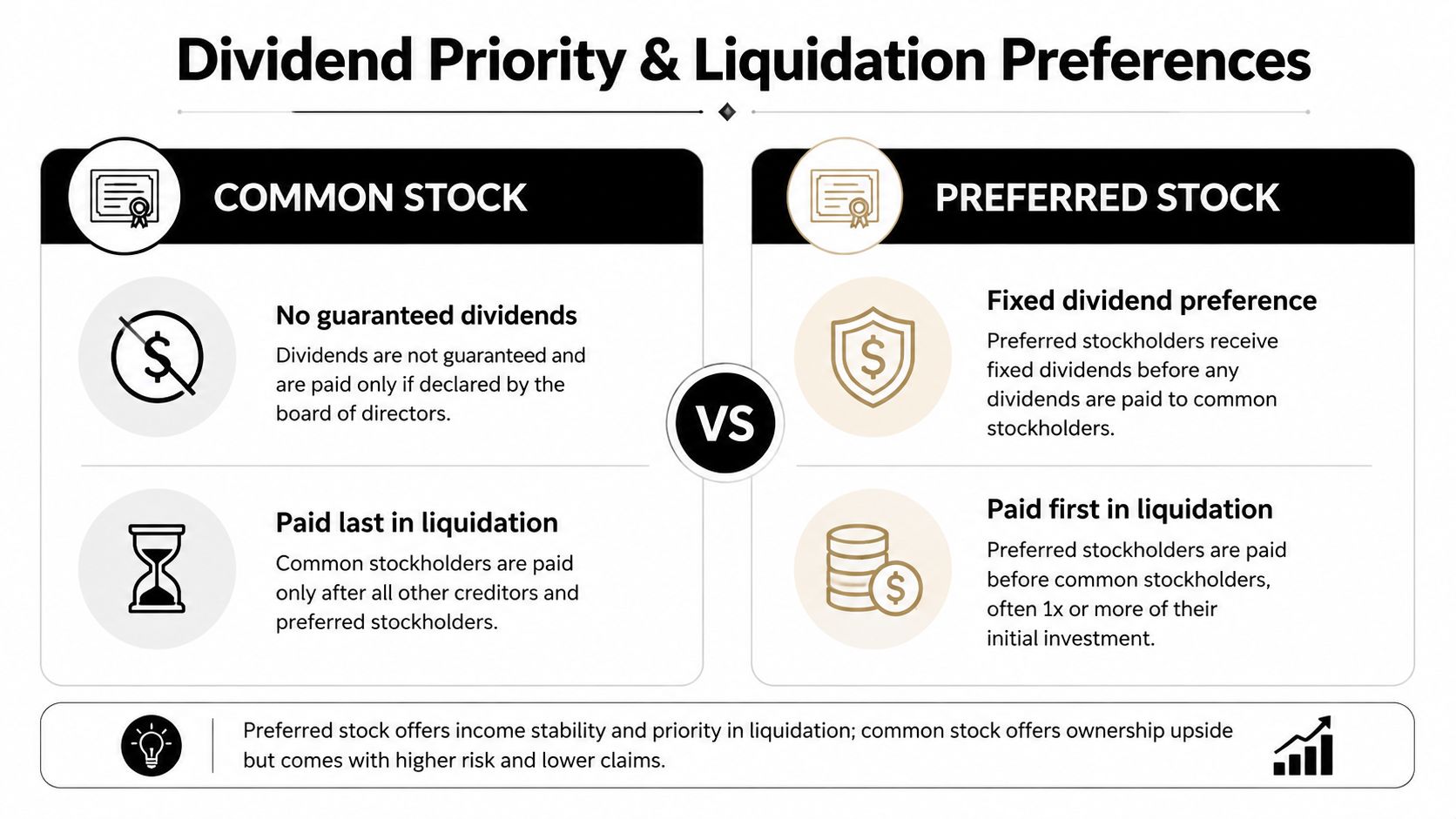
Preferred stock changes the order in which money moves through the company. Preferred holders typically receive dividends before common holders, and cumulative preferred terms can create arrears that must be paid before common dividends resume. Common stock may receive dividends, but the board generally has discretion over whether and when to declare them.
A liquidation preference applies when the company is wound up, sold, or placed into bankruptcy, depending on the governing documents. Preferred holders receive the defined preference before common holders receive residual proceeds. Standard terms often calculate that preference as the original issue price multiplied by the number of preferred shares, although accrued dividends and other negotiated features can increase the amount.
The same exit can produce very different payouts
Consider a hypothetical company with a $5 million exit. The figures below are an illustration of payout mechanics, not a prediction about any company or investment. To make the example concrete, assume the preferred financing documents establish a defined return that must be calculated from the actual capitalization and financing terms.
| Structure | Preferred return | Common return |
|---|---|---|
| Single non-participating preference | Preferred receives the contractual preference or converts to common, whichever produces the better result under the documents | Common receives the residual after the preferred election is applied |
| Single participating preference | Preferred receives its contractual preference, then participates in the remaining proceeds with common | Common shares the residual, but the preferred holder receives both layers |
| Multiple preference layers | Senior and junior preferred series are paid according to rank and negotiated terms | Common receives value only after the preference stack is satisfied |
A single non-participating preference gives the investor a choice between taking the preference and converting into common. That structure can protect the investor on a modest exit while allowing participation in a large outcome through conversion.
A participating preference can be more expensive for founders. The investor first takes the contractual preference and then participates in the remaining proceeds according to the participation terms. The founder's common equity may receive substantially less than a simple ownership-percentage calculation suggests.
A stack with multiple preferred series requires a waterfall model. The charter may rank one series ahead of another, give different conversion rights to each series, or provide separate dividend and redemption terms. A founder who models only ownership percentages is missing the distribution order that determines actual proceeds.
For a deeper warning about how cumulative terms can affect investors and sales practices, founders and investors may find this resource on broker mis-selling of cumulative preferred useful. It reinforces why the precise dividend and preference language matters.
Negotiation point: Ask counsel to model a low, middle, and high exit before you sign. If the spreadsheet shows only ownership percentages, it isn't a complete exit analysis.
The stock purchase agreement should align with the charter and term sheet. A mismatch between those documents can create uncertainty about what an investor purchased and what founders expected to retain.
Cap Table Impact and Dilution Considerations
A cap table doesn't merely show who owns what. It should show who gets paid first, who can convert, who votes, and how future issuances change the economics.
Founders often calculate dilution by dividing their shares by the new total share count. That calculation is necessary, but it isn't sufficient when preferred stock carries liquidation preferences, participation rights, or anti-dilution protection. Preferred shares may represent a smaller voting percentage while holding stronger downside rights than common shares.
Build the model in layers
Start with the company's fully diluted capitalization. Include issued common stock, preferred stock, options, warrants, and the employee pool if the financing documents treat those securities as part of the negotiated capitalization. Then model the financing on both a pre-money and post-money basis.
A useful working sequence is:
- Record the current capitalization. Separate each class and series rather than placing all shares in one ownership bucket.
- Add the option pool treatment. Confirm whether the pool is created or increased before the financing, because that changes who bears the dilution.
- Issue the preferred shares. Capture the price, number of shares, liquidation preference, dividends, and conversion ratio.
- Run the exit waterfall. Compare a preference election with conversion into common.
- Test future rounds. Add later preferred issuances and check whether seniority, participation, or anti-dilution provisions change the result.
A simple ownership illustration can show why the exit valuation matters. Suppose investors receive 20 percent preferred stock and the company reserves 15 percent for an employee option pool. The founder's final economic result depends on whether the preferred remains preferred or converts, whether the pool was counted before or after the financing, and how the liquidation waterfall distributes proceeds.
| Exit valuation | Pre-money founder % | Post-issuance founder % | Post-conversion founder % |
|---|---|---|---|
| Lower exit | Founder's pre-financing ownership | Reduced by the financing and pool treatment | May be unchanged if investors take the preference |
| Mid-range exit | Founder's pre-financing ownership | Reduced by the financing and pool treatment | Depends on whether conversion beats the preference |
| Higher exit | Founder's pre-financing ownership | Reduced by the financing and pool treatment | Conversion may allow preferred holders to share in common upside |
The table intentionally uses qualitative outcomes because the exact percentages require the company's starting capitalization, share price, pool mechanics, and financing terms. A cap table without those inputs can't produce a reliable answer.
Also review preemptive rights. These rights may allow an investor to participate in future issuances to preserve a percentage position, but the scope, exceptions, and exercise process depend on the governing documents.
Common stock remains the cleaner upside vehicle for founders and employees because it generally participates in residual appreciation. Preferred stock prices downside protection and control rights explicitly. Your job is to understand both layers before comparing ownership percentages.
Real-World Scenarios for Choosing Stock Type
A solo founder forming a Florida corporation usually has no reason to issue preferred stock to herself at formation. Common stock gives the founder ordinary ownership and voting participation without importing a financing waterfall that no investor has requested.
The same logic generally applies to co-founders. Issue common stock under clear vesting, transfer, and repurchase terms, then document each person's role and ownership in a way the company can administer. Early employees usually receive common stock, options, or another equity award rather than investor-style preferred shares.
Four situations founders actually face
Bootstrap company. A founder funding operations personally may want a simple common-stock structure. The company can reserve equity for future hires without negotiating preferred investor rights before there's an outside financing.
Angel financing. An angel may accept common stock in some circumstances, but the company should not assume that a simple share issuance is automatically safer. The investor may request a preferred class, a convertible instrument, or contractual rights that need to be documented accurately.
Venture financing. Institutional investors generally expect preferred stock because they're underwriting downside protection, conversion rights, information rights, and governance provisions. The founder should compare the entire package, not focus only on the price per share.
Family or closely held business. A family business bringing in outside capital may use multiple classes to separate economic participation from voting control. That structure can work, but it requires careful drafting because family expectations often differ from the legal rights stated in the charter.
Public-market income investors face a different decision. Preferred stock can offer dividend priority and a higher claim than common in liquidation, but it may also be less liquid, callable, and sensitive to interest-rate movements. It can trade more like a bond than a growth security, so “preferred” doesn't automatically mean safer.
The important question isn't which class wins in the abstract. It's which rights are embedded in the shares you're actually buying or issuing.
Founders should ask whether preferred stock is convertible, whether the preference participates, whether dividends accumulate, and whether the issuer can redeem the shares. In private companies, also ask who controls conversion and what happens during a sale that doesn't meet a preferred holder's return expectations.
Florida and Delaware corporations can both support flexible stock structures, but the company's governing law, charter, bylaws, and financing documents must work together. A structure that looks familiar from a Delaware venture deal shouldn't be copied into a Florida company without reviewing the applicable corporate law and drafting conventions.
Term Sheet Provisions and Legal Considerations for Startups
A term sheet can look short while committing the company to years of economic and governance consequences. Founders should treat each preferred provision as a business decision, not as boilerplate.
Provisions that deserve a line-by-line review
Conversion mechanics determine when preferred becomes common and at what ratio. Review optional conversion rights, automatic conversion triggers, and whether a sale or public offering causes conversion. A favorable conversion right may let investors choose the better economic path, while an unclear trigger can create conflict during a transaction.
Liquidation preference requires more than identifying the headline multiple. Confirm whether it's participating or non-participating, whether dividends are added, whether the preference is senior or pari passu with another series, and whether the preference applies to a merger or asset sale.
Redemption and call rights can force the company to buy back preferred shares under stated conditions. That may create a liquidity obligation when the company needs cash for payroll, product development, or debt service.
Protective provisions may give preferred holders veto rights over new securities, amendments, dividends, redemptions, a sale, or changes to the board. Limit them to material matters where investor protection is reasonable.
Dividend terms should state whether dividends are cumulative, non-cumulative, fixed, discretionary, or payable only when declared. Cumulative arrears can reduce the value available to common holders even when the company never paid cash dividends.
The SEC's explanation of preferred priority in a filed agreement illustrates how a stated per-share liquidation amount can operate before common receives a distribution. The exact amount and mechanics always come from the company's own documents.

Florida and Delaware issues
Florida founders should confirm that the articles of incorporation authorize the intended classes and state the rights attached to each class. Delaware venture companies typically use a charter-based preferred structure with detailed rights, but Delaware precedent and drafting expectations don't eliminate the need for transaction-specific analysis.
For either jurisdiction, review the charter, board approvals, stock purchase agreement, investor rights agreement, voting agreement, and any right-of-first-refusal or co-sale agreement together. The documents should identify the authorized shares, issued shares, consideration, class rights, and approval process.
Red flags include uncapped participating preferences, broad veto rights over ordinary operations, automatic redemption obligations that the company can't realistically fund, unclear conversion language, and an option pool adjustment that founders didn't model before agreeing to price.
Making the Right Choice for Your Situation
Use the company's stage and the other party's purpose as the starting point.
| Situation | Usually appropriate starting point | Main issue to verify |
|---|---|---|
| Founder formation | Common stock | Vesting, repurchase, and tax documentation |
| Co-founder issuance | Common stock | Ownership, vesting, roles, and transfer restrictions |
| Employee equity | Common stock or options | Equity plan approval and award terms |
| Priced institutional round | Preferred stock | Preference, conversion, governance, and dilution |
| Income-focused public investment | Preferred stock may fit | Liquidity, callability, rate sensitivity, and issuer credit |
| Growth or control transaction | Depends on rights package | Voting, redemption, and exit waterfall |
A practical founder checklist is short:
- Issue common stock to founders and employees unless there's a specific reason to use another class.
- Model the exit waterfall before accepting a liquidation preference.
- Prefer a single non-participating structure where the negotiation permits it.
- Limit protective provisions to material capital, governance, and sale decisions.
- Confirm conversion ratios and automatic conversion triggers in the charter.
- Review cumulative dividend language and any redemption obligation.
- Keep the cap table current after every issuance, transfer, option grant, and conversion.
- Don't treat a 409A valuation or a financing price as interchangeable. They serve different purposes.
Founders also need to protect the company's commercial position while raising capital. For a startup building visibility alongside its financing work, resources that help build backlinks for AI startups may support broader business development, but marketing activity never substitutes for accurate equity documentation.
The cost of reviewing a term sheet before signing is usually far lower than unwinding an unclear preference, correcting an unauthorized issuance, or renegotiating control after investors have acquired influence. Get the charter, cap table, term sheet, and financing agreements reviewed as one transaction.
Coto & Waddington, Attorneys at Law offers startup, corporate, and capitalization counsel for founders forming companies in Florida or Delaware and negotiating common or preferred equity financings. Visit Coto & Waddington, Attorneys at Law to discuss your cap table, term sheet, and preferred-stock rights before you sign documents that shape your company's future.



