
You're three days from signing a term sheet when diligence uncovers a familiar kind of disaster. The SAFE in your folder names one investor, the wire confirmation points to another, the option pool was never formally approved, and a spreadsheet formula makes the founders' ownership total 102 percent. The financing hasn't failed, but nobody can confidently explain who owns what.
That's the operational gap between a working spreadsheet and capitalization table management that can survive diligence. A cap table has to do more than display percentages. It must connect ownership math to signed instruments, approvals, stock records, vesting schedules, and a traceable history of every transaction.
Table of Contents
- What a Cap Table Really Does for Your Company
- Setting Up the Foundation Before Your First Entry
- Recording Equity Events the Moment They Happen
- Understanding Dilution and Vesting in Practice
- Spreadsheets Versus Cap Table Software Versus Counsel
- Common Mistakes and Red Flags We See in Diligence
- Your Cap Table Checklist and When to Call an Attorney
What a Cap Table Really Does for Your Company
A capitalization table, or cap table, is the operating record of every financing event that changes equity over time. It summarizes the current ownership structure across common and preferred shares, options, warrants, and convertible securities, while the stock ledger preserves the historical record of shares issued and cancelled since formation. Practical guidance on the distinction between a cap table and a stock ledger makes the important point that the cap table is an analytical summary, not a replacement for the underlying legal records.
In practice, the cap table performs three jobs:
- Ownership math: It calculates each holder's position on an outstanding and fully diluted basis.
- Transaction evidence: It gives investors, lenders, and acquirers a coherent view that can be reconciled to signed documents.
- Governance history: It shows which board and stockholder approvals support each issuance, grant, transfer, or conversion.
That last function is where founder-maintained files usually become difficult to defend. A pitch deck graphic can show ownership at a particular moment. An HR schedule can list employee grants. Neither one explains whether the board approved the grant, whether the recipient signed the agreement, or whether the shares match the stock certificate.
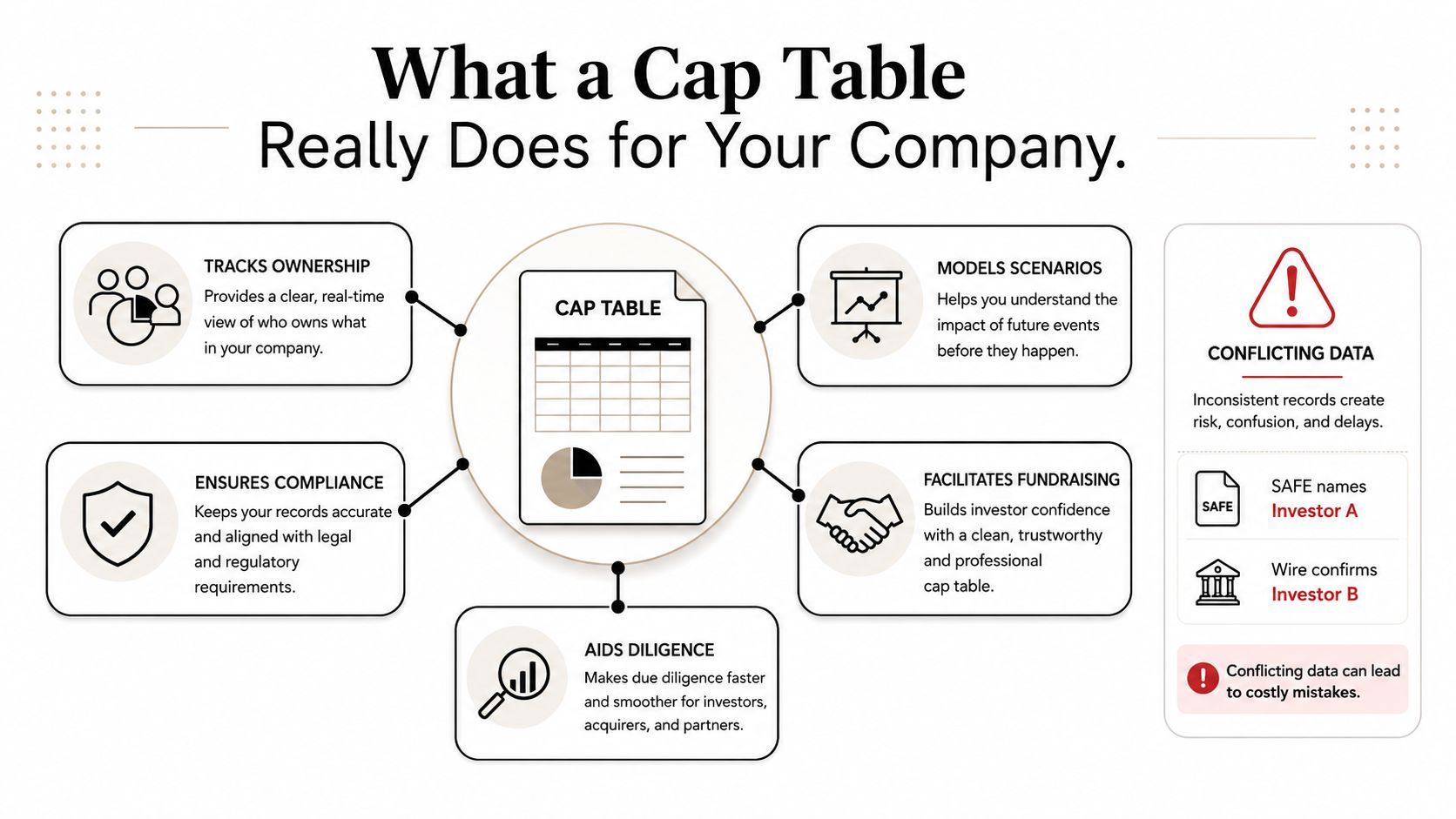
The cap table should therefore be dated, authoritative, permission-controlled, and tied to source documents. If your company has granted equity, accepted a SAFE, expanded an option pool, or completed a financing, the record must reflect that event when it occurs, not after someone discovers the omission during a closing.
Practical rule: Treat the cap table as the ownership control system, not as a presentation file.
For the financial side of the business, founders may also benefit from keeping equity records coordinated with bookkeeping and tax for startups, particularly when equity events affect financial reporting or tax documentation. And if investors receive contractual rights connected to future issuances, those rights should be reviewed alongside the company's preemptive rights obligations, rather than left as an isolated spreadsheet note.
Setting Up the Foundation Before Your First Entry
The first cap table entry is only as reliable as the legal structure beneath it. Start with the entity decision. A Delaware C-corporation remains the usual structure for companies pursuing venture financing, while a Florida entity or LLC may fit a closely held business, a bootstrapped company, or a business with different tax and governance priorities. An LLC conversion later can be managed, but it creates additional legal and tax work, so the choice deserves attention before founders divide equity informally.
Choose the structure and classes
Create the share architecture before recording ownership. Founders and employees commonly receive or earn Common Stock, while investors in a priced financing generally receive a designated series of Preferred Stock. The option pool should be represented as a defined number of shares reserved under an equity plan, not merely as a percentage typed into a presentation.
The table should distinguish authorized, issued, outstanding, reserved, granted, vested, exercised, cancelled, and available shares. That structure makes later financing analysis possible because the denominator can include securities that may become equity.
Connect entries to authority
Your initial rows should point directly to the documents that authorize and prove them:
- Certificate of Incorporation: Establishes the authorized capital and share classes.
- Founder Subscription Agreements: Document each founder's purchase or issuance.
- Section 83(b) elections: Founders and applicable early recipients should address the filing deadline, which is within 30 days, as explained in practical startup equity guidance.
- Initial Board Consent: Authorizes founder issuances, vesting arrangements, and other foundational actions.
- Form D filing: May be required when securities are sold under an applicable private offering exemption.
Use a consistent naming system from the start. A file such as 2026-09-03-Board-Consent-Founder-Issuance-v1 is easier to trace than final board minutes new revised.pdf. Each cap table row should reference the exact document name, approval date, and location.
This is the point where a basic spreadsheet can still work. It stops being defensible when the record no longer tells you which document supports each number.
Recording Equity Events the Moment They Happen
A cap table should operate like a daily ledger. Every equity event creates a dated change, and the person responsible for the event should update the table and supporting file before the transaction disappears into email.
For a stock issuance, collect the subscription agreement, board consent, stock certificate, and payment evidence. Then add a row showing the holder, security class, issuance date, share count, and price per share. The stock ledger must be updated at the same time.
An option grant requires a different control path. The board or compensation committee must approve it, the company should issue a stock option agreement and grant notice, and the record should identify the relevant 409A valuation reference date, exercise price, vesting start date, and vesting schedule. Track granted, vested, exercised, forfeited, and remaining pool capacity separately.
A SAFE or convertible note conversion requires the original instrument, the conversion notice, and the calculation supporting the conversion price. Once conversion occurs, add the resulting preferred shares by series and remove or mark the instrument as converted. Do not record a conversion using a round-number estimate because the result looks close.
Transfers, repurchases, exercises, and cancellations deserve the same discipline. Record the event date, affected holder, security type, number of shares, consideration where applicable, approval, and source document. An 83(b) election belongs in the supporting file with the related issuance, even though it isn't itself a share transfer.
Equity Events and Required Records
| Equity Event | Document to Execute | Cap Table Entry Fields |
|---|---|---|
| Stock issuance | Subscription agreement, board consent, stock certificate | Date, holder, class, shares, price per share, document reference |
| Stock option grant | Board or committee approval, option agreement, grant notice | Grant date, recipient, pool, options, exercise price, vesting schedule, 409A reference |
| SAFE conversion | Original SAFE, conversion notice, board approval | Instrument ID, conversion date, preferred series, conversion price, resulting shares |
| Convertible note conversion | Note, conversion notice, calculation, approval | Principal and applicable terms, conversion date, price, preferred shares |
| Option exercise | Exercise notice, payment record, board or plan documentation | Exercise date, shares exercised, resulting common shares, remaining options |
| Transfer or repurchase | Transfer agreement, consent, certificate update | Transfer date, transferor, transferee, shares, consideration, approval |
| Cancellation or forfeiture | Separation or cancellation documentation | Date, holder, cancelled shares, vested status, pool treatment |
Before a stock purchase is signed, the company should also confirm that the agreement aligns with the stock purchase agreement framework being used for the transaction. That review catches inconsistencies before they become ledger problems.
An event that sits unrecorded for a week is already a defect. Every later grant, conversion, and scenario calculation may rely on the wrong denominator.
A quarterly reconciliation remains useful, especially after a financing, but reconciliation isn't a substitute for immediate entry. The process should update first, preserve the supporting record, and then test the result against board resolutions, certificates, financial statements, and legal files.
Understanding Dilution and Vesting in Practice
Dilution becomes easier to understand when you separate shares held today from securities that could become shares. Fully diluted ownership generally includes issued common and preferred shares plus options, warrants, SAFEs, and convertible notes that may convert into equity, as described in this fully diluted ownership explanation.
Consider a simple formation scenario with two founders holding equal common stock. Before any pool is created, each founder owns half of the outstanding shares. The company then reserves an option pool. Even before every option is granted, the fully diluted denominator changes because the reserved capacity represents potential equity.
Now suppose the company tops up the pool as part of a priced round. If the pool expansion sits inside the pre-money capitalization, the founders and existing holders absorb that dilution before the new investor's percentage is calculated. Calling the pool “future hiring capacity” doesn't make the dilution disappear. The term sheet must state whether the pool is measured before or after the financing, and the pro forma table should show both outcomes.
Dilution Across a Sample Financing Round
| Stakeholder | Pre-Round % | Post-Round % | Change |
|---|---|---|---|
| Founder 1 | 50% | Lower percentage after the pool and new issuance | Diluted |
| Founder 2 | 50% | Lower percentage after the pool and new issuance | Diluted |
| Existing option pool | Reserved capacity before the round | Larger or smaller depending on the negotiated top-up | Changes with pool sizing |
| SAFE holder | Instrument position before conversion | Preferred ownership after conversion | Depends on cap or discount |
| New investor | 0% | Negotiated post-closing ownership | New issuance |
The table is intentionally qualitative because the result depends on the actual share count, pool size, financing price, and SAFE terms. The common mistake is presenting a single post-round percentage without showing the intermediate steps. Model the pre-money pool, the conversion, the new shares, and the post-money denominator as separate lines.
Vesting adds another layer. A grant can be approved on one date, begin vesting on another, and become exercisable or outstanding in stages. Each vesting event should update the schedule, and the company should check whether a related 83(b) filing applies to restricted stock or another relevant arrangement. Before the next financing, the cap table must agree with the vesting records and board minutes.
For founders evaluating instruments, the comparison between a SAFE and convertible note is practical, not academic. Their conversion mechanics, maturity features, valuation caps, discounts, and documentation determine how much equity appears when the priced round closes.
Spreadsheets Versus Cap Table Software Versus Counsel
No single cap table method fits every company. The right choice depends on transaction complexity, the number of equity holders, the quality of the underlying documents, and how soon the company expects to face diligence.
A spreadsheet is reasonable for a very simple two-founder company with no option grants, convertible instruments, or financing history. It's inexpensive and transparent. It also depends entirely on user discipline, so version control, formula integrity, permissions, and document linkage become manual responsibilities.
Dedicated platforms such as Carta and Pulley address several of those weaknesses. They can maintain an audit trail, automate vesting schedules, model conversions, and produce ownership reports. Market coverage identifies Carta as holding 77.24% share among tracked cap-table tools, with 958+ companies using such products in the cited dataset, as reported by cap table management market data from 6sense. Those figures describe the tracked category, not a guarantee that software alone produces a legally accurate record.
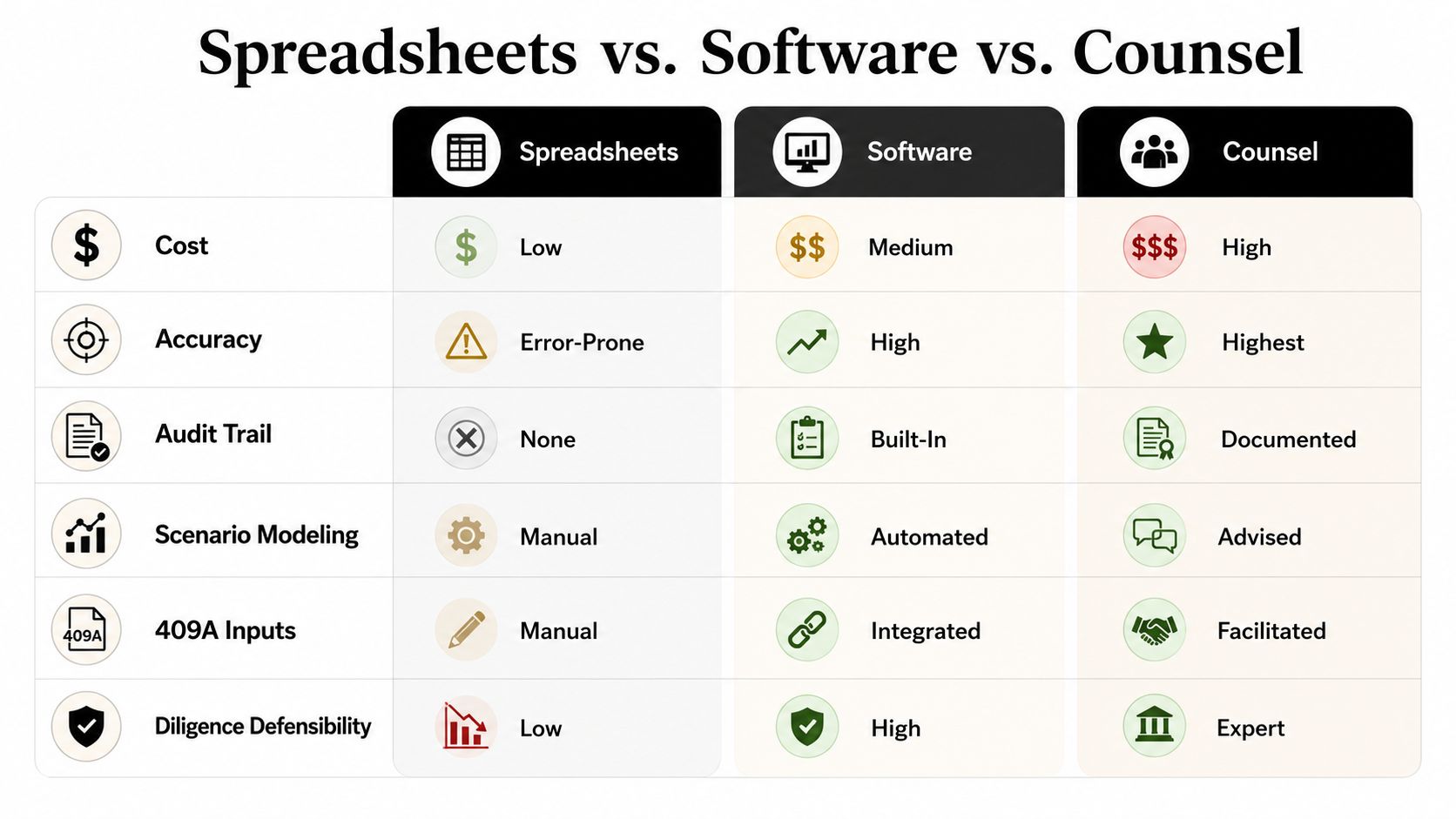
The trade-off founders should evaluate
| Criterion | Spreadsheet | Dedicated software | Attorney-managed record |
|---|---|---|---|
| Cost | Lowest direct cost | Subscription or service cost | Highest professional cost |
| Accuracy | Depends on formulas and review | Stronger controls, still document-dependent | Legal review plus system controls |
| Audit trail | Usually manual | Built into the platform | Documented and legally reviewed |
| Scenario modeling | Manual | Automated tools | Modeled with legal interpretation |
| 409A inputs | Manually entered | May be integrated or referenced | Coordinated with counsel and valuation providers |
| Diligence defensibility | Low once complexity grows | Stronger if reconciled | Strongest when counsel maintains the record |
Software doesn't cure a missing board consent, an incorrect SAFE term, or a certificate that was never issued. It gives the team a better system for recording the information. The legal documents remain the source of authority.
Founders who want broader context on how ownership analysis connects to financing decisions can review this resource on equity valuation by Dealmaker Wealth Society. For a company approaching a priced round, combining software with counsel is often more defensible than relying on either one alone.
A practical tiered rule works well:
- Simple formation: Use a controlled spreadsheet with document references and restricted editing.
- Multiple grants or SAFEs: Move to dedicated software and reconcile the imported data.
- Financing, audit, or exit: Have startup counsel review the table, source records, and pro forma model before signing.
Common Mistakes and Red Flags We See in Diligence
Diligence rarely finds one dramatic error. It finds a chain of small omissions that no longer reconcile.
A phantom grant is a promise made in an offer letter, founder email, or advisor conversation without board approval, a signed grant agreement, or a cap table entry. The fix isn't to add the recipient. Reconstruct the facts, obtain appropriate approval, execute the governing agreement, and document how the correction affects the record.
Mismatched certificates create a different problem. If the certificate says one share count and the cap table says another, the company needs to compare both records with the stock ledger and supporting approvals. Don't choose the number that makes the financing model look better.
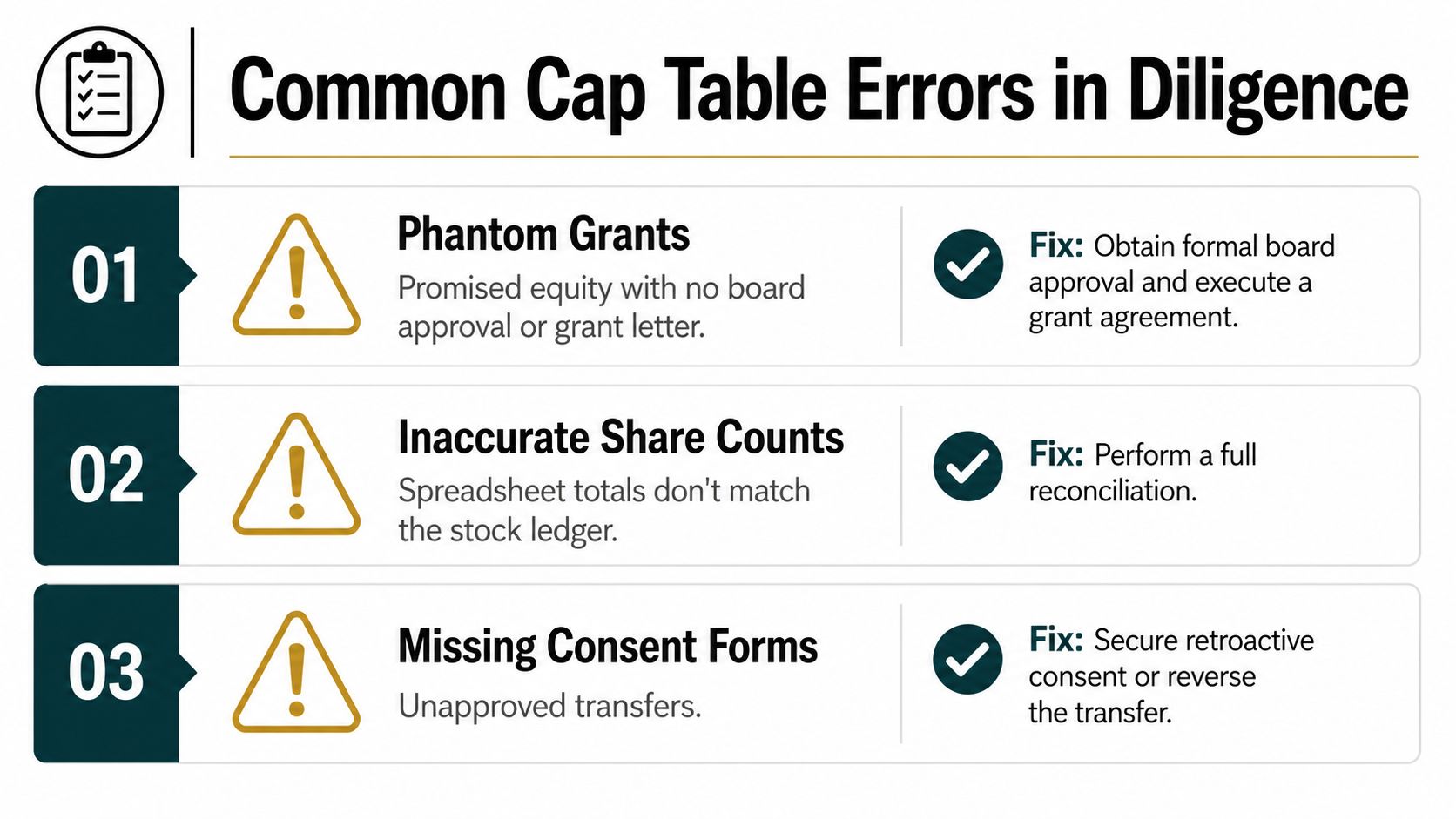
Other warning signs include:
- Missing 83(b) elections: Review whether applicable elections were filed on time and preserve evidence of filing.
- Unmodeled SAFEs: Record the conversion terms, valuation cap, discount, and instrument identity instead of treating the SAFE as an unexplained percentage.
- Backdated option grants: Use the actual approval date and maintain the related 409A reference rather than changing dates to fit payroll or onboarding records.
- Unapproved transfers: Confirm that the transfer complied with the governing agreement and received the required consent.
- Unproven pro rata rights: Keep the signed investor agreement that grants the right. A spreadsheet note isn't enough.
A useful operational rule is simple: every equity event needs a signed document, dated approval, and same-week cap table entry. A broader resource such as the cloud accounting blog can help teams think about recordkeeping discipline, but it doesn't replace equity-specific legal reconciliation.
Your Cap Table Checklist and When to Call an Attorney
Run this checklist before a financing and as part of a recurring governance process. The objective isn't to make the spreadsheet look clean. It's to prove that every number connects to an authorized transaction.
- Reconcile share counts: Compare the cap table with the stock ledger, certificates, board records, and filed corporate documents.
- Confirm approvals: Locate board and stockholder consents for every issuance, transfer, repurchase, option grant, and pool change.
- Verify option records: Confirm written agreements, current exercise prices, vesting schedules, and supporting 409A materials.
- Reconcile convertibles: Match every SAFE and convertible note to its original instrument and record its conversion mechanics.
- Check vesting: Compare the cap table against board minutes, grant notices, exercise records, and separation documentation.
- Review the financing model: Compare the current record with the most recent term sheet draft, including pool treatment and conversion assumptions.
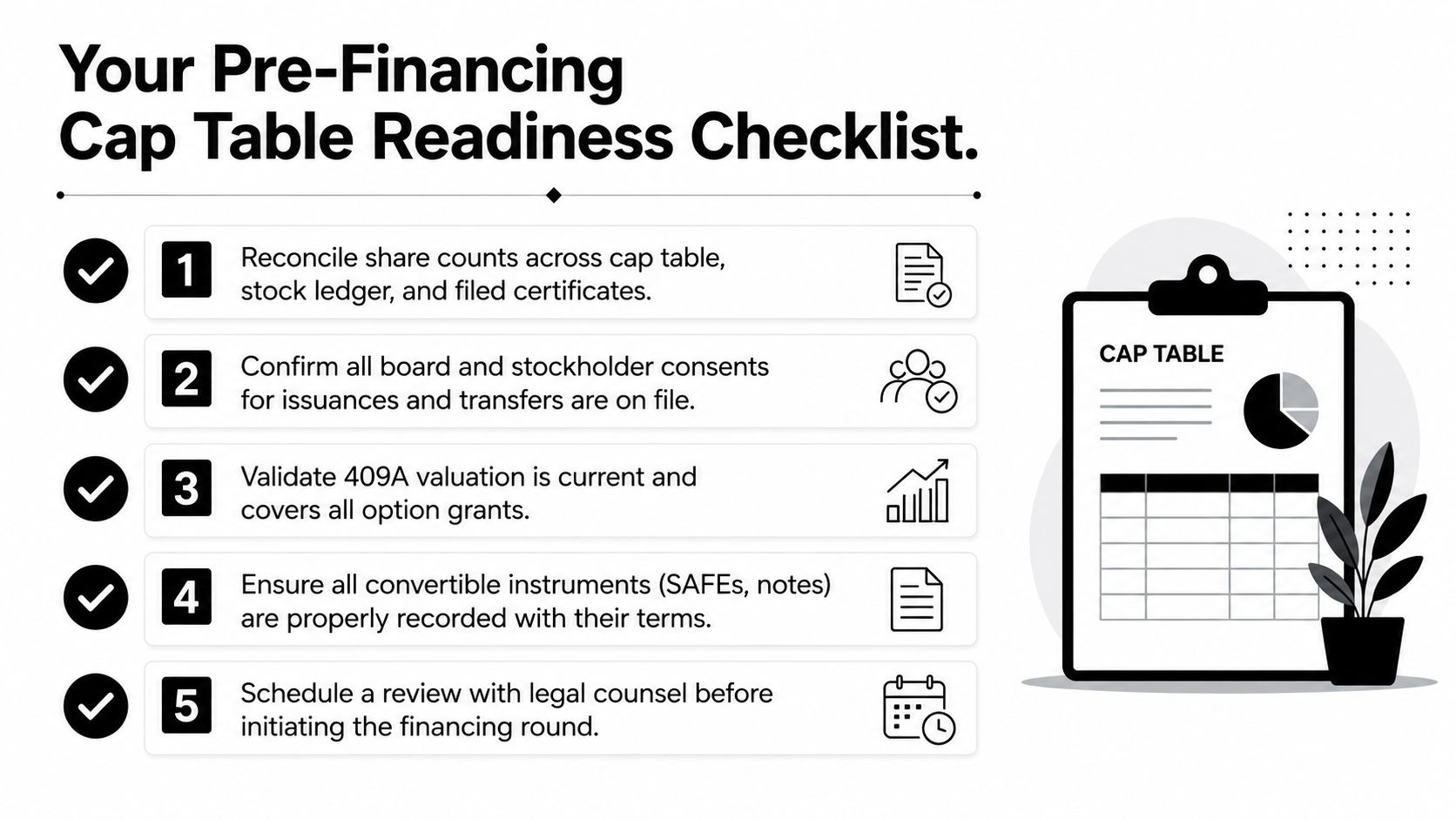
When counsel should be involved
Call startup counsel before a planned priced round, secondary restructuring, equity grant to a new executive, or any discovery that recorded shares don't match issued shares. Counsel can determine whether the problem is a data-entry correction, a missing approval, an invalid issuance, a tax issue, or a matter requiring consent from affected holders.
Frequently asked questions
How often should the cap table be updated?
Update it immediately after every equity event. Reconcile it quarterly and after major events such as financings, following the practical control guidance in cap table management software and reconciliation guidance.
What does audit-ready mean?
It means the record is current, complete, traceable, permission-controlled, and reconciled to source documents. A reviewer should be able to trace each material line from the cap table to an agreement, approval, certificate, ledger entry, or conversion calculation.
Who should own the record?
The company should designate one accountable owner, often a founder, finance lead, corporate secretary, or counsel. Multiple people may contribute, but only one system should be authoritative. Operational cap table guidance emphasizes maintaining a single authoritative record and updating it when transactions occur.
What fully diluted ownership should be used for investor analysis?
Use a denominator that includes issued common and preferred shares plus securities that could convert into equity, including options, warrants, SAFEs, and convertible notes. This shows the ownership impact an investor is evaluating.
The strongest capitalization table management process is not the one with the most advanced software. It's the one that keeps legal authority, transaction evidence, and ownership math synchronized every day.
Coto & Waddington, Attorneys at Law helps South Florida founders structure founder equity, vesting, option plans, SAFEs, convertible notes, financings, and clean cap table records. Visit Coto & Waddington, Attorneys at Law to discuss an ownership record that can withstand diligence before your next financing.



