Most founders search business license Florida expecting one clean answer, one form, and one fee. That's not how Florida works. The state doesn't issue a single general business license, so the question is not whether you need “the license,” it's which mix of entity registration, tax accounts, local business tax receipts, and industry permits apply to your exact city, county, and business model.
The practical mistake is easy to make. A founder files an LLC on Sunbiz, gets a clean approval, and assumes the business can open the next morning. In Florida, that filing is only one layer. Local licensing still lives at the county and city level, and some businesses need both approvals, which is why a Miami operation can end up with both a City of Miami Business Tax Receipt and a Miami-Dade County local receipt, depending on where it operates. For a broader framework on state licensing checks, HomeProBadge licensing guide is a useful reference point, but Florida's system still turns on local jurisdiction first.
Table of Contents
- Why Florida Has No Single Statewide Business License
- Forming Your Business Entity on Sunbiz
- Navigating Local Business Tax Receipts by Jurisdiction
- Identifying State Permits and Sales Tax Obligations
- Maintaining Compliance Through Renewals and Zoning Rules
- Your Florida Business License Checklist and Timeline
Why Florida Has No Single Statewide Business License
Local receipts, not one statewide permit
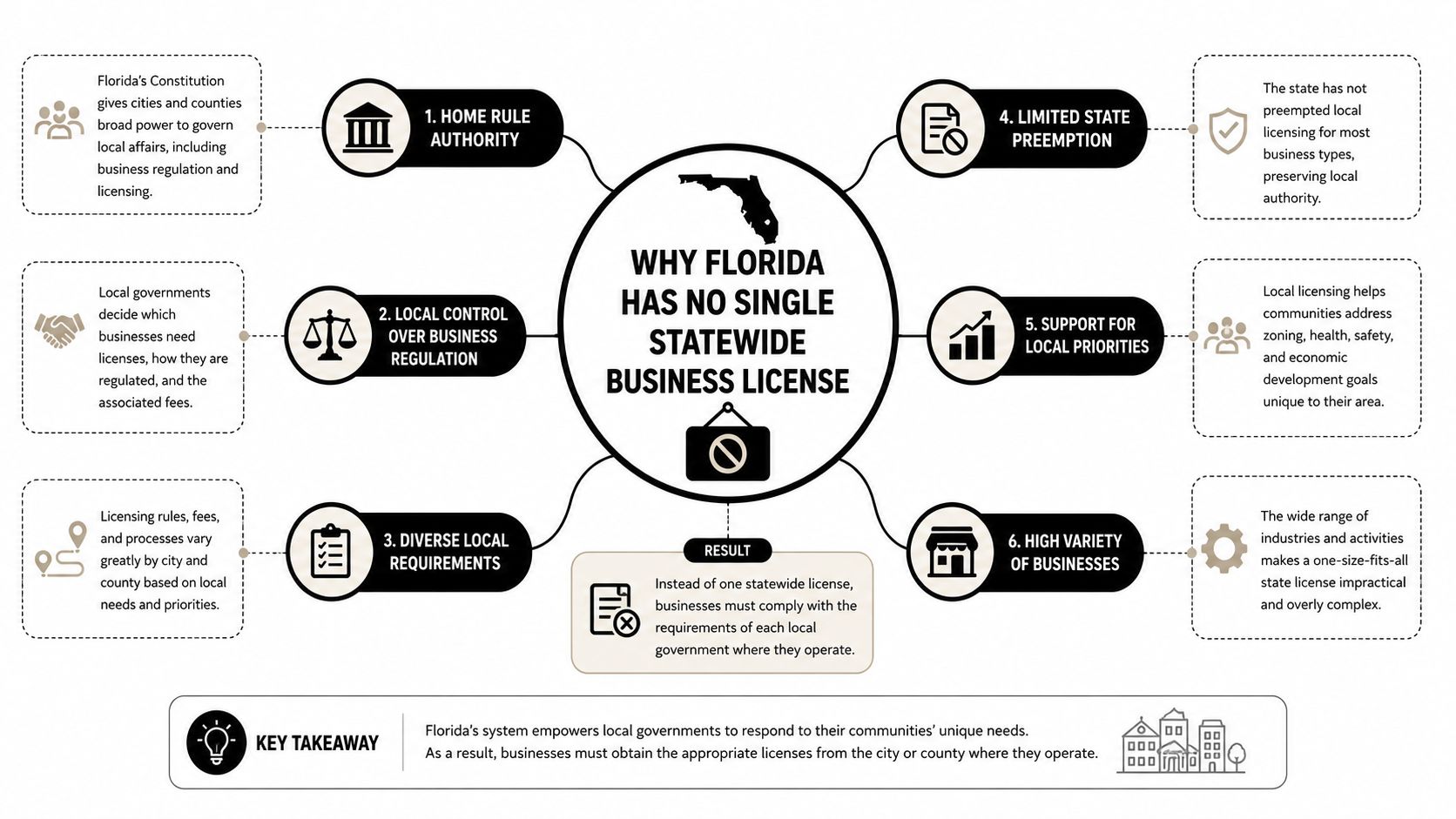
Florida's licensing structure is layered by design. The state does not issue a single statewide general business license, so owners usually deal with county and city business tax receipts plus any state or profession-specific permits that apply to the work. That is the part many founders miss when they search for a clean, one-step answer. Wolters Kluwer's Florida business license overview tracks with the official approach that points owners to local tax collectors instead of a state operating permit.
The practical question changes with the address. A company inside city limits may need a city receipt, a county receipt, or both. A business in an unincorporated area often deals with only the county layer. The label matters less than the jurisdiction. In practice, business license Florida is shorthand for a compliance map, not a single form.
Practical rule: if you do not know whether your address sits inside a city boundary, confirm it before you file anything.
The mistake I see most often is simple. Founders form their LLC, get the approval, and stop there. That leaves them legally formed but still exposed at the local level. The state recognizes the entity, but the city or county can still require its own receipt before you open doors, advertise, or start serving clients. If you are sorting the formation side at the same time, a Florida LLC formation guide helps separate entity setup from local licensing steps.
Why the distinction changes cost and timing
This layered setup affects budget and launch timing. Local business tax receipts are often in the $0 to several hundred dollars range depending on location and business type, and regulated industries can need extra state permits before they are allowed to operate. That matters for a startup planning cash flow or a tenant negotiating a lease start date. The HomeProBadge licensing guide makes the same point from the trade side, local approval and state approval can both matter before a business can open.
The right way to think about it is straightforward. Formation gets the entity into existence, tax and registration steps connect it to the state, and local receipts authorize the business to operate at a specific address. That sequence keeps the process organized and reduces rework, especially when a city clerk or tax office asks for zoning proof or an industry permit you have not secured yet.
A good way to avoid wasted time is to map the jurisdiction before filing. If you know you will operate across city lines, in multiple offices, or from a home base in one county and a warehouse in another, bring in counsel early. In Miami-Dade and Broward, that check often matters because nearby addresses can fall under different local rules even when the business model is identical. A business attorney can help sort the local layers before you submit the first form, which is much easier than fixing a noncompliant opening after the fact.
Forming Your Business Entity on Sunbiz
Choosing the right entity
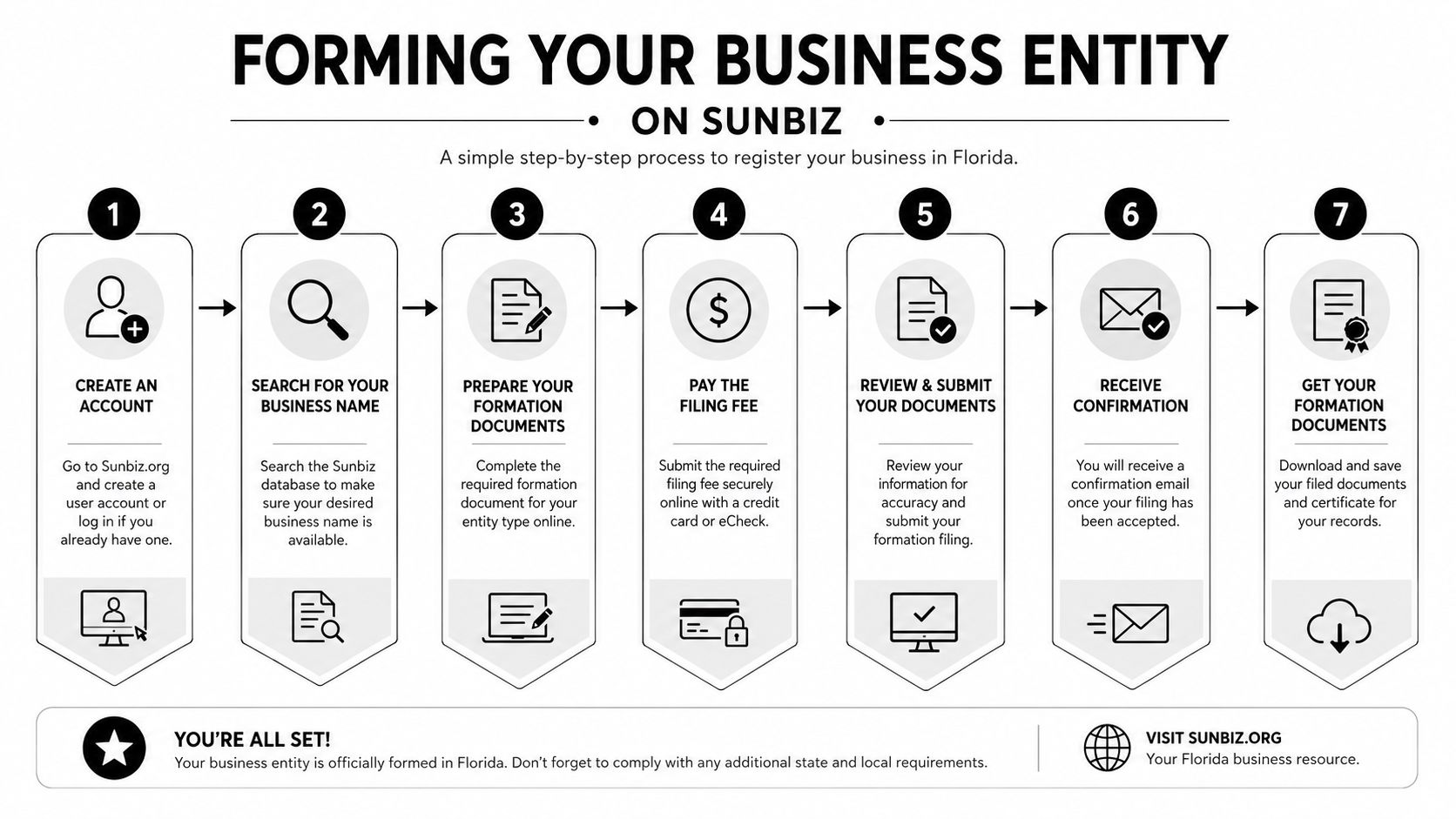
Before licenses, before tax receipts, before opening a bank account, Florida expects the business entity to exist. That usually means filing through the Florida Division of Corporations, Sunbiz. The entity choice, whether LLC, S-Corp, or C-Corp, shapes ownership, internal governance, and the way later licensing paperwork gets aligned. Sunbiz is also where your name availability check starts, so don't file until you know the name is open and the business structure matches your plans.
Florida's filing volume is no small thing. The state reports annual Sunbiz activity, and independent small-business data show 667,031 new business applications in 2023, the most of any U.S. state, with more than 3 million new businesses launched since 2019 and about 3.5 million small businesses making up 99.8% of all businesses in the state. Those numbers explain why incomplete filings can slow down quickly, because the system handles heavy volume and rejects sloppy submissions. Florida Division of Corporations yearly statistics is the source to keep in mind when you're deciding whether to rush or prepare.
A Florida-registered agent is worth using if privacy matters. It keeps your home address off public-facing records in many cases, which is especially helpful for solo founders and home-based businesses.
What to file before you apply for licenses
The clean filing sequence is straightforward. First, confirm the name. Then file the articles of organization or incorporation on Sunbiz, and after that get the EIN from the IRS so the business can open accounts and complete tax-related registrations.
Filing in the right order saves more time than trying to fix a rushed package later.
Before you submit, have the basics ready. Those usually include the business name, registered agent, principal address, and ownership details. If those items are still moving around, wait. A rushed filing is how founders end up with mismatched addresses, ownership records that don't line up with later permits, or a formation document that needs to be amended right away.
For a step-by-step formation reference, the Florida LLC formation guide is a useful companion if you're comparing structure choices. The main point is simple. Formation is not the end of compliance, it's the starting point. If your operating agreement or bylaws still need to be drafted, have them done before you file, not after your first local office starts asking how the company is governed.
Navigating Local Business Tax Receipts by Jurisdiction
City limits versus unincorporated areas
This is the part of Florida compliance that catches people off guard. Many businesses need a Local Business Tax Receipt, or LBTR, which is the modern local equivalent of what used to be called an occupational license, and it's usually issued by the county tax collector, sometimes with an extra city receipt if the business sits inside city limits. Wallace Law Florida's 2026 guide captures the basic structure well, and it reflects what local offices enforce.
The key distinction is city versus unincorporated county area. If your business address is inside a city, that city may require its own receipt on top of the county filing. If your address is outside city limits, the county often becomes the main local office. That difference matters for home offices too. A consultant working from an unincorporated Miami-Dade address may face a different approval path than a storefront inside Fort Lauderdale city limits.
Here's the operating rule I give founders: check the address first, then check the business activity, then check zoning. If any of those three change, the local answer can change too.
South Florida county comparisons
| Jurisdiction | County Receipt Required | City Receipt Required | Typical Fee Range |
|---|---|---|---|
| Miami-Dade County | Often yes, depending on address and business type | Sometimes yes, if inside a city such as Miami | $0 to several hundred dollars |
| Broward County | Often yes, depending on address and business type | Sometimes yes, if inside a city such as Fort Lauderdale | $0 to several hundred dollars |
| Palm Beach County | Often yes, depending on address and business type | Sometimes yes, if inside a municipality | $0 to several hundred dollars |
The office you contact depends on where the business operates, not where you plan to market it. A home-based consultant, for example, may have a simple county-level path if zoning allows it. A retail shop, on the other hand, can trigger both county and city review, plus a zoning check that looks at signage, parking, and customer traffic.
Zoning comes first in practice. If the address doesn't permit the activity, the tax receipt can be delayed or denied before fees even become the issue.
That's why the fastest route is not always the shortest form. Before applying, verify whether the location allows the business use, whether the county tax collector handles the filing, and whether the city separately requires a receipt. A founder who confirms those three points upfront usually avoids the back-and-forth that slows down openings in Miami-Dade, Broward, and Palm Beach.
Identifying State Permits and Sales Tax Obligations
Industry permits and sales tax triggers
Not every Florida business needs a state-level professional license, but many do, and the trigger is often what you sell rather than only where you sit. Construction, real estate, healthcare, food service, and cosmetology are obvious examples of regulated fields, and those businesses may need a permit from the Department of Business and Professional Regulation or another state agency before operating. A local receipt won't replace those approvals. It sits beside them.
You should also think about sales tax registration early, even if you do not have a storefront. Florida follows the same practical logic many states use, if you're making taxable sales, you may need to register with the Florida Department of Revenue before collecting tax. That is especially important for service businesses that also sell products, ecommerce brands that ship into Florida, and consultants who bundle taxable and non-taxable work in the same invoice.
A useful rule of thumb is this. Formation creates the entity, but it doesn't answer whether the business can legally sell the thing it sells. That question belongs to the state permit and tax side.
For owners comparing insurance and bonding needs alongside licensing, Florida All Risk Insurance guidance is a practical resource to review because some licensing paths and contracts expect proof of coverage or bonding before approval.
Remote sellers and cross-border activity
Remote and multi-jurisdiction businesses create a different kind of mistake. Founders often assume that because they don't have a storefront, they don't have a tax or licensing issue. That's not reliable. If the company sells across city, county, or state lines, the core question becomes which obligations attach to the transaction flow and where the business has nexus or local presence.
That matters for e-commerce and service businesses that operate from home offices, co-working spaces, or client sites. It also matters if you're selling into other states, because your Florida setup may be only one piece of a larger compliance picture. A bilingual attorney is especially helpful here, since a founder may be dealing with English-only forms from one office and Spanish-language communication from another, while trying to keep the tax registrations aligned.
For a broader setup checklist, the Florida startup setup guide can help you compare formation, tax, and licensing steps in the right order. The point is not to over-lawyer the process. It's to avoid the common assumption that one filing, or one storefront, solves everything.
Maintaining Compliance Through Renewals and Zoning Rules
Renewals, address changes, and zoning shifts
Getting approved is only the first checkpoint. Most local receipts renew on a recurring schedule, and Sunbiz requires annual reports for LLCs and corporations, so compliance is not a one-and-done event. If a business forgets a renewal, it can end up operating without a valid license, which is the kind of problem that starts with a late calendar reminder and ends with avoidable penalties or a forced pause in operations.
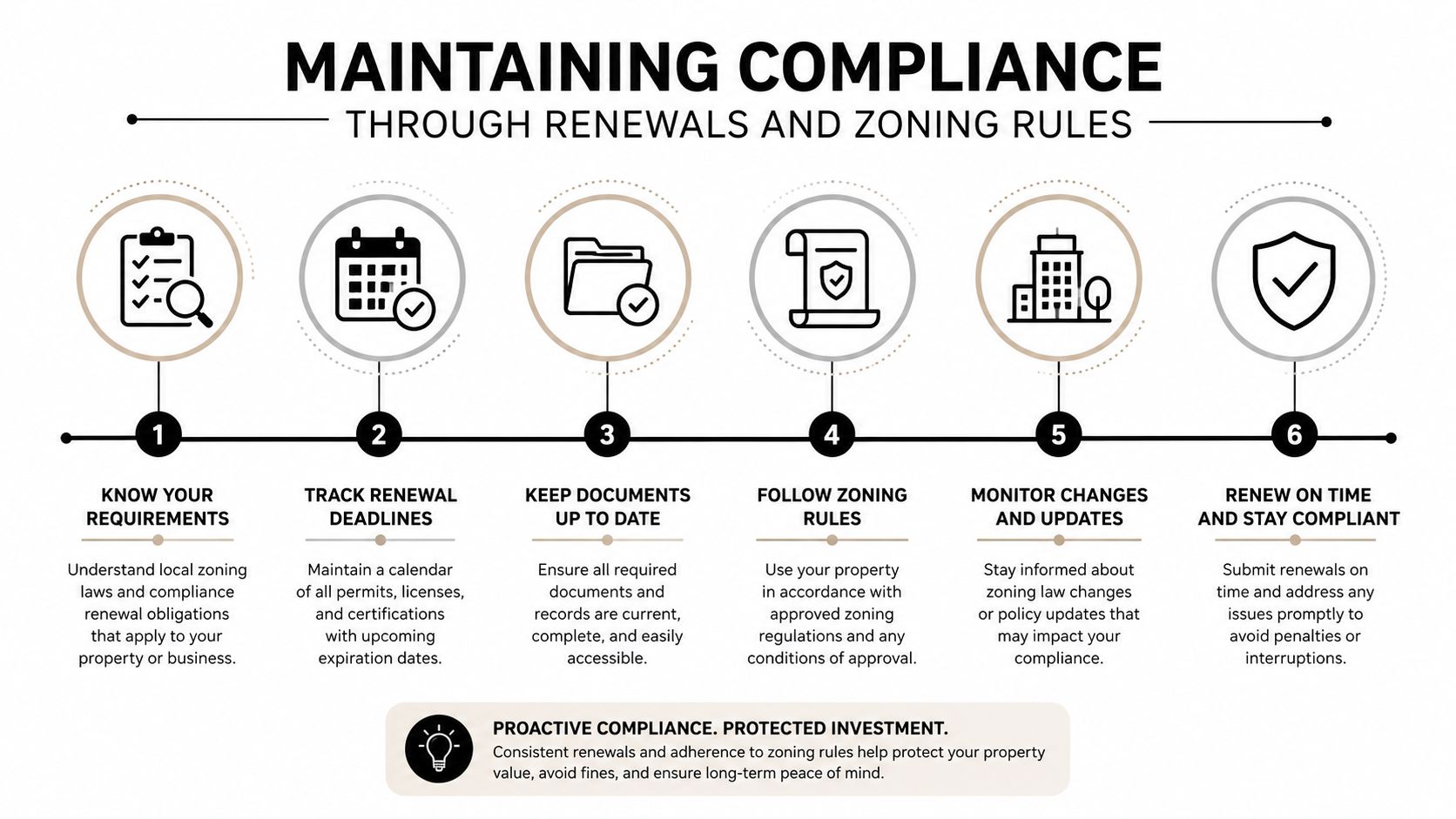
Zoning changes are just as important. If you move offices, add a home-based branch, or expand into a new city, you may trigger a new review. The same business that was fine at one address can become noncompliant at the next one because the local use category changed. That's why it's smart to think of licensing as tied to the location and activity, not just the entity name.
Best practice: set renewal reminders 60 days before each deadline, not the week before.
South Florida adds another practical layer. English and Spanish paperwork often move through the same office systems, and misunderstanding a local notice can create delay. A founder who can read both versions, or has counsel who can, usually catches filing issues earlier and keeps the office from bouncing the application back for avoidable corrections.
Keeping multi-location businesses clean
If you operate in more than one city or county, the compliance burden multiplies. One office may want a county receipt, another may require a city receipt, and a third may need both plus an industry permit. The business is still the same entity, but each address can create its own local profile.
A clean annual review prevents a lot of that friction. It should include the following:
- Renewal dates: confirm every local receipt and annual report deadline.
- Address changes: check whether a new lease or home office changes the local jurisdiction.
- Business activity: verify whether new services or products triggered a permit or sales tax update.
- Zoning status: make sure the use remains allowed at the current location.
Coto & Waddington, Attorneys at Law, is one option founders use for a bilingual compliance review when they need formation documents, licenses, and local registrations checked together. The value is in avoiding missed obligations before they become problems, especially when a company grows from one address to several.
Your Florida Business License Checklist and Timeline
A realistic 2 to 4 week sequence
A founder with clean documents can often move through the Florida setup process in roughly 2 to 4 weeks, which lines up with neutral industry guidance on licensing timelines when the paperwork is ready. Forbes Advisor's Florida business license guidance notes that many businesses can complete the process in that range, and the biggest variable is document readiness. In real life, the slowdowns come from missing addresses, unclear ownership records, zoning questions, or waiting to fix one filing before submitting the next.
A practical South Florida sequence looks like this. First, confirm the entity name and file formation on Sunbiz. Then get the EIN, register for any Florida Department of Revenue account that applies, and identify whether the county tax collector and city office both need applications. If the business is regulated, file the state-profession permit before opening. If the location is unusual, verify zoning before you submit the local receipt forms.
That order works because it keeps every filing aligned. It also avoids the common mistake of filing the local receipt before the entity name, ownership, or address is stable.
For a founder checklist that addresses the front-end setup, the Florida startup checklist is a useful companion when you want the sequence in one place.
Checklist for founders
Use this as a working license matrix, not a marketing document.
- Entity formation: File with Sunbiz. Keep the business name, registered agent, principal address, and ownership details ready.
- Federal tax ID: Obtain the EIN from the IRS before banking or tax registration.
- State tax account: Register with the Florida Department of Revenue if sales tax or employer registration applies.
- County receipt: Confirm whether your address falls under county-only filing or a county plus city path.
- City receipt: Check whether your municipality requires a separate Local Business Tax Receipt.
- Industry permit: Confirm DBPR or other state-agency licensing for regulated work.
- Zoning review: Verify that the business activity is allowed at the address.
- Renewal tracking: Put every expiration and annual report date in one calendar.
The easiest way to manage all of this is a spreadsheet with one line per obligation, one column for the office, one for the document, and one for the deadline. That keeps the business license Florida puzzle visible instead of buried in email threads and unread PDFs.
If you're forming, licensing, or cleaning up a Florida business structure, Coto & Waddington, Attorneys at Law can help you sort the entity, local receipts, and compliance timeline in plain English or Spanish. Visit Coto & Waddington, Attorneys at Law to schedule a consultation and get a practical plan for your city, county, and business model.