You're probably in a familiar spot. The idea is real, the name is picked, maybe you've already talked with a co-founder or your first client, and now you're staring at a formation site that promises you can launch in minutes. It feels efficient. It also makes it easy to confuse filing a business with building one.
That's where founders in South Florida get tripped up. A business can be “formed” on paper and still be exposed where it matters most: ownership disputes, unclear authority, cross-border tax issues, missing contracts, and basic compliance gaps that don't show up until money, conflict, or growth arrives. In Miami and Fort Lauderdale, those risks get sharper because many companies have bilingual teams, foreign owners, family capital, or business ties across multiple countries.
A good business formation attorney doesn't just submit state forms. The job is to structure the company so it can operate cleanly after filing day. That means governance, equity, signatures, authority, compliance, and planning for the decisions founders usually postpone until they become expensive.
Table of Contents
- Your Big Idea Needs a Strong Legal Foundation
- What a Business Formation Attorney Actually Does
- Attorney vs DIY The Hidden Costs of Cheap Formation
- Choosing Your Entity LLC vs S-Corp vs C-Corp in Florida
- Your Step-by-Step Guide to Engaging an Attorney
- Understanding Formation Costs and Flat-Fee Pricing
- FAQs for South Florida and Bilingual Founders
Your Big Idea Needs a Strong Legal Foundation
Founders often treat legal formation like an administrative errand. It isn't. It's the first serious decision about control, liability, taxes, and how the business will function when people disagree.
In practice, the biggest mistake isn't choosing the wrong online filing service. It's assuming the filing itself is the structure. The state accepts your Articles. That doesn't mean your ownership is clear, your internal rules are settled, or your personal assets are protected the way you think they are.
Filing the company is only step one
A business formation attorney helps you answer questions that the filing portal won't ask properly:
- Who owns what: Not just percentages, but voting rights, vesting expectations, and what happens if someone leaves early.
- Who can bind the company: If one founder signs a contract or takes on debt, the business needs clear authority rules.
- How profits and decisions work: Especially important for LLCs with multiple members or family-run businesses.
- What happens when things go wrong: Deadlocks, exits, disability, buyouts, and internal disputes need rules before emotions get involved.
A founder who skips that planning usually ends up paying for it later through cleanup work, renegotiation, or litigation risk.
Practical rule: If your business has more than one owner, more than one market, or any plan to grow, formation should be treated as strategy, not paperwork.
South Florida founders also need to think beyond the legal entity itself. Insurance, contract flow, privacy terms, and vendor risk all connect to formation. If you're working through your early risk stack, this overview of insurance for Miami small businesses is a useful companion because entity protection and operational protection work together.
Start with the business you want to build
The right structure depends on your actual business model. A solo consultant, a family-owned service company, a venture-backed startup, and an e-commerce brand with overseas partners should not be formed the same way.
That's why founders are usually better served by making the legal call early, before equity promises, handshake deals, and copied templates harden into problems. If you're planning a Florida launch, reviewing a practical guide on setting up a business in Florida can help you frame the right questions before you file.
The tip is simple. Don't ask only, “How do I form this company?” Ask, “How do I want this company to function six months from now when money, people, and responsibility start moving?”
What a Business Formation Attorney Actually Does
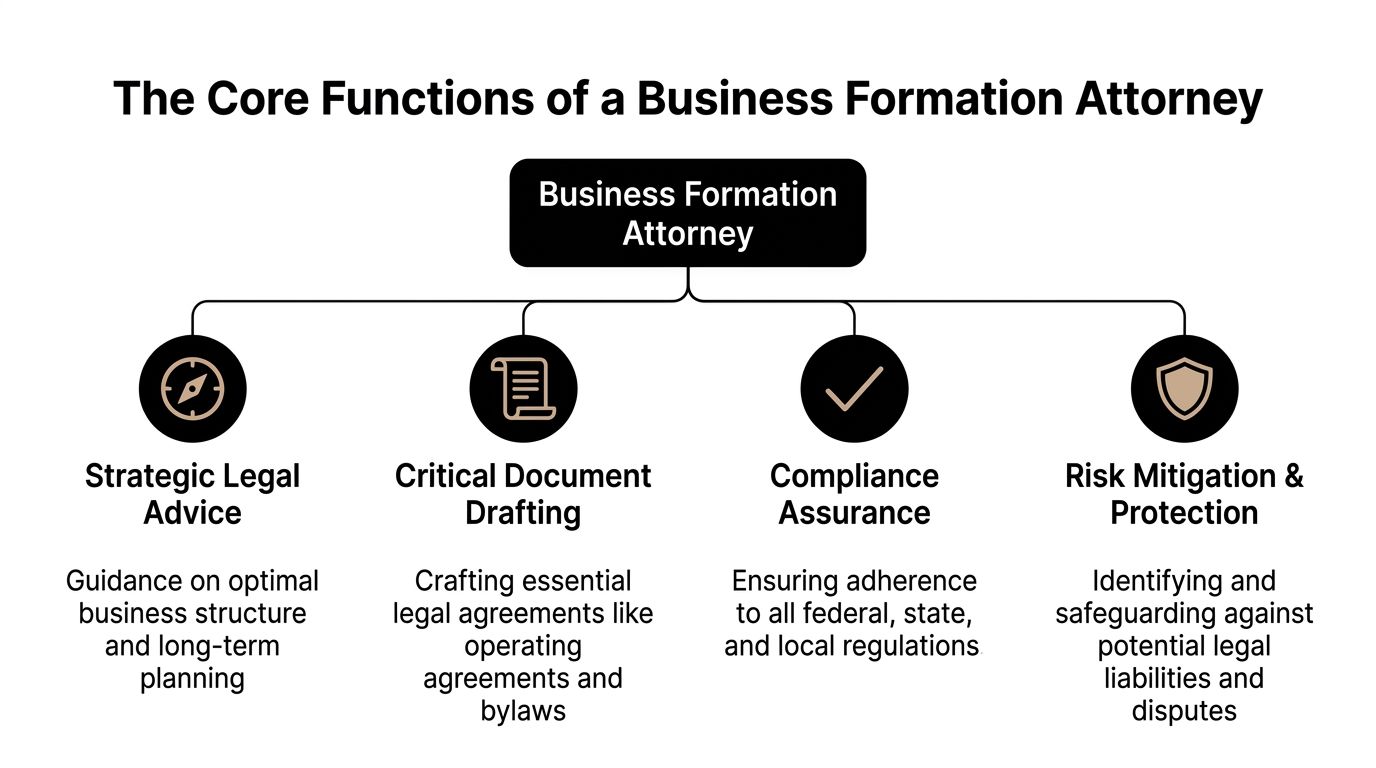
A business formation attorney is closer to an architect than a document filer. The state filing is the permit. The primary work is designing a structure that can carry weight.
Strategic entity selection
The first job is choosing the legal structure that fits the company's goals. That includes the immediate question of LLC versus corporation, but it also includes tax treatment, ownership restrictions, management style, fundraising plans, and whether owners are U.S. persons or foreign nationals.
Founders often oversimplify. They hear that an LLC is “easy,” an S-Corp “saves taxes,” or a C-Corp is “for startups.” Sometimes that's true. Sometimes it creates avoidable friction. The right answer depends on who owns the business, how profits will flow, and what kind of growth path you're building.
Governance documents that actually govern
Once the entity is chosen, the attorney drafts the rules that make the company operational. For an LLC, that usually means an operating agreement. For a corporation, it means bylaws, stock setup, and related governance records.
These documents aren't filler. They answer practical questions such as:
- Decision rights: Who votes, and on what.
- Transfers: Can an owner sell or assign an interest freely.
- Capital contributions: What each founder is putting in, and what happens if someone doesn't follow through.
- Exit mechanics: What the company and other owners can do if a founder leaves.
According to Boyer Law Firm's discussion of business formation lawyer selection, a business formation attorney must engineer the operating agreement or corporate charter so ownership structure and liability exposure are aligned, and the inclusion of indemnification clauses and capitalization tables can reduce the risk of piercing the corporate veil by up to 40% in litigation involving asset mismanagement.
A weak operating agreement doesn't fail on the day you sign it. It fails on the day someone challenges it.
Equity structure and founder planning
Early promises create late conflict. Founders say things like, “We'll split it evenly for now,” or “We'll paper it later.” Later usually arrives after effort is unequal, money has been spent, or one founder is no longer active.
A business formation attorney helps formalize equity in a way that reflects reality. That may include founder roles, vesting logic, contribution expectations, or simple restrictions that prevent a departed founder from keeping disproportionate control.
Foundational compliance
Formation also includes making sure the company can operate. That means federal tax identification, internal authorizations, signature authority, and basic compliance steps that support banking, hiring, and contracting.
A good tip here is to ask for a closing checklist at the end of formation. You want more than stamped filings. You want the practical set of documents and decisions the business will rely on in ordinary operations.
Attorney vs DIY The Hidden Costs of Cheap Formation
DIY formation works best when the business is extremely simple and likely to stay that way. One owner. No investors. No custom ownership terms. No meaningful contracts. No intellectual property concerns. No cross-border issues. That's a narrower category than most founders think.

Cheap formation often pushes cost downstream
The online service gets the entity filed. Then the operational phase begins. A partner assumes they own half because of a text exchange. A family investor expects repayment terms nobody documented. A founder signs a client agreement without clear authority. The company applies for funding and discovers its records don't match its story.
That's the hidden cost. The problem isn't always that DIY filing is wrong. It's that it leaves the operational rules unfinished.
The most common pain point is internal conflict. Concord Lawyers notes that 60% of small business lawsuits stem from internal disputes over ownership or management roles that were never clearly codified in a contract. That's exactly the kind of dispute template filings fail to prevent.
Where DIY documents break
Some founders use online platforms intelligently. Some even compare tools before deciding whether they need counsel. If you're evaluating that route, this breakdown of Clerky's offerings for startup founders gives helpful context on what startup formation tools are built to handle. The key is recognizing what they don't do. They don't give legal judgment specific to your facts.
Typical failure points include:
- Unclear ownership: A template doesn't know whether sweat equity, family money, or deferred contributions need special treatment.
- No real operating rules: Generic provisions rarely address deadlocks, founder exits, or approval thresholds in a meaningful way.
- Cross-border blind spots: A standard workflow won't flag the implications of non-U.S. owners, bilingual contracts, or foreign qualification issues.
- Cleanup costs later: Fixing mismatched cap structure, authority issues, or missing governance almost always costs more than setting it up correctly.
Founders don't usually call a lawyer because formation was expensive. They call because the “cheap” version didn't answer the question they're facing now.
What works better
The practical dividing line is this. If the company has multiple owners, expects outside money, depends on contracts, or has any cross-border element, legal formation should be custom, not assembled from default checkboxes.
A useful tip is to judge formation services by the questions they ask. If the process doesn't ask about decision rights, exits, future fundraising, or foreign ownership, it probably isn't solving the hard part.
Choosing Your Entity LLC vs S-Corp vs C-Corp in Florida
Entity choice shouldn't be reduced to internet slogans. Each option solves a different problem. In Florida, founders usually compare the LLC, the S-Corporation tax election, and the C-Corporation because those are the structures most commonly discussed for small businesses and startups.
Before comparing them, one point matters: an S-Corp is a tax election, not a separate state-law entity. In practice, a business is generally formed as a corporation or LLC, then evaluated for S-Corp tax treatment if it qualifies and if that election makes sense.
Florida-specific cost and filing context
Cost isn't the only factor, but it matters early. Lamar Legal explains that the Florida filing fee for an LLC is approximately $125, while forming a corporation requires a filing fee of about $70 plus additional document fees. That doesn't decide the entity choice by itself, but it does frame the basic filing threshold.
Florida Business Entity Comparison LLC vs S-Corp vs C-Corp
| Feature | LLC (Limited Liability Company) | S-Corporation | C-Corporation |
|---|---|---|---|
| Core legal form | State-law LLC | Usually a corporation or LLC with S-Corp tax election | State-law corporation |
| Liability protection | Strong if properly maintained | Strong if corporate formalities are followed | Strong if corporate formalities are followed |
| Tax treatment | Often flexible, commonly pass-through | Pass-through taxation if eligibility rules are met | Separate corporate taxation |
| Ownership flexibility | Often more flexible for custom arrangements | More restrictive, especially where ownership eligibility is concerned | Generally the cleanest structure for institutional investment |
| Foreign owners | Often more practical than S-Corp in cross-border situations | Can be problematic because eligibility restrictions matter | Common option when broader ownership flexibility is needed |
| Administration | Usually simpler than a corporation, but still needs real governance | Requires attention to both entity formalities and tax-election compliance | More formal governance, records, and stock mechanics |
| Investor readiness | Can work well for many closely held businesses | Usually not the default for venture-style growth | Often preferred for scalable equity, stock issuance, and venture financing |
| Best fit | Owner-operated businesses, family businesses, many service companies | Businesses that qualify and benefit from the election after tax review | Startups planning to raise capital or issue institutional-style equity |
When each structure tends to fit
For many closely held Florida businesses, the LLC is the most workable starting point. It allows flexibility in management and internal economics, which helps when founders have unequal roles or family relationships complicate ownership.
S-Corp treatment can be useful in the right fact pattern, but founders often jump to it too quickly. The better question is whether the underlying entity and tax eligibility do support it. This is one reason many small business owners review a focused comparison of LLC vs S-Corp for small business before making the election.
The C-Corp usually becomes the cleaner option when stock structure, future financing, and formal governance matter more than simplicity. That's why founders with venture ambitions often end up looking at corporate structure early, including whether Florida or Delaware is the right jurisdiction.
Founder tip: Choose the entity for the business you intend to run, not the one that sounds cheapest or most popular in a forum thread.
Your Step-by-Step Guide to Engaging an Attorney
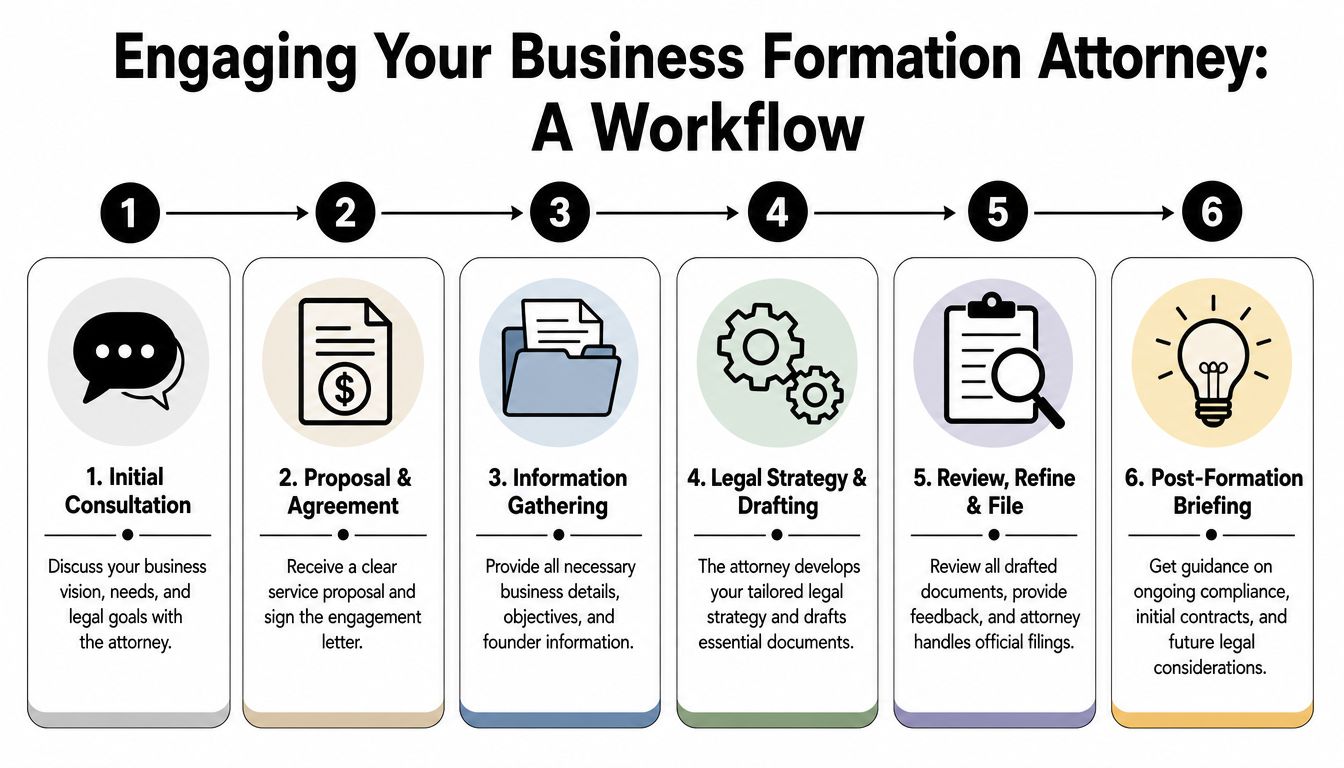
A lot of founders delay calling a lawyer because they assume the process will be vague, slow, or more formal than it really is. In a good formation engagement, the workflow is straightforward. The point is to get clarity early, make decisions in the right order, and leave with documents the business can use.
What the workflow usually looks like
Initial consultation
The first meeting should focus on facts, not theory. Who are the owners, where are they located, what does the business do, how will it make money, and what are the growth plans?Information gathering
You'll usually provide legal names, addresses, ownership percentages, management structure, and basic operational details. If there are foreign owners, family capital, prior side agreements, or existing IP, that should come up here.Drafting the core package
The formation process solidifies. The attorney prepares the filing documents and the internal governance documents that control ownership, authority, and operations.Review and revisions
Founders should read these documents carefully. This is the right moment to fix assumptions before they become obligations.
The filing stage and what must happen after
Once the structure is approved, the state filing is submitted. After that, the company still needs its operating setup completed. For incorporated businesses, Trembly Law notes that an EIN is a mandatory federal requirement, functioning like a corporate Social Security number for IRS tax reporting and hiring employees.
That matters because many founders think the state approval is the finish line. It isn't. Banking, payroll, vendor onboarding, and tax reporting often depend on federal and internal setup being handled correctly.
What to ask for before the matter closes
A clean handoff usually includes more than formation proof. Ask for:
- Final signed governance documents: Not drafts, not blank templates.
- A summary of ownership and authority: So founders know who can sign what.
- A compliance checklist: Annual filings, internal approvals, and immediate next steps.
- Practical follow-up guidance: Contracts, trademarks, privacy terms, and basic operational documents.
One example of a firm that offers this kind of startup-focused formation work is Coto & Waddington, Attorneys at Law, which handles LLC, S-Corp, and C-Corp setups along with related startup documentation in South Florida.
A useful tip is to bring your real business plan to the consultation, even if it's rough. The legal structure is only as good as the facts you share.
Understanding Formation Costs and Flat-Fee Pricing
Founders usually ask the cost question in the first conversation, and they should. Legal fees aren't just about price. They affect how comfortable you feel asking questions, making revisions, and getting practical advice before small issues turn into larger ones.
Hourly billing versus flat-fee pricing
Under hourly billing, every call, email, revision, and follow-up affects the final bill. That model can work for litigation or unusual transactions, but it often makes founders hesitate at the exact moment they should be asking more questions.
Flat-fee pricing is different. It defines the scope and cost in advance, which gives a startup room to get the structure right without worrying that every clarification starts a meter running.
This is easier to find now because the South Florida legal market is large and competitive. According to the South Florida legal market report, South Florida is the 3rd largest legal services market in the United States and has had the 4th fastest growth in lawyer population over the past five years, which creates room for modern firms to offer more predictable pricing models.
What a good flat-fee package should include
A formation quote is only useful if the scope is clear. A solid package should spell out whether it includes:
- Entity selection guidance: Not just filing whichever form the client first mentions.
- Core formation documents: Including the internal governance paperwork.
- Basic founder revisions: So the documents match the deal.
- Filing coordination and follow-through: Including practical next-step guidance.
If you're comparing billing models, this explanation of flat-fee vs hourly rate for a Miami startup lawyer is a useful way to frame the trade-off.
Ask two questions before you hire anyone: What exactly is included, and what would trigger an added fee?
That tip alone can prevent a lot of frustration.
FAQs for South Florida and Bilingual Founders
Can a non-U.S. owner be part of the business?
Sometimes yes, but the answer depends on the entity type, tax treatment, and where the owners live. This comes up constantly in Miami-area companies because cross-border ownership is normal here, not unusual.
A useful context point is that a 2024 NBER finding referenced by FindLaw states that 35% of new U.S. businesses are founded by immigrants, which helps explain why generic legal content often feels incomplete for South Florida founders.
Can a foreign company do business in Florida without extra filings?
That's risky. In Florida, foreign corporations doing business without proper qualification can face fines and may be barred from maintaining legal actions in Florida courts until they comply, according to Gilbert Garcia Group's discussion of Florida business formation.
The practical tip is to ask the qualification question before operations begin, not after contracts are signed.
Do I really need bilingual legal documents?
If owners, family investors, or counterparties are operating in both English and Spanish, bilingual drafting can prevent misunderstandings about authority, payment, ownership, and dispute terms. Informal translation after signing usually isn't enough.
Even basic language choices matter when people are discussing roles. If your team is trying to align business terminology across languages, this guide on how to say entrepreneur in Spanish is a simple reference point for founder-facing communication.
What if I already filed my entity myself?
That doesn't mean you're stuck. Many businesses need a post-filing legal cleanup. The first step is reviewing ownership, management authority, governance documents, and whether the current structure still matches the business.
What should I do first if I'm about to launch?
Get the legal structure reviewed before revenue, hiring, or fundraising starts. It's much easier to draft from a clean slate than to unwind undocumented promises later.
If you're forming a company in South Florida and want practical legal guidance on structure, governance, contracts, and cross-border issues, talk with Coto & Waddington, Attorneys at Law. A focused formation review early can save you from fixing ownership, compliance, and liability problems after the business is already moving.