You may be sitting on the exact inflection point that turns a successful sales career into a full-fledged business. You've closed deals, built relationships, and reached the point where staying under another broker's umbrella no longer fits how you want to operate. The Florida broker license is the gatekeeper, but the essential decision is bigger than passing an exam. You're stepping into compliance, supervision, contracts, and risk allocation.
That's why most guidance on broker license Florida issues feels incomplete. It tells you how to get licensed, but not how to think like the owner of a regulated business. In Florida, the licensing steps matter. So do the legal consequences of getting the structure wrong after the license is issued.
Table of Contents
- Understanding Broker Eligibility and License Types
- Navigating Florida's Pre-License Education and Exam
- The Application Process Background Checks and Fees
- Post-Licensing Education and Staying Compliant
- From Licensed Broker to Business Owner Forming Your Brokerage
- Fast-Track Your License with Broker by Endorsement
Understanding Broker Eligibility and License Types
A founder spends weeks comparing broker schools, picks a brand name, and starts planning office space. Then the application stalls because the founder does not yet meet Florida's experience standard for a broker license. I see versions of that mistake often. The licensing question comes first, but the business-structure question follows close behind, because the type of license you hold affects how you can lawfully operate the company.
Start with the requirements for a real estate broker
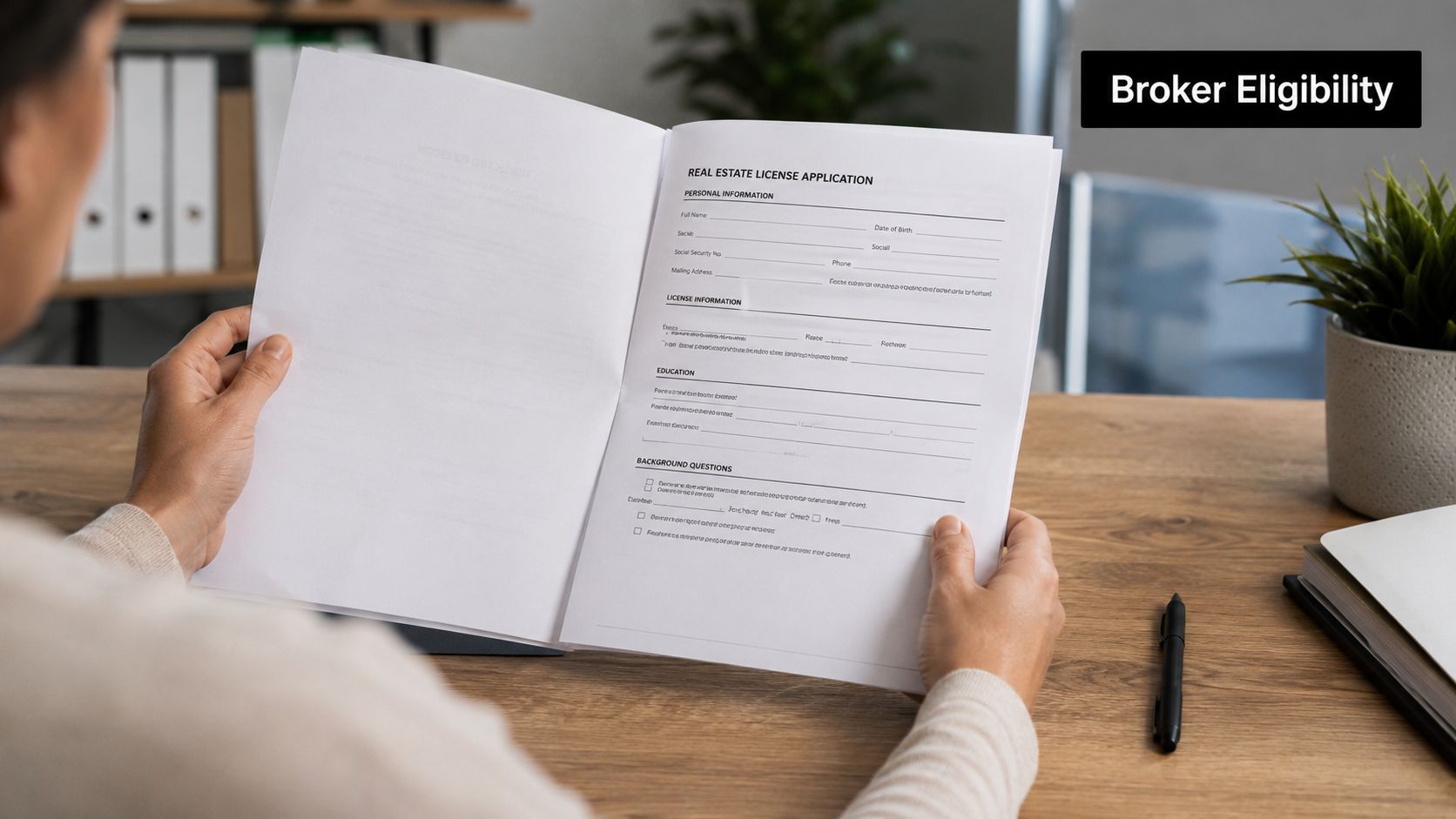
Florida treats a broker as a supervisory license, not a simple promotion from sales associate. To qualify, an applicant generally needs to be at least 18, hold a high school diploma or GED, have a Social Security number, and show the required active sales associate experience before the state will grant broker status, according to Kaplan's Florida state requirements summary.
That distinction has business consequences.
A sales associate can work under another broker. A broker can open the brokerage, supervise licensees, and take on compliance duties that attach to trust money, advertising, recordkeeping, and transaction oversight. If your long-term plan is to recruit agents or build a firm under your own control, broker eligibility is not just a licensing checkpoint. It is the legal threshold for operating the business model many founders assume they can start right away.
Before you spend money on branding, lease negotiations, or onboarding systems, review your entity and authority structure together. This Florida business setup guide is a useful starting point if you are mapping out who will own the company, who will serve as the qualifying broker, and what needs to be filed in the right name from day one.
Practical rule: Confirm that your experience, identity documents, and business plan line up before you pay vendors or sign contracts.
Choose the right license category before you form the business around it
Florida applicants often use "broker" loosely, and that creates preventable compliance problems. In real estate, the title determines more than status. It affects supervision, compensation flow, and whether the company can legally hold itself out as a brokerage.
The common lanes are straightforward:
- Sales associate. Licensed to perform real estate services under a supervising broker.
- Broker. Licensed to operate independently and supervise sales associates or broker associates.
- Broker associate. Holds broker-level qualifications but works under another broker rather than opening a separate brokerage.
That last category deserves more attention than it gets. Many experienced professionals qualify for a broker license but should not open a standalone firm yet. A broker associate structure can make sense if you want higher licensing status without taking on immediate office, staffing, trust accounting, and supervision risk. From a legal and financial perspective, that can be the better interim step.
Do not confuse real estate with other broker licenses
Florida uses the word "broker" across several regulated industries, but the licensing systems are separate. A real estate broker falls under the DBPR and Florida Real Estate Commission framework. Mortgage and insurance professionals answer to different statutes, regulators, forms, and operating rules.
The confusion usually shows up in two places. First, applicants pull the wrong checklist and rely on standards from another industry. Second, founders form an entity for one regulated activity and assume it can be repurposed for another without new filings or approvals. That assumption can delay launch and create advertising or compensation issues.
For a consumer-facing example from another regulated field, this guide for Florida homeowners on independent agents shows why insurance licensing works differently from real estate licensing. The lesson is simple. "Broker" is not one legal category in Florida.
Keep your records organized from the start. Maintain separate files for license eligibility, education records, entity formation documents, and brokerage operations. That discipline saves time later if the state asks for support, or if you need to prove that the company was formed and operated under the correct authority.
Navigating Florida's Pre-License Education and Exam
A common failure point looks like this. A strong sales associate decides to open a brokerage, signs up for the first course that fits the calendar, and studies just enough to pass. Weeks later, the person learns the school was slow to report completion, the exam window is tighter than expected, and the launch plan for the brokerage entity is now out of sequence. The licensing step and the business formation step are connected, even if the state processes them separately.
What the state expects before you sit for the exam
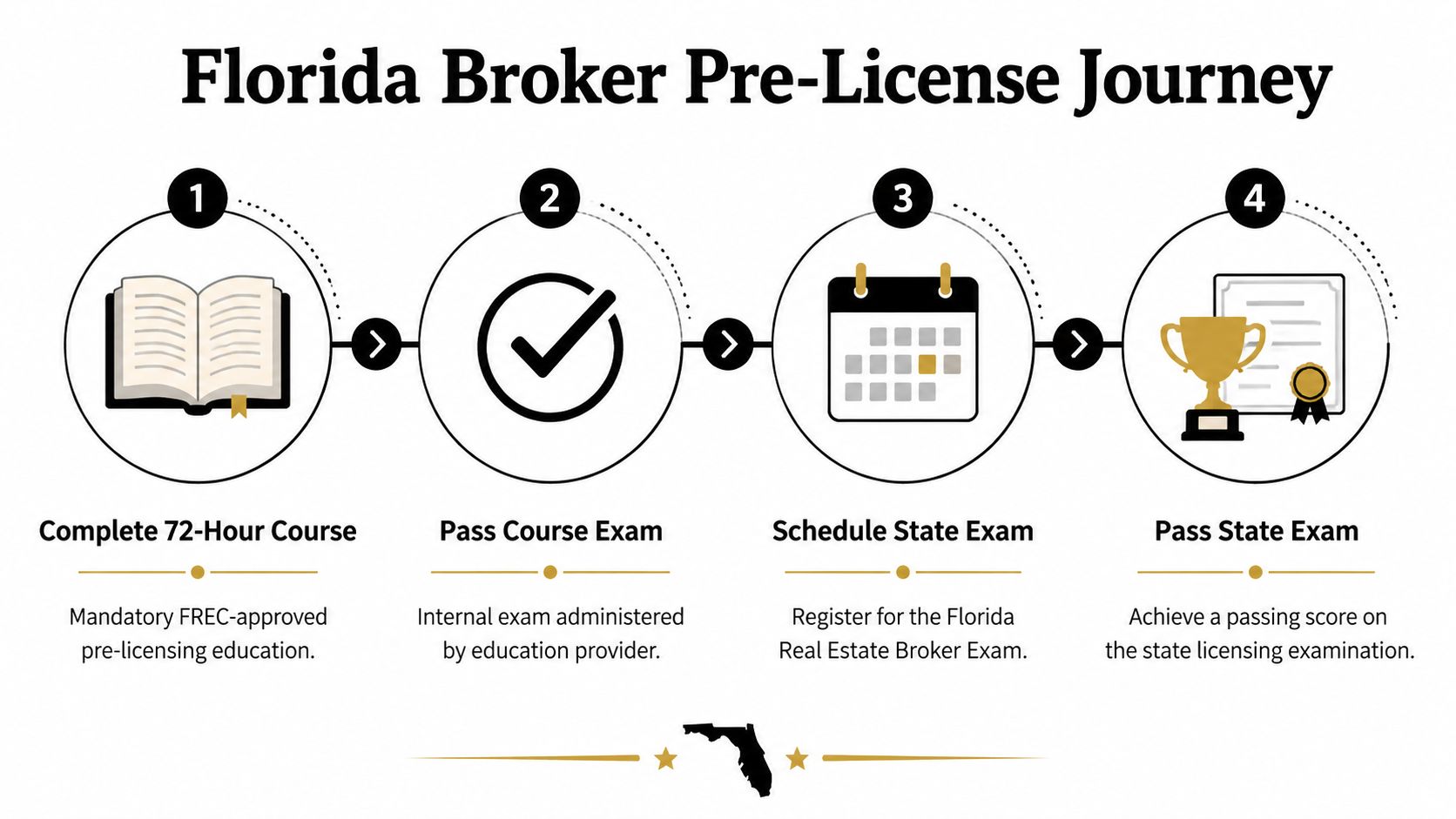
Florida requires broker applicants to complete a 72-hour FREC-approved pre-licensing course and meet the experience standard for prior licensure activity. Applicants also need a passing score on the state exam. Ed Klopfer Schools summarizes the broker requirements, including the point that a 4-year degree in real estate does not excuse the broker pre-license course: Florida broker license requirements.
That degree issue creates avoidable delays. I routinely see applicants assume an academic credential substitutes for the broker course. It does not. If your longer-term plan includes opening a firm, every incorrect assumption at the licensing stage pushes back entity filings, office setup, banking, and recruiting.
Course selection is partly an education decision and partly an operations decision. A low-cost provider can become expensive if reporting is slow or administrative support is weak. If your target is to move from individual licensure into a company launch, choose a school that can produce clean records quickly and confirm completion without back-and-forth.
A practical screening standard looks like this:
| What to check | Why it matters |
|---|---|
| FREC approval | The course only counts if the provider is approved |
| Delivery format | Evening, weekend, or self-paced options reduce the risk that client work interrupts completion |
| Exam prep tools | Practice questions and review modules usually matter more at the broker level |
| Administrative follow-through | Fast, accurate reporting keeps your application and launch timeline intact |
Applicants who expect to form a company soon after licensure should also sketch the business side early. That does not mean filing the brokerage entity before you are ready. It means understanding the sequence for forming a Florida corporation for a brokerage business so your licensing timeline and company timeline do not collide.
How to study for the broker exam like an operator
The broker exam tests legal judgment more than client-facing skill. Sales experience helps, but it does not replace close reading of agency law, brokerage relationships, supervision rules, and transaction duties. Those topics shape how a future brokerage gets run, how disputes arise, and where liability lands.
Study that way.
A good system usually includes four parts:
- Read for legal effect. Focus on what creates liability, what changes disclosure duties, and what authority belongs to the broker rather than an associate.
- Use timed practice. Exam pressure causes careless misses, especially on questions built around exceptions and statutory wording.
- Separate owner-level topics from deal-level topics. If you plan to operate a brokerage, spend extra time on office management, advertising control, supervision, and escrow-related rules.
- Review mistakes quickly. Missed questions are most useful when the reasoning is still fresh.
Candidates who pass cleanly usually treat the exam as a compliance screen, not a trivia contest.
That mindset matters later. Founders who study only to get through the test often miss the legal structure underneath the questions. The exam is giving you an early preview of what the state expects once you supervise people, hold deposits, approve advertising, and control compensation practices.
One more practical point. Background history can affect the licensing path, and applicants should review issues early rather than hope they never come up. VerticalRent's guide on criminal background checks is a useful plain-English reference for understanding what screening records can reveal before you get to the formal application stage.
Block study time on the calendar like a closing or a hearing prep session. If you leave it to spare hours, client work usually wins.
The Application Process Background Checks and Fees
A lot of broker candidates lose time here for avoidable reasons. The state is not testing your knowledge at this stage. It is checking whether your file is complete, consistent, and supported by the right records.
The filing sequence that avoids delays
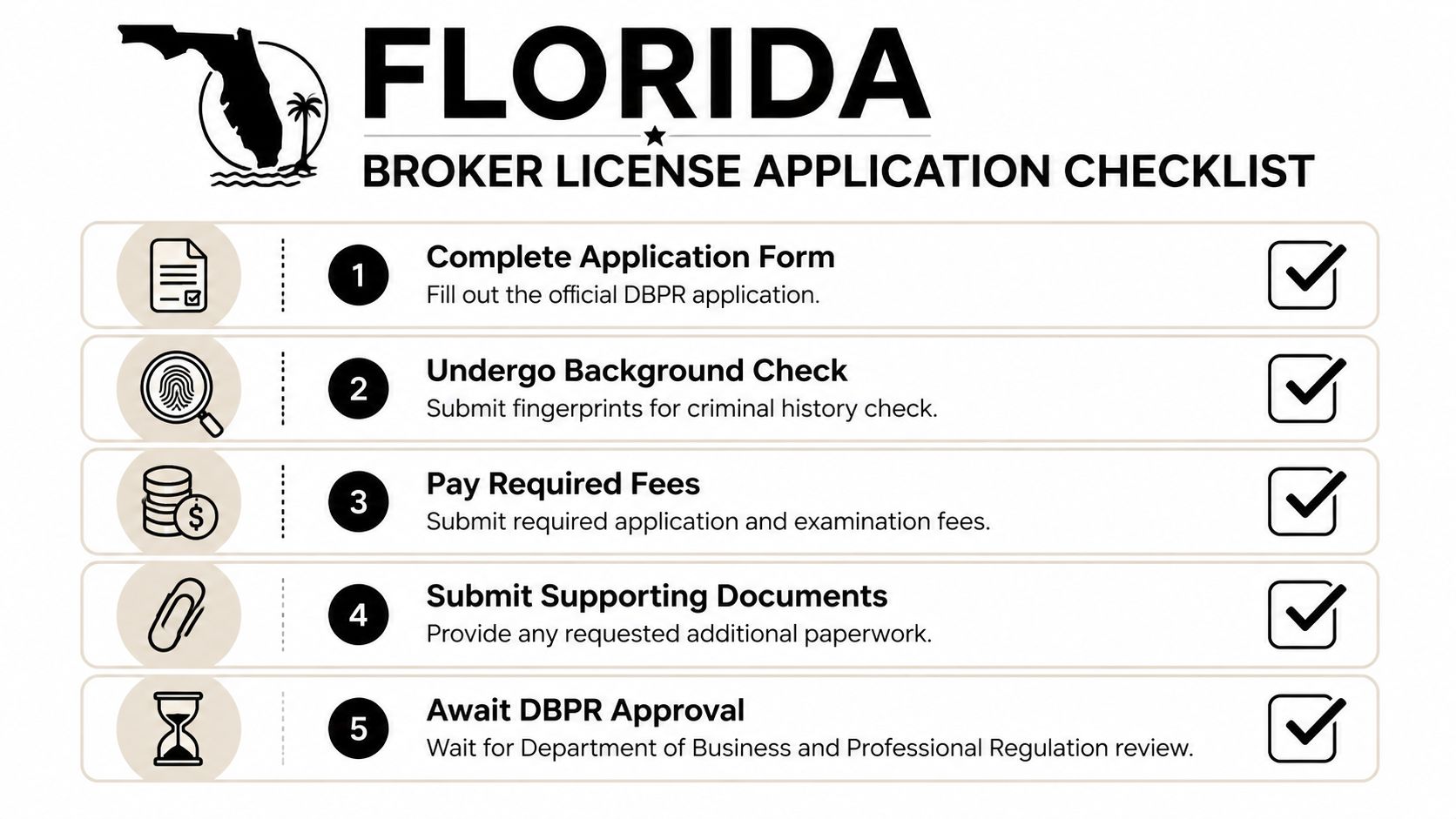
Florida broker applications move more smoothly when the applicant treats the filing like a regulated business submission instead of a school form. Names need to match. Course completion records need to be available. Fingerprints need to be processed on time. If any one of those pieces is missing, the application can stall while the state waits for clarification.
A practical sequence looks like this:
- Complete the required education and confirm the provider has reported it properly. Do not assume the record has posted just because you finished the class.
- Schedule electronic fingerprints early. Processing lag can hold up the application even when everything else is ready.
- File through the DBPR portal and save every confirmation. Keep receipts, submission emails, and any uploaded documents in one folder.
- Respond narrowly to deficiency notices. If the state asks for one document, send that document and make sure it answers the question cleanly.
Background issues deserve early review, especially for applicants planning to supervise agents or open a brokerage entity soon after approval. A criminal history does not always end the process, but undisclosed or poorly explained records create more trouble than the record itself. VerticalRent's guide on criminal background checks is a useful plain-English reference for understanding what screening records may show before you submit the application.
Founders should also use the waiting period wisely. If the goal is to open a real brokerage instead of just holding the license, start mapping the entity structure, ownership, and operating documents while the application is pending. This primer on Florida corporation filing for brokerage planning helps line up business formation with licensure so you are not making entity decisions after the license is already active.
Budget for the license and the business behind it
Applicants often budget for the application and exam, then underestimate the rest. That is a mistake if the plan is to become the qualifying broker for a new company.
You should expect separate costs for the state application, exam registration, fingerprinting, pre-license education, and post-licensing education. The exact amount varies by education provider and fingerprint vendor, but the larger point is legal and operational. A broker license is only one part of the spend. If you intend to form a brokerage, add entity filing costs, registered agent expenses if applicable, insurance, banking setup, accounting support, and document preparation for policies on supervision, advertising review, escrow handling, and compensation practices.
That trade-off matters. Filing the license application before you have a realistic operating budget can push a new broker into cutting corners on the business side. In my experience, the risk is not the filing fee. The risk is opening the doors without the structure to supervise agents and document compliance properly.
Treat post-licensing education as money already committed, not a future line item. Brokers who delay that planning usually delay the course too, and that creates a preventable compliance problem.
Post-Licensing Education and Staying Compliant
Getting the broker license is a milestone. It isn't operational safety. The first renewal cycle is where many new brokers create unnecessary risk.
Why first renewal is the real compliance trap
Florida law requires a new broker to complete 60 hours of post-licensure education prior to the first renewal. That education must cover subjects including business law, commercial brokerage, and advanced legal aspects. Failure to complete it results in the license becoming null and void, according to Florida Statute 475.17.
That phrase matters. “Null and void” is not the same as casually falling inactive. From a business-risk perspective, it means your assumptions about authority, marketing, hiring, and transaction supervision can collapse if you let the deadline pass.
The statute also describes the content areas broadly enough to show what Florida expects from a broker. This isn't filler education. It includes operational and analytical subjects such as advanced appraisal, property management, investment analysis, accounting, economics, syndications, commercial brokerage, and feasibility analysis under the statutory framework.
Missing post-licensing doesn't create a paperwork nuisance. It can break the legal foundation of the business you're trying to build.
A practical compliance system that works
The best protection is boring. Build a renewal system early and use it consistently.
Start with these actions:
- Check your date in DBPR: Florida law guidance specifically notes that you should log into your DBPR account at MyFloridaLicense.com to confirm the exact expiration date.
- Enroll early: Don't wait for a reminder email. Put the course on your calendar as soon as the initial license is issued.
- Keep the certificate: Save a PDF and a cloud copy.
- Confirm reporting: Don't assume completion means the record posted correctly.
If you're running a small operation, assign compliance ownership to a named person, even if that person is you. Problems begin when everyone assumes someone else is tracking the deadline.
A second issue is business continuity. If your brokerage branding, recruiting, and transaction workflow all depend on your broker status, then your personal compliance deadline is also a company deadline. Treat it that way in board notes, planning documents, and hiring decisions.
Tip: keep a one-page compliance calendar with license renewal, continuing education, insurance reviews, trust-account checks, and annual entity maintenance. Founders rarely fail because the law was hidden. They fail because the dates were scattered.
From Licensed Broker to Business Owner Forming Your Brokerage
Most broker license Florida articles stop at the license. That's only half the job. If you want to build a real brokerage, your next decisions create either durable protection or expensive exposure.
Choose the entity before you start recruiting agents
A founder's first instinct is often speed. File something quickly, open an account, print business cards, and sort out legal structure later. That approach creates avoidable cleanup.
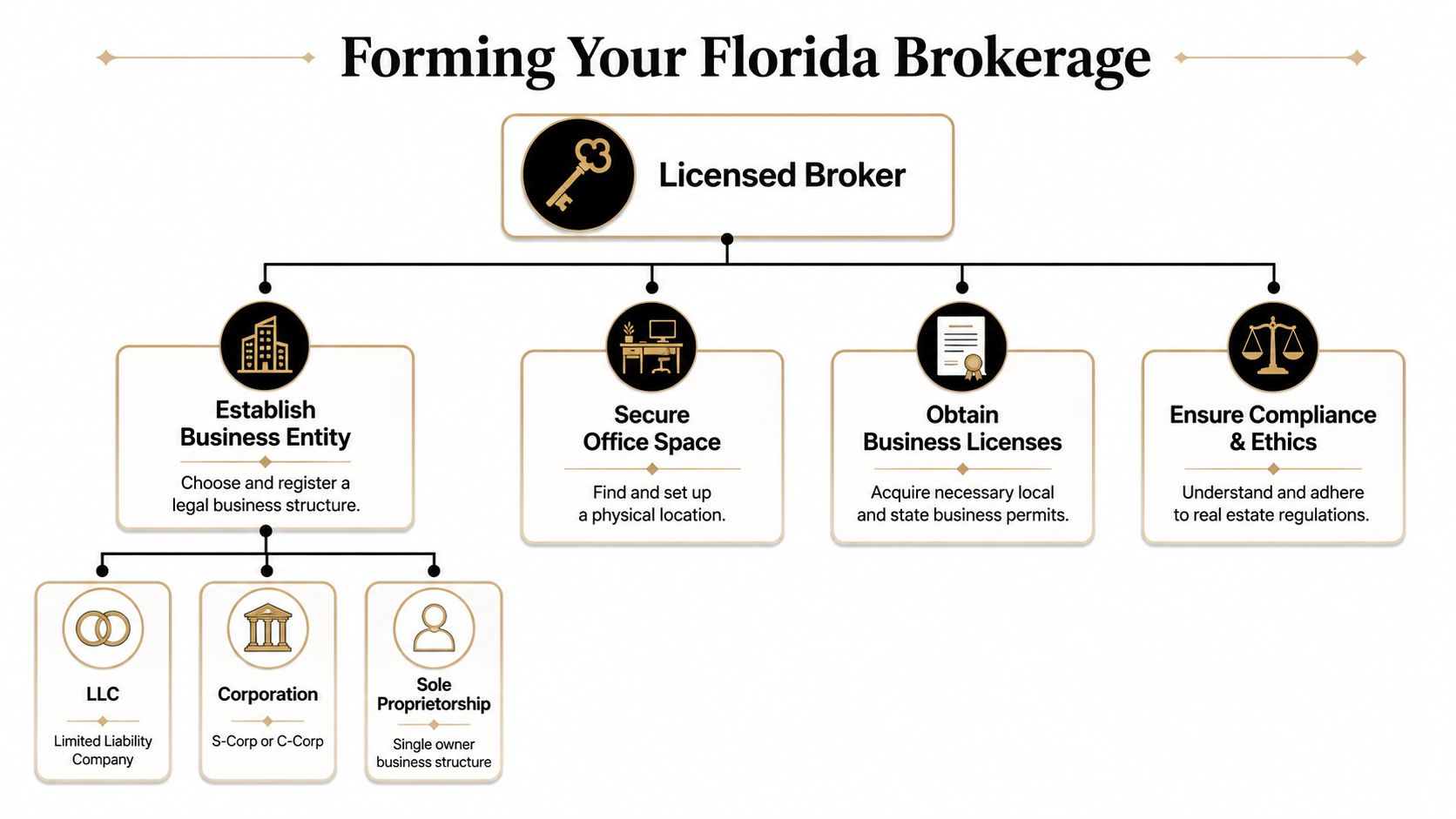
In Florida, many new broker-owners weigh an LLC, a corporation taxed as an S-Corp, a C-Corp, or in some cases a sole proprietorship. The right choice depends on liability planning, ownership structure, tax treatment, compensation strategy, and how you expect the brokerage to grow.
A simple comparison helps:
| Structure | Why founders choose it | Where it can create friction |
|---|---|---|
| LLC | Flexible governance and straightforward operations | Tax planning may need adjustment as profit grows |
| S-Corp | Often attractive for owner compensation planning | Requires tighter payroll and corporate formalities |
| C-Corp | Better fit in limited cases involving complex growth planning | Can be heavier than a small brokerage needs |
| Sole proprietorship | Simple to start | Weak liability separation compared with formal entities |
The legal point is straightforward. Your license authorizes regulated activity. It does not replace business structuring. If you sign office leases, vendor contracts, independent contractor agreements, or marketing obligations in the wrong name or before the entity is properly organized, you can create personal exposure that no later filing fully erases.
If you're evaluating structure options, this guide to forming an LLC in Florida is a helpful starting point for the business side of the decision.
Operational documents matter more than founders expect
A brokerage becomes fragile when it grows on verbal understandings. The first few agents may be friends or former colleagues, but that doesn't reduce risk. It increases it, because informal arrangements invite assumptions about splits, lead ownership, expenses, supervision, branding, and departure rights.
At minimum, a new brokerage should think carefully about:
- Independent contractor agreements: Define compensation method, payment timing, ownership of leads and CRM data, advertising rules, and exit obligations.
- Policies and procedures: Agents need written standards for disclosures, approvals, recordkeeping, and communications.
- Errors and Omissions insurance: Even careful brokers need a risk-transfer strategy for claims.
- Trust account discipline: Money handling must follow strict internal controls. Don't improvise this.
- Brand and marketing permissions: Team names, logos, websites, and ad copy should be controlled centrally.
Founder warning: The costliest brokerage disputes usually come from undocumented relationships, not from bad intentions.
There's also a scaling issue. Once you recruit, responsiveness becomes part of your business model. If you're building systems to capture more real estate leads, make sure your intake process, agent routing, and follow-up standards are documented. More lead flow without internal rules just accelerates inconsistency.
What works is a deliberate launch sequence. Form the entity. Open accounts correctly. Put agreements in place before onboarding agents. Set approval and supervision rules before the first advertising problem or commission dispute appears.
Tip: have every core document reviewed together, not one at a time over several months. Contract language, entity structure, and compliance policies should reinforce each other.
Fast-Track Your License with Broker by Endorsement
If you're already a broker elsewhere, the standard Florida path may not be the smartest one. A newer endorsement route changes the analysis for experienced out-of-state professionals.
Who should use endorsement
Effective July 1, 2024, Florida's Broker License by Endorsement pathway allows brokers with a current license in another U.S. state and 24 months of active experience to skip the 72-hour pre-license course and instead take a 40-question law exam, according to the Florida broker endorsement overview from Tampa School of Real Estate.
That's a major shift for relocating brokers, multistate teams, and national firms entering Florida. The benefit isn't just convenience. It also prevents experienced operators from spending time and money on education they may no longer need under the endorsement framework.
This route makes the most sense if you already have operating experience and need Florida-specific legal knowledge more than foundational brokerage training.
How to use the shortcut without creating new problems
The fast-track option is only valuable if you apply it correctly.
Use this approach:
- Verify your current out-of-state license status: Don't assume eligibility.
- Document the active experience requirement carefully: If the state asks for support, vague records won't help.
- Prepare for Florida law specifically: The shortened path still requires state-law competence.
- Coordinate business formation separately: Endorsement gets you licensed. It doesn't organize your brokerage.
A common mistake is treating endorsement like a complete market-entry package. It isn't. It solves the licensing side for a narrow group of applicants. You still need to address entity formation, operating documents, insurance, supervision systems, and branding compliance before launching in Florida.
Tip: if you're entering Florida from another state, compare your current brokerage forms and policies against Florida-specific requirements before you migrate your existing model.
If you're moving from individual licensure to building a compliant brokerage, legal structure and documentation need to happen early, not after problems appear. Coto & Waddington, Attorneys at Law advises Florida founders and small businesses on formation, contracts, and ongoing compliance so you can launch with cleaner documents, clearer risk boundaries, and a business model that's built to hold up under real operations.