You're probably at the point where the career starts to look real, not theoretical. Maybe you've sold businesses, worked in sales, or spent years around owners who keep asking who can help them exit. The appeal is obvious, but the first question isn't whether you can talk to owners. It's whether you can survive the slow ramp, the commission-only reality, and the fact that becoming a business broker is a relationship business before it's an income stream.
Table of Contents
- What a Business Broker Actually Does
- Licensing Requirements You Need to Know
- Credentials That Move the Needle
- Core Skills That Separate Brokers Who Close From Brokers Who Stall
- Building a Pipeline and Pricing Your Services
- Realistic Earnings and the Runway Question
- Compliance, Contracts, and Your First 90 Days
What a Business Broker Actually Does
A lot of people start looking at this career from a kitchen table after work, laptop open, trying to decide whether they are looking at a profession or just another sales job with a nicer title. The answer is more specific than that. A business broker sits in a narrow part of the market, and that market has stayed small rather than turning into a crowded commodity business. One industry account puts the U.S. at 3,237 business-broker businesses in 2025 in Business Brokerage Press, with 0.0% CAGR from 2020 to 2025, which is exactly why this career is a niche intermediary trade with limited office density and a strong apprenticeship culture.
The work is mostly seller-side quarterbacking
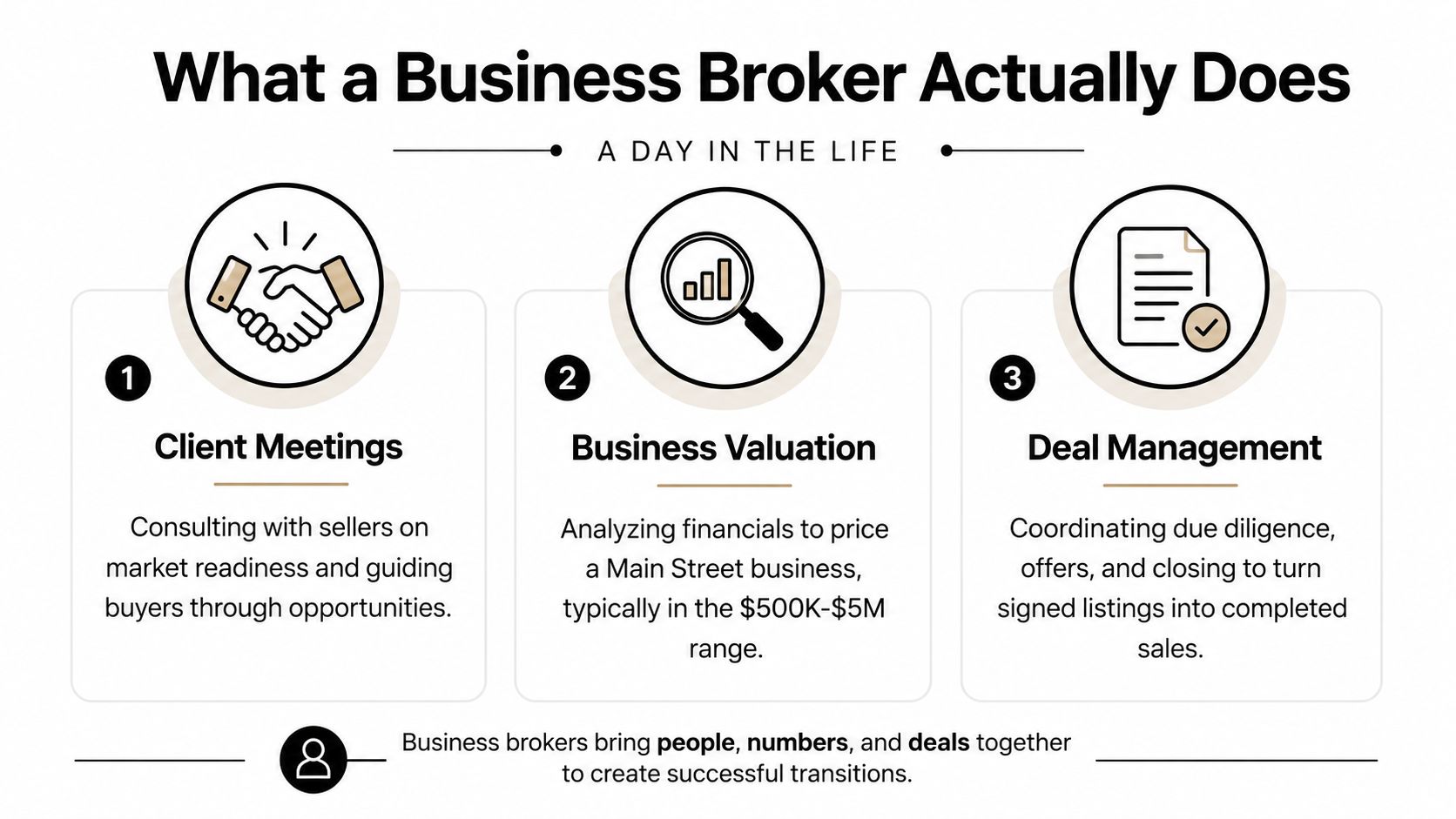
Most days revolve around client meetings, valuation work, and deal management. You sit with owners who are tired, cautious, and usually underprepared for a sale. Then you turn financials into a price range, shape the business into something buyers can evaluate, and stay on top of buyer questions, offers, due diligence, and closing logistics.
That work is closer to project management than pure sales. You are not just generating interest. You are protecting confidentiality, managing expectations, and keeping the seller from blowing up the process halfway through. A plain-English overview of selling your business with a broker helps make that side of the job easier to picture.
Practical rule: if you hate follow-up, paper chasing, and repeated conversations with the same owner, this career will wear you down fast.
Main Street deals are the actual training ground
The economics of the field are built around completed exits, not hourly billing. In smaller Main Street deals, fees often fall in the 8% to 12% range of sale price, so a single $300,000 sale at roughly 10% can generate about $30,000 in brokerage fees, according to industry reporting on broker economics from WebWire's coverage of the business-brokers market. That is why brokers obsess over listings, pricing discipline, and closing volume.
Main Street work is where most strong brokers prove themselves. It is also where weak brokers get exposed, because the process is repetitive, slow, and heavily dependent on trust. If you like talking to owners, staying organized, and pushing messy deals to finish lines, the work can fit. If you want instant gratification or clean lead flow, you will struggle.
Broker versus M&A intermediary
A business broker usually handles smaller transactions and owner-operated companies. A merger-and-acquisition intermediary is more likely to handle larger, more complex deals with heavier diligence and a more formal process structure. The difference is not just deal size. It is the amount of sophistication the transaction demands from the advisor.
A broker can represent sellers, buyers, or both depending on the assignment and local rules, but the seller relationship is where the actual advantage lies. Owners want someone who can tell the truth about price, readiness, and buyer quality. That is why the better brokers sound less like closers and more like disciplined advisors, and why a structured transaction process matters, as outlined in this overview of the mergers and acquisitions process.
Licensing Requirements You Need to Know
The first mistake new brokers make is assuming there's one national license that starts the career. There isn't. In the U.S., the licensing path depends on what you're brokering, where you're operating, and whether your state treats the work like real estate, securities, or a separate business-broker activity. That means you need to check your state before you spend a dollar on training.
Florida is strict on compensation
Florida is the clearest example of why this matters. If you're being compensated for selling or leasing business opportunities there, you generally need a real estate license. That makes Florida a state where the broker path can't be treated as a casual side pursuit, because the compliance entry point is tied directly to licensing status and continuing obligations.
Nevada gives you a different concrete model. The state requires a 24-hour pre-licensing business broker education course, an original Business Brokerage exam passing result dated within the last 12 months, and a Nevada Real Estate license before applying for the Business Broker Permit. The initial application fee is $40, and fingerprint cards expire after two months, according to the Nevada Real Estate Division's business broker permit requirements at Nevada's initial requirements page.
Use a decision tree, not guesswork
Here's the rule I'd use before enrolling anywhere:
- If your state ties the work to real estate, get the real estate license first.
- If your state treats certain transaction types as securities, check whether securities registration applies.
- If no special permit exists, confirm whether you still need to work under a licensed brokerage firm or sponsor.
- If you're moving into a state like Florida or Nevada, verify the local rule before you pay for coursework.
| State | Real Estate License Required | Special Broker Permit | Typical Application Fee |
|---|---|---|---|
| Florida | Yes, for compensated business opportunity sales or leasing | Depends on transaction structure and local compliance | Not specified in the verified data |
| Nevada | Yes, before applying for the permit | Yes, Business Broker Permit | $40 |
| Other U.S. states | Varies by jurisdiction | Varies by jurisdiction | Varies by jurisdiction |
That table is the right level of caution. In this profession, a wrong assumption about licensing can waste months and force you to restart. Treat the state rule as the first gate, not the last.
Credentials That Move the Needle
People love collecting certificates. Sellers don't care about your paper stack nearly as much as they care about whether you can price their company, protect confidentiality, and get a deal to close. So the right credential path is the one that gets you competent, credible, and connected without draining your runway.
Coursework helps, but deal exposure matters more
IBBA coursework and M&A Source training are useful because they give you vocabulary, process, and structure. They help you understand listing prep, valuation concepts, and transaction flow before you're holding a real file in your hands. That matters, because the first few files will expose every gap in your knowledge.
But coursework alone doesn't make you broker-ready. The certification side is more demanding than people expect, especially for designations like CBI, where documented brokerage activity matters. That requirement is the key filter, because it proves you've worked deals, not just attended classes.
Apprenticeship is the part most people underestimate
Informal firm-led apprenticeships are still the fastest way to learn the rhythm of the business. You see how senior brokers qualify sellers, how they write up listings, how they handle buyer pushback, and how they keep files from going stale. The downside is obvious, you'll trade independence for instruction.
A sensible sequence looks like this:
- Start with state-required licensing. If you can't legally earn compensation, everything else is premature.
- Add recognized training. IBBA or M&A Source coursework gives you the process frame.
- Work under an active broker. You need live files, real objections, and actual closings.
- Pursue CBI only when your activity history is documented. Coursework without transactions won't get you there.
For sellers, the signal is simple. A credentialed broker tells them you've at least been through a process. A broker with closed-file history tells them you can survive one. If you want to dig deeper into the valuation side of that credibility test, understanding business valuation is a helpful companion topic.
The fastest way to lose a seller is to sound educated but untested.
My view is straightforward. Get licensed, learn under a real broker, and earn one respected credential later. Don't spend your first year collecting badges while you still don't know how to keep a file moving.
Core Skills That Separate Brokers Who Close From Brokers Who Stall
A broker who closes deals does four things well, reads numbers cleanly, manages people without losing control of the process, protects the legal edges, and keeps emotion from taking over when pressure rises. The brokers who stall usually share one weakness. They confuse friendliness with competence and let gaps in technical skill show up at the worst possible time.
Financial analysis is learnable, but it takes reps
You do not need to be a CPA, but you do need to understand how buyers value earnings, how add-backs are defended, and how the story behind the numbers changes price. That means getting comfortable with seller's discretionary earnings, EBITDA, and the habits of Main Street valuation. If you cannot explain why a business is priced the way it is, you will lose sellers or invite unrealistic listings.
Treat valuation as evidence, not optimism. If the numbers do not support the asking price, no amount of charm fixes that problem. New brokers usually need a structured reference like Business Loan Warrior's valuation services overview before they start quoting ranges to owners, especially if they want to sound credible on the first call.
Negotiation is where money gets made or lost
Negotiation in this field is not about winning arguments. It is about controlling expectations, keeping sellers realistic, and helping buyers trust the process enough to stay engaged. Sellers want the highest number, buyers want the cleanest path, and your job is to keep both sides from walking away for the wrong reason.
The best brokers know when to slow the room down. They do not overtalk, they do not chase every objection, and they do not let a loud seller force a bad deal structure. That kind of discipline matters more than clever language.
Legal and tax fluency keeps you out of trouble
You need enough fluency to spot problems, not enough to pretend you are the lawyer or the tax adviser. Asset sales versus stock sales matter. Entity structure matters. So do listing agreements, letters of intent, confidentiality rules, and any state disclosure obligations tied to the deal. Florida brokers in particular should pay attention to state rules before they start speaking loosely about what they can do, because the licensing line is not the place to improvise.
Practical rule: if a contract term changes risk, price, or closing mechanics, stop and get a qualified attorney involved before the file advances.
A quick self-audit
- Financial analysis: Can you read a profit and loss statement without guessing?
- Market knowledge: Do you know what similar businesses sell for in your area?
- Negotiation: Can you keep a seller calm when a buyer chips away at price?
- Legal and compliance: Do you know when to stop drafting and start referring?
My view is blunt. Financial analysis can be learned on the job. Negotiation needs mentorship. Legal and compliance deserve upfront training, and when the structure gets messy, you should bring in a business attorney instead of freelancing through it.
Building a Pipeline and Pricing Your Services
The brokers who make it usually run their business like a disciplined sales machine. They don't wait for listings to show up. They build a source map, follow a calling cadence, and keep their names in front of people who already advise business owners. That's the difference between a hobby and a brokerage practice.
Your first four lead sources should be boring
The best early pipeline usually comes from four places, direct seller outreach, attorney and CPA referrals, re-engaged buyer lists, and business-for-sale platform relationships. None of that is glamorous. All of it works if you keep showing up.
A practical rhythm looks like this:
- Direct outreach: Contact owners in industries you understand and be specific about why you're calling.
- Advisor relationships: Build trust with attorneys and CPAs who already hear about owners considering exits.
- Buyer re-engagement: Stay in touch with buyers who missed on one deal, because they often become future sellers or referral sources.
- Platform visibility: Maintain a presence where buyers already search, then use that traffic to support your listing flow.
Price the engagement like a professional
Success fees are still the center of the business, but some brokerages use retainers, minimums, or flat-fee components to cover prep work and filter serious sellers. That isn't greed, it's survival. You're front-loading time, materials, and market work long before a closing check arrives.
The better move for a new broker is to understand the firm's split structure before taking a listing. If you're under a mentor, ask how the commission is divided, who owns the listing, who controls marketing, and what happens if another broker brings the buyer. If those terms aren't clear, you're building someone else's pipeline.
Think in 2 to 3 year ramps
BizBuySell's career guidance puts the path to independent deal management at 2 to 3 years, with year 1 focused on valuation and deal documentation, year 2 on co-brokering, and year 3 on leading smaller transactions, according to CT Acquisitions' breakdown of how to become a business broker. I'd take that seriously. It's the right mindset for a profession where deal flow compounds slowly.
- Year 1: Learn valuation, build your network, and support senior brokers on files.
- Year 2: Start co-brokering, presenting listings, and handling pieces of live negotiations.
- Year 3: Lead smaller transactions and tighten your own process around pricing, documentation, and buyer qualification.
If you want a separate planning lens for owners and advisors, the exit-prep mindset in business exit strategy planning maps well to how brokers should think about readiness and timing too.
Realistic Earnings and the Runway Question
This is the section most career articles dodge, and it is the one that matters most. You do not become a business broker and get paid next month like a standard employee. You build a pipeline, wait on trust, and live with uneven income in the early years. If you cannot fund that wait, the career will pressure you long before your skill does.
What closing volume means in practice
Broker income is tied to closings, so volume matters more than title. If you close five, ten, or twenty deals a year, your income changes sharply depending on deal size and fee structure. On smaller Main Street sales, the common 8% to 12% fee range is the key lever, and a single sale can produce meaningful fee income when it closes, as noted in WebWire's reporting on the industry economics.
The math is simple enough to guide your planning. A broker closing five modest deals with solid fees is in a completely different place than a broker who signs listings but never gets to closing. Cash comes from completed transactions, not activity.
Expenses are real, even if they are not glamorous
New brokers often underestimate the cost of staying in the game. There is marketing, brokerage splits, access to platforms, insurance, and the constant overhead of being visible. You also have the soft cost of time, because every hour spent prospecting is an hour not earning from another job.
If you are evaluating tax treatment of broker compensation or wondering how fees fit into your broader return, Allied Tax Advisors on broker fees is a practical resource to discuss with your accountant. The point is not that tax answers are one-size-fits-all. The point is that broker income should be planned with real tax and expense assumptions, not wishful thinking.
Runway is the real gatekeeper
I would tell anyone serious about this path to plan for 18 to 24 months of living expenses before they can count on the business to support them. That is prudence, not pessimism, for a relationship-driven profession with a delayed revenue curve. If your savings cannot support the ramp, you need a side income plan or a slower transition.
A smart side-income strategy usually looks like one of three things, part-time consulting, limited freelance work in an adjacent field, or a gradual exit from a current job while you build deal flow. I prefer the gradual exit if your employer allows it, because it reduces panic and lets you learn the business without forcing bad decisions.
Do not confuse momentum with income. Listings feel productive long before they pay.
If you are still deciding, use this rule. If the idea of waiting a year for meaningful revenue makes you anxious, the profession may not fit your cash flow. If that wait feels manageable and you are good at relationships, the model can work. For owners and advisors who want a separate planning lens, business exit strategy planning maps well to how brokers should think about readiness and timing.
Compliance, Contracts, and Your First 90 Days
Once you're licensed and trained, the core work is staying clean. Compliance is not a side issue in brokerage, it's part of the job. A sloppy listing agreement, a missing disclosure, or a bad confidentiality process can wreck a deal faster than a weak valuation can.
The first 90 days should be operational, not dreamy
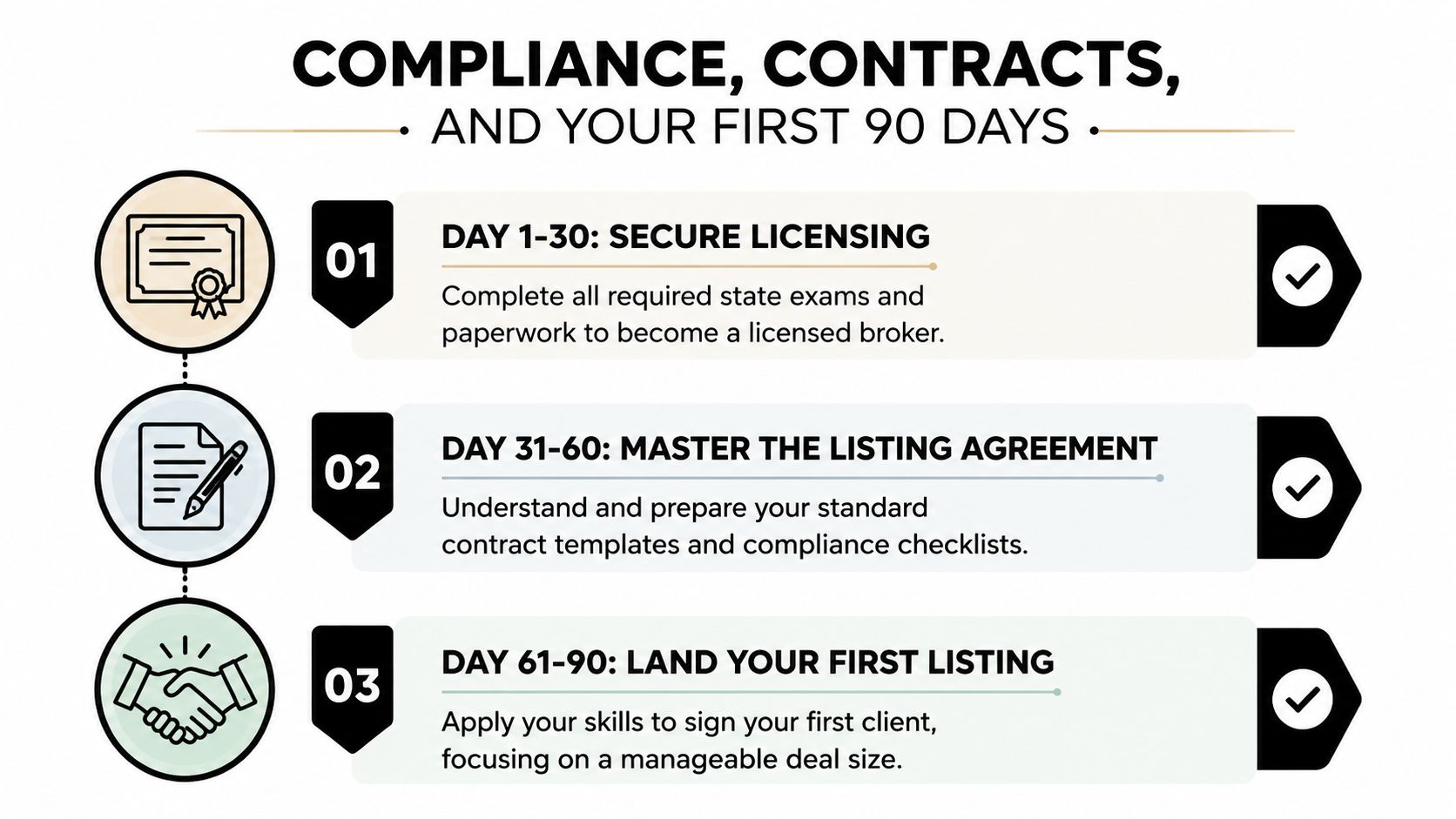
In the first month, finish every licensing requirement and verify your brokerage sponsorship if your state requires it. In the second month, learn the listing agreement cold, including exclusivity, term length, commission language, and co-brokerage clauses. In the third month, push for a manageable first listing and treat it like a process drill, not a trophy.
Contracts need to be boring and precise
A listing agreement should be clear enough that everyone knows what happens if the seller changes their mind, another broker gets involved, or a buyer appears through a different channel. Confidentiality and non-solicit obligations should be written in plain language you can explain to a seller without improvising. If the structure involves entity changes, asset purchase language, or any complicated transfer mechanics, review the asset purchase agreement guidance with counsel rather than guessing.
Know when to hand the file to a lawyer
If a transaction touches entity formation, contract interpretation, seller-side risk allocation, or Florida-specific deal structure questions, stop and refer out. That's especially true in South Florida, where business owners often want practical answers fast, but bad improvisation can create real exposure. A business attorney isn't a backup plan, it's part of a competent brokerage team.
Your first 90-day checklist should be short:
- Complete licensing: Finish the state exam, paperwork, and any required permit steps.
- Standardize documents: Keep your listing templates, disclosure forms, and confidentiality forms ready.
- Build referral habits: Start meeting attorneys, CPAs, and owners who can become deal sources.
- Review risk points: Know when to pause and call counsel before the file moves further.
If you want to become a business broker, don't start by chasing business cards. Start by making sure you can legally operate, speak intelligently about valuation, and survive the ramp. The brokers who last are the ones who respect the slow build and protect the deal at every stage.
If you're serious about entering this field or you're already handling deals and want sharper legal support, Coto & Waddington, Attorneys at Law helps South Florida entrepreneurs and deal professionals with entity formation, contracts, compliance, and transaction documents that hold up. Visit Coto & Waddington, Attorneys at Law to get practical guidance before your next listing, LOI, or closing file puts risk on the table.