You're in a small conference room in Miami, or maybe on a laptop between investor calls, and somebody says, “Just date the option grant back to last week. It's fine, we meant to reward the hire.” That's how a lot of trouble starts. The paperwork looks harmless, the intent feels generous, and then the board minutes, the valuation file, and the cap table all tell different stories.
A backdating stock option problem usually doesn't begin with fraud in somebody's mind. It begins with sloppy timing, loose approvals, and a founder who thinks the legal date is flexible if the business reason is good enough. It isn't. Once the grant date, approval date, and strike price stop lining up, you're in the zone where 409A, disclosure, accounting, and corporate authority all start to matter at once.
That's why founders need a practical rule, not just a legal lecture. If the grant wasn't approved when the paper says it was, treat it like a control failure until proven otherwise. If the strike price doesn't match the actual approval date and the current fair market value, stop and review. If your records are messy, fix the records before you fix the story.
Table of Contents
- When a Well-Meaning Grant Quietly Crosses the Line
- What Backdating a Stock Option Actually Means
- The Four Legal Triggers Founders Need to Understand
- Real Cases That Showed Up in the Headlines
- Red Flags That Backdating May Already Be Present
- How to Remediate a Discovered Backdating Problem
- Best Practices for Clean Option Grants Going Forward
- A Clear Path Forward for South Florida Founders
When a Well-Meaning Grant Quietly Crosses the Line
A founder in South Florida wants to do right by an early hire. The company is moving fast, cash is tight, and the team wants to issue options at a low strike price so the employee feels the upside. Someone reaches for an earlier date on the form, because that date had a lower valuation and everybody thinks it's just a cleaner way to reward the person.
That's where the trouble begins. If the board never approved the grant on that earlier date, the company has not just made an administrative shortcut. It has created a record that says one thing while the corporate action happened later.
Why intent doesn't save a sloppy grant
Intent matters to your conscience. It does not clean up your cap table. The SEC's own description of backdating is blunt, it means misrepresenting the date of an option award so it appears granted earlier and at a lower price than when it was made, which can create a lower exercise price and higher immediate value for the recipient (SEC backdating overview). Under APB Opinion 25, the key accounting date is the measurement date, the first date when both the number of options and the price are known, and changing the label on paper does not move that date if the terms were not fixed (APB 25 summary).
Practical rule: if the board didn't approve the grant on that date, don't pretend it did.
For founders, the danger is that one sloppy grant can quickly become a chain reaction. The board consent is off, the 409A file is stale, the employee agreement is wrong, and the cap table now carries a strike price that may not match the actual approval date. That's how a simple favor turns into a documentation problem, then a tax problem, then a diligence problem.
The fix is boring, which is good. Match the approval date, the grant date, and the written records. If they don't match, stop treating the issue as cosmetic.
What Backdating a Stock Option Actually Means
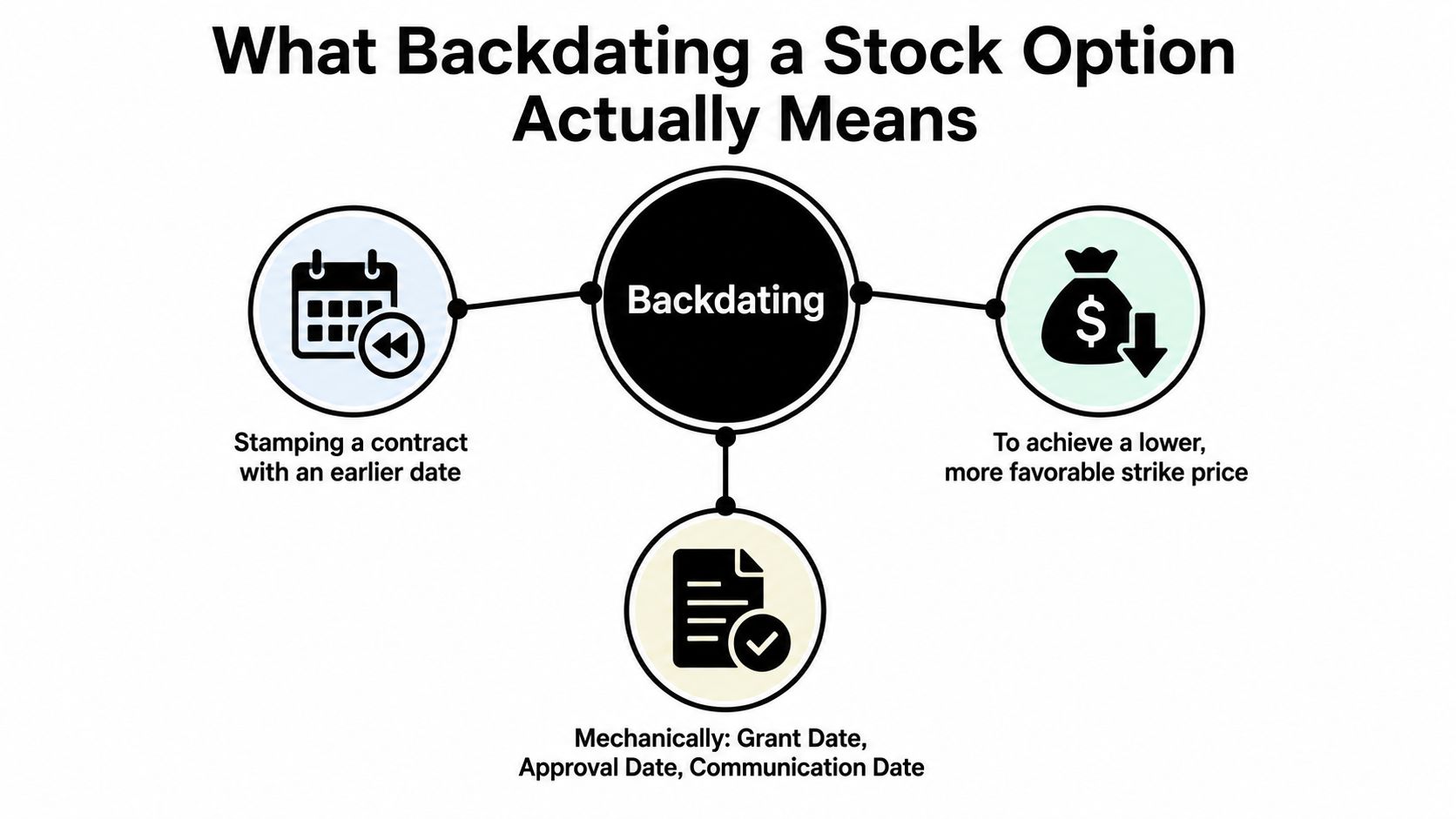
Backdating is basically stamping today's deal with yesterday's date so the economics look better than they really were. A founder or officer picks an earlier grant date, ties the strike price to that earlier lower valuation, and makes the award look like it was approved when it wasn't. The point is usually simple, to create a more favorable exercise price for the recipient.
The mechanics that matter
A true backdated grant has three moving parts. First, the paperwork uses an earlier effective date. Second, that earlier date is paired with a lower strike price that fits the historical valuation. Third, the records make it look as if the grant was authorized then, even though the board or compensation committee acted later.
That's different from a legitimate grant under a properly approved plan. A company can authorize options prospectively, document the approval date, and issue the agreement with the correct strike price tied to the correct valuation. The problem starts when the paper says one thing and the corporate action says another.
Legitimate timing versus after-the-fact dating
A properly documented grant can be effective as of the date the board approved it, even if the employee signs a day later. That's normal. What's not normal is rewriting history to capture a lower market price that existed before approval, especially when the company did not finalize the award at that time.
Plain truth: a grant date is not a wish. It's a corporate act.
The legal significance comes from how the facts line up, not just from the label on the form. If the record is clean, the company can defend the grant. If the record is backwards, every downstream document starts carrying the same defect.
The Four Legal Triggers Founders Need to Understand
For a South Florida startup, a backdated option can create four separate problems at once. The public-company scandals made the headlines, but the same weak controls show up in private companies through missing board consent, inconsistent 409A records, and cap tables that do not match the approvals.
| Risk Layer | What It Targets | Practical Founder Example |
|---|---|---|
| Section 409A | Discounted equity compensation and timing of fair market value | The company issues options with a strike price that does not match the grant date valuation, so the award may be treated as mispriced deferred compensation. |
| SEC and federal securities rules | Public disclosure, internal controls, and truthful books and records | A public issuer signs minutes and filings that do not match the actual grant approval date. |
| State corporate law | Authority of directors and proper advance approval | Management dates a grant earlier than the board authorized it, then tries to fix the record afterward. |
| Shareholder plan compliance | Whether the grant fits the approved plan and share reserve | An option falls outside the plan terms or exceeds the authorized reserve, making the award unauthorized. |
Section 409A is the tax issue founders usually encounter first. If options are granted below fair market value, employees may face immediate tax consequences, including income recognition, a 20% penalty, and interest. The practical control is straightforward: obtain a proper 409A valuation, confirm the valuation applies on the grant date, and use it consistently in the approval file and cap table.
SEC and federal securities exposure follows a different path. Once a company is public, or must later describe the issue in filings or investor materials, its grant records must be accurate. The SEC's enforcement history shows how option manipulation can become a books-and-records and antifraud matter, rather than a simple paperwork error, as reflected in this SEC enforcement chronology.
State corporate law focuses on authority. Directors or a compensation committee must approve grants under the company's governing documents and equity plan. An officer choosing an earlier date cannot substitute personal judgment for board action. After-the-fact ratification may not cure an approval that was missing or misleading, and it can leave directors exposed to a breach of fiduciary duty.
Finally, check the plan and the cap table together. Confirm the available share reserve, recipient eligibility, exercise price, vesting terms, and committee authority before issuing the agreement. A grant that violates the plan can be challenged as unauthorized even if everyone intended to compensate the employee fairly. Keep the signed consent, valuation support, grant agreement, and updated cap-table entry in one record. That file is what lets the company prove the grant was approved when it says it was.
Real Cases That Showed Up in the Headlines
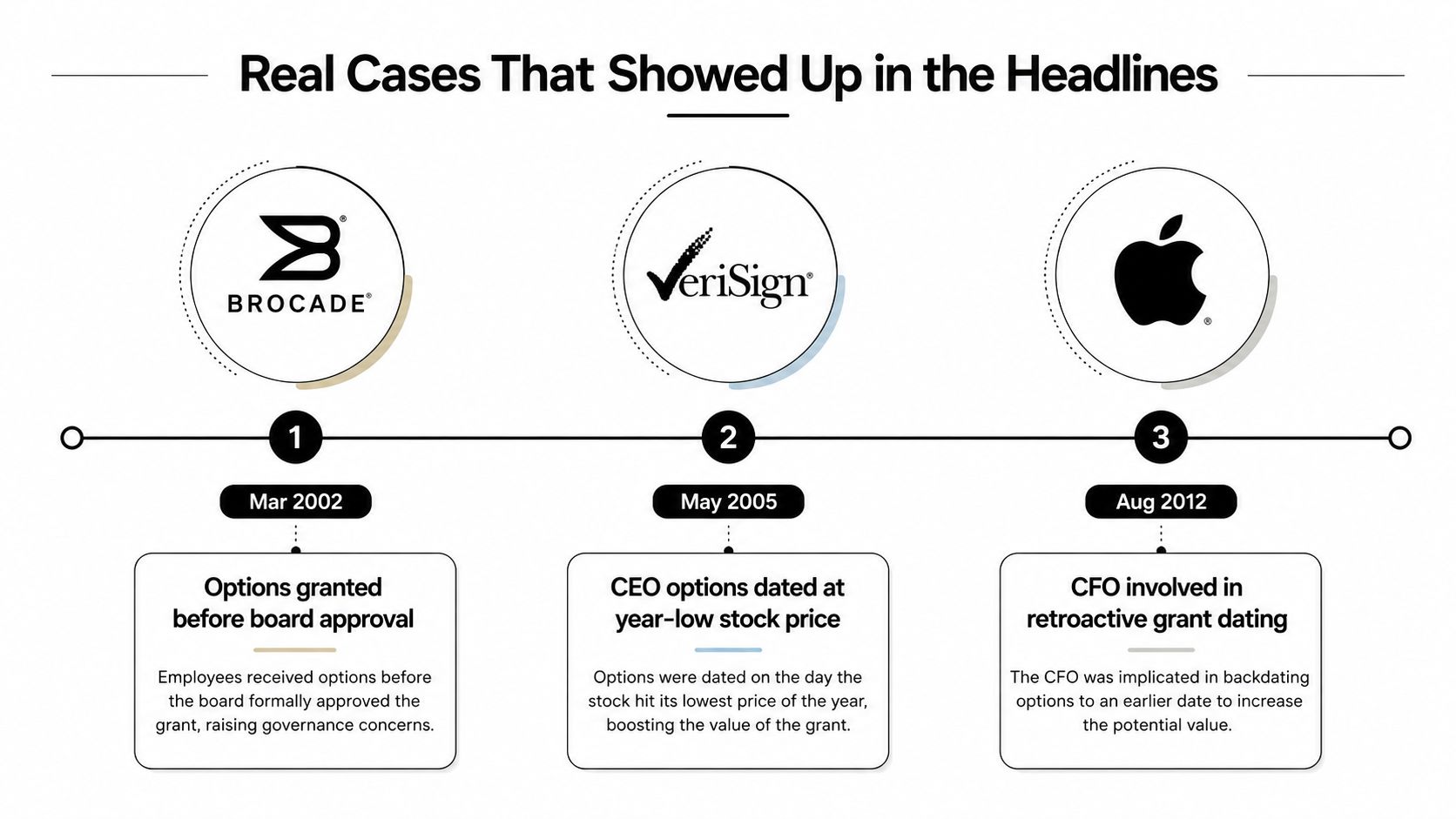
Brocade is the cleanest example of how this looked when regulators finally pulled the thread. The SEC's first high-profile civil case came against Brocade Communications executives Gregory Reyes and Stephanie Jensen on July 20, 2006, with allegations that grants made between 2000 and 2004 were backdated to create the appearance of at-the-money options while hiding millions in compensation expense (SEC speech with Brocade description). The company's problem was not a single typo. It was a pattern.
Brocade, the classic pattern
Brocade shows what happens when grant dates are treated like a moving target. The SEC treated the conduct as one of the first federal securities-law cases involving option-grant manipulation, which is exactly why founders should pay attention to the mechanics, not the headlines. When the grant file, the approval record, and the accounting treatment all point in different directions, the whole thing starts to look intentional even when the original motivation was casual.
The cleanup was predictable, and painful. Restatements, executive fallout, and tighter procedures followed. That's the cost of trying to make old dates work for new economics.
Broadcom, the paper trail that gave everyone away
Broadcom illustrates how a single internal actor can become the trail. The SEC's 2008 action said Broadcom's former CFO allegedly chose retroactive grant dates by comparing historical stock prices, and the agency said the scheme concealed more than $2.22 billion in compensation expense and overstated income by 15% to 422% over the relevant period (Broadcom SEC press release). That is not a bookkeeping mismatch, that is a corporate control failure.
The practical lesson is obvious. When one person controls dates, values, and approvals, the record is easy to manipulate and easy to unravel later. Companies end up disciplining officers, redoing the accounting, and rebuilding the grant process from scratch.
Comverse, where the controls were too weak to stop it
Comverse showed how long a bad process can survive when internal controls are thin. DOJ announced criminal charges against former Comverse Technology executives on August 9, 2006, showing how far the conduct had spread across major public issuers (SEC speech recounting DOJ action). Once a board investigation starts, the question is no longer whether the company intended harm. The question is how many years of records have to be rebuilt.
For founders, the takeaway is simple. You do not want to be explaining old options in a room with auditors, bankers, and lawyers who all start from the assumption that the records are broken.
Red Flags That Backdating May Already Be Present
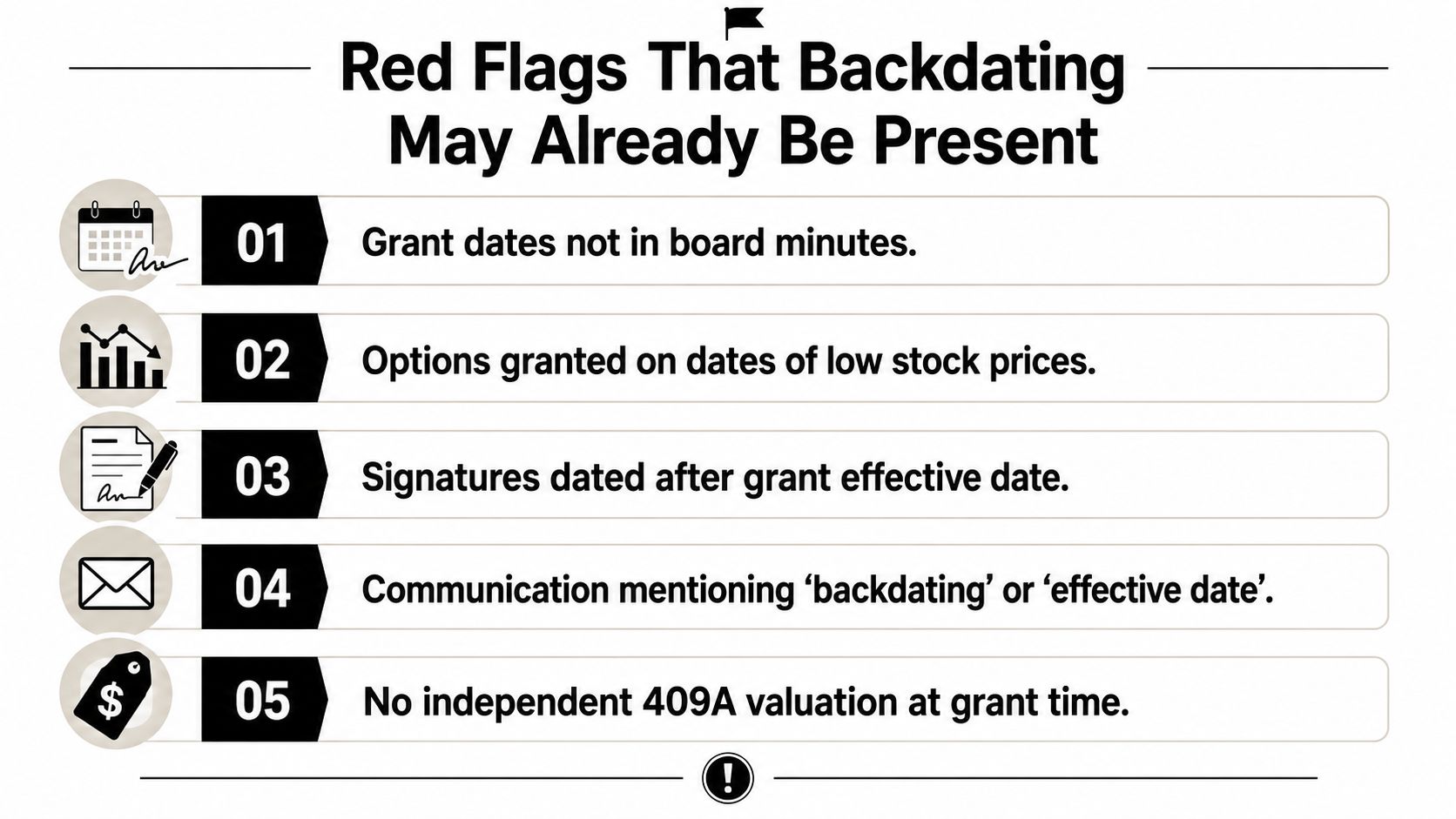
Grab the grant folder and check the dates. If the board minutes do not match the stated grant date, that's your first warning sign. If options were issued on a date where the stock or fair market value was unusually low, that deserves a second look.
What to scan first
- Grant dates not in board minutes: Compare every option agreement against the meeting minutes and written consents. If the approval is missing, pause the grant process and reconstruct the decision trail.
- Options granted on dates of low stock prices: If your records cluster around the lowest-looking dates, look for cherry-picking. That pattern is exactly what auditors and regulators notice.
- Signatures dated after the effective date: A later-dated signature with an earlier “effective as of” clause can hide a timing problem. Pull the email trail and confirm when the decision really happened.
- Emails mentioning backdating or “effective date”: Search the grant file, Slack, and inboxes for language that suggests someone was trying to make the paper match the price.
- No independent 409A valuation at grant time: If the strike price was picked without a current valuation, the company may have a mispricing problem as well as a dating problem.
If you also want a practical document checklist while reviewing employment and equity paperwork, the guide for attorney contract review is a useful companion for spotting loose drafting before it becomes a bigger issue.
If you see a date problem, don't argue with the file. Preserve it, print it, and get counsel involved.
A founder can do a first-pass review in an afternoon. Pull the board minutes, the consents, the grant notices, and the valuation report. Then line them up against the cap table and check whether the grant was authorized before the date the paper claims it was.
How to Remediate a Discovered Backdating Problem
Most private-company backdating issues are fixable if you move fast and stop pretending the problem will disappear. The cleanest response is procedural. Freeze new grants, secure counsel, and preserve every relevant email, minute, valuation, and signed agreement before anyone starts cleaning up the narrative.
The sequence that actually works
Start with independent legal review. If the company issued options before the board approved them, you need to know which grants have real exposure and which ones are just ugly on paper. That means reconstructing the record, not guessing at it.
Then compare the grant date to the actual fair market value and the board action. If the strike price was wrong, re-paper the award at the correct date and price, or replace the defective grant with cash compensation if that is cleaner. If a board action can be ratified lawfully, document it at the actual decision date, not a made-up one.
The SEC and disclosure side matters too. When public-company filings or investor materials need correction, fix them. The same goes for your cap table. Future investors should never inherit hidden defects because management was embarrassed to disclose a bad grant file.
Coto & Waddington, Attorneys at Law works with founders who need this kind of cleanup in the actual world, not the textbook version, including historical grant review, board-consent cleanup, and cap-table corrections. For companies that also need to tighten the transaction side of their equity process, a careful review of the registering with the SEC materials can help prevent the next round from inheriting old mistakes.
Best move: treat remediation like a governance upgrade, not a confession.
The companies that handle this well usually look more credible afterward, not less. They show investors that they found the problem, fixed the file, and put a real control system in place.
Best Practices for Clean Option Grants Going Forward
Clean grants require a repeatable operating process. Waiting until year-end, an audit, or the next financing invites date errors and missing approvals. Set the controls before the grant is issued.
Four habits that keep the file clean
Same-day approval and issuance. The board or committee consent should be signed and dated on the day the grant is approved. Do not roll the date forward, backfill it later, or ask a founder to make the records match after the fact.
One row, one truth. The cap table should identify the grantee, share count, strike price, vesting trigger, and approval timestamp in one consistent entry. If the team must search multiple systems to reconstruct a grant, the process needs correction.
Template the strike price correctly. The option agreement should pull the exercise price from the most recent 409A valuation. Do not rely on memory, an outdated spreadsheet, or an informal conversation. For related equity transactions, use a disciplined stock purchase agreement process so the transaction terms and supporting documents stay aligned.
Quarterly reconciliation. Compare board minutes, grant approvals, option agreements, and cap-table entries every quarter. Correct discrepancies before investors, auditors, or a buyer discover them during diligence.
Contemporaneous documentation is your best defense. A complete file should show who approved the grant, when approval occurred, which valuation supported the price, and how the entry reached the cap table.
For South Florida founders, these controls belong in routine legal hygiene alongside formation, equity issuance, and contract review. Coto & Waddington, Attorneys at Law can help establish that process and review historical records when the file is already inconsistent. A clean approval trail protects the company during financing, diligence, and a sale.
A Clear Path Forward for South Florida Founders
Backdating usually isn't one dramatic fraud. It's a stack of small shortcuts, a grant dated before approval, a strike price copied from an older valuation, a minute book updated after the fact, and a cap table that no longer matches reality. That's why the fix has to be practical, not emotional.
The main lesson is straightforward. Section 409A, SEC disclosure rules, state corporate law, and the company stock plan each create separate risk. If one grant is off, it can hit all four at once. Public-company history makes that plain. The SEC said it was investigating more than 100 matters involving potential employee stock-option abuses in 2006, Reuters and NPR coverage said the probe had expanded to more than 80 companies, and the SEC later said publicly disclosed backdating problems could collectively cost companies more than $10.3 billion in lost share price and extra compensation expense (SEC speech with enforcement milestone).
The better takeaway for private companies is not panic. It's discipline. If the old file looks messy, gather the documents, confirm the actual approval dates, fix what needs fixing, and make sure the next grant is clean on day one. The backdating risk that matters in 2026 is usually not the headline scandal. It's the hidden governance mess that shows up during diligence, financing, or a sale.
Coto & Waddington, Attorneys at Law serves founders and small businesses across Miami, Fort Lauderdale, Boca Raton, and Palm Beach with focused business and startup counsel, including grant-date review, board-consent cleanup, and equity documentation support. If your option records are old, inconsistent, or hard to defend, get the file reviewed before the next financing or acquisition conversation makes the problem more expensive.
If your option grants, board consents, or cap table records need a hard look, Coto & Waddington, Attorneys at Law can help you clean up the paper before it becomes a financing problem. Visit Coto & Waddington, Attorneys at Law to ask about a focused grant-date and compliance review, and get a practical plan for fixing the file, tightening approvals, and moving forward with cleaner equity records.