You're sitting in a South Florida coffee shop with a formation service open on your laptop. The business name is available, the payment screen is ready, and the articles of organization template looks simple enough to finish between meetings. The danger is assuming that every blank is merely administrative.
The articles are the filing that legally brings an LLC into existence. They also create a public record that banks, tax agencies, counterparties, and courts may later review. A good template helps you submit cleanly, but it can't decide whether a Florida domestic LLC, a Delaware holding company, or a professional-service entity is the right structure. That decision belongs to you and, when the facts are complicated, your lawyer.
Table of Contents
- Why the Articles of Organization Matter for Your LLC
- Anatomy of a Standard Articles of Organization Template
- Florida vs Delaware at a Glance
- Annotated Florida Filing Example
- Annotated Delaware Filing Example
- Public Filing Fields vs Operating Agreement Terms
- Filing Checklist Before You Submit
- Common Pitfalls That Get Filings Rejected or Delayed
- When to Use the Template and When to Call Counsel
- Next Steps After the Articles Are Filed
Why the Articles of Organization Matter for Your LLC
A founder can have a signed operating agreement, a business bank account application, and a ready-to-use contract, yet still lack an LLC. The entity begins when the state accepts its formation filing. In Delaware and some other states, that filing is called a Certificate of Formation, but it serves substantially the same function as articles of organization. A practical overview of LLC articles and their formation role-articles-of-organization) describes the document as the entity's administrative “birth certificate.”
The accepted filing places the company on the state's records and establishes it as a separate legal organization. Banks, licensing agencies, counterparties, and courts may later rely on that record. The filing supports contracts, banking, and operations, but it does not select the right structure for a Florida domestic LLC, a Delaware holding company, or a regulated professional business.
Public record versus private agreement
The articles usually identify the LLC's legal name, registered agent, principal address, management structure, organizer, and effective date. Those fields define the company's public profile. They rarely describe the owners' private economic arrangement.
Practical rule: Enter only information you would accept seeing in a public state record.
The filing tells the state:
- Who the entity is: The legal name must follow state naming rules and generally include “LLC” or “Limited Liability Company.”
- Where official notices go: The registered agent needs a physical in-state address and must be available to receive service of process.
- Who organized it: The organizer submits or signs the formation document.
- How the company is identified: The record may state the principal office, management model, purpose, duration, and effective date.
That baseline gives financial institutions, licensing bodies, contracting parties, and courts a reliable way to identify the company. It also gives the state the information needed to maintain and administer the entity.
The operating agreement handles the internal bargain instead. Ownership percentages, profit allocations, voting thresholds, capital calls, transfer restrictions, buyout rights, and detailed manager authority generally belong there. Publishing those terms in the articles can disclose private economics and make future amendments more cumbersome.
Founders considering a broader venture or professional structure can use Attorney Assistant's attorney assistant law firm structures guide to distinguish entity selection from internal governance. A template is useful when it stays within the filing's purpose. Regulated activity, foreign ownership, multiple states, or layered entities justify legal review before submission, especially where Florida and Delaware require different choices about purpose clauses, registered agent arrangements, or delayed effective dates.
Anatomy of a Standard Articles of Organization Template
A founder can complete every blank in an articles of organization template and still file the wrong document for the business. The form is a public record, so it should state the company's identity and required structure without turning private ownership terms into public filings. Templates follow a common pattern, but each state controls its own fields and filing mechanics. A state-focused explanation of how these templates developed explains why familiar templates still need state-specific review.
Start with identity and contact information
Legal name. Search the state's business database before filing. Keep the spelling, punctuation, and entity suffix consistent across the articles, EIN application, operating agreement, bank records, and contracts. A small mismatch can create avoidable questions during banking or licensing.
Registered agent and registered office. The agent receives official notices and service of process. The address generally must be a physical street address in the formation state, not a post office box. A founder may serve as agent, but a commercial agent can preserve privacy and continuity if the founder relocates or misses regular monitoring.
Principal office. This is the company's main business address or designated office. It may differ from the registered office and may become part of the public record. A home address may be permitted, but filing it can expose that address to public searches and business correspondence.
Add only the public structure the state needs
Purpose clause. Many states accept broad language covering any lawful activity. Others require a specific purpose, industry description, or additional wording. Broad language preserves room to grow, but a licensed or regulated company may need more precise wording and should confirm the requirement before filing.
Management structure. The form may ask whether the LLC is member-managed or manager-managed, and some states request member or manager details. Select the structure that matches the operating agreement. Voting rights, profit allocations, capital calls, transfer restrictions, and manager authority belong in that agreement rather than in the public filing.
Organizer information. The organizer creates the entity and signs the filing. That role does not automatically confer ownership. Keep organizer and member roles separate unless the facts make them the same person.
Effective date. A filing may take effect immediately or on a permitted future date, depending on state rules. Oregon's example template allows a delayed effective date that cannot extend beyond 90 days after filing. Review the state's filing instructions for fees, submission mechanics, and effective-date choices before selecting the field, as described in State filing guidance on fees, mechanics, and effective-date choices.
A reliable template is short, state-specific, and safe for public disclosure. It records what the filing office requires and leaves the company's private deal to the operating agreement. When the business is regulated, has foreign ownership, or will operate through multiple entities, legal review is appropriate before submission.
Florida vs Delaware at a Glance
A Miami consulting firm usually has a practical reason to form in Florida. A venture-backed company, holding company, or multi-state structure may have a reason to consider Delaware. The template cannot make that decision for you. It only records the formation choice after you have made it.
Florida files Articles of Organization through Sunbiz. Delaware uses a Certificate of Formation. Both states require a registered agent and an in-state address, but the filing details and ongoing obligations differ. Florida's LLC filing fee is $125, while Delaware's is $90. Confirm current charges through the official Florida Sunbiz fee information, and treat the filing fee as only one part of the cost.
Florida filings commonly use broad lawful-purpose language. Delaware certificates often use similarly broad lawful-activity language and may be kept relatively short. Neither state's formation document should carry the company's full ownership, voting, profit-allocation, transfer, or manager-authority terms. Those provisions belong in the operating agreement.
Delayed effective dates also require separate review. Florida and Delaware apply state-specific rules, and the selected date can affect when the entity exists for administrative and transaction purposes. Do not choose a future date just because the template offers the field.
Delaware's developed business-law system, Court of Chancery, and flexible operating-agreement rules can matter for a company with investors, complex ownership, or a deliberate multi-state strategy. Those advantages come with separate Delaware maintenance and tax obligations. A Delaware company operating in Florida may still need Florida registration, filings, and local compliance.
For founders evaluating that broader rationale, this guide to Delaware incorporation benefits offers additional context. The practical question is whether the legal, administrative, tax, and investor considerations justify forming outside the company's home state. If the business is operating from Florida with Florida owners and customers, Florida often avoids an extra layer of administration.
Annotated Florida Filing Example
A Miami consultant forming a single-member LLC for management advisory work might complete the Florida filing as follows. Treat the entries as a working example, then verify the current Division of Corporations form before submitting. The filing records the company's public-facing facts. It does not replace an operating agreement covering ownership, voting, distributions, transfers, or manager authority.
Sample public entries
- Article I, name: “Biscayne Advisory Group LLC.” Search the proposed name through Sunbiz and Florida LLC formation guidance before filing. Enter the name exactly as intended and review it for state acceptance.
- Article II, principal office: The consultant's business address, plus a separate mailing address if needed. Both addresses may become public.
- Article III, purpose: “To engage in any lawful activity.” This broad wording avoids unnecessarily limiting the company, provided the business does not require specialized purpose language or professional licensing treatment.
- Registered agent: A named Florida agent and a Florida street address. The agent must be available to receive official documents there.
- Effective date: Immediate effectiveness, unless a permitted future date fits the launch and transaction schedule.
- Signature: The organizer signs using the organizer's legal name and title.
Assume every field may enter the public record. That includes addresses, registered-agent information, organizer details, purpose language, and the signature block. Florida also requires a registered-agent acceptance statement, which the agent must sign and file through the state process.
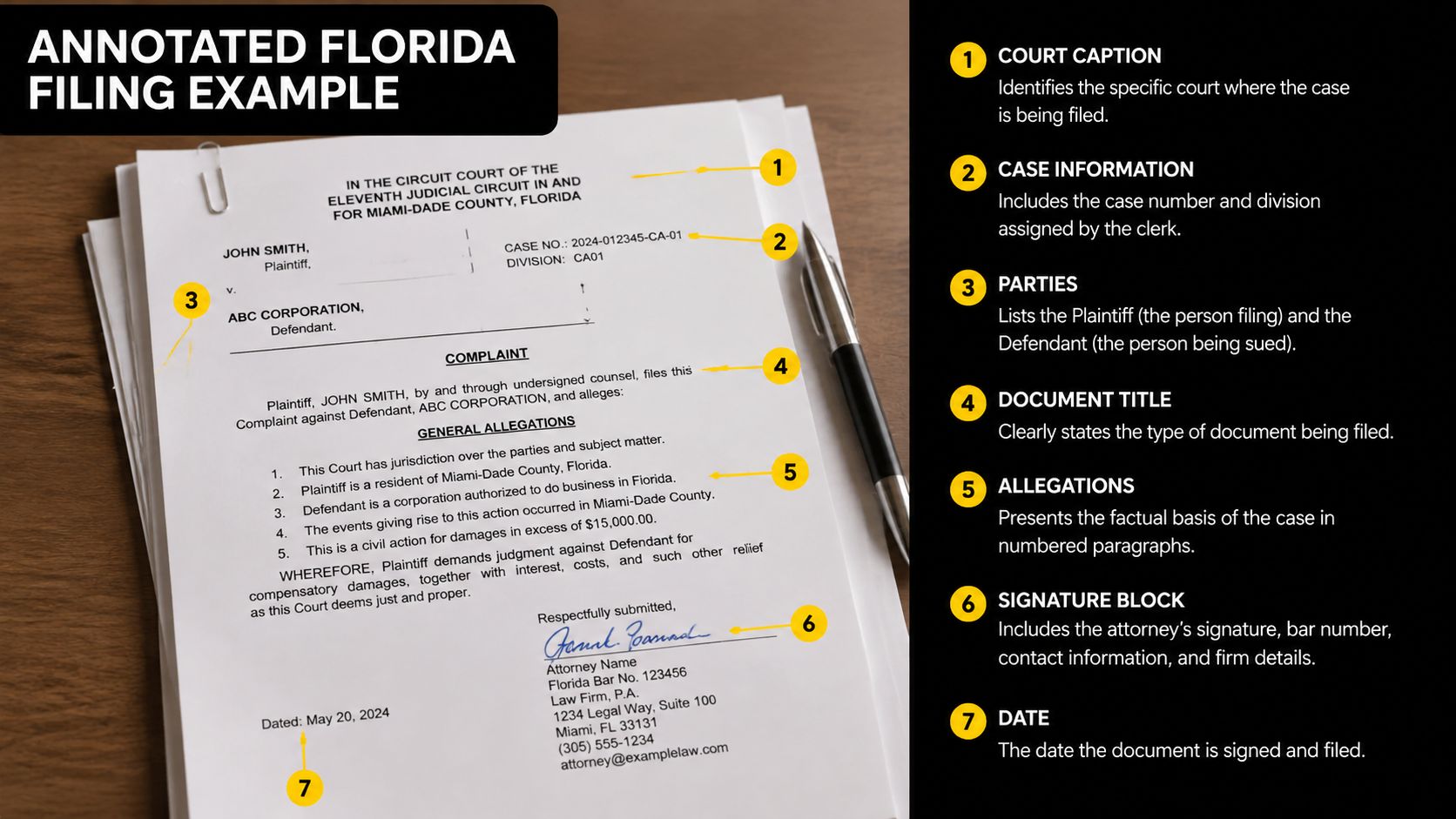
Florida's filing charge is $125, made up of a $100 filing fee and a mandatory $25 registered agent designation fee. After acceptance, the state stamps or otherwise marks the filing. Save the accepted copy and file number promptly.
Do not list a home address casually. If privacy matters, evaluate a lawful commercial office or registered-agent arrangement, then confirm that the address meets Florida's requirements. A template cannot decide whether that choice fits your privacy, service-of-process, and operating needs.
Annotated Delaware Filing Example
A Delaware example looks different in presentation, even though the core information remains familiar. Suppose a non-U.S. founder forms a Delaware LLC to hold interests in a U.S. business. The certificate commonly identifies the LLC name, Delaware registered agent and registered office, and the authorized person submitting the filing.
The leaner Delaware approach
A simple certificate might state:
- Name: “Atlantic Holdings LLC.”
- Registered agent: The Delaware agent's legal name and physical Delaware street address.
- Purpose: “To engage in any lawful act or activity,” unless the founder chooses a more specific purpose.
- Authorized person: The organizer or authorized representative signs or submits the certificate.
- Effective date: Immediate effectiveness, or a permitted future date if the formation plan requires it.
Delaware's shorter form doesn't mean the business has fewer legal issues. If the certificate is silent, Delaware statutory defaults and the operating agreement become especially important for membership, management, and economic arrangements. The certificate shouldn't be expanded with investor rights, vesting schedules, preferred economics, or tax allocations merely because the template appears brief.
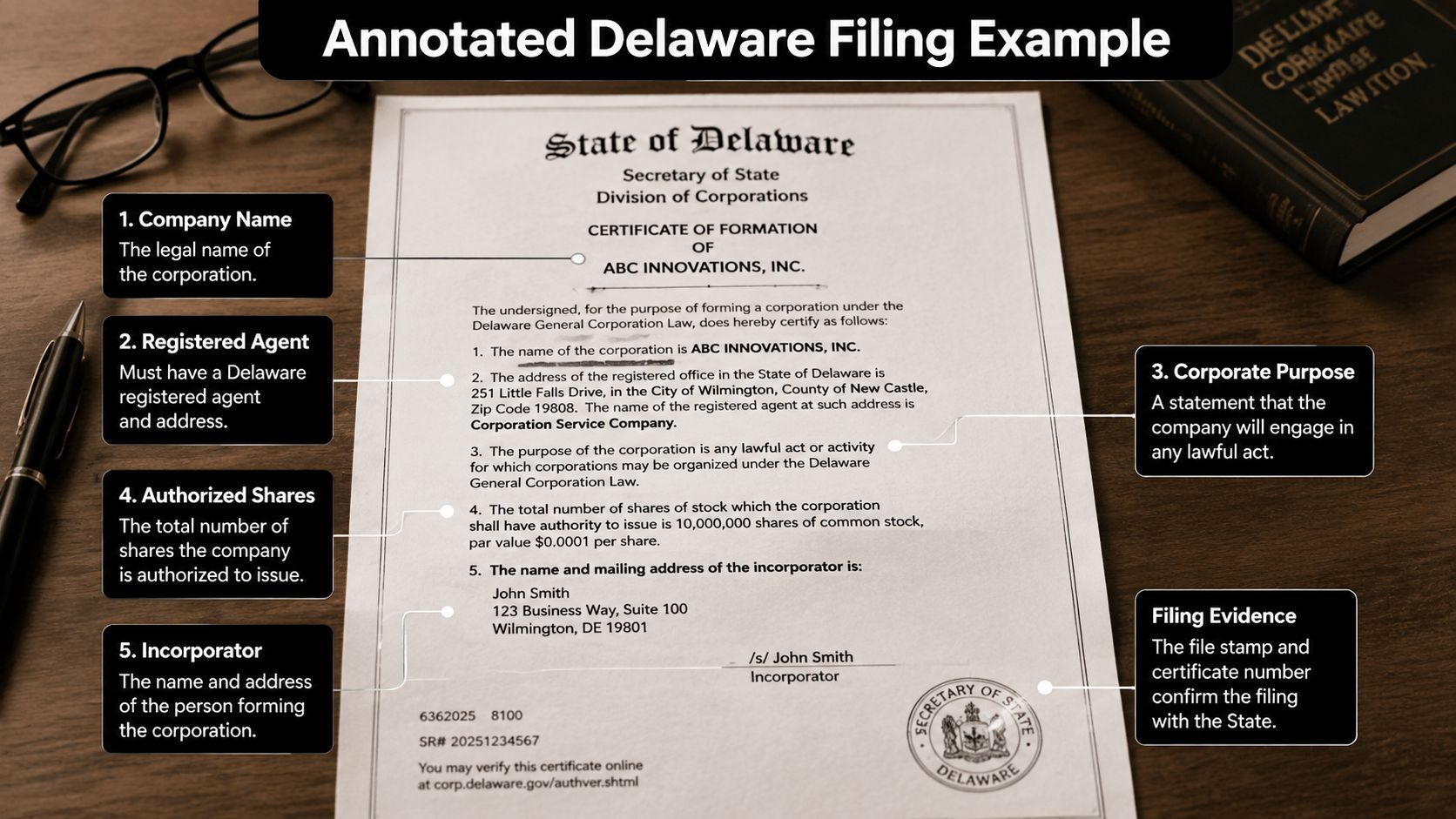
Delaware's LLC filing fee is $90. A certified copy request adds $50, and 24-hour expedited service is available for an additional charge, according to the Delaware filing-cost information provided in this Delaware LLC formation cost guide. Expedited processing can be useful when a bank, closing, or transaction has a fixed deadline, but it doesn't replace careful drafting.
The Court of Chancery and Delaware's flexible operating-agreement culture can matter for intricate structures. They don't automatically justify Delaware for a local Miami service business that will operate, hire, and contract primarily in Florida.
Public Filing Fields vs Operating Agreement Terms
The articles should tell the public and the state what the LLC is. The operating agreement should tell the members how the LLC works.
| Topic | Articles of Organization (public) | Operating Agreement (private) |
|---|---|---|
| Entity identity | Legal name and formation information | Internal naming conventions and authority rules |
| Address and notice | Principal office and registered agent | Internal records and communication procedures |
| Ownership | Sometimes limited member or manager information, depending on state | Ownership percentages, contributions, and profits interests |
| Management | Member-managed or manager-managed designation | Manager powers, voting rights, deadlock remedies, and approvals |
| Economics | Usually omitted | Profit and loss allocations, distributions, tax provisions |
| Transfers | Usually omitted | Transfer restrictions, buyouts, vesting, and succession |
| Purpose | Filed purpose or duration language | Business plans, scope, restrictions, and internal objectives |
A founder who copies the operating agreement into the articles creates three problems. First, the filing office may reject language that looks contractual or falls outside the form's intended purpose. Second, the public record may expose ownership economics, investor protections, or family arrangements that should remain private. Third, changing those terms may require a state amendment and filing fee, while an operating-agreement amendment typically remains an internal company record.
Keep the articles short enough to file confidently and detailed enough to satisfy the state. Put the negotiation between owners somewhere private.
Use the public filing for identity, notice, and statutory elections. Use the operating agreement for the relationship among members. A resource such as this business operating agreement template guide can help founders identify the private terms that shouldn't be forced into the formation document.
Filing Checklist Before You Submit
A filing can be legally sound and still create trouble because one field, attachment, or date was entered carelessly. Before submitting, compare the completed form against the formation plan and the state's current instructions.
Verify the completed form: Confirm the entity name, organizer information, registered-agent details, purpose, addresses, and signature blocks match across every page and attachment. Remove tracked changes, comments, and drafting notes before uploading.
Review public disclosures: Read the form as a public record, not as a private agreement. Check whether a principal office, mailing address, or other contact information should be exposed publicly. Keep ownership economics, transfer rights, and management arrangements in the operating agreement.
Check purpose and authority: Make sure the purpose statement fits the planned business and does not imply a regulated activity the company is not prepared to conduct. Confirm that the person signing has authority under the selected state form.
Confirm the effective date: Decide whether the LLC should exist upon acceptance or on a permitted future date. A delayed date can affect contracts, tax planning, licensing, and when the company may begin acting in its own name. The state filing guidance on effective dates and submission mechanics is a useful reminder to verify the formation state's specific rule before filing.
Reconcile payment and add-ons: Confirm the filing charge shown by the official state portal, then review any separate fee for expedited handling, certified copies, or registered-agent service. Florida and Delaware do not use identical fee structures, so do not rely on a fee from another jurisdiction.
Prepare the submission record: Save a final PDF of the exact document submitted, the payment confirmation, delivery receipt, and any agent consent or required attachment. If filing by mail, use a trackable delivery method and retain the completed cover sheet.
Calendar the follow-up: Record the submission date, expected processing window, annual report deadline, and any tax or licensing tasks that follow formation. After acceptance, confirm the entity's legal name and file number on the state record before opening accounts or signing contracts.
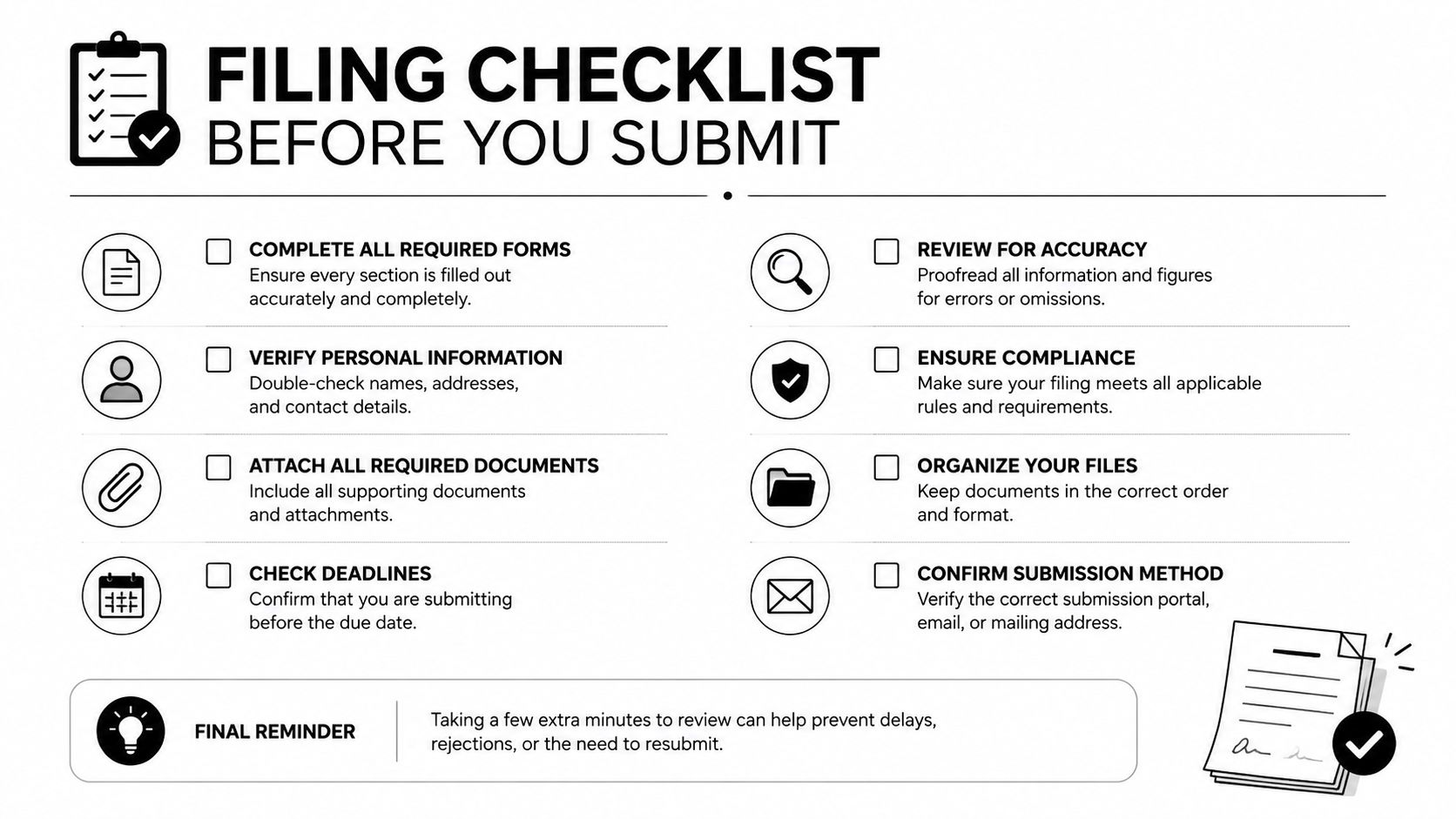
Use the current official state form whenever one is available. This practical sample-form resource can help you compare the document's structure, but the filing office's instructions control.
Common Pitfalls That Get Filings Rejected or Delayed
Most filing problems are preventable because they come from mismatched information rather than difficult law. The recurring trouble spots are the business name, registered agent, purpose language, effective date, and signature authority.
| Pitfall | Florida impact | Delaware impact |
|---|---|---|
| Similar or unavailable name | The state may reject a name that isn't distinguishable or lacks the required LLC designation | The certificate may be rejected if the name conflicts with an existing Delaware entity |
| Registered-agent issue | A missing or unsuitable Florida street address can stop acceptance | Missing agent information or required acceptance documentation can delay processing |
| Purpose mismatch | A regulated activity may require a specialized structure or wording | Vague or conflicting purpose language can prompt closer review |
| Effective-date error | An invalid future or inconsistent date requires correction | A date outside Delaware's permitted framework can create rework |
| Signature problem | Missing organizer or agent acceptance information can cause rejection | The authorized person or required attachment may be incomplete |
| Address inconsistency | Different spellings across the filing and related records create avoidable questions | Inconsistent principal or registered-office information can complicate later filings |
A home address isn't automatically wrong, but using one without considering public exposure can create a privacy problem. A post office box also isn't a substitute for a required physical registered-agent address. Names that include restricted terms, professional designations, or regulated-industry references deserve review before submission.
Purpose language deserves particular care. A neutral explanation of state-by-state articles requirements notes that some states require a business purpose, NAICS code, county filing, publication, or other steps. That variation is why copying a Florida clause into Delaware, or a Delaware certificate into Florida, can produce delay instead of speed.
When to Use the Template and When to Call Counsel
A template is usually reasonable for a straightforward single-member LLC or simple multi-member operating company. The business should have ordinary commercial activities, a clear ownership arrangement, no unusual licensing issue, and no complicated cross-border tax or entity structure.
Stop using the template as your primary tool when the consequences of a wrong assumption exceed the cost of legal review. Call counsel if:
- Ownership crosses borders: A nonresident alien or foreign entity may require tax, withholding, or reporting analysis.
- Real estate spans states: Property ownership can create registration, liability, and transfer questions beyond the certificate.
- The business is regulated: Cannabis, fintech, healthcare, insurance, and professional services may require specialized entities or approvals.
- The LLC sits in a larger structure: A C corporation, trust, parent company, or investor vehicle changes the drafting context.
- The economics are negotiated: Profits interests, vesting, preferred returns, special allocations, or capital commitments need coordinated documents.
- Family planning is involved: Marital, estate-planning, or asset-protection goals can make ownership and transfer language central to the formation.
New York's professional-service LLC process, for example, can require an accompanying certificate of good standing or professional authority. The state's professional-service LLC instructions demonstrate why a generic template isn't portable into every specialized filing.
Next Steps After the Articles Are Filed
Acceptance is the beginning of the company's administrative life, not the end of formation. Confirm the filing through the state's business-record system, order certified copies when a bank or out-of-state registrar requires them, and keep the accepted articles with the company's permanent records.
Then complete the operational documents:
- Obtain the EIN: Use the accepted formation record when applying with the IRS.
- Open the bank account: Provide the EIN, filed articles, and any ownership or authorization documents the bank requests.
- Adopt the operating agreement: Record ownership, management authority, contributions, distributions, transfers, and tax provisions privately.
- Check local requirements: Review county and city business-tax-receipt rules, fictitious-name registration, permits, and industry licenses.
- Record initial actions: Document the initial member or manager approvals and preserve them with the formation file.
- Track recurring compliance: Florida annual reports are due May 1, while Delaware franchise tax is due March 1. Missing these deadlines can put the entity's good standing at risk.
For South Florida and cross-border founders, the practical next move is to review the accepted filing alongside the operating agreement, EIN application, registered-agent arrangement, and local compliance plan. Coto & Waddington, Attorneys at Law handles LLC formation, operating agreements, EIN coordination, registered-agent follow-up, and broader startup counsel for businesses operating in Florida and Delaware. Visit Coto & Waddington, Attorneys at Law to request an intake and discuss your formation documents with the firm.