You've chosen a name, found a Florida registered agent, and you're ready to click “submit” on Sunbiz. The filing looks simple, but the receipt you receive is only the beginning. The Articles of Organization for a Florida limited liability company create the entity, while the operating agreement, annual report, amendments, tax registrations, and business records determine whether that entity remains usable and properly organized.
Florida's process is predictable when you separate the legal requirements from the assumptions founders bring to the filing. The state wants specific public information, a valid registered agent, an authorized signature, and the correct fee. It doesn't ask you to file your operating agreement with the Division of Corporations, and filing the articles doesn't automatically give you every license your business may need.
Table of Contents
- What the Articles of Organization Actually Do Under Florida Law
- Filling Out Every Required Field With Sample Language
- Filing Method, Fees, and Realistic Timelines
- Errors That Get Florida Filings Rejected
- Your First 90 Days After the State Approves the LLC
- Annual Reports, Amendments, and Ongoing Compliance
What the Articles of Organization Actually Do Under Florida Law
Florida Statutes § 605.0201 treats the Articles of Organization as the filing that legally creates the LLC. One or more persons form a limited liability company by signing and delivering the articles to the Florida Department of State, Division of Corporations. The LLC's existence begins when the filing receives the state's date and time endorsement, unless the articles specify a delayed effective date. Read the operative language in Florida Statutes Chapter 605.
That legal moment matters. Once the state accepts the filing, the business can begin operating, contracting, opening accounts, and holding assets in its own name. The LLC structure is intended to separate company obligations from the personal assets of its members, although that protection depends on proper formation, adequate records, and responsible operation. A Sunbiz filing is therefore not a ceremonial form. It's the company's public birth certificate.
Practical rule: Treat the articles as a core governance record. A bank, lender, investor, landlord, or contracting partner may rely on the information shown in the state's public record.
The filing doesn't answer every question about ownership or control. It generally doesn't establish the members' profit allocations, contribution obligations, voting procedures, buyout rights, or dispute process. Those provisions belong in the operating agreement, an internal contract among the members and the LLC. A manager-managed structure may be reflected in the articles, but the detailed authority and limitations should still be documented internally.
What belongs in the state filing
The articles are different from several documents founders commonly confuse with formation paperwork:
- Articles of Organization: Filed with Sunbiz to create the LLC.
- Operating agreement: Kept internally to govern the company's relationship with its members and managers.
- Internal resolution: Used to authorize actions such as opening a bank account or approving a contract.
- Fictitious name filing: Used when the company operates under a public-facing name different from its legal name.
The IRS issues federal tax identification, but it doesn't create the Florida LLC. A county clerk may handle local records or licenses, but that office isn't the formation agency. The correct destination for the articles is the Florida Division of Corporations through Sunbiz. Founders who want a broader formation overview can also review this Florida LLC formation guide.
A defective filing can be corrected through an amendment under Florida law, including § 605.0205. That doesn't make accuracy unimportant. An amendment requires another filing, may require another fee, and can delay banking, contracting, licensing, and other launch tasks.
Filling Out Every Required Field With Sample Language
Sunbiz uses form CR2E021 for Florida LLC Articles of Organization. The safest way to complete it is line by line, with the approved legal name and registered-agent information in front of you before you begin.
Start with the legal name
The LLC name must comply with Florida's naming rules and include an approved designation such as “Florida Limited Liability Company,” “L.L.C.,” or “LLC.” Before selecting the name, search Sunbiz and confirm that the name is distinguishable from existing records under § 605.0112. A name that sounds different to a founder may still be too close to an existing entity for state filing purposes.
Don't treat a name search as a trademark clearance. Sunbiz availability addresses the state's entity records. It doesn't automatically give you trademark rights or prevent another business from using a similar brand in the marketplace.
Enter both principal-office addresses
The form asks for the initial principal office street address and mailing address. The street address identifies the company's main office location. The mailing address is where the state and other correspondents can send documents, and it may differ from the street address.
A sample presentation might look like this:
- Principal office street address: 100 Brickell Avenue, Suite 900, Miami, Florida 33131
- Principal office mailing address: P.O. Box 1000, Miami, Florida 33101
Use the company's actual information, not an address selected merely because it appears professional. Review every apartment, suite, city, state, and ZIP-code entry before submitting. An invalid or incomplete address can stop an otherwise acceptable filing.
Complete the registered-agent section carefully
Florida requires a registered agent with a physical Florida street address. A P.O. box alone won't satisfy the registered-office requirement. The agent must accept the appointment in writing by signing the acceptance line on the form.
The form's information can be stated in plain terms:
“The initial registered agent is [Name], whose street address in Florida is [Address].”
The name on the appointment section and the name on the acceptance line must match. If the registered agent is an entity, use its legal name exactly as shown in state records. If the founder is serving individually, use the individual's legal name and confirm that the person can receive official papers at the listed location.
Decide whether to delay effectiveness
The articles can include an optional effective-date clause. A delayed effective date may be no more than 90 days forward, so founders should coordinate it with planned contracts, tax treatment, licensing, and banking rather than choosing a date casually.
Finally, an authorized person must sign the filing. The signer may be a member or an organizer, but the signature should accurately identify the signer's role. An organizer is the person taking action to form the LLC. That person doesn't necessarily become a member.
Filing Method, Fees, and Realistic Timelines
Florida gives founders two practical submission paths for Articles of Organization. Online filing through Sunbiz is usually the cleaner choice because the submission is electronic, payment is immediate, and the approved document can be downloaded from the state system. The Division of Corporations processes filings in the order received, so check the state's current processing-date tracker and filing instructions before relying on a launch date.
The official fee schedule sets the required formation cost at $125, consisting of a $100 filing fee and a $25 registered-agent designation fee. The same baseline applies whether the submission is online or mailed. Optional document requests are separate. A certified copy costs $30, and a certificate of status costs $5, according to Florida's official LLC fee schedule.
Online filing generally moves faster than paper submission. Independent filing guidance commonly places online approval at about 5 business days, while mailed filings may take about 12 business days plus mail transit, with heavier volumes sometimes producing a longer total wait. The state's live tracker should control your planning because queues change.
Mail filing can make sense when a founder needs a paper trail or can't use the online payment process. It doesn't create a fee advantage, and it adds delivery and intake risks. Hand delivery also doesn't guarantee immediate review.
Founders comparing entity formation systems in different states may find it useful to review Arizona incorporation pitfalls for startups, particularly when deciding how state-specific filing requirements affect launch planning.
Filing method comparison
| Filing Method | Total Fee (Filing + Registered Agent) | Typical Processing Time | Payment Options |
|---|---|---|---|
| Online through Sunbiz | $125 | Commonly about 5 business days, subject to the state tracker | Credit card |
| Mail to the Division of Corporations | $125 | Commonly about 12 business days plus mail transit | Payment method accepted with mailed filing |
A certificate of status and certified copy should be ordered only when a bank, lender, investor, landlord, or diligence process needs them. Don't assume either document is included in the formation fee.
Errors That Get Florida Filings Rejected
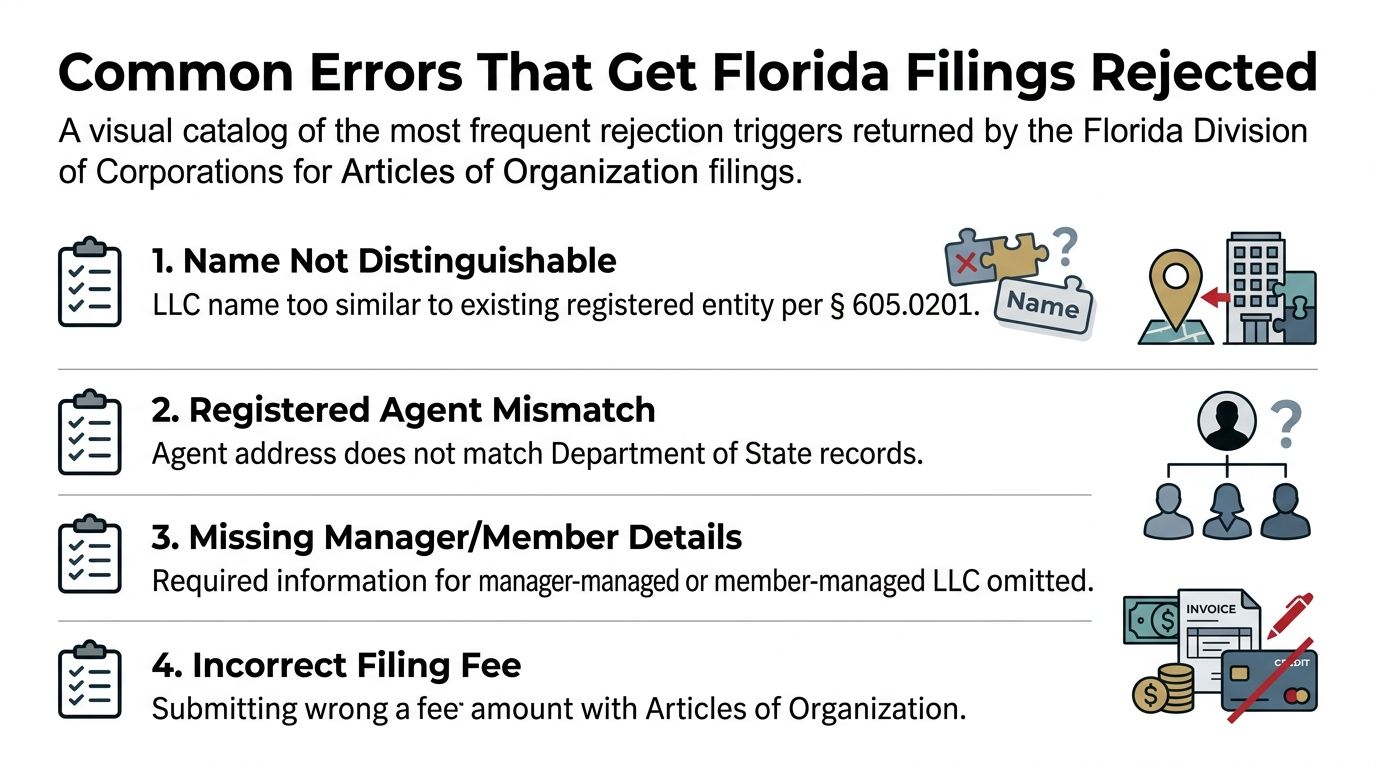
Most rejected filings fail for ordinary reasons, not complicated legal disputes. The rejection usually begins with a mismatch between the information the founder typed and the information the state expects to see.
Audit the name and entity type
The LLC name must be distinguishable under Florida's naming rules and must use the correct entity designation. “LLC,” “L.L.C.,” and “Florida Limited Liability Company” are acceptable forms, but the filing should identify the entity consistently from beginning to end. Don't use a corporate designation in one place and an LLC designation in another.
Match the registered-agent information
The registered agent's name, Florida street address, and written acceptance must align. A founder may type the commercial agent's abbreviated business name in the appointment field, then use a different legal name on the acceptance line. That mismatch can produce a rejection.
Confirm that the address is a physical Florida street address, not only a P.O. box. Also confirm that the agent has agreed to serve. An unpaid or unconsenting agent isn't a valid solution because the founder listed the person.
Check every address and signature
The principal office mailing address must be complete and usable. Mailed submissions also require close attention to the signature on the filing materials. A missing signature, an unsigned acceptance, or a signature from someone without authority can stop processing.
The state may sometimes allow a soft correction, but founders shouldn't build their timeline around a phone call resolving a defect. A hard rejection may leave the filing fee unrecovered and force a new submission. A rejected filing means another $100 filing fee plus the $25 registered-agent designation fee, and the processing clock starts over. That's why a short self-audit before payment usually costs less than correcting the first rejection.
Your First 90 Days After the State Approves the LLC
Approval gives you a legal entity, not a fully operational business. The first ninety days should convert the state record into a functioning company with separate finances, documented authority, and a compliance calendar.

Days 1 through 30
Download the approved Articles of Organization from Sunbiz and save the document in more than one secure location. If a bank or counterparty requests formal proof, order the certified copy or certificate of status that fits the request.
Apply for an EIN through the IRS when the LLC's structure or activities require one, and many banks will request it even when the federal tax rules may not. The IRS issues the EIN without a state formation fee, and eligible applicants can generally complete the online process promptly. Keep the confirmation with the company's permanent records.
Next, prepare and sign the operating agreement. It should address ownership, contributions, management authority, voting, distributions, transfers, deadlock, and dissolution. The agreement is especially important when members have different financial contributions or different levels of involvement. A Florida business operating agreement resource can help founders identify the provisions that need attention.
Open a dedicated business bank account using the approved articles, EIN where applicable, government identification, and any operating agreement the bank requests. Don't run personal and company expenses through one account if you want clean records and a credible separation between the owner and the entity.
Days 31 through 60
Register with the Florida Department of Revenue if the business sells taxable goods or services. The registration depends on the company's activities, so don't assume that formation automatically handles sales-tax compliance.
Check the county and municipality for any required local business tax receipt. Then identify professional or industry licensing through the Florida Department of Business and Professional Regulation, the relevant state board, or another responsible agency. A Florida LLC filing isn't a substitute for a professional license, zoning approval, health authorization, or local operating requirement.
Set up bookkeeping that identifies owner contributions, distributions, revenue, expenses, and company assets. The accounting system should match the operating agreement and the bank records.
Days 61 through 90
Review whether the LLC must file a Beneficial Ownership Information report with FinCEN, considering the current federal rules and any applicable exemptions. Set up a record book containing the articles, amendments, operating agreement, resolutions, tax registrations, licenses, and important contracts.
Finally, calendar the Florida annual report window. The report is filed through Sunbiz between January 1 and May 1, so put the deadline on the business calendar before the launch work becomes urgent.
Annual Reports, Amendments, and Ongoing Compliance
The formation filing is one event in a continuing compliance cycle. Florida LLCs must file an annual report every year, and the state's filing window runs from January 1 through May 1. The official guidance explains that the report also provides an opportunity to update the registered agent and registered-office information, which makes it both a compliance filing and a records check.
The annual report fee is $138.75 when filed by the deadline, while a late filing triggers a $400 penalty, according to Florida's annual report guidance. That difference is avoidable. Assign one person responsibility, use more than one calendar reminder, and review the public record before submitting the report.
Amendments belong on the maintenance map
A change to the company's articles may require a Certificate of Amendment. Common examples include a legal name change, a principal-office change, a registered-agent change, or a change to a governance provision stated in the public filing. Florida's amendment workflow and rejected-filing update process are available through the Sunbiz LLC filing system.
Not every internal change belongs in an amendment. A member's economic arrangement may be controlled by the operating agreement rather than the public articles, depending on what the articles state and what Florida law requires. Review the actual document before deciding that a routine update is merely internal.
Registered-agent changes deserve prompt attention. If the agent resigns, the LLC needs a replacement and updated state records so official notices and service of process reach the company. Leaving an old agent listed after a move or resignation creates a practical risk that has nothing to do with whether the business is actively selling.
Founders should also avoid relying on the phrase “biennial statement” as a substitute for Florida's actual annual-report system. The operative Florida process for an LLC is the annual report filing. If the company falls out of good standing, reinstatement may be necessary, and dissolution consequences can complicate contracts, banking, licensing, and asset ownership.
A reproducible compliance calendar
| Filing | Deadline | Fee | Late Penalty |
|---|---|---|---|
| Articles of Organization | Before operations begin, unless a delayed effective date is selected | $125 total | No separate late penalty, but a rejected filing requires correction and resubmission |
| Annual report | January 1 through May 1 each year | $138.75 by the deadline | $400 |
| Certificate of Amendment | Promptly after a change requiring an amendment | Fee depends on the applicable filing | Delay and record inconsistency |
| Registered-agent update | When the agent or registered office changes | Confirm the current Sunbiz fee before filing | Missed legal notices and compliance correspondence |
Use the state's annual report filing to verify the company name, principal office, mailing address, registered agent, and public management information. For a broader checklist of formation and maintenance obligations, review Florida LLC requirements.
Coto & Waddington, Attorneys at Law helps South Florida founders with Florida and Delaware LLC formation, Sunbiz Articles of Organization filings, registered-agent coordination, operating agreements, amendments, and ongoing business compliance. Visit Coto & Waddington, Attorneys at Law to discuss your filing, post-formation records, or annual compliance plan with a business attorney.