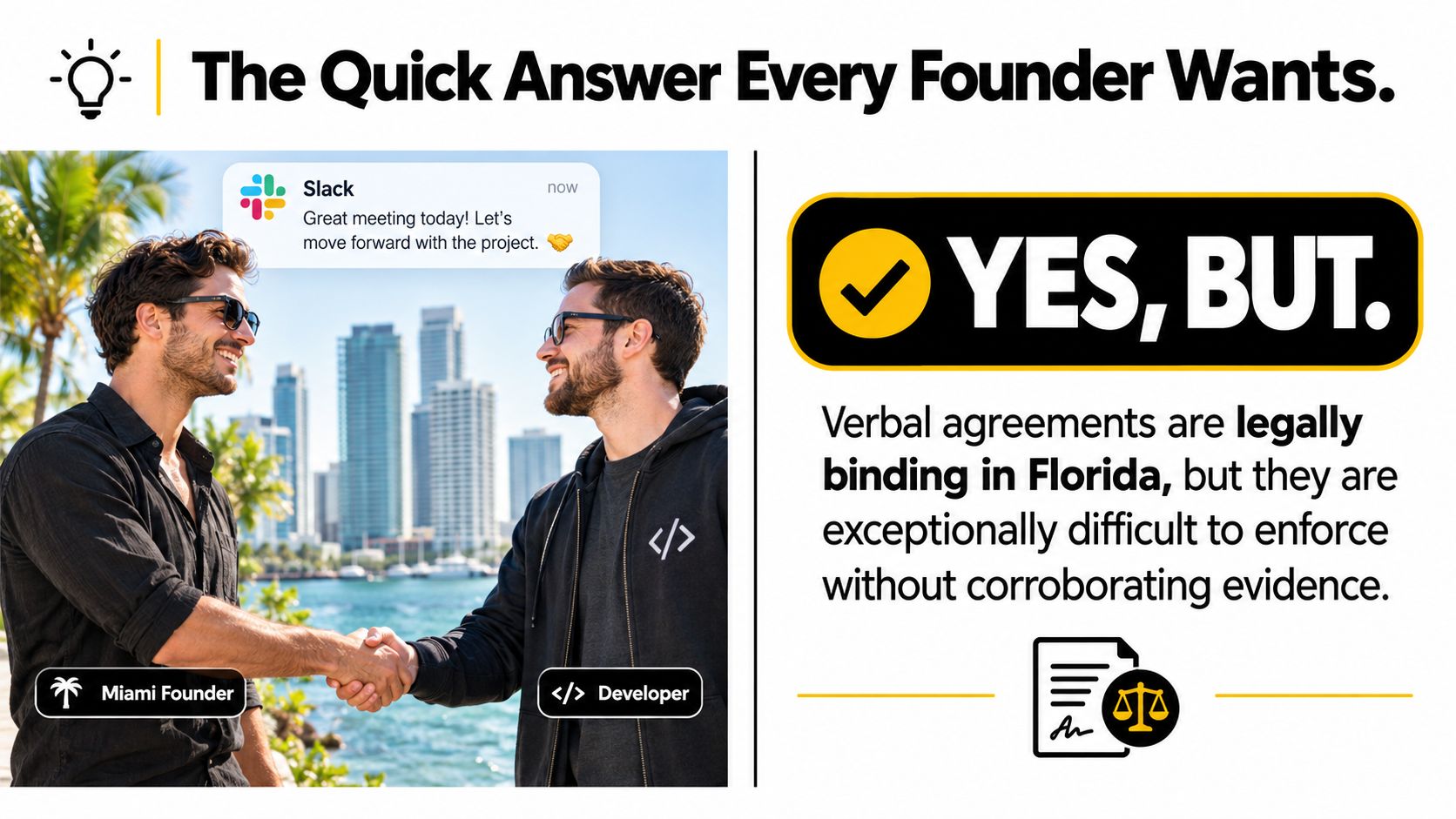
Yes. Verbal agreements can generally bind you, but the Statute of Frauds creates exceptions, including goods deals at or above $500 and agreements that cannot be performed within one year. In practice, enforceability usually turns less on whether someone made a promise and more on whether you can prove the exact terms.
A Miami founder may recognize the situation. You agree over coffee that a freelance developer will finish the product, you confirm the scope in Slack, and you seal the deal with a handshake. The developer starts work, invoices you, and then the relationship breaks down over a missed deadline or disputed payment. Suddenly, the question isn't just “are verbal agreements binding?” It's whether a judge can determine what both sides agreed to.
Table of Contents
- The Quick Answer Every Founder Wants
- The Five Elements That Make Any Agreement Binding
- When the Statute of Frauds Forces a Writing
- How Florida and South Florida Courts Treat Oral Deals
- Exceptions That Still Let Oral Agreements Survive
- Oral Modifications and the No Oral Changes Clause
- How to Prove a Verbal Agreement in Court
- Protect Yourself With These Practical Next Moves
The Quick Answer Every Founder Wants
A Miami startup founder who pays a freelance developer based on a Slack thread and a handshake may have a binding agreement. If the conversation shows an offer, acceptance, consideration, and mutual intent to create legal obligations, Florida contract principles can recognize the deal even without a formal signature. The general rule in common-law systems is that verbal agreements can be enforceable when the core contract elements exist, subject to specific writing requirements under the Statute of Frauds.
The problem is proof. A court doesn't enforce a founder's memory. It evaluates evidence showing what the developer promised, what the founder agreed to pay, when the work was due, and whether both parties acted as though a deal existed.
Practical rule: A handshake may create the obligation. A paper trail gives you a realistic chance of enforcing it.
That distinction matters because two legal problems can defeat an otherwise credible claim:
- The deal may fall into a Statute of Frauds category. Some transactions must be supported by a signed writing, including certain land transfers, surety promises, and agreements that can't be completed within one year.
- The terms may be too difficult to prove. A Slack exchange that says “let's move forward” is weaker than a message identifying the deliverables, price, deadline, ownership rights, and payment schedule.
South Florida founders also face practical complications in construction, real estate, commission, and supplier disputes. Those deals often involve multiple conversations, changing scopes, and informal approvals. The person who keeps the clearest records usually has the stronger position.
Run your handshake deal through the five contract elements below. Then test it against the Statute of Frauds and your available evidence. That process tells you whether you have a real enforcement position or only an expensive disagreement about who remembers the conversation correctly.
The Five Elements That Make Any Agreement Binding
Start with the basic question: did the parties form a contract at all? A useful overview of what makes a binding agreement focuses on the same core concepts a founder should examine before arguing about enforcement.
Take a Boca Raton SaaS founder hiring a growth marketer under a six-month referral split. The founder sends a Slack message offering a defined referral fee for qualified customers. The marketer replies with a thumbs-up and begins contacting prospects. The referral fee supplies consideration, and both sides' conduct can support the conclusion that they intended to create a business arrangement.
| Element | What It Means | Founder Example | Proof to Look For |
|---|---|---|---|
| Offer | One party proposes sufficiently definite terms | A Slack message describes the marketing work and referral split | The original message, proposal, or email |
| Acceptance | The other party agrees to the offer | The marketer confirms the terms and starts work | A reply, signed proposal, or conduct consistent with acceptance |
| Consideration | Each side gives or promises something of value | The founder promises a referral fee, and the marketer provides lead-generation services | Payment records, invoices, or the agreed compensation terms |
| Capacity | The parties have the legal ability to contract | An adult founder hires the marketer for business services | Entity records, authority to sign, and facts addressing impairment or minority |
| Intent to be bound | The parties mean to make a legal commitment, not a casual promise | The founder gives access to customer materials and assigns active campaigns | Project access, work product, deadlines, and follow-up communications |
Capacity rarely causes trouble in ordinary founder transactions. It matters more when the other party is a minor, claims impairment, or lacked authority to commit a company. Don't assume a company is bound merely because an employee participated in a conversation. Confirm who had authority to approve the deal.
The terms also need enough detail to identify the bargain. “Help with growth” leaves room for argument. “Create the campaign, deliver the agreed assets, and receive the stated referral fee for qualified customers” gives a court something more concrete to evaluate.
Before worrying about exceptions, apply this five-point filter to every handshake deal. If you can't identify the offer, acceptance, value exchanged, capacity, and intent, your dispute may involve failed formation rather than a simple breach.
When the Statute of Frauds Forces a Writing
The Statute of Frauds is the main reason a verbal deal can collapse even when both parties shook hands in good faith. The original English statute was enacted in 1677 under the title An Act for Prevention of Frauds and Perjuries, and its framework still influences contract rules in major common-law markets. The policy is straightforward. Certain transactions create enough risk that courts generally require written evidence.
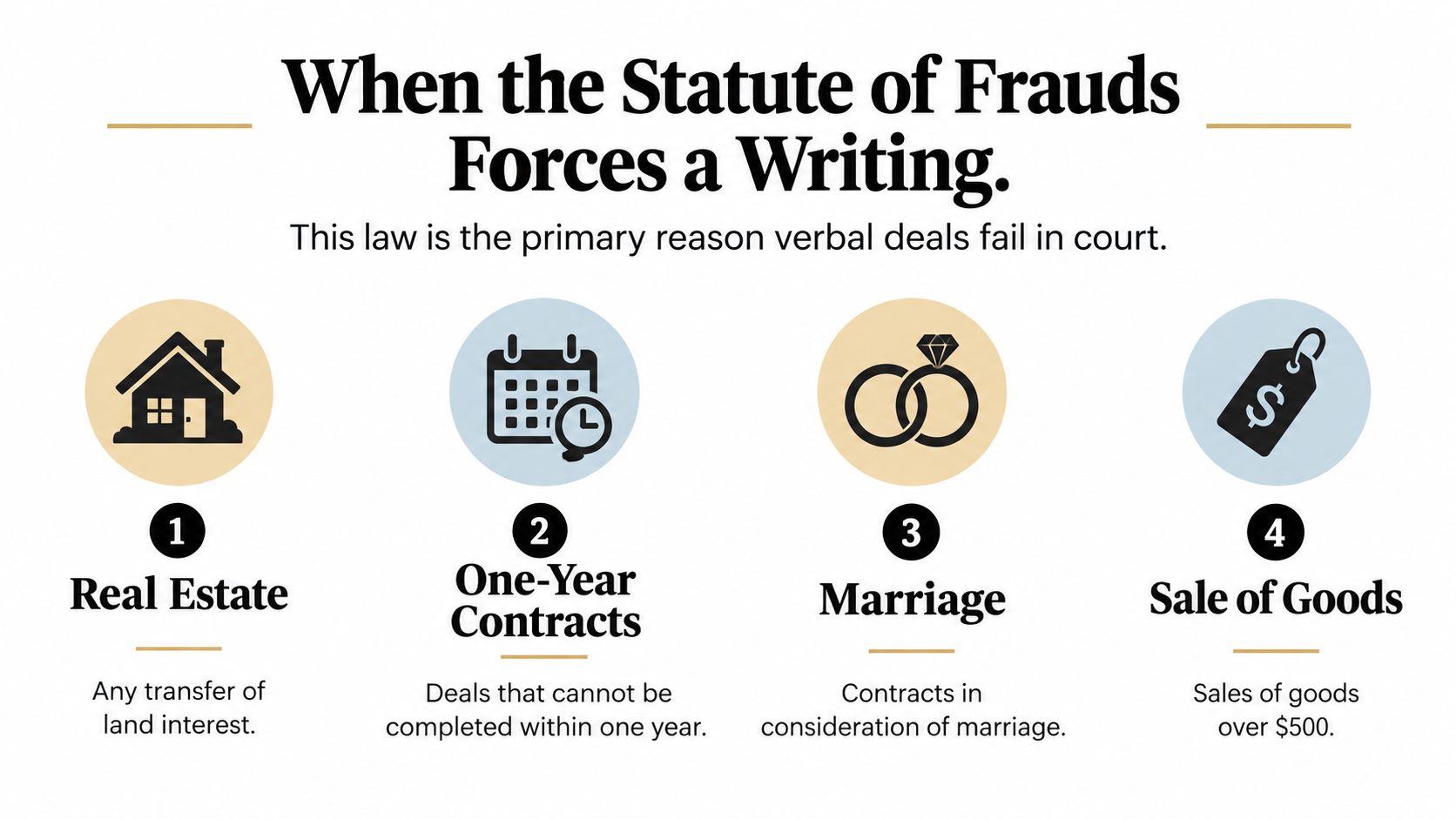
The categories founders should flag include:
- Real estate transactions: A verbal agreement to sell a warehouse or transfer an interest in land is a dangerous bet. Put the deal in a signed writing.
- Agreements that cannot be performed within one year: A Fort Lauderdale founder who promises equity for a two-year consulting role should document the arrangement. The one-year rule is interpreted narrowly, but contracts that cannot be fully performed within the applicable period create a serious writing issue.
- Sales of goods at or above $500: Under the Uniform Commercial Code, certain goods contracts at or above the $500 threshold generally require written evidence. That can affect equipment, inventory, and custom product orders.
- Surety agreements: A promise to answer for another person's debt commonly falls within the writing requirement.
- Contracts in consideration of marriage: These agreements are another traditional category requiring written evidence.
The Statute of Frauds overview from Cornell Law School summarizes the general rule that oral contracts can be enforceable when the core elements exist, while land transactions, longer leases, surety promises, and qualifying goods sales receive different treatment.
Don't treat strong testimony as a substitute for a required writing. If the transaction falls within a statutory category, a court may refuse enforcement unless an exception applies. A short signed term sheet is far safer than trying to reconstruct a major purchase from calls, texts, and memory. Founders who need a preliminary framework can also review when a memorandum of understanding becomes useful, while confirming whether the document is intended to be binding.
How Florida and South Florida Courts Treat Oral Deals
Florida founders should separate two questions. First, does the alleged agreement satisfy the basic contract elements? Second, does Florida's writing requirement apply to this type of transaction?
That analysis becomes especially important in South Florida real estate, construction, and commission disputes. A conversation may sound conclusive in a restaurant or job site, but the court still has to determine whether the parties agreed on price, scope, timing, ownership, authority, and other material terms. When witnesses tell different stories, credibility becomes central. A founder's confidence doesn't eliminate the need for corroboration.
Florida Statute § 725.01 belongs on the checklist whenever a deal may involve a transaction covered by the Statute of Frauds. Real estate closings and transfers also deserve separate attention because the parties typically need formal documents to identify the property, obligations, and closing mechanics. A commercial landlord's verbal promise to change a lease term can create a dispute over whether the parties formed a modification, whether the existing lease controls, and whether the change required written evidence.
South Florida's business culture rewards speed. Courts still require precision.
Construction creates another recurring risk. Owners, contractors, subcontractors, and vendors may discuss change orders in the field, then disagree about authorization or payment. Licensing rules and project documentation can add another layer of complexity. The same problem appears with commission splits, where a salesperson says the broker approved a different arrangement and the broker says the conversation was only exploratory.
The parol evidence rule can also matter when the parties have a written contract and one side tries to use earlier or outside conversations to alter its meaning. Florida case law, the exact contract language, and the purpose of the proposed testimony determine how that issue is handled. Cases such as Seaside Community Development Corp. v. Edwards belong in a lawyer's research file when an alleged oral understanding conflicts with a written deal.
Your word isn't worthless. It is much stronger when your emails, invoices, project records, and conduct tell the same story.
Exceptions That Still Let Oral Agreements Survive
A missing writing doesn't always end the case. Courts recognize exceptions that can support enforcement when fairness, conduct, or the opposing party's own statements make it difficult to deny the arrangement. These exceptions are fact-specific, and founders shouldn't treat them as a substitute for documentation.
Partial performance is the most practical example. A vendor ships custom goods after an oral order, the buyer accepts delivery, and the buyer makes a payment that identifies the transaction. Those actions can provide evidence of the deal and may support enforcement despite a writing problem.
Full performance goes further. If one party has completed the agreed work and the other side accepted the benefit, the facts may support a claim that the transaction should not be defeated only because the parties failed to sign. The court still has to determine what the actual terms were.
Promissory estoppel focuses on reliance. A founder may take a significant action because of a promise, such as renovating a Miami storefront after a landlord verbally promises a lease arrangement. The claim depends on the promise, reasonable reliance, resulting detriment, and the circumstances surrounding the transaction.
Admissions can also change the evidentiary picture. An opposing party's pleading, deposition answer, email, or other statement acknowledging the arrangement may carry more weight than the claimant's unsupported recollection. The discussion of enforcing oral contracts identifies partial performance, full performance, promissory estoppel, admissions, and customary industry practice as recognized routes that can preserve an oral-contract claim.
The limitations period matters too. Florida Statute § 95.11 should be reviewed promptly because the applicable period can affect when a lawsuit must be filed. Don't wait until the relationship ends completely. Preserve invoices, payment records, work product, access logs, delivery records, and messages while the information remains available.
An exception is a litigation position, not a business plan. If the transaction involves significant money or property, document it before relying on equitable arguments later.
Oral Modifications and the No Oral Changes Clause
Founders often understand the original written contract and then casually renegotiate it in a call. That is where trouble starts. A written agreement may contain a no oral modifications clause, also called a NOM clause, stating that changes must be in writing and signed by the parties.
Consider a construction change order. The owner says, “Keep the same price, but add the second floor.” The contractor proceeds, and the owner later refuses the additional payment. Or a software supplier agrees by phone to a different pricing arrangement, then invoices under the original contract. The issue isn't whether the parties had a relationship. It's whether their later conduct legally changed the written terms.
An integration clause can also state that the written document contains the complete agreement. When an informal email says “let's just keep it as we discussed,” lawyers need to examine the full record, the contract language, the parties' conduct, and whether Florida law permits the alleged modification despite the NOM provision.
Seaside Community Development Corp. v. Edwards and the Restatement Second approach are useful research references for analyzing how courts treat alleged changes to written agreements. The point for a founder is practical: don't assume an informal message automatically controls, and don't assume a NOM clause makes every later action irrelevant.
Cheap insurance: Confirm every pricing, scope, deadline, and commission change in a signed writing before anyone performs under the new terms.
Partial performance may strengthen an otherwise weak modification claim. If both sides consistently operate under the new terms, that conduct can become important evidence. It still won't guarantee success, especially when a statute requires a writing for the underlying transaction.
Use a written change order for construction, a signed amendment for commission splits, and a confirmation email for supplier pricing. The cost is minor compared with litigating whether an informal renegotiation changed the deal.
How to Prove a Verbal Agreement in Court
The strongest evidence usually comes from records created close to the transaction. Texts, emails, Slack threads, shared Google Docs, proposals, and calendar entries can show what the parties discussed before memories became self-serving. A message confirming deliverables and payment terms is far more useful than a later statement that “we had an understanding.”
Financial records add structure. Invoices, wire transfers, ACH records, partial payments, payment memos, and bounced checks can connect conduct to the alleged deal. A payment marked “deposit for website build” tells a clearer story than an unexplained transfer.
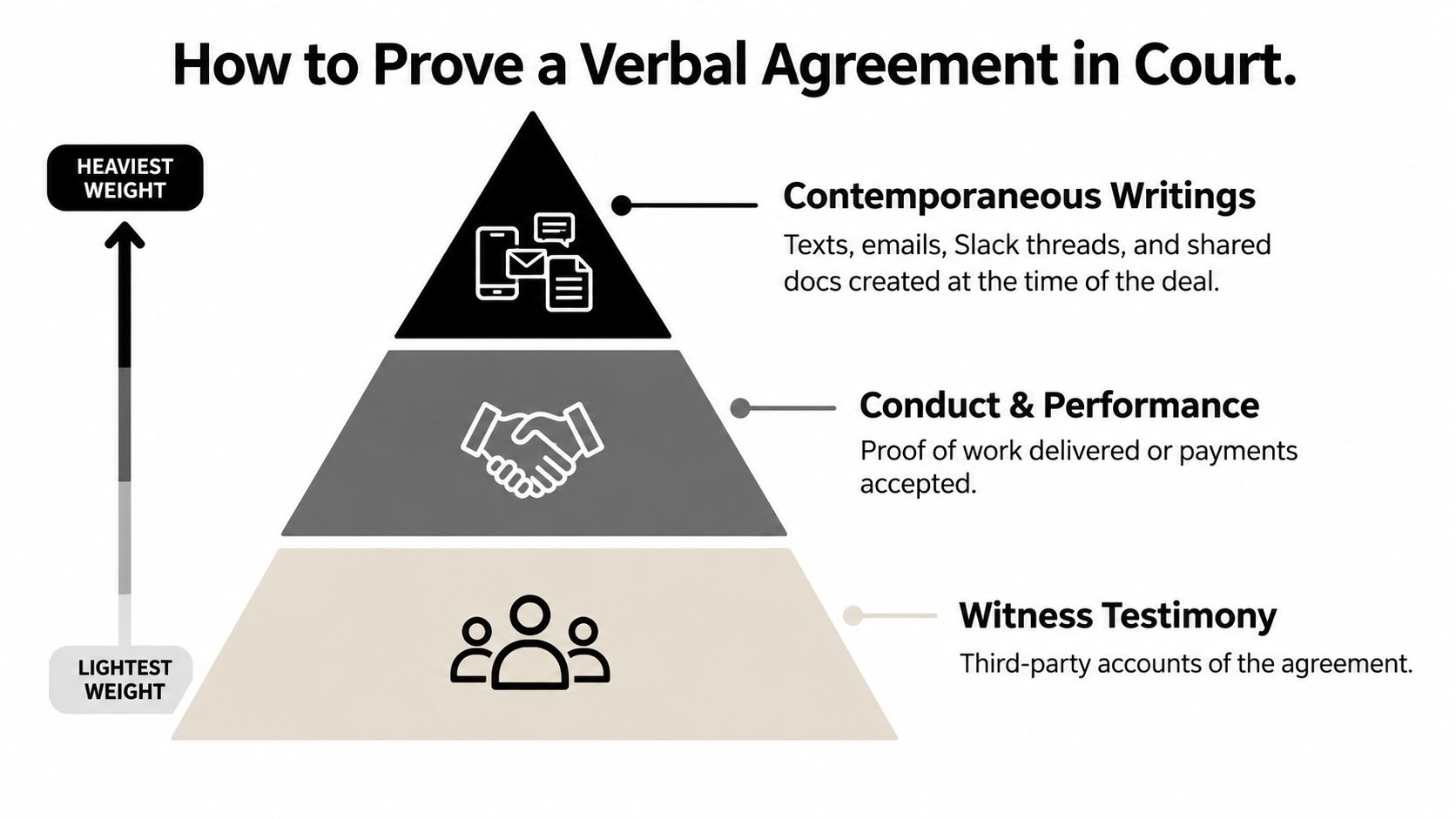
Use this practical hierarchy:
- Contemporaneous writings: Look for messages created during negotiation and performance. Preserve the full conversation, not only the favorable excerpt.
- Conduct and performance: Show who delivered services, accepted goods, granted system access, approved work, or made payments.
- Admissions: Search pleadings, deposition testimony, emails, and messages in which the opposing party refers to the agreement or its terms.
- Witness testimony: Identify neutral witnesses where possible. Former employees, relatives, and co-founders with a financial stake may face credibility attacks.
Preserve electronic evidence carefully. The AI Video Detector evidence guide offers useful context on authentication and the need to establish that digital material is genuine and reliable. The same mindset applies to Slack exports, screenshots, recordings, and shared documents.
Florida's Dead Man's Statute can raise special issues when a dispute involves an estate, and the best evidence rule may matter when a party relies on a written confirmation. Get legal advice before deleting messages or presenting edited screenshots.
The most persuasive combination is documents plus conduct plus admissions. Witness testimony can fill gaps, but it rarely carries a messy handshake dispute by itself. For a practical local perspective, founders can review how to prove a verbal agreement in Kendall small businesses.
Protect Yourself With These Practical Next Moves
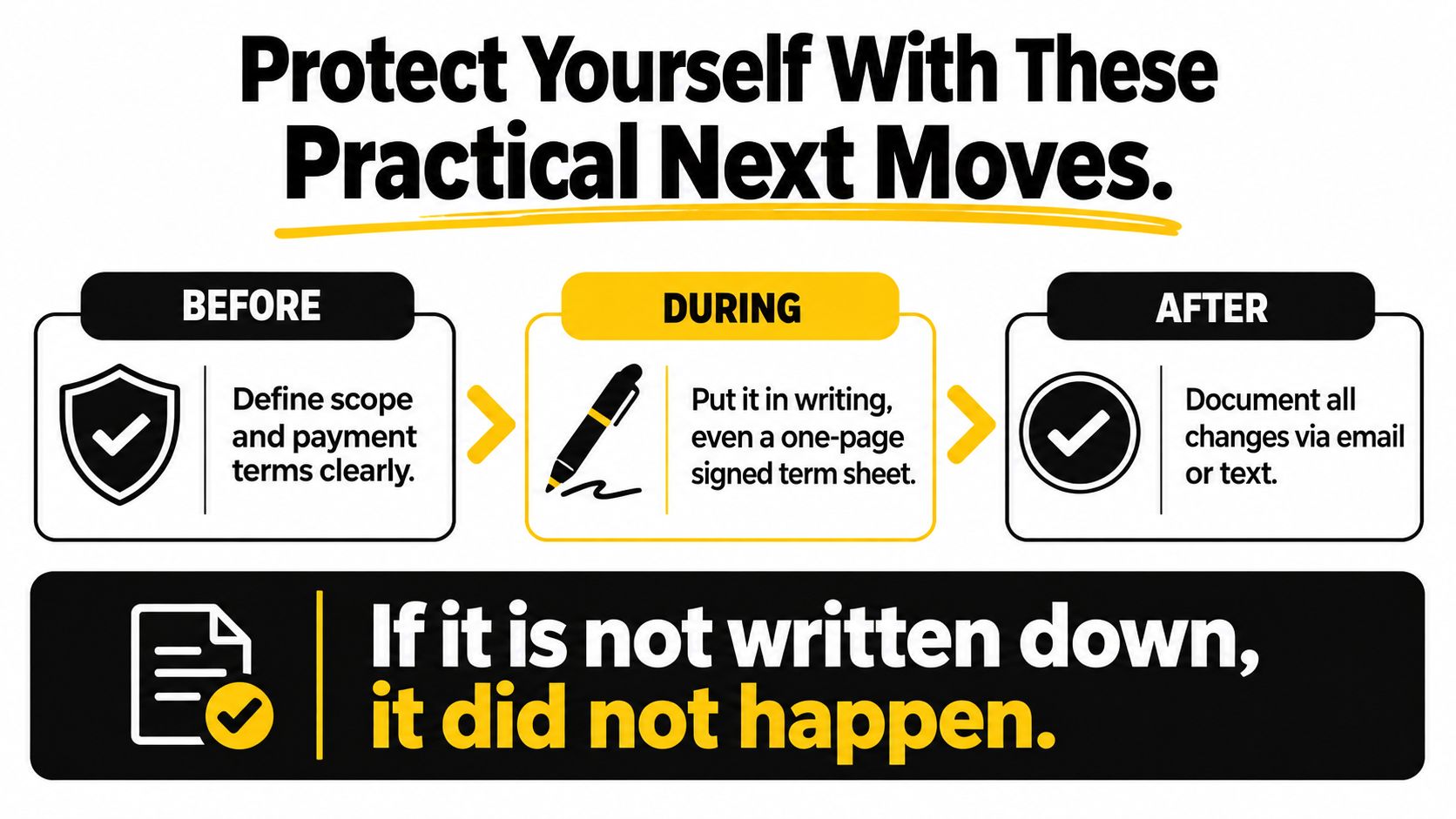
Put the deal in writing. You don't always need a lengthy contract at the first conversation, but you should create a signed term sheet or clear confirmation that identifies the parties, scope, price, payment schedule, deadlines, ownership rights, and termination rules. Most disputes concern those terms, not the abstract question of whether a conversation occurred.
Use this founder checklist:
- Recap the deal quickly: Within 24 hours, send an email stating what you understood and ask the other party to confirm or correct it.
- Define the deliverable: Name the work, goods, milestones, acceptance standard, and person authorized to approve changes.
- Track money clearly: Use invoices, partial payments, and payment descriptions that identify the project or obligation.
- Preserve project records: Keep shared documents, task assignments, approvals, delivery confirmations, and access records in an organized folder.
- Check writing requirements: Flag real estate, multi-year service commitments, surety promises, marriage-related agreements, and goods transactions at or above the UCC threshold.
- Document every change: Use a signed amendment or written change order, especially when the original contract contains a no-oral-modifications clause.
Don't rely on a verbal agreement involving meaningful money, real estate, exclusive rights, equity, or a long-term commitment until a South Florida business attorney reviews it. If the deal has already gone wrong, preserve every message and payment record before confronting the other side or sending a demand.
Coto & Waddington, Attorneys at Law advises South Florida founders and businesses on contracts, startup matters, corporate structure, and the documentation needed to prove or prevent oral-agreement disputes. Contact the firm to review a handshake deal, prepare a written agreement, or assess your evidence before you rely on it in court.