If you're a parent in Miami with young children, or a founder in South Florida whose business is most of your balance sheet, you've probably had the same thought at some point: a basic will may say who gets everything, but it doesn't say how they should handle it after you're gone. That gap is where many family plans start to break down.
We see this often. A client wants to leave assets to a spouse, children, or both, but doesn't want an outright distribution to land in the hands of an inexperienced adult child, a beneficiary going through a divorce, or someone vulnerable to creditors and lawsuits. A will alone can transfer property. It usually can't provide meaningful long-term management after the transfer. For many families, the better answer is a will that includes a testamentary trust.
Table of Contents
- Why Your Florida Estate Plan Needs More Than Just a Will
- Will vs Testamentary Trust The Fundamental Difference
- Key Decision Factors Probate Asset Protection and Control
- Practical Scenarios for Florida Families and Founders
- How to Create a Testamentary Trust in Your Will
- Is a Testamentary Trust Right for You Next Steps
Why Your Florida Estate Plan Needs More Than Just a Will
A simple will works for one job. It directs where property goes after death. For some people, that's enough. For many Florida families, it isn't.

When a child inherits outright, or when a surviving beneficiary receives a large distribution with no guardrails, the law stops giving you much control. The beneficiary owns the asset. That means they can spend it, lose it, expose it to claims, or mix it into a future divorce fight. If your estate plan doesn't account for those real-life risks, your family may follow your instructions and still end up with the wrong result.
That planning gap is common. Approximately 32% of American adults reported having an estate plan in 2024, according to estate planning survey data discussed by Financial Sense. The same discussion notes a decline from the prior year, which tells us something we see in practice too: many people delay planning until family, health, or business pressure forces the issue.
What a will alone often misses
A will usually doesn't solve these issues by itself:
- Minor children need management, not ownership. A child can't responsibly receive and manage inherited assets.
- Adult children may need structure. Many parents don't want a large lump sum handed over the moment a beneficiary reaches legal adulthood.
- Family businesses create timing problems. Ownership transfers, operating agreements, and probate administration don't always line up neatly.
- Creditor exposure matters. An outright inheritance is often more vulnerable than assets held under trust terms.
Practical rule: Treat your will as more than a distribution document. It should function as the rulebook for your legacy.
A testamentary trust lets you build those rules into the will itself. That means you can name who manages the inheritance, state when distributions can happen, and decide whether money should be used for support, education, business continuity, or staged distributions over time.
For families trying to organize conversations before they meet with counsel, this guide to family estate planning is a useful starting resource because it helps identify the practical decisions that usually come before drafting.
A tip before you draft anything
Write down three things before meeting with an attorney:
- Who should receive assets
- Who should control those assets after your death
- When beneficiaries should receive unrestricted access
If your answers to those three questions aren't the same person and the same moment, you're likely not looking for a simple outright gift. You're looking at wills and testamentary trust planning.
Will vs Testamentary Trust The Fundamental Difference
A lot of confusion comes from treating a will and a testamentary trust as competing documents. They aren't. In practice, a testamentary trust is often a feature inside the will, not a replacement for it.
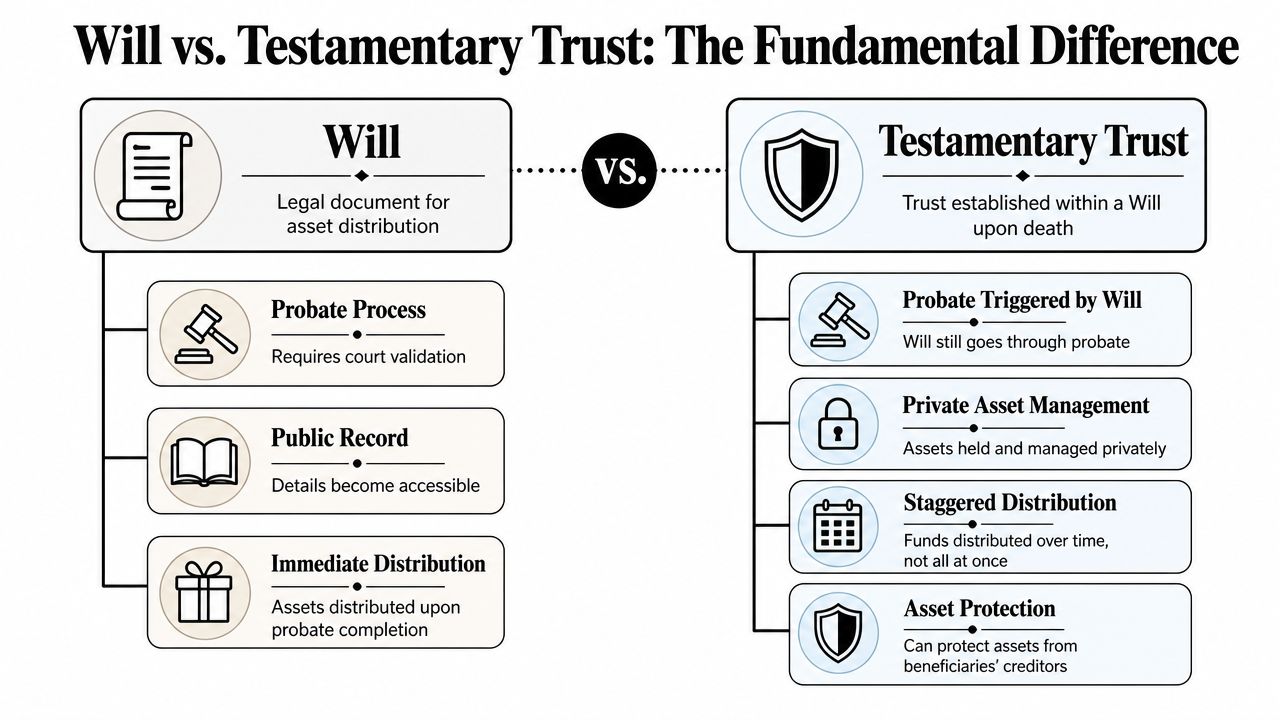
Think of the will as the instruction manual handed to the probate court. It says who should serve, who should inherit, and what legal directions control administration. The testamentary trust is the management structure created from those instructions after death.
The legal difference in plain English
A testamentary trust is created by the terms of a last will and testament and does not legally exist or hold assets until after death and the completion of probate, as explained in Investopedia's explanation of testamentary trusts. That point matters because it answers one of the biggest misunderstandings immediately: a testamentary trust doesn't spring into action during your lifetime.
It also means this kind of trust isn't a probate-avoidance tool. The will has to be admitted, the executor has to act, estate expenses and claims have to be handled, and only then are the specified assets transferred into the trust for administration under the will's terms.
A useful analogy for clients
We often explain it this way:
| Document or structure | What it does |
|---|---|
| Will | Gives legal instructions for probate and distribution |
| Testamentary trust | Holds and manages assets after probate under rules written into the will |
That distinction is critical for expectation-setting. If privacy and probate avoidance are your top priorities, another planning structure may fit better. If your priority is keeping full control of assets during life while creating post-death controls for beneficiaries, a testamentary trust can be a practical fit.
The will is the blueprint. The testamentary trust is the structure built from that blueprint after death.
What clients usually like and dislike
What tends to work well:
- Control after death. You can impose age milestones, health and education standards, or discretionary distributions.
- Protection-oriented design. Trust terms can be written to reduce the risks of irresponsible spending or external claims.
- Lower lifetime maintenance burden. Some clients prefer not to fund and maintain a separate trust during life.
What doesn't work well for every family:
- It won't bypass probate.
- Funding is delayed until probate administration moves forward.
- Drafting needs precision. Vague trust language causes problems later.
For readers comparing basic concepts before diving into Florida-specific drafting, Cremation.Green's family protection guide offers a straightforward consumer-level comparison. For Florida-specific trust issues, it's also worth reviewing this overview of Florida trust laws because local administration rules and drafting choices affect how well the plan works in real life.
Key Decision Factors Probate Asset Protection and Control
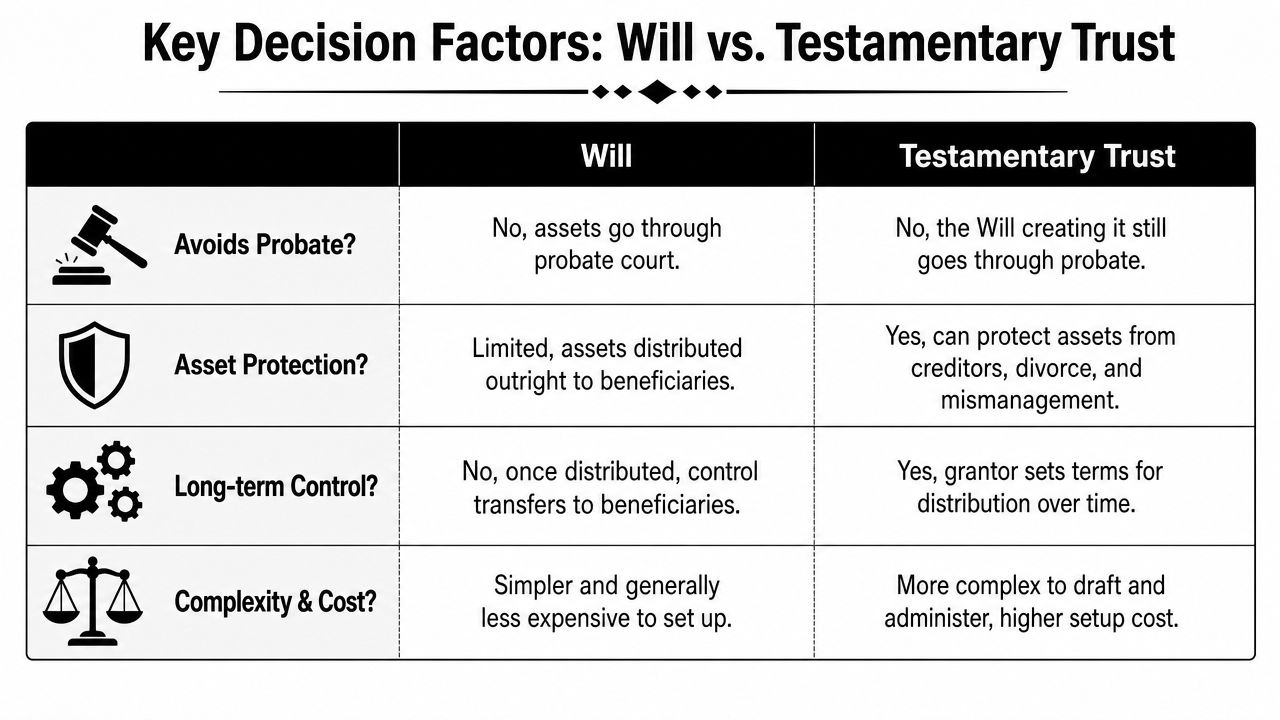
The best way to choose between a simple will and a will that includes a testamentary trust is to ask three direct questions. Does it avoid probate? Does it protect the inheritance? Does it let you control timing and use after death?
Probate
A simple will does not avoid probate. A testamentary trust doesn't either.
That isn't a flaw in the drafting. It's how the structure works. A testamentary trust does not come into existence until the testator dies, and because it is established by the will, it must pass through probate before the trust can be funded and administered, as discussed in this explanation of testamentary trusts in a will.
For Florida families, that means the court validates the will, confirms the executor, and supervises the transfer of probate assets into the trust. If a client's primary goal is avoiding the probate system altogether, we usually evaluate other planning tools alongside a will.
If you're not sure what that court process looks like in practice, this overview of the probate process in Florida helps frame the timeline and administration issues that often affect families and business owners.
Asset Protection
At this point, the difference becomes practical.
With a simple will, assets often pass outright to the beneficiary once administration is complete. Once that happens, the beneficiary generally controls the property directly. If they later face a lawsuit, creditor claim, poor spending habits, or a contentious divorce, that inheritance may be far more exposed.
With a testamentary trust, the trustee holds legal control under the terms you wrote into the will. If distributions are discretionary and properly drafted, the beneficiary may benefit from the trust without holding the assets outright. That separation can matter a great deal when the beneficiary runs a business, works in a high-liability profession, struggles with money management, or has relationship instability.
A distribution plan that protects children at age ten can fail them at age thirty if the inheritance was handed over without structure.
A practical Florida tip is to think beyond minors. Parents often focus on childhood support, but many of the biggest threats to inherited wealth show up in adulthood. Divorce, guarantees on business debt, personal injury claims, and judgment collection efforts don't ask whether the money came from a loving parent.
Control
A simple will gives instructions for transfer. A testamentary trust gives instructions for management.
That difference affects almost every family planning conversation. If your child inherits outright, you lose control once the estate distributes the asset. If your will creates a trust, you can decide whether the trustee may distribute for health, education, maintenance, support, business needs, housing, or emergencies. You can also delay principal distributions or keep assets in trust for a beneficiary's lifetime.
Here is the comparison clients usually need most:
| Issue | Simple will | Will with testamentary trust |
|---|---|---|
| When beneficiary receives assets | Usually as soon as distribution is authorized | According to trust terms |
| Who manages assets after probate | Beneficiary | Trustee |
| Can you stage distributions | No practical long-term control | Yes |
| Can you separate benefit from ownership | Usually no | Often yes |
Three control features tend to work especially well:
- Age-based releases. You can hold assets until the beneficiary reaches milestones you select.
- Purpose-based distributions. The trustee can pay for tuition, housing, healthcare, or support without handing over the full fund.
- Lifetime trust design. In some family situations, continued trust administration is the point, not a temporary stopgap.
The trade-off is simple. More protection and control require better drafting, a capable trustee, and a family willing to respect the structure. A trust that exists on paper but names the wrong trustee or uses vague standards can become a source of conflict instead of protection.
Practical Scenarios for Florida Families and Founders
A testamentary trust becomes easier to evaluate when you apply it to an actual family problem instead of treating it as a generic legal tool.
A Miami family with young children
A married couple in Miami owns a home, investment accounts, and life insurance. Their biggest concern isn't who should inherit. That's easy. They want everything used for their children if both parents die. Their primary concern is timing.
If they rely on a simple will with outright gifts, the inheritance path is blunt. Assets pass through probate, and when the legal conditions for distribution are met, the children eventually take ownership directly. That may satisfy the law, but it doesn't necessarily protect the children well.
A testamentary trust changes the design. The will can direct that, after probate administration, the children's inheritance is held by a trustee. The trustee can use funds for tuition, housing, healthcare, activities, and other support while the children are young. The parents can also set age-based or milestone-based distributions later, rather than forcing a full transfer as soon as the child reaches adulthood.
What works in this scenario is clarity. The parents should identify:
- Who serves as trustee
- Who serves if that person can't act
- What expenses the trustee may pay without court fights
- Whether distributions should be discretionary or fixed
- When, if ever, the child receives principal outright
The common mistake is naming a loving guardian and assuming that solves financial management too. Sometimes the guardian is the right trustee. Sometimes that creates too much pressure or too little oversight. Those are separate roles and should be considered separately.
If a beneficiary isn't ready to manage the inheritance alone, the plan shouldn't pretend otherwise.
A founder planning for a spouse and children
Now consider a founder in Fort Lauderdale who owns a closely held business. Most of the family wealth is tied up in the company. The founder wants to keep complete control during life, but after death wants the estate to do three things: support a surviving spouse, preserve value for children, and avoid handing business-related proceeds over in one unrestricted lump sum.
Wills and testamentary trust planning can be especially useful. From a business and tax planning perspective, testamentary trusts in wills are used as a low-cost, post-mortem alternative to inter vivos trusts for founders and small-business owners who want to retain full control during life but impose post-death governance and tax-efficiency structures on inheritances, as described in MetLife's discussion of testamentary trusts.
In practice, that can look like this: the founder's buy-sell arrangement, operating agreement, or equity transfer provisions determine what happens to the company interest at death. The estate receives the proceeds or ownership interest through probate administration. Then the will's testamentary trust takes over management of the inherited value under the rules the founder drafted.
One structure that often fits this fact pattern is a trust that provides a surviving spouse with ongoing support or income rights while preserving the remainder for children later. That can reduce the risk that remarriage, poor investment decisions, or family conflict derails the founder's long-term plan.
For business owners, one tip matters more than most: don't draft the trust terms in isolation. Your will, shareholder terms, LLC operating agreement, beneficiary designations, and insurance structure need to point in the same direction. If they don't, the business succession plan can stall right when the family needs clarity most.
How to Create a Testamentary Trust in Your Will
A testamentary trust isn't created by checking a box on a form. It has to be drafted into the will with enough precision that the executor, trustee, court, and beneficiaries can all follow the same roadmap.
What the will must say
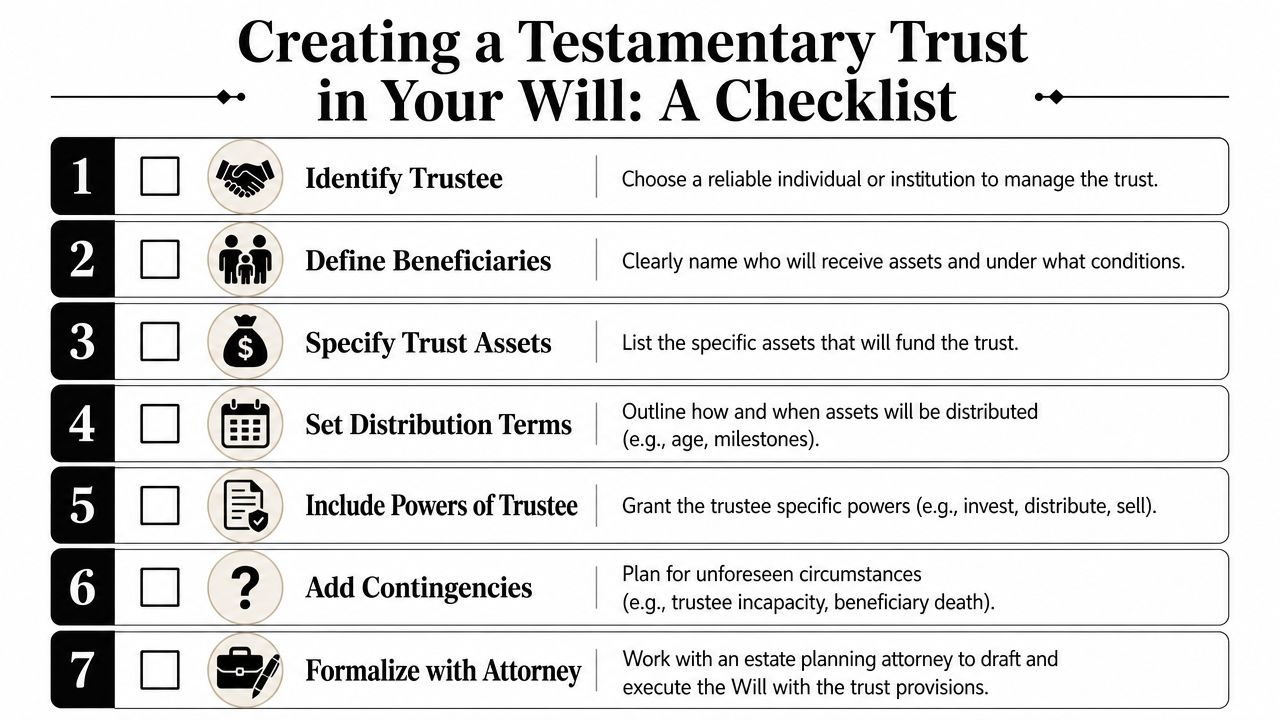
The core mechanics are straightforward. The will needs to name the trustee, identify the beneficiaries, and define the conditions, timing, and amounts of distributions. Practitioners also emphasize that the document should specify the type of trust, the trustee's powers, and any age-contingent distributions, because the trust does not exist until the will is probated and the court authorizes those terms, as described in this discussion of testamentary trust drafting.
In practice, we want the will to address at least these points:
- Trustee selection. Name the first trustee and at least one successor.
- Beneficiary definition. State exactly who benefits, including contingent beneficiaries.
- Funding source. Identify what property pours into the trust under the will.
- Distribution standard. Decide whether the trustee uses discretion, fixed rules, or a combination.
- Trustee powers. Investment, sale, leasing, litigation, tax matters, and business management authority should be explicit.
- End point. State whether the trust ends at a certain age, on a life event, or continues for life.
- Backup provisions. Cover what happens if a trustee dies, resigns, or becomes unable to serve.
For people reviewing the basics before a drafting meeting, a Florida-specific last will and testament forms overview can help identify the foundational pieces of the will itself.
A simple example of trust language
A simplified example might read like this:
Upon my death, I direct my Personal Representative to distribute my residuary estate to the Trustee of the Children's Trust created under this Will. The Trustee shall hold, invest, and distribute trust assets for my children's health, education, maintenance, and support, in the Trustee's discretion, and may distribute principal in stages at the ages stated in this Will.
That example is only educational. It is not a substitute for legal drafting, and it leaves out many terms that become critical in real administration, including successor trustee mechanics, tax language, standards for unequal needs, spendthrift protection, and what happens if a beneficiary dies before final distribution.
Drafting tips that matter in practice
The biggest drafting problem is ambiguity. Families often say, "I want the trustee to use common sense." That isn't enough. Trustees need actual authority and actual standards.
Use practical detail:
- Pick a trustee who can say no. A trustee's job isn't to be popular. It's to follow the document.
- Coordinate with business documents. If the trust may receive LLC interests or sale proceeds, your governance documents need to match.
- Write for conflict, not harmony. Good drafting assumes someone will disagree later.
- Set milestones carefully. Ages alone may be too rigid. Some clients prefer education completion, sobriety periods, or staged distributions tied to maturity.
- Plan for the long term. Minor children become adults. Adult children may later marry, divorce, borrow, litigate, or start businesses.
One option for families and founders who want customized drafting is to work with an estate planning attorney familiar with both succession planning and business documents, including firms such as Coto & Waddington, Attorneys at Law, where the legal work can be aligned with Florida wills, trusts, and closely held business structures.
Is a Testamentary Trust Right for You Next Steps
A testamentary trust isn't the right answer for every estate. If your goals are simplicity, immediate transfer, and minimal post-death management, a straightforward will may be enough. If your goals include protection, delayed control, or family oversight after your death, this structure deserves serious consideration.
Who should look closely at this option
You should look hard at a testamentary trust if any of these apply:
- You have minor children. They need management and supervision, not direct ownership.
- You have an adult child who isn't ready for a lump-sum inheritance.
- You want to provide for a spouse while preserving assets for children later.
- You own a business and need succession terms to work with inheritance planning.
- You have concerns about creditors, divorce, or financial mismanagement affecting heirs.
- You have a blended family and want clearer long-term control over who benefits and when.
For South Florida families, there is another issue that often gets overlooked. Cross-border planning can complicate everything. The tax-efficiency and compliance complexity of cross-border testamentary trusts for mixed-nationality families, including U.S. citizens with Latin American heirs or assets held abroad, is often oversimplified, as discussed in this analysis of cross-border testamentary trust issues. If your family spans countries, don't assume a Florida will clause solves foreign inheritance, reporting, or recognition issues automatically.
What to do now
Start with a practical checklist:
- List your beneficiaries and any concerns tied to each one
- Identify who should manage inherited assets
- Review business ownership documents for transfer restrictions
- Decide whether probate exposure is acceptable for your plan
- Bring existing wills, trusts, deeds, and operating agreements into one review
Your best estate plan is the one that matches how your family lives, not how a generic form assumes they live. A testamentary trust can be an excellent tool for post-death control. It just needs to be drafted with realistic expectations about probate, administration, family dynamics, and succession planning.
If you want a Florida estate plan that coordinates your will, testamentary trust provisions, and business succession documents, schedule a consultation with Coto & Waddington, Attorneys at Law. We help families and founders across Miami and South Florida turn broad intentions into clear, workable legal instructions.