The most popular advice you'll hear about why form an S corp is simple. Elect S status, pay yourself a small salary, take the rest as distributions, and save on payroll tax.
Don't follow that advice as a default. It's incomplete, and for many South Florida businesses it's backwards.
The right question isn't whether an S corp can save tax in a good year. It's whether your owners, your pay, and your funding plans can live inside the S corp rules without creating a bigger problem later. If they can't, the payroll-tax headline doesn't matter.
Table of Contents
- Why Owners Elect S Corp Status
- Salary Versus Profit Distributions
- Ownership Rules That Can Block the Election
- Real Businesses Where the Math Changes
- Costs and Fit Before You File
- Have Counsel Review the Election First
Why Owners Elect S Corp Status
Owners elect S status for two connected reasons. They want a corporate legal form and limited liability without the classic C corp double tax, and when the facts support it, they want employment tax to apply to reasonable wages instead of to all business profit.
That's the verdict. Everything else is a fit test.
Think of a C corp as a bucket that's taxed before money moves to you. The corporation pays tax on profit, then you can be taxed again on dividends. An S corp works more like a pipe. Income, deductions, losses, and credits generally pass through to shareholders, who report them on personal returns and track basis in their stock.
The IRS page on S corporations puts the core point plainly, saying an S corporation generally does not pay federal income tax at the entity level, while shareholders report allocated income, deductions, and losses on personal returns and pay tax at individual rates. That one-level model is why profitable, owner-operated companies look at the election in the first place.
It doesn't mean the business income escapes tax. It means the tax lands on you, the owner, instead of first landing on the corporation. You still deal with payroll tax on wages, income tax on pass-through profit, and state filings where they apply.
LLC, S corp, and C corp at a glance
Read the ownership rows before you admire the tax rows. That's where most bad elections start.
| Question | LLC taxed as sole prop or partnership | S corporation | C corporation |
|---|---|---|---|
| Federal income tax | Owner reports profit; no entity-level federal income tax | Generally no entity-level federal income tax; shareholders taxed on pass-through income | Entity pays corporate tax, then shareholders are taxed on dividends |
| Employment tax on owner profit | Generally self-employment tax on net earnings | Payroll tax on reasonable wages; qualifying distributions generally not subject to self-employment tax | Wages are subject to payroll tax; dividends are not wages |
| Owner pay | No formal W-2 salary required | Shareholder-employees must take reasonable compensation before non-wage distributions | Working founders are paid as employees |
| Who can own | Flexible members, including many entities | Generally no more than 100 eligible shareholders; partnerships, corporations, and nonresident aliens are not eligible | Broad ownership, including entities and non-U.S. investors |
| Equity structure | Flexible economic rights in an operating agreement | One class of stock; voting rights may differ | Multiple classes, including preferred stock |
| Typical fit | Early or low-profit businesses with simple operations | Profitable owner-operated companies with a simple cap table | Companies retaining earnings or raising venture capital with preferred equity |
That table also explains why founders argue past each other. An LLC is flexible for many small businesses. An S-corp may offer tax advantages. A C-corp, especially in Delaware, is common for startups seeking venture capital. Those aren't competing slogans. They're different tools for different ownership and funding plans.
Don't assume you have to abandon an LLC to get S treatment. Many LLCs keep the LLC as the legal entity and elect S status as a tax election on top of it. The state-law shell stays an LLC, while federal tax treatment changes if the company qualifies and files correctly. If you're weighing that exact move, compare the mechanics in our guide to LLC vs. S corp choices for a small business before you file anything.
The election is a choice, not a label you pick up
S status isn't automatic, and history explains why the rules stay narrow. As a Chapman Law Review article on Subchapter S history recounts, Congress enacted Subchapter S in 1958 through the Technical Amendments Act, the original rules allowed no more than 10 shareholders, Congress increased the limit to 15 in 1976, and it extended that 15-person limit to all electing corporations in 1978.
The design intent hasn't changed. Congress built a small-business compromise, not a universal tax shelter. You get corporate form and one-level taxation, but you accept restrictions on who can own the company and how equity can work.
To elect, an eligible corporation files Form 2553, signed by all shareholders, generally no later than two months and 15 days after the beginning of the tax year the election covers. After that, the corporation files Form 1120-S and issues the shareholder reporting that goes with pass-through tax. Miss eligibility or botch the filing, and you don't get to claim the benefit just because you intended it.
What pass-through treatment does and does not do
Pass-through treatment removes the entity-level federal income tax layer. It doesn't remove your personal income tax on allocated profit, even if the company keeps cash in the bank account. It doesn't remove payroll tax on wages. It doesn't remove Florida filings, local business taxes, sales tax duties, or any state tax that applies to your operations in another state.
That distinction matters in South Florida, where owners often sell across state lines, hire remote staff, or bring in family owners who live abroad. A clean federal model can still produce messy state and ownership results if you don't map them first.
Practical rule: If a future owner, investor, or equity right can't fit the S corp rules, stop modeling tax savings. Fix the structure question first.
Tip: Check the ownership rows in the table before the tax rows. In our work guiding clients through entity options, the owners list usually decides the answer before a CPA finishes the first projection. If the cap table fails, there's no savings number worth chasing.
Salary Versus Profit Distributions
The second reason owners elect S status is the split between pay for work and return on ownership. If you work in the business, you're both shareholder and employee. You don't get to pick only the shareholder hat at tax time.
The order is fixed. The company pays you reasonable compensation for services first. Only after that wage is handled can remaining profit be treated as a distribution.
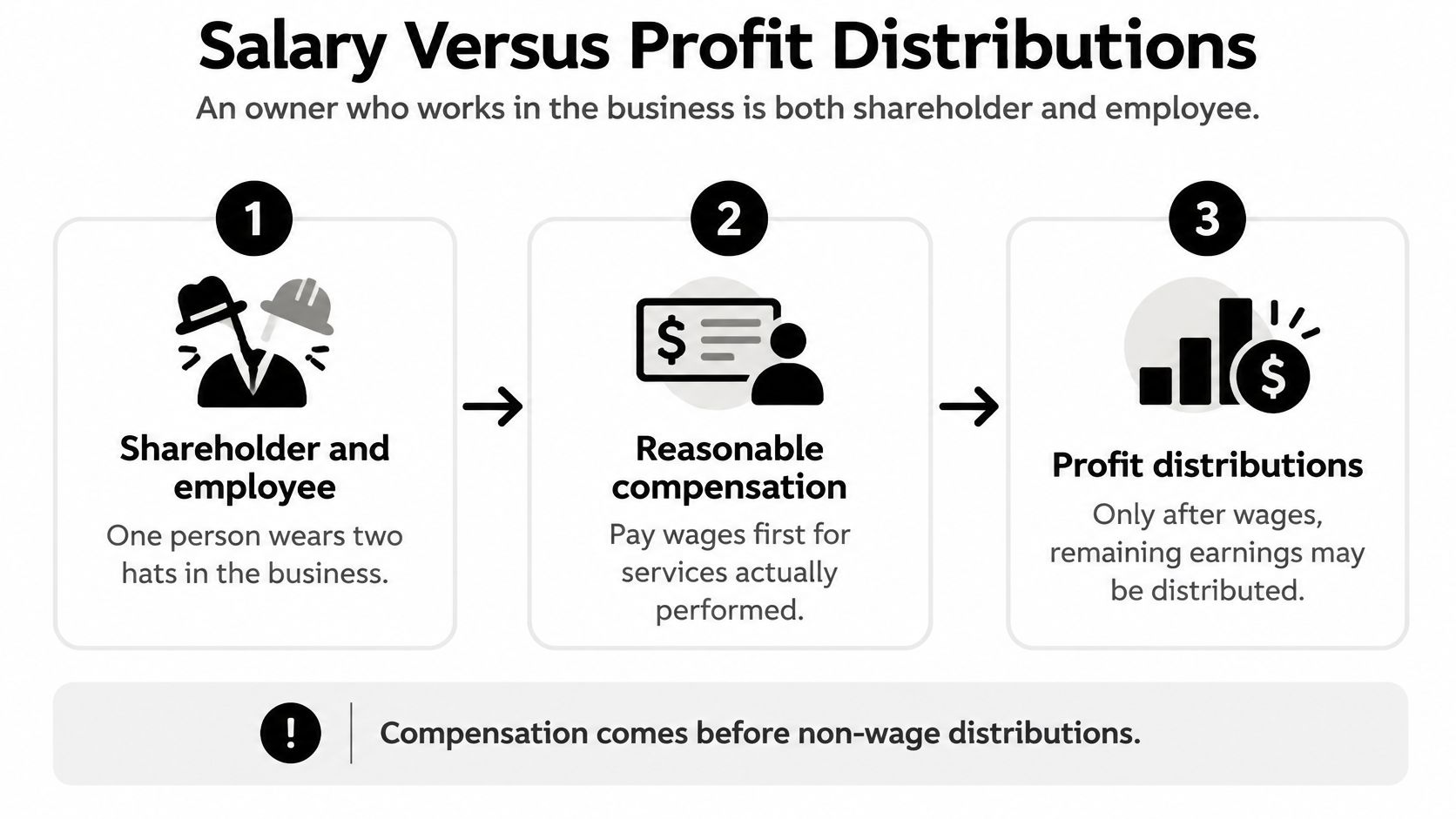
Wages run through payroll. They bear Social Security and Medicare taxes, withholding, and normal payroll reporting. Qualifying distributions of S corp profit that has already passed through to you for income tax purposes generally aren't subject to self-employment tax. That's where the potential savings live, and it's narrower than social media makes it sound.
One illustration, with the limits stated
Say a profitable company has $150,000 of profit before owner pay, and a defensible salary for the owner's actual job is $80,000. Employment tax is calculated on the $80,000 wage. The remaining $70,000 isn't treated like wages if it qualifies as a distribution.
Compare that with a sole proprietor who treats the full amount as self-employment income. The S corp owner may pay employment tax on a smaller base. That's the appeal.
Now change the facts. If a defensible salary is $140,000 because the owner personally produces almost all revenue, the gap nearly disappears. You still added payroll processing, a separate corporate tax return, and stricter bookkeeping. Savings that looked obvious at $150,000 can vanish once the salary is set appropriately.
A token salary doesn't create savings. It creates an audit story you will have to explain.
The IRS grades substance, not your labels
Calling a transfer a distribution doesn't make it one. The IRS guidance on S corporation employees, shareholders, and corporate officers explains that a shareholder-employee must receive reasonable compensation for services, that compensation is treated as wages subject to applicable employment taxes, and remaining qualifying distributions generally are not subject to self-employment tax.
The same guidance draws the line owners need to understand. If receipts are primarily generated by the shareholder's personal services, a larger share should generally be treated as wages. If profits arise materially from non-shareholder employees, equipment, or invested capital, a distribution component may be more supportable.
Build the file before you rely on the split:
- Duties and time: Write down what you do each week, not your founder title.
- Comparable pay: Pull salary data for the same role, experience, and South Florida market.
- Profit sources: Identify revenue produced by staff, equipment, recurring contracts, or capital you've invested.
- Payroll records: Run wages through a real payroll system and keep pay stubs, deposits, and filings consistent.
If the IRS reclassifies distributions as wages, you can face back payroll taxes and potential penalties. The company also has to clean up reporting that should have been right the first time. That's why a low-profit or pure personal-service business often gains little. Nearly all earnings must be wages, so there's almost no distribution piece left to justify the extra compliance.
Tip: Set salary with a CPA from comparable pay before the first distribution goes out. Start with the job you'd have to hire if you stepped away, price that job, and only then look at what profit remains. Never work backwards from the tax savings you hope to see.
Ownership Rules That Can Block the Election
Stop asking only whether an S corp reduces tax. Ask who can own your company after you elect, and what economic rights those owners can hold. For many founders, that answer kills the election faster than any spreadsheet.
The IRS instructions for Form 2553 frame a structurally narrow system, under which the company generally may have no more than 100 shareholders, may not have partnerships, corporations, or nonresident aliens as shareholders, and may have only one class of stock, although voting rights can differ.
S corp eligibility limits
| Rule | Limit | What breaks it |
|---|---|---|
| Shareholders | Generally no more than 100 | More than 100 shareholders |
| Shareholder type | Individuals and certain trusts and estates | A partnership, corporation, or nonresident alien owner |
| Stock | One class of stock; voting rights may differ | Preferred economic rights or uneven distribution rights |
| Entity | Domestic corporation that elects under IRC 1362(a) | An ineligible entity or a foreign corporation |
| Election timing | Form 2553 signed by all shareholders, generally within 2 months and 15 days of the tax year start | A late filing without IRS relief |
Those rows sound abstract until you put names on them. A parent abroad who helped fund the business and wants shares can break eligibility if that parent is a nonresident alien. An investing LLC, a family partnership, or a corporate strategic investor can't sit on the cap table as a shareholder. A trust isn't automatically fine either, since certain trusts qualify only if they're structured under the IRS rules.
Equity promises break elections too. An angel who wants a preferred return, first money out, or distribution rights that differ from other shareholders is asking for economics that don't fit one class of stock. Voting rights can differ, but money rights are the trap. Side letters and handshake promises about who gets paid first can create exactly the second economic class you're supposed to avoid.
Why this hits South Florida founders early
Miami and Fort Lauderdale companies often have cross-border families, foreign co-founders, overseas angel money, and relatives who expect ownership for early support. That's normal here. It's also where S eligibility gets tight fast.
A domestic, closely held company with individual U.S. owners and simple pro rata distributions can fit comfortably. A company planning institutional funding, preferred stock, or international ownership usually can't. If you're already in a C corp and thinking about moving the other way, review the ownership consequences in our overview of a C corp to S corp conversion before shareholders sign anything.
Changing course later isn't free. You may need new governance documents, shareholder approvals, tax analysis, revised investor paperwork, and a cleanup of rights that were granted while the company had a different structure. Buyers and investors also discount messy cap tables because they have to pay lawyers to sort them out.
Tip: Write down every current and expected owner before anyone signs Form 2553. Include spouses, trusts, parents who wired startup money, advisors promised equity, and investors you're courting. If one name doesn't fit, solve that now while it's still a planning conversation.
Real Businesses Where the Math Changes
Three South Florida patterns show why there's no universal answer. Match yourself to the closest one. Don't average them.

The Miami design studio that should model it
Say a Miami design studio has two U.S. individual owners, a small team of employees, recurring client contracts, and no outside investors. Both owners work in the business, but junior designers and project managers also produce billable work. Profit sits well above salaries that match what comparable creative directors earn locally.
This is the strongest case. The owners can pay defensible W-2 wages, keep one simple class of ownership, and distribute remaining profit pro rata. Employment tax applies to wages, while qualifying distributions may sit outside employment tax. The company stays eligible because nobody needs preferred economics or entity ownership.
The answer isn't automatic yes. It's model it seriously. If projected savings beat payroll service, Form 1120-S preparation, and added bookkeeping by a clear margin, the election earns its keep.
The solo consultant who should probably skip it
Now say a solo consultant sells strategy work that's entirely personal. Clients hire her judgment, she delivers every engagement herself, and she has no employees or meaningful equipment producing income. Her profit drops sharply any month she takes time off.
Nearly all of that profit looks like pay for services. A defensible salary would consume most earnings, leaving little distribution to shelter from employment tax. After payroll fees, a separate return, and tighter basis and expense tracking, the net benefit can shrink to nothing.
She may still want an LLC for liability and clean contracts. She doesn't need an S election just because another consultant in a different business saved money. Skip it unless profit grows beyond her personal output in a durable way.
The tech founders who need a different entity
Two founders building software expect a SAFE round within the year. One founder's relative abroad may invest directly, and a future priced round will likely involve preferred stock. They have modest revenue today, so the tax story tempts them anyway.
Don't elect. The funding plan points to a C corp, where preferred equity and broad investor ownership are normal tools. Electing S status now and converting later means more than filing a one-page form. The company may need new governance documents, stock paperwork, investor consents, and intellectual property assignments cleaned up under time pressure during diligence.
Founders lose negotiating power when diligence turns into repair work. Choose the structure that matches the next financing, not the structure that flatters this year's tax projection.
Tip: Pick the case that matches your owners and funding plan, then test that case with your CPA. Treat these scenarios as screening tools, not personal tax opinions, because your salary, state exposure, and cap table can move the answer.
Costs and Fit Before You File
Run this six-step test with a CPA before you elect. Don't let a formation website run it for you.
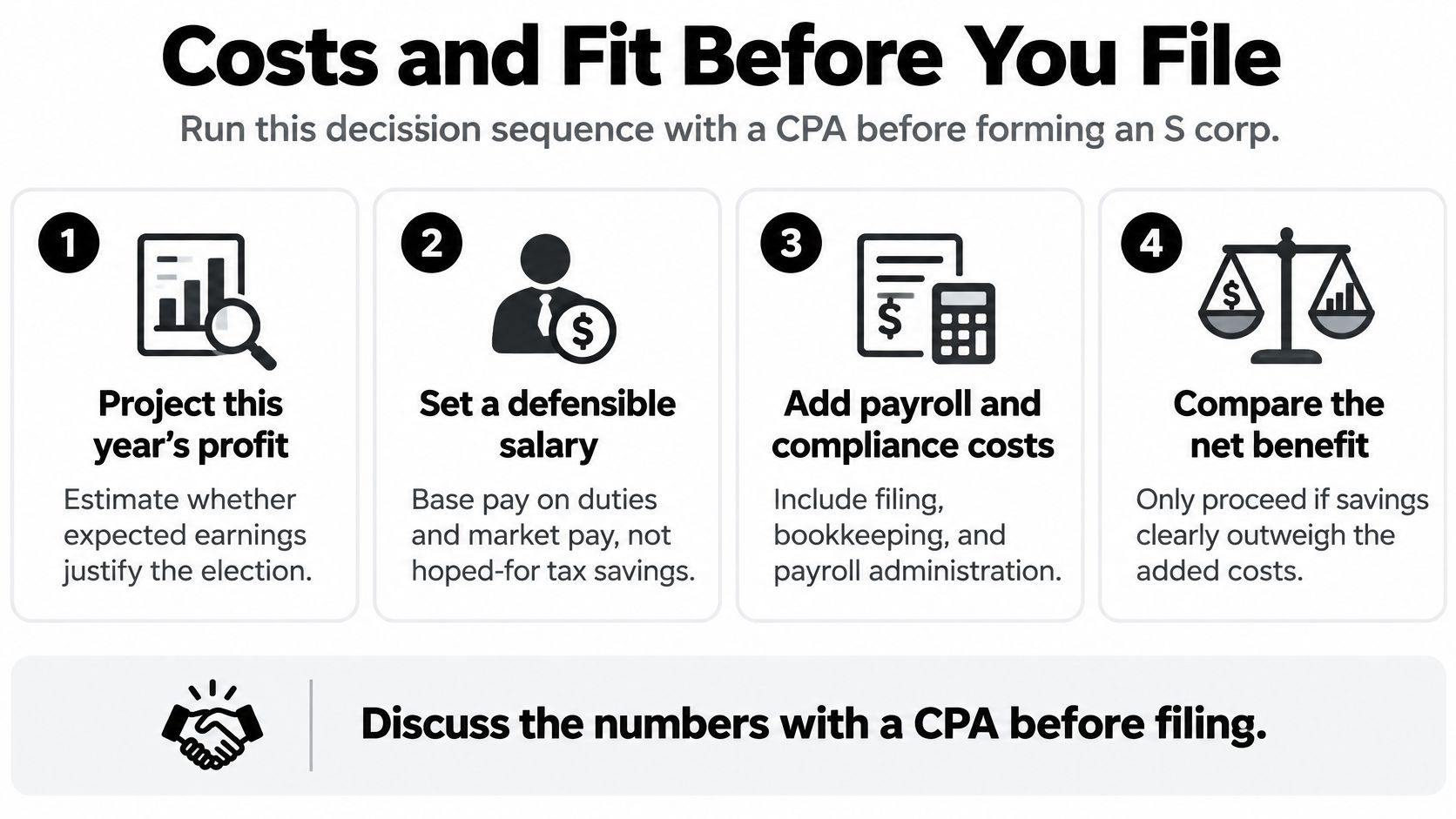
- Project this year's profit. Use signed contracts and realistic pipeline, not best-case revenue.
- Set a defensible salary. Base it on duties, hours, experience, and market pay.
- Estimate the employment-tax gap. Compare tax on all profit as self-employment income with tax on wages only.
- Subtract added costs. Include payroll processing, Form 1120-S preparation, basis tracking, bookkeeping, and legal work.
- Check every owner. Confirm each current holder fits the eligibility limits.
- Look ahead 24 months. Ask whether investors, a second economic class, or a nonresident owner are likely.
If the gap in step three is small, don't elect for the tax story. If the answer in step six is yes, don't elect and hope you'll unwind it later. Either result is a real answer, and it saves you from buying compliance you don't need.
The IRS guidance on S corporation compensation and medical insurance issues supports that caution, noting that S-corporation shareholders are not subject to self-employment taxes on items passed through by the corporation, while shareholder-employees must receive reasonable compensation before non-wage distributions are made. The benefit comes from separating wages for labor from distributions for ownership, not from excluding all profit from payroll tax.
State tax belongs in the same model. A federal payroll gap can shrink once another state's income, franchise, or entity-level rules enter the picture, especially if owners or employees work outside Florida. Founders expanding beyond Florida should also check formation duties in the other state, just as you'd review publication requirements for Arizona corporations before assuming a Florida filing routine travels well. If you do form here, get the state mechanics right through proper Florida corporation filing and governance paperwork from the start.
Do-it-yourself formation often looks cheap until diligence or an audit. Common do-it-yourself issues include missing IP assignments, unclear ownership, wrong entity selection, and policy gaps that surface during fundraising or audits. An S election that fits a quiet first year can become a trap after a new partner joins or an investor asks for a preferred return.
Tip: Rerun the six steps when profit, owners, or funding plans change. Form 2553 isn't permanent wisdom. It's a decision tied to facts, and facts in a growing company don't sit still.
Have Counsel Review the Election First
Don't file Form 2553 from a generic online template and hope your CPA can bless it later. The legal eligibility review and the tax model have to happen together, before the filing window and before payroll starts.
Bring three items to one coordinated review:
- Full owner list: Include spouses, trusts, family lenders who expect equity, and anyone promised a future stake.
- Draft reasonable salary: Show duties, hours, and market pay support for each working owner.
- One-year profit estimate: Bring contracts, recurring revenue, payroll for staff, and expected owner draws.
Counsel checks entity choice, ownership, stock rights, and whether your documents match the election. Your CPA checks salary, distributions, estimated taxes, and whether projected savings survive compliance costs. Splitting those conversations by months is how owners end up eligible on paper but wrong on payroll, or strong on tax math but blocked by a shareholder nobody mentioned.
If venture funding, preferred equity, or a nonresident owner is likely within the next 24 months, ask about a C corp path instead of electing S status you'll have to unwind. That conversation should cover Florida versus Delaware where relevant, founder stock, and 83(b) guidance if restricted stock is part of the plan.
At Coto & Waddington, business formation covers LLC, S-corp, and C-corp setup through Sunbiz and the IRS, including Articles of Organization or Incorporation, operating agreements, bylaws, and EIN registration. We guide a new Florida LLC, S-corp, or C-corp through the options and implement the structure that fits, with flat-rate legal packages that can evolve from formation to long-term general counsel support. That structure review works best with your CPA in the loop, not after filings lock you in.
Tip: Book the review before the first payroll run. A salary set too low is harder to defend after distributions have already gone out, and early transfers create the paper trail an examiner will read first.
If you're deciding whether an S election, an LLC with default tax treatment, or a C corp fits your owners and funding plans, schedule a structure review with your CPA and Coto & Waddington, Attorneys at Law before you file Form 2553 or run owner payroll. We'll review the cap table, formation documents, governance, and election timing with you, then implement the Florida or Delaware structure that matches the business you're building.