You filed your LLC online, got your EIN, and opened a business bank account. Your partner wired in seed money, you signed a lease, and customers are already paying. The only document you skipped is the one that says who owns what, who can sign for the company, and what happens if one of you wants out. A small business operating agreement fills that gap, and putting it off until you disagree is the costliest time to write it.
Table of Contents
- What Is a Small Business Operating Agreement
- Why Your LLC Needs an Operating Agreement
- Essential Clauses Every Operating Agreement Should Include
- Florida and Delaware Rules You Should Know
- Drafting Checklist and Sample Clauses
- Red Flags and Common Mistakes to Avoid
- When to Consult a Business Attorney
What Is a Small Business Operating Agreement
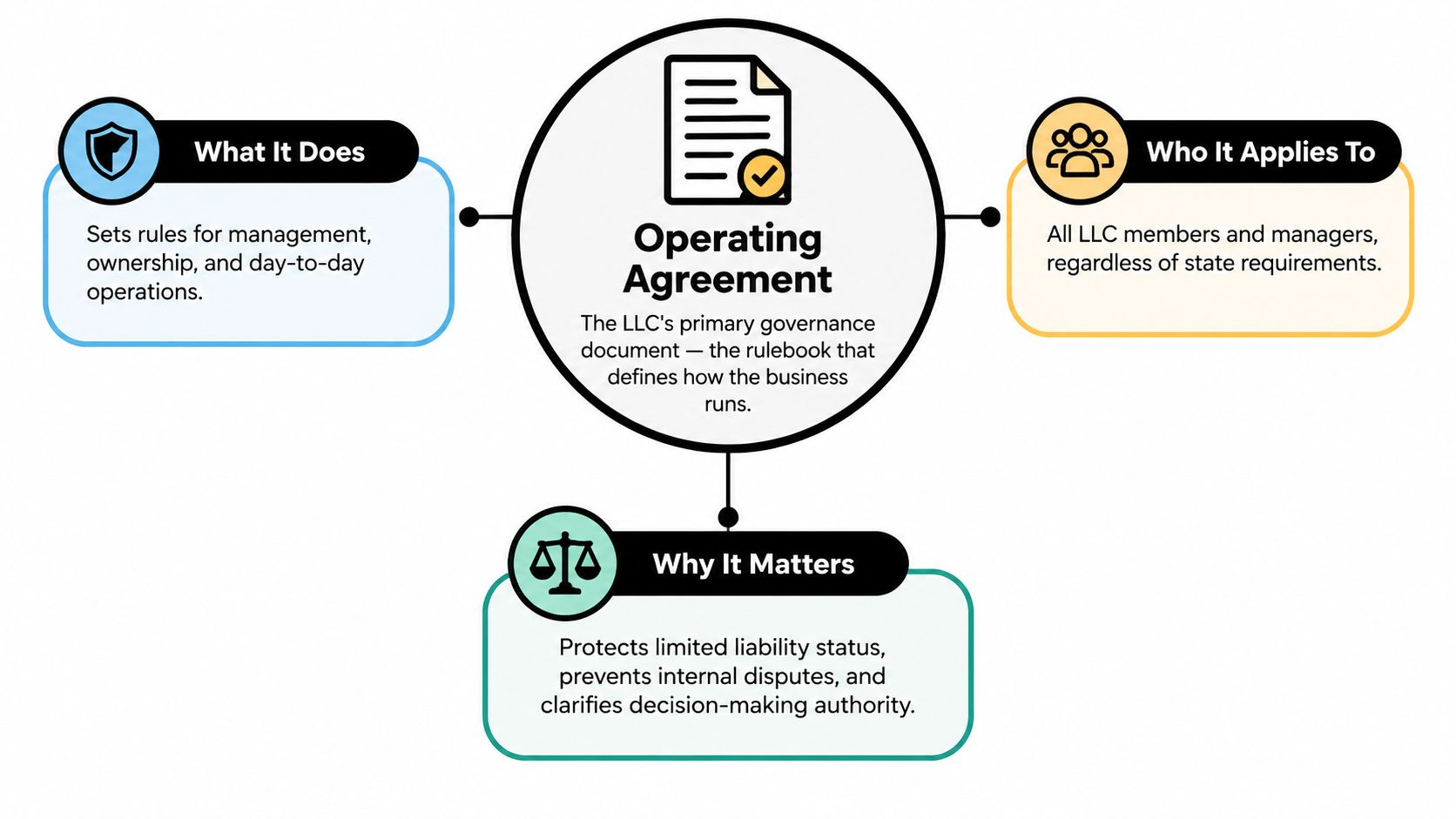
An operating agreement is your LLC's primary governance document. It records your deal with your co-owners in writing so you don't have to rely on memory, text messages, or assumptions when money gets tight. The U.S. Small Business Administration describes the agreement as the document that explains financial and functional decision making, and it defines members' duties, powers, and responsibilities.
Think of your articles of organization as a birth certificate. That short state filing creates the LLC and lists basic information, but it doesn't say how you'll run the company. Your operating agreement is the rulebook.
What the Rulebook Actually Covers
A solid agreement typically records ownership percentages, capital contributions, voting arrangements, and management structure. It also covers how you allocate profits and losses, when cash gets distributed, and who has authority to sign contracts or borrow money. Transfer restrictions, admission of new members, and procedures for deadlock or a member departure belong in there too.
Those topics sound routine until they're disputed. If you contributed equipment and your partner contributed cash, the agreement should say how each contribution was valued. If one owner runs daily operations and the other is passive, it should say who can hire, fire, and spend without a vote.
What Happens Without One
When members haven't adopted an agreement, state default rules govern automatically. Those defaults can produce unintended results for voting, allocations, information rights, transfers, and dissolution. The state doesn't know your side deal, your family arrangement, or the reason one founder was supposed to have final say on product decisions.
That risk applies to single-member LLCs too. A solo founder still benefits from documenting who manages the company, what happens on death or disability, and how the business is separate from personal affairs. Banks, buyers, and estate representatives will ask for that clarity.
Tip: Treat the agreement as your operating manual, not a formation formality. If a new manager can't read it and understand who approves what, it's not finished yet.
Call to action: Before your LLC takes more money, signs another major contract, or adds an owner, write down ownership, contributions, and approval rights in one signed document and keep it with your company records.
Why Your LLC Needs an Operating Agreement
Skip the agreement and you're choosing the state's generic rules by default. That's rarely the deal you negotiated. A written agreement lets you override defaults on voting, management authority, and profit splits with terms that match your actual contributions and roles.
That point matters at scale. Internal Revenue Service Statistics of Income data for tax year 2023 recorded more than 4.5 million partnership returns and over 30.2 million partners, with LLCs accounting for 72.7% of all partnerships. The same data reported approximately $12.0 trillion in receipts and $2.1 trillion in pass-through income or loss for partnerships in 2023. Operating agreements aren't niche startup paperwork. They're the governance backbone for millions of closely held, family, professional, and investment businesses moving serious money.
Protection That Templates Alone Don't Provide
An agreement helps protect your limited liability posture because it shows the LLC operates as a separate business with its own rules. It doesn't replace separate bank accounts, clean bookkeeping, or proper signatures, but it supports them. Without internal records, it's harder to show where you end and the company begins.
Credibility is the other practical reason. Banks want to know who can borrow. Investors want to know who owns what and whether interests can be transferred. A buyer conducting diligence will ask whether a co-owner can block a sale, inherit control, or force a buyout at the worst moment.
- Disputes get expensive fast: Unclear authority turns a disagreement about a vendor contract into a fight about whether the contract binds the company.
- Tax results can surprise you: Economic ownership and taxable allocations don't always move together, and defaults won't fix a mismatch for you.
- Enforcement gets messy: A handshake understanding is difficult to prove when memories diverge and emails point in different directions.
The Single-Member Misconception
Solo founders often assume an agreement is pointless because there's nobody to argue with. That misses disability, death, banking, and a future co-owner. Your agreement can name a successor manager, confirm your contribution, and set the baseline terms before an investor or spouse enters the picture.
A one-owner agreement isn't for today's argument. It's for the bank, buyer, or family member who needs proof of authority when you can't explain it yourself.
Tip: Pair your agreement with a decision matrix that sorts actions into routine, major, and unanimous consent categories. Post it where managers can check it before signing.
Call to action: Pull your current agreement this week. If you don't have one, or you can't find a signed copy, put drafting it ahead of your next financing, hire, or ownership change.
Essential Clauses Every Operating Agreement Should Include
A useful small business operating agreement answers specific operational questions. Who put in what, who decides what, who gets paid when, and who can leave on what terms. Comparing your draft against LiveDocument contract examples can help you spot missing topics, but your final clauses need to reflect your tax, banking, and ownership facts.
Money In and Money Out
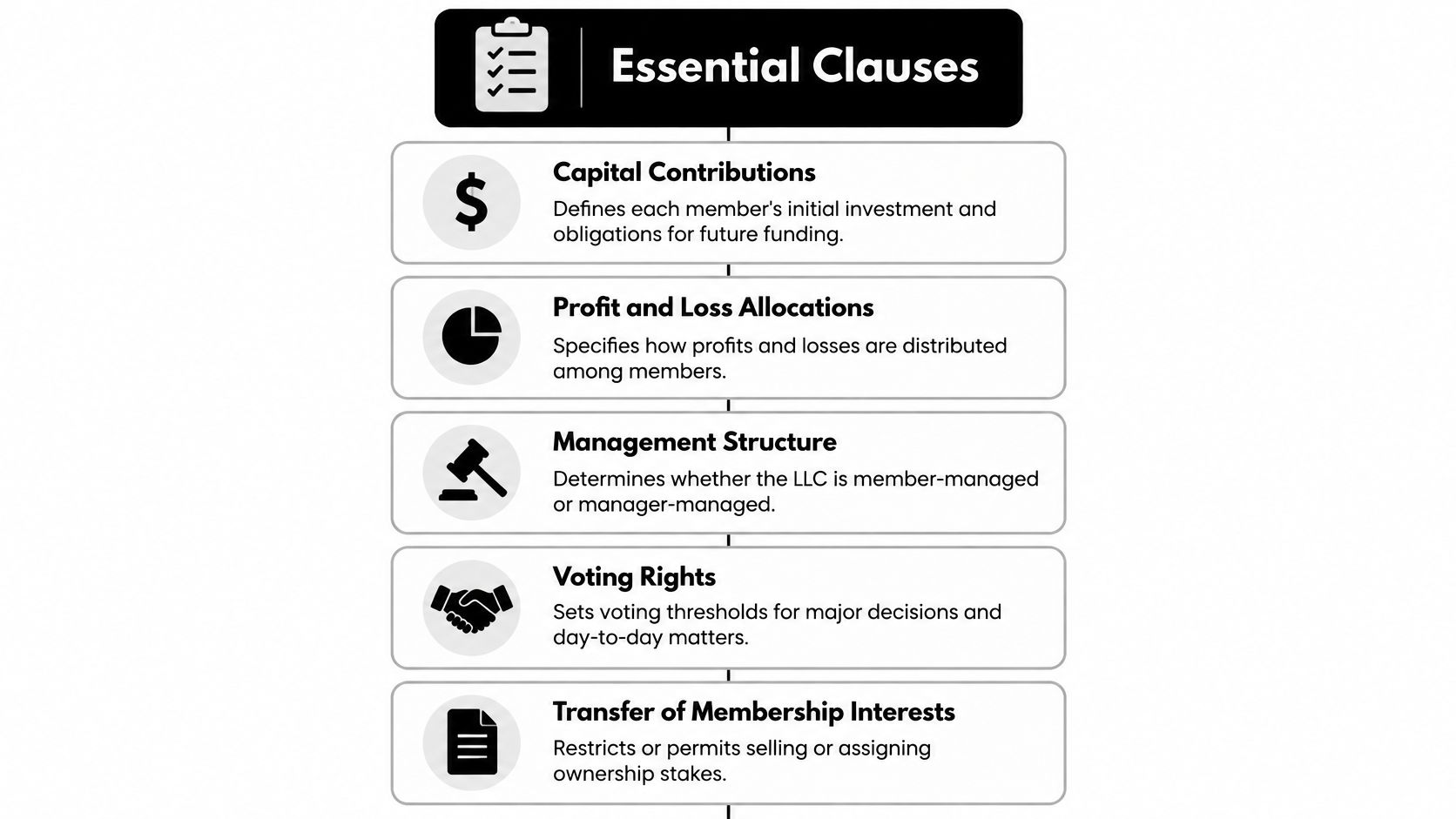
Start with capital contributions. List cash, property, services, and intellectual property, assign values, and state whether members must contribute more later. Your capital call language should set notice periods, deadlines, and consequences for nonpayment, such as dilution, a member loan, or loss of voting rights.
Then separate allocations from distributions. IRS guidance describes the partnership agreement as determining allocations of income, deductions, gains, and losses, and it requires the agreement to explain distributions and liquidation rights. An LLC taxed as a partnership can allocate taxable income to you without distributing cash to pay the tax.
That's why a tax distribution clause matters. It can require periodic distributions sufficient to cover members' assumed tax liabilities, typically using an agreed federal, state, and local rate applied to allocable taxable income, subject to available cash and debt covenants. Define whether those payments are advances against regular distributions and how you handle losses, basis limits, or a change in tax classification.
Control, Transfers, and Exit
State plainly whether you're member-managed or manager-managed. Set approval thresholds for borrowing, equity issuances, related party dealings, major transactions, and amendments. Routine spending can sit with a manager, while selling the company may require a supermajority or unanimous vote.
Transfer restrictions keep you from waking up in business with a stranger, a former spouse, or a creditor. Address rights of first refusal, permitted family transfers, and whether a transferee gets economic rights only or full membership. Review how those restrictions interact with buy-sell agreement mechanics for owner exits before you copy generic exit language.
Close with dissolution and dispute resolution. Name the events that wind up the company, the order creditors and members get paid, and whether disputes go to mediation, arbitration, or court. Specify governing law and forum so a fight about the business doesn't start with a fight about location.
Tip: Have your tax adviser review allocation, capital account, withholding, and liquidation language before you sign. Ownership percentages alone don't determine every tax result.
Call to action: Mark up your draft clause by clause this week. If any money, control, or exit question has no written answer, treat that gap as a drafting item, not a detail to settle later.
Florida and Delaware Rules You Should Know
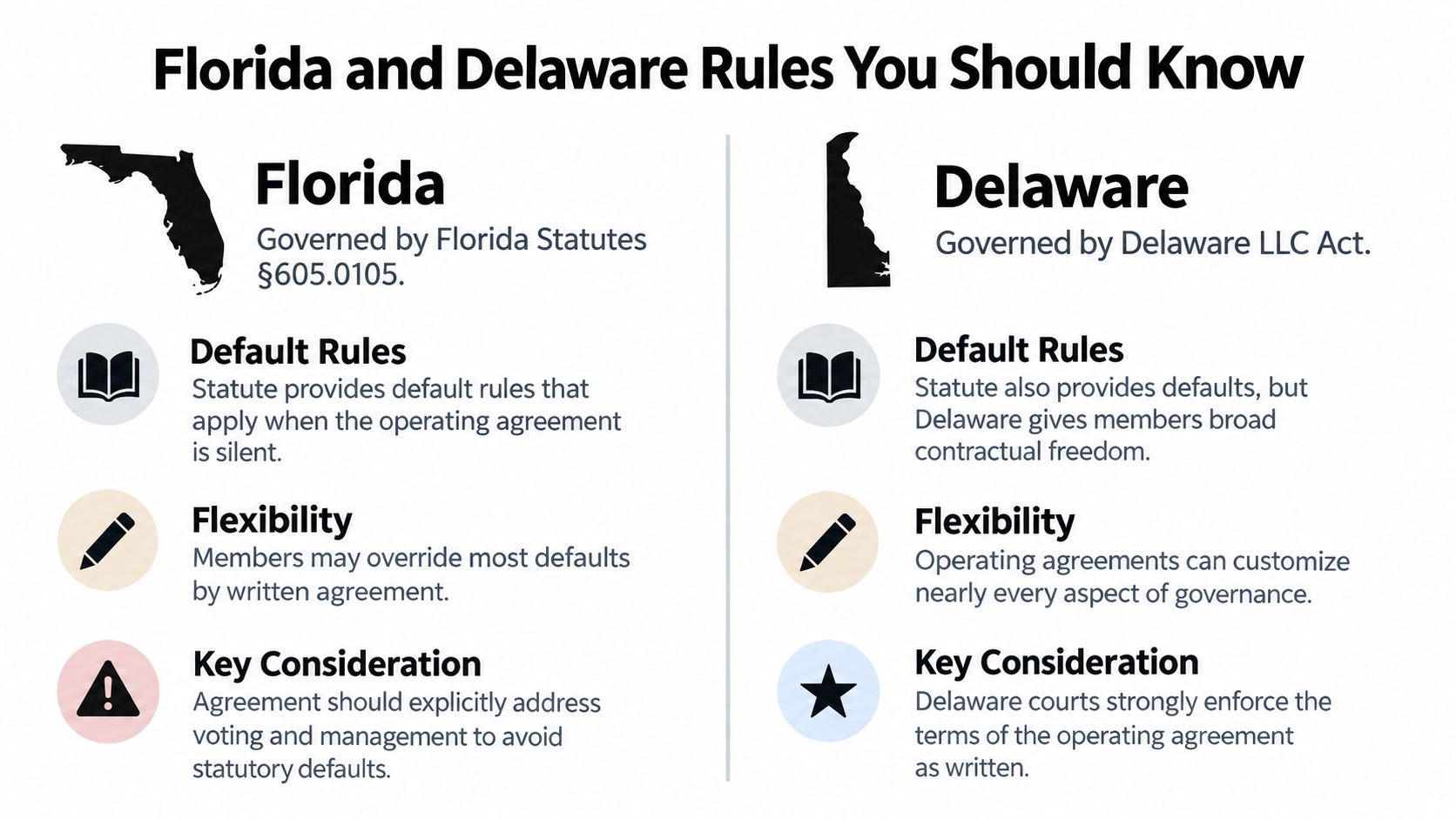
Your formation state supplies the defaults your agreement replaces, so Florida and Delaware aren't interchangeable choices. Florida founders who form in Delaware still operate, hire, bank, and sign leases in Florida. Your governing law, forum selection, and authority provisions need to coordinate across both places.
How Florida Treats Your Agreement
Under Florida Statutes §605.0105 and its rules on the scope of an operating agreement, the agreement governs relations among members, relations between members and the LLC, managers' rights and duties, company activities, and the amendment method. If your agreement is silent on a covered matter, the Florida statute supplies the default. Silence is a decision, just not yours.
Florida also recognizes an agreement that is oral, implied, written in a record, or a combination, including later amended versions and single-member companies, under the Florida Revised LLC Act definitions in Chapter 605. That flexibility creates evidentiary risk. Emails, conduct, and informal conversations may be argued as company rules when no signed document controls.
Version control matters for another reason. Under the current Florida Chapter 605 provisions on who is bound by an operating agreement, the LLC is bound by and may enforce its agreement even without separate assent, and a person who becomes a member is deemed to assent even without signing. A new owner can be bound by a document they've never read unless your admission process forces that review.
Where Delaware Differs
Delaware gives members broad contractual freedom. Its LLC statute permits an agreement to expand, restrict, or eliminate fiduciary duties, but it preserves the implied covenant of good faith and fair dealing and doesn't permit protection for bad faith violations. That freedom rewards precise drafting and punishes vague drafting, because the written standards you choose carry real weight.
If you're weighing formation there, review Delaware incorporation benefits and tradeoffs against your investor plans, tax footprint, and where you operate. Don't form in Delaware for prestige, then run a Florida business with Florida contracts that point to a different forum and different signatories.
Tip: State standards of conduct, conflict procedures, reliance protections, indemnification limits, and reserved matters expressly. Don't assume statutory defaults match your negotiated deal.
Call to action: Have counsel compare your intended arrangement against Florida or Delaware defaults before you file, accept investment, or register in a second state.
Drafting Checklist and Sample Clauses
Drafting works best as a checklist tied to decisions, not as a search for perfect boilerplate. The Small Business Administration guidance on operating agreements supports treating the document as the place where you define management, authority, and member responsibilities before a dispute forces the issue. Use the list below to test whether your draft is complete.
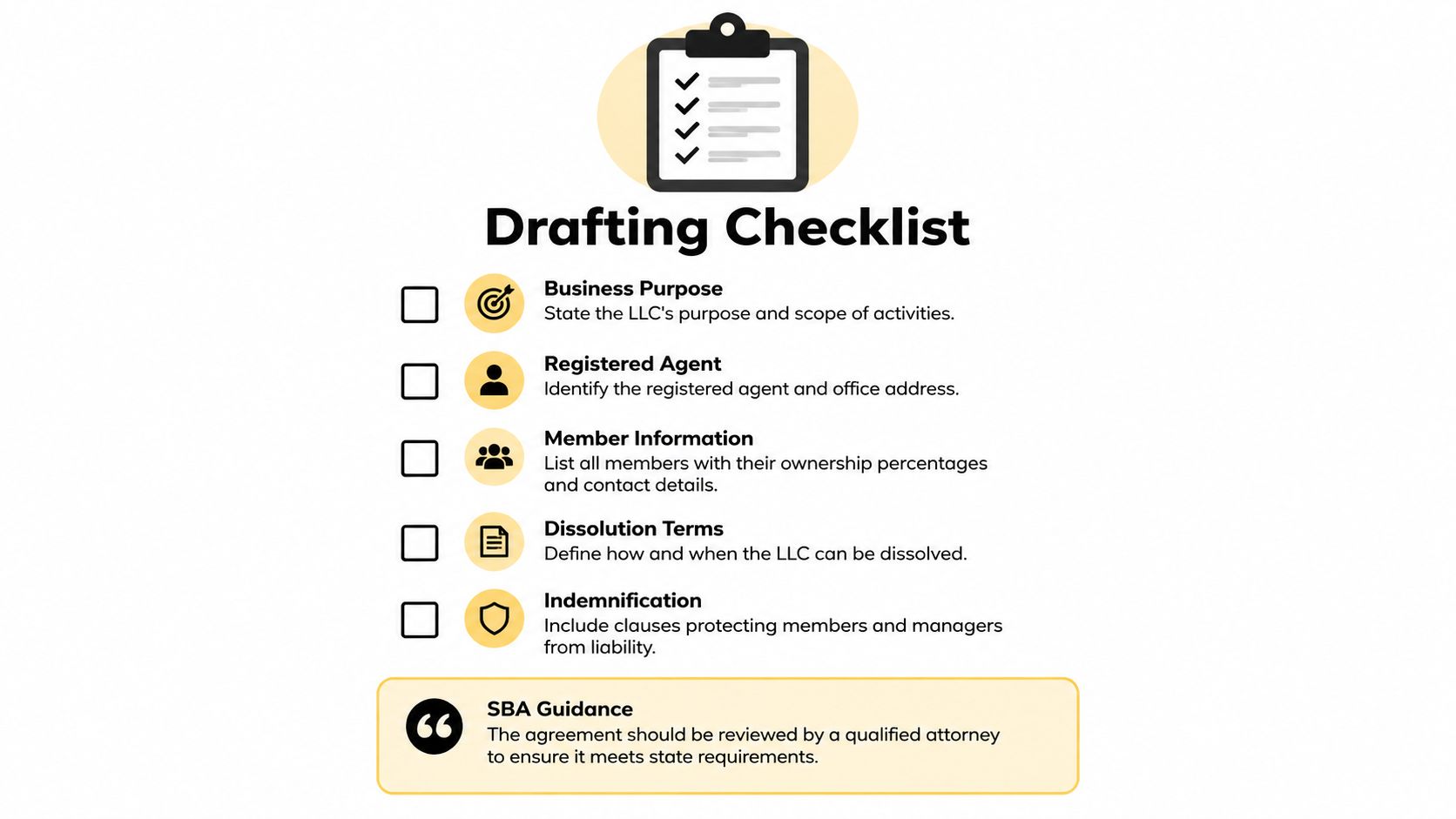
Your Drafting Checklist
- Company basics: Legal name, purpose, principal address, registered agent, term, formation state, and tax classification.
- Ownership schedule: Each member's percentage, units if you use them, initial contribution, and how the schedule gets updated.
- Management authority: Member-managed or manager-managed structure, officer roles, signing limits, and bank authority.
- Voting thresholds: Ordinary, major, and unanimous actions, including debt, new members, equity grants, and amendments.
- Economics: Allocation method, distribution waterfall and timing, reserves, withholding, tax distributions, and liquidation priorities.
- Transfers and buy-sell: Restrictions, triggers, valuation method, payment terms, insurance funding, and rights of first refusal.
- Exit and disputes: Dissolution events, deadlock steps, mediation or arbitration, governing law, forum, and fee responsibility.
- Amendments and records: Who can amend, required vote, notice to members, and where the operative version is kept.
Sample Language to Discuss With Counsel
For tax distributions, founders often consider language along these lines. The company will, subject to available cash and loan restrictions, distribute amounts intended to cover each member's assumed tax on allocated income, and those amounts will reduce later regular distributions to that member. Your adviser still needs to set the assumed rate, payment dates, and true-up process.
For a buyout trigger, don't stop at naming death or withdrawal. State who may trigger the purchase, whether the company or remaining members buy, how value is set, whether discounts apply, and whether the price is paid in installments secured by the interest. That mechanical detail decides whether the clause works.
For amendments, require a written, signed amendment that identifies the version it replaces. Oral changes invite proof problems, especially after a founder departure or a financing.
Practical rule: If a clause names a right but not the procedure, deadline, and remedy, redraft it. Procedures are what members actually use.
Tip: Keep the signed agreement, amendments, member consents, and capitalization schedule in one records folder that matches your tax and banking files.
Call to action: Schedule a legal review whenever ownership, financing, management, or your business model changes, and bring this checklist with your current draft.
Red Flags and Common Mistakes to Avoid
The most dangerous agreement isn't always the missing one. It's the signed template nobody updates while the business changes around it. A living company issues interests, admits a spouse or investor, changes tax elections, takes on debt, grants signing authority, and creates subsidiaries. Each event can make your old governance records inconsistent with tax returns, bank files, licenses, and ownership disclosures.
Federal reporting adds another layer founders confuse with internal governance. FinCEN's 2025 announcement removing beneficial ownership reporting for U.S. companies exempted entities formed in the United States and their U.S. beneficial owners from federal BOI reporting, while qualifying foreign entities registered here remained subject to reporting and new deadlines. That change doesn't eliminate your need for accurate internal ownership records. South Florida companies with cross-border founders, foreign parents, or U.S. subsidiaries need extra care separating those duties.
Buy-Sell Language That Fails in Real Life
Generic exit clauses often say a departing member's interest will be bought at fair value. They don't say who triggers the buyout, how valuation handles intangible assets and founder goodwill, or how the company pays if cash is tight. They also ignore deadlock, death, divorce, disability, and unequal contributions, which are the events that fracture small businesses.
Family companies face a wider problem. Succession involves management authority, voting control, employment, and estate planning, not just a transfer on paper. Connect your agreement with wills, trusts, marital property planning, and key-person insurance, an approach reflected in business succession planning guidance for owners. Ask whether remaining owners can legally require and afford the intended outcome if an owner dies, divorces, becomes disabled, or stops contributing.
Other red flags are mundane but telling. Watch for unsigned drafts, missing schedules, inconsistent percentages across tax and bank documents, managers who left years ago, and amendment clauses nobody follows. Those aren't clerical issues. They're evidence problems.
Tip: Create an amendment trigger list inside your company records. New debt, new members, new tax elections, and management changes should automatically prompt a document review.
Call to action: Audit your agreement against your current cap table, bank signatories, and tax classification now. Fix mismatches while all owners are still cooperating.
When to Consult a Business Attorney
You don't need counsel for every routine decision. You do need counsel at the moments when your small business operating agreement changes who owns, controls, or gets paid by the company. Those moments are predictable, which means you can plan the review instead of paying for cleanup during a dispute.
Trigger Points Worth a Call
Call before formation if founders contribute different amounts, one founder will manage while others invest, or family members will own together. Call again when you add members or investors, issue interests to employees, borrow money, change tax classification, or shift from founder management to professional management. A founder departure, divorce, disability, or planned sale should trigger the same review.
Counsel should compare your intended deal with state defaults, test the tax and distribution mechanics, and align admission, transfer, and buy-in documents. Expect questions about who can bind the company, how deadlocks end, and how records stay consistent with banking, licensing, and ownership disclosures. For execution and record retention, many firms also rely on secure PDF solutions for attorneys to manage signed copies and amendments in an organized file.
South Florida founders often need that conversation in English or Spanish, sometimes with family owners in both languages at the same table. Coto & Waddington provides bilingual business counsel for Florida and Delaware formation and operating agreements, and its small business legal services for ongoing company needs cover drafting and review for single-member, multi-member, and manager-managed LLCs. Bilingual support isn't a courtesy in that setting. It's how you confirm every owner understands voting control, buyout triggers, and tax distributions before signing.
Tip: Bring your articles, current agreement, cap table, loan documents, and tax classification records to the first meeting. You'll get specific advice faster and avoid drafting around missing facts.
Call to action: If your agreement is missing, unsigned, or older than your last ownership or financing change, schedule a review before the next signature goes on a company document.
Your operating agreement should say, in plain and enforceable terms, who owns your LLC, who controls it, how cash and taxes are handled, and how an owner exits. Coto & Waddington, Attorneys at Law drafts and reviews Florida and Delaware operating agreements for startups and family businesses across South Florida, with bilingual English and Spanish support and flat, predictable pricing. Visit Coto & Waddington, Attorneys at Law to schedule a consultation and get your agreement aligned with how your business operates.