A state-law S corporation is governed by its articles of incorporation and bylaws, not by an LLC operating agreement, and it can have no more than 100 shareholders and only one class of stock. You still need a shareholder agreement that protects that election, because the wrong owner or the wrong economic right can destroy it.
Most popular advice gets this backwards. Founders search for an operating agreement for S corp use, download an LLC form, and think they've solved governance. They haven't. They've often created the document most likely to contradict their tax election, skip their bylaws, and leave their stock ledger telling a different story than their tax return. Don't sign that form before you fix the structure.
Table of Contents
- What Document an S Corp Actually Needs
- How to Draft the Governance Package
- Clauses That Keep the S Election Intact
- Tax Distributions Basis and K-1 Duties
- Florida and Delaware Rules Founders Miss
- Have Counsel Review Before You Sign
What Document an S Corp Actually Needs
An S election doesn't turn a corporation into an LLC. If you're a corporation under state law, your primary rulebook is corporate, no matter what a template site calls the download. The IRS S corporation page describes the federal limits you must preserve, including that the corporation must be domestic, have no more than 100 shareholders, maintain only one class of stock, and restrict ownership to eligible individuals, certain trusts, and estates, while partnerships, corporations, and nonresident aliens generally cannot hold shares. Form 2553 must be signed by all shareholders when the election is made.
The Right Paper for the Right Entity
Founders use the phrase operating agreement for S corp to mean the whole internal package covering ownership, management authority, voting, transfer limits, buy-sell rights, distributions, and disputes. For a corporation, that package is articles of incorporation, bylaws, a shareholder agreement, board resolutions, and state corporate law. For founders who want context on how the owner-level piece fits, corporate governance guidance for closely held businesses is a useful starting point before you draft.
| Document | Entity it fits | What it controls | Use for S status |
|---|---|---|---|
| Articles or certificate of incorporation | State-law corporation | Name, authorized shares, registered agent, charter limits | Yes, the charter |
| Bylaws | Corporation | Directors, officers, meetings, notice, quorum, voting, records | Yes, primary internal rules |
| Shareholder agreement | Corporation owners | Transfers, buy-sell, eligibility, distributions, disputes | Yes, the practical governance package |
| Board and shareholder resolutions | Corporation | Officer roles, Form 2553 approval, adoption of agreements | Yes, how the package is approved |
| Stock ledger and cap table | Corporation | Owners of record, percentages, legends | Yes, must match tax reporting |
| LLC operating agreement | LLC, including an LLC taxed as an S corporation | Members, management, transfers, economics | Only when the entity is an LLC |
| Form 2553 | Federal tax election, not a state entity | S election and shareholder consents | Required, signed by all shareholders |
An LLC that elects S status is the exception that confuses everyone. State law still expects an operating agreement for that LLC, and that agreement must obey the same federal limits as a corporation. It can't use partnership-style allocations, waterfalls, or special distribution rights that a normal multi-member LLC form would allow.
The One-Class Line You Cannot Cross
Voting rights can differ between shares. Economic rights generally can't. Shares generally count as one class when all outstanding shares have identical rights to distributions and liquidation proceeds, even if voting rights differ. An agreement that creates unequal economic rights, permits an ineligible owner, or lets a transfer happen without tax review can jeopardize the election.
For South Florida founders, treat this as a compliance job, not a naming debate. Your capitalization table, stock legends, transfer procedures, shareholder consent requirements, and distribution provisions must all match the election. If one document says a founder gets paid first and another says everyone is equal, you've built a conflict into your own records.
Practical rule: Corporation means bylaws plus a shareholder agreement. LLC taxed as an S corporation means an operating agreement scrubbed of any second economic class.
Tip: Before drafting anything, pull your state filing record and confirm the entity type you formed. A mismatch between the filed form and the governing document is the fastest way to end up with the wrong rulebook, and it's completely preventable. Check the record, then draft to that entity.
How to Draft the Governance Package
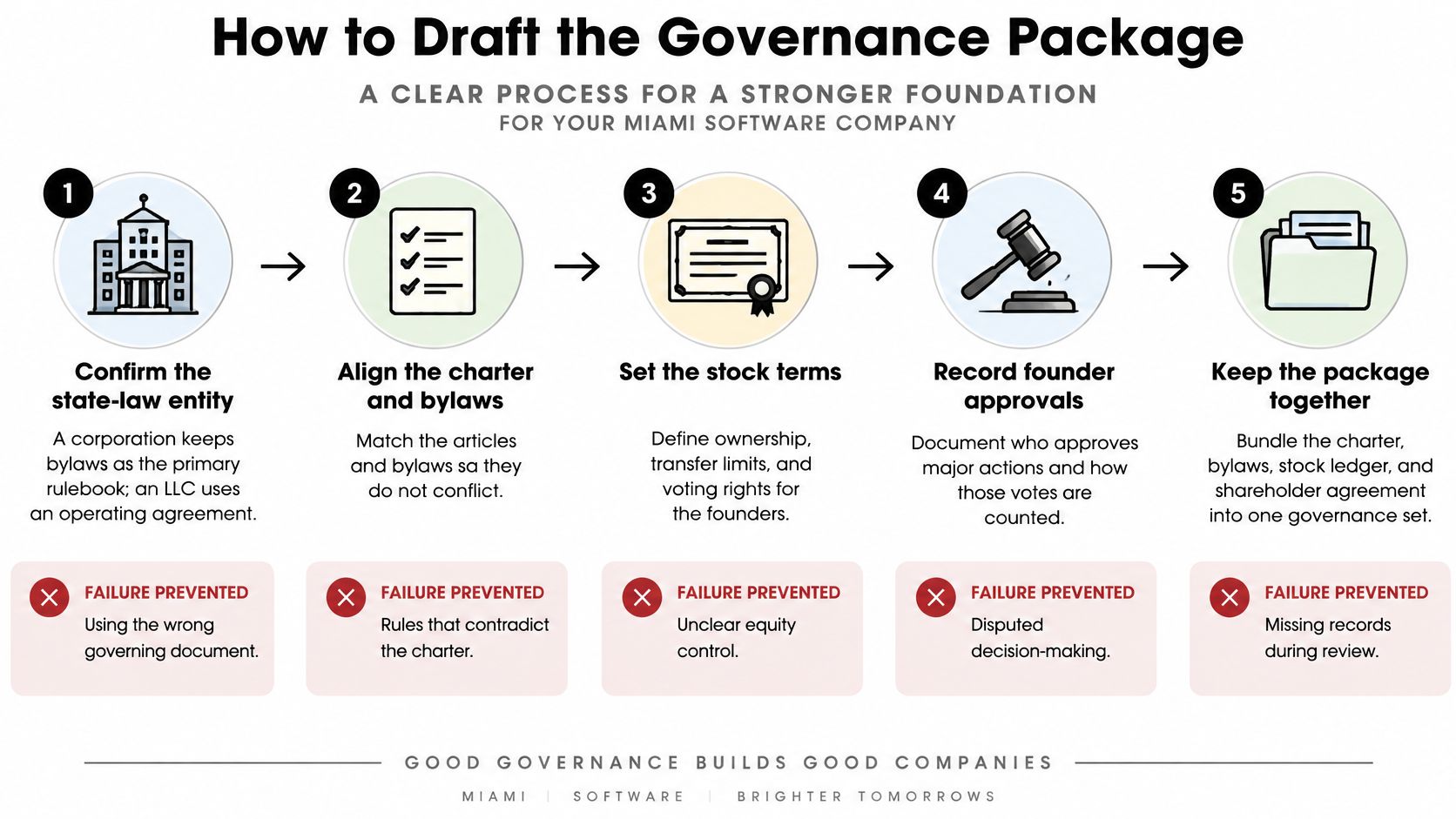
Say two founders in Miami form a software company, split it evenly, and elect S status because their CPA recommends it. They download an LLC form, skip bylaws, and never reconcile who owns what. Every step below prevents a specific failure that shows up later in diligence, a tax return, or a founder fight.
Build It in Order
- Confirm the state-law entity. A corporation keeps bylaws as its primary rulebook. An LLC electing S status keeps its operating agreement and applies the same tax controls. This step prevents the most basic failure, governing a corporation with an LLC contract.
- Adopt bylaws. Cover directors, officers, meetings, notices, quorum, voting, and records. The SBA business registration guide distinguishes LLC operating agreements from corporate bylaws or resolutions, explaining that bylaws define decision-making and the duties and powers of officers and shareholders. Without bylaws, you have no clean answer for who can call a meeting or remove an officer.
- Approve the shareholder arrangements by resolution. Use board and shareholder resolutions to adopt the agreement and authorize filing Form 2553. Every shareholder signs the consent. If you're deciding how detailed that owner agreement should be, review what a shareholder agreement should cover before you vote.
- Build the capitalization table and stock ledger. Name each owner of record, the number of shares, the percentage, and the date issued. Add legends to certificates or ledger entries flagging transfer limits, so nobody can claim they didn't know approval was required.
- Attach an S corporation compliance schedule. List Form 2553 consents, eligible owner categories, the shareholder count, and the transfer approval process in one place your CPA can check. This schedule is where a future transfer gets stopped before it breaks eligibility.
- Subordinate economics to the one-class rule. Make every transfer restriction, buy-sell formula, redemption term, and liquidation provision expressly subject to identical distribution and liquidation rights. Voting differences are fine. Different economic rights are the danger.
Where the Miami Example Breaks
Now say those two equal founders give shares to a relative who helped with early coding. They don't update the ledger, don't get a consent, and don't tell the tax preparer. The Schedule K-1, which is required for each person who was a shareholder during the year, no longer matches the books, and nobody has verified the shareholder count or the relative's eligibility.
That's not a paperwork nit. It's how clean companies create messy tax reporting. Don't use preferred, guaranteed-return, or disproportionate-distribution language to reward that relative either, because protective-sounding economics can create a second class even when you meant something simple.
Tip: Reconcile the charter, bylaws, ledger, and shareholder agreement before anyone signs, because each step depends on the others. If the charter authorizes shares the ledger never issued, or the agreement promises economics the bylaws don't support, stop and fix it on paper first.
Clauses That Keep the S Election Intact
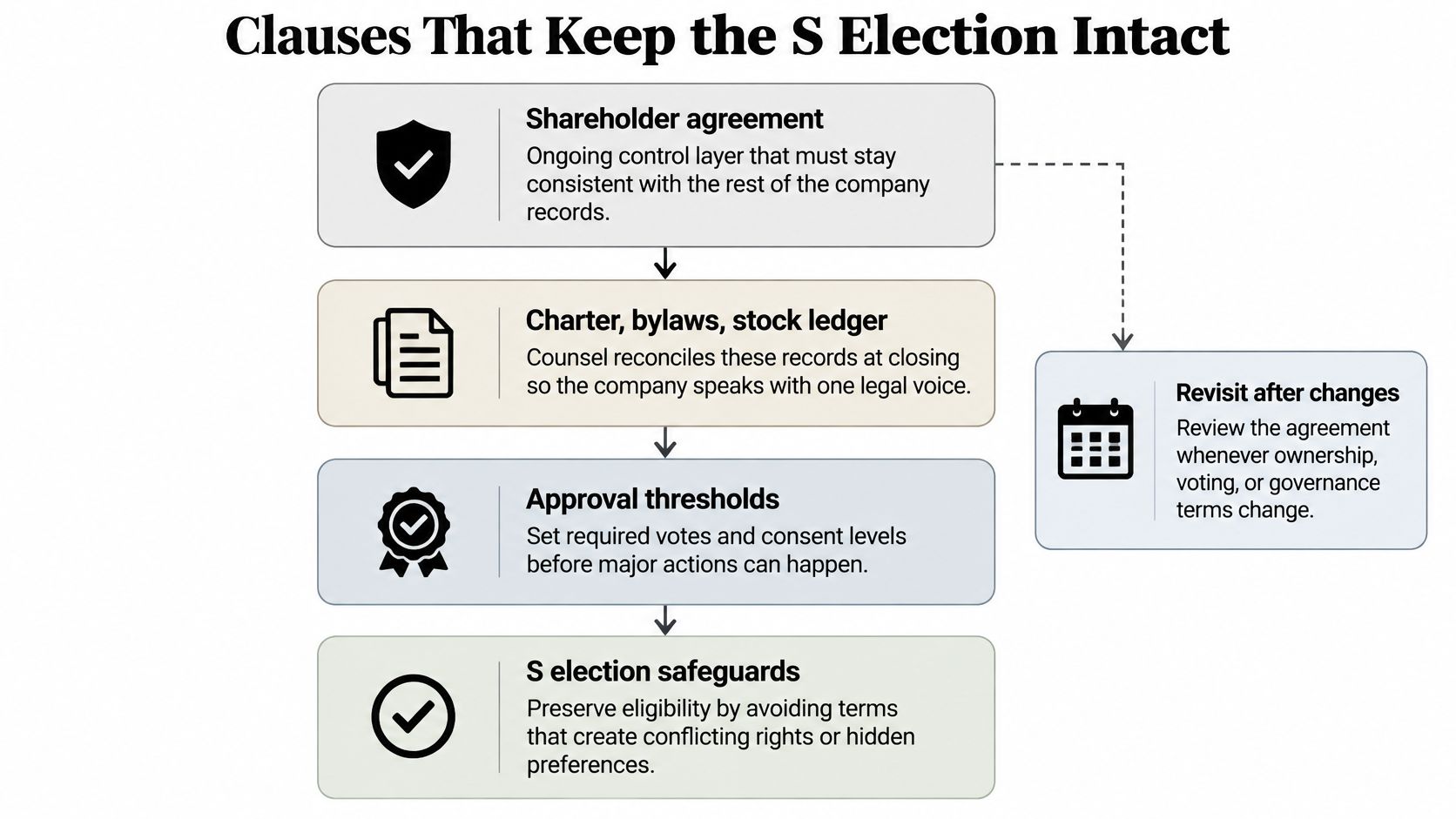
Treat the shareholder agreement as a living control, not a form you sign once and file away. At formation or closing, counsel should reconcile four records, the charter, bylaws, stock ledger, and shareholder agreement, so the company speaks with one voice. Then set approval thresholds for equity transfers, death or disability buyouts, deadlock escalation, valuation, funding, and permitted transferees.
Run Every Transfer Through a Gate
The IRS Form 2553 instructions require shareholder consent and identify the 100-shareholder ceiling, eligible shareholder classes, the nonresident-alien restriction, and the one-class-of-stock requirement, and ownership information including the shareholder of record and ownership percentage must appear on Schedule K-1. Your transfer gate should mirror those tests every single time.
| Clause | Required control | Failure that creates risk |
|---|---|---|
| Transfer approval | Eligible owner, count at or below 100, corporate consent, ledger update, tax-preparer notice | Undocumented gift to an ineligible person or trust |
| One class of stock | Identical rights to distributions and liquidation proceeds; voting may differ | Preferred return, liquidation preference, or guaranteed yield |
| Buy-sell and redemption | Written valuation hierarchy and funding method | A price that changes economic rights by owner |
| Distributions | Cash follows ownership percentages | Informal unequal draws |
| Disputes and deadlock | Notice, cure, then a set escalation path | A side letter that rewrites economics |
Founders hit predictable failure points. A family transfer happens at a kitchen table with no paper. Ownership percentages on the return don't match the ledger. A redemption clause names no valuation method, so the price becomes a negotiation during a crisis. Informal draws ignore pro rata ownership because one founder needed cash and nobody objected that week.
Build the defenses directly into the agreement. Require notice and cure before a breach becomes a termination fight. Require mandatory legal and tax review before any transfer closes. Set a fixed valuation hierarchy, such as agreed value first, then a formula, then an independent appraisal. State plainly that distributions track stock ownership, with no side deals.
If you're moving an existing C corporation into S status, these controls matter before the election, not after, which is why founders should review the C corp to S corp conversion steps alongside the shareholder agreement. Converting the tax status without rewriting owner economics is a common and expensive oversight.
Preferred, guaranteed return, or liquidation preference language can threaten the election even when you meant it only as protection for one founder.
No government source publishes a success rate for these agreements, so don't let a template seller imply one. The defensible benchmark is procedural completeness against the IRS eligibility tests and consistency across corporate and tax records.
Tip: Turn the transfer gate into a signed one-page form kept with the ledger. Buyer eligibility, shareholder count, economic rights, corporate approval, ledger update, and tax-preparer notice should each get a checked box and a date.
Tax Distributions Basis and K-1 Duties
Here's the cash surprise that angers first-time S corporation owners. Income passes through to shareholders whether or not the company distributes cash, so you can owe tax on your share of profit without receiving a matching check. If your agreement doesn't address that gap, your founders will address it informally, and informal cash is where pro rata discipline dies.
Separate Tax Cash From Profit Cash
Your agreement should authorize tax distributions as a distinct policy, separate from discretionary profit distributions. The board may approve periodic distributions intended to help owners pay estimated federal and state taxes, while reserving enough cash for payroll, inventory, debt service, and working capital. The IRS instructions for Form 1120-S state that shareholders must report their share of corporate income on their individual returns even when the corporation retains the money.
Say the policy out loud in the document. Tax allocations and cash distributions are different mechanics. An owner may be allocated income based on ownership and still receive less cash in a given quarter because the company needs reserves. Founders who understand that distinction argue less in April.
Don't promise automatic equal payments to every owner regardless of ownership percentage. Distributions should follow stock ownership, and the board should document why a payment is being made, when it's being made, and what reserve remains afterward. A written schedule tied to estimated tax dates is far better than ad hoc requests.
Basis Decides Whether a Distribution Is Taxable
The tax treatment of a distribution turns on stock basis, not on how the founders describe the payment. The IRS guidance on S corporation stock and debt basis states that a nondividend distribution is generally tax-free only to the extent it does not exceed the shareholder's stock basis, that debt basis cannot be used to determine whether that distribution is taxable, and that excess amounts are generally treated as capital gain. Shareholders, not the corporation, are responsible for maintaining their basis records and may use Form 7203 to calculate stock and debt basis.
That allocation of responsibility surprises owners, so put it in the agreement. Require accurate capital-account and shareholder-loan records. Name who approves distributions. Require a basis check against each shareholder's records before payment, with the company's CPA looped in before year end, not after K-1s are drafted.
Use clause language that doesn't overpromise. For example:
"Tax distributions are made pro rata to stock ownership to help shareholders meet estimated tax; they do not guarantee tax-free treatment to any shareholder, and each payment is subject to a basis review by the approving officer."
That sentence does three jobs. It keeps payments pro rata, it warns each owner that personal basis controls personal tax results, and it creates a review step an officer must perform. Have counsel and your tax professional coordinate that language with annual Form 7203 calculations.
Tip: Adopt a written cash-reserve policy and distribution schedule instead of promising automatic equal payments. List payroll, tax deposits, debt service, and a minimum operating reserve as first claims on cash, then define when tax distributions are considered.
Florida and Delaware Rules Founders Miss
South Florida founders usually choose between forming at home in Florida or forming in Delaware and operating here. Both can work. They don't create the same maintenance list, and your agreement should assign each duty to a named person instead of assuming the S election simplifies state compliance.
Home State Versus Operating State
| Issue | Florida corporation | Delaware corporation operating in Florida |
|---|---|---|
| Core statute | Florida corporate law | Delaware corporate law plus Florida qualification if doing business here |
| Charter paper | Florida articles of incorporation | Delaware certificate of incorporation |
| Internal rules | Bylaws and shareholder agreement | Bylaws and shareholder agreement |
| Registered agent | Florida agent | Delaware agent, and a Florida agent if qualified |
| State tax hook | Florida corporate return if federal tax is on Form 1120-S line 23c | Delaware annual maintenance, and the same Florida trigger can still apply |
| Agreement job | Assign federal and Florida filings, extensions, and shareholder notices | Assign Delaware maintenance plus any Florida filings |
A Fort Lauderdale consultancy formed in Florida lives under Florida corporate law, with Florida articles, bylaws, a Florida registered agent, and annual corporate approvals. A Delaware holding company with a Miami office needs Delaware maintenance, including its annual franchise-tax and report cycle, and if it's doing business in Florida it generally also qualifies there and keeps a Florida registered agent. Founders weighing that choice should review the benefits and tradeoffs of Delaware incorporation against their actual operating footprint, not investor folklore.
The Florida Filing Trigger
Don't write that an S election eliminates every corporate tax or filing duty. The Florida Department of Revenue corporate income tax page identifies S corporations that pay federal income tax on Line 23c of Form 1120-S as entities that must file a Florida corporate income tax return. That's a specific trigger a South Florida agreement shouldn't overlook, especially where the company has unusual income or a federal-level corporate tax.
Assign the work expressly. Name who prepares federal and Florida returns, maintains registered-agent and tax records, approves extensions, and collects the information shareholders need for individual filings. If nobody owns the calendar, deadlines become shared excuses.
Tip: Build a compliance calendar covering Form 1120-S, Schedule K-1 delivery, any Florida filing, payroll deposits, Delaware maintenance where applicable, and annual corporate approvals. Have Florida counsel and a CPA confirm whether your federal tax profile creates a Florida filing requirement before you rely on a one-line tax clause in the agreement.
Have Counsel Review Before You Sign
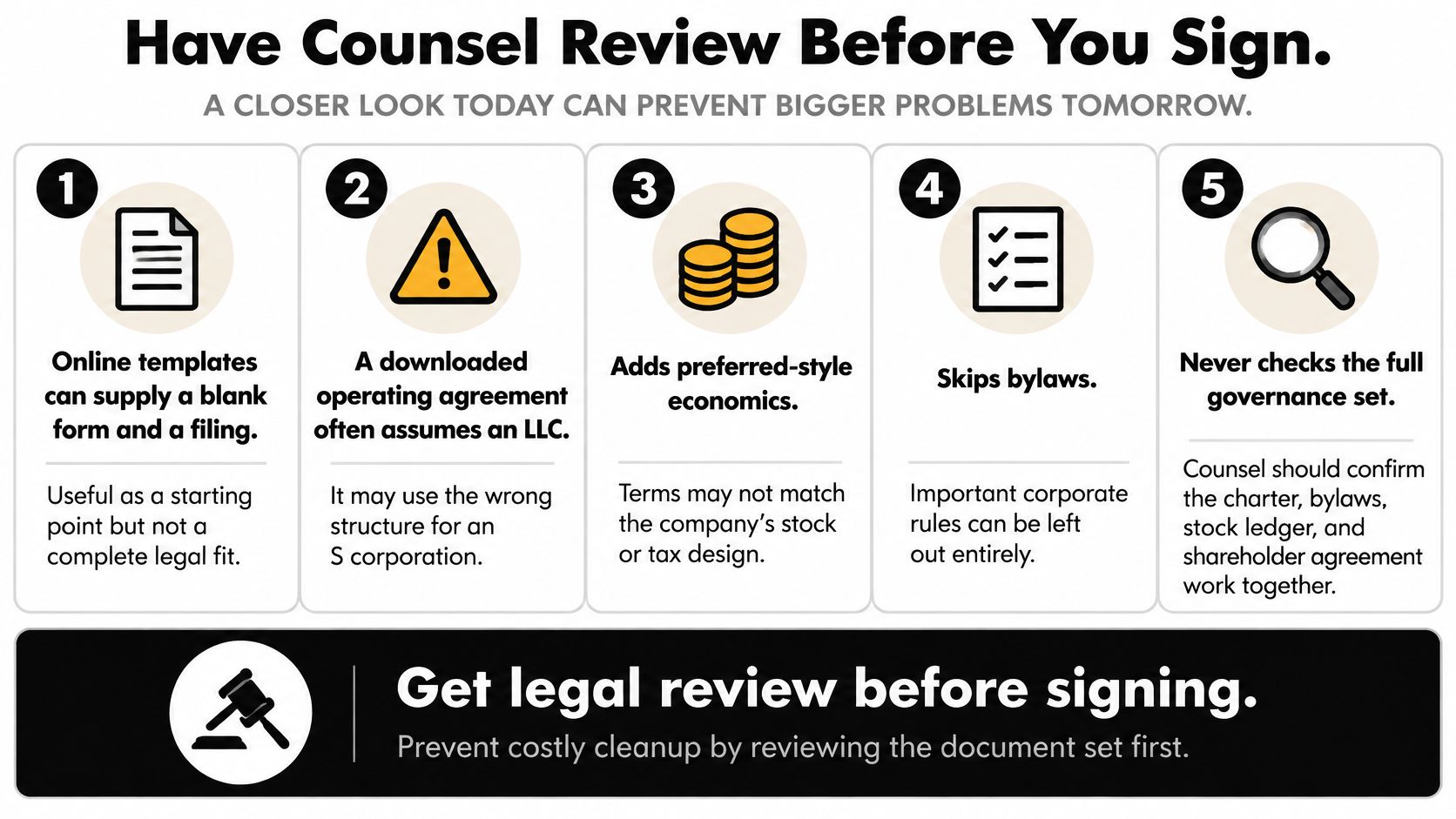
Online templates aren't useless. They can supply a blank form and a filing checklist. The problem is what they assume. A downloaded operating agreement for S corp companies often assumes an LLC, adds preferred-style economics, skips bylaws entirely, and never checks Florida or Delaware maintenance. That's four structural mistakes before you've typed your company name.
Test Any Template Against Four Questions
- Entity type: Does the form govern a corporation, or does it talk about members and managers while your state record says corporation?
- Second economic class: Does it create preferred returns, special allocations, distribution waterfalls, or liquidation preferences?
- Ineligible owners: Does it let a partnership, corporation, nonresident alien, or unreviewed trust end up holding shares?
- Valuation and K-1 process: Does it name a valuation method for buyouts and a calendar for reporting ownership changes to the tax preparer?
If a template fails any one of those, don't patch it with handwritten edits and hope. When valuation is the weak point, founders can find answers about business valuations to understand what a buy-sell formula must answer, then have counsel draft a hierarchy that fits the company.
Your Sign-Off Checklist
Don't sign until you can put these items in one folder and confirm they agree with each other: charter, bylaws, board and shareholder resolutions, stock ledger, shareholder agreement, Form 2553 consents, basis recordkeeping procedures, tax-distribution language that doesn't promise tax-free cash, and the compliance calendar. If one item is missing, you don't have a governance package. You have fragments.
If the form says operating agreement and the company is a corporation, you're reading the wrong primary document.
For a South Florida startup, have a Florida business lawyer and a CPA read the package together before signatures. That joint review matters most when you have more than one founder, a planned hire who may receive equity, a family member who may inherit shares, or a Delaware charter being used for a Miami operation. Counsel checks entity and transfer law, the CPA checks eligibility, basis, and reporting, and neither review substitutes for the other.
Tip: Ask one direct question before you pay for any template or sign any form. Show the reviewer your state entity record and ask, is this the governing document for that entity, and does any clause create different distribution or liquidation rights? If you can't get a clear yes on both parts, don't sign.
Bring Coto & Waddington your charter, bylaws, stock ledger, and draft shareholder agreement, and we'll reconcile the four records, scrub the economics for second-class risk, and confirm your Florida or Delaware filing duties before you elect S status or sign. Visit Coto & Waddington, Attorneys at Law to schedule that review while the fix is still a drafting change, not a tax cleanup.