You've formed a Delaware LLC, you're running it from South Florida, and your co-founder wants to open the bank account this week. The formation service supplied an operating agreement, but nobody has checked whether it matches your ownership deal, your financing plans, or what happens if someone leaves.
A Delaware LLC operating agreement should turn those business decisions into workable rules. Treat it as a living governance system, not a document you sign once and forget.
Table of Contents
- Essential Clauses Every Delaware Operating Agreement Needs
- Drafting Order, Fiduciary Limits and Deadlock Fixes
- Choosing Between Member-Managed and Manager-Managed Governance
- Voting Thresholds, Capital and Distribution Rules That Protect Each Owner
- Sample Clauses to Adapt Before Signing
- Tax and Florida Duties for a Delaware LLC Run From Miami
- Schedule Governance Checkups After You Sign the Agreement
Essential Clauses Every Delaware Operating Agreement Needs
Say two co-founders agree to a hypothetical 60/40 ownership split, sign a free template in an afternoon, and get back to building. They never decide how to resolve a deadlock on protected decisions, buy out a departing founder, or approve a new investor. Their percentages don't answer those questions.
Start with the core clauses below. Delaware's policy favors freedom of contract and enforceability of LLC agreements, subject to the implied covenant of good faith and fair dealing, under the Delaware LLC Act's construction provisions. That flexibility makes drafting omissions consequential.
Core clauses and what each one decides
| Clause | What It Decides | Why It Matters |
|---|---|---|
| Formation and purpose | Legal name, Delaware registered agent, business purpose | Anchors company authority and later filings |
| Members and ownership percentages | Who owns what share and why | Connects ownership to voting and economic rights |
| Capital contributions | Cash, property, services, promissory notes, and deadlines | Documents commitments and enforcement remedies |
| Management structure | Member-managed or manager-managed, and manager selection | Identifies who runs the business |
| Voting and reserved matters | Approval thresholds for major decisions | Restricts unilateral action on significant matters |
| Profit, loss and distributions | Allocation method and cash waterfall | Coordinates ownership economics and tax allocations |
| Transfers and new members | Consent rights, first refusal, drag-along, and tag-along | Controls entry and exit |
| Fiduciary duties and exculpation | Duties retained, narrowed, or waived | Defines managers' potential personal exposure |
| Indemnification and insurance | Protected persons and advancement of legal costs | Allocates defense expenses during disputes |
| Deadlock and dispute resolution | Negotiation, mediation, buy-sell, or dissolution | Provides a route forward when owners disagree |
| Dissolution and exit | Triggers, valuation method, and buyout terms | Reduces uncertainty over winding up or departure |
| Amendments, records and notices | Amendment votes, books, and contact addresses | Keeps governance procedures usable and current |
For owners comparing jurisdictions or coordinating international relationships, RNC Group's resource on choosing governing law for LLC agreements offers useful context. Governing law, dispute forum, and the company's operating location deserve separate decisions.
- Mark the draft without sugarcoating it. Label each clause as negotiated, copied from a template, or missing.
- Prioritize expensive silences. Start with deadlock, transfers, and distributions, where disagreement can interrupt operations or trap an owner.
- Test against actual records. Compare the agreement with the cap table and ask who can authorize a payment from the company's bank account.
This checklist defines the first draft's scope. It doesn't replace negotiation: the agreement should reflect the owners' bargain, rather than leave important outcomes to defaults they never considered.
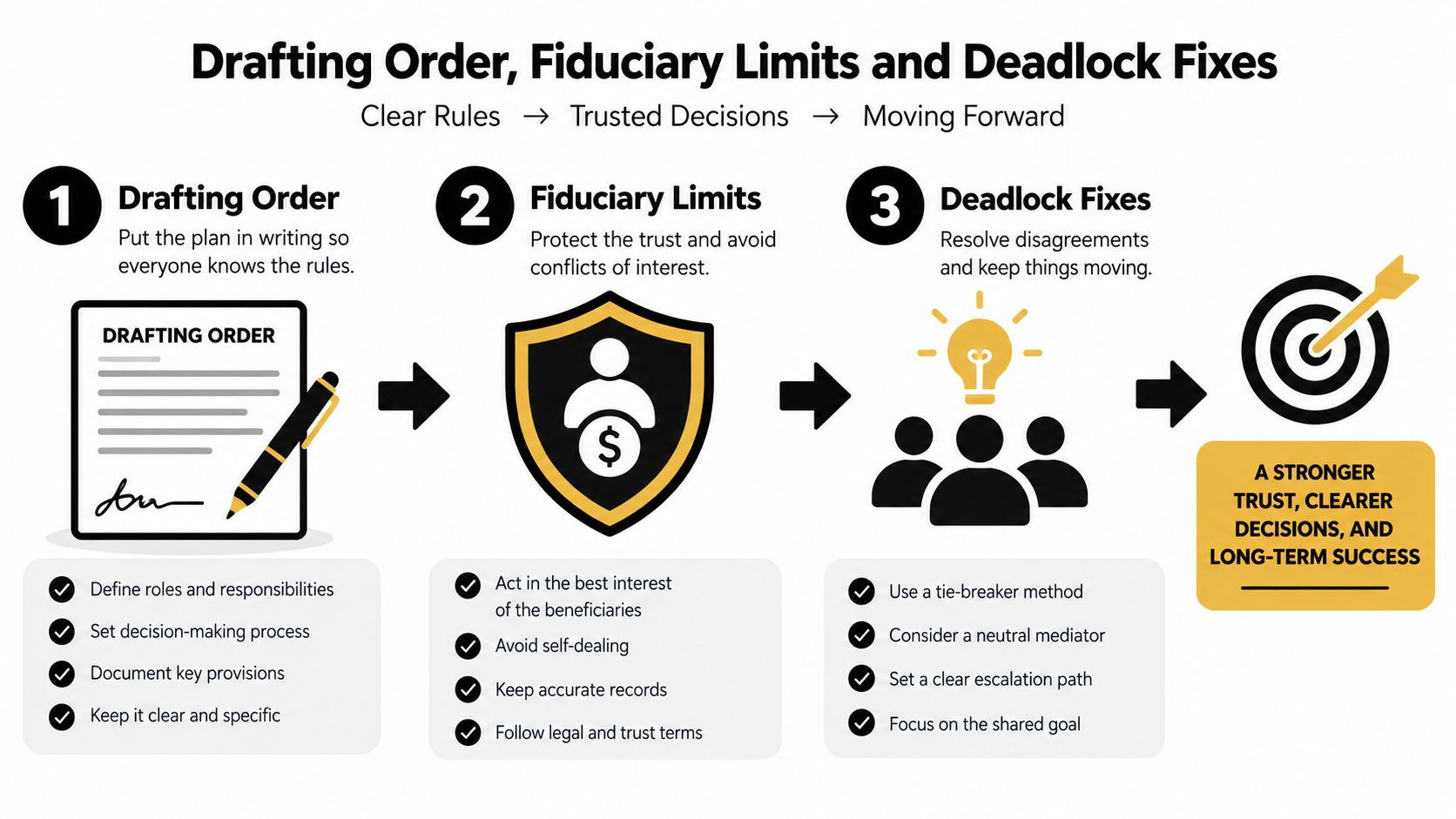
Drafting Order, Fiduciary Limits and Deadlock Fixes
Sequence matters more than polishing language. A decision about ownership changes voting; a decision about voting changes control; control affects the protections an investor or minority founder will request.
Build control before drafting protections
Set the business inputs. Choose the governance model, ownership percentages, and capital commitments. Use the current cap table, not the percentages from an early founder email.
Map admitting members, issuing equity, borrowing, asset sales, related-party deals, amendments, and dissolution to a consent rule, notice period, quorum, and deadlock remedy. Don't assume a general voting clause answers every transaction.
Choose the duty standard deliberately. Decide whether loyalty and care duties remain, are narrowed, or are waived. Define gross negligence, willful misconduct, or bad faith unambiguously where those standards apply. Address corporate opportunities, conflicts, self-dealing, confidentiality, and competing businesses separately. Then coordinate exculpation, indemnification, advancement, insurance, contribution, conflict approvals, and recordkeeping.
The Delaware LLC Act's contractual-freedom provisions permit substantial limits on duties and liability, but not protection for a bad-faith violation of the implied covenant of good faith and fair dealing. A broad waiver also needs a consistency review: best-interests language or separate approval obligations may impose contractual duties despite the waiver.
Understanding a potential breach of fiduciary duty helps founders distinguish a duty waiver from permission to disregard the agreement.
Draft the economic schedules. Tie capital commitments and distributions to the cap table and negotiated investor economics. A polished waterfall is still wrong if it describes a different deal.
Establish an order of precedence among the operating agreement, financing documents, and employment contracts. Specify which provisions control particular subjects rather than declaring that every later document automatically wins.
Test failure paths before execution
- Test founder departure, financing, death or incapacity, deadlock, and sale. For deadlock, compare these options:
| Remedy | When It Helps | Principal Trade-off |
|---|---|---|
| Cooling-off period and mediation | Owners need time and a neutral facilitator | Doesn't guarantee a binding resolution |
| Shotgun buy-sell | One owner names a price; the other buys or sells at that price | Unequal access to cash can disadvantage an owner |
| Dissolution after specified failed votes | Owners need a definitive endpoint | Can destroy an otherwise viable business |
Coordinate damages caps, equitable relief, fee allocation, forum selection, and valuation procedures together. Check that investor vetoes don't contradict manager authority or amendment rights.
Reconcile related documents. Match tax allocations, employment terms, and intellectual-property assignments. An unsigned IP assignment isn't fixed by describing the founder's contribution in a schedule.
Sign, date, and store the integrated agreement with the formation records. The Delaware LLC Act's definitions recognize written, oral, and implied agreements and allow members or managers to be bound without signing, making a clear executed document the practical control against disputes over implied terms.
Drafting tip: Test who can authorize the action, who can block it, and who pays if it goes wrong. Those are different questions.
Choosing Between Member-Managed and Manager-Managed Governance
Unless the agreement provides otherwise, Delaware places management with members according to their relevant profit interests, with more than 50% controlling ordinary management decisions under the Delaware LLC Act's management provisions. A member holding 60% of the profits generally controls under that default, even in a company with three owners.
Ownership therefore isn't the same as equal votes by headcount. If the founders want a different arrangement, write it expressly.

Governance models compared
| Model | Who Decides | Best Fit | Main Risk |
|---|---|---|---|
| Member-managed | Members, voting by ownership percentage unless changed | Owner-operators and small partner groups | Unclear roles create authority disputes |
| Manager-managed | Appointed managers, who may or may not be members | Outside investors, passive owners, larger groups | Removal and succession need explicit procedures |
| Hybrid | Managers run daily operations; members approve reserved matters | Startups preparing for a priced round | Longer drafting and precise reserved-matter lists |
Member-managed works when owners actively operate the business and can make decisions without repeatedly convening passive participants. Still allocate responsibilities. Responsibility for sales doesn't necessarily include authority to guarantee company debt or hire a relative.
Manager-managed separates ownership from operational authority. It can suit a family business with passive owners or a startup whose investors don't want to approve vendor contracts. The trade-off is accountability: members need meaningful reporting and a workable way to replace management.
A hybrid is often the practical choice for founders seeking outside capital. Managers handle ordinary business while members retain approval over decisions that change their investment.
- Choose the voting formula. State whether votes follow ownership, capital, class rights, or another negotiated measure.
- Define reserved matters precisely. Avoid language requiring member approval for every material decision without defining materiality.
- Write succession early. Address removal, vacancies, incapacity, interim authority, and replacement appointments before an investor asks.
Choose the structure before opening bank accounts or signing major contracts, then make the bank resolutions and signing-authority records match it.
Don't appoint someone a manager merely because a form needs a name. That appointment should reflect the authority the owners intend to delegate.
Voting Thresholds, Capital and Distribution Rules That Protect Each Owner
Consider a hypothetical 50/50 company where one founder supplies cash and the other promises services. They agree on ownership but never specify whether the service equity vests, what performance is required, or how available cash will be distributed. Equal ownership hasn't resolved the economic bargain.
Under the Delaware LLC Act's finance provisions, agreements may allocate profits, losses, and distributions among different classes or groups; absent agreement, profits and losses follow the agreed value of contributions received and not returned. Contributions can include cash, property, services, promissory notes, and obligations to contribute.
Approval standards by decision
These are negotiating starting points, not mandatory statutory thresholds. Define the voting denominator, class approvals, and treatment of interested members for each choice.
| Decision | Typical Approval Standard | Why It Matters |
|---|---|---|
| Routine operations | Manager or majority in interest | Keeps daily decisions moving |
| Borrowing above an agreed limit | Member approval at the negotiated threshold | Controls leverage and guarantee exposure |
| Sale of substantially all assets | Supermajority or unanimous member consent | Protects against a fundamental business change |
| Issuing new equity | Supermajority, including key investors | Limits dilution surprises |
| Admitting a new member | Unanimous or supermajority | Controls who joins |
| Related-party transaction | Disinterested-member approval | Addresses self-dealing |
| Amending the agreement | Unanimous or supermajority | Prevents unilateral rewrites |
| Dissolving the company | Majority or specified supermajority | Establishes an exit route |
A high approval threshold offers protection but can create paralysis. Unanimity gives each owner a veto, including an owner who has stopped participating. Majority control permits faster decisions but may leave minority owners exposed unless specific rights receive separate protection.
Make the economic schedules operational
- Record contribution details. List the contributor, asset or service, agreed value, delivery deadline, and evidence of performance.
- Define service conditions. Address vesting, departure, missed milestones, and treatment of unearned interests.
- Write distribution priorities. Distinguish tax distributions, preferred economics, returned capital, and residual cash.
- Specify contribution remedies. Address the company's ability to require cash equal to the agreed value of undelivered property or services, rather than relying on a vague promise to contribute.
Separate cash distributions from accounting allocations. The tax preparer should be able to implement the agreement without guessing what the founders intended.
For departure economics, a coordinated buy-sell agreement can establish valuation and payment mechanics. Before anyone signs, reconcile the waterfall with the investor term sheet, capitalization schedule, and available cash.
Sample Clauses to Adapt Before Signing
These plain-English models identify decisions to negotiate. They aren't execution-ready clauses, and the final language needs to fit the rest of the agreement.
Governance and reserved matters
Governance model
The Company is member-managed. Each Member votes in proportion to its Percentage Interest on Schedule A. Ordinary decisions require a majority in interest, subject to the reserved matters expressly identified in this Agreement.
Decision to make: Should voting follow ownership, contributed capital, or a separate formula? Define ordinary decisions and ensure Schedule A identifies voting rights, not merely economic interests.
Reserved matters model
Issuing equity, borrowing above the approved debt limit, selling substantially all assets, admitting a Member, or amending this Agreement requires written consent under the reserved-matter approval schedule.
Decision to make: Assign a threshold to each action. For a hypothetical business, founders might select a $50,000 borrowing limit and 66⅔% approval, but those are negotiated examples, not Delaware requirements. Specify whether related transactions are aggregated so someone can't evade the limit by splitting a loan.
Document priority and notice delivery
Order-of-precedence model
If this Agreement conflicts with an executed financing document or employment agreement, the executed financing document controls only as to rights it expressly grants and only after all approvals required by this Agreement have been obtained.
Decision to make: Confirm the ranking before financing. Don't let an unsigned investor term sheet silently override negotiated member protections, and distinguish governance rights from employment obligations.
Notice model
Contractual notices go to each Member's address on Schedule B. The Company will maintain current registered-agent information and a designated recipient for forwarded legal notices. Each Member must promptly report changes to its contact details.
Decision to make: Replace promptly with a negotiated deadline. Specify approved delivery methods, when notice is effective, and backup recipients for urgent correspondence. Contractual notice procedures shouldn't be confused with formal service of process.
- Remove placeholders. Replace every bracket, incomplete schedule, and drafting comment.
- Check defined terms. Member, manager, percentage interest, and business day must mean the same thing throughout.
- Verify cross-references. A reserved-matter clause pointing to an empty schedule provides no workable approval procedure.
Tax and Florida Duties for a Delaware LLC Run From Miami
Forming in Delaware doesn't move your business out of Florida. A company managed from Miami or Fort Lauderdale still needs a Florida compliance assessment covering foreign registration, applicable sales and payroll taxes, and local licensing.
Start by determining whether the company's activities require Florida foreign LLC registration. Don't assume the Delaware certificate authorizes every activity where employees, offices, or operations are located.
The Delaware Division of Corporations' tax FAQ states that a Delaware LLC owes an annual tax of $300, due on or before June 1. Missing compliance deadlines can produce penalties and jeopardize good standing, so assign responsibility to a named person rather than leaving it with whichever founder receives the reminder.
Coordinate tax treatment with the agreement
The agreement should identify the company's expected tax classification and who can authorize a change. A multi-member LLC generally expects partnership treatment unless it elects another classification, but the founders should confirm the intended treatment with their tax adviser before finalizing allocations.
For an accessible starting point on entity treatment and filing responsibilities, Allied Tax Advisors provides tax reporting guidance for small-business LLC owners. The practical question is whether the legal documents and tax preparer are describing the same arrangement.
- Align allocations and cash. Have the tax adviser review the waterfall, tax distributions, and allocation provisions together.
- Require owner cooperation. Specify who must provide tax forms, ownership information, and other documents needed for federal and Florida filings.
- Assign election authority. Identify who can approve a classification change and whether affected owners receive consent rights.
- Separate compliance responsibilities. Name the person coordinating Delaware filings, Florida requirements, payroll, and accounting.
Calendar habit: Review governance records and tax compliance together, with reminders early enough to correct missing information before the annual tax deadline.
Don't treat the operating agreement as a substitute for tax advice. Use it to assign decisions and information duties clearly, then have the accountant confirm that the agreed economics can be reported as intended.
Schedule Governance Checkups After You Sign the Agreement
A priced round can expose a control problem before anyone discusses valuation. The founders may agree with the investor commercially, yet the operating agreement may require a separate class consent, a non-member's approval, or permission from an owner who no longer participates.
Delaware Senate Bill 98, effective August 1, 2025, clarified amendment authority in connection with an LLC division or merger of a registered series, while preserving the role of contractual amendment mechanics and applicable statutory exceptions. That's a reason to inspect transaction authority, not assume every merger or financing follows the same approval path.
Before signing a SAFE or priced-round document, identify who can approve issuance, admission, conversion, and related amendments. Read those provisions alongside investor vetoes and drag-along rights. A general amendment power shouldn't be treated as an automatic answer to every protected right.
Verify the external systems too
The enacted registered-agent provisions of Senate Bill 98 also provide, effective August 1, 2025, that a Delaware registered agent may not perform its duties solely through a virtual office, mail-forwarding service, or both. A Florida-based founder should verify the agent's actual service arrangements rather than assume an inexpensive online package covers every requirement.

I recommend a quarterly governance checkup with a short written record:
- Verify the registered agent. Confirm current contact information, availability, and who receives forwarded legal papers.
- Update owner and manager contacts. Remove obsolete addresses and identify backup recipients.
- Document major consents. Store approvals with the transaction documents they authorize.
- Test notice delivery. Confirm the process works across states and for owners who communicate in different languages.
- Reconcile ownership records. Update schedules only after the underlying issuance, transfer, or admission has been properly approved.
Keep an event-triggered review process as well. Financing, a new owner, a manager's departure, family succession, or a move of operations can require attention before the next scheduled check.
If your agreement predates a financing, a move to Florida, or a new owner, review it now. Bring the signed agreement, amendments, cap table, financing documents, and registered-agent details so counsel can evaluate the company's actual governance system rather than an isolated template.
For drafting or review of Delaware and Florida LLC operating agreements, visit Coto & Waddington, Attorneys at Law. The firm supports South Florida founders and family businesses in English and Spanish, with counsel on ownership, voting, distributions, transfers, and ongoing governance. Bring your current documents and upcoming transaction plans to discuss what needs to change before you sign or raise capital.