The popular advice is simple: form an S corporation and save 15.3% on self-employment tax. That advice is incomplete and often wrong. An S corporation can separate reasonable wages from distributions, but the IRS doesn't give founders a fixed safe salary percentage, and an aggressive distribution split can become wages with additional payroll taxes, interest, and penalties.
For a South Florida founder, the decision is a four-part test: reasonable compensation, payroll overhead, K-1 cash-flow timing, and the IRS audit lens on founder-services businesses. An LLC and an S corporation aren't opposing legal entities. An LLC is a state-law structure, while S corporation status is generally a federal tax election. The same Florida LLC can remain the legal entity and elect S corporation taxation.
| Question | Default-taxed LLC | LLC with S corporation election |
|---|---|---|
| Legal entity | LLC | LLC |
| Federal tax treatment | Disregarded entity or partnership by default | S corporation tax rules after a valid election |
| Owner compensation | Business earnings generally flow through to the owner or members | Shareholder-employees receive wages, with possible distributions |
| Self-employment or payroll tax exposure | Generally applies to qualifying business earnings | Applies to wages, while qualifying distributions generally aren't subject to self-employment tax |
| Main risk | Assuming the LLC itself changes federal tax treatment | Setting wages too low or overlooking payroll and cash-flow obligations |
If you want the practical background before making the election, this LLC versus S corporation comparison for small businesses is a useful starting point. But the decision shouldn't be made from a headline savings figure. It should be made from the business's actual profit, the owner's actual work, and the cost of staying compliant.
Table of Contents
- The Self-Employment Tax Myth Founders Should Stop Repeating
- How a Default-Taxed LLC Actually Works
- The 15.3% Rate and the 2026 Wage Base in Plain English
- Worked Example With 100,000 Dollars of Earnings
- Reasonable Compensation and the Founder-Services Trap
- Compliance Costs, Payroll, and the Florida-Specific Wrinkles
- Applying the Four-Part Test to Real Florida Founders
The Self-Employment Tax Myth Founders Should Stop Repeating
An S corporation doesn't automatically save 15.3%. That figure is the combined statutory Social Security and Medicare rate, not a guaranteed tax reduction available to every S corporation owner. The IRS still expects an active shareholder-employee to receive reasonable compensation before taking non-wage distributions, and the compensation analysis depends on the work the owner performs.
The most dangerous version of the myth sounds like this: “Take a tiny salary and call the rest distributions.” That approach ignores the IRS's focus on duties, time, training, experience, comparable compensation, and the source of the company's receipts. Courts have also rejected attempts to avoid employment taxes simply by relabeling compensation as distributions.
Practical rule: An S corporation is a wage-versus-distribution structure, not a permission slip to turn personal labor into untaxed profit.
The right question is whether the business earns more than a defensible market-rate salary after accounting for the cost of running the structure. If nearly all revenue comes from the founder's own services, the potential distribution pool may be limited. If revenue also comes from employees, equipment, intellectual property, or invested capital, the analysis may be more favorable.
The four questions that matter
- Is the proposed salary reasonable? The IRS evaluates the owner's specific duties, the time committed, and what comparable businesses pay.
- Do the savings exceed payroll overhead? Payroll setup, filings, bookkeeping, tax preparation, and state compliance reduce the benefit.
- Can the business fund taxes on K-1 income? S corporation income can pass through even when cash stays in the company.
- Would the records survive an IRS review? A low salary with large distributions creates an avoidable audit problem.
A default-taxed LLC isn't automatically a bad choice. It may be the cleaner structure while a business is building predictable profit, especially when the owner would need to treat most earnings as wages anyway. An S corporation becomes more compelling when the company has durable earnings beyond reasonable compensation and the owner can handle disciplined payroll administration.
How a Default-Taxed LLC Actually Works
Start with the legal distinction. A Florida LLC is created under state law, but its federal tax classification is separate. Forming the LLC can provide a liability shield when the owner respects the entity, but it doesn't automatically change how the IRS taxes the business.
A single-member LLC is generally disregarded as separate from its owner for federal income-tax purposes. If that owner operates a trade or business, the business activity generally flows onto the owner's individual return, and qualifying net earnings are treated under the self-employment-tax rules in much the same way as a sole proprietorship.
A domestic LLC with two or more members is generally classified as a partnership unless it elects corporate treatment. The business reports its activity, and members receive distributive shares through partnership reporting. Depending on the member's role and the character of the income, those shares may be subject to self-employment tax.

Follow the money
For a default single-member LLC, the practical chain is straightforward:
- Business activity: The LLC earns revenue and pays deductible business expenses.
- Net earnings: The remaining qualifying business earnings generally flow to the owner.
- Individual reporting: The owner reports the activity on the individual return.
- Self-employment tax: The applicable net earnings are analyzed under the self-employment-tax rules.
For a multi-member LLC taxed as a partnership, the reporting is different, but the central point remains. The LLC's default classification doesn't create an automatic wage-versus-distribution split like an S corporation. Members need to analyze partnership self-employment-tax rules, their services, and the nature of the income.
The IRS's partnership framework also doesn't impose the same statutory reasonable-compensation regime that applies to S corporations. That doesn't mean every partnership allocation is immune from scrutiny. It means the compliance analysis uses a different set of rules.
Founders comparing entity models in different jurisdictions may also benefit from this practical resource on partnership versus company in Australia, particularly when a family or international venture is weighing legal form against tax classification.
Your operating agreement still matters
Tax treatment doesn't replace governance. Ownership percentages, voting rights, distributions, capital contributions, transfers, and deadlock procedures belong in the operating agreement. A useful overview of what an operating agreement does for an LLC can help founders separate the legal document from the later tax election.
The takeaway is direct: forming an LLC in Florida doesn't, by itself, eliminate self-employment tax. It gives you a legal entity. You still need to choose, or confirm, the federal tax classification that fits the business.
The 15.3% Rate and the 2026 Wage Base in Plain English
The statutory self-employment-tax rate is 15.3%, made up of 12.4% for Social Security and 2.9% for Medicare. The Social Security component is subject to an annual wage base, while Medicare tax has no equivalent general wage cap. The Social Security Administration's 2026 wage-base information reports a 2026 Social Security taxable earnings base of $184,500 and a maximum self-employed OASDI amount of $19,557.

Those figures matter because a flat-rate comparison can mislead an owner with other wages or substantial business income. Social Security tax doesn't continue applying to every dollar once the applicable wage base is reached, but Medicare tax continues to apply under its own rules.
A simple way to read the calculation
Suppose a founder has qualifying self-employment earnings below the 2026 Social Security base and no other wages affecting the calculation. The combined statutory rate provides the initial framework, with the Social Security and Medicare components applying according to their separate rules.
Now change the facts. If the founder's total applicable wage and self-employment income rises above the 2026 Social Security base, the 12.4% Social Security component no longer applies to earnings above that base, while Medicare tax continues. The founder shouldn't apply 15.3% mechanically to every dollar without checking total earnings and wage history.
This is why a serious projection includes more than business profit. It should account for wages from another employer, shareholder wages, self-employment income, deductions, statutory adjustments, and possible additional Medicare-tax considerations.
A plain-language guide for sole traders calculating self-employment tax can help clarify the underlying mechanics for owners who are used to thinking only in terms of income tax. But founders should still obtain a current-year calculation rather than relying on a general illustration.
The useful mental model is this: the 15.3% figure is a starting rate, not a promised savings amount. The LLC-versus-S-corporation comparison becomes more precise only after the owner identifies which earnings are subject to self-employment tax, which wages are subject to payroll tax, and where the Social Security base affects the result.
Worked Example With 100,000 Dollars of Earnings
Assume a business has $100,000 of qualifying earnings before considering the structural differences. The default-taxed LLC generally passes the business earnings through to the owner or members, so the owner can't assume that forming the LLC removes self-employment tax.
For the S corporation illustration, assume $60,000 is reasonably treated as wages and $40,000 is treated as a distribution. At the combined 15.3% Social Security and Medicare rate, the covered wage amount represents $9,180 in combined employer and employee employment-tax components before considering wage-base limits, additional Medicare rules, deductions, or state taxes. The example is mechanical, not a guaranteed tax saving.
| Item | Default LLC | S Corp Election |
|---|---|---|
| Business earnings | $100,000 | $100,000 |
| Owner wages | Not separately established under the default classification | $60,000 |
| Potential distribution amount | Not separated as an S corporation distribution | $40,000 |
| Amount used for the illustrated employment-tax comparison | Qualifying business earnings generally flow through under the applicable rules | $60,000 of wages |
| Combined rate used for illustration | 15.3% statutory rate | 15.3% statutory rate |
| Illustrated employment-tax components | Depends on the applicable self-employment-tax calculation | $9,180 before stated adjustments |
What the example does and doesn't prove
The default LLC column doesn't mean every dollar is taxed identically in every owner's circumstances. Social Security wage-base limits, Medicare rules, deductions, and statutory adjustments affect the final liability. A multi-member LLC also requires attention to the member's role and the nature of the partnership income.
The S corporation column doesn't mean the owner pockets a guaranteed difference. The company must run payroll, withhold and deposit employment taxes, file the required forms, and support the $60,000 wage with compensation evidence. The remaining $40,000 may be a distribution if it is properly supported and otherwise allowable, but it remains subject to income tax as pass-through income.
The calculation is useful only if the salary is defensible and the business can afford the compliance system that produces it.
A low salary could create a larger apparent distribution, but that isn't a legitimate planning strategy if the owner's work justifies more compensation. The IRS may reclassify distributions as wages and assess additional payroll taxes, interest, and penalties. State taxes and business-level costs can also change the result.
Use this example as a stress test, not as a conversion trigger. Model multiple income levels, test different defensible salary assumptions, and include the owner's other employment income. The right S corporation decision is the one that still works after payroll, tax preparation, bookkeeping, and reserves are included.
Reasonable Compensation and the Founder-Services Trap
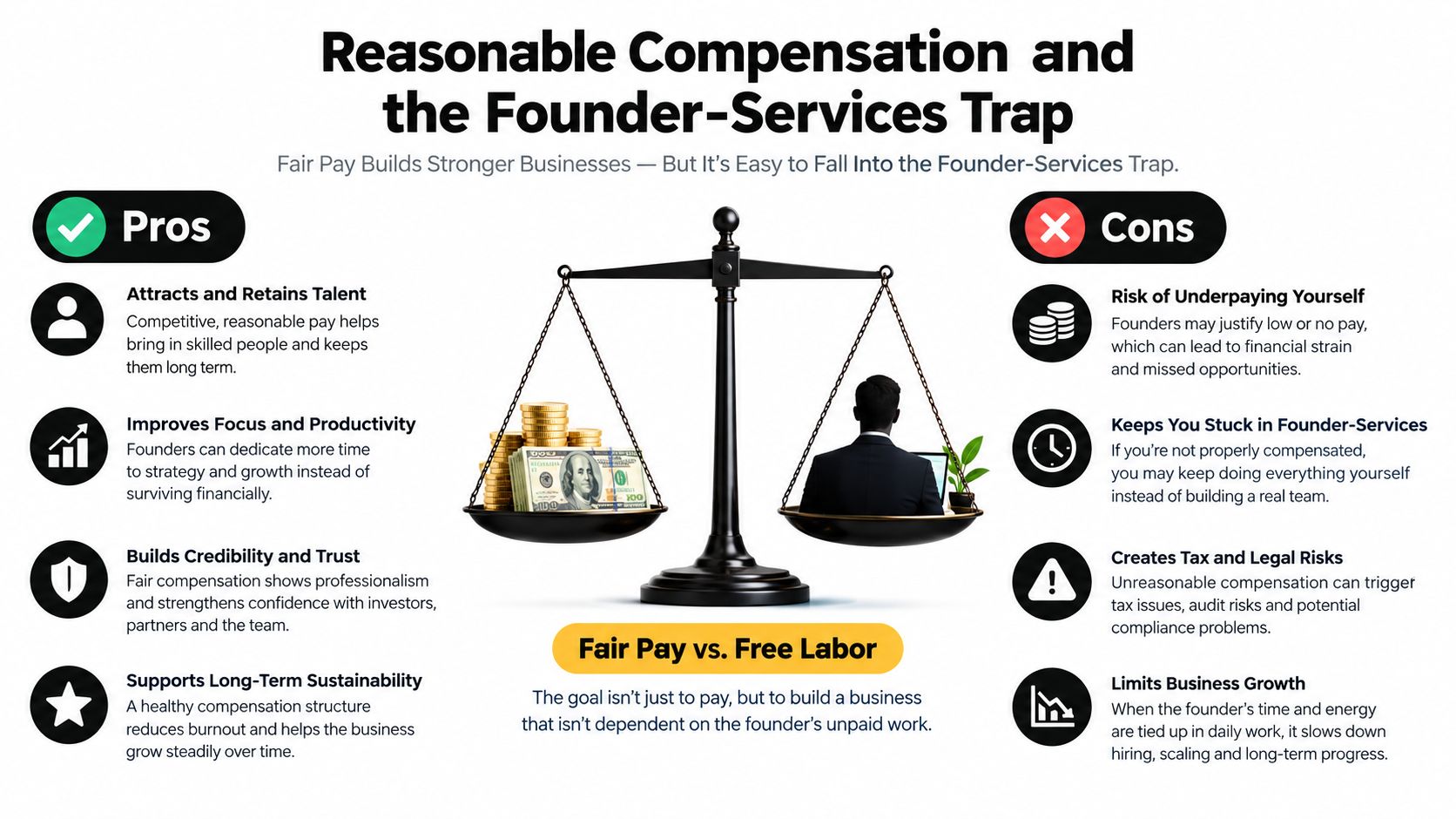
The founder-services problem is where many attractive S corporation calculations collapse. The IRS requires reasonable compensation for shareholder-employees who provide meaningful services, and it evaluates the owner's actual role rather than the label placed on a payment.
Relevant factors include:
- Duties and time: What does the owner do, and how much time does the owner spend doing it?
- Training and experience: Does the founder possess the specialized skill that generates the revenue?
- Comparable pay: What would a similar business pay someone performing the same work?
- Compensation history: Has the company paid other employees for comparable responsibilities?
- Source of receipts: Do the receipts come from the shareholder's personal services, or from employees, equipment, capital, or other business assets?
The last factor deserves particular attention in South Florida's professional and founder-led economy. A consultant who sells personal expertise, a lawyer who performs legal work, a designer who creates the deliverable, a physician who provides care, or a creator whose audience and production depend primarily on personal labor may have limited defensible distribution income.
How the IRS sees a low salary
Consider a founder who performs nearly all revenue-generating work but reports a modest wage and takes most remaining cash as distributions. The IRS can argue that the receipts are attributable to the founder's services and should have been paid as wages. The label on the bank transfer won't control that analysis.
Reclassification can produce additional payroll taxes, interest, and penalties. It can also create a recordkeeping problem if the company has no job description, compensation study, payroll history, time records, or explanation for the salary selected.
An active shareholder shouldn't wait until an audit to decide what reasonable compensation means. Document the decision when payroll begins and update it when the owner's duties, hours, staff, pricing, or business model changes.
For Florida founders who are also evaluating workers' compensation obligations or exemptions, a practical resource on who qualifies for a Florida exemption may help identify a separate compliance issue. Workers' compensation treatment doesn't replace the federal requirement to pay reasonable compensation, but the two questions often arise together during entity planning.
My recommendation is blunt: don't elect S corporation status to disguise personal-service income as distributions. Elect it when the company has a credible economic basis for profit beyond the owner's market-rate labor, and maintain records that explain the compensation decision.
Compliance Costs, Payroll, and the Florida-Specific Wrinkles
An S corporation election adds an operating system. The company needs payroll, withholding, employment-tax deposits, periodic filings, unemployment-tax compliance, and a separate business tax return. The owner also needs a reliable process for issuing a W-2 and reporting pass-through income on a K-1.
The election itself requires proper Form 2553 mechanics and eligibility analysis. A late, incomplete, or improperly authorized election can create avoidable problems. The company should also keep its registered-agent information current and maintain the LLC's legal records.
Florida changes one part of the calculation because the state doesn't impose a state-level personal income tax. That doesn't make federal compliance disappear. The LLC's Florida annual report obligation remains, and the S election doesn't change the LLC's legal identity.
Keep the legal entity aligned
The operating agreement, bank accounts, contracts, licenses, invoices, and succession documents should continue to identify the LLC correctly. Tax classification changes how the IRS treats the entity. It doesn't automatically rewrite those documents.
Founders sometimes describe the business casually as an “S corp” after the election and then use inconsistent names on contracts or banking records. That creates unnecessary confusion. A legal review, including planning for a C corporation to S corporation conversion, can help keep tax filings and entity records aligned.
The cash-flow problem
S corporation income generally passes through to shareholders even when the company retains the cash. That creates a mismatch for seasonal companies, startups reinvesting in inventory or staff, and family businesses building reserves. The owner may owe personal tax on K-1 income while the company needs cash for payroll, taxes, and operations.
Build a tax-distribution policy before adopting the election. It doesn't need to promise that every dollar will be distributed. It should establish how the company will reserve cash, fund owner tax obligations, pay wages on schedule, and handle uneven revenue.
The election makes sense only when the business can sustain that discipline. If payroll and cash management will be improvised, the theoretical tax benefit isn't worth the operational risk.
Applying the Four-Part Test to Real Florida Founders
A solo Miami consultant whose revenue comes almost entirely from personal work should generally stay with the default-taxed LLC until the business has meaningful profit beyond a defensible market-rate salary and can support payroll. The founder-services issue is decisive.
A Miami family operating business with employees, equipment, and revenue not dependent on one owner's labor may have a stronger S corporation case. Choose the election only after modeling reasonable compensation, payroll overhead, K-1 cash-flow timing, and the records needed to defend the split.
A creative Miami company with Delaware ownership or expansion plans shouldn't treat the S election as a substitute for entity planning. Review ownership eligibility, contracts, operating documents, banking, and succession goals before making the tax choice.
Use these tips:
- Model multiple income levels: Include wages, distributions, other employment income, and Medicare considerations.
- Document compensation contemporaneously: Keep duties, hours, comparable-pay research, and the salary decision together.
- Reserve cash for K-1 taxes: Don't distribute every dollar needed for payroll and operations.
- Revisit the structure annually: A business can outgrow its default classification, or discover that S corporation administration isn't justified.

Ask for a current-year projection before filing anything. It should include wages, distributions, other employment income, compliance costs, and the business's cash needs. If you want legal help coordinating the entity, operating documents, contracts, and tax-election strategy, Coto & Waddington, Attorneys at Law advises South Florida founders on LLC and S corporation formation, corporate records, contracts, and practical business structuring. Schedule a consultation before you make the election, not after payroll or ownership problems appear.