You're about to give a new developer access to your codebase, a salesperson your pricing, or an agency your customer list. Someone sends you a combined template labeled non disclosure and non compete agreement, and it looks thorough. That's usually where the trouble starts. The two clauses do different jobs, face different legal tests, and fail for different reasons. Choosing the narrowest one that protects a defined asset is almost always safer than signing the broadest form you can find.
Table of Contents
- What NDAs and Non Competes Actually Protect
- Non Disclosure and Non Compete Agreement Differences
- Enforceability Rules and Florida Limits
- When Workers and Deals Cross State Lines
- When Startups Should Use One Both or Neither
- Drafting Clauses That Survive Scrutiny
- Choosing the Right Protection and Next Steps
What NDAs and Non Competes Actually Protect
Most founders bundle two fears into one document. They don't want their information used against them, and they don't want a former worker competing with them. Those are related risks, but they aren't the same risk, and a court won't treat them as interchangeable.
A non-disclosure agreement protects defined confidential information. It limits who can access that information, how they can use it, who they can share it with, how long they must protect it, and what happens to it when the relationship ends. A non-compete restricts competition itself. It tries to stop someone from joining a rival, serving certain customers, or starting a competing business for a period after they leave.
Core distinction: An NDA controls information. A non-compete controls work. That difference drives every drafting choice that follows.
Start With the Asset, Not the Form
Before you pick a covenant, name what you're protecting. Source code, a supplier price sheet, a family business process, a product roadmap, and a book of customer relationships each call for a different tool. If the asset is information, an NDA tied to specific categories is usually the direct fit. If the asset is a customer relationship someone could divert, a customer non-solicitation clause may fit better than a ban on working in the industry.
Founders who want to see how early stage paperwork frames these choices often review practical founder NDA clauses alongside their own information inventory, such as the examples in founder NDA clauses. That exercise helps, but it doesn't replace state specific review. A template written for a national audience won't know whether your company sits in Miami, hires remotely from three states, or stores its real value in unpatented know how.
For information that rises to the level of a secret with independent economic value, the contract also has to match your wider trade secret protection practices. If everyone in the company can open the pricing folder, download it to a personal drive, and keep access after leaving, a signed NDA becomes much harder to enforce. Paper protection and real secrecy practices have to point in the same direction.
Tip: Write one sentence for each role that states the asset, the risk, and the narrowest restriction that addresses it. If you can't finish that sentence, you're not ready to choose between an NDA, a non-solicit, and a non-compete.
Non Disclosure and Non Compete Agreement Differences
Put the two agreements side by side and the practical gap is clear. In the United States, a non-compete restricts post-employment competition while an NDA restricts unauthorized use or disclosure of defined confidential information, and for startups the NDA is generally the more durable control because it can be tied to specific information categories, access permissions, permitted purposes, return or deletion duties, incident notification, and survival periods, as described in the FTC overview of its noncompete rule. That durability comes from precision. You're not asking a court to keep someone out of a market. You're asking it to protect identified information.
An NDA says don't use or reveal this information. A non-compete says don't work in this competitive space.
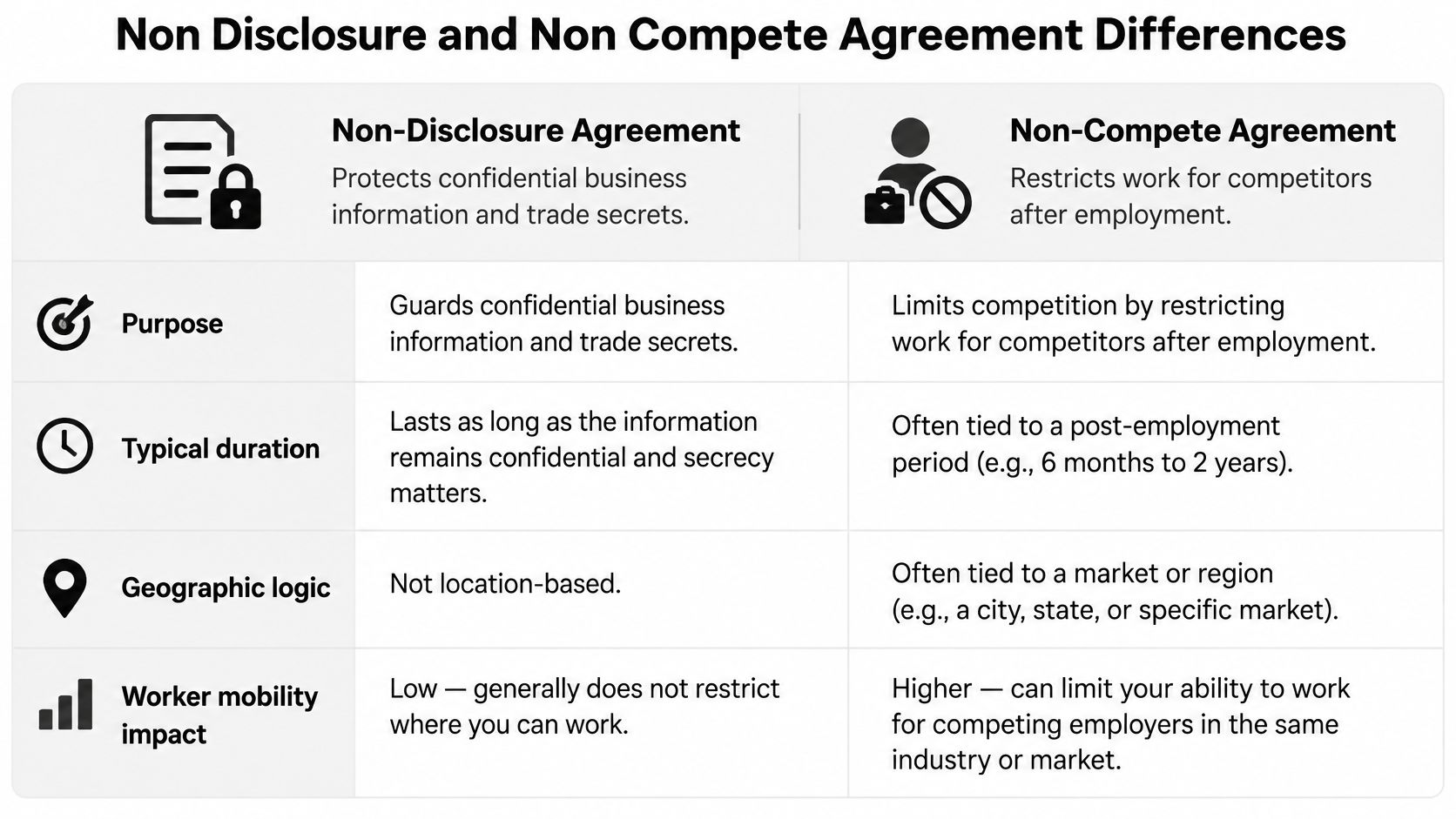
NDA vs Non-Compete Decision Matrix
| Criterion | NDA | Non-Compete | Better Fit When |
|---|---|---|---|
| Purpose | Guards confidential information and trade secrets | Limits work for competitors | You can name the information at risk |
| Typical duration | Lasts while secrecy matters, with a defined survival period | Tied to a post-employment period | The secret stays valuable longer than the job |
| Geographic logic | Usually not location based | Often tied to a market or region | The worker is remote or mobile |
| Worker mobility impact | Low, if categories are narrow | Higher, because it restricts employment | You need to hire experienced talent |
| Enforcement focus | Proof of access, secrecy, and misuse | Proof of a legitimate interest and reasonable scope | Your records show who saw what |
| Investor diligence | Shows disciplined information control | Can raise enforceability questions | You're preparing for financing or a sale |
Investors and acquirers read these documents differently than founders do. In diligence, a clean NDA chain, clear invention assignment language, and evidence of access controls tend to support the story that the company owns and protects its assets. A stack of aggressive non-competes signed by junior staff can prompt the opposite question. Why did this company restrict people who never touched sensitive information or key customers?
Duration follows the same logic. Confidentiality should last as long as the information remains nonpublic and valuable, subject to careful drafting. A mobility restriction, by contrast, needs a tighter link to time, place, and role because it limits how someone earns a living.
Tip: If a clause would stop a former worker from using general skills legitimately learned on the job, you've probably drafted past information protection and into a mobility fight.
Enforceability Rules and Florida Limits
There's no single national answer founders can rely on. In April 2024, the Federal Trade Commission estimated that approximately 30 million American workers, nearly one in five, were subject to a noncompete clause, adopted its final rule on April 23, 2024, and then saw a federal district court block that rule nationwide on August 20, 2024, leaving enforceability dependent on state law and judicial decisions, according to the FTC announcement of its noncompete rule. Don't read that sequence in either extreme direction. The blocked rule doesn't make every non-compete valid, and it didn't create a nationwide ban you can assume applies today.
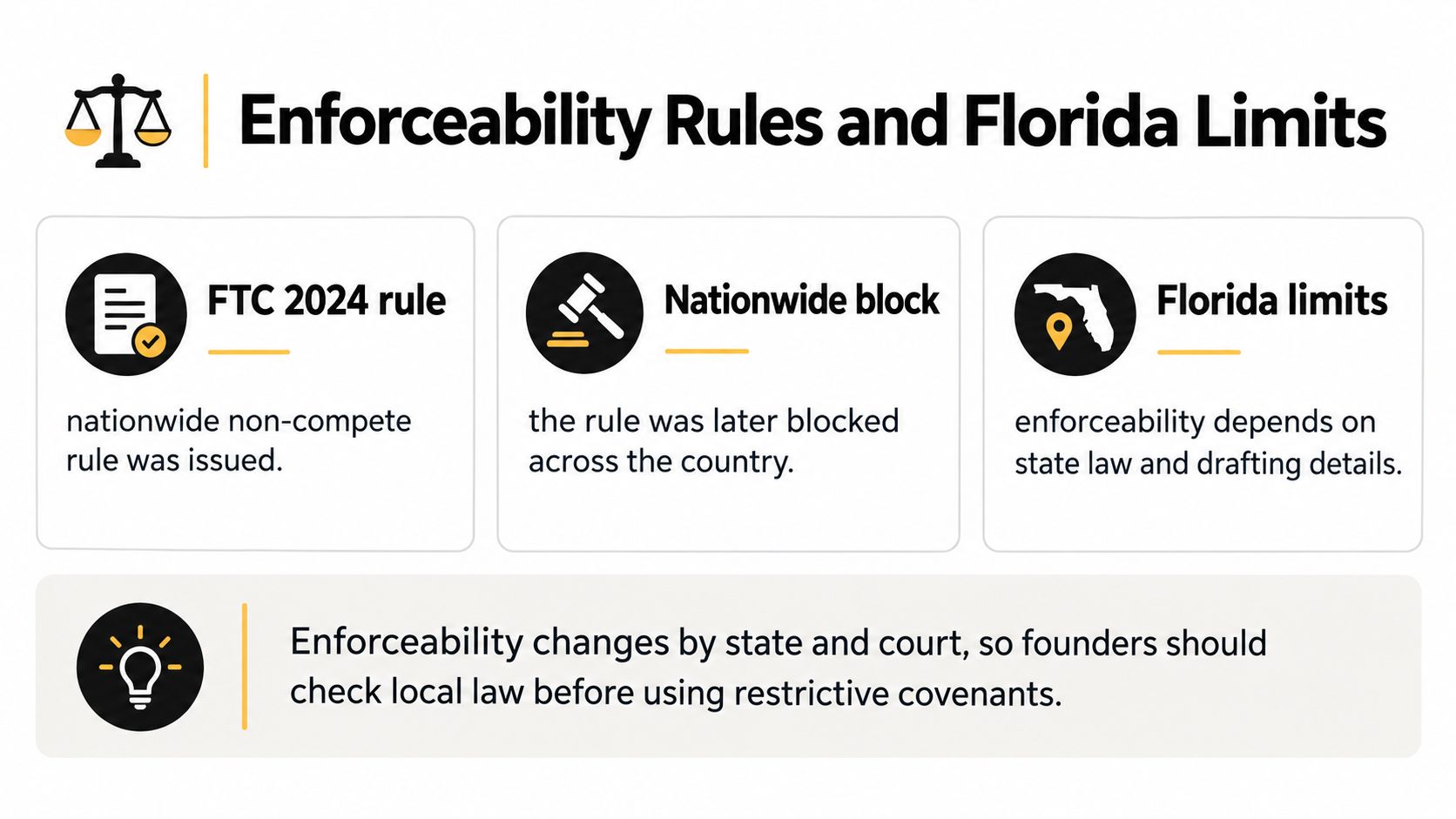
What a Court Is Likely to Test
For a South Florida employer, the practical questions are concrete. What legitimate business interest does the clause protect? Is the duration tied to that interest? Does the territory match where the worker served customers? Does the role definition describe the work the person performed, or does it sweep in any job at any competitor?
- Legitimate interest: Trade secrets, confidential information, and substantial customer relationships are stronger foundations than a general wish to avoid competition.
- Duration: A period chosen because a template used it is weaker than one tied to how long pricing, plans, or relationships remain sensitive.
- Territory: A statewide or nationwide ban needs a business footprint that supports it. Vague territory language invites a challenge.
- Customer definition: Named accounts or customers the worker materially served are easier to defend than every customer the company might someday pursue.
Founders comparing how courts approach these questions in other jurisdictions can benefit from reading how Nick Norris explains non-compete enforceability, then testing those same factors against Florida law and their own facts. The comparison is useful precisely because it shows enforceability turning on drafting details, not on the label at the top of the document.
NDAs usually face less hostility than non-competes because they can be narrower. They aren't immune from scrutiny, though. An NDA that defines everything a worker ever learned as confidential, bars all future use of general knowledge, or has no sensible exceptions starts to function like a disguised non-compete. Courts and opposing counsel will describe it that way.
The FTC history matters for another reason. It signals continued policy attention to worker mobility even while state law controls the immediate analysis. A founder building a five year hiring plan shouldn't anchor that plan to the most aggressive covenant a court might tolerate today.
Tip: Stress test every restriction against information protection, worker mobility, and transaction context. A clause in a bona fide business sale is a different animal from the same clause handed to a junior employee.
When Workers and Deals Cross State Lines
A governing law sentence doesn't solve a multi state workforce. Non-compete enforceability remains highly dependent on state law, the employee's location, governing-law language, industry, and the clause's geographic and time limits, and recent developments have reinforced state specific approaches rather than uniform national treatment, a point especially relevant to South Florida businesses using remote workers or hiring talent who relocates, as discussed in the American Bar Association review of mobility covenants and trade secrets.
Consider a common pattern. Your LLC is in Fort Lauderdale. Your head of sales works from another state, calls on customers across the Southeast, and later takes a job with a competitor in a third state. Your agreement chooses Florida law and a Florida forum. That language matters, but it may not end the analysis. A court can still examine where the employee lived and worked, where the alleged harm occurred, and whether another state's policy limits the restriction.
Four Locations to Map Before Signing
- Worker location: Where does the person live and perform the work, not just where payroll sits?
- Customer location: Where are the accounts the clause tries to protect?
- Harm location: Where would diverted business or disclosed information cause damage?
- Forum location: Where would you realistically file, and could the worker file first somewhere else?
Remote work makes geographic drafting harder, not easier. A radius around an office the employee never visited is difficult to justify. A restriction tied to specific customers, territories the employee covered, or product lines they handled usually tells a more credible story.
Relocation creates a second trap. A covenant that was defensible when a worker lived in Florida may face a different reception after that worker moves. If your team is mobile, build review points into promotions, role changes, and relocations instead of treating the original signature as permanent protection.
Deals cross lines too. A buyer in another state, a seller who stays on as a consultant, and customers spread nationally can pull one agreement in several directions. Validate governing law, forum, duration, and territory separately for the transaction instead of copying the employment form into the purchase documents.
Tip: Keep a simple covenant register that lists each signer, work state, role, customer territory, and agreement date. When someone moves or changes roles, flag the agreement for review before a dispute forces the question.
When Startups Should Use One Both or Neither
Role by role analysis beats a company wide habit. Federal survey materials show that businesses distinguish among nondisclosure agreements, trade secrets, trademarks, copyrights, design patents, and utility patents when assessing intellectual property protection, which confirms that an NDA is only one component of a broader strategy, and the key question is whether the business can prove what was confidential, who accessed it, and what safeguards were used, as reflected in federal business survey materials on intellectual property protection.
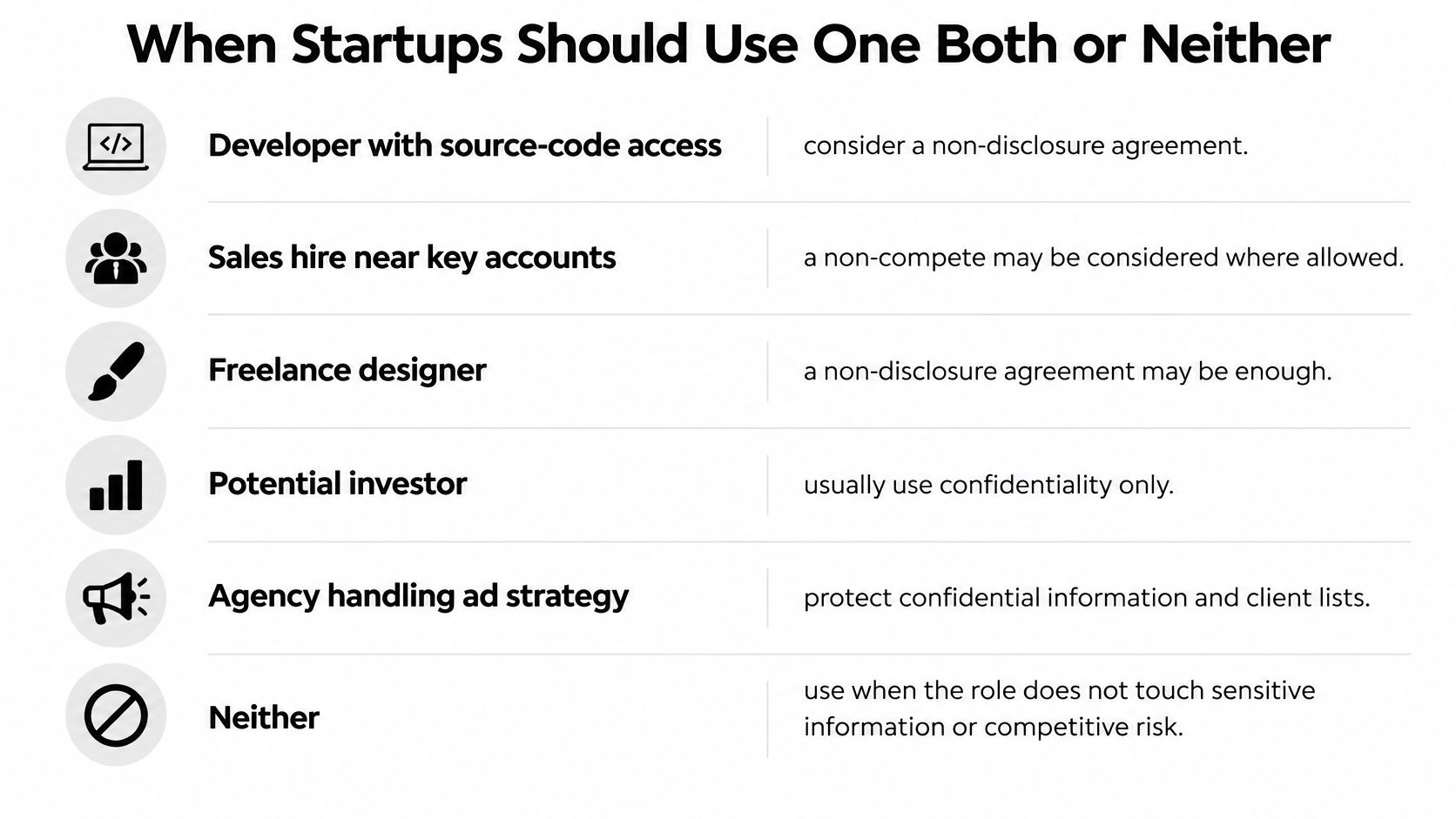
A developer with source code access usually needs a strong NDA plus invention assignment and access controls. The risk is misuse or disclosure of code, credentials, architecture, and roadmap details. A broad ban on working for any technology company adds friction without adding much protection.
A sales hire near key accounts presents a different profile. If that person will own relationships with your most valuable customers, a narrowly drawn customer non-solicitation agreement may address the poaching risk more directly than a general non-compete. Where a non-compete is considered, tie it to the accounts, territory, and role the person handled.
- Freelance designer: Use an NDA for unreleased brand work, plus clear ownership and portfolio terms. A non-compete is usually overreach for a short project.
- Potential investor: Expect resistance to NDAs at early meetings. Share in stages, watermark sensitive decks, and use confidentiality terms when diligence deepens.
- Agency handling ad data: Cover account access, audience data, client lists, subcontractors, and deletion duties at termination.
- Family business sharing recipes or processes: Pair the NDA with need to know access. A secret everyone can photograph isn't being managed as a secret.
Sometimes neither document belongs in the packet. A worker who never touches sensitive information, customers, pricing, or systems doesn't become safer to employ because you added restrictions. You gain recruiting friction and a clause you'd struggle to justify.
Both documents can be layered when the facts justify it, for example with a senior leader who knows pricing strategy and owns major relationships. Layering should still be deliberate. Each clause should do its own job instead of repeating the other in stronger language.
Tip: Stage access the way you stage trust. Give contractors and new hires the information their task requires, expand access as the role expands, and document each change.
Drafting Clauses That Survive Scrutiny
Good drafting is mostly disciplined narrowing. Define confidential information by category, such as source code, nonpublic pricing models, customer lists, and product plans, without printing the secret itself in the agreement. Separate true trade secrets from ordinary confidential business information, because the protection logic and lifespan can differ. Then state permitted purpose in plain terms. Information shared to build a feature shouldn't be usable to launch a side product.

Clauses Founders Underdraft
- Exclusions: Carve out public information, independently developed information, and information received lawfully from another source.
- Compelled disclosure: Address subpoenas and court orders, with prompt notice where legally allowed.
- Return or deletion: Say what must be returned, what must be deleted, and how the person confirms completion at exit.
- Incident notice: Require prompt notice of unauthorized access or disclosure so you can respond while evidence is fresh.
- Residual knowledge: Decide how to treat general skills and experience retained in memory. Silence here creates arguments later.
Confidentiality language also has a workplace rights boundary. In 2023, the National Labor Relations Board ruled in McLaren Macomb that employers could violate Section 7 of the National Labor Relations Act by offering severance agreements with broad confidentiality or non-disparagement provisions, and in September 2024 the Sixth Circuit enforced that order, confirming that an NDA can't safely be drafted as an unlimited ban on communication, as explained in the Sixth Circuit discussion of the McLaren Macomb ruling. Protect secrets. Don't try to silence legally protected discussions about wages or working conditions.
That same discipline applies when you place covenants among the other clauses in a contract. Survival, remedies, governing law, assignment, and severability language can change how a restriction behaves in a dispute. Founders often negotiate the non-compete period and ignore the boilerplate that decides where they'll litigate and whether one bad clause takes down its neighbors.
For a non-compete, narrow every dimension you can. Shorten the period to the sensitivity window. Limit geography to the market served. Define prohibited work by function and product line, not by naming an entire industry. Limit customer classes to relationships the worker touched. Each narrowing move costs you theoretical coverage and buys you credibility.
A clause drafted to win an argument in the break room often fails in court. Draft for the judge who will read it cold.
Tip: Add marking and handling procedures to the contract itself. If the agreement requires reasonable secrecy measures, your labels, permissions, and offboarding checklist become part of the enforcement story.
Choosing the Right Protection and Next Steps
Use a decision ladder instead of a template habit. It keeps the analysis in the right order and prevents a mobility restriction from becoming your default answer to every risk.
- Name the asset. Is it code, pricing, a customer list, a process, or a relationship?
- Name the risk. Disclosure, misuse, customer poaching, employee raiding, or ownership confusion each point to a different clause.
- Pick the least restrictive tool. Start with confidentiality, then consider non-solicitation or invention assignment, and reach for a non-compete only when narrower tools don't address the risk.
- Match operations to paper. Access logs, confidentiality markings, contractor limits, and documented deletion make the contract provable.
- Test location and role. Confirm the worker's state, territory, and actual duties still match the signed language.
This is the point where many South Florida founders bring in counsel for a focused review rather than a full redraft. Coto & Waddington, Attorneys at Law is a boutique bilingual firm serving the greater Miami and Fort Lauderdale area, and its work for startups and small businesses includes drafting founder minded business contracts and reviewing covenant scope before documents go out for signature. Presented that way, outside review is one option on the ladder, most useful when remote hiring, investor diligence, or a pending sale raises the cost of a drafting error.
Before your next hire or contractor engagement, inventory your confidential assets on one page. Map who can access each asset today, including former workers whose accounts may still be active. Then compare that map to your signed agreements. Gaps usually appear immediately, such as an agency with permanent admin access, a developer without invention assignment language, or a salesperson bound by a territory they never covered.
Fix the operational gaps first, because they're cheapest to close. Revoke stale accounts, label sensitive files, and set deletion duties for vendors. Then revise the clauses that no longer match real roles or real locations.
Tip: Do this review before a financing, a key hire, or a sale process, not during it. Diligence teams find covenant and access gaps quickly, and fixing them under time pressure is harder.
If you're hiring, engaging contractors, or preparing for diligence in South Florida, have your non disclosure and non compete agreement tested against your actual assets, worker locations, and secrecy practices before anyone signs. Coto & Waddington, Attorneys at Law drafts and reviews founder minded NDAs, non-competes, and related business contracts for startups and closely held companies, with practical counsel on scope, duration, and enforceability risk. Visit the firm to discuss your documents and choose the narrowest protection that still protects what you've built.