You may be in a familiar Fort Myers position right now. You bought a home after moving from another state, you have retirement accounts and brokerage assets, maybe a closely held business or investment property, and you already have “documents somewhere.” On paper, that sounds organized. In practice, it often isn't.
A Florida estate plan has to do more than name beneficiaries. It has to work under Florida law, fit the way your assets are titled, and hold up if incapacity happens before death. That's where many families and entrepreneurs get exposed. They assume an old will, a generic trust, or a stack of unsigned forms is enough until a bank, hospital, or probate court says otherwise.
If you're searching for an estate planning attorney in Fort Myers, the critical question isn't who can produce documents. It's who can design a plan that effectively transfers what you own, protects the people you care about, and avoids preventable court involvement.
Table of Contents
- An Introduction to Securing Your Legacy in Fort Myers
- What an Estate Planning Attorney Actually Does for You
- Your Florida Estate Planning Toolkit Key Documents Explained
- Navigating Florida's Unique Estate Laws
- The Risks of Using an Out-of-State Plan in Florida
- Understanding Estate Planning Costs and Timelines
- How to Choose Your Fort Myers Attorney and Next Steps
An Introduction to Securing Your Legacy in Fort Myers
Estate planning usually gets postponed for the same reason people avoid major home repairs. Nothing looks urgent until one small problem reveals a much larger structural issue. In our practice, families often come in after a move to Florida, a property purchase, a business sale, a remarriage, or a health event. The trigger changes, but the pattern doesn't. They realize their plan was built for an earlier version of their life.

A good attorney doesn't just draft a will and send you home. We approach the plan like an architect approaches a blueprint. First, we identify the structure. What do you own, how is it titled, who depends on it, and where could the plan fail? Then we design for function. That means planning for incapacity, coordinating beneficiary designations, addressing real estate correctly, and choosing the right mix of wills, trusts, and appointment documents.
Fort Myers families need that strategy because Southwest Florida isn't a generic planning environment. Homestead rules, probate procedure, and the nature of retiree and seasonal ownership create legal friction that many out-of-state plans never anticipated.
What the strategy phase should include
- Asset mapping: Your attorney should review the home, bank accounts, investment accounts, business interests, life insurance, and any jointly owned property.
- Family decision points: Blended families, adult children from prior marriages, and uneven inheritance goals need careful drafting.
- Incapacity planning: The plan should work while you're alive, not just after death.
- Transfer mechanics: A document that says one thing while a deed or beneficiary form says another is where trouble starts.
Estate planning works best when the documents and the asset titles tell the same story.
A practical tip before you meet with counsel
Bring your current deed, existing will or trust, powers of attorney, healthcare documents, and a recent list of account titling and beneficiaries. That single step shortens the analysis and makes weaknesses visible quickly.
What an Estate Planning Attorney Actually Does for You
A Fort Myers couple moves down from Ohio, buys a homestead home, keeps brokerage accounts up north, and assumes their old documents will carry the plan. Then a health event happens, or one spouse dies, and the family learns the papers do not fit Florida ownership rules, Florida probate procedure, or Florida decision-making documents. We see that pattern often with new residents and seasonal owners.
An estate planning attorney's role is to prevent that failure before it becomes a court problem, a family conflict, or a tax mess. The work covers three jobs at once. We set up decision-making authority while you are healthy, we prepare for incapacity, and we structure transfers at death so assets pass the way you intended.
Drafting is only part of the job.
In our practice, the first question is rarely, “Do you need a will or a trust?” The better question is whether your current documents will function with your Florida home, your account titling, your beneficiary forms, your business interests, and the people you want in charge. For snowbirds, that review matters even more because one state's documents do not always translate cleanly into another state's rules.
The attorney's job is broader than drafting
A sound plan assigns authority, reduces points of conflict, and gives the family a workable process. A will may direct probate assets. A revocable trust may keep certain assets out of probate and provide privacy. A durable power of attorney may let someone manage financial matters during incapacity. Health care documents may avoid confusion at the hospital. Each document has limits, and the plan fails when families assume one signed form solves every issue.
That is why we review more than the signature pages. We examine deeds, account registrations, beneficiary designations, business records, prior marriage issues, and whether your chosen fiduciaries can serve in practice. The legal answer and the practical answer are not always the same.
| Issue | Why it matters |
|---|---|
| Asset title | Ownership determines whether an asset passes through probate, by survivorship, or under a trust |
| Beneficiary designations | Retirement accounts and insurance often pass outside the will |
| Family dynamics | A technically valid choice can still create delay, resentment, or litigation |
| Business ownership | Operating authority and succession planning need separate attention |
| Incapacity planning | Bills, investments, and medical decisions do not pause because documents are incomplete |
Trade-offs matter here. A trust can make administration easier, but it requires funding and follow-through. Joint ownership can avoid one probate issue, but it may create creditor exposure, gift questions, or unequal outcomes among children. A simple will may be enough for some Florida residents. It is often not enough for a family with out-of-state property, a second marriage, or a closely held business.
We also spend time translating legal consequences into plain decisions. Who should control money if you cannot? Should one child serve alone, or would co-fiduciaries slow everything down? Does the Florida home need deed work to match the rest of the plan? Those are the questions that shape a plan that works under pressure.
For clients preparing for the first meeting, our estate planning documents checklist helps organize the records that usually expose gaps quickly. Families considering life-insurance-based wealth transfer planning may also benefit from Coveredly's ILIT guidance, especially when estate liquidity and beneficiary control are part of the conversation.
A good estate planning attorney does not sell documents in isolation. We build a plan that fits Florida law, fits your property, and fits the way your family will have to use it.
Your Florida Estate Planning Toolkit Key Documents Explained
A Fort Myers family often arrives with a signed will from Illinois, a power of attorney from New York, and beneficiary forms scattered across old accounts. Then they buy a Florida home, open local bank accounts, and assume the old plan still fits. In our practice, that is where document review starts. The issue is rarely the absence of paperwork. The issue is that the paperwork no longer matches the property, the state, or the people expected to act in a crisis.
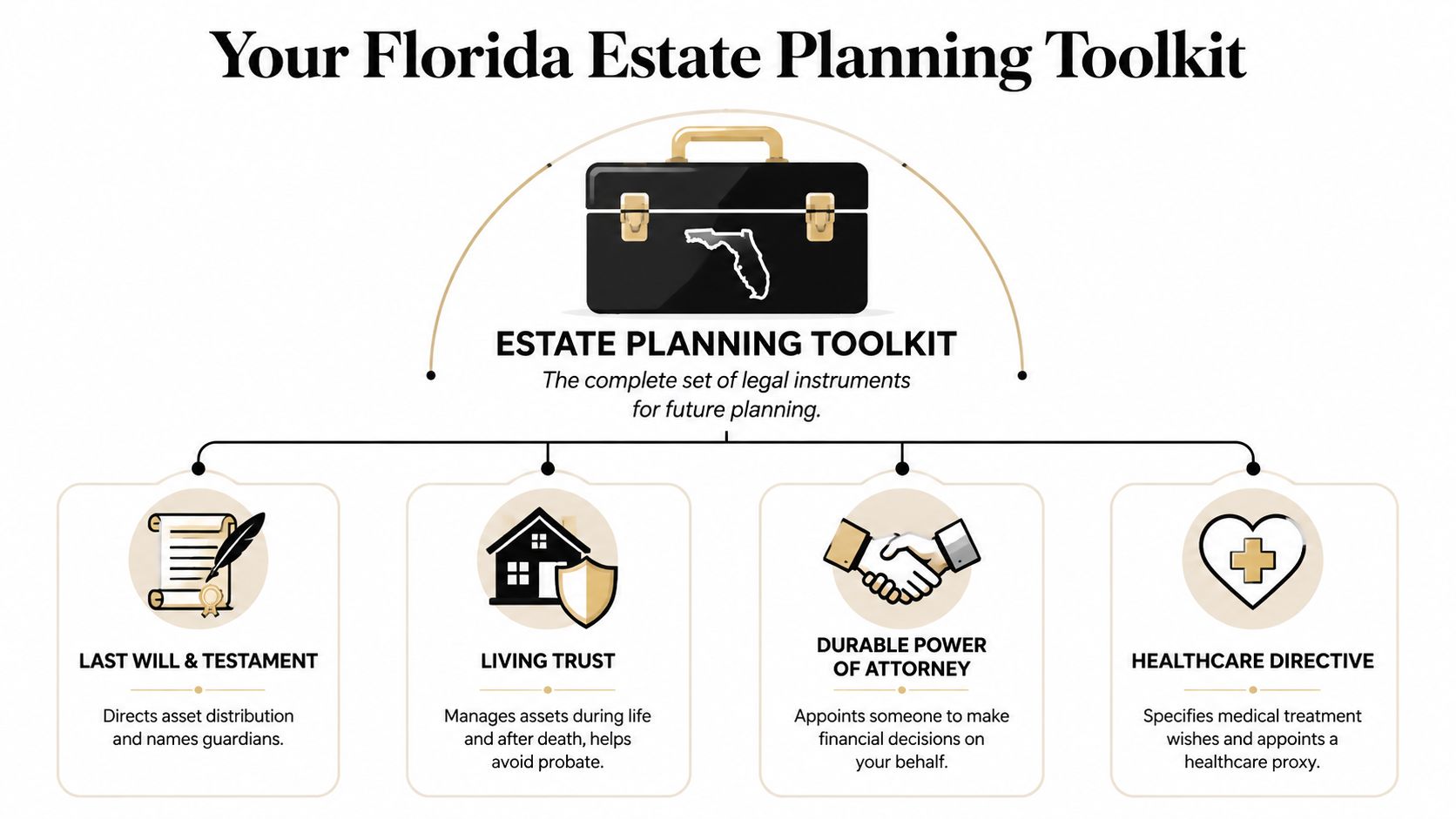
Last will and testament
A last will and testament controls assets that must pass through probate and names the personal representative who will handle that process. For parents of minor children, it also gives the court your nomination for guardian.
That matters, but a will has limits. It does not control jointly owned property with survivorship rights, retirement accounts with beneficiary designations, or assets already titled in a trust. New Florida residents are often surprised by that because their prior attorney focused on getting the will signed, while the actual result at death depends on how each asset is titled today.
Revocable living trust
A revocable living trust is often the central document for families who want easier administration, more privacy, and less dependence on probate for selected assets. We use it frequently for Fort Myers clients with brokerage accounts, rental property, business interests, or children who would benefit from staged distributions instead of an outright inheritance.
A trust only works if it is funded. That means changing title on the right assets, updating beneficiary designations where appropriate, and making sure the Florida home is reviewed separately before any deed work is done. For snowbirds, this is usually the gap. They created a trust up north, then bought Florida property that never made it into the plan.
Durable power of attorney and healthcare documents
A durable power of attorney gives a trusted agent authority to manage financial and legal matters during incapacity. A designation of healthcare surrogate, living will, and related directives cover medical decisions and end-of-life instructions.
These documents carry real day-to-day weight. If you are hospitalized during season while family is in another state, the person helping with bills, insurance, banking, and treatment decisions needs authority that institutions will recognize. We review older out-of-state forms carefully because signing standards and granted powers can differ, and vague authority often causes delay at exactly the wrong time.
Why coordination matters more than any single document
Estate planning works document by document, asset by asset. A will may be well drafted and still fail to produce the result a family expects because the deed, account title, or beneficiary form says something else. Florida homestead adds another layer. The residence is not handled the same way as an LLC interest, a checking account, or a life insurance policy.
That is why we build the toolkit as a system. Before signing, many clients use our estate planning documents checklist to gather deeds, prior estate documents, account statements, beneficiary designations, and fiduciary choices. The exercise usually exposes the core planning issues quickly.
For families considering life insurance trusts as part of a larger transfer plan, especially where control over distributions matters, Coveredly's ILIT guidance is a useful starting point.
What each document is meant to do
- Will: Directs probate assets and names guardians for minor children.
- Trust: Holds selected assets and sets the rules for management and distribution.
- Power of attorney: Lets an agent act during incapacity on financial and legal matters.
- Healthcare directives: State medical wishes and identify who can speak for you.
The goal is not a thicker binder. The goal is a plan your family can use under Florida law, with documents that match your assets and your life in Fort Myers.
Navigating Florida's Unique Estate Laws
A couple buys a Fort Myers home after years of spending winters here. Their old estate plan from another state still sits in the binder, signed and seemingly complete. Then we review the deed, the residency facts, and the family structure, and the problem becomes clear. Florida may treat the house, the probate process, and even incapacity documents differently than their prior state did.
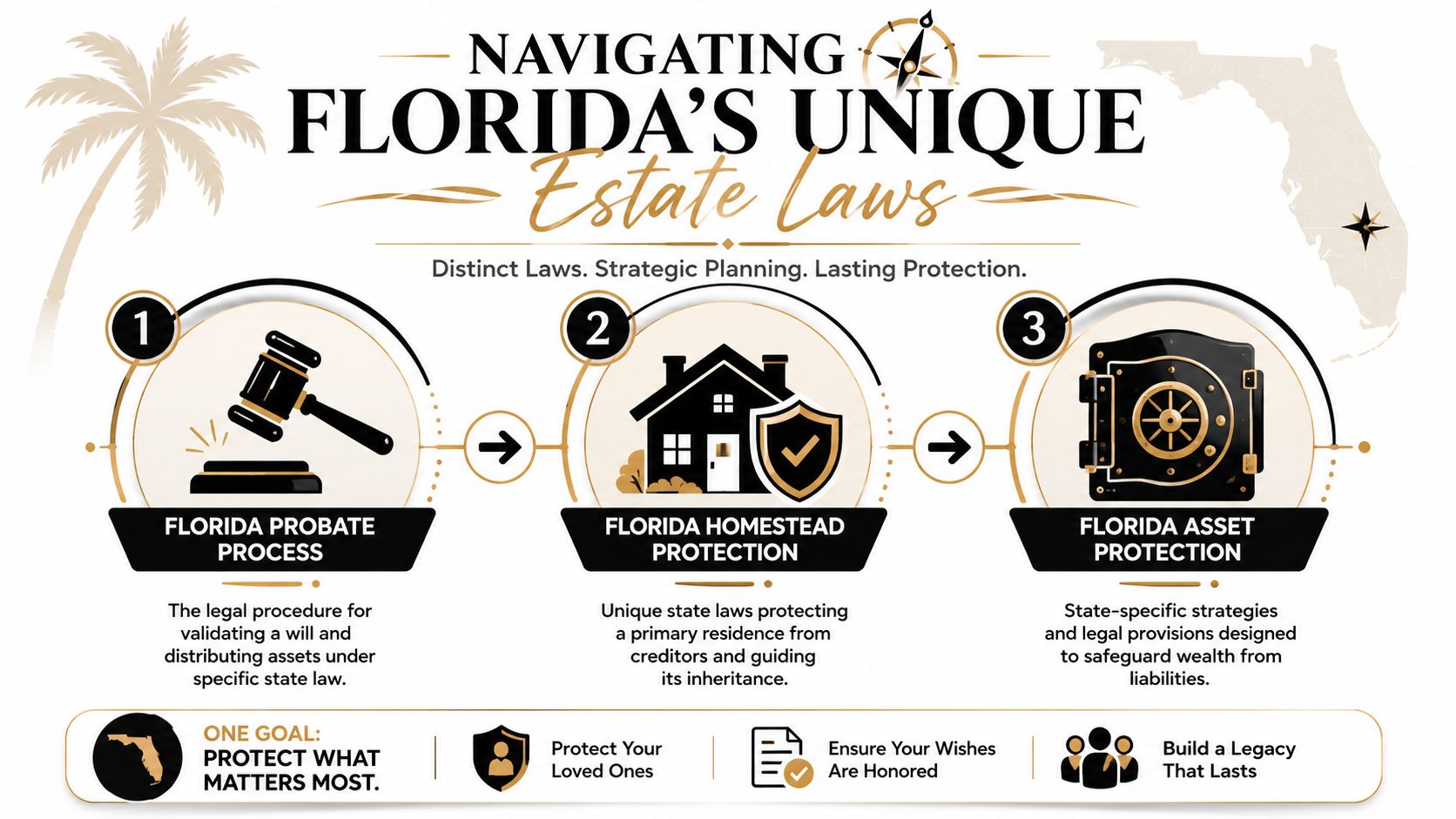
Probate rules shape the whole plan
In Florida, probate is not just a court procedure at the end of life. It often determines how we structure ownership while you are alive. For Fort Myers families, retirees, and business owners, the practical question is simple: which assets will pass through the court system, which will transfer by title or beneficiary designation, and which need trust-based planning to avoid delay, cost, or conflict.
For readers who want a plain-language overview of what property may pass through probate, this guide for Florida probate property is a helpful companion to a legal review.
A will alone rarely solves that problem. If a revocable trust is part of the plan, it must be funded. If an account is meant to pass by beneficiary designation, that form must match the rest of the estate plan. We regularly see plans fail at the coordination stage, not the drafting stage.
Homestead law changes the analysis
Florida homestead law carries real consequences for new residents and snowbirds. A primary residence in Fort Myers can receive strong protections, but those protections come with rules on devise and descent that do not exist in the same form in many other states. A client may assume a trust clause or will provision controls the house. In some cases, Florida law overrides that expectation.
The first review is usually factual, not theoretical. We look at whether the property is the client's Florida homestead, how the deed is written, whether the client is married, whether there are minor children, and whether the intended transfer matches Florida restrictions. If those pieces do not line up, the family may face litigation, a forced result under state law, or a title problem when trying to sell after death.
That issue is common in Southwest Florida because the residence is often the largest asset.
What we review for Fort Myers residents
For clients who recently moved to Florida or split time between states, our practice usually reviews these points first:
Domicile and residency facts
Florida planning works best when your documents and real-world conduct support the same state of residence.Homestead status of the residence
The answer affects creditor protection, tax treatment, and who can inherit the property.Title to the home and other real estate
Joint ownership, trust ownership, and inherited property each raise different Florida issues.Authority during incapacity
An older power of attorney may be valid where signed and still create problems in Florida use.Trust structure and funding
For a practical summary of how state rules affect trust design and administration, see our Florida trust laws overview.
The central point is straightforward. Florida estate planning is not a matter of swapping your old state name for a Florida address. For new Fort Myers residents, the law governing the home, the probate path, and the transfer mechanics often needs a fresh legal review.
The Risks of Using an Out-of-State Plan in Florida
A move to Fort Myers changes the legal environment around your estate plan. That doesn't always mean every old document must be thrown out. It does mean every important document should be tested against Florida law, Florida real estate rules, and your current domicile.
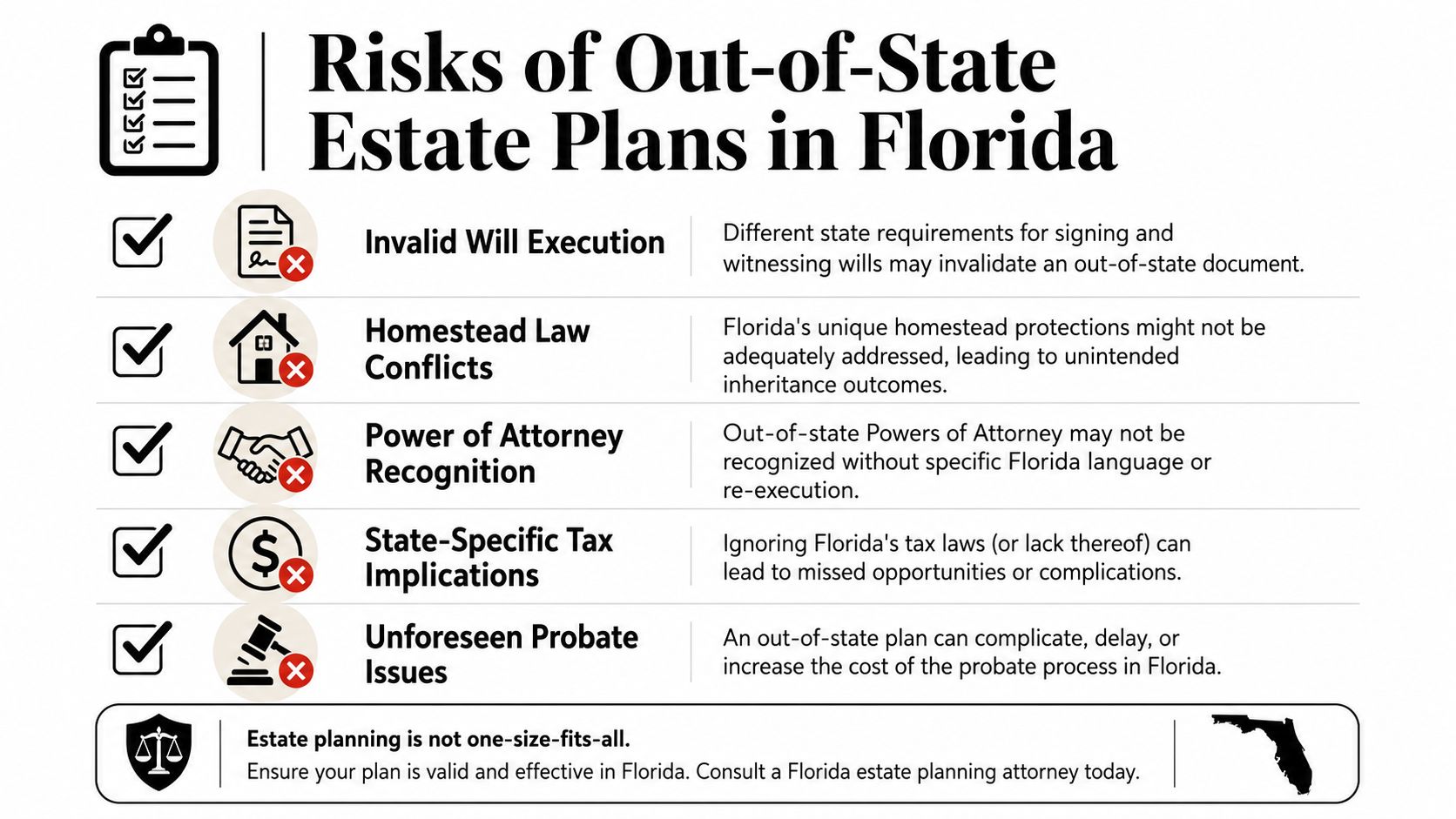
Why relocation creates legal friction
The most useful framework for snowbirds and new residents is a relocation checklist. Verified Florida planning guidance highlights the need to review domicile, homestead, healthcare surrogate, durable power of attorney, and beneficiary alignment, with a clear explanation of which documents usually need Florida review rather than replacement (Florida relocation-specific estate planning checklist).
That distinction matters. Sometimes the issue is validity. Other times the issue is usability. A bank, title company, or healthcare provider may hesitate when an older out-of-state document doesn't fit Florida expectations or current facts.
Five common problem areas
| Risk area | What can go wrong |
|---|---|
| Domicile mismatch | Your documents may reflect another state as the legal center of your affairs |
| Homestead conflict | A deed or transfer clause may not fit Florida restrictions |
| Old power of attorney | The document may be technically valid but operationally awkward |
| Healthcare paperwork | Decision-makers may be named, but the documents may need Florida review |
| Beneficiary drift | Retirement and insurance designations may no longer match the plan |
What we tell new Florida residents
- Review the deed first: The house usually drives the most important Florida-specific issues.
- Check incapacity documents next: These are the papers your family needs while you're alive.
- Audit every beneficiary form: Accounts often pass outside the will.
- Look at timing: A plan that made sense before a move, remarriage, or new business venture may not fit now.
If your current goal is to reduce exposure to probate after relocation, our Florida probate avoidance resource is a practical place to compare common strategies before a full legal review.
Moving to Florida without reviewing your estate plan is a lot like moving into a new house and assuming the old keys will fit every lock.
The mistake isn't having an out-of-state plan. The mistake is assuming it remains complete after your legal and property circumstances change.
Understanding Estate Planning Costs and Timelines
A Fort Myers couple buys a home after years of wintering in Florida, then brings us a will package drafted in another state and asks a fair question: what does it take to get this plan into shape here, and what will it cost? The answer depends less on page count and more on what has to be coordinated under Florida law, especially for new residents, snowbirds, business owners, and families with property in more than one state.
In our practice, fees and timing usually turn on scope. A straightforward plan for one person with no trust, one Florida residence, and clean beneficiary designations takes far less work than a plan involving a second marriage, a revocable trust, homestead review, business interests, or title issues. Wealth matters sometimes. Complexity matters more often.
What tends to affect price
The legal fee usually rises when the lawyer has to do more than draft a will and a power of attorney. Review, coordination, and implementation often drive the difference.
Questions that commonly shape the scope include:
- Do you own real estate in Florida and another state?
- Did you move here recently, while keeping older documents from your prior state?
- Is there a revocable trust that needs funding or amendment?
- Do you own an LLC, corporation, or partnership interest?
- Are there children from a prior relationship, minor beneficiaries, or concerns about creditor protection?
- Do beneficiary designations on retirement accounts and life insurance need to be aligned with the plan?
- Will deed work or homestead analysis be part of the engagement?
For snowbirds, one of the biggest cost drivers is deciding what Florida work is needed now versus later. Some clients need a full Florida-based plan. Others need a targeted review, updated incapacity documents, and a strategy for Florida real estate. Good planning is not about paying for documents you do not need. It is about avoiding gaps that create larger costs later.
Flat fee versus hourly work
Many estate planning matters are handled on a flat-fee basis. That works well when the deliverables are defined up front, such as a will package or a revocable trust package with standard signing meetings.
Hourly billing is more common when the work is harder to predict. Examples include title cleanup, complex trust revisions, business succession analysis, tax-sensitive planning, or fixing problems in older documents after a move to Florida.
Ask a direct question before you hire counsel: What is included? Some fees cover drafting and signing only. Others also include document review, deed recommendations, trust funding instructions, coordination with financial accounts, and follow-up revisions within a set period. That distinction matters.
What affects timing
Clients often assume drafting is the slow part. It usually is not.
Delays tend to come from incomplete records, undecided fiduciary choices, or last-minute changes after the first draft. A missing deed, an unsigned operating agreement, or uncertainty about who should serve as trustee can slow the process more than the legal writing itself.
| Timing factor | Why it slows matters down |
|---|---|
| Unclear fiduciary choices | Families need time to choose the right personal representative, trustee, or agent |
| Missing deeds or account records | The attorney cannot review title, beneficiary structure, or funding issues without them |
| Business ownership questions | Entity documents and succession terms may need separate analysis |
| Late plan changes | Revisions near signing often affect multiple documents at once |
A prepared client can shorten the timeline significantly. Bring the current deed, prior estate planning documents, basic asset information, business records, and recent beneficiary designations to the first meeting. That allows us to spot issues early and keep the drafting process focused.
The better way to judge cost is against the expense of fixing preventable problems later. In Fort Myers, those problems often involve probate for Florida property, a trust that was never funded, or documents from another state that no longer fit the family's circumstances here. A well-structured plan costs less than confusion during incapacity or after death.
How to Choose Your Fort Myers Attorney and Next Steps
A couple buys a home in Fort Myers after years of wintering here. They already have a will and trust from Illinois, so they assume they are covered. Then we review the deed, the homestead status, the beneficiary designations, and the trustee language. The documents are not useless, but they are not ready for Florida without careful revision.
That is the standard to use when choosing counsel. You want a Fort Myers estate planning attorney who reviews how Florida law affects the plan you already have, the property you own here, and the people who will need to act if something happens. For new residents and snowbirds, that review is often more important than the drafting itself.
Questions worth asking in a consultation
Start with practical questions that show whether the attorney is looking beyond the signature pages.
How do you evaluate a client's Florida residence and homestead status?
A sound answer should include title, devise restrictions, creditor issues, and how the homestead fits with the rest of the plan.How do you review out-of-state documents for Florida use?
We regularly see powers of attorney, trust provisions, and older wills that worked reasonably well elsewhere but create gaps once a client owns Florida property or becomes a Florida resident.Do you review deeds, beneficiary forms, and account titling as part of the engagement?
Good planning includes implementation. A will or trust alone does not control every asset.How do you advise business owners, LLC members, and clients with rental or seasonal property?
Business interests and second-home ownership usually require coordination across estate documents, entity records, and succession planning.What does your fee include, and what happens after signing?
Clients should know whether the process covers funding guidance, deed work, beneficiary review, and future updates.
What strong answers usually sound like
A capable attorney should explain how the plan works in real life. Who can act during incapacity. Whether the surviving spouse can stay in the home without title problems. Whether a revocable trust is worth the extra work for your asset mix. Whether a simple will-based plan is enough, or whether it leaves too much exposed to probate or administrative friction.
Trade-offs matter. A trust can improve administration and privacy, but it also has to be funded and maintained. A will may be appropriate for a simpler estate, but not if the client owns Florida real estate, has children from a prior relationship, or splits time between states. We tell clients this plainly because the right answer depends on the facts, not on a template.
Communication also matters, especially in families where spouses, parents, or adult children are more comfortable discussing legal and financial issues in different languages. Coto & Waddington, Attorneys at Law provides bilingual legal services for Florida families, founders, and small business owners, which can make planning meetings more productive and reduce confusion when decisions need family agreement.
A short next-step checklist
- Gather every estate planning document you have, including anything signed in another state.
- Pull the current deed for your Fort Myers home and any other Florida property.
- List your retirement accounts, life insurance, and transfer-on-death or payable-on-death designations.
- Identify who would serve as personal representative, trustee, and agent under a power of attorney.
- Schedule a Florida review before the next emergency, move, marriage, or season change.
Clients usually feel relief once the review starts. Uncertainty is often worse than the work itself.
If you recently moved to Fort Myers, spend part of the year here, or bought Florida property while keeping an older plan from another state, get the documents reviewed before you rely on them. That step can prevent probate complications, homestead mistakes, and authority gaps at the moment your family needs clarity most.