What does a trademark registration protect? It records a name, logo, or slogan for the goods or services listed in the filing. The USPTO charges a base filing fee per class, so the goods and services you select affect both the cost and the scope of the record.
A registration is not a one-time certificate to file away. You must define the covered products, keep ownership records current, and track compliance deadlines to maintain the registration. A new product may fall outside the protection if it is not covered by the filing.
For a South Florida startup, that means connecting the product list with ownership records, expansion plans, and a calendar for ongoing trademark obligations.
Table of Contents
- What Trademark Registration Means and Why It Matters
- Types of Marks You Can Register
- Federal vs State Trademark Registration
- How to File a USPTO Trademark Application Step by Step
- What Trademark Registration Costs in 2026
- Renewal Deadlines and How to Enforce Your Mark
- Pitfalls and Your Pre-Filing Checklist
What Trademark Registration Means and Why It Matters
Trademark registration formally records a distinctive brand identifier and its owner, with protection tied to specified goods or services in a particular jurisdiction.
A registration works somewhat like a property deed. It creates a public record showing who owns the asset and what the record covers. Unlike a deed to land, though, trademark protection concerns how customers identify the source of goods or services.
Say you launch a coffee brand. Your trademark identifies your business as the source of that coffee, rather than giving you ownership of the word in every possible setting. The filing's wording matters because it describes the commercial activity behind your claim.

What the legal record gives you
Federal registration, particularly on the Principal Register, can provide practical advantages:
- Ownership presumptions: A nationwide presumption of ownership and exclusive rights within the registration's scope, subject to applicable exceptions and earlier rights.
- Public notice: A searchable record that helps other applicants identify potential conflicts.
- Enforcement tools: A stronger foundation for asserting rights and, for eligible registrations, customs recordation against infringing imports.
- Registered status: The right to use the registered symbol, ®, for the registered mark and covered goods or services.
- A transferable asset: Rights that can support licensing, investment discussions, or a business sale.
Registration fits within a broader intellectual property protection strategy, alongside contracts, confidentiality practices, and appropriate protection for other business assets.
Product planning belongs in that strategy too. Founders developing new offerings can explore AI-driven brand product development through Genpire, then separately evaluate whether proposed names and product categories fit their legal protection plans.
Where protection stops
Trademark rights are territorial. A U.S. registration doesn't itself protect your brand in Spain or Mexico. The Madrid System provides a centralized route for seeking protection in several member jurisdictions, not a universally enforceable global trademark, as explained in WIPO's Madrid Yearly Review.
Nor does registration reserve domain names or social-media handles. It doesn't automatically add products that your filing never identified.
Practical tip: Treat the registration as an asset record with boundaries, not a blanket claim to your brand everywhere.
Types of Marks You Can Register
The type of mark determines what you're asking the registry to protect, so compare the actual identifier before choosing your filing.
| Mark type | What identifies the business | Main filing consideration |
|---|---|---|
| Word mark | The name or wording | Standard-character protection isn't tied to a particular font |
| Design or logo mark | A visual design | The drawing defines the visual claim |
| Combined mark | Wording and design together | Protection concerns the submitted combination |
| Slogan | A source-identifying phrase | The phrase must function as a mark |
| Sound or motion mark | An audio identifier or animation | Evidence must demonstrate the claimed identifier |
| Trade dress | Packaging or product appearance | Distinctiveness and nonfunctionality matter |
| Certification or collective mark | Certification standards or group affiliation | Ownership and authorized use follow special rules |
Names, logos, and slogans
A standard-character word mark protects wording without limiting the claim to a particular font, size, or color. It's often the most useful starting point when the name is stable but the visual identity is still evolving. It doesn't, however, make weak wording strong or eliminate conflicting rights.
A logo filing focuses on the visual design. A combined filing includes the name and design together, which may be sensible for a distinctive emblem but offers less flexibility when the business later changes its presentation.
Typography can create separate concerns about copying another brand's appearance or using a font without permission. Font Checker Pro's Bears font guide offers context for evaluating sports-inspired typography and alternatives, but choosing a font doesn't replace trademark clearance.
A slogan must identify source rather than merely communicate praise or an advertising message. A plain statement about excellent quality may not function as a trademark because you place it beneath your logo.
Less conventional identifiers
Sound and motion marks require a clear definition of what's claimed and evidence appropriate to the sound or animation. A static screenshot alone won't necessarily demonstrate the claimed movement.
Trade dress concerns a product's or packaging's overall appearance. Functional features aren't protectable as trade dress, and the distinctiveness requirements can make these filings more demanding than a straightforward name application.
Certification marks identify compliance with standards, while collective marks identify group membership or goods and services associated with members. A certifier generally doesn't use its certification mark on its own certified goods; collective-mark use requires a different analysis of the organization and its members.
Filing priority: For many early-stage businesses, clear and file the stable word mark first. Consider a separate logo application once the design is settled.
Federal vs State Trademark Registration
Federal vs state trademark registration at a glance
| Factor | USPTO federal registration | State registration |
|---|---|---|
| Geographic scope | Nationwide across the United States, subject to applicable limits | Only within the issuing state |
| Filing office | United States Patent and Trademark Office | State trademark office or Secretary of State |
| Typical cost | Class-based federal base fee | Amount set by the current state fee schedule |
| Examination depth | Substantive review of conflicts and registrability | State-specific review, often lighter |
| Common-law rights | Use creates rights; registration adds federal presumptions | Use supports rights in the local market |
| Best fit | Online sellers and interstate businesses | Businesses operating within a single state |
Geographic reach matters more than the cheapest certificate. A state filing is often less expensive and faster, but it doesn't provide nationwide registration. State examination also shouldn't be treated as an assurance that your name is clear elsewhere.
Federal examination addresses conflicts and other registrability issues. The USPTO's Trademark Case Files Dataset reflects that broader administrative record, including examination events, ownership, classifications, oppositions, and maintenance history.
Choose based on how customers buy
A federal registration provides national benefits, including ownership presumptions for eligible registrations, access to federal enforcement mechanisms, and potential customs recordation. Those benefits remain subject to the particular registration and legally recognized competing rights.
Common-law rights can arise from using a mark without registering it. Their reach generally follows actual use and reputation, and proving priority may require sales records, advertising, customer evidence, and geographic detail. A certificate is therefore different from the underlying history of who used the mark first.
A business-name filing is another separate issue. Registering an entity or understanding what a fictitious name means helps you comply with business-record requirements, but it doesn't establish that the name is available as a trademark.
Apply the distinction to your business
- A single-city restaurant: Local use and a state filing may be a reasonable starting point if expansion isn't planned, although clearance still matters.
- An online store shipping nationwide: Federal registration is generally the stronger fit because customers and potential conflicts aren't confined to the owner's home state.
- A company preparing to export: Coordinate federal filing with a destination-country strategy. Don't assume foreign filing must wait until the U.S. registration issues.
Decision tip: For most startups selling online or across state lines, federal registration is the practical default. Choose the route around your actual sales model and foreseeable expansion, not merely your office address.
How to File a USPTO Trademark Application Step by Step
A usable application connects the correct owner, mark, commercial activity, and filing basis. The USPTO's base application requirements explain the required ownership information, verified statement, classification, and examination prerequisites.
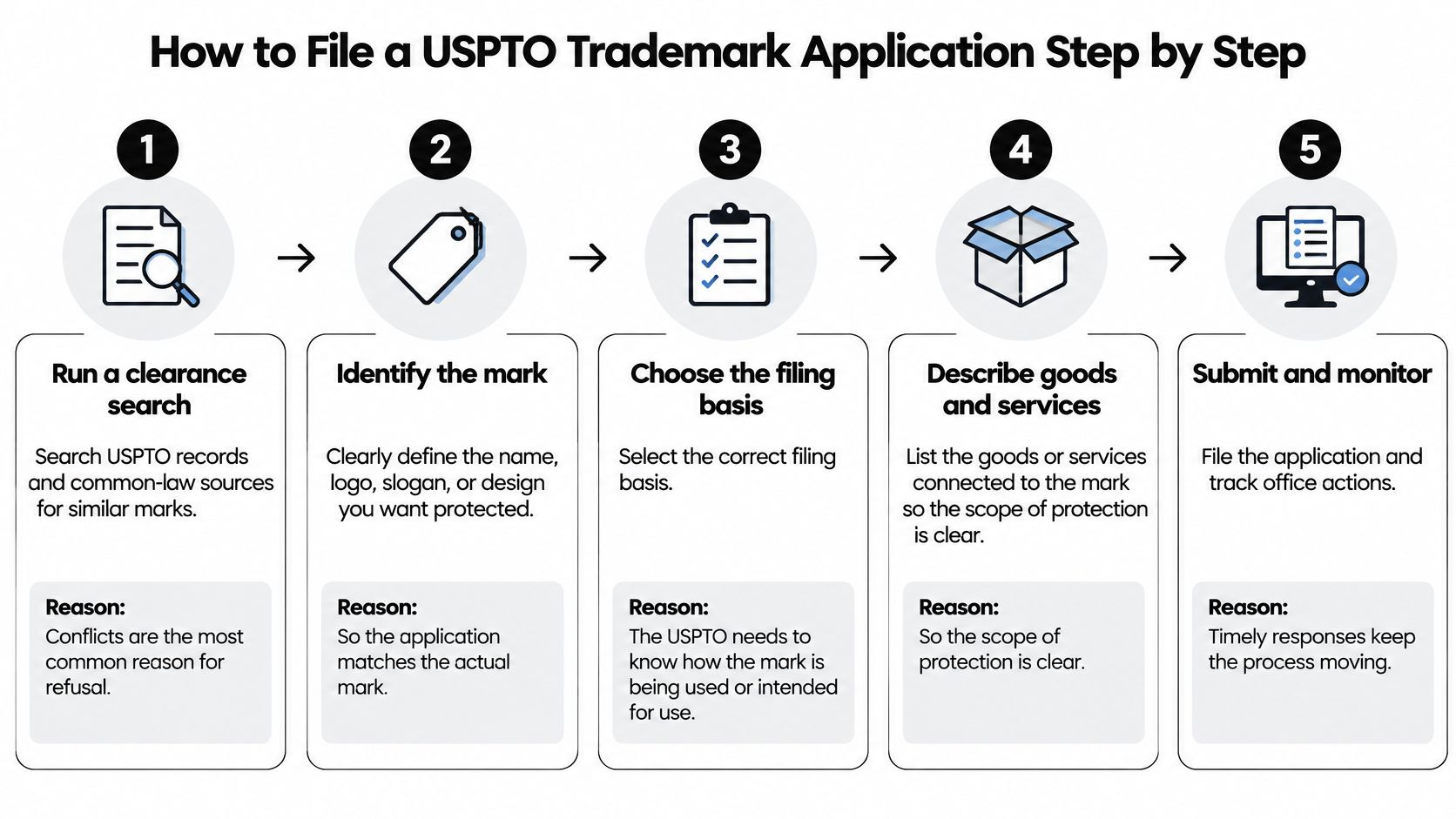
Run a clearance search. Search the USPTO's trademark records, then investigate common-law uses through search engines, marketplaces, business directories, and relevant industry sources. Look for similarities in sound, meaning, appearance, and related offerings, not just exact matches.
Define the mark and confirm its owner. Decide whether you're filing wording, a design, or another identifier, and use the exact legal name of the person or entity entitled to own it. Check the address, entity type, citizenship, or incorporation information before submission.
Choose the filing basis. A use-in-commerce application relies on qualifying existing use and an appropriate specimen. An intent-to-use application relies on a genuine intention to use the mark and requires later proof of use before registration.
Write the goods-and-services identification. Use the USPTO's Trademark ID Manual where suitable entries accurately describe your offerings. Avoid vague wording such as business products or technology services, and don't claim activities merely because you might pursue them someday.
Select the relevant classes and pay the fees. Classification organizes the goods and services, but a class heading doesn't substitute for a precise identification. Check that every selected entry matches actual use or a supportable planned offering.
Sign and submit electronically. Review the verified statements carefully and use the USPTO's online filing system. Save the submission receipt and application record in the company's legal files.
Monitor examination and respond. An examining attorney is assigned after minimum filing requirements are satisfied. An office action may identify procedural defects or substantive refusals, and failing to respond on time can abandon the application.
The visual workflow helps connect searching, defining, filing, and monitoring.
Publication isn't automatic approval
Under the USPTO's trademark process, approved applications proceed to publication in the weekly Trademark Official Gazette, followed by a 30-day opposition window in which eligible parties may oppose or request additional time.
USPTO filing stages and typical timing
| Stage | What happens | Typical timing |
|---|---|---|
| Filing | Application, fees, and any required specimen are submitted | Submission date |
| Examination | Attorney reviews the mark, goods, and conflicts | After assignment and initial processing |
| Office action, if issued | Applicant addresses refusals or requirements | Deadline stated in the action |
| Publication | Approved mark appears in the Trademark Official Gazette | Scheduled after approval |
| Opposition window | Third parties may challenge registration | Publication-based statutory window |
| Registration | Certificate issues after applicable conditions are met | After opposition issues and filing-basis requirements are resolved |
An intent-to-use application may require additional steps before registration, so publication doesn't mean the certificate is next in every case.
Before submitting: Ask counsel to review the clearance results, owner, identification, and filing basis together. That review is more useful than checking spelling alone.
What Trademark Registration Costs in 2026
The USPTO base fee is $350 per class for most applications under the relevant use-based and foreign-registration provisions, according to the USPTO's fee-change summary. That schedule also lists $100 per class for insufficient information and $200 per class for using the free-form identification text box, and explains that the former TEAS Plus and TEAS Standard distinction ended with the fee changes effective January 18, 2025.
For a hypothetical brand requiring separate classes for clothing, downloadable software, and retail services, the base-fee calculation is $350 × 3 = $1,050, before additional charges. Separate applications for the name and logo create separate application budgets.
Trademark filing fees and surcharges
| Cost item | Amount | When it applies |
|---|---|---|
| USPTO base filing fee | Per-class base charge described above | Each class in a covered application |
| Insufficient information surcharge | Per-class surcharge described above | Required application information is missing |
| Free-form identification surcharge | Per-class surcharge described above | Free-form wording is used instead of ID Manual entries |
| Madrid basic fee, black-and-white mark | Basic fee plus applicable additional charges | Eligible international application |
| Madrid basic fee, color mark | Higher basic fee plus applicable additional charges | Eligible international application for a color mark |
| Attorney review | Quoted professional fee | Review, search, drafting, or prosecution services included in the engagement |
International and professional costs
WIPO's Madrid System guide lists a basic fee of 653 Swiss francs for a black-and-white mark or 903 Swiss francs for a color mark, plus additional fees associated with selected territories and classes. Those basic fees aren't an all-inclusive price for foreign protection.
Attorney charges are separate from government fees. Ask for a flat quote that specifies whether it includes clearance, application preparation, routine correspondence, substantive office-action responses, and later use filings.
A low initial quote can be misleading if it excludes work your application is likely to need. Compare the engagement scope, not just the headline amount.
Budgeting rule: Draft the goods-and-services list before setting the filing budget. The commercial activities you claim drive both coverage and class-based expense.
Choose commercially relevant classes, but don't cut a real product category solely to reduce the filing bill. Equally, don't buy extra classes as speculative insurance when you lack a genuine plan to use the mark for those offerings.
Renewal Deadlines and How to Enforce Your Mark
Post-registration deadlines for a U.S. trademark
The windows below come from the USPTO's registration-maintenance guide and run from the registration date, with the optional incontestability filing also requiring qualifying continuous use.
| Filing | Window | What you submit |
|---|---|---|
| Section 8 declaration | Between years 5 and 6 after registration | Declaration of use or excusable nonuse, specimen per class, fee per class |
| Combined Sections 8 and 9 renewal | Between years 9 and 10 | Declaration plus renewal application, specimen, fees |
| Repeat renewal | Between years 19 and 20, then every 10 years | Same combined filing as the first renewal |
| Section 15 incontestability, optional | After 5 years of continuous use | Declaration of incontestability, subject to legal requirements |
Assign someone to maintain the record
The use declaration is a substantive statement about marketplace activity, not a payment. Review each listed offering and confirm that your evidence supports the goods or services you intend to retain.
The combined declaration and renewal continues that maintenance process. The optional incontestability declaration can strengthen certain aspects of the registration's legal position, but it doesn't make the mark immune from every challenge.
Review the certificate for accuracy when it arrives, and keep contact and ownership information current. The USPTO's post-registration guidance emphasizes certificate review, corrections, maintenance, and the owner's continuing responsibilities.
Respond to conflicts deliberately
- Monitor relevant uses: Run periodic searches or engage a watch service for confusingly similar marks, particularly in your industry.
- Preserve evidence: Save screenshots, product listings, advertising, and information about the other user before contacting them.
- Assess the legal position: Compare priority, commercial context, and customer confusion before sending demands.
- Choose the response: In clear cases, counsel may begin with a cease-and-desist letter. Marketplace reports, opposition proceedings, negotiation, or litigation may fit other circumstances.
A marketplace takedown isn't a substitute for legal analysis. Platforms apply their own procedures, and an overbroad complaint can create avoidable disputes.
Record assignments when ownership changes, and review trademark controls when licensing the brand. Nonuse can jeopardize rights even if the business still values the name.
Evidence tip: Keep dated examples of genuine use in a shared folder, organized by mark and covered offering. Give one person responsibility for the calendar and designate a backup who can access the records.
Pitfalls and Your Pre-Filing Checklist
A cheap application isn't necessarily a low-cost trademark strategy. Founders often focus on obtaining a filing receipt while overlooking defects that become harder to fix after launch.
The better question isn't what trademark registration is. It's whether the proposed record accurately reflects your business and whether someone will keep it accurate as the company changes.
Mistakes that create avoidable work
Filing before clearance. A conflicting mark can surface after you've paid fees, printed packaging, and announced the launch. Search registered marks and real-world uses before committing, and investigate close results rather than dismissing them because the spelling differs.
Using a vague or inflated goods list. Broad language can trigger examination problems, while unsupported claims create issues when evidence of use is required. Match ID Manual entries to what you offer or intend to offer, and have counsel review descriptions that don't fit available entries.
Naming the wrong owner. A founder, operating company, and holding company aren't interchangeable applicants. An ownership error can be fatal to an application, so establish which entity controls the mark before filing rather than expecting a later transfer to cure every defect.
Ignoring foreign exposure. A U.S.-focused filing plan may be inadequate when your distributors, manufacturing arrangements, or launch commitments already involve other markets. Build a territory list from concrete operations and expansion plans, then assess filing priority before making public commitments abroad.
Confusing a word mark with every version of a logo. A standard-character filing can remain useful when typography changes, but it doesn't separately register a distinctive graphic. Check whether the wording shown in actual use matches the application and whether the visual element warrants its own filing.
Treating approval as the end of the job. A founder can keep selling under a valuable name while overlooking a maintenance obligation. Put responsibility into the company's operating procedures, including a handoff when employees, counsel, or ownership change.
Expecting the certificate to secure digital accounts. A registration doesn't automatically deliver a desired domain or handle. Check account availability during brand selection, secure the accounts you need, and assess disputes under the relevant platform or domain procedures.
These problems share a pattern: the application gets separated from the business decisions behind it. A carefully drafted filing won't eliminate every dispute, but it reduces avoidable uncertainty about what you claimed and why.
Your pre-filing checklist
- Stabilize the identifier: Confirm the intended spelling, wording, and any design being submitted.
- Verify the applicant: Match the legal entity name and organizational details to company records.
- Document clearance: Keep search results and the reasoning behind the decision to proceed.
- Describe the offering: Separate current goods and services from genuine planned expansion.
- Choose the route: Favor federal filing for interstate or nationwide online operations.
- Prioritize territories: Base foreign filings on concrete commercial plans without ignoring time-sensitive risks.
- Prepare evidence: Collect authentic specimens where the filing basis requires them.
- Name the administrator: Assign monitoring, correspondence, ownership updates, and maintenance responsibilities.
For most growth-oriented startups, the practical verdict is clear the mark and pursue federal filing promptly, rather than waiting until the business becomes large. That recommendation assumes the name is registrable, the owner is correct, and the filing basis is supportable.
Registration is most useful when the legal record and the business stay aligned. Product launches, rebrands, acquisitions, and licensing deals should prompt a trademark review, just as they prompt contract and accounting reviews.
Coto & Waddington, Attorneys at Law offers trademark clearance and filing support, including review of your mark, goods-and-services list, and filing basis, with bilingual counsel and flat, predictable pricing. Visit Coto & Waddington, Attorneys at Law to request a consultation, and bring your proposed name, logo, product list, and expansion plans so the discussion can address both the application and the obligations that follow.