Who could sign for you tomorrow if you couldn't speak?
Estate planning is the legal process of deciding who manages your property and decisions if you cannot, and who receives what you own after death. Most U.S. adults never assemble a complete set of those documents.
A plan works like a set of labeled channels. Your house, your bank account, your business, and your medical choices each travel on a different one. A will, a trust, a beneficiary form, or a power of attorney controls that channel. If the wrong paper is missing, the asset does not follow the route you assumed. It waits for a court, a default rule, or a family argument.
A stroke can start that problem while you are still alive. Death is only the second test.
Table of Contents
- What Estate Planning Covers in Plain Terms
- Why Estate Planning Matters Beyond Wealthy Families
- How Assets Pass at Death and During Incapacity
- How to Build an Estate Plan Step by Step
- Digital Accounts, Business Interests and Blended Families
- Federal Estate Tax Rules Affecting Your Plan
- Common Misconceptions That Leave Families Unprotected
- When to Hire an Estate Planning Attorney
What Estate Planning Covers in Plain Terms
In plain terms, an estate plan is a set of signed documents that answers two questions: who decides for you while you're alive, and who receives what you own after you die. Everything else, the trusts, the tax elections, the business agreements, exists to make those two answers enforceable.
A plan is a map you draw before the trip. Draw it while you're healthy and the people you love follow a route you chose. Skip it and they proceed by guesswork, in bad weather, with a court clerk reading directions.
The will is the oldest instrument on that map. Legal scholarship traces evidence of wills in Egypt to roughly 3,000 years before Christ, and England's Statute of Wills in 1540 let landowners pass freehold land by will instead of leaving it to default inheritance rules, as the Notre Dame Law Review records. The purpose hasn't moved since: a will speaks for you when you can't.
Two jobs run on different clocks. The incapacity job covers the years you're alive but can't sign, decide or speak, handled by powers of attorney, healthcare directives and trust provisions that switch on early. The death job covers the transfer of what you own, handled by your will, your trust and the beneficiary forms on retirement accounts and insurance. Most incomplete plans give one job documents and the other job nothing.
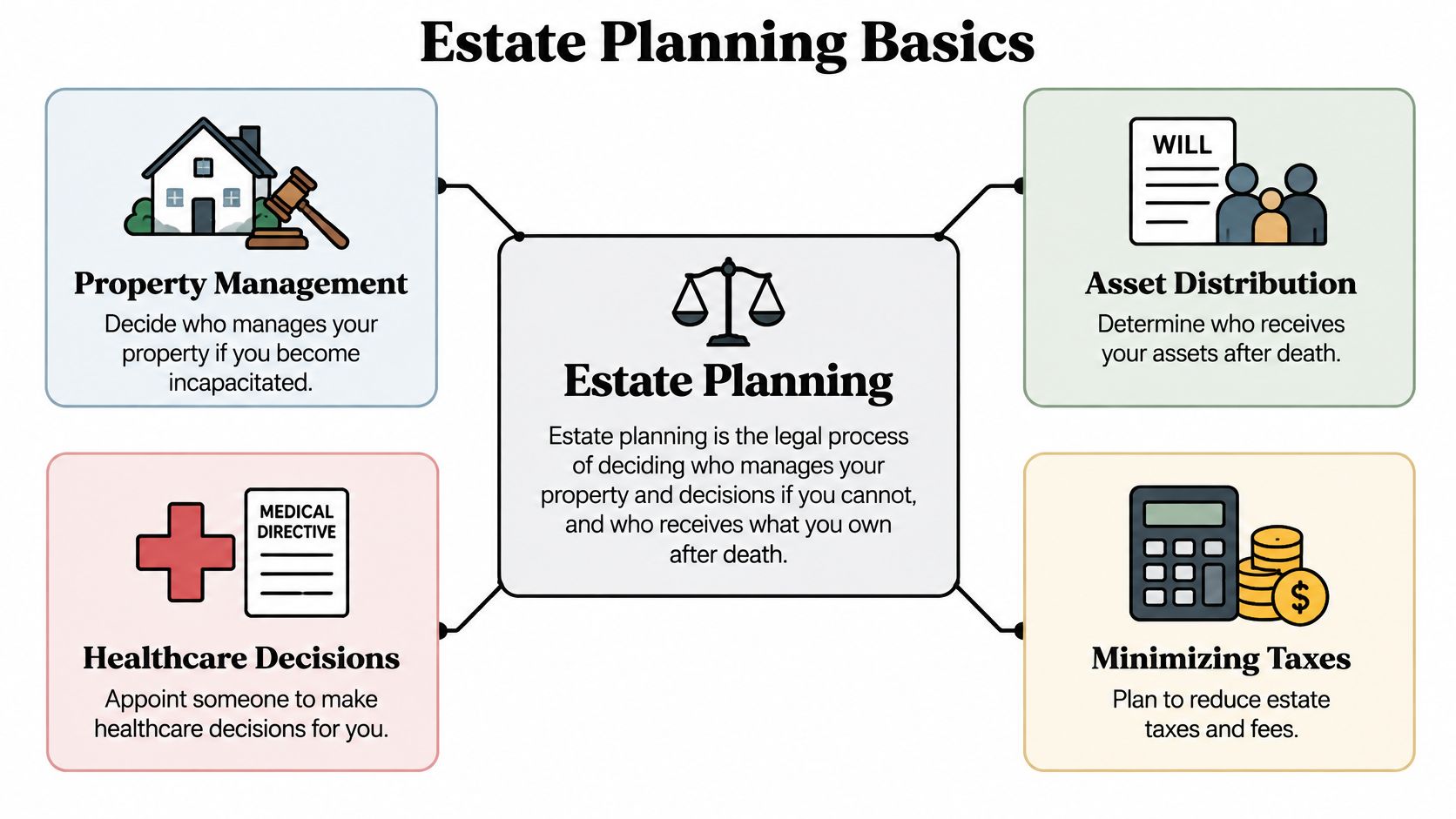
Six documents carry the work. The diagram below maps the same ground onto four tasks: managing property, distributing assets, making healthcare decisions and reducing taxes and fees.
| Document | What It Controls | When It Takes Effect | Usually Involves Probate Court? |
| Last will and testament | Property titled in your name and guardians for minor children | At death | Usually yes |
| Revocable living trust | Assets moved into the trust, managed by a successor trustee | At death for funded assets, or during incapacity if the trust gives that power | Usually no, for funded assets |
| Durable power of attorney | Financial decisions, bank access and contract authority | While you're alive but unable to manage affairs | No |
| Healthcare directive | Medical treatment choices and the person who speaks for you | While you're alive but unable to decide | No |
| Beneficiary designation | Retirement accounts, life insurance and payable-on-death accounts | At death, and it overrides the will for that asset | No |
| Business succession agreement | Ownership, voting rights and transfer of company interests | Per the agreement, at death or incapacity | No, if the agreement and entity documents are current |
Notice that three of the six take effect while you're alive. A will doesn't manage your bank account during a hospital stay, and a power of attorney doesn't distribute a house.
Storage rule: keep signed originals in one place your executor can reach without your phone or laptop, and tell that person where the folder lives.
Start this week by listing the documents you already hold and marking which of the six you lack. Many find they have one and need four.
Why Estate Planning Matters Beyond Wealthy Families
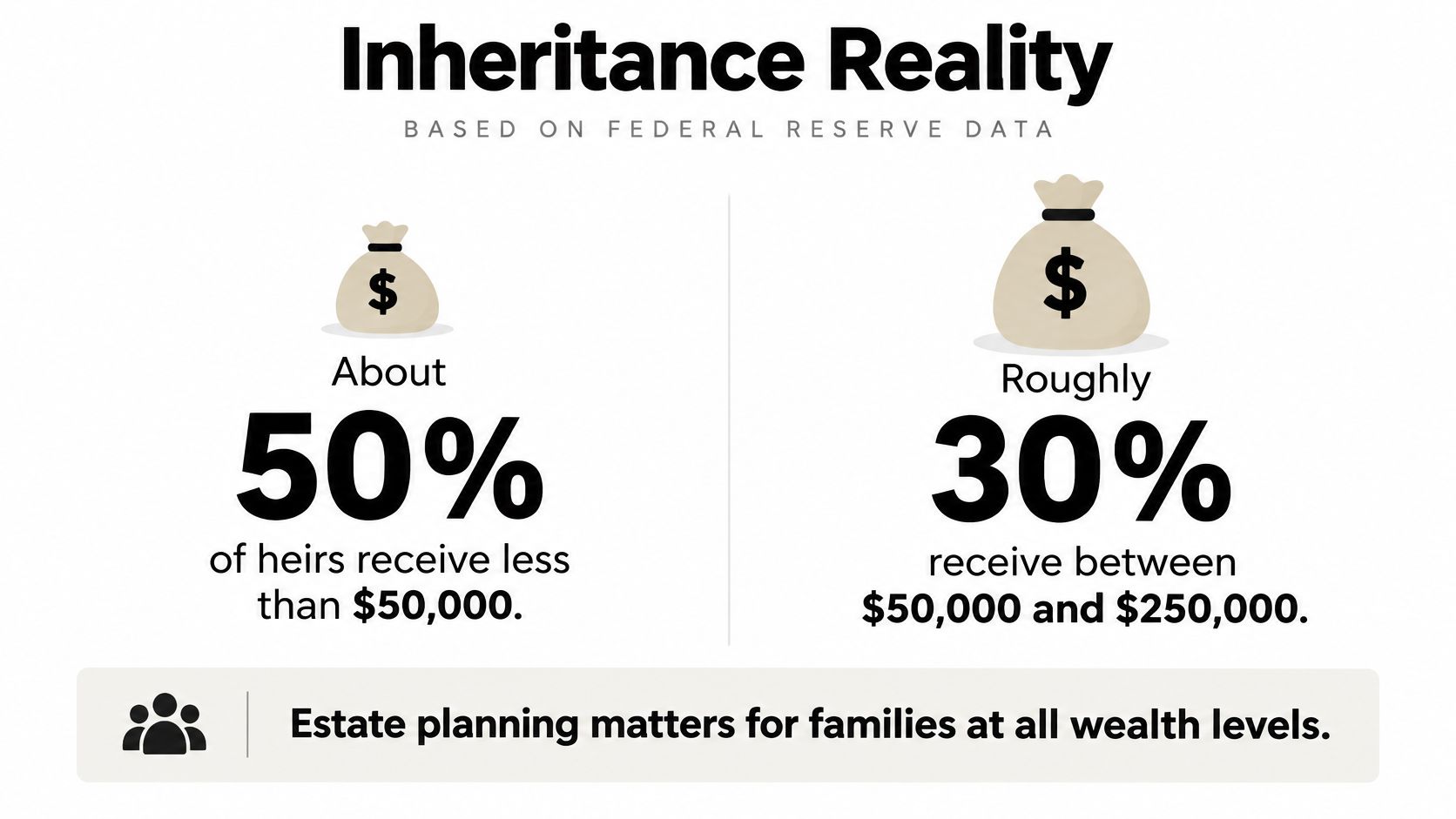
Estate planning gets filed mentally under rich-people problems, and the numbers don't support that. Federal Reserve data summarized by Kiplinger shows that approximately 50% of heirs receive less than $50,000, while about 30% receive between $50,000 and $249,000. Modest inheritances are the normal case, and a modest estate has the same gaps as a large one: a house with a mortgage, a car, a retirement account with a named beneficiary, and maybe a small company with two employees.
Take a couple in their forties with two children, a townhouse and a landscaping business run out of a shed. No will. They die in the same accident. State intestacy rules decide who gets the house and in what shares, a court appoints an administrator to sell and divide, and a judge chooses who raises the children. Nobody in that chain knew them.
The basic fix is small: a will that names a guardian and says who gets what, a financial power of attorney, and a healthcare directive. The cost that breaks modest estates isn't the funeral, it's years of care, which is why families end up researching Medicaid nursing home coverage in NJ in the middle of a crisis rather than beforehand.
Start where the risk is highest, not where the paperwork is fanciest. If money is tight, do the will and the two powers of attorney first, since they cost the least and prevent the most expensive outcomes, then add trust work as assets grow.
Sort your own situation now:
- Simple: a will, powers of attorney, a healthcare directive and a guardian choice.
- Complex: business interests, property in more than one state, a blended family, or a dependent who needs lifetime support.
How Assets Pass at Death and During Incapacity
Assets don't move as a group. Each one follows the channel written on its own paperwork, and the channels don't talk to each other. That's the most useful thing to understand about how an estate works, and it's where plans fail.
Channel one, the will. A will directs property titled in your name alone. The American Bar Association guide puts it directly: a will can direct distribution of property titled in the decedent's name, but beneficiary designations on retirement accounts and life insurance commonly control those assets independently. So a will leaving everything to your new spouse can be beaten by a 401(k) form that still names your former spouse. The form decides that account.
Channel two, the trust. A trust controls only what's inside it. Signing a revocable trust without retitling the house or the checking account leaves those assets outside its reach, and they'll go through probate anyway. Funding is the step people skip, and it's the step that does the work.
Channel three, beneficiary forms. These pass outside the will and carry tax rules for whoever inherits. Required withdrawals on an inherited IRA run on a different schedule than the original owner's, which is why who you name matters as much as how much you leave.
Channel four, business documents. A personal power of attorney may not authorize your agent to run an LLC or vote corporate shares. To see how much authority a financial power of attorney can carry, a Florida power of attorney sample lays out the powers, the effective date and the gifting limits line by line.
Review beneficiary forms after every marriage, divorce, birth, death, relocation or change in business ownership. A document can be perfectly valid and still produce a result nobody intended.
Run a test tonight:
- Write down your three largest assets.
- Note where each one is titled.
- Note who is named to receive it.
If any answer surprises you, that's the gap to close first.
How to Build an Estate Plan Step by Step
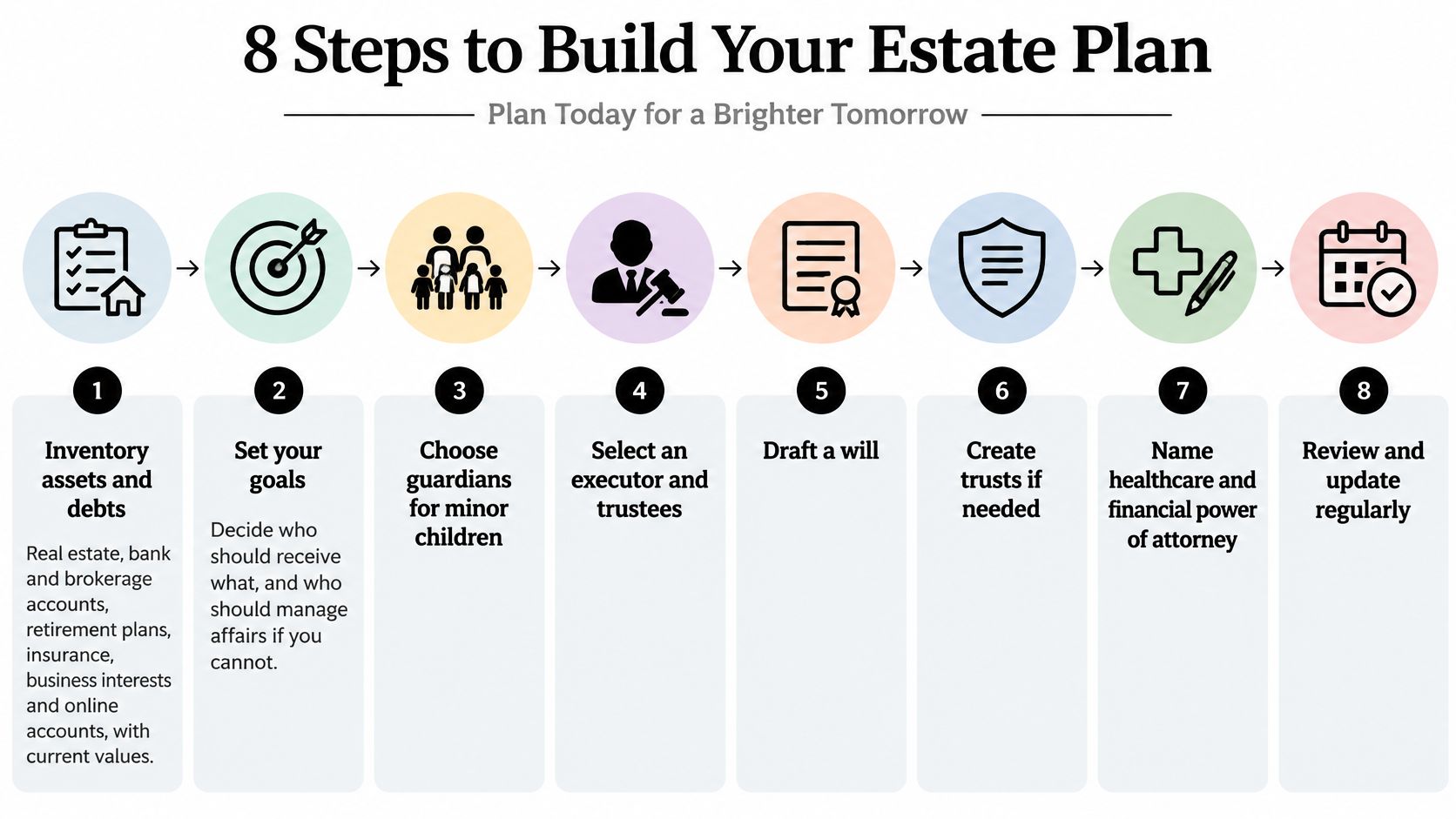
Eight steps, in order. Skipping ahead is how people end up with a beautifully drafted trust and a house that never made it inside.
- Inventory assets and debts. List real estate, bank and brokerage accounts, retirement plans, insurance, business interests and online accounts with current values. The common slip is forgetting the small ones, like the second 401(k) from a job you left and the savings account you opened for a car.
- Gather the governing documents. Pull existing wills, trusts, LLC operating agreements, shareholder agreements and old powers of attorney. The common slip is assuming the will you signed in another state a decade ago still matches your life.
- Check beneficiary designations and account titling. Compare what each form says against the outcome you want. The common slip is a retirement account still pointing at an ex-spouse.
- Choose your decision-makers. Name an executor, a trustee, a financial agent, a health-care agent and a guardian for minor children, each with an alternate. The common slip is naming one person with no backup, then discovering that person is on the same flight.
- Define incapacity authority. Spell out what each agent may do, when the authority begins, and whether it reaches business decisions rather than only personal ones.
- Pick the structure. A will alone, or a will plus a revocable trust, based on probate avoidance, privacy, asset size and family situation. Life insurance often funds the pieces that cost money at death, and this checklist for end-of-life planning covers the practical items families forget.
- Sign with the formalities your state requires. A will needs the right number of witnesses and signatures, and a missed witness can invalidate the entire document. The same discipline applies to notarization on powers of attorney.
- Store and review. Keep originals where your executor can find them, give copies to your agents, and revisit the plan after major events and every few years.
One master list: a single page naming every document, where the original lives, and who holds a copy. It's the difference between your executor finding the will in an afternoon and finding it in a storage unit six months later.
Digital Accounts, Business Interests and Blended Families
A signed will can leave the house to the right person and still lock the family out of the accounts that pay the bills. Each asset moves through its own channel, the way water follows a labeled pipe. A document written for one pipe does not repair a break in another, and that break can happen while you are alive and unable to act, not only after death.
Digital property fails when nobody can open it. Readers often expect the will to control a crypto exchange or an online store. Those places follow their own rules. The inventory has to name what heirs cannot see: cryptocurrency wallets, exchange accounts, and the password manager that opens the rest; domain names, social accounts, and storefronts tied to the business; royalties, subscriptions, and licensing payments that keep arriving. A court order may still lose to the platform's terms.

A 2025 survey reported by PSS USA found respondents increasingly viewed digital legacy and pets as proper subjects for estate planning, with 62% identifying pets as deserving inclusion.
A company interest splits into two channels. Dollar value can pass under a will or trust. Voting and day-to-day control follow the company's own agreement, so an heir can inherit the value without automatically running the firm. Buy-sell provisions decide who operates the business if you cannot, and who may buy the shares.
Many married couples never complete an estate plan. Unmarried partners, stepchildren, and children from an earlier relationship can receive nothing by default, so estate planning for blended families starts with explicit instructions rather than a formula that assumes one household.
Access rule: keep the one-page map somewhere your executor can reach without the device that holds the passwords, and update it every time you open an account or cancel a subscription.
Federal Estate Tax Rules Affecting Your Plan
Most estates never owe federal estate tax, but the filing rule catches people who assume they're safely below the line. Per the IRS, a federal estate-tax return is generally required when the decedent's gross estate, increased by adjusted taxable gifts and certain prior exclusions, exceeds the filing threshold, which is $15 million for deaths in 2026.
| Item | 2026 Value | Why It Matters |
| Federal estate-tax filing threshold | $15 million for deaths in 2026 | Estates above this level must file a federal estate-tax return |
| Annual gift-tax exclusion | $19,000 per recipient | Gifts within this limit per person don't use up lifetime exemption |
| Portability of unused exclusion | Passes to a surviving spouse | Requires a timely estate-tax return even when no tax is due |
| State estate or inheritance tax | Set by each state, separately from the federal threshold | A state-level tax can reach estates far smaller than $15 million, so confirm the local rule |
How the taxable estate is calculated
The math runs in a fixed order. Deduct qualifying debts, administration expenses, transfers to a surviving spouse and charitable gifts. Add lifetime taxable gifts. Then apply the unified credit. Because lifetime transfers re-enter the calculation, every gift you make while alive changes both the eventual tax base and the reporting duty, and valuing a closely held business interest can move the number more than any deduction will.
Portability deserves its own warning. A surviving spouse can use a deceased spouse's unused exclusion only through a timely estate-tax return, even when no tax is due. Families that skip the return because the bill was zero can forfeit the exemption.
Keep a dated ledger of every gift and ownership transfer, and file the paperwork for company shares alongside the shareholder or operating agreement those transfers have to satisfy.
These figures are federal. Estate tax planning strategies have to start with your state's separate rule, so confirm local thresholds with a qualified adviser before you build a plan around the federal exclusion.
Common Misconceptions That Leave Families Unprotected
Five beliefs keep people from finishing a plan, and each one has a correction.
- "I'll get to it later." Delay is common. A 2025 Caring.com survey conducted with YouGov among more than 2,500 adults found 24% of U.S. respondents reported having a will and 13% reported having a living trust. Action: book one hour this week to write your asset list.
- "A trust means no probate and no taxes." A trust avoids probate only for the assets it holds, and tax exposure depends on value and structure, not on the label.
- "An online template is enough." Templates rarely match your state's signing rules, your business ownership or a blended family. Action: read the witness and notary instructions on your state's form at minimum.
- "My family will work it out." Without written instructions, state law and a court decide, and that process is both slow and public.
- "Once it's signed, it's done." Laws, assets and relationships change. Action: put a review date on the calendar every few years and after every major event.
The pattern behind all five is the same. Failures rarely come from badly written documents. They come from assuming a document does something nobody ever checked.
When to Hire an Estate Planning Attorney
Who acts if you cannot sign tomorrow, and who receives the house after you die? Those are different jobs. Estate planning works like labeled channels, and each asset already sits in one. A retirement account follows its beneficiary form. A house in your name alone often waits for a court. A living trust moves only what you placed in it. A will speaks mainly after death, through probate. Counsel is worth the fee when those channels conflict, or when the plan must cover incapacity as well as death.
Pay for that advice when distribution is no longer simple. Triggers include a business or co-founder shares, property in more than one state, a blended family or children from an earlier relationship, minor children or a dependent with special needs, substantial retirement and insurance accounts, and digital assets or pets that need a named person.
What to bring to the first meeting
Bring the inventory from step one, existing wills and beneficiary forms, the company's governing documents, and a short question list. The useful questions are who acts if you cannot, whether business documents need amendments, what funding a trust still requires, and how fees are structured. Carry the papers, not a memory of them. A form that names the wrong person is the reason the meeting exists.
Coto & Waddington, Attorneys at Law is a bilingual boutique firm serving South Florida. Its trusts and estates work covers durable powers of attorney, healthcare directives, guardianship planning, living trusts, and estate administration. Call (786) 228-6361 to schedule a consultation, or fill out the Need Legal Help form on the firm's website and the lawyers will reach out. Website content is general information rather than legal advice, and no attorney-client relationship forms until a signed agreement is in place.
Coto & Waddington, Attorneys at Law prepares durable powers of attorney, healthcare directives and living trusts for South Florida families and founders, and handles estate administration when an estate has to be settled. Visit Coto & Waddington, Attorneys at Law to send the Need Legal Help form and start with the asset inventory you already wrote.