A revocable trust is a trust you create during your lifetime, can change or cancel at any time while legally competent, and that a successor trustee administers if you become incapacitated or die.
You may be asking because your parent needs help paying bills, you've bought a home, or you're wondering who would manage your business interests if you couldn't. The paperwork can sound intimidating, but the central question is practical: who should manage your property, and what instructions should they follow?
For Florida families, understanding what is a revocable trust also means separating its benefits from its limits. A trust can help with management and inheritance, but signing one doesn't automatically move your assets, eliminate taxes, or make your finances secret.
Table of Contents
- A Revocable Trust Defined in Plain Terms
- How a Revocable Trust Works Through Three Stages
- What a Revocable Trust Does and Does Not Do
- Revocable, Irrevocable and Will Compared
- Who Uses a Revocable Trust and Why
- Florida Trust Administration Compared With Probate
- How to Create and Fund a Revocable Trust
- When to Call a Florida Attorney and Your Next Step
A Revocable Trust Defined in Plain Terms
A revocable trust is a legal arrangement you establish while alive, with instructions you can revise or cancel while you have the legal capacity to do so. You'll also hear it called a revocable living trust.
Think of it as a labeled storage box. You own the box, hold the key, and can rearrange its contents. The label tells a helper what to do if you can't manage things yourself or after you die.
Say you establish a trust for your home and investments. You can usually serve as its first trustee, continue managing the property, and receive its benefits. The IRS's trust questions and answers explain the retained control associated with revocable and grantor trusts.
Parties in a revocable trust
| Role | Who fills it | What the role does |
|---|---|---|
| Grantor (settlor) | You, the person who creates the trust | Sets the terms, can amend or revoke, and often serves as first trustee |
| Trustee | The person or institution managing the assets | Manages trust property under the document's instructions |
| Successor trustee | A named backup chosen in advance | Steps in at incapacity or death without a new court appointment, generally after satisfying the document's requirements |
| Beneficiary | The person or charity receiving benefits | Receives income or property on the terms the grantor set |
You can occupy several roles at once. Being both grantor and trustee doesn't mean you've handed your finances to someone else.
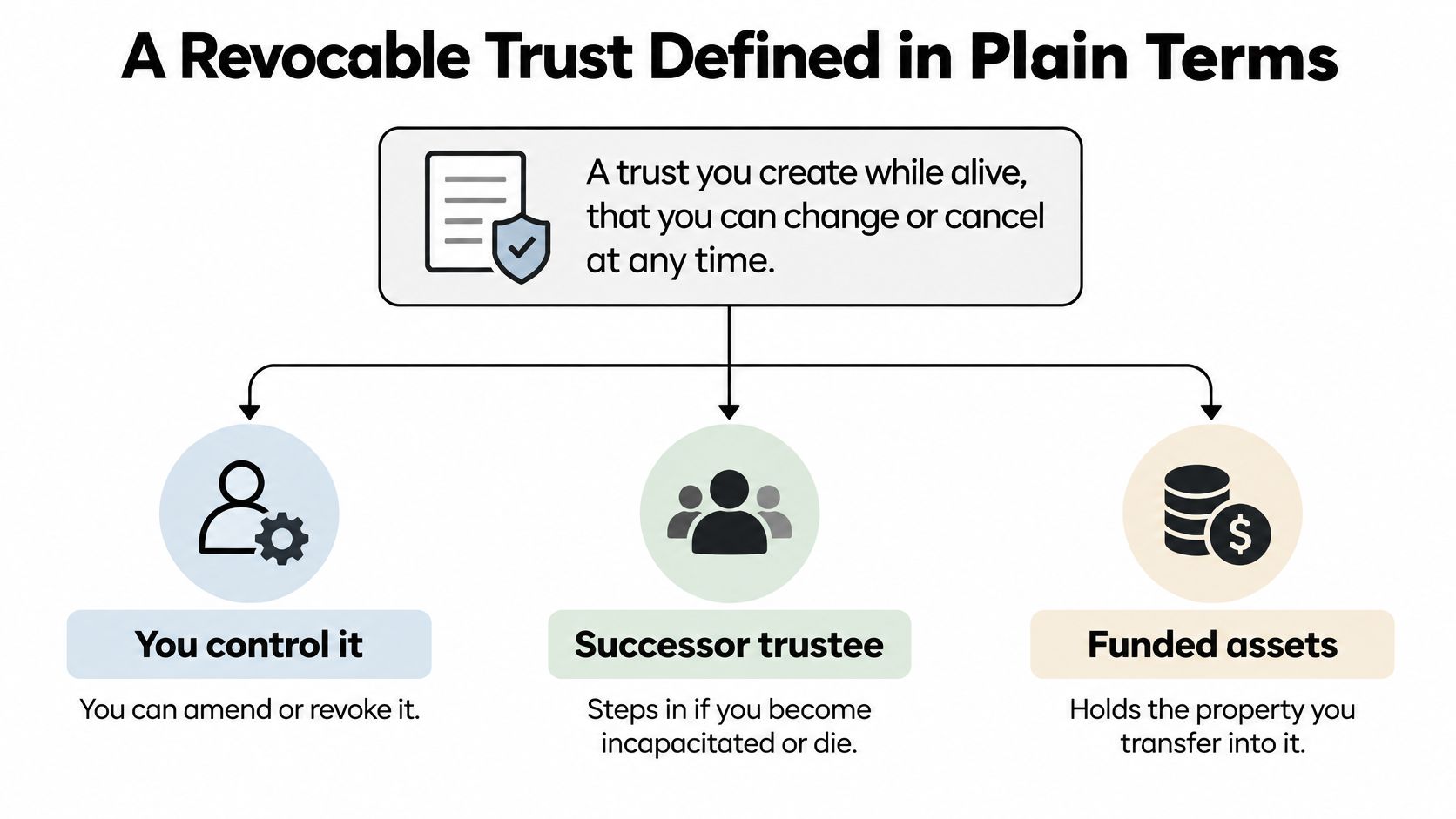
Funding means transferring appropriate property into the trust, commonly by changing ownership records. Signing the agreement alone doesn't move your house or bank account into that storage box.
For another plain-language perspective, the Law Office of Bryan Fagan – Kingwood TX Lawyers discusses keeping family affairs private through trusts. Treat privacy as a planning objective, not a promise of secrecy.
Before drafting: Make a one-page asset list showing each asset's current owner and whether you want your successor trustee to manage it.
Which assets would you want someone to manage without seeking a court appointment if something happened to you?
How a Revocable Trust Works Through Three Stages
Consider a hypothetical example: Maria, 72, of Coral Gables, transfers her home and brokerage account into her revocable trust. She names her daughter as successor trustee and writes instructions for managing her finances and eventually distributing her property.
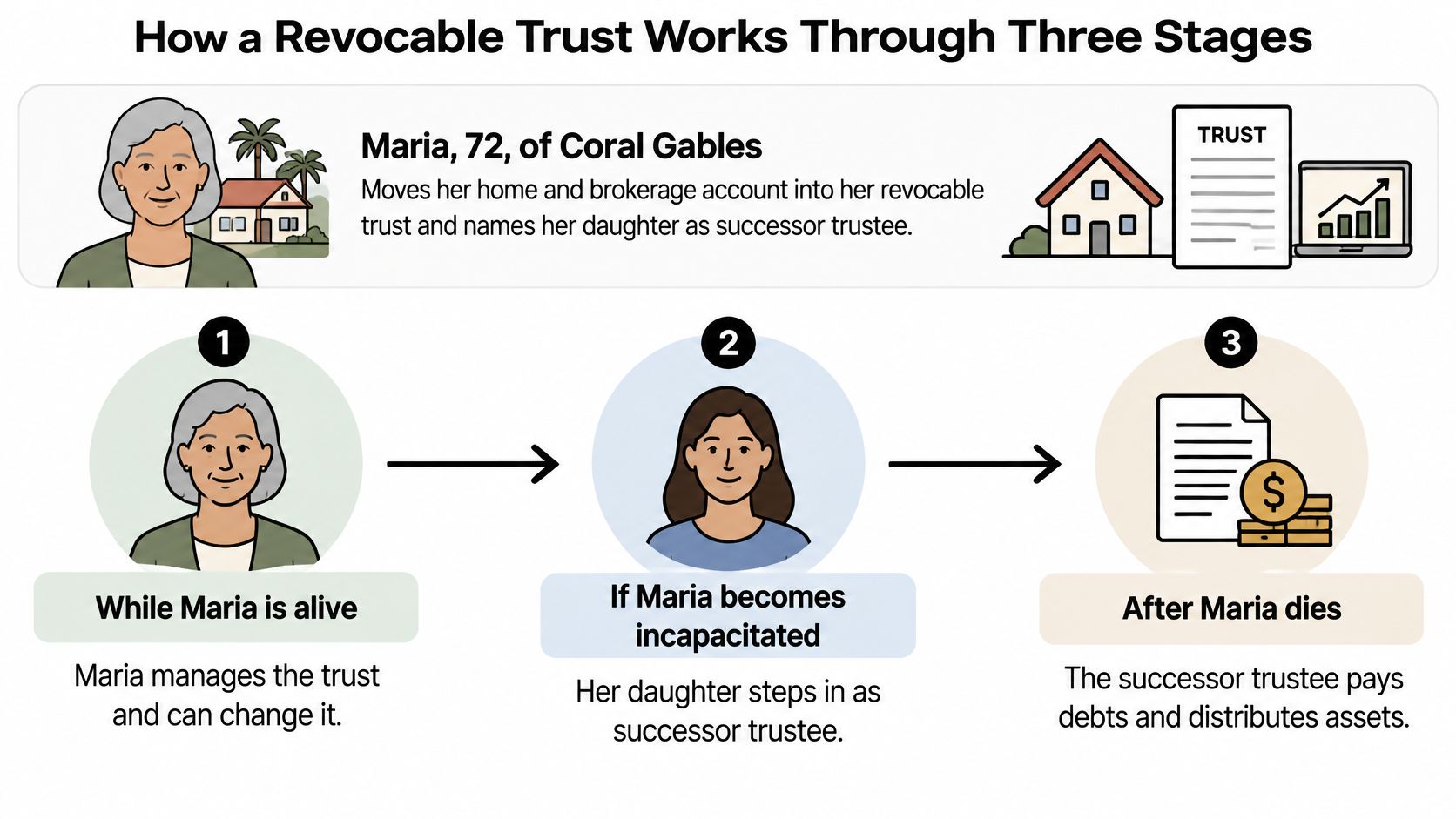
While Maria can manage her finances
Maria continues paying the mortgage and directing investments. She can buy and sell trust property and change her instructions while legally competent.
Her daughter's designation as successor trustee doesn't give the daughter permission to override Maria. For your own plan, ask: does the document preserve the control you expect to keep?
If Maria becomes incapacitated
Suppose Maria's agreement says her daughter takes over after a physician certifies that Maria can't manage her financial affairs. Once that requirement is satisfied, her daughter follows the trust's instructions and uses the trust-owned brokerage account to pay Maria's bills.
That physician-certification requirement belongs to this example, not every trust. Your agreement should explain exactly how incapacity is established, who receives the supporting documentation, and how authority returns if you recover.
Ask: could your chosen successor understand the trigger without guessing? Vague language can leave family members and financial institutions uncertain about who may act.
After Maria dies
Her daughter identifies and gathers trust assets, addresses valid debts, expenses, and taxes, and follows the distribution instructions. Those instructions might require outright distributions or continued management for beneficiaries, including minors.
The daughter isn't free to substitute her own idea of fairness. Her responsibility is to follow the agreement and applicable law.
Practical tip: Ask your successor to read the incapacity provisions now and explain, in their own words, when they would take over. Tell them where the signed agreement and account information are kept.
Then write down who would pay your mortgage and access your accounts while you're well, during incapacity, and after death. Confirm that your documents authorize the person you've named.
What a Revocable Trust Does and Does Not Do
The main benefit is continuity of management and potential probate avoidance for properly funded assets. Probate is the court process for administering certain property after someone dies.
The American Bar Association's explanation of revocable trusts distinguishes that administrative benefit from tax savings and cautions that a living trust can almost never eliminate probate entirely.
What a revocable trust does and does not do
| Goal | Achieved by a revocable trust? | Why |
|---|---|---|
| Manage assets during incapacity | Yes | The successor trustee acts under the written incapacity provisions |
| Keep the plan out of public records | Partly | Probate filings may be avoided, but beneficiaries, banks, and courts can still receive trust terms |
| Reduce federal estate tax | No, not by itself | Retained control generally keeps assets in the grantor's taxable estate |
| Shield assets from creditors | No, generally | The grantor can revoke, so creditors generally can reach trust property |
| Separate income tax from the grantor | No, generally | The trust is generally disregarded as a separate income-tax entity during the grantor's life |
Privacy and tax treatment are separate questions
Probate avoidance isn't secrecy. The Maryland Register of Wills' revocable-trust publication explains the public-record distinction between probate property and trust property. Although that publication addresses Maryland, its privacy discussion illustrates why avoiding routine probate disclosure doesn't prevent disclosure to beneficiaries, financial institutions, or courts.
Likewise, avoiding probate doesn't remove property from your taxable estate. The estate-tax question concerns what property counts for federal tax purposes, not whether a court supervises its transfer.
During life, the grantor generally remains responsible for the trust's income-tax items. Moving an investment account into a standard revocable trust doesn't, by itself, turn the account's earnings into someone else's taxable income.
A trust also doesn't replace every other planning document. A Florida power-of-attorney overview and sample discussion can help you understand a separate document that authorizes an agent to handle specified matters outside the trustee's role.
A signed trust agreement isn't proof that a particular asset will avoid probate. Check the ownership record.
Tip: List your priorities, such as bill payment during illness, reduced public disclosure, creditor planning, or tax planning. Match each priority to the table before assuming a revocable trust alone accomplishes it.
Revocable, Irrevocable and Will Compared
A revocable trust emphasizes flexibility and continuity. An irrevocable trust generally requires surrendering meaningful control in pursuit of specific planning goals. A will directs inheritance at death and can nominate guardians for minor children, but doesn't provide lifetime asset management.
These tools aren't interchangeable. The right choice depends on the job you need the document to perform, not which name sounds more protective.
Revocable trust, irrevocable trust and will compared
| Criterion | Revocable trust | Irrevocable trust | Will |
|---|---|---|---|
| Can you change it later? | Yes, the grantor can amend or revoke while competent | Generally no unilateral right to revoke; permitted changes require legal analysis | Yes, while competent |
| Takes effect | During life, with instructions for incapacity and death | Usually when signed, with asset administration requiring funding | Only at death |
| Avoids probate for funded assets | Generally yes | Generally yes | No, probate is usually required for property passing under it |
| Included in taxable estate | Generally yes | Generally no when structured to accomplish estate exclusion | Yes, property passing under a will generally remains included |
| Requires asset transfers to work | Yes, funding required | Yes, funding required | No lifetime funding, but probate property passes through administration |
| Typical main purpose | Flexibility and incapacity planning | Specific tax or creditor goals with less control | Naming heirs and guardians for minors |
Why a trust plan still includes a will
A pour-over will directs eligible property left outside your trust into it after death. It's a backstop, not a substitute for lifetime funding, because property passing through that will may still need probate.
For example, you might open an account in your individual name and never coordinate it with your estate plan. A pour-over will can direct its eventual destination, but it doesn't retroactively make the account trust-owned during your lifetime.
Irrevocable planning deserves particular care. The word irrevocable alone doesn't guarantee estate-tax exclusion or creditor protection. The provisions, retained powers, timing, and applicable law determine the result.
The guide to Florida trust laws provides context for discussing those choices with counsel.
Decision tip: Choose revocable planning when flexibility and incapacity management are your priorities. Before considering an irrevocable arrangement, identify the specific tax or creditor problem and ask what control you would have to surrender to address it.
Who Uses a Revocable Trust and Why
A revocable trust may suit a family with property in more than one state, a blended family, or someone who wants a trusted person to manage assets if they become unable to do so. The key question is whether the trust's terms fit the family's needs and whether the relevant assets are transferred into it. A trust controls only the property it holds.

Common family situations
A parent needs financial backup. Elena wants her son to pay household bills if she becomes ill. Trust provisions can authorize management of assets held in the trust, so she should discuss the role with him and make sure the relevant property is transferred into it.
A family owns homes in different states. The Patel family owns a Florida residence and an out-of-state cabin. If the cabin is properly transferred into the trust, it may avoid a separate probate proceeding there. The deed and transfer requirements depend on the property's location.
A blended family wants clear boundaries. David wants his spouse to use property after his death, with what remains eventually passing to children from a prior marriage. Trust terms can set out how the property is managed and distributed, rather than leaving those expectations to informal promises.
Parents want managed inheritances. Ana and Luis want a trustee to manage inherited property for their minor children. Their instructions can specify permitted expenses and when distributions should occur.
Fit matters more than popularity
Retirement-community residents should review their estate documents to make sure they fit their circumstances and Florida requirements. A discussion of estate documents for 55+ community residents offers general planning context, but the page addresses Texas, not Florida.
Tip: Start by listing the people who may need to manage or receive property, then check which assets the trust would control. Substantial assets, complicated family relationships, or a need for financial backup may make trust planning useful. A small, straightforward estate may call for simpler arrangements.
Florida Trust Administration Compared With Probate
In Florida, a funded revocable trust generally lets the successor trustee manage trust assets after death without first obtaining a court appointment. Property left outside the trust may require probate unless another valid transfer method applies.
The Florida Bar's revocable-trust consumer guide explains that avoiding probate doesn't eliminate administration. Someone must still identify property, address obligations, maintain records, and carry out the distribution instructions.
Florida trust administration versus probate
| Feature | Funded revocable trust | Probate estate |
|---|---|---|
| Court appointment before managing assets | Generally not required for the successor trustee | Required for a personal representative |
| Public filing | Notice of Trust filed with the clerk in the county of residence | Will and estate filings enter the court record; access to particular documents is governed by Florida law |
| Creditor claim window | Potentially longer when no probate proceeding is commenced | A shorter non-claim procedure can apply when statutory requirements are satisfied |
| Post-death obligations | Address valid claims, expenses, and taxes before appropriate distributions | Payment of claims and expenses through probate administration |
The Notice of Trust and creditor timing
Under the Florida Bar's probate guidance, a trustee must file a Notice of Trust with the clerk in the county where the deceased settlor resided; without a probate proceeding, potential creditor claims against revocable-trust assets can extend up to two years, compared with a three-month non-claim period available in certain probate administrations.
The notice identifies the deceased grantor and current trustee. Filing it doesn't mean the trustee can immediately distribute everything or assume that all creditor rights have ended.
Sometimes opening probate is useful even when a trust holds much of the property. The choice requires reviewing claims, remaining assets, and the procedures available, rather than treating probate as something to avoid under every circumstance.
For Florida-specific preparation, consult the overview of the probate process in Florida. The Law Office of Bryan Fagan probate timelines resource offers a separate Texas perspective, not a timetable or legal standard for Florida estates.
Administration caution: Don't promise beneficiaries a distribution date before reviewing debts, taxes, and the legal procedures for handling claims.
Tip: Obtain legal and tax guidance promptly after death. Distributing assets too quickly can leave the trustee facing unpaid obligations and potential personal exposure.
How to Create and Fund a Revocable Trust
Creating the document and implementing it are separate tasks. The Cornell Legal Information Institute's revocable-trust explanation describes the lifetime transfer of ownership that allows a trust to function as a will substitute.
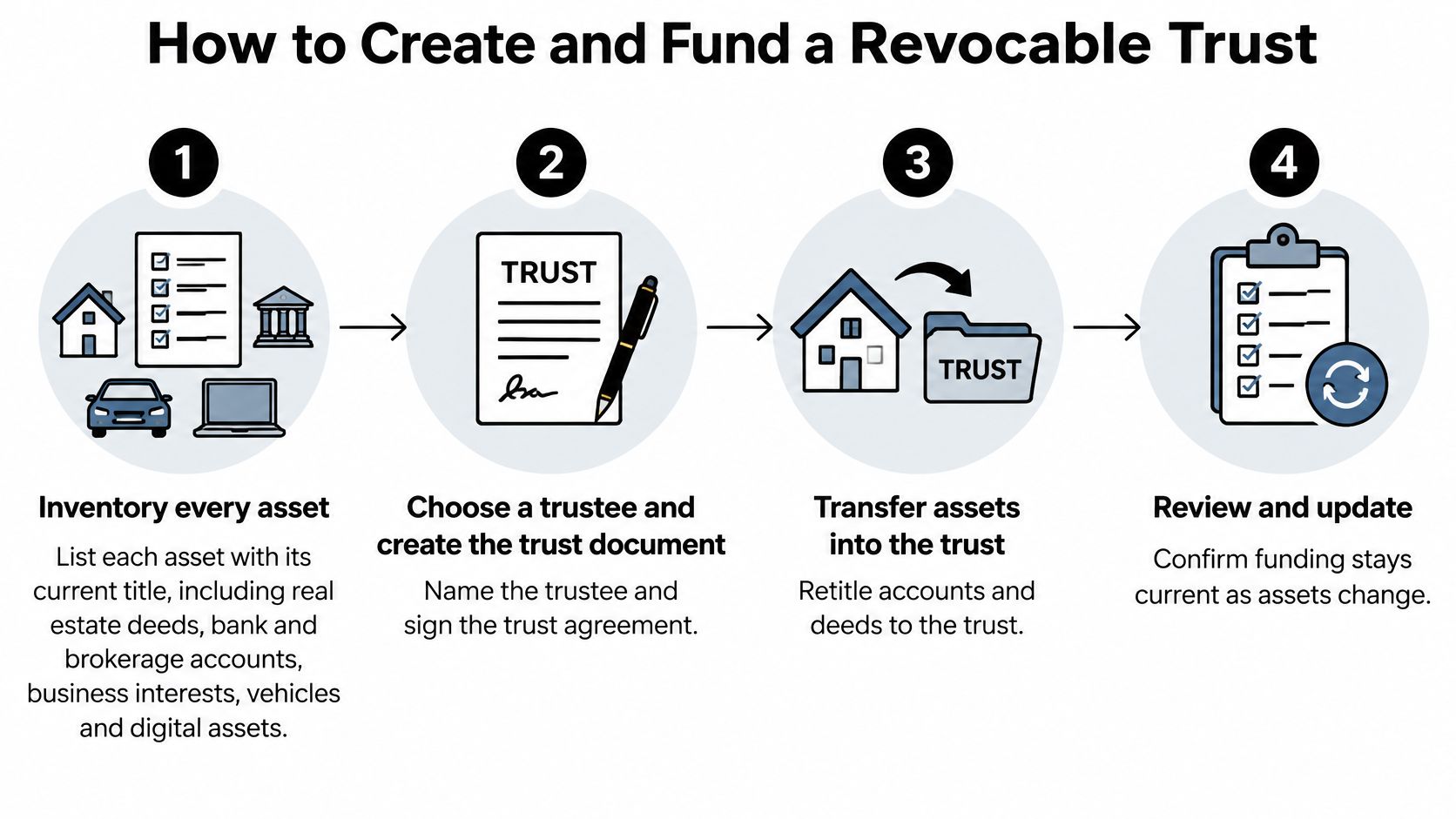
From inventory to implementation
Inventory every asset and its current title. Include deeds, bank and brokerage accounts, business interests, vehicles, and digital assets. Don't rely on memory or list only account balances; ownership and beneficiary records determine how the plan operates.
Choose a trustee and at least one successor. Name them in the agreement and discuss the responsibilities before signing. Someone who loves your family may still lack the time or judgment to manage investments, records, and beneficiary communications.
Draft usable incapacity instructions. Specify how the successor's authority begins and how funds may be used for your care and household obligations. Avoid assuming that relatives or banks will infer what you intended.
Sign under the applicable Florida requirements. Have counsel confirm execution formalities for your agreement and related documents. A downloaded form with incomplete signing formalities can create uncertainty when nobody can ask you to clarify.
Transfer appropriate assets. Counsel should review a deed transferring the home to the trustee, account re-registration, and business assignments permitted by governing agreements. A major implementation failure is leaving the home individually titled despite having a signed trust; Florida homestead, insurance, and ownership considerations require attention before recording a deed.
Review beneficiary designations. Coordinate retirement accounts and life insurance with the plan instead of automatically retitling everything. Naming a trust as beneficiary can have consequences that require separate tax and distribution analysis.
Execute a pour-over will. Use it to address eligible assets missed during funding and other matters a will handles. Don't treat its existence as permission to leave the transfer work unfinished.
Keep proof, not just intentions
Maintain a funding checklist with these fields:
- Asset and current owner: Identify the property and exact registration.
- Required action: Record the deed, account change, assignment, or beneficiary review needed.
- Completion evidence: Keep the recorded deed, institution confirmation, or executed assignment.
- Review trigger: Recheck after purchases, sales, marriage, divorce, or other significant changes.
Funding tip: Prioritize reviewing the home's title rather than assuming it was handled. Retitle it only after counsel confirms the appropriate Florida treatment.
For later changes, use a signed written amendment that follows the agreement and applicable law. A full revocation or restatement should follow the formalities your attorney confirms, with related ownership and beneficiary records reviewed as needed.
When to Call a Florida Attorney and Your Next Step
Get legal help when the difficult part isn't the definition of a trust but how your family, assets, and existing documents fit together. A generic agreement can leave important decisions unresolved.
Situations that warrant individualized advice include:
- Property across state lines: Deeds and local transfer requirements need coordination.
- Business ownership: LLC agreements and closely held company documents may restrict transfers.
- Blended families: Spousal benefits and children's eventual inheritances need precise instructions.
- Minor or disabled beneficiaries: Distribution provisions should address management needs and potential benefit consequences.
- Complex estates: Tax, creditor, and ownership questions may require tools beyond a revocable trust.
- Related decision-making documents: Financial authority, healthcare decisions, and guardianship planning need compatible instructions.
Prepare for an asset-by-asset conversation
Bring your asset list, deeds, account registrations, beneficiary confirmations, and existing estate documents. Ask the attorney to distinguish what needs drafting from what needs transferring, and identify who will complete each task.
A consultation typically addresses the trust, funding, and coordination with a pour-over will. Ask how fees are structured, which documents you'll receive, and whether implementation assistance is included.
At Coto & Waddington, Attorneys at Law, our listed services include Business Law, Trusts & Estates, and Homeowners Association (HOA) Law. Our related planning services include durable powers of attorney, healthcare directives, and guardianship planning.
Preparation tip: Request an asset-by-asset review rather than assuming one document resolves probate and tax questions alike. An attorney-client relationship with our firm forms only through a signed engagement agreement, not by making an inquiry.
Coto & Waddington, Attorneys at Law offers customized revocable living trust planning to help families organize asset management and inheritance instructions. Gather your asset list and visit Coto & Waddington, Attorneys at Law to book a consultation about creating, funding, or reviewing your Florida trust plan.