The USPTO base fee is $350 per class for Sections 1 and 44 applications, but your real trademark budget also depends on the number of classes, professional fees, filing strategy, and later maintenance. A one-class filing and a three-class filing are different budget decisions, not different versions of the same bill.
You're at your laptop in Miami, trying to decide whether the brand name you've built is finally ready for federal protection. The headline number looks manageable until you list the software, consulting, apparel, subscription, or retail services you plan to offer. Then you discover that trademark registration fees can grow by class, country, description length, filing basis, and renewal deadline.
That's the conversation founders need before signing a retainer. The government fee is only one layer. You may also pay for clearance work, legal strategy, application drafting, responses to USPTO correspondence, international designations, and post-registration filings. The practical question isn't, “How much does a trademark cost?” It's, “Which costs protect the business I'm building, and which costs come from avoidable drafting or planning mistakes?”
A useful primer on the difference between a company name and a protectable brand is Inpro's practical trade name guide. Keep that distinction clear before you spend money on an application.
This guide walks through the bill in the order a South Florida founder should review it: classes first, USPTO base fees and surcharges next, intent-to-use timing after that, professional fees, international options, and the maintenance charges people forget. The figures are current as of early 2026, but USPTO fees can change. This is practical information for budgeting, not a substitute for a confidential legal consultation about your mark.
Table of Contents
- What Founders Pay to Register a Trademark
- Understanding Trademark Classes and Why They Drive the Bill
- USPTO Base Fees and the New Surcharges That Catch Applicants Off Guard
- Intent-to-Use Costs and the Six-Month Notice of Allowance Clock
- What Attorneys and Trademark Agents Typically Charge
- International Trademark Fees When You Sell Beyond the U.S.
- Building a Realistic Trademark Budget and Next Steps
What Founders Pay to Register a Trademark
A founder reviewing a trademark bill should separate it into three layers:
- Government fees, paid to the USPTO or another trademark office.
- Professional fees, covering searches, legal analysis, drafting, filing, and prosecution.
- Lifecycle fees, triggered by intent-to-use deadlines, extensions, statements of use, and registration maintenance.
For a qualifying U.S. application filed under Sections 1 or 44 of the Trademark Act, the USPTO's 2025 structure starts at $350 per class (USPTO fee changes). That figure covers one class, not every product or service your company may offer. The bill grows as you add classes, countries, filing steps, and renewal obligations.
The invoice grows from business decisions
A restaurant may need one class for restaurant services. A technology company may need separate coverage for downloadable software and software as a service. A clothing company may need a class for apparel. Each legitimate additional class raises the government baseline.
The filing basis changes the timing and total cost. If you already use the mark in commerce, you may avoid later use-based filings required by an intent-to-use application. If the business has not launched, filing early can secure a strategic position, while creating future statement-of-use and extension costs.
Budget rule: Do not request a trademark quote until you know the mark, owner, actual goods and services, filing basis, and countries that matter.
Professional fees reflect the work performed. A filing-only service may prepare and submit the application. A fuller engagement may include a clearance search, legal opinion, class strategy, drafting, filing, monitoring, and responses to USPTO objections. Compare the deliverables, not just the price.
Before paying for an application, review Inpro's practical trade name guide to confirm that the company name and the protectable brand are not being confused.
The most common waste is filing a weak or overbroad application before deciding what the company sells. International filings create another expensive mistake when founders add countries without a sales or enforcement reason. Build the budget around commercial priorities, then fund the protection that supports them.
Understanding Trademark Classes and Why They Drive the Bill
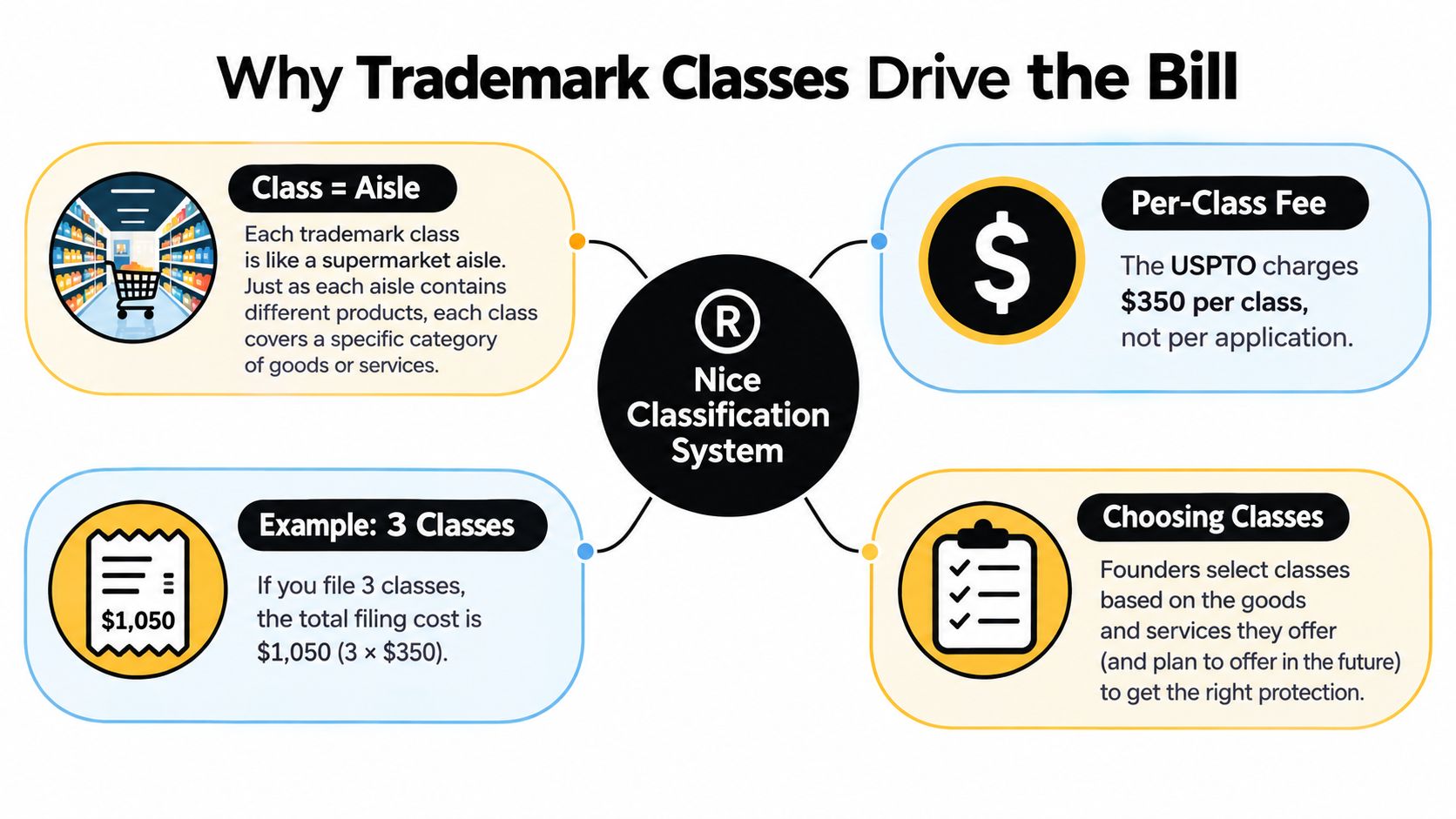
The Nice Classification system organizes goods and services into classes. Think of each class as a supermarket aisle. The grocery store doesn't charge you one price for entering the building and then let you claim every aisle. Trademark offices generally charge according to the aisles, or classes, your application covers.
Match each class to real commercial activity
The USPTO calculates almost all trademark fees by class. The practical result is simple. If your application covers two classes, the government generally charges twice the applicable per-class amount, not one application fee that happens to include two categories (USPTO trademark fee information).
Consider common South Florida businesses:
- Restaurant: Class 43 can cover restaurant services.
- Software startup: Class 9 may cover downloadable software, while Class 42 may cover software as a service.
- Clothing brand: Class 25 can cover apparel.
- Consulting company: A service class may be appropriate for the consulting work, depending on the precise service description.
A technology founder who sells downloadable software and separately provides software as a service may have a legitimate reason to evaluate two classes. A founder who hopes to enter an unrelated industry someday doesn't automatically need that class today.
Speculation is an expensive substitute for strategy
Adding a class can expand the application's scope, but it doesn't strengthen the brand merely because the class appears on paper. A speculative class raises the government fee and may create a problem later if the business can't support the claimed goods or services.
Use this test for every proposed class:
- Do we provide this good or service now?
- If not, is there a concrete launch plan rather than a vague idea?
- Does the proposed description accurately reflect what customers receive?
- Would losing this category create a meaningful business problem?
Practical advice: Start with the revenue channels and customer-facing offerings that matter. Don't buy protection for an imaginary business.
The class decision also affects professional fees because more classes require more analysis and drafting. A clean class strategy can control both government and legal costs. A sprawling list can make the application look ambitious while delivering little practical value.
USPTO Base Fees and the New Surcharges That Catch Applicants Off Guard
A founder can budget $350 for one class and still receive a $750 government bill. The difference usually comes from the application's information and wording, not from the brand's complexity. The USPTO now uses a single $350 base application fee per class for Sections 1 and 44 applications, replacing the former TEAS Plus fee of $250 per class and TEAS Standard fee of $350 per class. The current structure also adds charges for incomplete information and free-form goods-and-services descriptions, as outlined in the USPTO 2025 fee changes.
Read the fee line by line
| Fee Type | Amount Per Class | When It Applies |
|---|---|---|
| Base application fee | $350 | A qualifying Section 1 or Section 44 application |
| Insufficient information surcharge | $100 | The application lacks required information |
| Free-form identification surcharge | $200 | The applicant uses free-form wording instead of the Trademark ID Manual |
| Additional character-group surcharge | $200 | Each additional 1,000-character group beyond the first 1,000 in the free-form identification |
The $100 insufficient-information surcharge is a filing penalty. It does not buy broader or better protection. If required details are missing, a planned $350 class becomes more expensive before an examiner reviews the mark.
The $200 free-form surcharge applies when you write your own identification instead of selecting wording from the USPTO's Trademark ID Manual. Custom language can be appropriate, but it should not be your starting point. Search the manual first. That review can avoid the surcharge and give the application wording the office already recognizes.
Character count creates another avoidable cost. The USPTO charges $200 for each additional 1,000-character group beyond the first 1,000 characters in a free-form identification, per affected class. Descriptions that combine several products, technical features, sales channels, and hypothetical offerings can grow quickly without adding useful protection.
Clean filing versus avoidable expense
| Filing approach | Government result |
|---|---|
| One qualifying class with complete information and accepted identification | $350 per class |
| One class with insufficient information | $450 per class |
| One class using free-form wording | $550 per class |
| One class with free-form wording plus one additional character group | $750 per class |
The table shows why a single class can run from $350 to $750 based on drafting choices rather than business complexity. Control the bill by limiting the identification to goods and services you provide or intend to provide, then checking the manual before choosing custom language.
Founders comparing government charges across jurisdictions can also review your ASIC fee guide. The systems differ, but the budgeting rule is the same: identify each fee trigger before submitting.
Florida applicants should also review Florida trademark application requirements before finalizing a filing strategy. Paying for a careful application is usually preferable to paying to repair an avoidable filing problem.
Intent-to-Use Costs and the Six-Month Notice of Allowance Clock
An intent-to-use application is for a founder who isn't yet selling goods or providing services under the mark but has a genuine plan to do so. It can make strategic sense for a startup preparing a launch, especially when the brand is being developed before inventory, software, or distribution is ready.
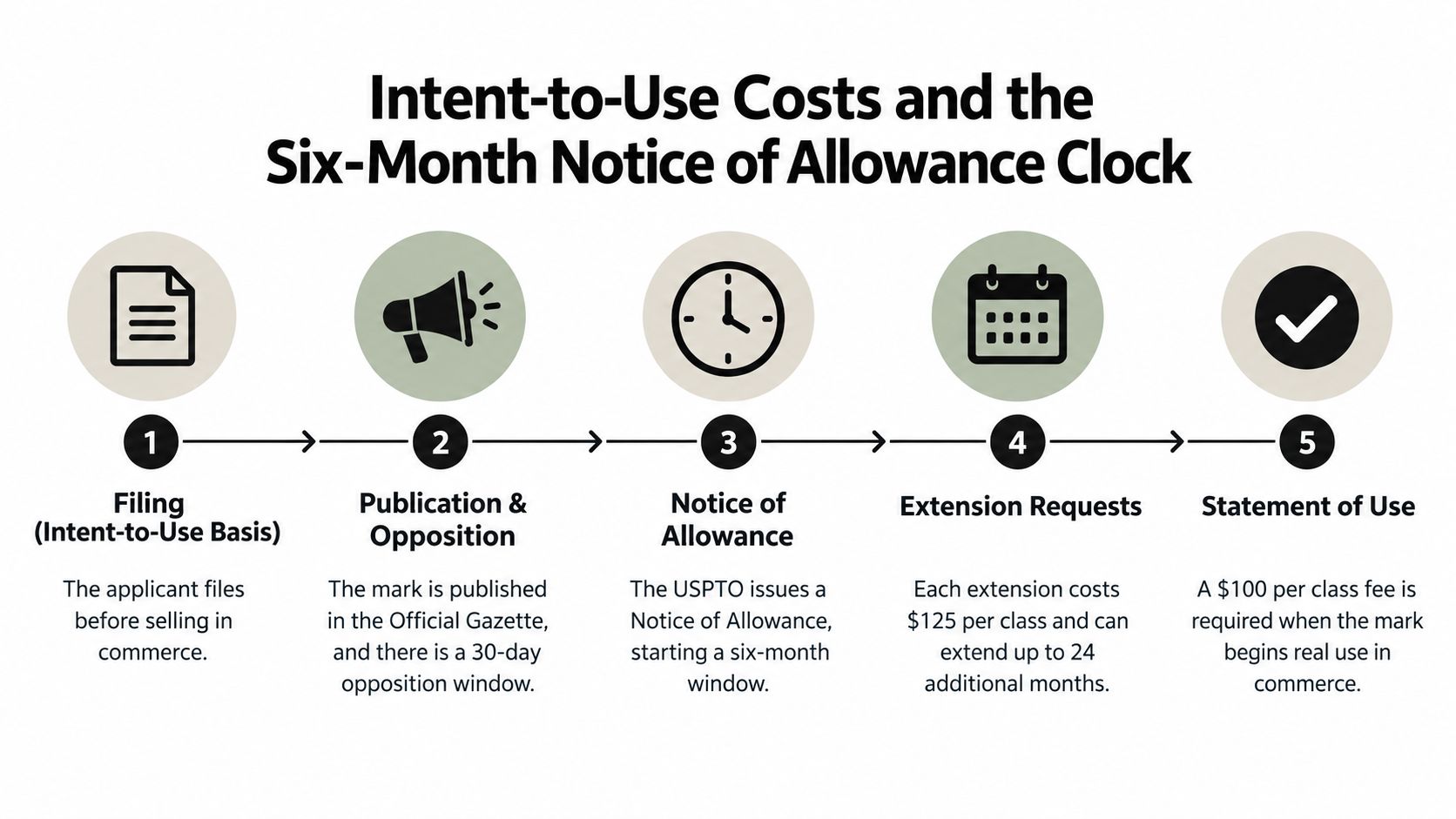
The cost problem starts after the USPTO issues a Notice of Allowance. The applicant gets a six-month window to file a Statement of Use or request an extension. A Statement of Use costs $150 per class, and each extension request costs $125 per class (USPTO cost guidance).
Model the launch delay before filing
Assume a startup files in January before its product is available. The company then receives a Notice of Allowance while manufacturing, fulfillment, and distribution are still being arranged. If the founder isn't ready to show real use by the deadline, the company requests an extension. If the launch slips again, another extension may be necessary. Once the product is in commerce, the company files the Statement of Use.
The government charges for every class at each step. An application that began with a $350-per-class base fee can therefore accumulate additional use-based and extension charges while the founder waits for launch. The original filing budget can roughly double once the business needs repeated extensions and then a Statement of Use.
Put the deadline on someone's calendar
Track the Notice of Allowance date as a legal deadline, not as a marketing milestone. Preserve specimens showing actual commercial use, such as the way the mark appears on the goods, packaging, website, or service sales process. If the Statement of Use isn't timely and acceptable, the application may be abandoned, and USPTO filing fees aren't refunded.
Launch discipline matters: If the product won't be ready, budget for extensions before you file. Hope is not a filing strategy.
The alternative is waiting until launch and filing under Section 1(a), a use-in-commerce basis. That may reduce delay-related government charges, but waiting can expose the brand to intervening filings or business changes. A founder should compare the likely intent-to-use total with the commercial risk of waiting, rather than choosing based only on the initial fee.
If the mark is a logo, the same timing analysis applies to the design and the evidence showing how customers encounter it. This overview of how to trademark a logo can help founders separate design protection questions from launch timing.
What Attorneys and Trademark Agents Typically Charge
Professional fees often exceed the government filing fee because the lawyer's work begins before the application reaches the USPTO. A responsible engagement may include a clearance search, legal analysis, class selection, identification drafting, application preparation, filing, and management of the early prosecution process.
Compare the service, not just the price
A filing-only quote may cover data entry and submission. A fuller flat-fee package may include:
- Clearance search: Reviews relevant records and marketplace use before filing.
- Legal opinion: Explains whether the proposed mark presents meaningful conflict or registrability concerns.
- Application drafting: Matches the identification to actual goods and services.
- Filing: Submits the application and handles basic filing formalities.
- Initial prosecution: May include a response to the first office action, depending on the engagement.
Ask what isn't included. Office action responses may be separate. Oppositions, appeals, consent agreements, foreign counsel, monitoring, specimens, amendments, and additional classes can all generate new work. A low initial quote becomes expensive when every predictable issue appears on a separate invoice.

Flat fees create a better budget conversation
For a South Florida founder, a sensible quote should identify the government fee separately from the professional fee and explain the assumptions behind the legal price. One class, a strong mark, a clean search, and no office action is a different assignment from three classes, a crowded field, an intent-to-use basis, or a mark that needs substantial narrowing.
Large firms may bill hourly. That structure can work for complex disputes, but it can make a routine application difficult to forecast. A boutique firm may offer a flat fee for defined work, then quote separately for unusual prosecution or disputes. The important point is not that one billing model always wins. It's that the scope must be written down.
Review the trademark and business services offered by Coto & Waddington's small business legal team when comparing South Florida counsel. The firm describes practical support for entrepreneurs and small companies, including trademarks and related business matters.
Ask before signing: How many classes are included, what search is performed, whether the first office action is covered, and which government fees remain separate?
Professional help is most valuable before filing, when class selection and identification wording can still be changed without building a repair project around a weak application. Don't pay for a cheap submission if the mark hasn't been cleared or the goods and services haven't been defined.
International Trademark Fees When You Sell Beyond the U.S.
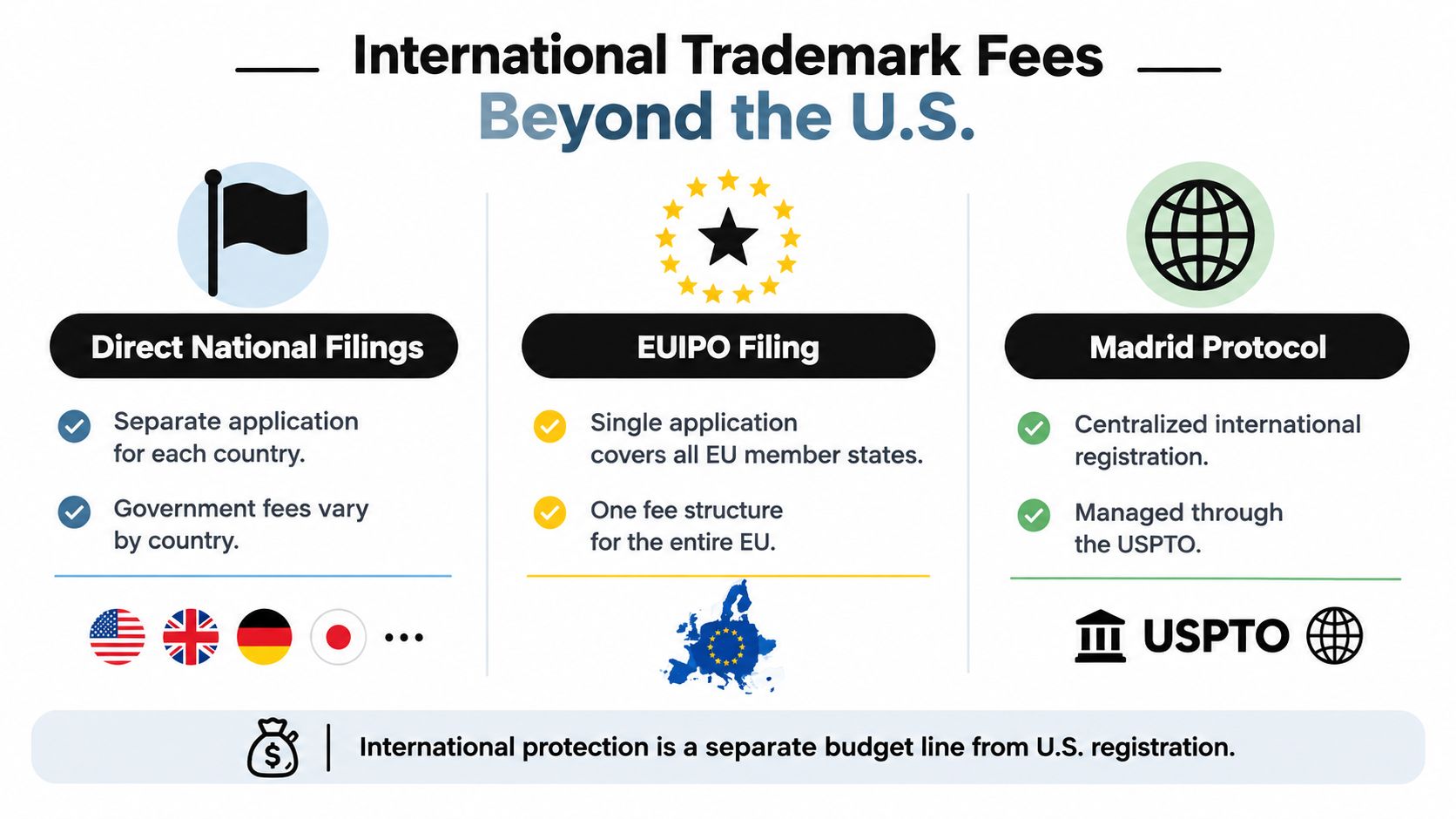
International protection is a separate budget line. A U.S. registration doesn't create one worldwide trademark, and expanding into another market requires a deliberate choice among direct national filings, an EUIPO application, or the Madrid System.
Three routes, three pricing models
An EU trade mark provides a single registration framework across EU member states. For an ordinary electronically filed individual mark, the fee is €850 for the first class, €50 for the second, and €150 for each additional class (EUIPO fee schedule). That makes a three-class application €1,050 and a five-class application €1,350.
The former Community trade mark system bundled up to three classes into a €900 electronic application and charged €1,050 for a paper application. The later EUTM model made the relationship between commercial scope and official fees more explicit, so founders should select classes based on real business activity rather than automatically reproducing a broad list.
The Madrid System uses a layered model. WIPO's basic fee is 653 Swiss francs for a black-and-white mark or 903 Swiss francs for a color mark. Country-specific fees then apply for each designated member, and a supplementary fee of 100 Swiss francs applies for each class above three where the standard fee structure is used. All Madrid fees are paid in Swiss francs, so a U.S. founder also faces exchange-rate variability (WIPO Madrid fees).
| Route | Base Structure | Typical First-Class Cost | Key Variable |
|---|---|---|---|
| Direct national filings | Separate application in each country | Varies by country | National fee, classes, local counsel, and examination |
| EUIPO filing | One EU trade mark application | €850 for the first class | Additional classes and EU-wide refusal or opposition risk |
| Madrid System | Basic fee plus designated-country and class charges | 653 Swiss francs black-and-white, or 903 Swiss francs color | Designated countries, classes, mark color, and exchange rates |
Choose countries by business exposure
The Madrid route centralizes filing and later portfolio management, but each designated office still examines the mark under its own law. Direct national filings may give you more control in priority markets or may be cheaper when you only need protection in a small number of countries.
The USPTO's Madrid-related Section 66(a) application fee increased from $500 to $600 per class in 2025, and the subsequent-designation fee also increased from $500 to $600 per class (WIPO Madrid fee calculator). For a Miami e-commerce company selling into Latin America, Canada, or Europe, model the United States, the European Union, and each priority export market separately.
Building a Realistic Trademark Budget and Next Steps
A founder can budget for one U.S. class, then watch the bill grow through extra classes, intent-to-use filings, foreign designations, legal work, and renewals. Build the budget from the business outward. List the mark, owner, actual offerings, filing basis, target countries, professional scope, and maintenance dates before signing a retainer.
| Scenario | Government starting point | Costs that may follow |
|---|---|---|
| Single-class U.S. filing | $350 for one qualifying class | Search, legal work, office action response, and maintenance |
| Multi-class U.S. filing | $350 multiplied by each qualifying class | Additional class-based drafting, prosecution, and later maintenance |
| U.S. plus international filing | U.S. class fees plus selected foreign route | EUIPO classes, Madrid designations, Swiss-franc charges, currency movement, and local examination |
Do not accept one blended professional-fee number. A one-class clearance and filing assignment requires a different scope from a multi-class intent-to-use application with international planning. Request a written quote that separates USPTO fees, legal fees, and later event fees. That format shows which charges are predictable, optional, or triggered by delay.
The line items founders forget
- Section 9 renewal: The USPTO increased the renewal application fee from $300 to $325 per class in 2025. Treat the renewal as a per-class charge, not a single portfolio expense.
- Five-year declaration: The USPTO lists a $325 fee for a five-year declaration and $650 for a combined five-year declaration and ten-year renewal, with charges calculated per class where applicable.
- Intent-to-use filings: Statement-of-use and extension fees can accumulate if a launch slips.
- International expansion: Madrid country designations and EUIPO additional classes increase the foreign budget as your commercial footprint grows.
- Brand scope: A logo, word mark, software offering, consulting service, or apparel line may require different class and evidence decisions.
Before filing, compare the cost of protecting one class with the cost of leaving a core offering exposed. Then run the same exercise by country. A founder selling apparel should also review branded apparel strategies while defining the goods and commercial scope of protection.
Bring your proposed mark, owner information, current offerings, launch plans, target countries, and existing branding or sales materials to a short trademark consultation. Counsel can identify avoidable surcharges, set a defensible class list, and explain whether filing now fits the budget.
Coto & Waddington, Attorneys at Law offers trademark registration support for businesses in Miami, Broward County, and the broader South Florida market. Visit Coto & Waddington, Attorneys at Law to discuss your classes, filing basis, international priorities, and total expected cost before you commit.