
The popular advice on small business legal fees is to find the lowest hourly rate. That advice misses the economic problem founders face. The more useful question is, what will legal risk cost the business over its life, and which legal work can be priced and handled before a preventable issue becomes an emergency?
For a South Florida startup, legal spending usually includes more than formation paperwork. Contracts, ownership records, employment decisions, privacy policies, trademarks, fundraising documents, regulatory updates, and dispute response can all affect cash flow. A sensible budget separates one-time setup work from recurring support and treats preventive counsel as risk control, not merely overhead.
Table of Contents
- The True Cost of Avoiding Legal Counsel
- Decoding Common Legal Billing Structures
- Typical Price Ranges for Routine Business Matters
- How to Evaluate Engagement Letters and Scope
- The Hidden Labor Costs of DIY Compliance
- Building a Predictable Legal Budget in South Florida
The True Cost of Avoiding Legal Counsel
Many founders postpone legal advice because a lawyer's invoice feels more concrete than the risk being managed. A template appears inexpensive. A handshake feels efficient. An owner may also believe that a contract, equity arrangement, or compliance policy is “good enough” until a customer, investor, employee, or regulator tests it.
That approach often transfers cost instead of eliminating it. A weak customer agreement can complicate collection. An incomplete founder agreement can create conflict over ownership or decision-making. A copied privacy policy may not match the company's actual data practices. By the time counsel is involved, the lawyer may be repairing a relationship, reconstructing records, or negotiating under deadline rather than reviewing a clean document before signature.
The available survey data makes the false economy visible. A 2025 survey found that 47% of small businesses lost at least $500 because of legal issues, nearly one in five lost more than $5,000, and 40% missed revenue opportunities because of legal uncertainty (Rocket Lawyer's 2025 small-business survey). Those losses don't represent only courtroom judgments. They can include delayed transactions, unrecovered invoices, abandoned deals, and management time spent correcting legal uncertainty.
Prevention beats fragmented emergency work
Preventive work has a defined decision point. Before signing a major customer contract, counsel can identify indemnity, payment, termination, intellectual-property, and governing-law provisions that deserve attention. Before bringing in a co-owner, a lawyer can document contributions, voting rights, departures, and transfer restrictions. Before launching a consumer-facing product, the business can align its privacy disclosures with its actual operations.
Emergency work is different. It may involve multiple people, incomplete documents, urgent communications, and a business decision that can't easily be reversed. The resulting legal bill reflects not just legal analysis, but the cost of speed, uncertainty, and remediation.
Practical rule: Compare preventive legal spending with the financial exposure being managed, not with zero spending.
A South Florida founder also needs to account for local operating realities. Businesses may work across municipalities, serve customers in different states, hire contractors remotely, or handle personal information through online platforms. A limited-scope review at the right moment won't eliminate every risk, but it can prevent a routine business decision from becoming an expensive legal project.
Decoding Common Legal Billing Structures
The billing model matters because it shapes behavior, timing, and total cost. Founders often fixate on the hourly rate, but the better question is what the arrangement does to the life of the matter. A low quoted rate can still produce an expensive file if the scope is loose, revisions keep expanding, or the work starts only after a problem is already live.
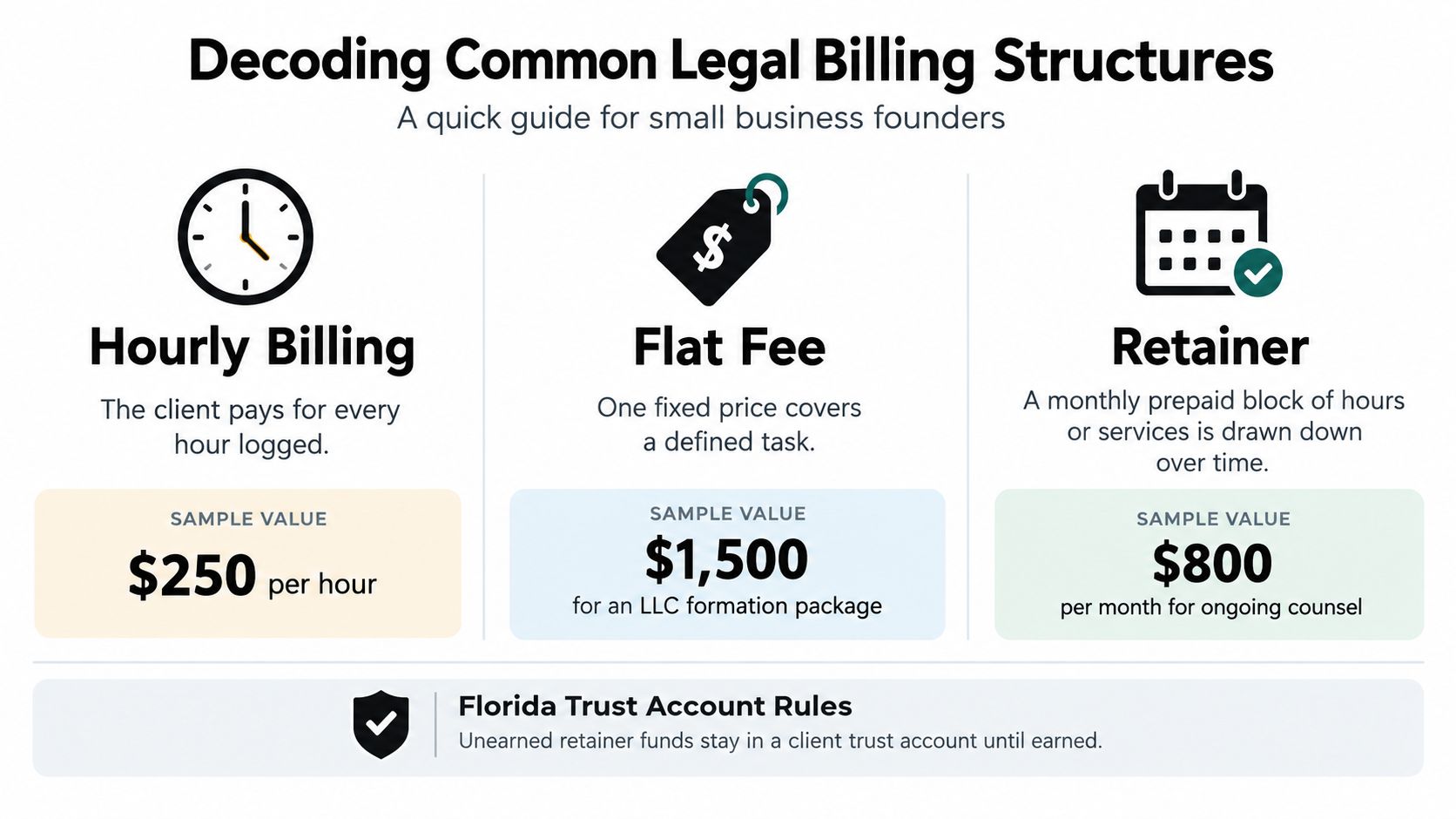
Hourly billing charges for recorded time. The final bill depends on the lawyer's rate, the hours required, who works on the matter, and any added expenses. For small businesses, a metropolitan rate can approach $300 per hour, and 15 hours would produce about $4,500 before filing charges and other costs, according to a U.S. Small Business Development Center summary of legal-services research. Hourly work can make sense for negotiations, disputes, or projects where the facts may shift. It is harder to budget when no one has pinned down the decision points, the document set, or the approval chain.
Flat fees work better when the assignment is defined at the start. Entity formation, a contract package, a policy set, or a filing stage often fits that model. The trade-off is scope discipline. A flat fee does not cover every follow-up question, every rewrite, or every side issue that appears once the work begins. A good engagement letter should state the deliverables, assumptions, revision limits, excluded services, government charges, rush work, and the rate for anything outside scope.
A retainer is where founders get confused. The label alone tells you very little. It may be an advance deposit against future hourly work, a fee earned on receipt, or a recurring monthly arrangement for a defined set of services. Florida draws real distinctions among retainers, advances, earned fees, and expenses, and those distinctions affect where the money goes and when it becomes the lawyer's property.
How Florida handles client funds
Under Florida Bar Rule 5-1.1, money received for fees, costs, or expenses generally must be placed in a separate, federally insured trust account, not the lawyer's operating account (Florida Bar rules on trust accounting). Until earned or properly applied, an advance remains the client's property.
Read the engagement letter closely. It should explain the opening balance, what triggers billing against the funds, which expenses may be paid, and how unused money is returned. If you want predictable access instead of episodic cleanup, review how fractional general counsel services are commonly structured, then confirm response times, covered matters, excluded litigation, and rollover treatment before signing.
Contingency billing is more common in disputes than in startup counseling. In Florida, compensation tied wholly or partly to a successful prosecution or settlement requires a written, client-signed agreement (Florida Bar fee agreement guidance). Whatever the model, document the trigger, calculation method, expenses, staffing, invoice timing, and approval threshold.
Typical Price Ranges for Routine Business Matters
Routine business work rarely stays routine for long. What matters is not just what a lawyer charges by the hour. It is what the matter costs over its full life cycle if the first draft is too thin, the scope is unclear, or the business waits until a problem turns urgent.
There is no universal South Florida price sheet for startup legal work. Entity choice, cap table complexity, industry rules, document quality, timing, and the number of revision rounds all change the quote. A single-owner formation is a very different project from a company with multiple founders, contributed intellectual property, investor-facing documents, and regulated operations.
The best way to compare small business legal fees is to separate the task from the billing method and from the risk of rework later. The table below is a planning tool, not a guaranteed quote. As noted earlier, hourly rates in metropolitan markets can make undefined matters expensive fast, which is why founders often get better budget control from a clearly scoped flat fee or an ongoing fractional counsel arrangement.
| Legal Service | Typical Cost Range | Common Billing Model |
|---|---|---|
| Entity formation | Depends on structure, ownership, and scope | Flat fee or hourly |
| Founder or operating agreement | Depends on negotiation and complexity | Flat fee or hourly |
| Trademark filing | Depends on search, filing stage, and response work | Flat fee by stage or hourly |
| Standard commercial contract | Depends on template, customization, and negotiation | Flat fee or hourly |
| Contract review | Depends on length, risk, and turnaround | Flat fee or hourly |
| Ongoing corporate maintenance | Depends on frequency and service coverage | Subscription, retainer, or hourly |
A formation package gets the company started. It usually does not cover the follow-up work that keeps the company out of preventable trouble. Founders commonly need annual maintenance, ownership updates, contract revisions, privacy terms, employment documents, trademark strategy, and advice before signing leases, taking on investors, or entering major vendor relationships. Those items belong in the budget as separate line items.
Many founders misread a low quote. A smaller upfront fee can still produce a higher total cost if it excludes the documents the business will predictably need in the next few months, or if every revision starts a new billing cycle. Predictable pricing works best when the scope matches the company's actual operating pattern.
Contract-heavy businesses benefit from systematizing this work early. Working with a small business contract lawyer can turn recurring drafting and review into a defined process instead of a string of emergency fixes.
Founders should also pay attention to how firms describe their services in public. Clear descriptions usually signal clearer scoping. Vague promises often lead to scope disputes later. Digital Skyrocket's law firm marketing ethics tips offer a useful outside check on whether a service description explains the work or sells certainty without defining the terms.
How to Evaluate Engagement Letters and Scope
A quote is only as reliable as the document behind it. Read the engagement letter as a project specification, not as a formality. If the letter says “formation services,” ask which entity documents, resolutions, ownership records, filings, tax elections, registered-agent services, and follow-up questions are included.
Florida defines a flat fee as payment for the legal services specified in the representation. The agreement should identify exactly what the fixed amount covers and separately identify government fees and out-of-scope work (Florida Supreme Court discussion of flat fees).

Build a scope-of-work matrix
Create a simple list with four columns: deliverable, included, excluded, and price treatment. Use it to compare proposals line by line.
- Defined deliverables: Identify the exact documents, filings, calls, and review stages included.
- Excluded services: Look for litigation, tax advice, accounting, immigration, patent work, extensive negotiation, and unrelated employment matters.
- Third-party charges: Separate government filing fees, registered-agent charges, searches, expedited services, transcription, and vendor costs.
- Revision limits: Confirm how many drafts or rounds of comments are included and what counts as a new project.
- Staffing assumptions: Ask whether a partner, associate, paralegal, or outside specialist will perform each task.
- Change orders: Require written pricing before work outside scope begins.
- Approval thresholds: For hourly work, negotiate a not-to-exceed ceiling or approval requirement before the matter exceeds a stated amount.
The details matter because a “flat” project can still contain variable elements. A filing may require an additional government charge. A contract may expand after the other side sends extensive revisions. A trademark matter may move into a different stage. A written change-order process lets the owner decide whether the new work is worth the cost before the invoice grows.
Ask this before signing: “What facts would cause this quote to change, and how will I approve that change?”
Also ask how invoices will describe time and expenses. A useful invoice should let you connect each charge to a deliverable or decision. If an initial payment is called a retainer, determine whether it is an advance held in trust, an earned flat fee, or a monthly payment for defined services. Those categories affect accounting, refunds, and expectations.
The Hidden Labor Costs of DIY Compliance
DIY compliance doesn't mean the work is free. The founder may spend evenings reading agency guidance, comparing policy language, updating onboarding documents, tracking renewals, and deciding whether a contractor classification or privacy question requires professional review. The business pays through management time, delayed decisions, and the opportunity cost of work the owner could have delegated.
A 2025 European SME study estimated that businesses devoted about 1.5 billion hours annually to legal compliance, representing approximately EUR 61 billion in labor costs, with the average SME spending about 32 working hours per month on compliance (KfW analysis of bureaucracy and SME compliance). The figures concern compliance labor broadly, not a U.S. legal invoice, but they illustrate why internal effort belongs in the budget.
Decide what belongs inside the business
Owners should distinguish legal judgment from administrative execution. A bookkeeper may handle records. An HR platform may organize onboarding. An insurance broker may address coverage. A technical consultant may implement security controls. A lawyer should advise on legal obligations, draft or review legal documents, and help the owner choose among risk-based options.
A practical comparison looks like this:
- Keep routine administration internal: Maintain a renewal calendar, organize executed agreements, and preserve decision records.
- Use specialized operational tools: Compare HR platforms with a PEO vs HRIS guide when deciding how employment administration should be supported.
- Outsource recurring legal judgment: Use counsel for policy updates, contract standards, employment questions, privacy changes, and issue-spotting.
- Escalate high-impact decisions: Obtain review before investment, a major customer commitment, a new co-owner, a brand launch, or a material change in data handling.
Fractional counsel can make sense when legal questions recur but a full-time legal department would be disproportionate. The arrangement should state what the lawyer covers, how quickly the firm responds, whether unused time carries forward, and which matters are billed separately. The point isn't to outsource every business decision. It's to avoid paying the founder to repeatedly relearn the same legal issue.
Building a Predictable Legal Budget in South Florida
A predictable budget begins with an inventory, not a guess. List the legal events your business expects during the coming year and separate them into setup, recurring maintenance, transactions, and disputes. A startup may need formation and founder documentation first. A growing company may need contract support, employment updates, privacy work, trademark protection, and fundraising review. A family-owned company may prioritize succession, ownership transfers, and asset protection.
The SBA reports that the average U.S. company pays approximately $13,000 per employee each year to comply with federal regulations, a broad average rather than a quote for legal services or a prediction for a particular company (SBA guidance on rules and responsibilities). The practical lesson is that compliance exposure belongs in operating planning, especially as headcount and regulatory obligations grow.
Use a quarterly legal-risk calendar
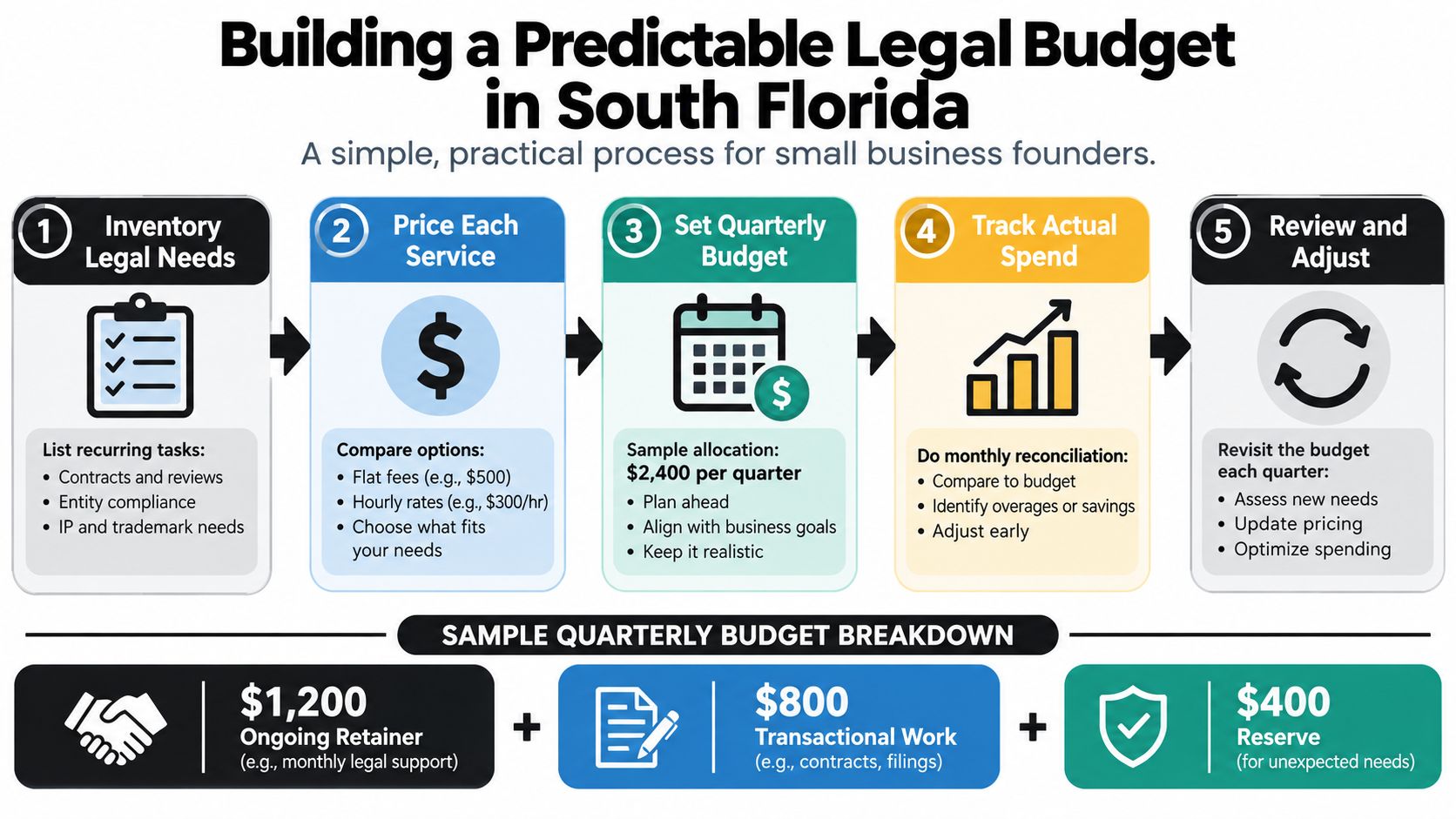
- Inventory legal needs. Record renewals, filings, contract cycles, employee changes, policy reviews, intellectual-property tasks, and anticipated transactions.
- Price each service. Request separate estimates for flat-fee work, hourly matters, filing charges, third-party costs, and recurring counsel.
- Set a quarterly allocation. Create a planned amount for ongoing support, transactional work, and a reserve for unexpected issues.
- Track actual spending. Reconcile invoices monthly and compare the work performed with the agreed scope.
- Review and adjust. At the end of each quarter, move resources toward the risks and transactions the business is encountering.
A budgeting method should match the business's cash-flow pattern and decision-making style. Founders who want to compare approaches can use this practical guide on how to pick a budgeting method, then adapt the method to legal work rather than treating counsel as an unplanned exception.
The budget should also identify the cost of delay. If a major contract is likely to close, schedule review before the deadline. If the company is hiring, update employment documents and processes before the first dispute. If a brand is becoming valuable, address trademark strategy before the business has invested heavily in promotion. The most useful legal calendar connects each expense to a business event and a financial exposure.
For South Florida founders, small business legal services can be structured around formation, contracts, trademarks, compliance, and recurring advice. A boutique bilingual firm may offer flat pricing for defined projects and monthly support for continuing needs, but the engagement still needs clear exclusions, response expectations, and change-order rules.
Coto & Waddington, Attorneys at Law helps South Florida founders and family-owned businesses with formation, contracts, trademarks, privacy and compliance policies, capitalization, and fractional general counsel support. Visit Coto & Waddington, Attorneys at Law to discuss a transparent legal-fee structure that fits your business's current risks and upcoming decisions.


