You opened the banking packet, saw the request for the LLC's operating agreement, and realized the file you've been leaning on is either a one-page template or nothing at all. That's the moment many Florida founders learn the hard way that a single member LLC operating agreement Florida isn't paperwork for the drawer, it's the document that shows who can act, what the company stands for, and what happens when life gets messy.
For a solo owner, the agreement does three jobs at once. It gives you internal authority, it gives banks and investors a clear record, and it gives family members a path forward if you die or become incapacitated.
Table of Contents
- Why a Single Owner in Florida Still Needs an Operating Agreement
- How Florida Law Treats a Single-Member Operating Agreement
- The Core Clauses Every Florida Single-Member Agreement Should Contain
- Member-Managed Versus Manager-Managed and the Tax Election Question
- Sample Language You Can Adapt With Counsel
- Florida-Specific and 2026 Compliance Layers Founders Often Miss
- Your Customization Checklist and Next Steps
Why a Single Owner in Florida Still Needs an Operating Agreement
The problem usually shows up at the worst possible time. A bank asks who can sign for the company, and the banker wants more than your word. A title company or lender wants proof that the LLC is really being run as its own entity. A spouse, child, or personal representative needs to know who takes over if you can't manage the business yourself.
That's why the absence of a written agreement is expensive. It leaves authority, succession, and recordkeeping to assumptions, and assumptions don't hold up well in a dispute. Florida's veil-piercing analysis makes this even more practical, because courts and counterparties look for evidence that the company was treated like a real company, not just an alter ego of the owner, and that issue is explored in more depth in this discussion of piercing the corporate veil.
The document is evidence, not decoration
A useful single-member agreement is really an evidence-of-governance document. It shows that the owner made deliberate choices about authority, distributions, records, and succession. That matters when a bank asks for signer authority, when a buyer checks diligence, and when a family member needs to prove who had control after an incapacity event.
A thin template often looks fine until someone else needs to rely on it.
Florida's operating-agreement rules are broad enough to let the document do real work. But a bare-bones form usually doesn't explain enough to satisfy third parties, and it often leaves the hardest issues to default rules the owner never meant to accept. For practical drafting guidance on how business lawyers position these documents in the market, law firm marketing strategies can also help you see how strong legal positioning depends on showing authority clearly, not vaguely.
What it should prove
The agreement should prove three things simultaneously. First, that the owner controls the company on defined terms. Second, that outside parties can rely on a written governance record. Third, that the company can survive an interruption in the owner's ability to act.
That's the trade-off. If you treat the agreement as optional, you save a little time now and create avoidable uncertainty later. If you document the company properly, you give the LLC a structure that works inside the business, outside the business, and after the owner's lifetime.
How Florida Law Treats a Single-Member Operating Agreement
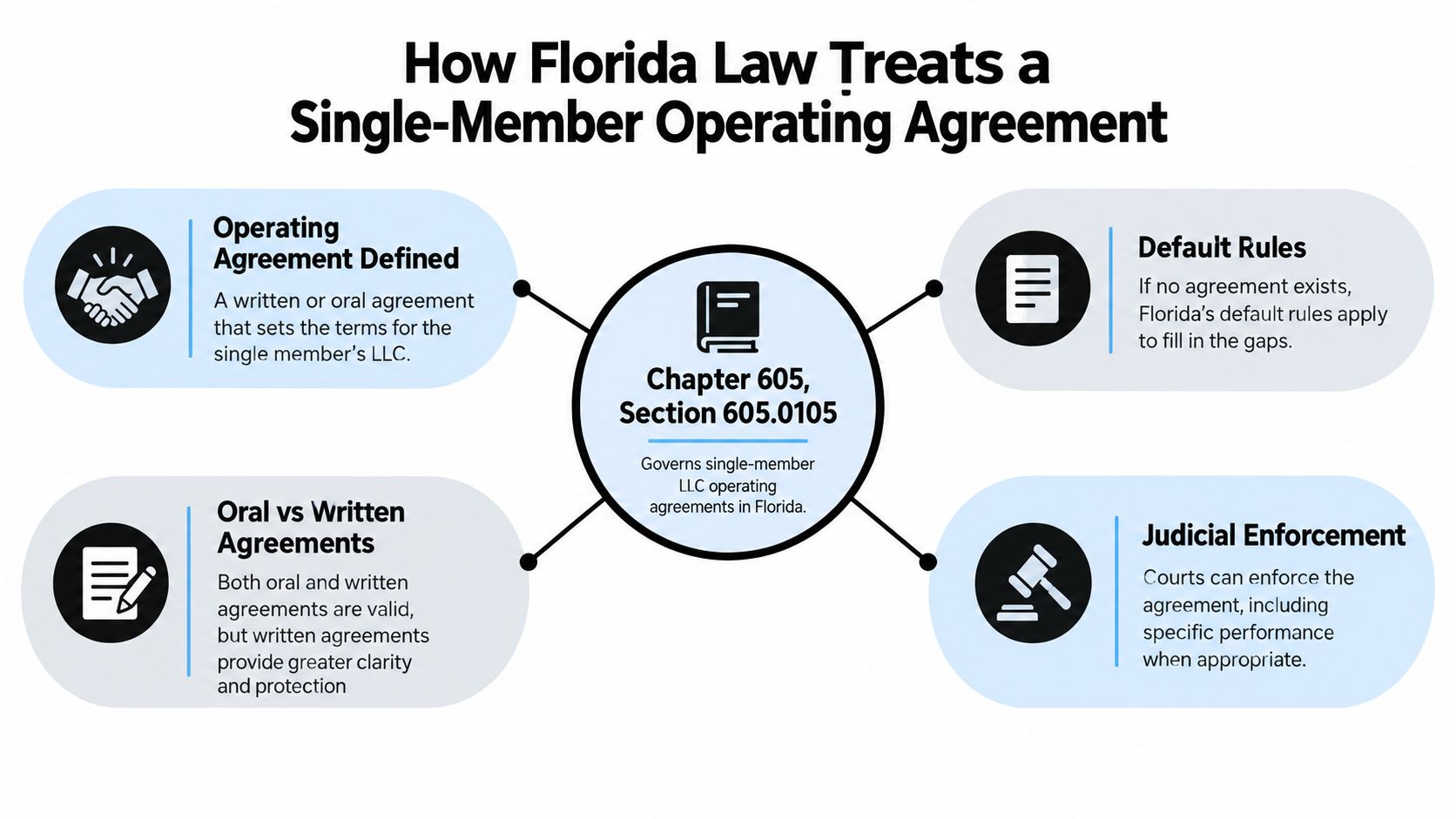
Florida's Revised Limited Liability Company Act makes the operating agreement the center of the company's internal governance. Under §605.0105, the agreement governs the LLC's activities and affairs, the relationship between the company and its member, the rights and duties of managers, and the amendment process. Where the agreement is silent, Florida supplies default rules, and where the statute contains mandatory protections, the agreement can't erase them Florida Statute §605.0105.
That means the first drafting question is simple. What do you want the agreement to decide, and what do you want Florida law to decide for you? In a single-member LLC, that choice matters more than many founders realize because silence becomes the rulebook.
Why one signature still works
Florida expressly rejects the idea that a single-member operating agreement is unenforceable just because only one person is involved. Section 605.0106 says that a one-member operating agreement isn't unenforceable merely because there is a single party, and it also lets the initial member agree to terms that become effective when the LLC is formed Florida Statute §605.0106.
That is a big deal for founders who think “single member” means “too informal to matter.” It doesn't. It means the governance document can be created around one decision-maker without pretending the company has a partnership structure it doesn't have.
Where the defaults quietly take over
If the agreement doesn't address an issue, Florida fills the gap. That can be helpful for routine matters, but it's risky for authority, banking, succession, and dissolution. A default rule may be legally valid and still completely wrong for the way your company operates.
Draft the document as if a banker, successor, and judge will all read it later, because eventually one of them might.
A written agreement still beats an oral or implied arrangement, even though Florida recognizes broad forms of operating agreements. The reason is evidentiary. A written document gives you cleaner proof of ownership, control, and decision-making, and it makes the company easier to explain to third parties who need certainty before they let anyone act in the LLC's name.
The Core Clauses Every Florida Single-Member Agreement Should Contain
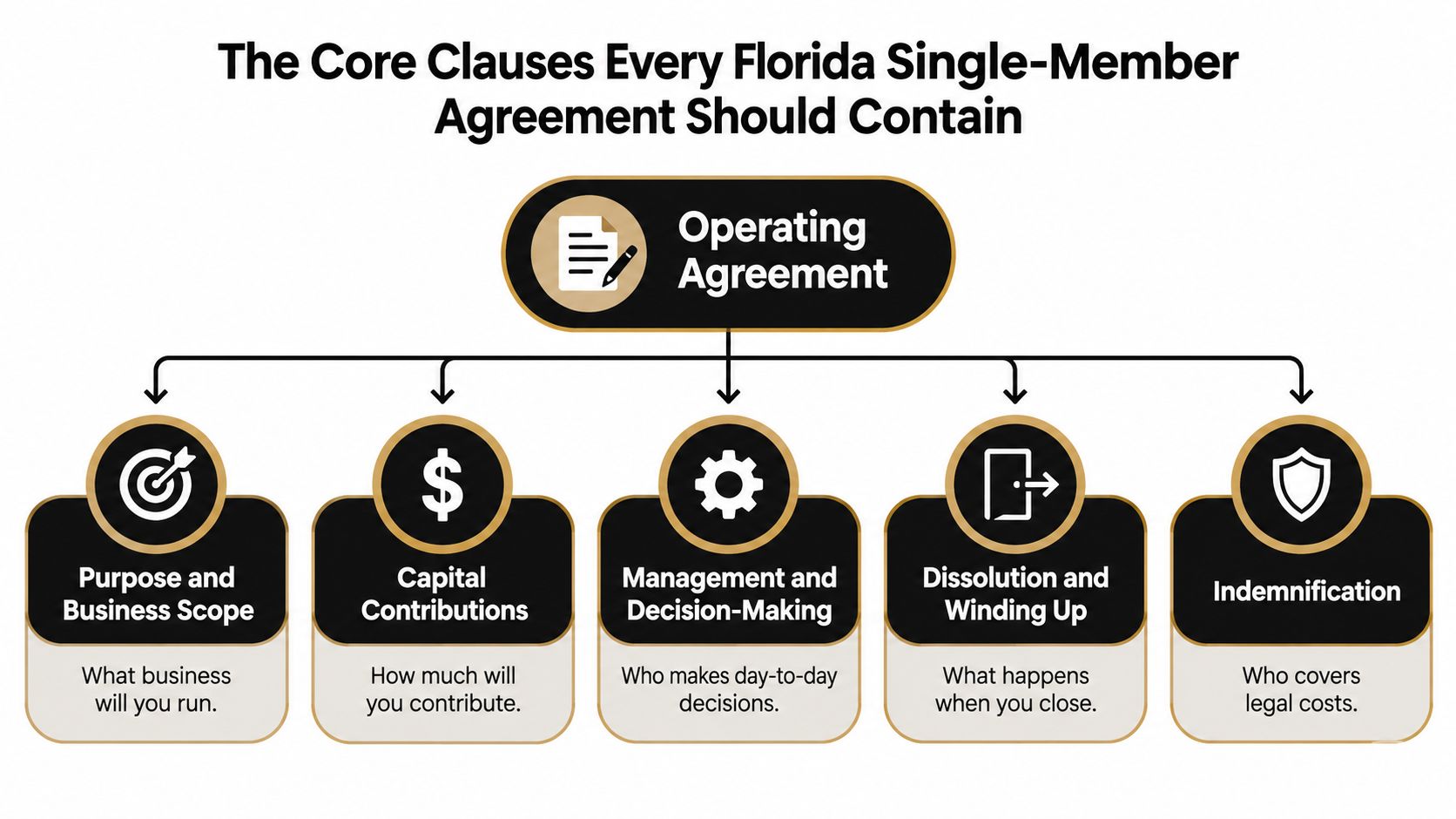
A good single-member agreement isn't long for the sake of being long. It's long enough to answer the questions that create friction later. The clauses that earn their keep are the ones that force a real decision, not the ones that copy generic LLC language from another state.
Purpose, member identity, and contributions
Start with the basics, but make them useful. The agreement should identify the LLC, state the business purpose, name the sole member, and record the initial contribution. That contribution can be cash, property, or services previously rendered, as long as the document accurately reflects what was given and why it matters.
If you skip this part, later questions get harder. Was the owner acting as an individual or on behalf of the LLC? Was the company funded with a real contribution or just run from the owner's personal account? Clear identification and contribution language help separate personal and business activity.
Management, authority, and money movement
Next comes control. The agreement should say whether the company is member-managed or manager-managed, who signs contracts, who opens bank accounts, and who can authorize payments. Even in a one-person company, that clarity matters if an assistant, spouse, officer, or outside manager handles day-to-day tasks.
The practical point is simple. If the agreement doesn't spell out signing and banking authority, the bank or counterparty may demand extra proof later. When the document does spell it out, you reduce friction and create a cleaner chain of authority.
Records, transfers, amendment, and exit
Books and records deserve their own section. The LLC should keep separate financial records, track distributions, and preserve approvals for major decisions. That's what lets you show that the business is real and not mixed with personal finances, which is one of the most common failure points in poorly run single-owner entities.
Transfer restrictions and amendment mechanics matter just as much. A single-member LLC today might not stay that way. The agreement should say how a future member gets admitted, how amendments are approved, and what happens if the business is sold, closed, or inherited.
For founders who want a more asset-sensitive drafting lens, the operational ideas in asset protection tips from Blue Sage Tax are worth reading alongside a Florida-specific agreement because the way you document authority affects how well the entity separates business risk from personal risk.
The best single-member agreements don't ask, “What's the minimum to file?” They ask, “What will I need to prove later?”
Member-Managed Versus Manager-Managed and the Tax Election Question
A solo founder still has to choose how the company is run. That choice affects who signs contracts, who handles banking, and how lenders, vendors, and investors read the LLC's authority.
Management structure
A member-managed structure keeps control with the owner and fits many small Florida companies. A manager-managed structure works better when someone else handles day-to-day operations, recurring contracts, or property management while the owner focuses on strategy, travel, or another business. The agreement should match the way the company functions, not the way a form assumes it does.
That decision has to line up across the paper trail. Resolutions, contracts, and banking records should tell the same story. If the agreement says the member runs the company but a manager keeps signing everything, outsiders start asking for proof.
Federal tax posture
A Florida single-member LLC is generally disregarded for federal income tax purposes unless it files Form 8832 to elect corporate classification. It remains separately recognized for employment tax and certain excise tax purposes IRS guidance on single-member LLCs.
The operating agreement does not change tax status by itself. It should support the chosen tax position with separate accounts, clear authority for elections, and records that match the filing posture. If the owner later elects corporate treatment, the agreement and bookkeeping system need to reflect that shift. Founders who want a working first draft before counsel reviews it can use an AI Contract Maker to shape the governance language, then tighten it for the company's facts.
What belongs in the document
The agreement should name who handles tax matters, who approves tax elections, and how the company records changes in classification. If the owner later wants payroll, benefit planning, or investor-facing corporate treatment, the governance record should already support that choice.
The tax question also belongs in the entity-choice conversation. A close look at LLC vs S-Corp for small business helps founders separate management authority from federal tax treatment, which is where DIY documents often go off track.
Sample Language You Can Adapt With Counsel
Below is the kind of language that usually works better than a copied internet form because it is specific enough to prove authority but flexible enough to fit a real company. Keep the wording tight, then adjust it with counsel to match your facts, taxes, and succession plan.
| Clause | Decision It Forces | Risk If Skipped |
|---|---|---|
| Purpose | What business the LLC is actually in | Confusion about scope and authority |
| Member identity | Who owns and controls the company | Weak proof of separation |
| Capital contribution | What the owner contributed | Disputes over funding and recordkeeping |
| Management structure | Who runs daily operations | Unclear signing and banking authority |
| Distributions | How money comes out of the company | Improper or undocumented owner draws |
| Records | What the company must keep | Poor evidence in banking or litigation |
| Transfer rules | How ownership can change | Unplanned admission of a new owner |
| Amendment and dissolution | How the company changes or ends | Informal edits and messy wind-up |
| Successor authority | Who acts after death or incapacity | Family conflict and operational paralysis |
Adaptable clauses
Purpose. “The Company is organized to conduct lawful business activities in Florida and elsewhere as determined by the Member.”
Member and contribution. “The sole Member is [Name], and the Member has contributed [cash, property, or services previously rendered] to the Company as reflected in the Company's books.”
Management. “The Company shall be [member-managed/manager-managed], and the Member retains authority to act for the Company unless delegated in writing.”
Signing authority. “The Member, or any person authorized in writing by the Member, may execute contracts, open or close bank accounts, and bind the Company within the limits stated in this Agreement.”
Distributions. “Distributions shall be made at times and in amounts determined by the Member after reserving for taxes, liabilities, and reasonable business needs.”
Books and records. “The Company shall maintain separate books, records, and financial accounts, and the Member shall keep the Company's affairs distinct from personal affairs.”
Transfer and future members. “No person becomes a member unless admitted in a written instrument approved by the Member and reflected in an amendment to this Agreement.”
Succession. “If the Member dies or becomes incapacitated, the designated successor authority may act only as allowed by this Agreement and applicable law.”
For founders who want a starting point before a lawyer customizes the final draft, the outline at business operating agreement template is a useful drafting reference, as long as it's adapted to Florida law rather than copied mechanically.
Florida-Specific and 2026 Compliance Layers Founders Often Miss
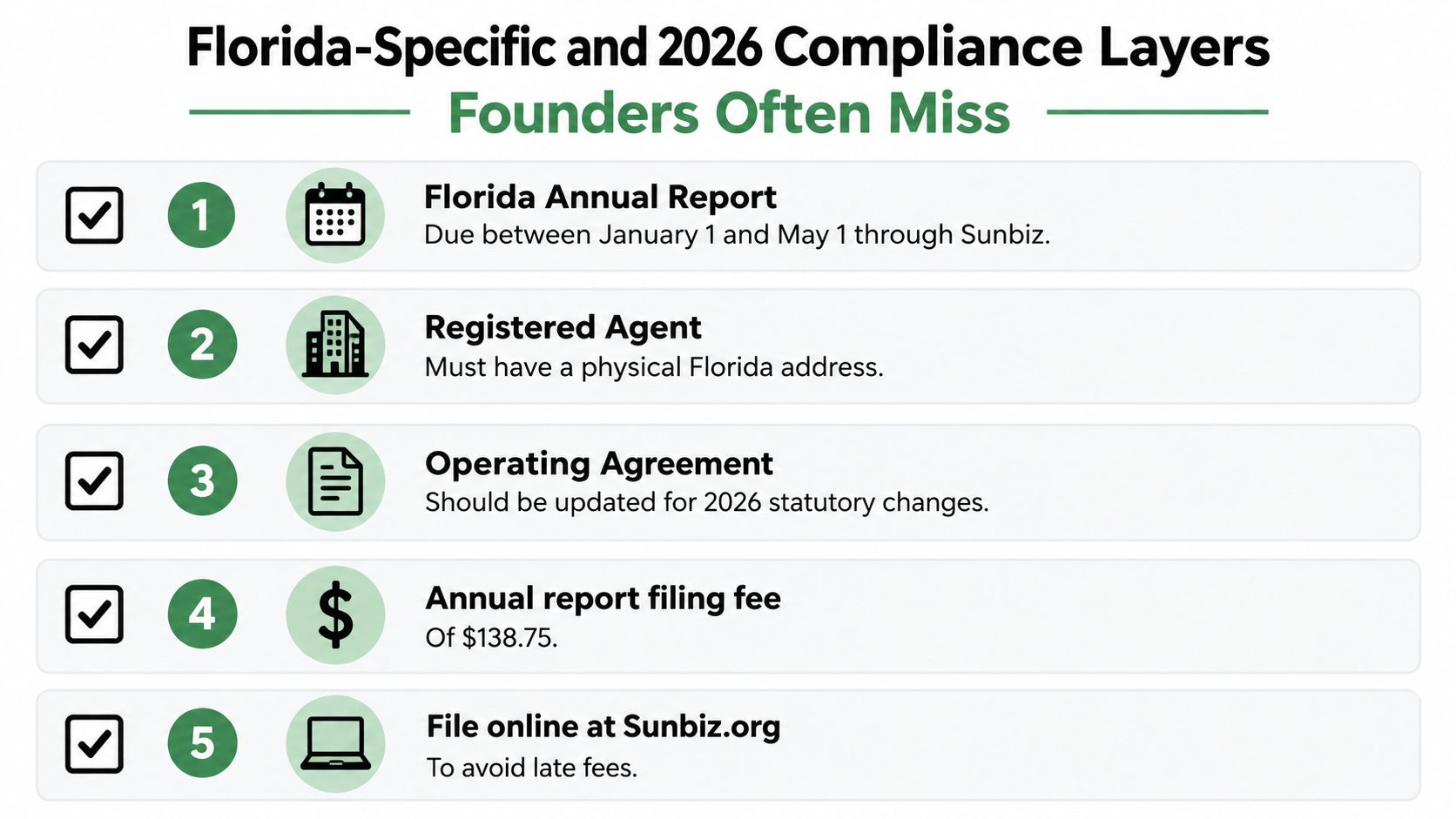
A Florida operating agreement should do more than describe ownership. It should assign who handles state filings, current reporting rules, and the routine compliance tasks that keep the company in good standing. Generic templates usually skip those details.
State filings and deadlines
Florida LLCs must file an annual report each year between January 1 and May 1, and Sunbiz lists the filing fee as $138.75 when filed in that window, with a $400 late fee after May 1 Sunbiz annual report filing page. That deadline sits outside the operating agreement, but the agreement should still name who files, who tracks the registered agent, and who keeps proof of submission.
A practical administrative clause reduces avoidable problems. It should require calendar reminders, a check of the company's public record, and prompt updates if the address or responsible person changes. Missing the filing deadline creates noise and cost without helping the business.
Federal reporting and privacy
FinCEN changed the Corporate Transparency Act reporting rules in 2025, and U.S.-created companies and U.S. persons are now exempt from the BOI reporting requirement under its interim final rule. Even with the BOI exemption, the agreement still needs privacy, recordkeeping, and ownership-change procedures, and it should not freeze an outdated filing assumption into the document. For the underlying rule update, see FinCEN's interim final rule guidance FinCEN interim final rule guidance.
The better approach is a change-management clause. If ownership, management, address, tax classification, or business purpose changes, the owner should review the company's federal and Florida reporting obligations again. That matters for family entities, trusts, holding companies, and e-commerce businesses that tend to change faster than their forms.
A current compliance clause is worth more than a generic “future filings” paragraph that no one ever updates.
South Florida founders often deal with layered ownership, informal family participation, and fast-moving banking relationships. The agreement should account for that reality instead of assuming the company will stay static. When the structure changes, the document should change with it.
Your Customization Checklist and Next Steps
Use this as the working checklist before you sign anything. Confirm the exact owner name, the initial contribution, the management structure, and who can sign for the company. Then lock in distribution rules, books and records, transfer restrictions, amendment mechanics, dissolution triggers, and successor authority.
- Verify ownership and contribution.
- Choose member-managed or manager-managed control.
- Spell out signing and banking authority.
- Document distributions and owner draws.
- Require separate books, records, and accounts.
- Restrict transfers and plan for future members.
- Define amendment and dissolution procedures.
- Assign annual report responsibility and calendar reminders.
- Note the company's current federal tax posture.
- Review the agreement after any ownership, tax, or control change.
The right time to fix the document is before a bank review, investor meeting, landlord request, loan application, or estate event forces you to prove authority under pressure. If the agreement doesn't tell that story now, it probably won't help when someone else asks for it later.
Coto & Waddington, Attorneys at Law drafts and reviews Florida LLC operating agreements for founders who need the document to work in real life, not just sit in a records binder. If you want a single-member agreement that matches your banking, tax, and succession needs, visit Coto & Waddington, Attorneys at Law to learn how the firm handles Florida business formation and operating-agreement drafting.