
Think of a security interest as a private promise between a lender and a borrower. The borrower pledges an asset (like inventory or equipment) as collateral, and the lender gets the right to claim that asset if the loan isn't repaid. But what happens when other creditors show up?
The perfection of a security interest is the legal step that takes this private promise and announces it to the world. It’s the process of giving public notice of a creditor's claim on an asset, ensuring that claim is legally superior and enforceable against everyone else. While a basic security agreement creates rights between the two parties, perfection establishes priority over other potential claimants.
Why Perfecting a Security Interest Is Non-Negotiable
Let’s use an analogy. A security agreement is like the blueprint for a house—it details the arrangement between the lender and the business owner. But perfection is like filing the deed at the county courthouse. It's the official, public act that tells the world, "This property has a claim on it."
Without that public filing, your agreement is only effective between you and the lender. This leaves the lender dangerously exposed. Another lender could come along, provide a loan against the same asset, file their own public notice, and suddenly jump ahead in line to be repaid. Perfection is what turns a private handshake into a publicly recognized right.
Before we dive deeper, here's a quick overview of what perfection involves.
Quick Guide to Perfection of a Security Interest
This table provides a high-level summary of the core components of perfecting a security interest, giving you a quick reference before diving into the details.
| Component | Description | Why It's Critical for Your Business |
|---|---|---|
| Attachment | The creation of a valid security interest between the debtor and creditor through a signed agreement. | This is the foundational step. Without a valid security agreement, there is nothing to perfect. |
| Perfection | The public notice process (e.g., filing a UCC-1) that makes the security interest effective against third parties. | It establishes your lender's place in line, protecting them from other creditors, buyers, or even a bankruptcy trustee. |
| Priority | The legal ranking of competing claims against the same collateral, usually determined by the timing of perfection. | Determines who gets paid first if the business defaults. Proper perfection is key to securing top priority. |
This framework is the bedrock of secured financing. Getting any part of it wrong can have serious consequences for your business and its ability to raise capital.
The Dangers of an Unperfected Interest
An unperfected security interest is a high-stakes gamble. It creates a "secret lien" that offers a false sense of security. While you and your lender have a valid contract, it's invisible to the outside world. This can lead to disastrous outcomes.
For example, imagine your Miami-based startup secured a loan using its inventory as collateral. You signed a solid agreement, but your lender never filed the public notice (a UCC-1 financing statement). If your company later faces financial trouble and files for bankruptcy, the bankruptcy trustee can—and will—treat that lender as just another unsecured creditor. Their claim to your inventory becomes void, and they'll likely receive pennies on the dollar, if anything.
Key Tip: The core purpose of perfecting a security interest is to move a claim from a private agreement to a public right. It's the difference between having a handshake deal and having a legally enforceable position against the entire world.
This isn't just a theoretical risk. In 2025, lenders nationwide suffered significant losses due to unperfected interests, with small businesses hit hardest—42% of cases involved startups with less than $5 million in revenue. For our clients forming LLCs or C-Corps, whether in Florida or Delaware, timely perfection in the correct state office is crucial. It ensures "first-in-time" priority and prevents lapses that could wipe out the value of your collateral. You can explore the legal foundations of these priority rules in more detail in this South Carolina Law Review article.
Protecting Your Ability to Secure Future Financing
For startups and small businesses, especially in a dynamic market like South Florida, the ability to secure capital is everything. Proper perfection isn't just about protecting one lender; it's about building a creditworthy reputation. When you seek your next round of funding, sophisticated investors and banks will run public record searches.
When they see cleanly perfected security interests, it signals that your company operates with financial discipline and legal foresight. On the other hand, a messy or non-existent filing history is a major red flag. It can scuttle a crucial funding round or a line of credit just when you need it most.
Here are a few tips to ensure your security interests are solid:
- Verify Debtor Names: The debtor's legal name on the filing must be exact. A small typo can invalidate the entire filing.
- File in the Correct Jurisdiction: For a Florida-based company, the filing location might be different than for a company incorporated in Delaware but operating in Miami. Getting this wrong is a common and fatal error.
- Describe Collateral with Specificity: Vague descriptions like "all assets" can be challenged in court. Be as precise as possible to avoid ambiguity.
Ultimately, taking the steps to perfect a security interest shows you understand the rules of the game. It protects your current lenders, which in turn makes your business a more attractive and less risky partner for future financing.
Don't leave perfection to chance. Consult with experienced legal counsel to review your security agreements and establish a clear process for all future financing. This ensures your claims are rock-solid from day one.
The Three Core Methods for Perfecting Your Interest
Once your security interest is attached, the real work begins. You need to “perfect” it, which is the legal step that announces your claim to the rest of the world and puts you in line ahead of other creditors.
The Uniform Commercial Code (UCC) gives you a playbook for this, but it’s not a one-size-fits-all game. The right move depends entirely on the type of collateral you’re securing. Getting this wrong can make your security interest practically worthless in a dispute.
Let’s break down the three fundamental methods for perfection: filing, possession, and control.
Perfection by Filing the UCC-1 Statement
Think of the UCC-1 financing statement as the workhorse of secured lending. It’s the most common and versatile method by far. This is a public notice filed with a state office—usually the Secretary of State—that officially plants your flag on a debtor’s specific assets.
This method is the go-to for a wide range of tangible and intangible collateral, including the assets that keep a business running:
- Inventory: All the goods your business holds to sell.
- Accounts Receivable: The money customers owe your business.
- Equipment: The computers, machinery, and tools essential for operations.
- General Intangibles: Assets like intellectual property (though some IP needs extra steps beyond a UCC-1).
The filing process itself seems straightforward, but it demands absolute precision. The UCC-1 must contain the debtor’s exact legal name and a crystal-clear description of the collateral. Any mistake can invalidate your claim.
Actionable Tip: For businesses, especially those incorporated in Delaware but operating out of South Florida, knowing where to file is critical. The general rule is you file where the debtor is registered (Delaware), not where it physically operates (Florida). Always verify the state of incorporation before filing.
This decision tree shows how perfection transforms a private agreement into a right you can enforce against the public.
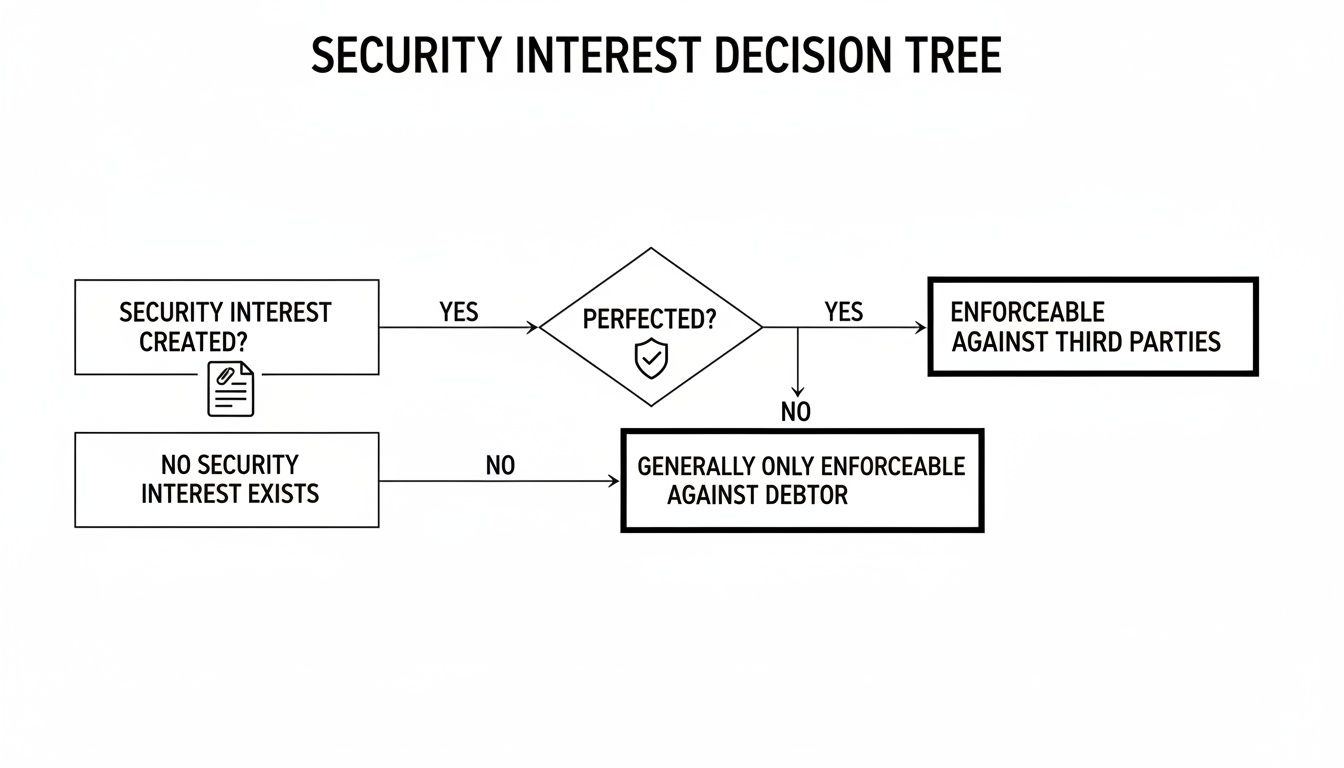
The takeaway here is simple: an attached but unperfected interest leaves you exposed. A perfected interest gives you a defensible position in the line of creditors.
Perfection by Possession
Sometimes, the oldest method is still the best. Perfection by possession is exactly what it sounds like: the creditor physically takes hold of the collateral. This is an incredibly powerful form of public notice because the debtor obviously no longer has the asset to offer to someone else.
Possession works perfectly for certain types of collateral:
- Instruments: Things like promissory notes or physical checks.
- Certificated Securities: Old-school physical stock or bond certificates.
- Tangible Goods: High-value items like jewelry, fine art, or precious metals.
For example, if a founder uses their personal collection of rare coins to secure a business loan, the lender perfects its interest by locking those coins in a vault. No UCC-1 is needed. Of course, this method is completely impractical for assets a business needs to function, like its equipment or inventory.
Pro Tip: Even when you have possession, a rock-solid security agreement is non-negotiable. It prevents future disputes by clearly defining the loan terms and the conditions for returning the collateral. If you’re new to drafting these, our guide on how to write a business contract offers a strong starting point.
Perfection by Control
The third method, perfection by control, was designed for modern, intangible assets where filing is insufficient and physical possession is impossible. Control means the secured party has the exclusive authority to dispose of the asset without needing any further permission from the debtor.
Control is the only way to perfect an interest in certain key financial assets:
- Deposit Accounts: A bank automatically has control over an account held at its own institution. Other lenders must use a "control agreement," a three-way contract between the lender, the debtor, and the bank.
- Investment Property: This includes securities accounts held with a brokerage.
- Electronic Chattel Paper: Digital records representing a payment obligation that is secured by goods.
Imagine a startup pledges its primary business bank account as collateral for a loan. The lender perfects its interest by signing a control agreement with the startup’s bank. This agreement gives the lender the right to seize the funds if the startup defaults. As business becomes more digital, this method is only growing in importance.
Choosing the right perfection method isn't just a box-ticking exercise. It's a critical strategic decision that determines whether your security interest will actually hold up when it counts. To ensure you select and execute the correct method, contact our experienced legal team for a consultation.
Securing Digital Assets and the New Rules of Control
For tech and e-commerce companies, your most valuable assets probably don’t sit in a warehouse. They live on the blockchain or in the cloud, forcing the law to catch up with collateral you can't physically hold. This is a new frontier for the perfection of a security interest.
Old methods like filing a simple UCC-1 or taking physical possession just don't work for digital collateral. The Uniform Commercial Code (UCC) finally evolved, creating new rules built around a single, powerful concept: control. If your business deals in cryptocurrency, NFTs, or other digital records, proving you have control is now the only way to truly secure your claim.

The Rise of Controllable Electronic Records
The biggest legal shift is the new UCC Article 12, which created a formal category for Controllable Electronic Records (CERs). Think of this as a catch-all term for any digital asset that one party can exclusively control, including:
- Cryptocurrencies like Bitcoin and Ethereum
- Non-Fungible Tokens (NFTs)
- Certain digital payment rights or vouchers
This new article establishes a clear food chain for perfection. While you can still file a UCC-1 for CERs, a creditor who perfects by control jumps to the front of the line, gaining priority over anyone who only filed. This is a monumental change. Filing and forgetting is no longer a safe strategy.
This legal update is a direct response to a market that has absolutely exploded. With CERs like crypto and NFTs hitting a projected global market cap of $3.5 trillion, UCC Article 12 was desperately needed. Yet, a recent survey showed that 68% of founders had no idea these new rules even existed, leaving their collateral dangerously exposed.
What Does Control Mean in a Digital World?
In this context, control isn't some vague idea; it's a specific legal test. To have control over a CER, a lender must have the exclusive power to use, sell, or transfer the asset without needing any help or permission from the borrower.
Key Tip: Control is the digital equivalent of holding the keys to the vault. It means the secured party has the sole ability to sell or transfer the digital asset, rendering the borrower powerless to interfere.
Here’s how we see control established in the real world:
- Exclusive Wallet Access: The lender takes control of a crypto wallet by exclusively holding the private keys. Without those keys, the borrower is completely locked out.
- Smart Contract Execution: The security interest is coded directly into a smart contract on the blockchain. If the borrower defaults, the contract can automatically transfer the asset to the lender.
- Third-Party Custodian: The digital asset is placed with a qualified third-party custodian who agrees to follow only the lender's instructions, effectively putting the asset in a neutral-party escrow.
When you're figuring out how to establish control, the principles of Self Custodial Security are a great starting point. You must understand how to manage private keys and secure wallets to prove you have exclusive power over the collateral.
Practical Tips and a Critical Call to Action
For founders using digital assets as collateral, the message is simple: your security agreements are now obsolete. Relying on old language or just filing a UCC-1 is a recipe for losing your spot in the priority line.
Actionable Tips for Founders:
- Update Your Security Agreements: Your agreements must explicitly mention Controllable Electronic Records and spell out the exact method for establishing control.
- Document Your Control Method: Whether it’s through managing private keys or a smart contract, create a clear paper trail proving how you took exclusive control.
- Use Qualified Custodians: If you use a third party, make sure they are reputable and formally agree, in writing, to their role in the control arrangement.
As you build out your company's digital infrastructure, it’s also important to have a compliant data management framework. You might be interested in our guide on privacy policy requirements for websites, as robust data practices often go hand-in-hand with securing digital assets.
The rules for perfecting an interest in digital assets are new, complex, and still being tested. Don’t wait for a dispute to discover your security agreement is worthless. Review your documents now and get legal advice to ensure your most valuable assets are properly collateralized under these new rules.
Perfecting Your Claim on IP and Special Collateral
A standard UCC-1 financing statement is a powerful tool, but it's not a silver bullet for perfection of a security interest. When your company’s real value is tied up in ideas, inventions, or specialized equipment, you’re playing in a different league. Simply filing a form with the state isn’t going to cut it.
For many forms of intellectual property (IP), securing your claim means navigating a dual-filing system. You’ll often need both a standard UCC-1 filing at the state level and a separate registration with a federal agency to be fully protected. Skipping that second step can leave your most valuable assets completely exposed, even if you thought you checked all the boxes.
The Special Rules for Intellectual Property
Federal law often takes precedence when it comes to IP, creating specific rules that override or add to the state-level UCC framework. Each type of IP has its own unique process, and getting it wrong can be a catastrophic, business-ending mistake.
- Patents: To perfect a security interest in a patent, you must record your interest with the United States Patent and Trademark Office (USPTO). While a UCC-1 filing is still a good idea for backup protection, courts will almost always look to the USPTO’s records first to decide who has priority.
- Trademarks: It's a similar story for federally registered trademarks. Security interests must be recorded with the USPTO. If you fail to do this, a later buyer could potentially acquire the trademark free and clear of your security interest.
- Copyrights: The rules for registered copyrights are even more strict. The U.S. Copyright Act is explicit: security interests must be recorded with the U.S. Copyright Office to be perfected.
This isn't just dry legal theory; it has massive real-world consequences. A landmark bankruptcy case, National Peregrine, Inc., established that a lender's security interest in a film library was worthless because they only filed a UCC-1 and never recorded it with the U.S. Copyright Office. For South Florida's e-commerce and creative sectors, where trademarks can drive over 35% of small business revenue, these mistakes proved devastating, leading to millions in disputed lender claims in 2025 alone.
Critical Tip: Always treat IP perfection as a two-step process. File the UCC-1 with the correct state agency, but immediately follow up with the required federal filing at the USPTO or Copyright Office. Assume the federal filing is mandatory, not optional.
Beyond IP: Collateral That Isn't Standard
The need for specialized perfection methods goes beyond just intellectual property. Certain physical assets also have their own set of rules that exist completely outside the standard UCC-1 filing system.
A classic example is company vehicles. You can't perfect an interest in a car or truck just by filing a UCC-1. Instead, the lender's lien has to be physically noted on the vehicle’s certificate of title, which is managed by the state's Department of Motor Vehicles (DMV). This note on the title is what serves as the official public notice of the security interest.
Other specialized assets, like aircraft (FAA registration) or ships (Coast Guard registration), have their own federal registries. And as business evolves, so does the nature of collateral. For instance, as more companies look to tokenize real world assets, new rules are emerging that blend technology and law to define how security interests in these digital assets are perfected.
A Call to Action for Protecting Your Assets
The rules for perfecting interests in IP and other special collateral are unforgiving. Unlike a minor typo on a standard filing, failing to use the correct federal registry or title notation process isn't a small mistake—it’s a fatal flaw that can render your security interest completely void.
Protecting these unique assets requires diligence and specialized knowledge. If you’re building a business around your intellectual property, you can read our guide on how to protect intellectual property to get a broader view of your strategy. However, when it comes to securing financing against those assets, you absolutely need to consult with legal counsel who understands both UCC law and the specific federal requirements. This proactive step ensures your most valuable creative and technical assets are properly secured, giving you a solid foundation for growth.
Understanding Priority Rules and State Differences
When a business defaults on its loans, one brutal question cuts through everything else: who gets paid first? The answer comes down to priority—a legal ranking that dictates the order in which creditors can claim what's left of the company's assets. Getting the best possible priority is the entire point of perfecting a security interest.
The core rule is deceptively simple: first-to-file-or-perfect. This means the first creditor to either file their financing statement or otherwise perfect their security interest wins the race. It doesn't matter who loaned the money first. In this game, timing is everything.
The First-to-File-or-Perfect Rule in Action
Let’s see how this plays out with a familiar story. Imagine a Miami-based startup, "InnovateCo," needs capital to grow.
- On March 1st, Lender A gives InnovateCo a $100,000 loan, secured by all the company’s equipment. The security agreement gets signed, but Lender A gets busy and puts the UCC-1 financing statement on the back burner.
- On March 15th, Lender B provides a separate $50,000 loan, also secured by the very same equipment. Lender B, however, is on top of their game and files their UCC-1 with the Florida Secretary of State that same day.
- On April 1st, Lender A finally remembers and files their paperwork.
If InnovateCo eventually defaults, Lender B gets paid first. Why? They were the second to lend but the first to perfect. Lender A’s two-week delay just cost them their spot at the front of the line.
Actionable Tip: This rule shows just how urgent perfection is. A signed agreement isn't enough. You have to give public notice, and you have to do it fast. File your UCC-1 as soon as possible, even before the loan officially closes.
The Power of a Purchase-Money Security Interest
While the "first-in-time" rule is the standard, there's a powerful exception that lets a lender jump the line: the Purchase-Money Security Interest (PMSI).
A PMSI grants a lender "super-priority" over other creditors, but only for the specific item they financed. It’s a special status given to those who provide the funds for a business to acquire new goods or equipment.
For example, if a lender gives InnovateCo a loan specifically to buy a new server, they can get a PMSI in that server. To lock in this super-priority, the lender must perfect their interest before or within a short window (usually 20 days) after the company gets the equipment. This is a critical tool that allows startups to get financing for new assets even when their existing property is already pledged to someone else.
Jurisdictional Nuances: Florida vs. Delaware
The "where" of filing is just as critical as the "when." Filing in the wrong office makes your perfection totally invalid. The right location depends on where the debtor is located—and that’s not always as obvious as it sounds.
- For Registered Organizations (LLCs, Corporations): You file in the state where the company is legally registered. A business with its main office in South Florida but incorporated in Delaware means the UCC-1 must be filed with the Delaware Secretary of State.
- For Individuals or Sole Proprietorships: You file in the state of the individual's main residence. A freelance designer living in a Fort Lauderdale apartment would require filings in Florida.
We see this mistake all the time, and it's a costly one. Filing in Florida for a Delaware entity is a fatal error. It gives you zero priority. You must always verify the company's official state of incorporation before filing anything.
Here is a quick reference for the most common asset types founders pledge as collateral.
Perfection Method by Collateral Type
| Asset / Collateral Type | Primary Perfection Method | Key Tip for Founders |
|---|---|---|
| Equipment, Inventory, General Intangibles | UCC-1 Financing Statement | This is the default method for most business assets. File in the correct state (usually state of incorporation). |
| Deposit Accounts (Bank Accounts) | Control Agreement | You need a three-way agreement between the bank, the debtor, and the lender to establish control. |
| Certificated Stock | Possession | The lender must physically hold the paper stock certificates. This is common in founder pledges. |
| Titled Vehicles (Cars, Trucks) | Notation on Certificate of Title | The lien must be noted directly on the vehicle's official title document issued by the state DMV. |
| Intellectual Property (Patents, Trademarks) | UCC-1 Filing + USPTO Filing | A UCC-1 filing perfects the interest, but a secondary filing with the USPTO is recommended to protect against future IP buyers. |
This table shows that a one-size-fits-all approach doesn't work. The asset itself dictates the rules you have to follow.
Actionable Tip: After you submit your UCC-1, always run a "post-filing search." This search is your proof that the filing is on the public record, is indexed correctly under the debtor's exact legal name, and is searchable. If a court can't find it, it might as well not exist.
Don't let a simple procedural mistake put your entire financial security at risk. The rules of priority and jurisdiction are unforgiving. Work with experienced legal counsel from the start to make sure your security interest is locked in, giving you the strongest priority position possible.
Common Perfection Pitfalls and How to Avoid Them
When it comes to the perfection of a security interest, there’s no room for error. A single misplaced word or a filing in the wrong office can instantly transform a secured creditor into an unsecured one, dropping you to the bottom of the pile in a default or bankruptcy.
These aren't esoteric legal traps; they are simple, administrative mistakes that we see derail promising ventures and investments all the time. Think of this as a field guide to the most common pitfalls—and how to sidestep them from day one.

Here's where things most often go wrong.
Inaccurate Debtor Names and Wrong Jurisdictions
This is by far the most frequent—and fatal—mistake. A UCC-1 financing statement is a public notice, and for it to work, it has to be searchable. That search is based on the debtor's exact legal name.
Using a trade name, a "dba," or even a minor typo can make your filing undiscoverable. If a search using the correct legal name doesn’t pull up your filing, the law treats it as if it never happened.
Just as critical is filing in the correct state. You must file where the business is legally registered (e.g., its state of incorporation, like Delaware), not just where it has its headquarters (like Miami). A filing in the wrong jurisdiction is legally worthless.
How to Prevent It (Actionable Tip): Always obtain a copy of the debtor’s official formation documents, like their Articles of Incorporation or Organization. Verify the exact legal name and state of registration, then use that precise information—no abbreviations, no assumptions.
Vague Collateral Descriptions
Your UCC-1 needs to describe the secured property with enough clarity for an outsider to understand what’s covered. Relying on overly broad terms like "all business assets" might seem like a good way to cover all your bases, but it can open the door to legal challenges.
Courts can—and do—invalidate claims where the collateral description is too ambiguous, potentially leaving valuable assets unprotected.
Key Tip: A collateral description is not just a box to be checked on a form. It's a public declaration of your claim. If a judge or another creditor can’t tell what specific property is yours by reading it, your perfection has failed its core purpose.
How to Prevent It (Actionable Tip): Precision is your best defense. If you're securing specific machinery, include the model and serial numbers. If it’s accounts receivable, clearly define the accounts covered. The more specific you are, the less room there is for costly disputes later.
Forgetting to Renew Your Filing
A UCC-1 filing is not a "set it and forget it" document. It has a shelf life. In most jurisdictions, it automatically expires after five years.
Forgetting to file a UCC-3 continuation statement before that five-year deadline is a brutally simple error that completely extinguishes your perfected status. Your security interest becomes unperfected, and your priority in the collateral falls behind any other creditor who filed after you—even if they filed years later.
How to Prevent It (Actionable Tip): Treat the five-year renewal date with the same seriousness as a loan maturity date. The moment you file a UCC-1, calendar multiple reminders for its renewal, starting at least six months before expiration. This buffer gives you plenty of time to prepare and file the continuation statement without any last-minute panic.
These details are what separate a secured, protected creditor from an unsecured one left with nothing. The difference is rarely a complex legal theory; it's almost always a failure in administrative execution. Building a system with experienced counsel to manage these filings is the only way to ensure your security interests remain enforceable and your position protected. Contact our legal team to help you establish a fool-proof system.
Answering Your Top Perfection Questions
Once founders grasp the what and why of perfecting a security interest, the practical questions usually follow. We hear these all the time from startups in Miami and Broward County, so let's get straight to the answers.
How much does it cost to file a UCC-1?
The government filing fees are almost trivial—typically $20 to $100 depending on the state. Don't let that fool you.
The real cost isn’t the filing fee; it's the professional guidance required to file it correctly. Paying a small legal fee upfront to ensure your filing is precise is an investment. Trying to save a few hundred dollars here can, and often does, cost founders their entire security interest down the road.
Pro Tip: Think of legal fees for perfection not as a cost, but as insurance on your entire investment. The small upfront expense protects a much larger asset.
What if my interest isn't perfected and the borrower goes bankrupt?
This is the nightmare scenario every lender and investor wants to avoid. If your security interest is not perfected, the bankruptcy court will treat you as just another unsecured creditor.
Your special claim to the collateral is gone. You're thrown into the general pool with all the other unsecured creditors, where you'll be lucky to recover pennies on the dollar—if you recover anything at all.
Key Takeaway: In bankruptcy, an unperfected security interest is functionally worthless. The bankruptcy trustee has the power to void your claim, pushing you to the absolute back of the line for repayment.
How long does a UCC-1 filing last?
A standard UCC-1 financing statement is effective for five years from the date it's filed. It is not permanent.
To maintain your perfected status, you must file a continuation statement (a form called a UCC-3) within the six-month window before the five-year expiration date. If you miss that window, your perfection evaporates, and you could lose your priority to another creditor who filed after you.
Actionable Tip: Forgetting to renew is a simple but catastrophic error. Use a legal calendaring system or set multiple digital reminders for 4.5 years after your filing date to ensure you never miss a renewal deadline.
Can I handle perfection myself or do I need a lawyer?
While you can technically file a UCC-1 form yourself, it is one of the riskiest DIY legal tasks a founder can attempt. The rules are incredibly unforgiving.
A minor typo in the debtor's exact legal name, an imprecise collateral description, or filing in the wrong state (like filing in Florida for a company incorporated in Delaware) can render the entire filing invalid. You won't get a notification that you did it wrong; you'll only find out when you try to enforce your rights and discover you have none.
Hiring experienced legal counsel to handle the perfection of a security interest is a critical, high-ROI investment. It’s the only way to ensure your filings are precise, your priority is locked in, and your assets are truly protected. The cost of getting it right is tiny compared to the total loss of your investment.
Don't leave your company's financial security to chance. The rules of perfection are complex, and the consequences of getting them wrong are severe. At Coto & Waddington, Attorneys at Law, we provide founder-minded legal strategy to ensure your security interests are rock-solid from day one. Protect your assets and streamline your deals by scheduling a consultation with us today at https://cotowaddington.com.


