You had a strong meeting. The other side wants to move fast. You both agree on the big points, and nobody wants to spend the next few weeks arguing over a full contract before you’ve even confirmed the relationship makes sense.
That’s when people start asking for a memorandum of understanding contract.
The phrase is common, but it causes confusion. A memorandum of understanding, or MoU, usually is not the same thing as a binding contract. It can be a smart business tool. It can also create problems if you treat it casually, copy a bad template, or assume “non-binding” means “legally irrelevant.”
For South Florida startups, family businesses, and bilingual ventures moving between Miami and Latin America, that distinction matters. A short early-stage document can help preserve momentum. It can also lock in a bad process, expose sensitive information, or create a fight over whether anyone was obligated to do anything.
Your Handshake Agreement Needs a Blueprint
Two founders meet in Brickell after months of informal talks. One has the product idea. The other has distribution relationships and operating experience. They leave the meeting aligned on the mission, the rough division of responsibilities, and the next set of deliverables.
They’re not ready for a full operating agreement, a full joint venture agreement, or a detailed services contract. But they also know a verbal understanding won’t hold up well once money, time, and expectations start to diverge.
That’s where an MoU earns its place. It captures a serious business understanding without pretending the parties have already negotiated every term that belongs in a final contract.
An MoU works like a disciplined written handshake. It records intent. It identifies the parties. It outlines the project, timeline, and next steps. It gives everyone a shared reference point before the heavier legal drafting starts.
This isn’t a new idea. The Memorandum of Understanding emerged as a foundational instrument in international diplomacy during the mid-20th century, and its business use now underpins 80% of initial merger and acquisition negotiations in major markets like the US and EU, according to the cited background at Wikipedia’s memorandum of understanding entry.
Why founders reach for an MoU
An MoU is often the right document when parties need to:
- Capture momentum: A good meeting shouldn’t dissolve into conflicting email summaries.
- Define the lane: It helps separate what has been discussed from what still needs negotiation.
- Reduce misunderstanding: Each side can see the same scope, same assumptions, and same next steps.
- Test the relationship: You can explore a venture before you commit to a long-form contract.
A handshake starts trust. A written blueprint protects memory.
Used well, an MoU doesn’t replace a contract. It creates order before a contract exists.
MoU vs Contract The Fundamental Difference
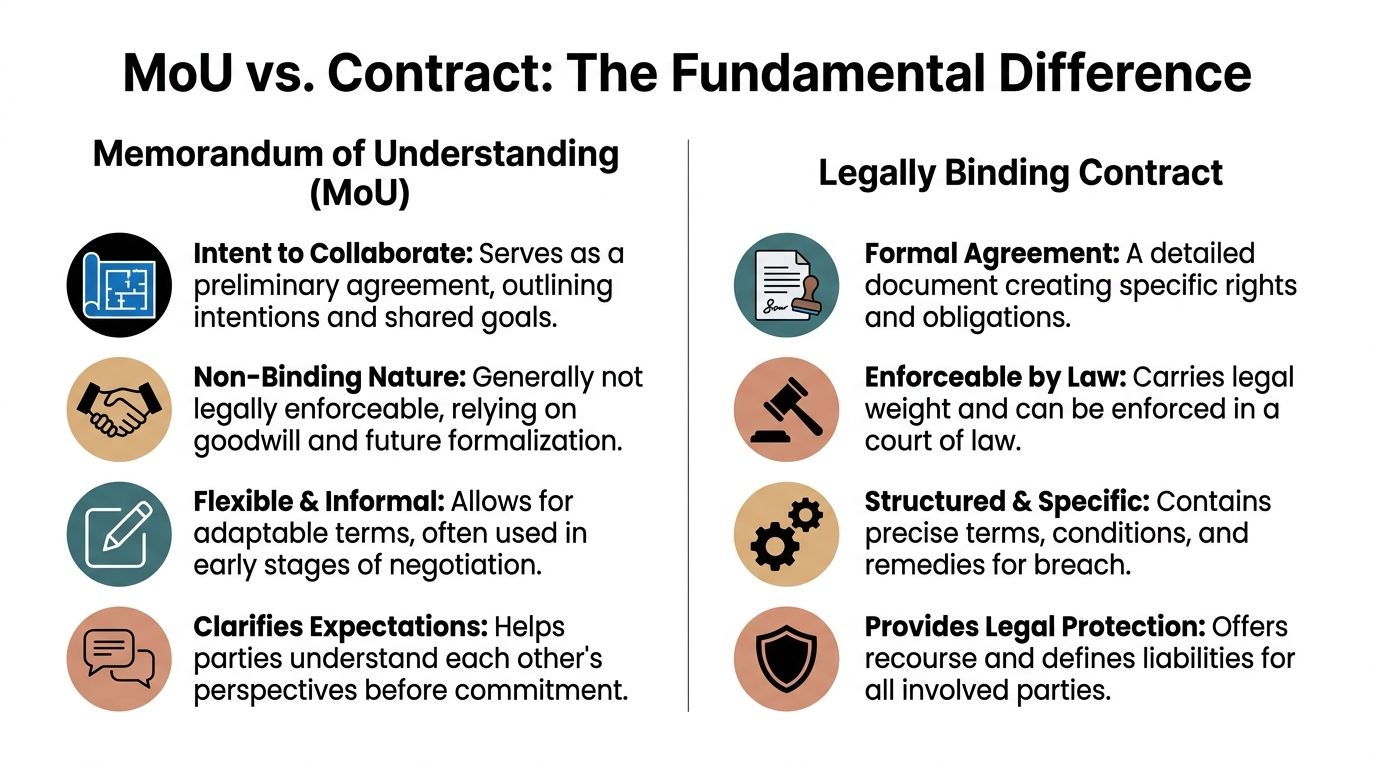
The cleanest way to understand the difference is this. An MoU is a blueprint. A contract is the construction agreement.
A blueprint shows the vision, major dimensions, and intended result. It’s about alignment. The construction agreement is where the parties commit to build, pay, deliver, insure, and accept legal consequences if someone fails.
That’s the practical line founders need to keep in mind.
The core distinction
An MoU is usually an agreement to explore or align. A contract is an agreement to perform.
That difference affects everything that follows, including whether a court can enforce the document, whether money can be recovered for breach, and whether a party can walk away with limited consequence.
If you’re reviewing early deal documents, it also helps to compare MoUs with more formal commercial contracts so you can see how a preliminary document differs from one designed to create enforceable obligations.
MoU vs Contract at a glance
| Characteristic | Memorandum of Understanding (MoU) | Contract |
|---|---|---|
| Primary function | Records intent, framework, and shared goals | Creates enforceable rights and obligations |
| Typical stage | Early negotiations or pre-deal alignment | Finalized business commitment |
| Level of detail | Usually broader and more flexible | Usually precise and operational |
| Legal status | Generally non-binding, unless specific provisions are made binding | Binding if validly formed |
| Use of remedies | Often limited, especially if non-binding | Usually includes legal remedies for breach |
| Business purpose | Clarify expectations and preserve momentum | Allocate risk and govern performance |
What works in practice
An MoU works well when the parties still need to answer important questions.
Examples include a founder relationship that still needs cap table negotiation, a brand partnership that still needs technical integration details, or a family business arrangement where the parties agree on concept but not on final control rights.
A contract works better when the business has moved from exploration to execution. If someone is paying, transferring ownership, granting exclusive rights, licensing IP, or making long-term commitments, the room for ambiguity gets smaller very quickly.
The gray zone that causes trouble
Most online explanations are too binary. They say MoUs are non-binding and contracts are binding, as if the line is always obvious.
It isn’t.
A major practical issue is the enforceability gray zone. As noted in HyperStart’s discussion of MoUs, an MoU can contain selectively binding provisions, especially confidentiality language. That matters for startups sharing code, customer lists, marketing plans, pricing, product roadmaps, or investor materials. It also matters more when the parties are in different states or different countries.
If your document says “non-binding” on page one and then imposes mandatory confidentiality, exclusivity, or payment language on page three, you may have created a mixed document with mixed legal consequences.
A practical rule of thumb
Use an MoU when you need structure without full commitment.
Use a contract when any of these are true:
- Money is changing hands
- IP is being assigned or licensed
- One side must perform by a deadline
- The parties need clear remedies if something goes wrong
- The relationship will continue beyond an exploratory stage
The biggest mistake isn’t using an MoU. It’s using one while expecting contract-level protection.
Is a Memorandum of Understanding Legally Binding in Florida
The short answer is: sometimes.
That’s not evasive. That’s how these disputes work. A Florida business can label a document a memorandum of understanding, call it non-binding, and still create enforceable obligations if the language and structure look enough like a contract.

What a court looks for
The legal analysis usually turns on familiar contract concepts. The key questions are whether the document shows:
- Offer
- Acceptance
- Consideration
- Intent to be bound
If those elements are present, calling the document an MoU won’t save a party who assumed the label controlled everything.
Founders often encounter trouble this way. They download a template that says “this MOU is non-binding,” then fill it with mandatory performance language, exclusivity obligations, payment terms, deliverables, and signatures that read like a final deal.
Selectively binding clauses are real
A non-binding MoU can still include provisions the parties intend to make binding. That often makes sense.
Confidentiality is the most common example. Exclusivity can also matter in a sale process or joint venture discussion. Non-solicitation sometimes belongs in the same bucket. The question is whether the clause is drafted clearly enough, with sufficient contractual substance, to stand on its own.
According to the verified background drawn from Sirion’s MOU guide, specific clauses in an MOU, such as confidentiality or exclusivity, can be binding despite the document’s overall non-binding nature, and U.S. courts may uphold those clauses in 20-35% of disputed cases if they satisfy contract law tests.
That’s the gray zone in action.
How to keep an MoU non-binding
If the business goal is alignment without legal commitment, the document needs to say that clearly and consistently.
Use language that states the parties are discussing a possible transaction or collaboration, that no party is obligated to consummate any final deal, and that any binding commitment will arise only through a later definitive written agreement.
A simple example looks like this:
Except for any section expressly identified as binding, this Memorandum of Understanding reflects the parties’ current intentions only and does not create a binding obligation to enter into any transaction or relationship.
That kind of clause helps, but it isn’t enough by itself. The rest of the document has to match it.
Language that accidentally creates obligations
Words matter. Small drafting choices change legal risk.
Be careful with:
- “Shall” and “must” when you really mean “intend” or “plan”
- Detailed payment mechanics in a document meant to stay preliminary
- Firm delivery commitments before a final deal exists
- Overly complete deal terms that make the MoU look like the final contract
- No reservation of rights to continue negotiation or walk away
When you should make a clause binding on purpose
There are many situations where a mixed document is the right move.
If a Miami startup is sharing code architecture, ad account data, product roadmap materials, or investor deck details with a potential partner, a binding confidentiality provision often belongs in the MoU.
If a buyer needs a short no-shop period while conducting diligence, a binding exclusivity clause may be worth negotiating early.
If the parties are exchanging sensitive lists of customers, vendors, or creators, a targeted non-solicitation term may also make sense.
Practical rule: Don’t make the whole MoU binding by accident. Make only the clauses binding that you can defend, define, and enforce.
Bilingual and cross-border caution
This issue gets sharper in South Florida because so many deals are bilingual or involve parties outside Florida.
If one version says the document is non-binding, but the other version uses stronger mandatory language, you’ve created a drafting problem before the business has even started. The same is true when one side assumes “memorandum” means a casual summary and the other treats it like a firm commitment.
In bilingual drafting, the parties should decide which version controls if a translation dispute appears, and they should harmonize legal verbs carefully. That work sounds small. It isn’t.
A useful operating rule
If you would be upset to learn the other side can walk away tomorrow, your MoU probably isn’t enough.
If you would be upset to learn a judge might enforce one of its clauses, your MoU may be too aggressive or too sloppy.
Both problems are preventable with disciplined drafting.
When to Use an MoU A Strategic Playbook for Founders
An MoU makes sense when speed matters, the business concept is real, and the final contract would be premature.
That’s why founders use them so often. In a 2023 study of 1,500 international partnerships, 65% initiated with MOUs, which shortened full contract timelines from 12 months to 4 months and cut initial setup costs by 30-40%, according to the verified data from Taylor & Francis.
That efficiency is useful. It’s also easy to misuse.

Good use cases
Early founder alignment
Two people want to launch together, but they haven’t finalized equity, vesting, decision rights, or capital contributions.
An MoU can record the project’s purpose, each person’s immediate role, and the timeline for converting those understandings into proper formation documents. If you’re at that stage, it also helps to understand the mechanics of starting a Florida LLC before you treat a preliminary business arrangement like a finished company.
Joint venture exploration
A local brand and a logistics operator want to test a market opportunity. They know the broad commercial idea but still need to evaluate systems, margins, staffing, and regulatory questions.
An MoU works well here because it creates structure for diligence and pilot planning without forcing the parties into a long-form agreement too early.
Family business transition discussions
A family business may have broad agreement about bringing in the next generation, separating operating roles, or spinning off a new line of business. But families often need time to work through ownership, authority, compensation, and control.
A carefully drafted MoU can document what the parties are trying to build while preserving room to negotiate the harder issues with less emotional friction.
Strategic partnerships in e-commerce or tech
An e-commerce company may want to test a fulfillment partner, software integration, co-marketing relationship, or channel partnership before signing a larger deal.
An MoU can define the pilot period, points of contact, expected deliverables for the exploration phase, and what information can be shared.
When an MoU is the wrong tool
Some situations need a contract from the start.
Use a real contract when:
- Payment starts immediately
- A party is creating or transferring IP
- The relationship depends on exclusivity with serious consequences
- One side is relying on the other to perform by a fixed deadline
- Regulatory compliance or data handling requires precision
If a business is hiring a freelancer for defined work, granting a license, onboarding a manufacturer, or selling an ownership interest, a short preliminary memo usually doesn’t carry enough precision.
A fast decision test
Ask these questions before using a memorandum of understanding contract:
| Question | If yes | Better tool |
|---|---|---|
| Are we still testing the relationship? | You likely need flexibility | MoU |
| Are we still negotiating major deal points? | You likely need room to adjust | MoU |
| Is someone paying or delivering now? | You likely need enforceability | Contract |
| Is valuable IP or sensitive data involved? | You may need mixed treatment | MoU with binding clauses or separate NDA |
| Would a failed commitment hurt the business immediately? | You need remedies | Contract |
What works best in founder practice
The strongest MoUs have a narrow job. They don’t try to solve every legal issue at once.
They capture the commercial understanding, establish the next milestone, and identify which provisions are binding right now, if any. They also set an expiration point so the document doesn’t linger while the parties argue over whether the deal is still alive.
An MoU should move a deal forward, not become a substitute for making decisions.
If you use one as a parking lot for unresolved conflict, the same conflict will return later with higher stakes.
Drafting an Effective MoU Key Clauses and Language
A strong MoU is short, specific, and internally consistent. It doesn’t try to mimic a full contract. It says enough to guide the relationship, but not so much that it accidentally becomes the final deal.
The drafting discipline matters more than people think.

The basic anatomy
The verified drafting guidance drawn from the background on Sirion identifies 7-10 core sections as the optimal structure for an MoU. In practice, those sections usually include the effective date, the parties, purpose, scope, roles, timing, policy provisions, and review mechanics.
If you want a broader contract-drafting framework before narrowing it down to an MoU, this guide on how to write a business contract is a useful companion.
Clauses that belong in most MoUs
Parties
Use full legal names. Include the correct entity type and state of formation if a business entity already exists.
If a founder hasn’t formed the entity yet, say so clearly. Don’t pretend an LLC is already a party if it doesn’t exist.
Purpose
State the project in plain English.
Bad drafting says the parties want “to collaborate in the business space.” Good drafting says they want to explore a branded online retail venture for a defined product category and market.
Scope
Many problems arise from this.
Specify what the MoU covers and what it does not cover. If IP ownership, final compensation, equity issuance, regulatory compliance, or final vendor onboarding will be addressed later, say that directly.
Roles and responsibilities
List who is doing what during the preliminary stage.
This can include meetings, diligence, pilot tasks, access to documents, introductions, timeline coordination, or preparation of later agreements.
Timeline and termination
A good MoU should not float forever. Give it a start date and an end point, or a clear milestone that ends it.
That keeps stale understandings from turning into future arguments.
Sample non-binding language
If the document is meant to stay non-binding except for identified sections, the disclaimer needs to be unmistakable.
A practical example:
This Memorandum of Understanding sets forth the parties’ current intentions regarding a potential collaboration. Except for Sections [Confidentiality], [Exclusivity], and [Governing Law], which the parties intend to be binding, this document is non-binding and does not obligate either party to enter into any definitive agreement or complete any transaction.
That language works because it does two things at once. It states the general rule and identifies the exceptions.
Sample binding confidentiality language
If confidentiality matters, treat it like a real obligation.
A simple example:
Each party may receive confidential business, technical, financial, or customer information from the other in connection with the discussions described in this Memorandum of Understanding. Each party agrees to maintain that information in confidence, use it only for evaluating the proposed collaboration, and not disclose it to third parties except to professional advisors or as required by law.
This clause usually needs follow-up details. Define confidential information. State exclusions. Address return or destruction of materials. Clarify duration. If the risk is high, a separate NDA may be cleaner.
Drafting tips for South Florida and bilingual deals
South Florida businesses often work in English and Spanish at the same time. That changes drafting strategy.
Use one of these approaches:
- Single controlling language version: Draft in one language and provide the other as a convenience translation.
- Dual-language integrated text: English and Spanish appear together, section by section.
- Separate bilingual counterparts: Useful when both sides need clean internal versions, but risky if terms diverge.
In bilingual MoUs, pay close attention to legal verbs and qualifier words. A softer phrase in one language and a mandatory phrase in the other can create exactly the kind of dispute the document was supposed to avoid.
Practical drafting checklist
Before signing, check these items:
- Defined next step: What happens after the MoU is signed?
- Clear expiration: When does this document stop governing the discussion?
- Binding sections identified: Are the enforceable provisions clearly labeled?
- No accidental promises: Have mandatory verbs been reviewed?
- Sensitive information protected: Is confidentiality handled well enough for the business risk?
- Version control: If there are bilingual drafts, does one govern in case of conflict?
The best MoU is readable by the business team and defensible by counsel.
What to avoid in the draft itself
Don’t overload an MoU with every issue you can think of. That usually creates contradiction.
Avoid:
- Template leftovers from unrelated deals
- Undefined terms that mean different things to different people
- Detailed economics if final pricing is still under negotiation
- Boilerplate dispute language that clashes with the intended non-binding structure
- Contradictory signature blocks that imply final commitment
A memorandum of understanding contract should feel deliberate. If it reads like a stitched-together document from three old templates, the risk goes up fast.
Common MoU Pitfalls and Red Flags to Avoid
Most MoU problems aren’t caused by the idea of using an MoU. They’re caused by false confidence.
One side assumes the document has no legal effect. The other side assumes the “important parts” are settled. Months later, they’re arguing over confidentiality, exclusivity, ownership, payment expectations, or whether anyone ever had a duty to proceed.
The transition from MoU to final contract is where many deals break down. The verified background from Contractbook’s memorandum of understanding template page notes a significant but undocumented failure rate in that transition, especially when parties dispute terms they thought had already been agreed.
Red flags that deserve immediate attention
- Vague business language: If the document says the parties will “work together” without saying how, on what, and for how long, it creates more heat than clarity.
- Mixed signals on enforceability: A document that says “non-binding” but uses mandatory obligation language throughout is asking for a fight.
- No protection for sensitive information: Founders often share product plans, pricing, lists, and internal strategy before tightening confidentiality.
- Template mismatch: Generic online forms rarely reflect the actual deal, the actual state law concerns, or the actual cross-border issues.
- No path to the final agreement: If the MoU doesn’t identify what happens next, one party can stall while the other keeps investing time.
What founders often miss
The early draft isn’t just a note. It shapes later negotiating positions.
If one side believes the commercial terms are already set because they appear in the MoU, they’ll resist changes in the final contract. If the other side believed those same terms were placeholders, negotiations can sour fast.
That’s especially common in family businesses and founder relationships where trust is high at the start and documentation is treated as secondary.
A better way to pressure-test an MoU
Before signing, ask:
- What does each side think is already decided?
- What issues are intentionally left open?
- Which provisions survive if the larger deal dies?
- What event triggers the move to a real contract?
If the parties can’t answer those questions cleanly, the draft needs work.
A good MoU reduces ambiguity. A bad one memorializes it.
One practical habit that saves deals
After circulating the draft, ask each party to send a short written summary of what they believe the MoU does and does not require.
That sounds simple. It catches misunderstandings before they become positions.
From Handshake to Contract When to Engage Counsel
A good MoU buys clarity and time. It doesn’t buy certainty.
Once the relationship reaches the point where money will move, IP will be created or transferred, exclusivity becomes meaningful, or one side needs reliable performance, the memorandum of understanding contract should give way to a real agreement.
That’s where legal counsel stops being optional. It becomes part of risk management.
A business attorney doesn’t just draft paper. Counsel helps define what should be binding now, what should wait, what can stay flexible, and what language creates avoidable exposure. If you want a clear view of that role, this overview of what a business attorney does is a useful starting point.
The practical trigger is simple. If a failed deal would cost you more than a short legal review, it’s time to escalate the documentation.
For South Florida founders, family businesses, and bilingual ventures, that usually happens earlier than expected. The costliest MoU mistakes rarely come from over-lawyering. They come from assuming a preliminary document will somehow do the work of a final contract.
If you're negotiating an MoU, revising a preliminary deal document, or trying to move from a handshake to a contract without creating avoidable risk, Coto & Waddington, Attorneys at Law can help. The firm advises startups, family businesses, and growing companies across Miami, Fort Lauderdale, and South Florida with practical, bilingual business counsel designed to keep deals moving and protect what matters.