An LLC isn't capped by a single nationwide number of DBAs, and a Florida LLC may register multiple fictitious names. The more important decision is how many brands should share that LLC before you form a separate entity.
The popular advice to register another DBA and keep moving answers the filing question, not the business question. A founder needs to know who signs the contract, whose assets are exposed, what the bank recognizes, and which name belongs on the tax paperwork. A cheap name filing can be the right move, but it's a poor substitute for choosing the right structure.
Table of Contents
- Why the Better Question Is Not a Number
- What a DBA Actually Is and What It Is Not
- How Florida Treats Multiple Fictitious Names
- Filing Step by Step Without Surprises
- Multiple DBAs Versus Separate Entities
- A Multi-Brand Founder Story in South Florida
- A Founder Playbook and Next Steps
Why the Better Question Is Not a Number
A universal DBA limit is the wrong thing to look for. The SBA's business-management guidance explains that assumed-name requirements depend on business structure and location, with rules generally set at the state, county, or municipal level. There is no single statutory cap that settles every founder's situation.
Treat each proposed DBA as a decision about how your company operates. Ask whether the new brand sells to the same customers, uses the same assets, and carries the same insurance as the existing LLC. If it does, keeping it under that LLC may make sense. Your team still needs to coordinate registrations, contracts, payment records, and insurance.

At a Glance: What Multi-DBA Means for an LLC
| Layer | LLC Legal Name | Each DBA / Fictitious Name |
|---|---|---|
| Business identity | Identifies the underlying company | Identifies a public-facing operating brand |
| Documentation | Provides the legal reference point | Needs a clear connection to that company |
| Administration | Requires entity-level oversight | Adds name-specific records and deadlines |
| Strategic purpose | Establishes the business structure | Helps organize how customers encounter it |
Set the operator before building the brand. Founders can end up with a domain, website, and incoming payments before they decide which company is responsible for the business. Establish the operator, assess the risk, clear the name, then build the customer-facing presence.
For marketing, StartupSubmit's guide to non-spammy SEO backlinks can help with brand visibility. Keep that work separate from legal clearance. A marketing listing does not establish who owns a name or satisfy registration requirements.
Practical rule: Add a DBA because customers need a distinct name, not because it seems easier than resolving an ownership or liability issue.
So, how many DBAs can an LLC have? As many as applicable rules allow and the business can responsibly support. The count is only part of the decision. Taxes, banking, trademark exposure, and whether unrelated activities should share one company all matter when choosing how to structure your brands.
What a DBA Actually Is and What It Is Not
Think of a DBA as the storefront sign, not the company behind the counter. A founder might use a brand for a coffee cart, a Shopify store, or a creative-services practice while the underlying LLC remains the operator. DBA, trade name, assumed name, and fictitious name describe this naming layer, although terminology varies by jurisdiction.
The distinction becomes concrete when someone asks who owes the money. A customer-facing name identifies the operation, but it doesn't replace the entity responsible for its obligations. Florida's official fictitious-name registration overview describes the filing as a way to operate under a name different from the business's legal name.

Keep the Sign Connected to the Operator
Use the brand prominently where customers need to recognize it. In agreements, identify the legal company clearly rather than leaving the counterparty to infer who operates the brand. A useful drafting approach is Brand Name, a fictitious name of Legal LLC, with the actual registered names substituted.
- Contracts: Identify the operator and have the authorized person sign for that company.
- Customer documents: Make invoices and payment instructions consistent with the operating identity.
- Name protection: Review how to protect your business name before treating registration as the end of the process.
A DBA also isn't a subsidiary or a replacement for entity formation. Don't describe a brand as a separate company because it has its own logo, website, or social media account.
If your expansion involves the United Kingdom, Grow My Acorn's Companies House name registration guide provides a separate resource to review. Don't import another jurisdiction's naming process into a Florida filing. Use the rules for the place and structure you're operating in.
How Florida Treats Multiple Fictitious Names
Florida separates the LLC's legal name from the names under which it conducts business. The state's fictitious-name statute defines a fictitious name as a name used to transact business other than the person's legal name and generally requires registration before conducting business under it. The registration identifies the name, business mailing address, and each registrant's name and address.
The LLC's legal-name requirements belong to a different naming system. Its entity name must contain limited liability company, L.L.C., or LLC and generally must be distinguishable in state entity records. Registering an operating brand doesn't replace that legal identity.

Separate Names Mean Separate Applications
Florida permits multiple fictitious-name registrations associated with an LLC, but it doesn't let you bundle every brand into a single application. Under Sunbiz's fictitious-name filing instructions, only one fictitious name belongs on each application, so three DBAs require three registrations; each registration costs $50, an optional certificate of status costs $10, and an optional certified copy costs $30.
Those instructions also expressly state that fictitious-name registration isn't required to form an LLC. It's an additional operating-name filing, not articles of organization under another label.
- Budget by brand: Multiply the filing fee by the names you'll use, rather than registering speculative names without an operating plan.
- Order documents deliberately: Ask the bank, landlord, payment processor, or licensing agency which evidence it needs before buying optional documents.
- Check more than Sunbiz: Treat a database search as record research, not a declaration that nobody else can assert rights to the name.
The distinction between entity-name availability and brand clearance deserves attention. Don't read the search illustrations as an instruction to reject every repeated fictitious name, or as proof that an unlisted name is legally safe.
My filing tip: Prepare a brand inventory before opening Sunbiz. Put the proposed name, operating LLC, intended activity, and person responsible for compliance on the same sheet. That preparation is more useful than rushing through a form and reconstructing the ownership details later.
Filing Step by Step Without Surprises
Start with the LLC's existing records, not the name you typed into a logo generator. The registrant should reflect the company that will conduct the business. If the LLC is the operator, don't accidentally identify the founder personally as though the activity belongs to an individual.
Keep the legal name, document number, mailing information, and relevant entity records available while completing the application. Review the current Sunbiz instructions before submitting, including any applicable advertising requirement and certification. Don't attest to a step you haven't completed.
A Clean Sunbiz Filing Sequence
- Research the proposed name. Search Sunbiz records and investigate potentially conflicting commercial use. A database result is a starting point, not trademark clearance.
- Identify the correct registrant. Use the LLC's exact legal identity rather than an abbreviation or another DBA.
- Complete the business information. Check the mailing address and registrant details against your records.
- Review and submit. Read every certification, pay the applicable fee, and verify the entry before final submission.
- Preserve the evidence. Save the confirmation, receipt, and registration record in the brand's compliance folder.
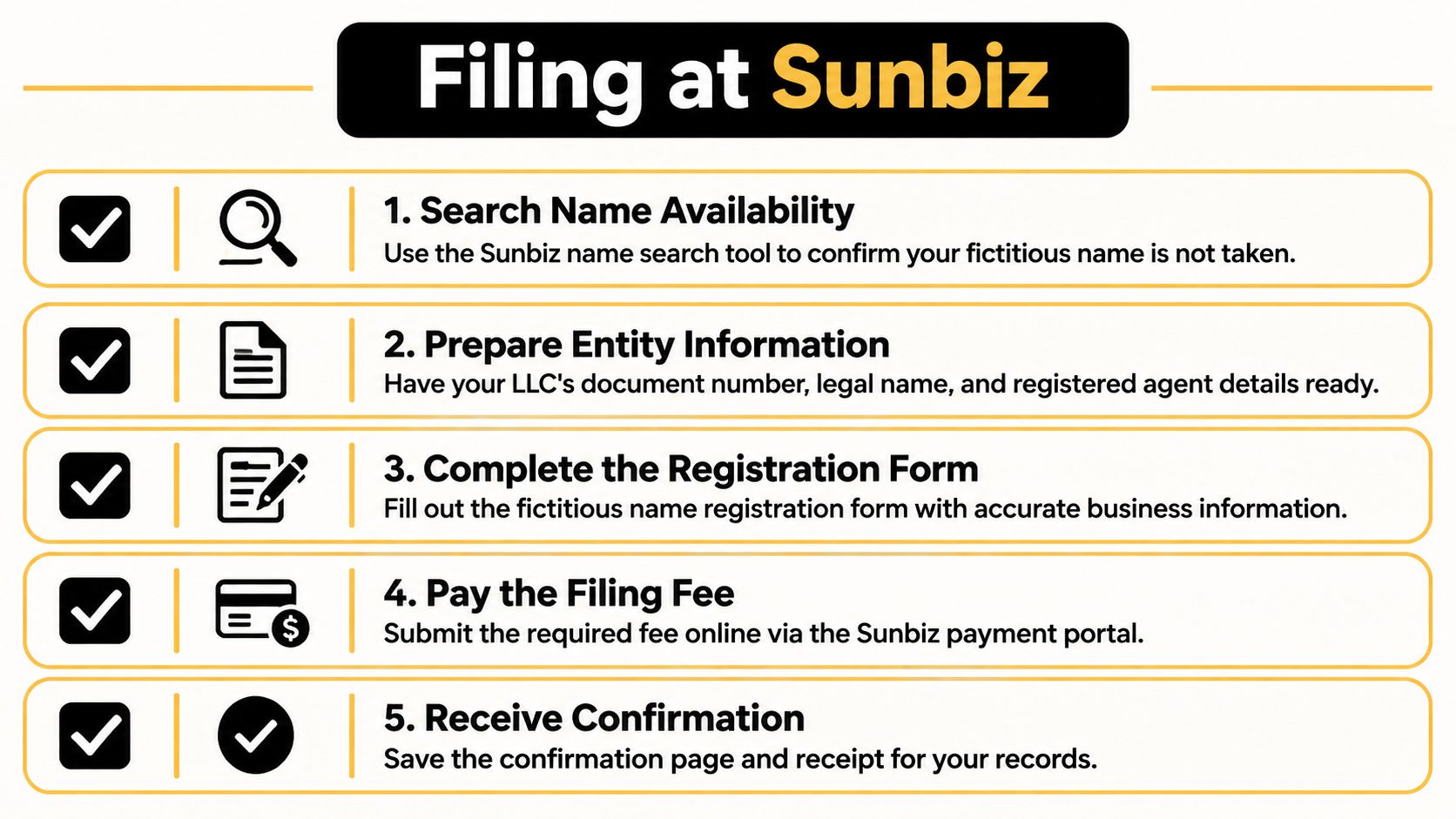
Don't assume a similar name automatically causes rejection. Focus your review on accurate entity identification, complete information, and compliance with the current application requirements. Separately resolve whether the proposed brand creates a trademark problem.
Under Florida's fictitious-name renewal instructions, a registration lasts five years, expires on December 31 of its final year, and carries a $50 renewal fee; an expired registration can't be renewed or reinstated, and a name change requires cancellation and a new registration rather than alteration through renewal.
Calendar tip: Give each DBA its own renewal reminder and responsible person. Don't assume the LLC's other filing reminders cover its operating names.
Keep certificates and certified copies when requested, but confirm the recipient's requirements first. Above all, carry the exact legal-name connection from the filing into your contracts and payment setup.
Multiple DBAs Versus Separate Entities
Use another DBA when you need another name. Consider another entity when you need a different ownership arrangement, asset boundary, or risk structure. That distinction should drive the decision more than the filing cost.
The SBA's business-launch guidance explains that DBA registration doesn't establish a separate entity or trademark-like protection, and multiple businesses may use the same DBA in a state. Multiple DBAs therefore don't create separate liability shields, subsidiaries, taxpayers, or segregated assets merely through registration.
When a DBA Is Enough and When a New Entity Is Better
| Scenario | Use a New DBA | Form a New LLC or Corp |
|---|---|---|
| Related course brands within a coaching practice | A sensible option if ownership and risks align | Consider if the business arrangement changes |
| Adjacent Shopify product lines | Useful for testing distinct branding | Consider when exposure or investment diverges |
| A brand with different investors | Don't use a name filing to allocate ownership | Evaluate a separate entity and governing documents |
| A materially different regulated operation | Don't assume existing arrangements cover it | Review structure, licensing, and insurance first |
| A business intended for a separate sale | Assess whether the branding arrangement fits the deal | Evaluate separation with transaction counsel |
My rule of thumb is shared ownership, compatible activities, and an acceptable combined risk profile. If those conditions hold, a multi-DBA arrangement can be practical. If they don't, stop adding names and examine the structure.
Separate the Decisions Founders Often Bundle Together
Banking organization isn't liability separation. You can organize records by brand without creating independent companies. Likewise, neither an additional DBA nor a newly formed LLC replaces trademark analysis.
A separate entity also needs a deliberate operating plan. Discuss contracts, insurance, bookkeeping, tax treatment, and ownership documentation with counsel and your accountant rather than assuming formation alone resolves the problem.
If related businesses need an ownership structure, review holding-company setup as a planning option, not a default solution. If a future sale is part of the strategy, The Owner's Shortlist's business transfer lawyer options offers a resource for considering transaction counsel.
Don't put a new investor into a brand conversation before deciding what, legally, that investor will own.
The tipping point isn't the next name. It's the next meaningful difference in owners, assets, obligations, or exposure.
A Multi-Brand Founder Story in South Florida
Consider a hypothetical South Florida founder, not a reported client case, operating a creative-services brand, an e-commerce product line, and a local events label through an LLC. The services brand handles design work, the online store sells products, and the events label markets local gatherings. Each presents a distinct identity to customers.
The founder starts sensibly by recording which company operates every brand and using that identity in agreements. Bookkeeping tracks revenue and expenses by brand, allowing the founder to evaluate each activity without pretending the internal categories are separate legal entities.
The First Friction Appears in the Paperwork
The creative-services customer asks for a W-9. For an LLC other than a disregarded single-member LLC, IRS Form W-9 calls for the legal entity name on line 1 and the business, trade, or DBA name on line 2. A disregarded single-member LLC needs to follow the owner-name instructions instead of blindly copying the LLC's name into the taxpayer field.
That distinction is why I wouldn't tell every founder to use the LLC name and EIN everywhere. Follow the applicable tax classification and keep the records coordinated. The operating brand isn't a new federal taxpayer identity.
- Banking mismatch: A payment arrives under the events label, but the bank hasn't received matching operating-name documentation. In this hypothetical, the bank pauses processing while the founder supplies records.
- Processor mismatch: The store's onboarding information doesn't match the tax documentation. The founder corrects the legal and tax identity instead of applying for a new taxpayer identity just for the brand.
- Trademark conflict: Another business objects to the product-line name. The founder needs a rights analysis, not merely proof of a Sunbiz filing.
Reassess the Events Business
The events activity deserves its own risk discussion rather than automatic inclusion because the branding looks related. The founder should review the actual operations, agreements, permits, and insurance with advisers.
The practical win is organized administration, not immunity from disputes. My recommendation: Treat each brand as an internal profit center, maintain consistent documentation, and reconsider the entity structure whenever an activity changes materially. None of those steps guarantees a bank or processor's decision, but they give the founder a cleaner record to explain.
A Founder Playbook and Next Steps
Stop counting names and start auditing the businesses behind them. Your next move should be a coordinated review of the operating brands, filing records, tax documentation, and actual activities, not another isolated Sunbiz submission.
Put the Brand Inventory to Work
- Confirm the operator: Identify which legal entity conducts business under every customer-facing name.
- Check registration status: Record each filing and renewal deadline separately, including responsibility for monitoring it.
- Reconcile payment documents: Compare invoices, bank records, processor profiles, and taxpayer information for inconsistencies.
- Clear the brand: Investigate trademark exposure before investing further in packaging, signage, or advertising.
- Review the structure: Flag different investors, valuable assets, regulated activities, and materially different risks for counsel.
- Organize the books: Use a consistent approach to business expense tracking so you can evaluate each brand without confusing accounting categories with separate entities.
Florida's separate-application rules and renewal requirements make each brand an ongoing administrative commitment. Use the filing and renewal terms above to build your budget and calendar, and investigate any lapse before continuing to rely on outdated records.
The right number of DBAs is the number that serves a coherent business structure. Bring your current registrations, proposed brands, ownership plans, and target markets to a legal review. If expansion reaches other states, include assumed-name requirements, qualification, taxes, licenses, and disclosures in that discussion rather than assuming the Florida filing travels with you.
Coto & Waddington, Attorneys at Law offers Florida business formation, contract, trademark, and ongoing counsel services for founders choosing between additional DBAs and separate entities. Visit Coto & Waddington, Attorneys at Law to book a consultation and review your existing names, planned brands, and target markets with practical South Florida counsel focused on protecting assets, streamlining deals, and reducing risk.