TL;DR: A holding company setup is a strategic way to separate valuable assets from day-to-day operating risk, centralize ownership, and improve management across multiple businesses. It often makes the most sense for founders with more than one venture or meaningful IP or real estate, but the added entities, filings, and compliance only pay off when the structure fits your actual business. A consultation is the right next step if you need to weigh the trade-offs for your specific Florida or Delaware setup.
You usually start looking at a holding company after the business gets more complicated.
A South Florida founder opens one company, then a second. The first company is profitable. The second is riskier. Maybe there's a warehouse, a trademark, software code, or a storefront lease in the mix. Maybe a sibling or spouse is involved. Maybe an investor is coming in. At that point, the question isn't academic anymore. It's whether all of those assets and liabilities should stay inside one entity.
A lot of founders assume a holding company is automatically the optimal choice. It isn't. It's a tool. A good one, in the right fact pattern. A bad one, if you build complexity you don't need.
Is a Holding Company Structure Right for Your Business

A common local scenario looks like this. You run an e-commerce brand from Miami, you're launching a second product line, and you also own the trademark and maybe the equipment or the property the business uses. If all of that sits in one operating company, one lawsuit or one debt problem can put everything in the same blast radius.
A holding company can solve that by separating ownership from operations. One entity owns the assets or ownership interests. Another entity runs the business.
When the structure usually makes sense
The structure tends to fit best when you have:
- Multiple businesses: You want one parent entity coordinating ownership across separate operating companies.
- Valuable IP or real estate: Trademarks, software, equipment, or property may be safer outside the operating entity.
- Different risk profiles: One venture is stable, another is experimental, and you don't want liabilities crossing over.
- Long-term planning goals: You expect future investors, a sale of one line of business, or family succession planning.
That said, many guides praise holding companies but don't really quantify when the structure becomes economically justified. If the businesses aren't producing significant profit, the benefit may not outweigh the setup and maintenance burden, as noted by Collective's discussion of whether you should start a holding company.
When the answer is probably no
Sometimes the better answer is simpler.
If you're operating one modest business with no meaningful assets outside normal operations, a separate holdco may be too much too early. The same goes for founders who aren't ready to maintain separate books, separate bank accounts, and clean intercompany documentation.
Practical rule: If you won't maintain entity separateness in real life, the paper structure won't save you later.
In those cases, one operating company with strong contracts, internal divisions, or carefully documented leases may get you most of the practical benefit with less friction.
For founders still deciding what their primary operating entity should even be, the better first step is often to get clear on your tax and governance baseline through a guide on how to choose between an LLC, S-Corp, and C-Corp in Florida.
The real decision
The right question isn't "Should I have a holding company because well-run businesses do?"
It's this:
- What exactly am I trying to protect
- What entities need to exist
- Will the tax and management advantages justify the ongoing work
- Can I run this structure cleanly every month, not just on formation day
If you can't answer those four questions, you're not ready to file yet.
Your Foundational Decision Entity Type and Jurisdiction
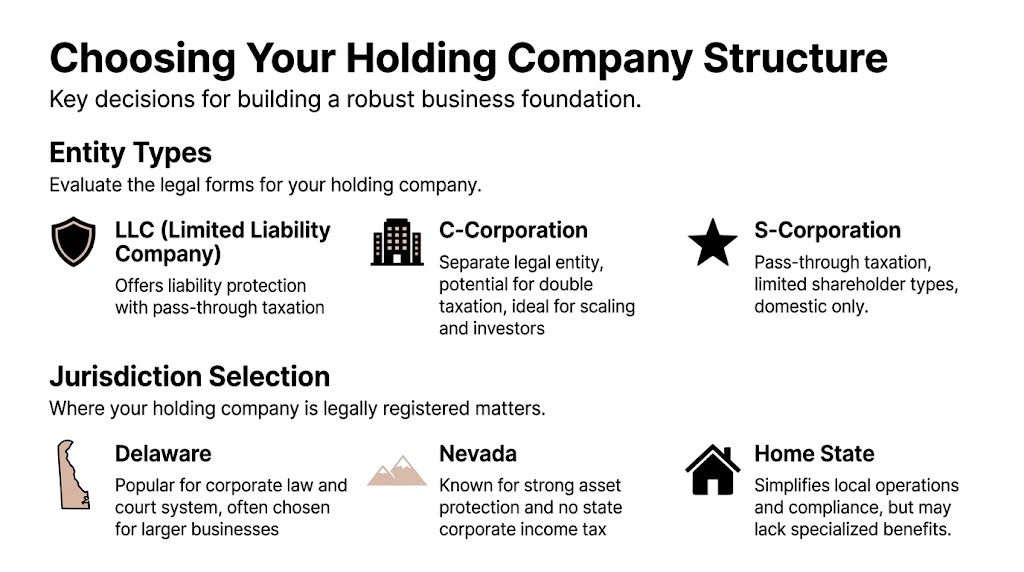
The first two choices drive almost everything that follows. You need to choose the legal form of the holding company, and you need to decide where to form it.
LLC vs C-Corp for the holding company
An LLC is often the cleanest starting point for closely held businesses. It gives liability protection and flexible internal governance. For family-owned structures and founder-led businesses, that flexibility matters.
A C-Corporation is different. It tends to fit better when the group expects outside investment, formal equity planning, or a more traditional corporate governance model.
An S-Corporation can also play a role in some holding structures, especially where pass-through taxation and self-employment tax planning are part of the design. But eligibility rules and drafting issues make it less forgiving.
A practical way to choose
- Use an LLC if you want flexibility, simpler internal economics, and a structure built around founder control.
- Use a C-Corp if investor expectations, stock design, or future scalability point in that direction.
- Use an S-Corp carefully if tax treatment is the point of the structure and you've confirmed eligibility and drafting details up front.
One issue founders miss is the administrative side. Every entity needs proper tax registration, and usually its own EIN and banking relationship. This overview on LLCs and EINs is a useful practical primer because multi-entity problems often start with basic setup mistakes.
Delaware vs Florida
For South Florida founders, this is where strategy matters.
Delaware is popular for holding companies for a reason. Over 80% of Fortune 500 companies use a Delaware holding structure due to its Chancery Court, and Florida's filing fee is around $125, while Delaware is often chosen for privacy and no state income tax on intangible assets like IP held by the company according to Wolters Kluwer's discussion of holding company risk mitigation.
Florida, however, is often easier for local founders to run day to day. If your team, records, operations, and advisors are all here, simplicity has value.
| Factor | Delaware | Florida | Founder's Tip |
|---|---|---|---|
| Court system | Strong reputation for corporate disputes | Familiar for local operations | If ownership or investor disputes are a real possibility, Delaware deserves serious attention |
| Privacy | Often preferred by founders who want more privacy | More straightforward local filing environment | Privacy matters most when the structure will hold IP or passive assets |
| Intangible assets | Common choice for IP holding | Often used for direct local ownership | If trademarks or software are central, think beyond formation cost |
| Filing experience | Built for corporate structuring | Convenient for local businesses | Cheap formation doesn't always mean cheaper long-term management |
| Local operations | Usually paired with a Florida operating entity | Natural fit for in-state operations | A Delaware holdco with a Florida opco is common because each entity does a different job |
The hybrid model many founders choose
A practical pattern is the Delaware holding company owning a Florida operating company.
The holdco owns equity, IP, or other key assets. The Florida entity employs people, signs customer contracts, and runs the business. That can give you stronger separation between ownership and operations.
If you form outside Florida but do business here, don't forget the follow-up registration issue. Founders often miss that a non-Florida entity may still need authority to operate here. This explanation of what is a foreign limited liability company is worth reviewing before you assume your Delaware filing ends the analysis.
The right state isn't the one founders talk about most. It's the one that matches how your group will actually operate.
One more warning. Wolters Kluwer also notes a 40% risk of veil piercing if funds are intermingled in inadequate DIY separations. That's the kind of mistake that turns a smart structure into expensive fiction. I don't treat that as a drafting footnote. I treat it as a deal-breaker.
Drafting the Core Legal Documents That Give Your Structure Strength

A holding company isn't strong because the state accepted your filing.
It's strong because the documents match the business reality, and the business reality follows the documents.
The governing document for the parent
If the parent is an LLC, the operating agreement needs to do real work. If it's a corporation, the bylaws and shareholder arrangements need to do the same.
Generic templates usually fail in three places:
- Control provisions: They don't clearly define who can approve subsidiary sales, financing, major contracts, or distributions.
- Transfer restrictions: They don't adequately limit what happens if an owner wants out, dies, divorces, or transfers interests informally.
- Economic terms: They blur the line between ownership, management rights, and actual rights to profit distributions.
A holding company often exists to centralize control. The documents should say exactly how.
Intercompany agreements are not optional
Without clear asset delineation, many DIY structures collapse. The parent may own trademarks, software, real estate, or equipment. The operating company uses those assets. That means you need a written agreement spelling out the terms.
According to the NASS issue paper on corporate structuring, a holding company structure isolates risk because subsidiary debts remain with the subsidiary, but that protection is only effective if arm's-length intercompany agreements are in place. The same source also notes that an S-Corp holding company owning an LLC operating company can reduce self-employment taxes from 15.3% on all earnings down to salary-only treatment, but only if the structure is drafted carefully enough to preserve S-Corp status.
That "arm's-length" point matters more than founders expect.
Common intercompany agreements
IP license agreement
The holdco owns the trademark or code. The opco gets a license to use it, with terms on scope, payment, quality control, and termination.Services agreement
The parent may provide administrative, legal, HR, or management support to subsidiaries. The agreement should describe the services and the charge methodology.Lease agreement
If the parent owns real estate or equipment, the operating entity shouldn't just "use it." It should lease it under written terms.
If money moves between entities, paper it. If assets move between entities, paper that too.
Clauses founders most often get wrong
Template language usually doesn't account for how holding groups run. The clauses below deserve custom drafting.
Approval authority
Who approves borrowing, hiring executives, licensing IP, or selling a subsidiary? If the documents are silent, people improvise. That creates conflict later.
Payment mechanics
If the operating company owes rent, royalties, or service fees, the agreement should define timing, amount, and records. Vague obligations invite sloppy bookkeeping.
Default and unwind rights
What happens if the operating company stops paying or a subsidiary is sold? The agreements should explain what terminates, what survives, and which assets stay with the parent.
A lot of founders ask whether a standard online contract can cover this. Usually it can't. A contract that works for one standalone company often breaks in a multi-entity group because it doesn't address related-party control, tax elections, or ownership overlap. This practical guide on how to write a business contract is a useful reminder that good contracts aren't about length. They're about fit.
What works in practice
The strongest structures usually share three habits:
- They document related-party transactions before money moves
- They charge and pay under a defined method
- They update documents when the business changes
The weak ones rely on assumptions. Someone says, "We own both entities, so we'll fix the paperwork later." Later is usually when there's a lawsuit, an audit, a breakup among owners, or a due diligence request from a buyer. That's the worst possible time to discover the structure was never built properly.
Structuring Ownership Capitalization and Tax Strategy

The legal chart is only half the job. The ownership percentages, capital contributions, and tax elections determine whether the structure delivers what you built it for.
Moving existing ownership into the holdco
If you already own one or more businesses, the usual task is to place those ownership interests under the new parent.
That may mean transferring LLC membership interests or corporate stock to the holding company. The transfer needs to be documented carefully, reflected in the governing documents, and aligned with tax treatment from the start.
Founders often create a mismatch. The state filing says one thing, the cap table says another, and the tax records say a third. Buyers and accountants notice that immediately.
Questions to answer before the transfer
- Who owns what today
- What exactly is being contributed
- Will all owners transfer proportionally
- Are there lender, landlord, or investor consents needed
- Does the operating agreement or shareholder agreement restrict the transfer
If the answers aren't clear, don't move interests yet.
Control is not the same as tax efficiency
One of the most important thresholds in a holding company setup is the difference between control and tax consolidation.
A holding company can generally control a subsidiary with 51% of voting shares, but 80% or greater ownership is the threshold that allows C-Corp groups to file consolidated tax returns, according to Diligent's overview of holding companies. The same source notes that this structure can offset profits in one subsidiary with losses in another and take advantage of the 21% federal corporate rate compared with the 37% top individual marginal rate.
That distinction drives real planning decisions.
If you only need governance control, one ownership structure may work. If your priority is group tax treatment, the ownership percentage may need to be higher. Founders who give away equity early sometimes discover later that they kept control but lost the cleaner tax result they wanted.
C-Corp groups vs pass-through structures
A C-Corp holding group can be useful when there are multiple subsidiaries with different performance profiles. One entity may be profitable while another is still consuming cash. Consolidated treatment can matter.
A pass-through structure often fits founder-led companies that prioritize simpler cash flow treatment and flexibility. In that world, the tax conversation usually shifts to how salary, distributions, and ownership economics work together.
Where founders get into trouble
- They focus only on entity formation: They don't model how profits will move.
- They ignore ownership thresholds: They assume majority ownership automatically creates every tax benefit.
- They transfer assets but not records: Trademark assignments, stock ledgers, and member consents don't match.
- They confuse tax elections with legal structure: An LLC taxed one way is still legally an LLC unless the documents and ownership support the intended result.
Working rule: Don't choose percentages casually. The ownership split may decide control, tax treatment, exit flexibility, and family succession all at once.
Capitalization needs a business reason
The parent also needs to be funded properly.
Sometimes the holdco receives ownership interests and little else. Sometimes it also receives cash, IP, real estate, or equipment. Whatever the contribution is, it should be documented as a real capital contribution, purchase, or loan, not just an informal transfer among related parties.
That matters for internal accounting and for creditor defense. If the holdco is supposed to own a valuable trademark, there should be a paper trail showing when and how it acquired it.
Asset-specific planning matters
Not every asset belongs in the parent. Some assets create licensing and valuation issues if moved too early or without enough planning. Real estate, software, trademarks, and foreign property interests all raise different follow-up tax and compliance questions.
For founders with cross-border ownership or rental income concerns, even adjacent issues like property income tax rates for non-residents can become relevant once a structure starts holding assets in different places. The larger point is simple. A holdco chart on paper doesn't replace asset-by-asset analysis.
What usually works best
The best ownership structures are boring in the best sense.
They have a clean cap table. Transfers are documented. The parent owns what everyone says it owns. Tax elections are coordinated with the legal documents. And the founder understands how money is expected to move before the year ends.
That's the setup that survives diligence, disputes, and growth.
Execution Your Filing Checklist and Ongoing Compliance
A smart structure still fails if the execution is sloppy.
Founders often spend their energy on the organizational chart, then rush through the filings and ignore the maintenance work. That's backwards. The filing process is straightforward. The discipline that follows is where the structure either holds up or starts to leak.
Your formation checklist
Use a real checklist and complete each step in order.
Choose the entity names carefully
Confirm availability and consistency across the parent and each subsidiary. Random naming conventions create confusion in contracts, banking, and tax records.File the formation documents
That usually means Articles of Organization or Articles of Incorporation in the chosen state.Appoint the registered agent
Use a reliable provider and keep the address current. Missed service of process notices create avoidable legal problems.Get an EIN for each entity
Don't treat the group as one business for tax administration. The parent and each subsidiary need their own identity.Adopt the internal governance documents
Signed operating agreements, bylaws, written consents, and ownership records should be in place before the business starts moving money.Open separate bank accounts
This is essential. One entity, one bank account set. No shared debit cards. No casual transfers.Document asset and ownership transfers
If the parent will own stock, membership interests, IP, or equipment, paper those transfers right away.Put intercompany agreements into use
Not just signed. Used. If the opco owes rent or a service fee, invoices and payments should follow the agreements.
Your compliance checklist
The group needs recurring maintenance, not just a startup burst.
Corporate housekeeping
- Annual reports and renewals: Every entity has its own deadlines.
- Minutes or written consents: Major decisions should be documented at the correct entity level.
- Ownership records: Keep stock ledgers, membership records, and cap tables current.
Financial separation
- Entity-specific bookkeeping: Each company needs its own books.
- Intercompany entries: Record management fees, rent, reimbursements, and loans correctly.
- No commingling: Personal expenses and cross-entity payments are where problems start.
Operational boundaries
- Subsidiary leadership: Let the opco run operations.
- Parent oversight: Reserve strategic decisions for the holdco.
- Clear approvals: Major transactions should follow the authority rules in the documents.
According to Bajaj Finserv's discussion of holding company operations, effective holding companies can achieve 15-20% cost savings through centralized support services, but 22% fail due to decision bottlenecks. The same source notes that multi-state operations can create nexus and franchise tax issues in 10-15% of cases, and that parent-company control overreach can create veil-piercing risk.
That matches what founders run into in practice. Centralize support, not every decision.
A parent company should set direction, approve major moves, and protect assets. It shouldn't micromanage every contract, hire, or customer problem inside the subsidiary.
What works versus what doesn't
What works:
- Shared HR, legal, and admin support
- Separate books and clear internal billing
- Autonomy for each operating business
What doesn't:
- Using one entity's bank account for convenience
- Treating the parent and opco as interchangeable
- Waiting until year-end to fix intercompany records
- Having the holdco sign every operational contract
A good holding company setup isn't just filed correctly. It's run correctly every week.
Common Pitfalls and When to Engage Coto & Waddington
Most holding company mistakes aren't exotic. They're ordinary shortcuts with expensive consequences.
The mistakes that cause the most damage
The first is commingling funds. Founders move money between entities casually, reimburse expenses without backup, or let one company pay another's bills without documentation. That's how liability protection gets challenged.
The second is weak intercompany papering. The parent owns the trademark, but there's no license. The parent owns the building, but there's no lease. The parent supposedly provides management services, but nobody can explain the fee structure.
The third is bad tax coordination. Founders form entities first, then ask later how the profits are supposed to flow. That's how they end up with ownership percentages, elections, and compensation methods that pull against each other.
The hidden problem is usually operational
A lot of founders think the risk is in filing the wrong form. Usually it isn't.
The bigger issue is building a structure the team won't maintain. If bookkeeping is weak, if the ownership records aren't current, or if everyone signs contracts in the wrong entity name, the structure starts to drift from reality.
That drift becomes expensive in four moments:
- A lawsuit
- A tax review
- Investor due diligence
- A sale of one subsidiary or asset group
When those events happen, nobody cares what the org chart looked like on day one. They care how the companies were run.
When legal counsel is worth it
Founders should get specific legal help when any of the following is true:
- You already have an existing business and want to insert a new parent entity
- You own trademarks, software, equipment, or real estate that may move into a holdco
- There are multiple owners, family members, or uneven contribution levels
- You want Delaware and Florida entities working together
- You're considering S-Corp or C-Corp tax strategy inside a multi-entity structure
- You expect fundraising, acquisition interest, or succession planning issues
This isn't because the concept is mysterious. It's because small drafting and execution errors can undo the exact protections you were trying to buy.
A good lawyer doesn't just file the holdco. They pressure-test whether you need one, which assets belong where, how control should work, and what your team can realistically maintain. That's where value lies.
Holding Company Setup FAQs
Can a holding company own more than one type of asset
Yes. A holding company can own subsidiary interests, trademarks, equipment, real estate, or other business assets. The better question is whether a specific asset should be held there. The answer depends on liability exposure, licensing needs, financing restrictions, and tax treatment.
Do I need separate bank accounts and tax IDs for every entity
Yes, in practice you should assume each entity needs its own bank account and its own tax administration. Separate records are one of the basic habits that help preserve liability separation. If you don't want to maintain that discipline, a multi-entity structure may be the wrong fit.
Is Delaware always better than Florida for a holding company setup
No. Delaware is often attractive for governance, privacy, and more developed corporate law. Florida is often easier and more intuitive for local founders operating here day to day. A lot of South Florida businesses end up with a hybrid structure because the parent and the operating company are serving different purposes.
How much ongoing work does a holding company create
More than founders expect. Each entity needs filings, records, bookkeeping, and internal documentation. The work is manageable if the structure is necessary and the team is organized. It becomes wasteful when founders add entities before the business justifies them.
What's the most common mistake after formation
Treating the structure like a diagram instead of a system. The entities need to act like separate entities in contracts, payments, governance, and accounting. If that separation disappears, the legal benefit can disappear with it.
If you're weighing a holding company setup in Florida or Delaware, Coto & Waddington, Attorneys at Law helps founders build structures that are practical, clean, and defensible. The firm advises South Florida entrepreneurs on entity formation, contracts, capitalization, and multi-entity planning with clear communication, predictable pricing, and business-first legal strategy.