Say your family finds a handwritten letter from a Coral Gables widow explaining who should receive her home, savings, and jewelry. Everyone recognizes her handwriting and agrees those were her wishes, but nobody witnessed her signature. If the family offers that unwitnessed letter as her Florida will, the court generally can't admit it as one.
You may be facing a less obvious version of the same problem: you've finished an online form, agreed on beneficiaries, and only need to sign. That last appointment deserves as much attention as the drafting. A carefully written will can still fail because the people signing it weren't present together.
Table of Contents
- Florida Will Requirements at a Glance
- Who Can Make a Florida Will and Be Mentally Ready
- How to Sign and Witness a Florida Will Step by Step
- Self-Proving Affidavits That Shorten Probate
- Electronic Wills and Remote Witnessing Limits
- Revoking or Updating a Florida Will Correctly
- Homestead, Spousal Rights and Out-of-State Wills
- Confirm Your Florida Will and Talk to an Attorney
Florida Will Requirements at a Glance
A Florida will generally needs an eligible testator with testamentary capacity, a written document, a signature at the end, and attesting witnesses who complete the required signing ceremony.
The testator is the person making the will. The table below separates requirements for validity from safeguards that make the document easier to administer later.
Florida will requirements by element
| Requirement | Florida rule | Statute |
|---|---|---|
| Testator age | An adult, or an emancipated minor; marriage can establish emancipation, but military service alone isn't the statutory eligibility test | Fla. Stat. 732.501 |
| Testator capacity | Understands, in general, the property involved, relevant family relationships, and what the will does at signing | Fla. Stat. 732.501 |
| Writing | Paper or a qualifying electronic record; no fixed ceremonial wording required | Fla. Stat. 732.502 and electronic-will provisions |
| Signature | Testator signs at the end, or acknowledges an earlier signature in the witnesses' presence | Fla. Stat. 732.502 |
| Witnesses | Two attesting witnesses who sign in the presence of the testator and each other, under the Florida execution statute | Fla. Stat. 732.502 |
| Self-proof | Optional notarized acknowledgment and witness affidavits | Fla. Stat. 732.503 |
| Holographic will | An unwitnessed handwritten will generally isn't recognized; a separate federal military testamentary-instrument exception may apply | Fla. Stat. 732.502(2) |
| Revocation | A later qualifying testamentary instrument or an authorized physical act performed with revocatory intent | Fla. Stat. 732.505 and 732.506 |
Separate the document from the ceremony
Think of the written will as instructions and the signing ceremony as the authentication process. Clear instructions don't excuse defective authentication. Likewise, perfect signatures won't make an unclear gift easy to interpret.
Handwriting isn't itself the problem with a handwritten will. A handwritten document can potentially qualify when it's properly executed; the danger is assuming handwriting replaces witnesses.
A missing personal representative, an incomplete affidavit, and a missing required signature also aren't equivalent problems. Some omissions complicate administration, while others threaten validity.
Practical rule: If an essential requirement is missing, polished language won't repair it. Identify the defect before signing rather than asking your family to resolve it in probate.
Who Can Make a Florida Will and Be Mentally Ready
Eligibility comes before drafting. Florida Statutes section 732.501 permits an adult or an emancipated minor of sound mind to make a will. Don't assume that military membership, by itself, establishes eligibility under that provision.
Testamentary capacity concerns the person's understanding when making the will. It's not a test of whether relatives approve of the proposed distribution.
Think of the will as an estate map
Drawing an estate map requires a general understanding of what belongs on it. The testator should understand the nature of their property, the people who naturally bear on their estate decisions, and the effect of giving property through the will.
That doesn't mean reciting every account balance. A founder might describe an ownership interest in a design studio, a home, and investment accounts without remembering their exact values.
The distinction matters for someone experiencing memory problems. A diagnosis doesn't automatically answer the legal question, and a friendly conversation doesn't establish capacity. The relevant issue is the person's understanding at execution.
- Choose an alert period. Schedule around fatigue, medical appointments, and medication effects rather than around a beneficiary's convenience.
- Use the testator's words. Ask the person to explain intended gifts and significant exclusions without coaching.
- Document unusual decisions. A private attorney's note about the reasons for an unequal distribution can provide useful context.
- Arrange independent communication. Let the testator speak privately with counsel, particularly when a caregiver or relative benefits.
Distinguish help from control
Undue influence is a separate concern. A person can understand a document yet be pressured into signing terms that reflect someone else's wishes.
Say a new partner screens every phone call, selects the lawyer, supplies the gift instructions, and refuses to leave the appointment. Those circumstances deserve investigation even if the signing arrangements otherwise look correct.
For bilingual families, use explanations the testator genuinely understands. Don't rely on a beneficiary to translate a disputed gift or summarize the entire document.
Capacity and influence disputes turn on facts a court may examine much later. A calm appointment, independent instructions, and a careful signing record are more useful than a relative's assurance that everything was fine.
How to Sign and Witness a Florida Will Step by Step
Under Florida Statutes section 732.502, the testator must sign at the end, or direct someone to sign their name in their presence; the testator must sign or acknowledge the signature before at least two attesting witnesses, and each witness must sign in the presence of the testator and the other witness.
For a conventional paper signing, keeping everyone together throughout is the simplest way to avoid a presence mistake. Don't treat the appointment like circulating an office approval sheet.
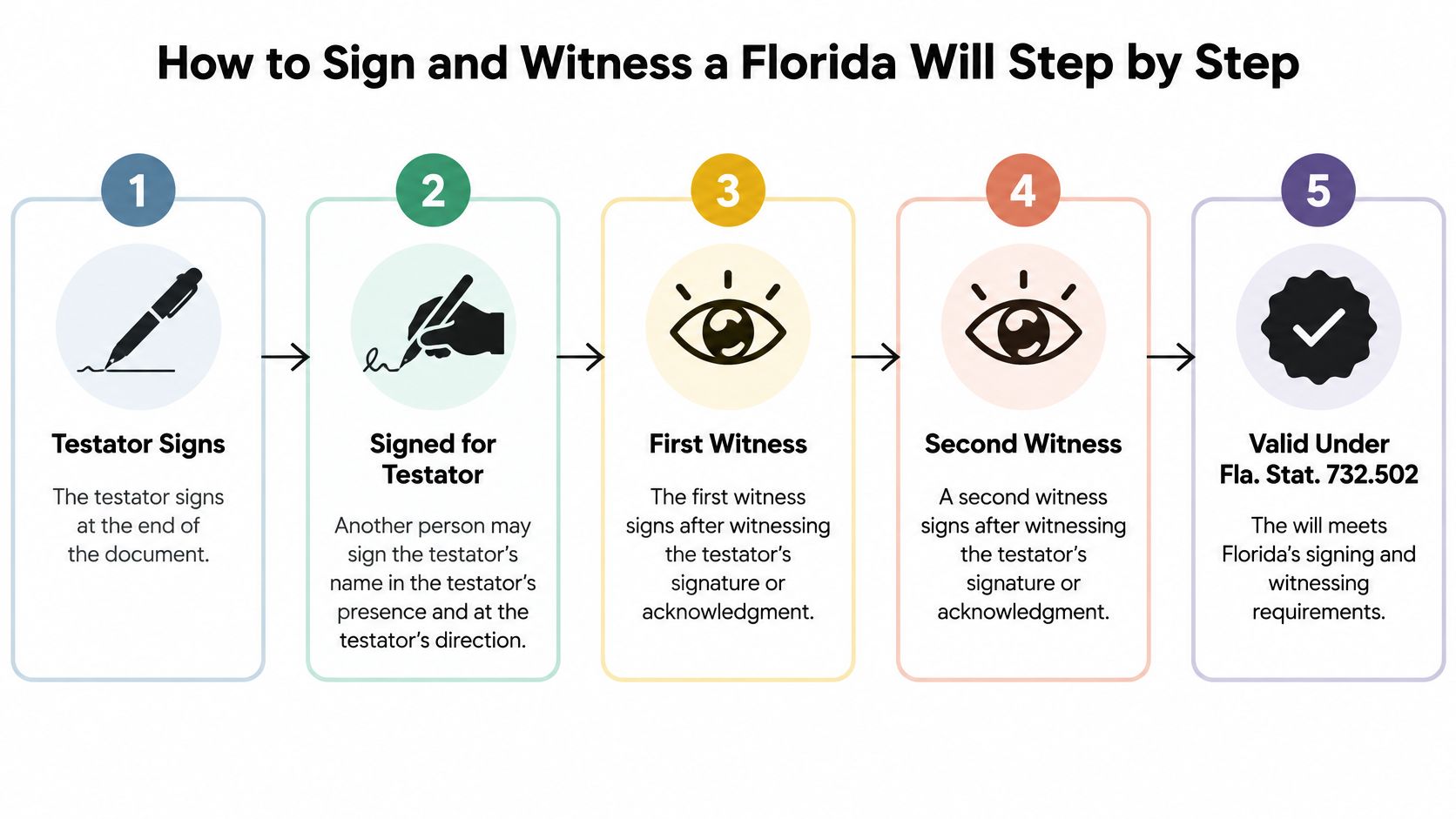
The signing-for-the-testator route is an alternative, not an additional signature everyone needs. Both witnesses must participate in the required presence arrangement, not merely watch separate portions of the appointment.
Follow a controlled signing sequence
Finalize the text and date. Check names, gifts, page order, and signature blocks. Resolve blanks before execution. A common slip is printing a corrected gift page after everyone has signed and substituting it into the original.
Gather the participants together. Use adult, neutral witnesses as a practical safeguard, and keep beneficiaries outside the signing room. Confirm nobody plans to leave early. Having a neighbor sign later in the kitchen isn't a substitute for the required ceremony.
Identify the document. Have the testator state that the document is their will. No ceremonial declaration is required, but this helps establish what the person understood. Avoid letting someone present it merely as paperwork that needs a signature.
Have the testator sign or acknowledge. The signature belongs at the document's end. If it already exists, the testator should clearly acknowledge it before both witnesses. Don't assume the witnesses' recognition of the handwriting supplies that acknowledgment.
Have each witness sign with everyone present. Keep the testator and the other witness there while each witness signs. The frequent failure point is sending witnesses to separate rooms or collecting their signatures on different visits.
Complete supporting safeguards. Initialing pages can help identify the assembled document, but it isn't a substitute for execution. Complete an optional self-proving affidavit with the notary. Don't describe page initials as a statutory requirement or let the notary appointment replace witnessing.
Secure the original. Use an accessible, protected location and tell the nominated personal representative where it is. A scanned copy is useful for reference, but shouldn't become an excuse to discard the executed paper original.
Decide who will supervise
Florida doesn't require special wording, but families shouldn't improvise the presence requirements. Choose someone to direct the appointment, check the completed signatures, and keep the document assembled.
If you're deciding whether to handle drafting yourself, compare DIY wills and professional guidance from Law Office of Bryan Fagan – Atascocita TX Lawyers. It's a useful decision-making resource, but Texas-oriented guidance doesn't replace Florida execution advice.
Self-Proving Affidavits That Shorten Probate
Suppose a Tampa father executes his will properly but leaves no self-proving affidavit. Years later, the witnesses have moved away, and the family can't locate one of them. Establishing execution may require additional evidence and procedural work before the will is admitted.
A self-proving affidavit prepares that evidence while the participants are available. It doesn't promise a shorter probate case overall, but it can remove an avoidable proof problem.
Authenticate execution in advance
The Florida Probate Code allows a properly self-proved will to be admitted without further proof of execution. The mechanism uses the testator's acknowledgment, sworn witness affidavits, and an authorized officer's certificate attached to or following the will.
The affidavit supplements a properly executed document. A notary's stamp doesn't cure an absent witness or a defective signing ceremony, and self-proof doesn't prevent challenges based on capacity or undue influence.
For a comparison of the concept in another jurisdiction, the Law Office of Bryan Fagan probate guide explains Texas self-proving affidavits. Use Florida's applicable statutory form and procedures for a Florida signing.
- Book the notary in advance. Confirm the notary can attend the appointment and administer the necessary oaths.
- Check the form before execution. Names, acknowledgment language, certificate details, and signature spaces should match the participants.
- Keep the original assembled. Preserve the will and affidavit together; don't insert replacement pages after notarization.
- Explain the remaining administration. Self-proof concerns admission evidence, not the entire Florida probate process.
Plan for delivery after death
Under Florida Statutes section 732.901, the custodian must deposit the will with the appropriate clerk within 10 days after receiving information that the testator has died. Depositing the will isn't the same as completing probate or obtaining authority to distribute property.
Before anyone leaves the notary appointment, check that the certificate is complete and the affidavit remains attached to the correct will.
Electronic Wills and Remote Witnessing Limits
A will can contain clear instructions and still face a challenge if the signing process fails. Florida's electronic-will rules, including section 732.526, recognize an electronic original deposited through the Florida Courts E-Filing Portal, as well as a notary-certified paper reproduction offered as the original electronic will.
A PDF stored on a laptop is not automatically a compliant electronic will. The difference is like the difference between a loose letter and a document whose identity and handling can be established.
Check custody as carefully as signatures
An electronic original needs more than a safe place to save a file. It needs a documented chain of custody, much like a sealed envelope kept in a vault.
For a self-proved electronic will, section 732.523 requires the acknowledgment and affidavits to be associated with the electronic record. It also requires a designated qualified custodian, continuous custody before probate, and the custodian's sworn certification about custody and alteration.
Ask who will hold the record if the platform changes ownership or stops operating. A downloaded copy may be convenient, but it does not replace the required custody arrangement.
Verify remote participation before booking
Under Florida's electronic execution statute, electronic signatures can satisfy signing requirements. A remote witness must confirm being physically present in the United States or a U.S. territory. Compliant remote execution also involves notarial supervision, identity authentication, and applicable audio-video procedures.
A relative abroad may be able to join a video call but still be ineligible to serve as a remote witness under the location rule. Beneficiaries living abroad raise separate planning questions. Their location does not establish whether the signing ceremony meets the requirements.
Before booking, check these details:
- Locate the witnesses. Confirm where each will physically be during execution, not only where they live.
- Identify the custodian. Ask who holds the record and how authorized people can access it.
- Request process documentation. Ask the supervising notary and provider how they handle identity checks, required recordings, and record integrity.
- Discuss technology failure. Find out what happens if identification fails or the connection drops during the ceremony.
Electronic execution works only when the participants, custody, and documented platform procedures fit the legal requirements. If those details are uncertain, a supervised paper signing may be easier to manage.
Revoking or Updating a Florida Will Correctly
A will resembles a recipe card: leaving conflicting versions in the kitchen invites mistakes. Unlike changing a recipe, however, crossing out an ingredient and writing a replacement may not legally change the instructions.
Updating requires a valid method, not merely convincing evidence that you wanted something different. Don't write a beneficiary's new name into a signed original and assume the alteration works.
Choose the right method
Florida Statutes section 732.505 addresses revocation through a later will, codicil, or qualifying writing executed with the required formalities. Physical revocation belongs under section 732.506, not section 732.505.
A physical act, such as burning, tearing, canceling, or obliterating, must be accompanied by intent to revoke. When another person performs the act for the testator, the presence and direction requirements matter.
A codicil changes an existing will but requires proper testamentary execution. An informal signed note isn't a reliable shortcut.
| Method or event | What it can trigger | Common trap |
|---|---|---|
| Replacement will | Revocation and replacement of earlier instructions | Destroying the old original before the replacement is validly executed |
| Codicil | Targeted changes to an existing will | Treating an unwitnessed amendment as sufficient |
| Intentional physical revocation | Revocation of the instrument | Confusing accidental damage with intentional cancellation |
| Divorce or annulment | Changes affecting former-spouse provisions under section 732.507, subject to exceptions | Assuming every estate-planning document updates automatically |
| Account beneficiary update | Changes to assets governed by the account designation | Editing the will but leaving the account form unchanged |
Coordinate the whole plan
Retirement-account and life-insurance beneficiary designations generally control those assets rather than contrary will language. Review the actual forms, not just your recollection of whom you named.
For a useful comparison of amendment choices, Law Office of Bryan Fagan discusses updating a will in Texas. Florida formalities still govern your Florida execution decisions.
- Review after major changes. Marriage, divorce, a child's birth, a business sale, or an interstate move warrants attention.
- Inventory the instructions. Check what to include in a will before replacing the document.
- Control superseded versions. Coordinate retirement of old originals with counsel after the replacement is effective, and label retained reference copies clearly.
Homestead, Spousal Rights and Out-of-State Wills
A valid will doesn't give you unlimited control over every asset. Florida's homestead protections and surviving-spouse rights can affect a distribution even when nobody disputes the signatures.
Homestead is especially important because families often treat the home like an ordinary investment account. Florida's constitutional restrictions require a separate analysis.
Start with the home
Article X, section 4 of the Florida Constitution restricts devising homestead when an owner leaves a spouse or minor child. When there's a spouse but no minor child, a devise to the spouse is permitted; when a minor child survives, the owner can't freely choose a different recipient through the will.
If the proposed gift violates those restrictions, changing the witness arrangements won't solve the problem. Counsel needs to examine the deed, family circumstances, and intended distribution.
Property and spousal rules that limit a Florida will
| Situation | What the will can do | Rule |
|---|---|---|
| Owner survived by spouse and minor child | Cannot freely redirect homestead away from the protected family interests | Art. X, s. 4, Florida Constitution |
| Owner survived by spouse, no minor child | Homestead may be left to the spouse | Art. X, s. 4, Florida Constitution |
| Owner with no spouse or minor child | Homestead generally may be devised freely | Art. X, s. 4, Florida Constitution |
| Surviving spouse | Gifts remain subject to applicable elective-share rights and valid waivers | Fla. Stat. 732.201 through 732.2155 |
| Spouse's elective-share deadline | A statutory election period and outside limit apply; obtain advice promptly after notice | Fla. Stat. 732.2135 |
| Out-of-state will | Certain nonresident wills valid where executed are recognized, subject to exclusions | Fla. Stat. 732.502(2) |
Separate spousal rights from document validity
The elective estate isn't necessarily identical to the property distributed under the will. Don't calculate a spouse's entitlement by looking only at the probate bank account, and don't postpone advice after receiving administration notices.
Out-of-state validity also needs care. Florida's self-proof statute recognizes specified nonresident instruments and certain self-proof completed under another state's law. That isn't blanket approval of every document valid somewhere else.
Say a Naples retiree has a Georgia will, a Florida home, and a surviving spouse asserting elective-share rights. Counsel must evaluate execution, homestead, and the spouse's claim separately.
A Florida Lady Bird deed may belong in a broader property discussion, but it's not a substitute for reviewing family protections. Have Florida real estate reviewed even when the existing will was properly prepared elsewhere.
Confirm Your Florida Will and Talk to an Attorney
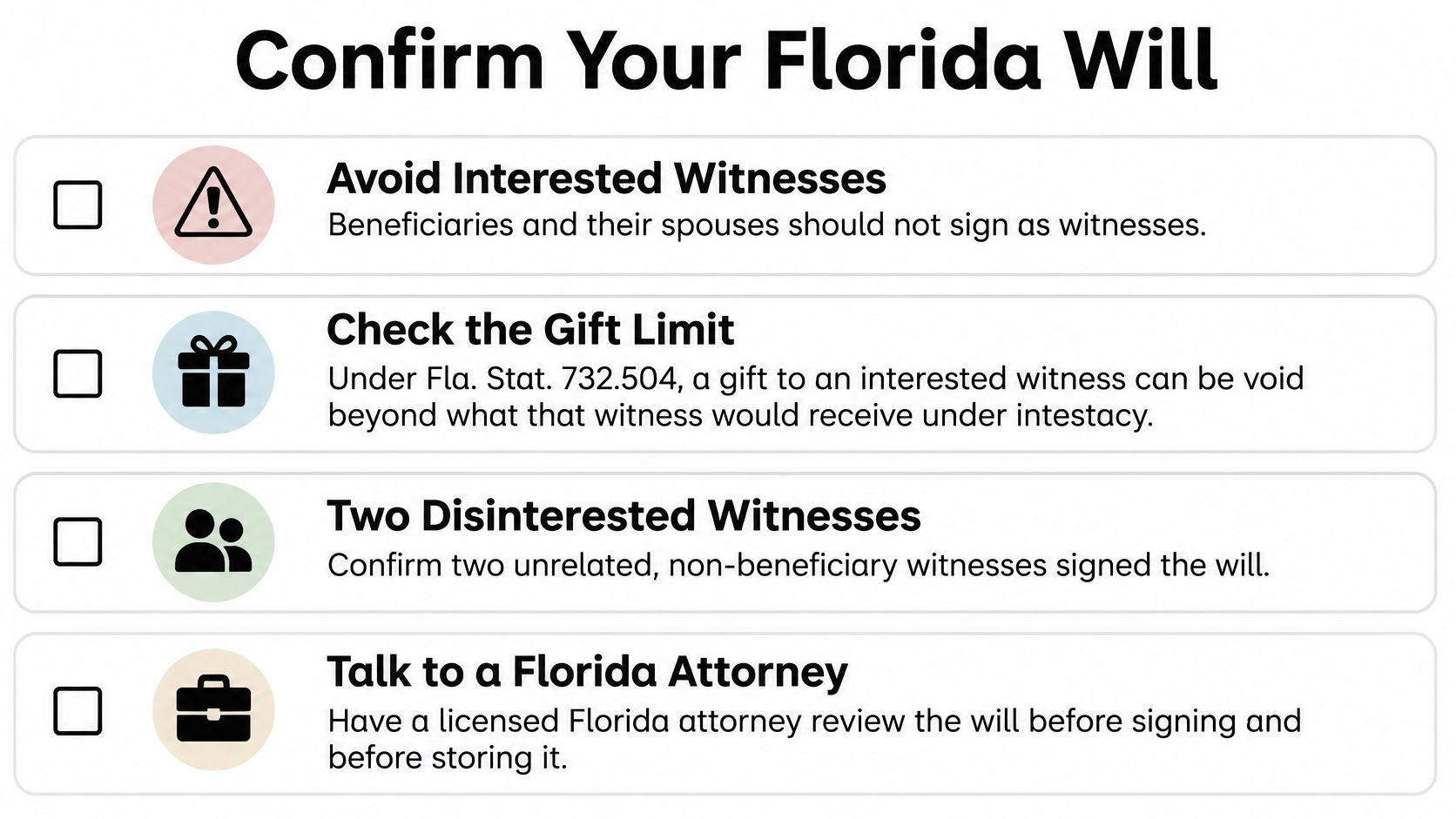
A beneficiary signs the will as a witness because they are already at the house. The will itself may remain valid, but under Fla. Stat. 732.504, a gift to an interested witness is generally void unless two other competent, disinterested witnesses also attest to the will. Use neutral adult witnesses so the intended gift is not put at risk.
Identify the actual defects
An imperfect document is not automatically invalid. Missing page initials, for example, are different from a missing required execution signature. Focus first on whether the signing ceremony followed Florida's requirements.
- Incomplete execution. Check the required signature blocks and whether everyone followed the presence rules.
- Witnesses signing prematurely. Witnesses should sign only after the testator signs or acknowledges the signature.
- Unreviewed templates. An out-of-state form may assume procedures or property rules that do not fit Florida.
- No suitable representative. Omitting a nomination may complicate administration, even if it does not invalidate the will.
- Conflicting account instructions. Compare the gifts in the will with current beneficiary forms.
- Unrecorded wishes. An oral explanation to relatives does not reliably change the written distribution.
Prepare before the appointment
Confirm eligibility and capacity, arrange neutral adult witnesses, prepare any self-proving paperwork, and decide who will supervise the signing. Record where the original will will be kept. Review homestead or spousal-rights concerns before printing the final version.
Bring documents that explain ownership, such as the deed, account beneficiary confirmations, trust documents, and business operating or shareholder agreements. A founder's will should account for transfer restrictions. It should not promise an ownership interest that the governing agreement does not allow to pass that way.
Before you sign: Ask who receives each important asset, which document controls that transfer, and who can locate the controlling original.
A short will can still involve a complicated family or restricted property. Seek Florida legal review when there is a homestead, blended family, minor child, business interest, out-of-state property, or special-needs beneficiary. If the testator needs Spanish explanations, arrange bilingual communication before signing rather than relying on a hurried family translation.
Coto & Waddington, Attorneys at Law offers bilingual English and Spanish estate planning for South Florida families, including will preparation and coordination with an overall estate plan. Request a will review through Coto & Waddington, Attorneys at Law to discuss the document, signing arrangements, and property concerns.