You picked a business name. The logo looks sharp. Your Instagram handle is available. The packaging proof is in your inbox, and your cousin already started telling people the launch date.
Then someone asks the question founders usually ask too late. Can you own that name?
That’s where a Florida trademark application stops being paperwork and becomes business strategy. In South Florida, that question comes up fast. A Miami service brand may need local protection now. A Fort Lauderdale software startup may need national protection before its first paid campaign. A bilingual founder may also need to think about how a name sounds, reads, and creates confusion in both English and Spanish.
A trademark protects the brand signals customers use to find you and remember you. Your name. In many cases, your logo. Sometimes a slogan. If those assets aren’t cleared and protected early, you can spend months building customer recognition around a mark you may later have to change.
Your Brand Is Your Business Your Guide to Trademarks
A founder opens a coffee concept in Miami under the name Miami Wake Up. The cups are printed. The menu boards are installed. Delivery apps are queued up. Everything feels ready.
Then the true risk appears. Another business may already have rights in a similar name for related goods or services. If that happens, the issue isn’t just legal. It affects packaging, signage, social handles, customer reviews, and every dollar spent teaching people your brand.

A business name is not the same as a trademark
This confusion causes expensive problems.
Forming an LLC or registering a fictitious name only handles business registration. It doesn’t give you the same rights a trademark can provide. A founder can have a valid company filing and still run into a trademark conflict.
That’s why brand clearance comes before confidence. A name can be catchy and marketable, but still weak, descriptive, or already too close to someone else’s mark. If you’re still deciding on a name, this guide on what makes a good brand name is useful because it looks at memorability and distinctiveness from a branding angle that lines up with legal reality.
Competition for names is substantial
Brand protection isn’t a niche issue anymore. In 2023, the USPTO received over 730,000 trademark applications nationwide. Florida’s Division of Corporations registered 1,421 state-level marks in a recent year, contributing to over 18,800 active registrations (patentpc.com/blog/analyzing-uspto-trademark-statistics-what-you-need-to-know).
That volume matters. It means more overlap, more conflicts, and less room for founders who pick a name first and research later.
A strong name doesn’t just sound good. It survives clearance, works in the market, and gives you room to grow.
South Florida founders need a practical plan
For a local restaurant, salon, or home service company, Florida protection may be a sensible first move. For e-commerce, SaaS, consumer products, and content-driven brands, state-only protection often isn’t enough.
If you're sorting out that difference, this practical overview of how to trademark a business name is a good next step.
The key point is simple. Treat your trademark like inventory you haven’t bought yet. Don’t build a launch around it until you know what rights are available.
Deciding Your Path Florida State vs Federal USPTO Protection
Most founders don’t need more theory. They need a decision.
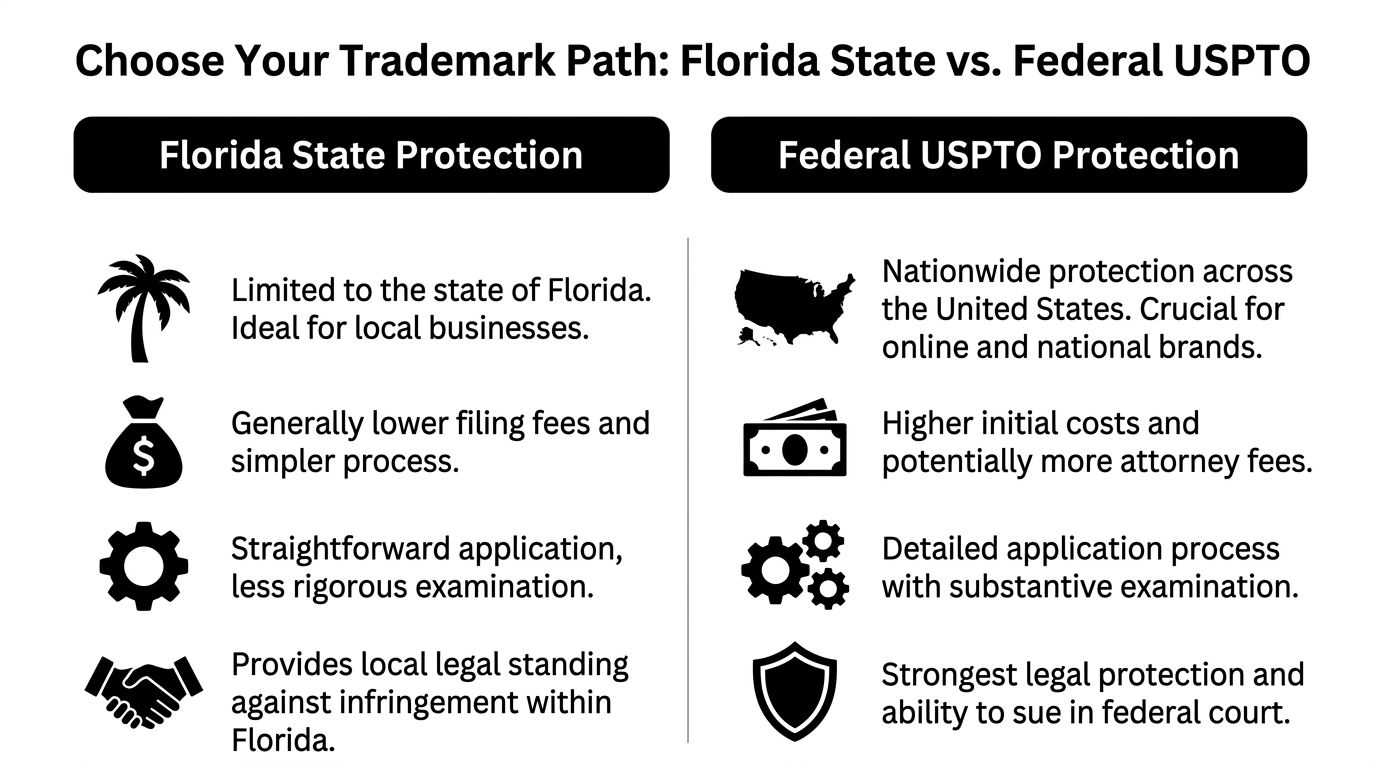
Should you file a Florida state trademark or go directly to the USPTO? The answer depends on where you do business, where you plan to sell next, and whether federal law creates a roadblock for your industry.
The basic trade-off
A Florida filing is narrower, faster in practice, and often easier for a local business to manage.
A federal filing is broader, more demanding, and usually the right move if your customers can come from anywhere in the United States.
Neither option is universally better. The better option is the one that matches your business model.
Florida State vs Federal USPTO Trademark At a Glance
| Feature | Florida State Trademark | Federal (USPTO) Trademark |
|---|---|---|
| Geographic scope | Limited to Florida | Nationwide |
| Best fit | Local service businesses, brick-and-mortar operators, Florida-only brands | E-commerce, software, scalable consumer brands, multi-state services |
| Governing law | Chapter 495, Florida Statutes | Federal trademark law through the USPTO |
| Use requirement | Based on in-state use | Can be based on current use or intent to use |
| Duration | Valid for five years, then renewal | Can continue indefinitely with required maintenance |
| Procedural burden | Simpler | More rigorous examination |
| Litigation value | Useful for local enforcement | Stronger influence and federal enforcement tools |
When a Florida filing makes sense
A state filing can be a smart first layer for:
- Local services: Think salons, med spas, restaurants, cleaning companies, and neighborhood retail.
- Florida-first launches: Some founders want brand protection while proving concept before spending more on federal filing.
- Industries blocked federally: In this situation, state registration becomes more than a backup plan.
A Florida filing won’t solve everything. It won’t give your Miami company automatic rights in Texas or California. But for a founder operating inside Florida, it can still be a practical legal asset.
When federal is the right call
If the brand is online, digital, or built to scale, federal protection usually isn’t optional.
That includes:
- E-commerce stores selling across state lines
- Software and app companies
- Creators and product brands with national marketing plans
- Service companies taking clients outside Florida
- Franchise-minded businesses that want expansion advantage
A bilingual founder should think carefully here. If customers may encounter your mark in ads, marketplaces, and search results across the country, state-only rights are usually too narrow for the significant exposure.
Practical rule: If your checkout page, booking flow, or ad campaign reaches customers outside Florida, build your trademark strategy around federal protection.
The cannabis and hemp exception
Some businesses don’t get a choice.
Florida’s cannabis market generated $2.5 billion in sales in 2024, and because the USPTO denies registrations for federally illegal goods, state registration under Chapter 495 is often the only formal option for high-THC brands (contractlawmiami.com/state-trademark-registration-common-law-rights-florida).
For those founders, a Florida trademark application can be the core filing, not the stepping stone. That doesn’t remove the limits. Enforcement is still geographically constrained, and branding still needs to be distinctive. But it gives a legal framework where federal registration may not be available.
What works in practice
A lot of founders make one of two mistakes.
The first is overfiling. They pay for a federal filing before they’ve even checked whether the name is clear or whether the business is ready to use it properly.
The second is underfiling. They file only in Florida even though they’re already selling through Shopify, Amazon, or national ad campaigns.
A better approach is to match the filing path to the business reality:
- Local and service-based: Start with Florida if the footprint is local.
- Digital and scalable: Prioritize federal.
- Regulated products with federal barriers: Use Florida strategically.
- Mixed plans: Sometimes a founder uses both, with state protection now and federal as the business expands.
A quick founder filter
Ask yourself four questions:
- Where are customers today? If the answer is only Florida, state may be enough for now.
- Where can customers buy tomorrow? If your product can cross state lines easily, federal becomes more important.
- Is the mark tied to federally restricted goods? If yes, state may be your only formal registration path.
- Will investors, partners, or buyers care about national rights? Many will.
A Florida trademark application works best when it’s part of a brand plan, not a rushed reaction after someone else objects.
Conducting a Knockout Search Before You File
The fastest way to waste filing fees is to skip clearance.
A knockout search won’t replace a full legal opinion, but it will tell you whether your chosen mark has obvious problems. Founders should do this before ordering signage, launching ads, or filing anything.

Start with the right question
Don’t ask, “Is my exact name available?”
Ask, “Is my mark too close to something already in use for related goods or services?”
That is the core issue. Trademark refusals and disputes often turn on likelihood of confusion, not perfect identity.
If you want to use Miami Shine Cleaning, a conflict may exist even if no one owns that exact phrase. A prior Miami Sunshine Maids for related cleaning services could still create trouble.
Search Florida records and federal records
For a Florida-first review, check the Florida Division of Corporations database. Then search the USPTO’s trademark system. You’re looking for similar wording, similar sound, similar meaning, and similar commercial impression.
Use different search variations:
- Plural and singular versions
- Spacing changes
- Misspellings
- Spanish and English equivalents
- Abbreviations
- Key dominant words only
For South Florida brands, bilingual searching matters. A mark that looks distinct in English may sound close to an existing Spanish-facing brand, or the reverse. That issue comes up often in hospitality, retail, beauty, and food concepts.
Weak marks create weak protection
A lot of founders fall in love with names that describe the business too directly. Those names may feel good for marketing, but they’re hard to protect.
A 2025 analysis found that descriptive marks failed in 65% of trademark infringement claims in Florida’s 11th Circuit (kewlegal.com/trademark-disputes-florida). That should change how founders think about naming.
If your name immediately tells the customer exactly what you sell, that may help at first glance, but it often hurts you later when enforcement matters.
The best trademark is usually not the clearest product description. It’s the name customers learn to associate only with you.
A practical knockout checklist
Use this before filing:
- Search the exact name in Florida records and the USPTO database.
- Search the dominant words without articles, punctuation, or design elements.
- Search sound-alikes because spelling differences often don’t solve confusion.
- Search related services, not just identical ones.
- Search bilingual variations if your market is South Florida or your branding crosses languages.
- Search online usage to spot businesses using the mark without a registration.
If you want a fuller roadmap from search through enforcement, this guide on Florida trademark strategy from clearance to enforcement is a useful reference.
What founders usually miss
They focus too much on logos.
Word marks usually matter more at the clearance stage. A stylized logo won’t rescue a weak or conflicting name. If the name itself is vulnerable, changing the font won’t fix the problem.
They also ignore the goods and services description. A mark can coexist in one industry and fail in another. Context matters.
Finally, they search only what they hope to find. Clearance works better when you assume the conflict exists and try to uncover it.
How to Complete the Florida State Trademark Application
If a state filing fits your business, the next step is execution. Most Florida application problems come from details, not dramatic legal issues.
The Florida application is Form CR2e014 filed with the Division of Corporations. It’s straightforward on paper, but founders still get tripped up by owner information, classification, and specimens.
Get the owner information right
The owner listed on the application needs to match the business reality.
If the trademark belongs to an LLC, the LLC should usually be the applicant. If the founder personally owns the mark before assigning it, that’s a different setup and should be handled intentionally. Sloppy ownership creates headaches later in contracts, licensing, due diligence, and enforcement.
Prepare these basics before you open the form:
- Legal owner name
- Business address
- Entity type
- FEIN if applicable
- The exact mark you use
- The goods or services tied to that use
Don’t guess at any of this. The application becomes part of the public record.
Classification matters more than founders think
Florida uses classes for goods and services. Your application has to place the mark in the correct class and describe what you sell.
Misclassification can slow the process and force amendments. It also leads founders to think they’ve protected more than they have.
Be concrete in the description. Broad marketing language usually causes trouble. “Lifestyle services” is vague. “Online retail store services featuring coffee beans and branded mugs” is much clearer.
The specimen is where many filings fail
The specimen shows real-world use of the mark. This is not a concept draft. It is not a mockup prepared only for filing.
Florida charges $87.50 per class, and inadequate specimens can appear in up to 30% of initial reviews by pro se filers (entertainmentlawyermiami.com/understanding-trademark-registration-in-florida).
Good specimens usually include:
- Product packaging showing the mark as customers encounter it
- Product labels or tags
- Website screenshots where the mark appears with the service offering
- Menus, signage, or storefront materials if they show real commercial use
Poor specimens often include:
- A standalone logo file
- A business card with no real service context
- Marketing mockups
- Artwork that hasn’t been used in commerce
For services, the specimen should show the mark used to offer or advertise the service, not just decorate a page.
A field-by-field founder approach
Here’s the practical order to follow:
| Application piece | What to watch |
|---|---|
| Owner name | Match the legal entity or person who owns the mark |
| Mark | Use the exact wording or design currently in use |
| Goods or services | Describe specific commercial activity, not branding language |
| Class | Choose the class that fits what customers buy from you |
| Specimen | Show real use in commerce in Florida |
| Fee | Pay per class and confirm the count before submitting |
What works better than DIY guessing
Founders usually do fine with the mechanics once the strategy is settled. The main risk is filing a weak mark or filing the wrong version of a good mark.
For example:
- A restaurant may want to protect the name first, not only the logo.
- A consultant may need the service mark tied to the service offering, not just the LLC name.
- A bilingual brand may need to think about whether both language versions should be used and protected consistently.
Review the application the way an examiner would. Does the owner make sense? Does the description fit the specimen? Does the mark appear the same way throughout? If any answer feels uncertain, stop and fix it before filing.
An Overview of the Federal USPTO Application Process
A Miami founder launches a bilingual skincare brand, gets traction on Instagram, starts shipping to Texas and New York, and then learns a similar mark was filed first at the federal level. That problem is common. Once a brand is selling across state lines, Florida registration alone usually stops being enough.
Federal filing with the USPTO gives broader rights, but it also demands tighter drafting, cleaner evidence, and more patience. For South Florida companies selling online, offering software nationwide, or building service businesses that market in both English and Spanish, the federal application is often the filing that matters most.
Filing options shape the application from day one
Federal applicants usually choose between TEAS Plus and TEAS Standard.
TEAS Plus costs less per class, but it requires stricter compliance with the USPTO's approved identification language. TEAS Standard costs more and gives more room to tailor the goods or services description. That trade-off matters. A founder with a straightforward product line may do well with TEAS Plus. A tech company, a multi-service business, or a brand still refining how it sells may need the flexibility of TEAS Standard.
We see this issue often with South Florida service businesses. A simple label like "consulting" is rarely enough. The application works better when it describes what the company does, how it does it, and what customers are buying.
Use-based and intent-to-use filings solve different business problems
A federal application can be based on current use in commerce or a bona fide intent to use the mark in commerce.
Intent-to-use filings are useful for startups that are still building inventory, finalizing packaging, waiting on funding, or planning a staged launch. That is especially relevant in regulated spaces. Cannabis-adjacent brands, for example, often need careful advice here because federal trademark protection depends on lawful use in commerce under federal law, even if parts of the business are permitted under Florida law.
For bilingual brands, timing also matters. If the English version is in use but the Spanish version is only on draft packaging or coming soon pages, the filing strategy should reflect that reality. Filing the wrong version too early creates avoidable problems later.
Expect examination, not instant approval
The USPTO does not treat trademark filing as a formality. After filing, an examining attorney reviews the application for conflicts, descriptiveness, proper classification, acceptable specimens, and other technical defects. The USPTO also publishes application guidance and status expectations through its trademark application process resources, which founders should review before assuming the timeline will be short.
A federal application usually moves through these stages:
Filing
The application identifies the owner, the mark, the filing basis, and the goods or services.Examination
A USPTO examining attorney reviews the application and may issue an Office Action.Publication
If the application clears examination, it is published for opposition.Registration or proof-of-use stage
Use-based applications can proceed to registration. Intent-to-use applications must later submit acceptable proof of use.
Office Actions are where strategy matters
Many founders can complete the form. Fewer can answer a substantive refusal well.
Some Office Actions ask for limited fixes, such as a clearer description or a disclaimer of a non-distinctive term. Others raise harder problems, including likelihood of confusion, mere descriptiveness, surname refusals, or specimen defects. Those responses require legal judgment about whether to amend, argue, limit the application, or abandon and refile on better terms.
For e-commerce, SaaS, and service brands, the specimen issue comes up constantly. The USPTO wants proof that the mark is being used as a trademark or service mark, not just as decoration or as part of a social media graphic. That distinction sounds minor until it delays registration.
Founders who want a practical review before filing or help responding after an Office Action should look at our Florida trademark lawyer services for brand protection, registration, and enforcement.
What to lock down before filing with the USPTO
A strong federal application usually starts with five decisions made correctly:
- Confirm the owner. The applicant should be the person or entity that owns the mark.
- Choose the right filing basis. File based on use only if real interstate commerce has started.
- Draft goods and services carefully. Broad language often causes trouble. Overly narrow language can limit value later.
- Match the mark to actual use. This matters for stylized marks, logos, and bilingual versions.
- Prepare for follow-up. The filing fee is only the beginning if the examiner raises objections.
The best federal applications are usually the least dramatic. Clear owner. Distinctive mark. Accurate description. Real specimens. A filing plan that matches where the business is going, not just where it was last week.
After You File Common Mistakes and When to Call a Lawyer
Filing is a checkpoint, not the finish line.
Once the application is submitted, the work shifts from preparation to protection. That means monitoring status, responding to examiner issues, keeping use consistent, and making renewal deadlines part of the business calendar.
The mistakes that keep showing up
The same problems return over and over:
The mark is too descriptive
Founders pick a name that says exactly what the business does, then learn it’s hard to register and even harder to enforce.
The specimen doesn’t match the filing
The application claims one mark, but the submitted proof shows a different presentation or only decorative use.
The owner is wrong
The founder files personally when the company should own the mark, or uses one entity name in one place and another somewhere else.
The goods or services are drafted poorly
Broad, vague language creates examination problems and weakens the registration.
Nobody watches the file
An office action arrives, a deadline passes, and the application dies for procedural reasons.
Renewal and maintenance are part of the job
A registration only helps if you keep it alive.
Florida registrations are valid for five years and require renewal. Federal registrations can continue as long as maintenance filings are made on schedule, including required filings at specified intervals.
Founders should calendar these dates early. Waiting until the last minute is risky, especially if the business has changed names, owners, packaging, or website presentation since the original filing.
When a lawyer is worth it
Not every founder needs full-service legal help for every step. But some stages are far more expensive to handle badly than to handle professionally.
Legal help usually makes the most sense when:
The clearance search is unclear
Similar marks exist, bilingual issues matter, or the line between descriptive and distinctive isn’t obvious.
You’re filing federally
Federal strategy usually deserves more care because the process is slower, stricter, and more valuable.
You received an Office Action
At this point, many DIY filings go off the rails.
Someone opposed your application or challenged your use
That’s no longer a filing issue. It’s a dispute.
The trademark matters to funding, licensing, or sale
If investors or buyers will review the file, clean ownership and prosecution history matter.
One practical option for founders who want help with search, filing, and brand protection strategy is this overview of a Florida trademark lawyer for business brand protection registration and enforcement.
A simple checklist before you move forward
Use this as your final screen:
- Clear the name before launch
- Check both Florida and federal records
- Look for similar sounding and bilingual conflicts
- Avoid marks that merely describe the product or service
- Choose the right owner before filing
- Match the filing path to the business model
- Use real specimens, not mockups
- Track deadlines after submission
- Get legal help if the mark is important or the issues are not obvious
A Florida trademark application should support growth, not create a future rebrand. The right filing provides an advantage. The wrong one gives you paperwork.
If you're launching, rebranding, or expanding a business in South Florida, Coto & Waddington, Attorneys at Law helps founders make practical trademark decisions in English and Spanish, from clearance and filing strategy to brand protection as the business grows.