
Estate planning for blended families is all about creating a solid legal strategy to manage and distribute your assets. The goal is simple: make sure both your current spouse and children from previous relationships are taken care of exactly how you intend.
This isn't a "one-size-fits-all" deal. A standard will often backfires, creating unintentional conflict and, in the worst cases, can lead to your children being completely disinherited. A custom-built plan is the only way to navigate these tricky waters and secure your legacy.
Why Standard Estate Plans Fail Blended Families

When you form a blended family, you're merging lives, homes, and finances. But standard estate plans? They were designed for a much simpler, traditional family structure. They usually direct all assets straight to the surviving spouse, just assuming that spouse will eventually pass the remaining assets down to the kids.
In a blended family, that assumption is a huge gamble.
Without a specific legal framework in place, a surviving spouse has total control over everything they inherit. They could remarry, create a new will that only names their own biological children, or simply spend down the assets over their lifetime. This doesn't mean they're a bad person—it's just the natural outcome of a plan that wasn't built for your family's unique dynamics.
And this isn't a niche problem. Data from the Pew Research Center shows that 16% of children in the U.S. live in blended families. It’s a reality for millions, and without careful planning, it can lead to serious friction.
The Pitfall of Default Inheritance Laws
If you pass away in Florida without a will (a situation called "intestacy"), the state's laws take over. These are rigid, impersonal rules that dictate who gets what. For blended families, the outcome is almost never what you would have wanted.
A generic plan is like using a map for a different city. You might eventually get somewhere, but it almost certainly won't be where you intended to go. Your family's future is too important to leave to default legal formulas.
Without a custom plan, you're walking right into major risks:
- Accidental Disinheritance: Under Florida law, stepchildren have zero inheritance rights. If your assets pass to your spouse first, your own children could be left with nothing down the line.
- Unintended Beneficiaries: Your hard-earned assets could end up with your spouse’s new partner or their children, instead of your own.
- Family Conflict: Ambiguity and feelings of unfairness can ignite lasting resentment and even ugly legal battles between your spouse and your children.
Pro Tip: To avoid these risks, your first step should always be to create a foundational document like a will or trust. Never assume the state's default rules will align with your wishes.
Let's look at a practical example. This table shows just how different the outcomes can be when you compare Florida's default rules to a thoughtful estate plan.
Default Inheritance vs Planned Estate Outcomes in Florida
| Scenario | Outcome Without a Plan (Intestacy) | Outcome With a Custom Plan |
|---|---|---|
| Spouse and Your Children (Shared) | If you have children only with your current spouse, they receive 100% of the estate. | You can structure a plan where your spouse is cared for, but a specific inheritance is also guaranteed for your children, often held in a trust. |
| Spouse and Your Children (from a prior relationship) | Your spouse receives 50% of the estate, and your children from the prior relationship split the other 50%. This can force the sale of a home or business. | You can use a QTIP trust to provide income and the home for your spouse for life, with the remaining assets passing to your children upon the spouse's death. |
| You Die, then Spouse Remarries and Dies | The assets you left your spouse now belong to them. Upon their death, their new spouse or their own children will likely inherit everything. Your children get nothing. | Your plan ensures that after your surviving spouse passes, the remaining trust assets go directly to your children, regardless of who your spouse remarried. |
As you can see, relying on the state's default plan is a recipe for unintended consequences. A custom plan puts you back in the driver's seat.
Taking Control with a Custom Plan
The solution is proactive estate planning for blended families that uses specific legal tools to enforce your exact wishes. A well-designed plan eliminates guesswork and protects everyone you love. It allows you to provide for your current spouse while also guaranteeing an inheritance for your children.
This process starts with open conversations and requires guidance from an experienced attorney who truly understands the nuances of blended family structures. By creating a plan that reflects your unique situation, you can preserve both your assets and your family’s harmony for generations to come.
Ready to build a plan that protects everyone you love? The team at Coto & Waddington is dedicated to helping South Florida families secure their legacies. Learn more about our approach and how we can assist you.
The Building Blocks of Your Blended Family Estate Plan
Building a solid estate plan is a bit like constructing a custom home in South Florida—you wouldn't use a generic blueprint designed for a different climate or terrain. The same is true for your family. You need the right legal tools, the building blocks specifically engineered to handle the unique structure of your life and protect everyone you love.
Think of a Last Will and Testament as the basic framework. It’s absolutely essential. This is the document where you name an executor to handle your affairs, appoint guardians for your kids, and lay out your wishes for who gets what. But for a blended family, a will alone is often just the starting point.
A will has to go through probate court. That's a public, often painfully slow process that practically invites disputes. This is precisely why we need to bring in more specialized tools.
Beyond the Will: Your Most Powerful Tools
To build a plan that’s truly secure, you need to layer your legal protections. The most effective strategies rely on instruments that give you far more control, privacy, and precision than a simple will ever could.
Revocable Living Trusts: Imagine a trust as a private container for your assets. You transfer ownership of your major property—your home, investments, bank accounts—into this "container." While you're alive, you're in complete control, managing everything just like you always have. The magic happens when you pass away: the assets inside are distributed directly to your chosen beneficiaries, completely bypassing the probate process.
Prenuptial and Postnuptial Agreements: These are your financial "rules of engagement." A prenuptial agreement is drafted before marriage, and a postnuptial agreement is created after. Both clearly spell out which assets are separate property (belonging to one spouse) and which are marital property (belonging to the couple). This clarity is priceless in a blended family, preventing huge headaches during divorce or after a death.
These tools don't operate in a vacuum. A prenup can define exactly what assets go into your trust, which then follows the precise instructions you've laid out. It creates a seamless system that leaves no room for confusion.
Why Trusts Are a Game-Changer for Blended Families
For blended families, trusts aren’t just a good idea—they’re a necessity. They offer a level of control and peace of mind you simply can't get otherwise. Without one, a surviving spouse who inherits everything could later rewrite their own will, perhaps unintentionally disinheriting their stepchildren in favor of their biological kids.
When this happens, it almost always ends up in probate court. These legal battles can drag on for years and cost 3-7% of the estate's total value in fees. A well-designed trust, on the other hand, can provide for a surviving spouse for the rest of their life while guaranteeing that the remaining assets ultimately go to your children. Because the trust owns the assets, they are shielded from a new spouse's will or future creditors. You can learn more about the strategic power of trusts at WealthGenAdvisor.com.
A will tells your family what you want to happen. A trust makes sure it happens, exactly as you planned, without outside interference.
This is especially critical in remarriages where spouses come in with unequal assets—a situation that applies to roughly 40% of new unions. In these cases, using dual living trusts (one for each spouse) can provide an even greater layer of protection, safeguarding individual wishes and protecting assets meant for children from a prior relationship.
Tips for Selecting the Right Building Blocks
Choosing the right legal instruments is the most important decision you'll make to protect your legacy and your loved ones. Here are a few practical pointers to guide you:
Prioritize Privacy and Control: If keeping your family’s affairs out of the public eye and ensuring your wishes are followed to the letter are your top priorities, a revocable living trust is almost always the better choice over a will alone.
Define Assets Before You Blend: Use a prenuptial agreement to clarify ownership of assets before you get married. This simple step can prevent massive complications down the road and establishes clear, fair expectations for both of you.
Combine Tools for Maximum Protection: Stop thinking of it as "will versus trust." A comprehensive plan uses both. A "pour-over will" acts as a legal safety net, catching any assets you might have forgotten to place in your trust and automatically "pouring" them in upon your death.
By carefully selecting and combining these foundational tools, you can build an estate plan that is resilient, clear, and perfectly designed for the unique dynamics of your blended family.
Ready to discuss which building blocks are right for your family? A consultation with an experienced attorney can help you create a plan that provides security and peace of mind. Contact Coto & Waddington today to get started.
Using Trusts to Protect and Provide for Everyone
While a will sketches the blueprint for your estate, certain trusts are the skilled builders that bring it to life. This is especially true in estate planning for blended families. Trusts offer a level of precision and control that a basic will just can't match, ensuring your legacy is handled with fairness for everyone you love.
The central challenge for blended families is almost always the same: how do you provide for your current spouse while also guaranteeing an inheritance for your children from a previous relationship? This is where strategic trusts become indispensable.
The QTIP Trust: A Two-Stage Solution
Think of a Qualified Terminable Interest Property (QTIP) trust as a sophisticated, two-stage plan for your assets. It’s one of the most powerful tools we have for making sure both your spouse and your children are protected exactly how you want.
Here’s how it works:
Stage One: Lifetime Support for Your Spouse. After you pass away, the assets inside the QTIP trust are put to work, generating income for your surviving spouse for the rest of their life. You can even set rules allowing them to access the principal for specific needs like healthcare. This ensures they’re financially secure and can maintain their lifestyle.
Stage Two: A Guaranteed Inheritance for Your Children. Once your surviving spouse passes away, the trust's job is done. The remaining assets—the principal—are then distributed directly to your chosen beneficiaries, who are typically your children from a prior marriage.
This structure brilliantly solves the core blended family dilemma. Your spouse is taken care of, but they can't change where the assets ultimately go. They can't rewrite their own will to give that money to their children or a new partner. Your plan is locked in.
A QTIP trust creates a legal firewall. It lets you provide for your spouse's future without ever having to sacrifice your children's inheritance.
Securing an Immediate Inheritance with an ILIT
What if you want to give your children a direct, tax-free cash inheritance right away, without touching the main estate meant to support your spouse? An Irrevocable Life Insurance Trust (ILIT) is the perfect tool for the job.
An ILIT is a trust designed for one specific purpose: to own a life insurance policy. When you pass, the policy’s death benefit is paid directly to the trust. The trust then distributes the cash to your children according to the rules you set up.
This approach offers some huge advantages:
- Bypasses Probate: The insurance money isn't part of your probate estate, which means your children get the funds quickly and without public court proceedings.
- Tax-Free Funds: In most cases, life insurance proceeds aren't hit with estate taxes, so your kids get the maximum amount possible.
- Preserves Other Assets: It creates a separate pool of money for your children, leaving the rest of your estate intact to support your surviving spouse through a QTIP or another vehicle.
Using these tools together provides layers of security for every member of your blended family. The flowchart below shows how different planning tools can work in harmony to build a complete and resilient plan.
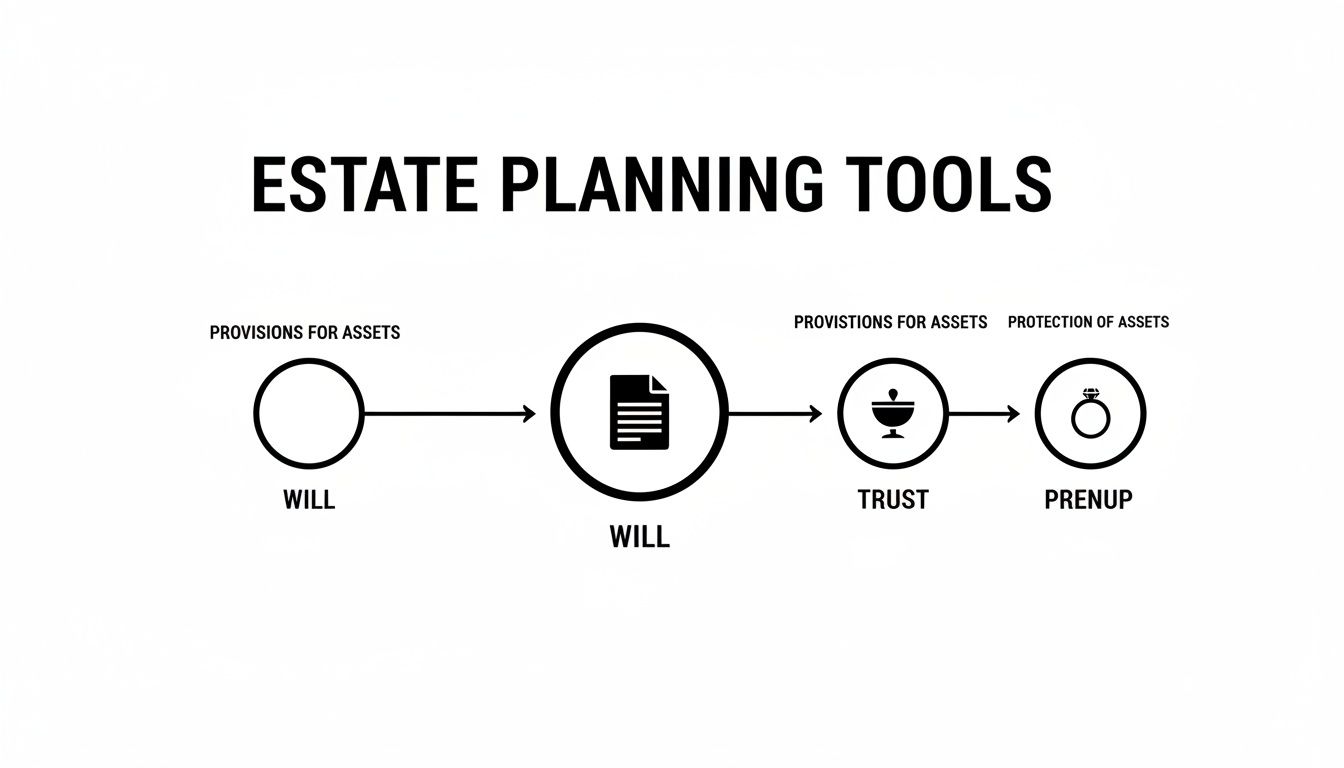
As the visual shows, wills and prenups lay the groundwork, but trusts are the powerful engines that manage and distribute assets with the precision your family deserves.
Tips for Using Advanced Trusts Effectively
- Get Specific with Instructions: Clearly define the rules for how your spouse can access trust principal (e.g., only for health, education, and maintenance). This helps preserve the final inheritance for your kids.
- Choose the Right Trustee: Don't put your surviving spouse or one of your children in the difficult position of being the trustee. Select a neutral third party, like a corporate trustee or a trusted professional, to manage the trust and prevent conflicts of interest.
- Fund the Trust Correctly: A trust is just an empty box until you put assets into it. You have to work with your attorney to properly retitle your property, investments, and accounts into the name of the trust. This step is critical.
By exploring these more sophisticated tools, you can design a plan that truly honors every important relationship in your life. To learn more about how these instruments work in Florida, check out our guide on trusts and estates.
Auditing Beneficiaries and Naming Guardians: The Critical Details
Even the best will or trust can be completely sideswiped by a single, overlooked piece of paper. Most of your high-value financial accounts—think 401(k)s, IRAs, life insurance policies, and annuities—have their own beneficiary designation forms. By law, these forms operate outside of your estate plan and will always override whatever your will or trust says.
Think of it this way: your will is the detailed itinerary for your estate, carefully routing every asset. A beneficiary designation, on the other hand, is a direct, non-stop flight. When you pass away, the money in that account goes straight to whoever is named on the form, completely bypassing the main plan.
This creates a massive trap in estate planning for blended families. If you named an ex-spouse on a life insurance policy a decade ago and forgot to change it, they will get the payout—no matter what your current will promises your new family.
The Danger of a Single Mismatched Form
It happens more than you’d think. People spend thousands on a sophisticated trust but forget to update the beneficiaries on their retirement accounts or insurance policies. The oversight can lead to irreversible and heartbreaking outcomes.
We’ve seen it happen: a father creates a trust designed to provide for his second wife and his children from his first marriage. But his multi-million dollar life insurance policy still lists only his wife as the primary beneficiary. She receives the entire payout directly, the funds never enter the trust, and his children are accidentally disinherited from a huge portion of his legacy.
Mismatched beneficiary designations are one of the most common and devastating mistakes in estate planning. An annual audit of these forms isn’t just good practice—it's absolutely essential to making sure your plan actually works.
A systematic review of every single account is a non-negotiable step in building a secure plan.
Actionable Tips for Auditing Your Beneficiaries
You can close this dangerous gap by doing a thorough review. Here’s a simple checklist to get you started:
- List All Accounts: Make a complete list of every account that has a beneficiary designation. This includes retirement accounts (401(k)s, IRAs), life insurance policies, annuities, and sometimes even bank accounts (Payable on Death or POD).
- Request Current Forms: Don’t rely on memory. Call each financial institution and ask for a copy of the current beneficiary designation form they have on file for you.
- Align with Your Estate Plan: Sit down with the forms and your will or trust. Make sure the primary and contingent (secondary) beneficiaries line up perfectly with what your core estate documents say. In many cases, the best strategy is to name your trust as the beneficiary.
- Update and Confirm: Fill out new forms for any account that’s misaligned. Send them in, and most importantly, get written confirmation that the change was made. Keep that confirmation with your other estate planning documents.
Naming a Guardian for Your Minor Children
Beyond the finances, protecting your minor children is everything. Your will is the only legal document where you can name a guardian—the person you trust to raise your children if something happens to both you and your spouse.
This isn’t a decision to make lightly. You need to choose someone whose values, parenting style, and life circumstances align with your hopes for your children's future. It is just as critical to name an alternate guardian, in case your first choice can't serve.
If you don’t name a guardian in your will, a judge will decide who raises your children. That process can ignite ugly family disputes and lead to a result that is the opposite of what you would have wanted. Taking the time to legally appoint a guardian gives your children stability and certainty when they need it most.
Worried about hidden gaps in your own plan? A comprehensive review can ensure your beneficiaries are aligned and your children are protected. Schedule a consultation with Coto & Waddington today to secure your family’s future.
Your Step-By-Step Guide to Getting Started

Understanding the concepts behind estate planning for blended families is one thing, but taking action is what actually protects the people you love. The idea of starting can feel overwhelming. The key is to break it down into a simple, manageable process.
This roadmap will walk you through the first few steps, helping you organize your thoughts and prepare for a productive conversation with an estate planning attorney.
Phase 1: Take Stock of Your Financial World
Before you can decide where everything goes, you need a perfectly clear picture of what you have. This isn’t about making judgments; it’s about creating a complete inventory that will serve as the foundation for your entire plan.
Start by listing it all out. This includes:
- Assets: Real estate (find the deeds), bank accounts, investment portfolios, retirement accounts like 401(k)s and IRAs, any business interests, vehicles, and other valuable personal items.
- Debts: Your mortgage, car loans, student debt, credit card balances, and any other outstanding liabilities.
Action Tip: Use a simple spreadsheet to create your inventory. Make two columns—one for assets and one for debts—so you can clearly see your net worth and share it easily with your attorney.
Gathering this information gives you the clarity to make smart decisions. More importantly, it ensures nothing gets missed by accident.
A well-organized financial inventory is like giving a detailed map to your attorney. It lets them see the entire landscape of your estate, helping them chart the most direct and effective path to your goals.
Phase 2: Define Your Goals and Talk Through the Scenarios
With a clear financial picture in hand, the next step is all about intention. This part requires honest, open, and sometimes difficult conversations with your partner. It's time to sit down together and discuss exactly what you want to achieve for each person in your family.
You need to ask the tough questions now to prevent conflict down the road:
- How do we ensure the surviving spouse is financially secure and can maintain their lifestyle?
- What specific inheritance do we want to guarantee for children from previous relationships?
- Do we have minor children who need a guardian named and a financial plan to support them?
- How should we handle jointly owned property, especially the family home?
Talking through these scenarios openly creates alignment. It ensures your final plan is built on a shared vision for your family’s future, making it the single most important conversation in this process.
Phase 3: Gather Your Documents and Schedule a Consultation
Once you've inventoried your assets and agreed on your goals, the final prep work is to collect all your key documents. Having these ready will make your first meeting with an attorney incredibly efficient and productive.
Create a folder—physical or digital—and include the following:
- Your complete asset and debt inventory.
- Deeds to any real estate you own.
- Recent statements for your bank and investment accounts.
- Information on any life insurance policies.
- Copies of existing prenuptial or postnuptial agreements.
- Contact information for your financial advisor or accountant.
With this folder organized, you are ready for the most important step: scheduling a consultation with an experienced attorney. A legal expert can translate your goals into a solid, legally binding plan that truly protects everyone you care about.
To learn more about the specific legal services available to help you build your plan, contact a firm that understands the unique dynamics of South Florida’s blended families.
Common Questions About Blended Family Estate Plans
When it comes to estate planning for blended families, we hear the same questions over and over. Getting clear, practical answers is the first step toward building a plan that protects everyone you love and finally gives you peace of mind. Let’s tackle some of the most common concerns we hear from families just like yours.
Can My Spouse Change the Will to Exclude My Children?
This is probably the single biggest fear we see in blended family planning. And the short answer is yes—if you leave all your assets directly to your spouse in a simple will, they generally have total freedom to write a new will later that cuts your children out entirely. This is a huge risk that standard, one-size-fits-all plans completely ignore.
The best way to prevent this is by using a trust, specifically a Qualified Terminable Interest Property (QTIP) trust. Think of it as a lockbox. This tool lets you provide for your surviving spouse for the rest of their life while legally guaranteeing that whatever is left in the lockbox goes to your children when your spouse passes away. The rules of the trust become permanent after your death, so you, and only you, have the final say over your legacy.
What Happens If I Do Not Have an Estate Plan in Florida?
If you pass away without a plan, you're letting the state of Florida make all the decisions for you under its "intestacy" laws. For blended families, this can be an absolute disaster. These default rules almost never match what people actually want and can lead to unintentional, heartbreaking outcomes.
For example, if you have children from a previous relationship, Florida's rules give your surviving spouse half of your estate, and your children from that prior relationship split the other half. Your stepchildren get nothing. This rigid formula could force the sale of the family home just to pay everyone their share and often throws families into expensive, emotionally draining legal battles in probate court. A custom plan is the only way to make sure your voice is heard.
Relying on state intestacy laws is like letting a stranger decide your family’s future. It removes your voice from the most important financial decisions you will ever make for them.
Do We Need a Prenup If We Have a Trust?
Yes, it’s a very good idea. A prenuptial (or postnuptial) agreement and a trust serve different but complementary roles. A prenup is about what happens if you divorce—a lifetime event. An estate plan, with its wills and trusts, is about what happens after you pass away.
Quick Tip: Think of it this way: a prenup protects you during life, and a trust protects your family after death. For a blended family, having both is the gold standard for comprehensive protection.
Having both creates a complete shield. Your prenup can clearly define what is considered separate property versus marital property. This makes it much easier to fund your individual trusts and ensures your estate plan works exactly as intended, without arguments over who owned what. They work together to build a rock-solid financial and legal foundation for your family.
How Often Should We Review Our Blended Family Estate Plan?
Life moves fast, and your plan needs to keep up. We recommend reviewing your estate plan every 3-5 years or anytime a major life event happens. For blended families, these check-ins are especially critical.
You should schedule a review if you experience:
- The birth of a new child or grandchild.
- A child reaching adulthood or getting married.
- A major change in your financial picture, like selling a business or receiving an inheritance.
- A child's divorce, which could put their inheritance at risk.
- Changes in federal or Florida estate tax laws.
Regular reviews ensure your plan stays aligned with your current family dynamics, financial situation, and wishes. An outdated plan is an ineffective plan.
Navigating the unique challenges of estate planning for blended families requires careful strategy and experienced guidance. The right legal partner can help you build a plan that honors every relationship and secures your legacy. At Coto & Waddington, Attorneys at Law, we provide clear, practical counsel to help South Florida families protect what matters most.
Schedule a consultation today to start building your family's future with confidence.


