In Florida, the statute of limitations for a breach of contract claim is generally five years for a written agreement and four years for an oral one. That is a hard filing deadline, and if you miss it, you can lose the right to sue even when the breach is obvious.
That matters more than most founders realize. A South Florida startup can spend months trying to salvage a customer relationship, renegotiate with a vendor, or wait for a partner to “make it right,” only to find out the legal clock kept running the entire time. If you're dealing with a missed payment, failed deliverable, broken founder agreement, or vendor nonperformance, the issue isn't just whether you were wronged. It's whether you can still enforce your rights in time.
The practical side of the breach of contract Florida statute of limitations is what usually gets overlooked. The deadline is only part of the problem. You also need to identify the actual breach date, preserve the documents that prove it, and avoid common business moves that weaken your position. For startups, that often means turning a messy thread of Slack messages, invoices, email approvals, and unsigned revisions into a usable legal record before the dispute gets worse.
Table of Contents
- Your Business Has a Deadline to Enforce a Contract
- Florida's Core Deadlines for Contract Disputes
- Pinpointing When the Legal Clock Starts Ticking
- Can the Deadline Be Paused or Extended
- Real World Examples for South Florida Businesses
- Proactive Steps to Preserve Your Claim
- When to Contact a Florida Business Attorney
Your Business Has a Deadline to Enforce a Contract
A contract claim can look deceptively calm at first. Your client says payment is coming next week. The developer promises the revised build is almost done. A supplier keeps asking for “just a little more time.” Founders often treat that phase like a business problem to manage, not a legal claim to calendar.
That instinct is understandable, but it creates risk. A breach claim isn't preserved because you were patient, reasonable, or still negotiating. It's preserved because you filed on time and kept the evidence needed to prove what happened.
What founders usually get wrong
The biggest mistake isn't always waiting too long to sue. It's failing to recognize that the dispute has already become a legal matter. Once the other side misses a required payment, refuses performance, or delivers something that plainly doesn't match the agreement, your business needs two tracks at once:
- Operational response: contain the damage, protect customers, keep revenue moving.
- Legal response: document the breach, preserve records, and calculate the filing window.
If you only do the first, you may solve the business emergency but lose your advantage later. If you only do the second, you may overreact and damage a relationship that could still be fixed. The right approach is controlled, documented escalation.
Practical rule: The day performance fails is a date your company should record immediately, even if you still hope the relationship can be salvaged.
Why this deadline changes business decisions
Founders usually focus on the size of the unpaid invoice or replacement cost. Lawyers focus on timing, proof, and claim type. Both matter. A strong breach claim can still fail if it's filed too late. A timely claim can still become expensive if your records are scattered across inboxes, text messages, unsigned drafts, and accounting software.
For South Florida businesses, this is especially common in fast-moving deals. Service agreements get updated by email. Scope changes happen over calls. Payment terms shift informally. The result is that by the time someone asks about the breach of contract Florida statute of limitations, the company often needs more than the deadline. It needs a clean timeline.
A useful internal question is simple: What exactly was supposed to happen, when did it fail, and where is that documented? If your team can answer those three questions quickly, your legal position is usually much stronger.
Florida's Core Deadlines for Contract Disputes
A Miami startup signs a vendor deal, performance breaks down, and everyone keeps working off email threads for another six months because no one wants to kill the relationship too early. The legal deadline does not wait for your operations team to sort that out.
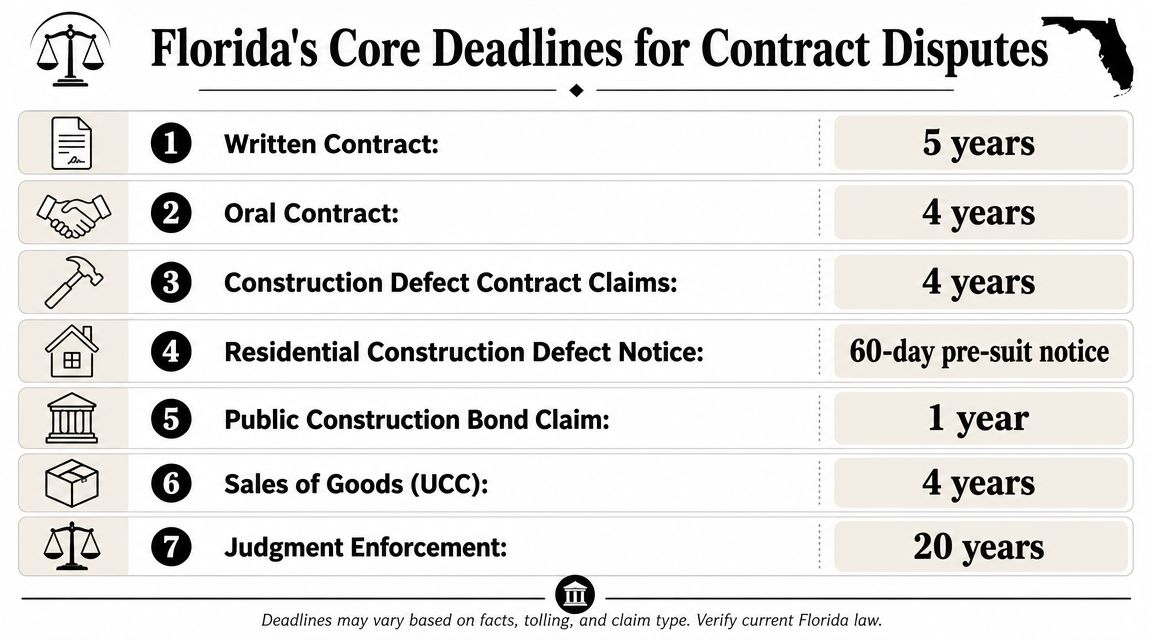
Under the Florida Bar's overview of civil filing deadlines, a breach of written contract claim is generally subject to a 5-year statute of limitations, while an oral contract claim generally has 4 years. Some contract-enforcement claims can be much shorter, including 1 year, which is why startups get into trouble when they assume every contract dispute gets the same timeline.
Here's the visual comparison.
Written versus oral in a modern business setting
For a founder, the first operational question is not academic. It is, "What do we have in our files?"
A written contract can be a signed master agreement, an accepted proposal, an order form with incorporated terms, or a set of emails that clearly establish the deal. If your company wants the benefit of the longer written-contract period, pull the complete document set now. That means the final signed version, exhibits, pricing schedules, change orders, and any later emails that modified scope or payment terms.
Oral agreements create a different risk profile. The problem is usually proof. A sales lead may remember one version of the promise, the vendor may remember another, and your finance team may have booked revenue based on assumptions that never made it into writing. In litigation, that turns a limitations question into an evidence problem fast.
A practical comparison for startup teams
Use this framework when you are assessing exposure and deciding what records to preserve:
| Agreement format | General Florida limitations period | What your team should collect now |
|---|---|---|
| Written contract | 5 years | Final executed agreement, amendments, approval emails, invoices, delivery records |
| Oral contract | 4 years | Emails confirming terms, texts, call notes, invoices, payment history, witness names |
| Special contract-enforcement claim | Can be as short as 1 year, as noted in the same resource | The exact claim type, the governing document, and any notice provisions |
What this means for your business
Classification drives strategy early. If the deal is well documented, counsel can usually assess the claim faster, identify the likely breach points, and send a more precise notice. If the record is thin, your team may need to spend time rebuilding the contract from inboxes, Slack messages, accounting entries, and drafts before anyone can even answer the deadline question confidently.
That reconstruction work costs money. It also creates avoidable risk if employees leave, phones are replaced, or messages disappear under routine retention policies.
For South Florida startups, the practical move is simple. As soon as a dispute looks real, create one folder for the contract package and one timeline for performance. Put every signed document, amendment, invoice, delivery confirmation, and message about changed terms into that file. If you later need to enforce the agreement, you will be deciding from a documented record instead of trying to recreate the deal under pressure.
Pinpointing When the Legal Clock Starts Ticking
Most businesses don't lose time because they misread the number of years. They lose time because they choose the wrong start date.
Under Florida law, the clock generally begins when the claim accrues, which courts describe as the point when the last element of the cause of action occurs, typically the breach itself. The filing deadline is driven by the breach date, not the date of a demand letter or failed settlement talks, as explained in Gunster's discussion of Florida accrual rules.
The breach date controls
That point matters because many founders instinctively use the wrong milestone. They count from the day the contract was signed. Or the day they sent a formal notice. Or the day negotiations finally collapsed. Those dates may matter for business history, but they usually don't control the limitations analysis.
A cleaner way to approach it is to identify the first date on which the other side failed a required obligation. In a startup context, that might be:
- Missed payment: the invoice due date passes and payment isn't made.
- Failed delivery: a vendor misses the agreed delivery deadline.
- Defective performance: a contractor delivers work that doesn't meet the contract's required standard.
- Refusal to perform: the other party states they won't do what the agreement requires.
How to document the date without overcomplicating it
Founders often have the information, but not in one place. The breach date may be buried in QuickBooks, Stripe records, DocuSign files, Google Drive folders, or email threads.
Use a short internal breach memo. It doesn't need legal jargon. It should identify:
- The contract at issue
- The exact obligation that was due
- The date performance failed
- The record proving that failure
- Who inside the company has first-hand knowledge
The best evidence is usually created in the ordinary course of business, before anyone is posturing for litigation.
One example that shows the difference
Suppose your company signs a service agreement and the other party is supposed to deliver a completed software integration by a stated date. That date passes with no delivery. Your team spends months trying to patch things together, holds status calls, sends follow-up emails, and eventually hires someone else.
The legal clock usually doesn't wait for those later events. It generally starts when the delivery obligation was breached. The later calls and messages may help prove the dispute, but they don't usually move the accrual date.
That's why documenting the nonperformance event matters so much. If your file only shows a long negotiation arc, but not the exact failure point, you create avoidable uncertainty right where timing matters most.
Can the Deadline Be Paused or Extended
Founders often ask whether the deadline can be stretched because the other side concealed facts, kept talking settlement, or made the dispute difficult to untangle. Sometimes there are arguments that affect timing. The problem is that businesses tend to assume an exception applies before they've analyzed the actual claim.
Florida's limitations framework sits in Chapter 95, and claim type matters. The Florida Legislature's statute text for section 95.11 shows the broader structure. It lists 5 years for actions on a written contract, 4 years for oral contract actions, a 7-year outer limit in certain construction-related claims when fraud, concealment, or intentional misrepresentation delayed discovery, and 20 years for actions on a judgment.
Why businesses get misled by exceptions
The existence of exceptions causes false confidence. A founder reads about tolling, concealment, or delayed discovery and concludes there's probably extra time. That's dangerous because those issues are fact-specific and often heavily contested.
In practice, relying on a possible extension without immediate legal review is one of the riskier moves a business can make. You may spend months assuming the clock is paused, only to learn later that the court sees the claim as an ordinary contract action with an ordinary deadline.
Settlement discussions rarely justify relaxed deadline management. If the other side wants to resolve the matter, they can still do that while you preserve your filing position.
A better way to think about timing disputes
Instead of asking, “Can this deadline be extended?” ask these questions:
- Is this really a standard contract claim, or a different claim type with a different rule?
- Is there an argument about delayed discovery, concealment, or another timing issue that materially changes the analysis?
- Do we have documents that support that argument, not just suspicions?
- What is the most conservative filing deadline if the court rejects our exception theory?
That last question is the one strategic businesses use. A conservative deadline protects the claim while counsel evaluates more nuanced arguments.
The practical trade-off
There's a real business tension here. Filing early may escalate a dispute you hoped to resolve privately. Waiting may preserve the relationship a little longer. But if your deadline analysis depends on a tolling argument that hasn't been vetted, you're taking litigation risk to buy negotiation time.
For most startups, the better course is to preserve the shorter, safer deadline internally and treat any extension theory as a backup argument, not the plan. That approach keeps your advantage intact and avoids the common mistake of building strategy around assumptions that may not survive scrutiny.
Real World Examples for South Florida Businesses
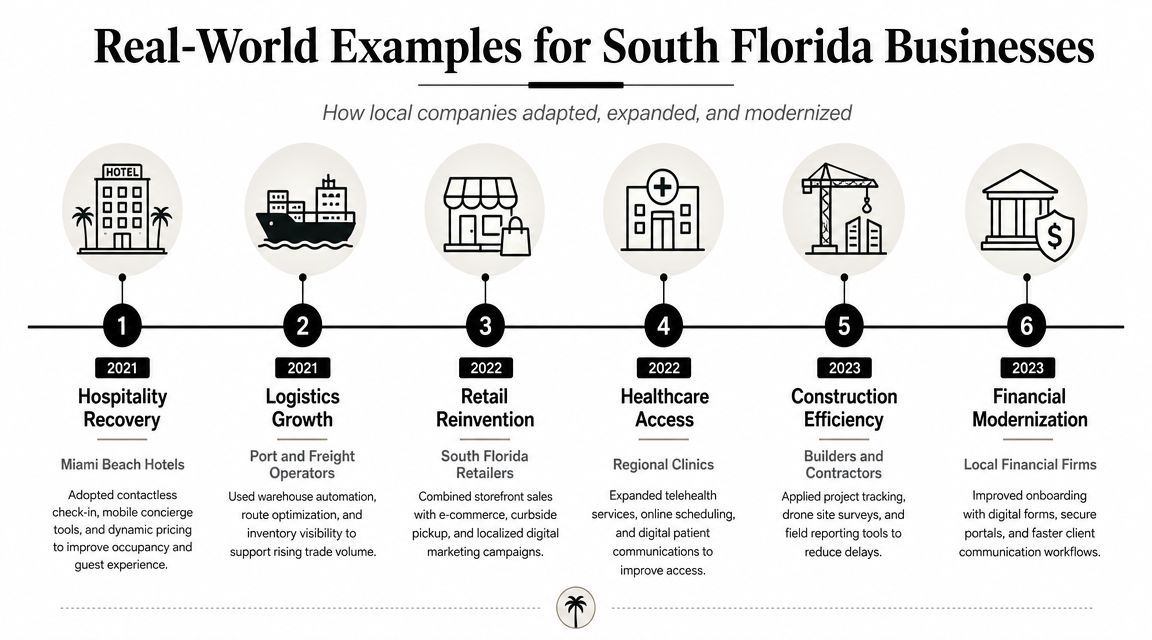
Abstract rules become easier to use when you map them onto real operating problems. These examples aren't about dramatic courtroom disputes. They're about the kind of contract breakdowns South Florida businesses see every day.
Miami tech startup with a licensing agreement
A SaaS company signs a written customer agreement for platform access and onboarding services. The customer stops paying but continues using internal work product created during implementation. The founder spends months trying to preserve the account because the customer logo matters for fundraising.
The operational instinct is understandable. The legal risk is that the company delays organizing the breach file. In that situation, counsel will usually want the executed agreement, invoice history, payment terms, suspension notices, and records showing the nonpayment event. If the startup eventually pursues litigation, it also needs to think through remedies available for breach of contract so the claim strategy matches the business objective.
Fort Lauderdale creative agency with unpaid invoices
A branding agency lands a major client through a mix of proposal documents, approval emails, and a signed statement of work. The agency delivers the campaign assets. The client launches the materials, then disputes the final invoice and points to alleged revision issues that were never raised during the project.
The intersection of timing and proof becomes critical. The agency may have a viable claim, but it needs to tie the payment obligation to the written record and identify when payment became due and unpaid. Founders in this position often have plenty of evidence. They just haven't assembled it in a way that makes the breach easy to prove.
If your file requires a lawyer to reconstruct the deal from twenty scattered messages, you've made enforcement slower and more expensive than it needed to be.
Family-owned service business with a vendor default
A South Florida company relies on a supplier for materials needed to fulfill customer work. The supplier repeatedly promises delivery, misses commitments, and causes downstream problems with the company's own clients. The owner keeps accepting excuses because replacing the supplier midstream is difficult.
This type of case often creates the most confusion because the business relationship continues after the first failure. Owners remember the whole season of disruption, but legal analysis still requires identifying the specific missed obligations and matching them to documents. The stronger file usually includes purchase orders, delivery schedules, change requests, written complaints, and substitute vendor costs.
Across all three examples, one point stays the same. The businesses that preserve their rights best are not always the most aggressive. They're the most organized.
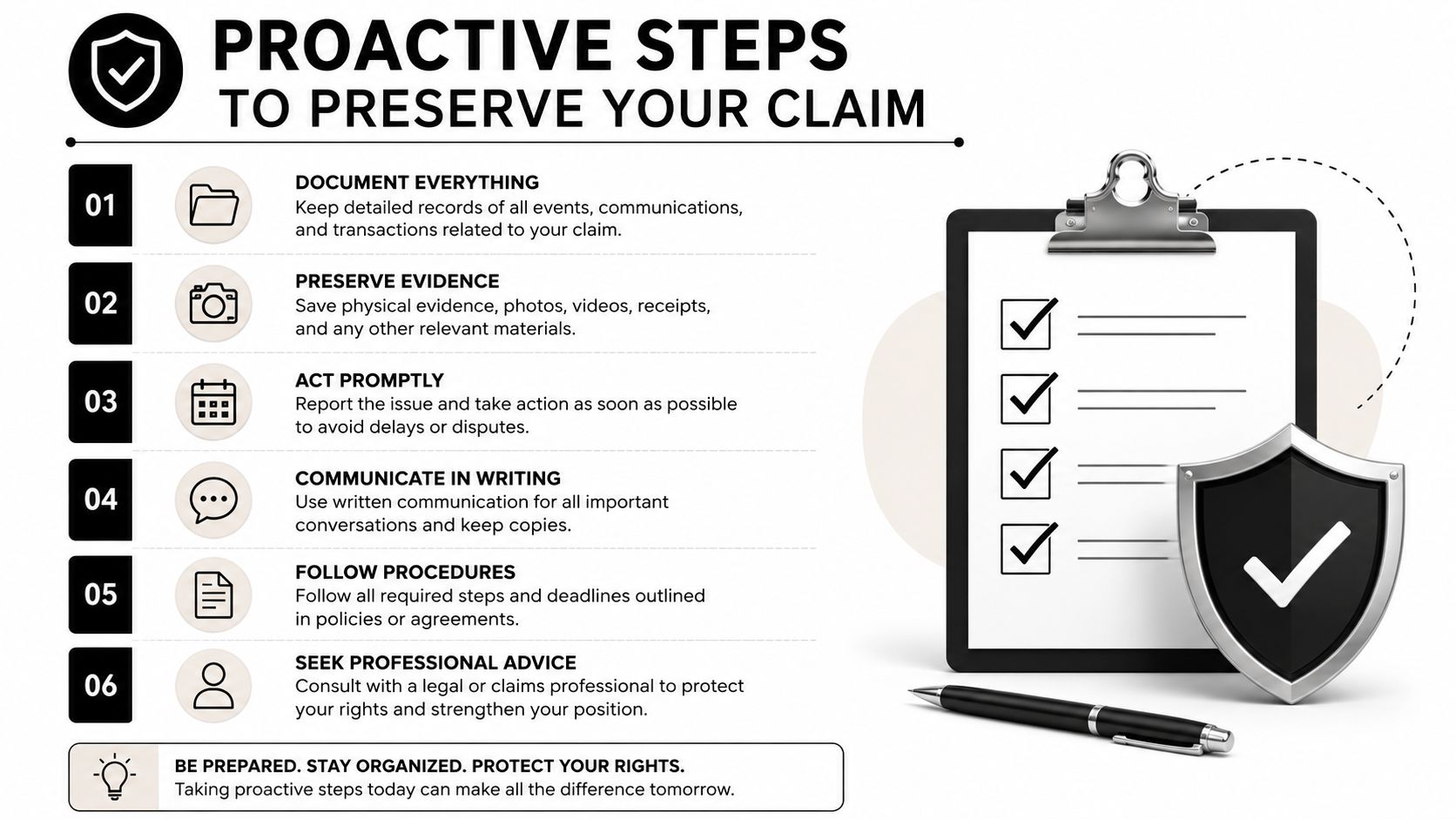
Proactive Steps to Preserve Your Claim
A founder usually calls at the same point. The vendor missed another deadline, the customer still has not paid, or a contractor insists the deal changed after the fact. The legal deadline matters, but the immediate business problem is simpler. If your records are scattered, your claim gets harder and more expensive to enforce.
The right move is to build the file now, while the facts are still easy to prove.
Start with the documents that control the deal
In a South Florida startup, contract records often live in too many places. The signed agreement is in a PDF, pricing changed in email, the scope shifted in Slack, and payment terms sit in an invoice no one saved centrally. That setup creates avoidable risk.
Get the full contract file into one folder:
- Executed agreement
- Amendments, addenda, and exhibits
- Statements of work, order forms, and purchase orders
- Approval emails that changed timing, price, scope, or deliverables
- Invoices, payment records, and account statements
If your company still handles this informally, fix the process now. A practical guide on how to write a business contract can help your team clean up future deals before a dispute starts.
Build a timeline that a judge, insurer, or investor could follow
Founders often know exactly what happened. The problem is they have never written it down in sequence.
Create a simple chronology with the dates that matter: when the contract was signed, when performance was due, what was delivered, what was missed, what notices were sent, and what your company did next. Keep the language plain and factual. A good timeline does two jobs at once. It helps your lawyer assess the claim, and it helps your team avoid inconsistent explanations in later emails or calls.
Preserve business records before they disappear
Do not wait for a formal lawsuit hold to start saving evidence. By then, key records may be harder to collect.
Pull the ordinary records tied to the deal, including:
- Project management logs
- Delivery confirmations
- Text messages and emails from the people who handled performance
- Internal notes about missed deadlines, rejected work, or customer complaints
- Replacement vendor quotes and added costs caused by the breach
Startups suffer operational challenges. Employees leave. Phones get replaced. Slack threads vanish into old channels. Accounting software changes. A claim that looked easy in May can become expensive to prove in November.
Control communications before they create new problems
A demand letter can help, but only after your company knows what it is claiming and what documents support it. Sending a heated email too early often creates cleanup work later. I see this often with founder-led companies that are trying to salvage the relationship while also threatening legal action.
Use written communications with discipline:
- Identify the specific obligation that was missed
- Reference the contract language or related document
- State the cure you expect and the deadline for it
- Avoid casual statements that change the original deal
- Keep emotion out of the record
That approach protects more than the lawsuit. It also helps with collections, board reporting, insurance submissions, and investor diligence if the dispute starts affecting revenue.
Stop these habits immediately
Several common practices make a decent claim weaker than it should be:
- Letting sales or operations staff agree to legal changes verbally
- Accepting repeated deadline extensions without written confirmation
- Failing to save notes from employees who saw the breach unfold
- Waiting until the relationship collapses before organizing the file
Each one gives the other side room to argue about what the contract required, whether your company waived the breach, or whether damages can be tied to the failure.
If your team needs outside review, options include litigation counsel, contract counsel, or a business law firm that handles startup and small business agreements. Coto & Waddington, Attorneys at Law provides contract and business law services for South Florida companies, which is the kind of support founders often use to assess documentation, deadlines, and enforcement options before a dispute gets worse.
Document first, posture later. Strong records often create a position of strength that emotional emails never will.
When to Contact a Florida Business Attorney
A South Florida startup often calls counsel too late in the same pattern. The vendor misses milestones, your team keeps trying to salvage the relationship, Slack threads replace formal notices, and no one can say which email changed the original deal. By the time a founder asks whether the statute of limitations is still open, the harder problem is usually the record.
That is the point to bring in counsel. The job is not just to recite a filing deadline. It is to turn a messy business problem into a clear timeline, identify which version of the agreement controls, and protect your company from avoidable waiver and proof issues while operations continue.
Early review matters most when the dispute affects decisions your team is making right now. You may be deciding whether to keep shipping, release a payment, replace a vendor, report a likely loss to the board, or tell investors why revenue slipped. Those calls can help or hurt the claim depending on what the contract says and what your company puts in writing.
A lawyer should get involved promptly if the contract history is fragmented, the alleged breach happened in stages, or the other side is using delay to pressure your business into informal concessions. The same is true if your team is preparing a termination notice, a demand for payment, or a response to a lawyer on the other side. Those are points where a careless sentence can create a new argument you did not need.
For many founders, the immediate value is operational. Counsel can map the contract file, separate binding amendments from loose email negotiations, tell you what to preserve from employees and systems, and frame communications so the company does not accidentally soften its position. A small business contract lawyer can also help decide whether the better next step is a demand letter, a negotiated exit, or filing suit before more time is lost.
Coto & Waddington, Attorneys at Law provides contract and business law services for South Florida companies. If your records are disorganized, the breach date is not clean, or the dispute is starting to affect cash flow or investor reporting, that is usually the right time to get legal review.