A security agreement is the contract in which a borrower grants a lender a security interest in specified collateral to secure repayment of a debt, governed in the United States by UCC Article 9.
You're applying for a business credit line, and the bank sends a stack of closing documents. One asks your company to pledge its assets. Before you sign, you need to know which property is at risk, what restrictions you're accepting, and whether the lender has completed the steps needed to protect its claim.
Signing the contract and protecting the lien against other creditors aren't the same thing. That distinction matters whether you're borrowing for payroll, financing equipment, or lending money to your own startup.
Table of Contents
- What a Security Agreement Means in Plain Terms
- The Parts and Key Clauses of a Security Agreement
- How a Security Interest Becomes Enforceable
- Collateral Types and How Each Is Perfected
- Who Gets Paid First When Creditors Compete
- What Borrowers and Lenders Each Gain and Risk
- Check the Agreement Before You Sign
What a Security Agreement Means in Plain Terms
Say your company applies for a bank credit line. The paperwork says the company grants a security interest in its inventory, equipment, receivables, and other assets. You still operate the business, but you've given the lender a legally recognized claim against the identified property to support repayment.
The collateral is the property backing the debt. The security interest is the lender's claim against that property. Neither term means the lender automatically owns your business or can take its assets whenever it chooses.
Think of a car loan. The lender holds a claim on the vehicle until the loan is paid. The security agreement identifies the property backing the debt and sets out the parties' rights concerning it.
For a business, collateral can include products sitting on shelves, manufacturing equipment, unpaid customer invoices, and bank accounts. The Office of the Comptroller of the Currency's explanation of revised Article 9 describes the framework governing credit secured by personal property, along with transactions involving sales of accounts and chattel paper.
Personal property doesn't mean the founder's personal belongings. In this context, it generally distinguishes property such as business equipment and receivables from real estate. A company's security agreement also doesn't automatically pledge the founder's house or create a personal guarantee.
Documents that do different jobs
These documents may arrive together, but they aren't interchangeable:
- Security agreement: Establishes the contractual grant of collateral and related rights and duties.
- UCC-1 financing statement: Generally gives public notice that a secured party claims an interest in described collateral.
- Mortgage: Secures an obligation with real estate rather than the business assets typically covered by a commercial security agreement.
If you're asking what is a security agreement because a lender sent you one, start with the collateral description. A loan secured only by a particular machine presents a different business risk from a lien covering nearly everything the company owns.
Practical tip: Read that description before getting absorbed in the interest rate. Then identify what the document requires, what makes the lien enforceable, and where the lender stands if another creditor claims the same assets.
The Parts and Key Clauses of a Security Agreement
Treat the agreement as a blueprint, not a signature page. Each provision should connect a particular borrower, a defined obligation, and identifiable property.
Start with the parties. The debtor grants the security interest, while the secured party receives it. If your operating company owns the equipment but a separate holding company signs the grant, that mismatch needs attention.
Next, locate the secured obligation. It might be a particular equipment loan, a revolving credit line, or a broader collection of present and future obligations. Compare that language with the loan agreement's repayment and other obligations. A collateral pledge can be broader than the founder expects if it supports additional debts.
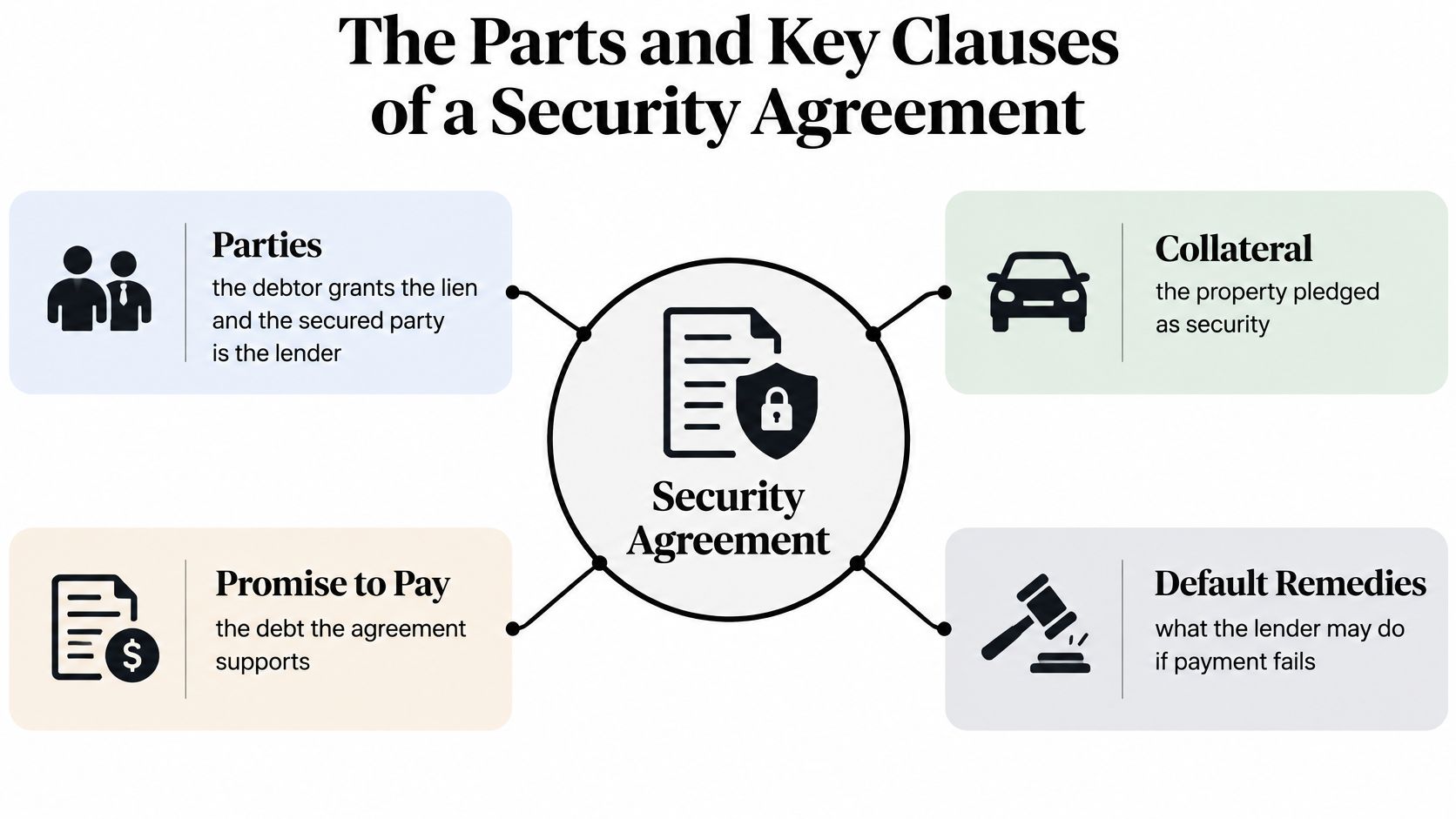
Common security agreement clauses and what to check
| Clause | What it does | What to check |
|---|---|---|
| Grant of security interest | Grants the lien on the listed collateral, subject to attachment requirements | Confirms it secures every obligation named in the loan |
| Collateral description | Identifies the assets pledged | Specific lists are safer; broad all-assets wording needs review |
| After-acquired property | Extends the lien to assets acquired later | Confirms the scope is not wider than the deal |
| Proceeds | Extends the lien to covered sale and insurance receipts | Requires records tracing where the money went |
| Representations and warranties | Borrower states it owns the collateral free of other liens, except disclosed or permitted liens | A false statement is usually a default |
| Negative pledge | Bars the borrower from granting other liens | Limits future financing, so check the carve-outs |
| Events of default | Lists triggers such as missed payments or insolvency | Check cure periods and any cross-default links |
| Lender remedies | Sets repossession, sale, and collection rights | Confirm the notice period and how sale proceeds are applied |
Translate the clauses into business decisions
The grant clause does the operative work. For example, it may pledge the company's equipment to secure its obligations under a named promissory note. Check both halves of that sentence: what property is pledged and what debt it supports.
An after-acquired property clause can reach inventory purchased after closing. That makes commercial sense for a rotating stock of products, but a founder should question whether a narrowly negotiated equipment loan also needs to cover unrelated future equipment.
The proceeds clause addresses what replaces collateral. If a pledged machine is sold or destroyed, sale receipts or covered insurance payments may become relevant collateral. Your bookkeeping needs to distinguish those receipts from unrelated funds.
A negative pledge can affect the next financing round. A company planning to finance delivery vehicles should negotiate appropriate permitted-lien exceptions rather than discover later that another loan would breach its existing agreement.
Default language deserves equal attention. A cross-default provision can connect trouble under another financing arrangement to this loan, even when payments on this particular debt are current.
Before signing: Match the parties, debt amount or credit limit, obligation references, and collateral against the other loan documents. Mark any clause you can't explain in an ordinary sentence for counsel to review.
How a Security Interest Becomes Enforceable
A signature alone doesn't establish that the lender has an enforceable interest in every asset listed. The borrower must have the necessary rights, the lender must give value, and the transaction must satisfy the applicable documentation or possession/control requirements.
Attachment is the point at which the security interest becomes enforceable with respect to the collateral. Perfection is a separate legal step relevant to protection against competing claimants. Perfection helps establish priority, but it doesn't guarantee that the lender wins every dispute.
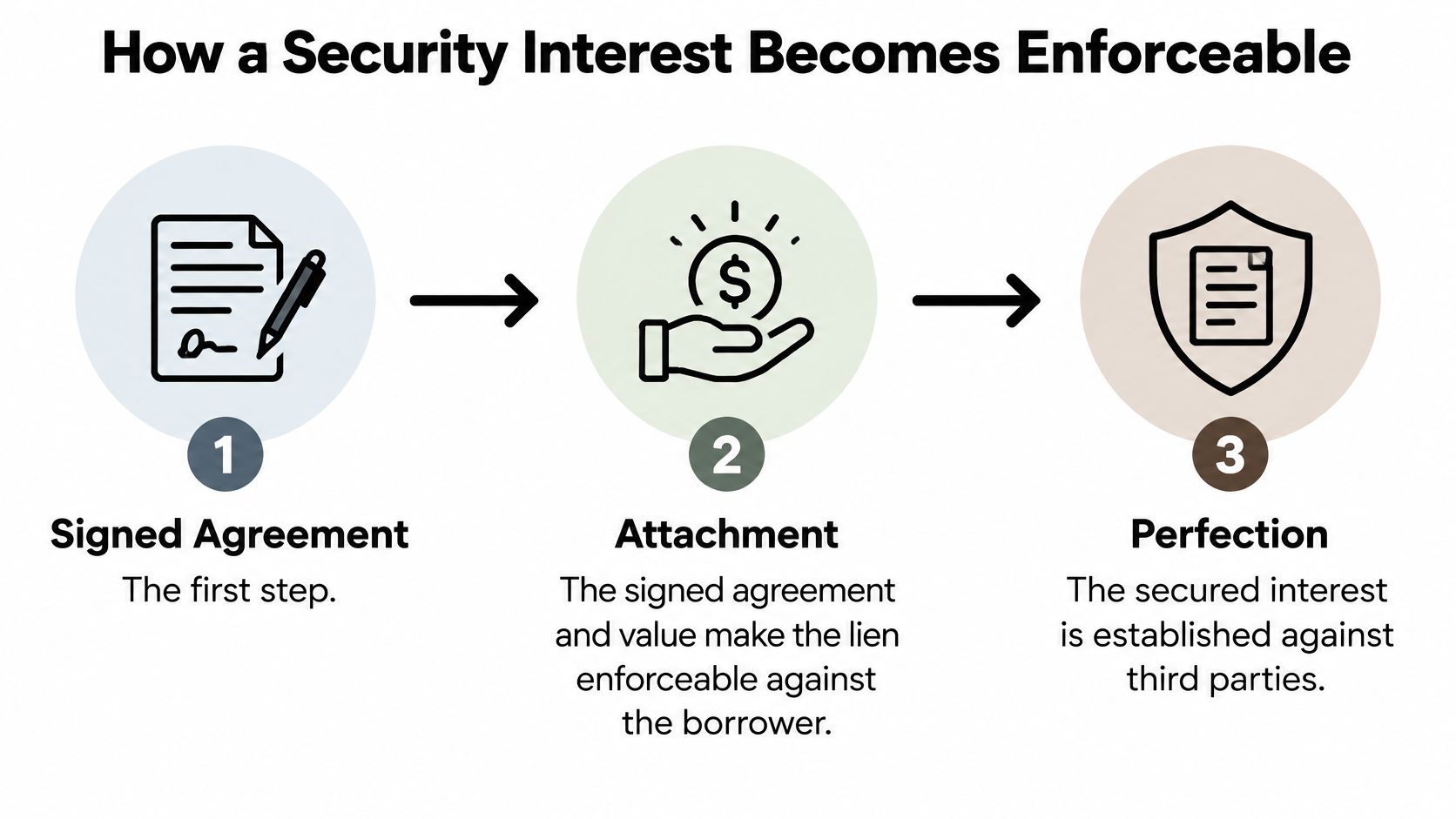
The sequence from promise to protected claim
Nebraska's enacted UCC attachment provision identifies the three core attachment conditions reflected in the sequence below.
The lender gives value. Advancing loan proceeds is the familiar example, although value isn't limited to handing over cash. Coordinate funding with the closing documents. A common slip is releasing funds before the parties have completed the required authentication, leaving the lender exposed while paperwork remains unfinished.
The borrower has rights in the collateral or authority to transfer those rights. Suppose a founder bought a machine personally and never transferred it to the company. The company can't grant a lien over ownership rights it doesn't have. Review invoices, titles, contribution records, leases, and existing financing documents rather than relying on the machine's physical location.
The required authentication, possession, or control condition is satisfied. The usual route is a debtor-authenticated security agreement describing the collateral. Authentication commonly involves signing, including an appropriate electronic signature. Certain assets permit alternative routes involving possession or control under the debtor's agreement.
The lender completes the appropriate perfection step. This commonly means filing a financing statement in the correct jurisdiction and office. Other assets require a different approach. A filing acknowledgment is evidence of filing, not proof that every legal detail or priority issue is correct.
Why the collateral description needs care
A description must reasonably identify the collateral. Listing equipment categories, receivables, and other applicable asset classes helps connect the grant to actual business property.
Don't assume that all-assets wording belongs everywhere. A broad indication may be appropriate in a financing statement, while a security agreement requires a legally sufficient collateral description. Consumer transactions also carry additional restrictions.
Closing discipline: Keep dated evidence of the grant, the borrower's rights, the lender's value, and the applicable perfection step. A signed PDF alone isn't a complete collateral file.
Ask the borrower to confirm ownership and existing liens in writing. At closing, the file should contain the authenticated documents, funding record, filing acknowledgment where applicable, and any required control or possession evidence.
Collateral Types and How Each Is Perfected
Perfection method by collateral type
The right protection step depends on what the borrower pledges. Inventory and receivables commonly call for a UCC-1 financing statement, while deposit accounts generally require control. A signed agreement may grant rights in the collateral, but the lender must also take the required perfection step to protect its position against competing claims.
| Collateral | Typical perfection method | Practical note |
|---|---|---|
| Inventory | UCC-1 financing statement filed in the debtor's applicable filing jurisdiction | Keep records current as stock turns over |
| Equipment (non-titled) | UCC-1 financing statement | Use serial numbers where useful to identify specific equipment |
| Motor vehicles and titled equipment | Notation on the certificate of title under applicable title law | A UCC filing alone is usually not enough |
| Accounts receivable | UCC-1 financing statement | Confirm which invoices are covered |
| Deposit accounts | Control, commonly through a control agreement with the bank | A filing alone does not perfect an original collateral interest |
| Investment property and certificated securities | Possession or control, as applicable | Deliver original certificates when relying on possession |
| Promissory notes and instruments | Possession of the original, or filing where permitted | Track where the original document is held |
| Tangible chattel paper | Possession, or filing | Check whether the paper is electronic instead |
| Proceeds of collateral | Follows the original collateral, subject to the proceeds timing rule | Keep sale and deposit records |
Filing jurisdiction depends on the debtor's legal location, not necessarily its storefront. For example, a South Florida business formed in Delaware should have counsel determine where to file instead of assuming its employees' work location controls.
The Article 9 provisions on effectiveness and attachment provide context for the rights created by a security agreement. The practical question is asset-specific: does this collateral call for filing, possession, control, or compliance with another statute? A guide to perfection of a security interest explains how these methods differ.
Control can also affect daily operations. Before signing a deposit-account control agreement, ask when the lender may direct the bank and how that could affect payments to employees and vendors.
Follow the property when it changes form
A wholesaler sells pledged inventory and receives customer payments. The lender's collateral may extend to the proceeds, but the required protection can depend on what happens to those payments.
Under UCC Section 9-315, perfection in proceeds generally ends on the 21st day after attachment unless an exception applies, including qualifying identifiable cash proceeds or timely additional perfection. The rule does not mean every inventory sale requires a new filing. It means the lender should check whether an exception preserves perfection rather than assume protection continues indefinitely.
Keep invoices, sale receipts, and bank records that trace proceeds. Recheck the method when the company acquires a new asset class or changes collateral into a different form.
A search resource can help you check lien priority across jurisdictions, though search results still need legal analysis. The collateral type, not the agreement's length, determines the protection steps.
Who Gets Paid First When Creditors Compete
A signed security agreement doesn't automatically outrank other creditors. A lender can have enforceable rights against the borrower and still lose the contest over who collects from particular assets.
Priority analysis asks about competing claims, filing or perfection timing, collateral classification, and statutory exceptions. The UCC provision addressing after-acquired collateral and future advances also matters when a lender expects its claim to reach newly acquired assets rather than a fixed closing-day list.
A bank and an equipment lender claim the same machines
Suppose a bank files a financing statement covering the company's assets before an equipment lender finances new machinery. The bank's earlier blanket lien may reach those machines through an after-acquired property clause.
The equipment lender may qualify for special purchase-money priority instead. Under the applicable rules in UCC Article 9, a qualifying equipment purchase-money security interest perfected within 20 days after the debtor receives possession can outrank an earlier blanket lien. That isn't a universal grace period for every kind of collateral, and inventory has different requirements.
The equipment lender therefore needs more than a clause saying it financed the purchase. Counsel must confirm that the transaction qualifies, the collateral category is correct, and the required steps occurred on time.
Who generally wins common creditor conflicts
| Scenario | Who generally wins |
|---|---|
| Unperfected lien vs perfected lien | Perfected secured party, subject to applicable exceptions |
| Two perfected liens, neither purchase-money | First to file or perfect under the general priority rule |
| Purchase-money lender perfects within the applicable equipment possession deadline | Qualifying equipment purchase-money lender beats the earlier blanket lien |
| Deposit account, control vs filing | Control holder |
| Borrower enters bankruptcy with unperfected lien | Trustee may avoid the lien |
Deposit-account disputes follow control-based priority rules, including special rules affecting the bank maintaining the account. Don't use ordinary filing dates alone to predict that outcome.
Bankruptcy introduces another risk: a trustee may challenge a lien that wasn't properly perfected. Certain tax liens and statutory claims can also change the expected order, so a clean-looking financing statement isn't a complete priority opinion.
Creditors sometimes negotiate a different ranking through subordination. If financing negotiations involve investors or junior lenders, LendingXpress's explanation of how subordination agreements affect investors offers useful context for understanding those contractual arrangements.
Before closing:
- Run a UCC lien search in the debtor's applicable filing jurisdiction.
- Obtain a written lien schedule from the borrower, including obligations that may not appear in an ordinary search.
- Identify earlier blanket liens and determine whether a release, consent, or intercreditor agreement is needed.
Priority, not the thickness of the contract, determines who can collect first from competing collateral claims.
What Borrowers and Lenders Each Gain and Risk
Secured credit is widely used across business markets, including smaller and privately held borrowers. A Federal Reserve study covering public and private companies of different sizes found that approximately 68% of borrowers in its sample used some form of asset-based collateral, while about 37% pledged real estate.
Those figures describe the study's sample, not the probability that a particular startup will qualify for financing. They also explain why collateral discussions extend well beyond buildings and mortgages.

The borrower's trade-off
- Potential gain: Pledging assets may make credit available or support a larger facility or more favorable pricing. It doesn't guarantee approval or a lower rate.
- Asset risk: Default can put essential operating property at risk, potentially disrupting production or collections.
- Operating restrictions: Asset sales, additional borrowing, and transfers may require consent or compliance with negotiated exceptions.
- Connected obligations: Cross-default provisions can make financial trouble under another agreement relevant to this loan.
The lender's trade-off
- Potential gain: Properly established collateral rights generally provide a stronger recovery position than an unsecured claim.
- Administration risk: The lender must maintain the relevant filings, possession, or control and monitor changes affecting its collateral.
- Enforcement duties: Repossession and disposition must comply with applicable requirements, including required notices and commercially reasonable sale practices.
- Exit responsibilities: Payoff needs an organized release process, including an appropriate UCC-3 termination when legally required, rather than merely marking the account paid.
Consider a company that pledges receivables to finance payroll. Customers later pay their invoices, but the founder can't assume those collections are unrestricted cash. The parties need clear rules for collection accounts, permitted spending, and reporting.
These decisions affect future borrowing capacity, investor negotiations, and acquisition diligence. A prospective buyer will want to know which assets can transfer free of liens and who must authorize their release.
Negotiate release terms before signing, including partial releases when you sell an approved piece of equipment. Don't leave the exit process for the day a buyer is ready to close.
Clear terms won't eliminate every dispute, but they reduce avoidable disagreements about permitted sales, cash use, and the conditions for releasing collateral.
Check the Agreement Before You Sign
A pre-signing review should connect the legal language to the company's actual assets and plans. Don't approve a broad pledge just because the lender calls it standard.
Use the draft, asset records, and loan documents together:
Confirm ownership or pledge authority. Verify that the debtor owns, or can grant the necessary rights in, each listed asset. Flag leased property, founder-owned equipment, and jointly owned assets.
Match the transaction documents. Check legal names, loan amounts or credit limits, obligation references, and signature authority. Resolve inconsistent entity names before execution.
Test the collateral description. Identify which asset categories are included and excluded. Make sure a limited equipment transaction hasn't become a pledge of unrelated operating assets.
Compare future coverage with the business plan. Review proceeds and after-acquired property language against expected inventory purchases, equipment replacements, and asset sales.
Confirm the filing plan. Identify the correct jurisdiction and filing office, obtain lien-search results, and assign responsibility for submitting and retaining the filing evidence.
Complete account-control arrangements. Where deposit accounts are pledged, resolve the bank's required documentation and operating instructions before funding.
Write down the release process. Address permitted asset sales, partial releases, final payoff, termination filings, and responsibility for delivering release documents.
Review the business effect, not just the wording
A clause can be readable and still be a poor fit. If your company expects to sell equipment, refinance receivables, or raise venture debt, evaluate whether the agreement leaves room for those transactions.
Understanding key clauses in a contract helps you identify questions, but transaction-specific review is what connects those questions to negotiated changes. Send counsel the complete financing package, not just the security agreement.
Our contract work includes review, redlining, and negotiation of MSAs, NDAs, vendor/client agreements, leases, employment contracts, and SaaS deals. The same business-first approach means examining scope and exit rights rather than treating a template as a finished solution. Customized agreements can protect scope, revenue, intellectual property ownership, and termination rights in ways that generic forms rarely fit to a particular business model.
Make the review concrete: Identify the assets your company cannot operate without and the financing flexibility it expects to need. Those priorities give counsel a useful basis for negotiating collateral scope, permitted liens, and termination provisions.
Coto & Waddington, Attorneys at Law reviews and negotiates security agreements and related financing documents, with attention to collateral scope, business restrictions, and release terms. Visit Coto & Waddington, Attorneys at Law to discuss your proposed transaction before signing. Gather your loan documents and a current list of business assets this week so the review starts with the complete picture.