A master service agreement is a framework contract that locks in recurring legal and commercial terms once, so later projects can launch through shorter statements of work. It establishes the rules for an ongoing business relationship without requiring you to negotiate a complete contract for every new assignment.
You've agreed on a software build, marketing campaign, or consulting engagement. The vendor sends a proposal, an MSA, and a short project attachment, then asks you to sign so work can begin. The price looks right, but you're not sure whether you'll own the deliverables, pay for unfinished work, or recover anything meaningful if the provider mishandles customer data.
Those questions deserve answers before signature, not after the first invoice. For a South Florida founder, the useful question isn't just what is a master service agreement. It's whether the agreement gives your team a workable system for approving work, controlling changes, and handling problems.
Table of Contents
- What a Master Service Agreement Actually Does
- Core Provisions Every MSA Must Address
- Why the Statement of Work Carries Most of the Real Risk
- Liability, Indemnity, and Insurance Clauses Explained
- When a Startup Actually Needs an MSA
- Living Governance for Changing Data, AI, and Affiliates
- Red Flags in Vendor and Customer MSAs
- Before You Sign a Founder Action Plan
What a Master Service Agreement Actually Does
You shouldn't have to renegotiate confidentiality, payment procedures, and dispute resolution every time your agency starts another campaign. But signing a short proposal without settled legal terms leaves too much unresolved. An MSA addresses that recurring problem by separating the relationship's standing rules from each project's commercial details.
The architecture is straightforward: the MSA governs the relationship, while later statements of work, purchase orders, or service orders authorize particular work. The advantage is timing. You negotiate the difficult issues before the pressure of a launch deadline makes careful review harder.

Why the Framework Matters
Federal procurement offers a comparable structure, though a commercial MSA isn't identical to a government contract. The GAO's report on indefinite-delivery contracts found that agencies obligated more than $130 billion annually through indefinite-delivery/indefinite-quantity contracts during fiscal years 2011–2015, approximately one-third of total federal contract obligations. That illustrates the economic importance of establishing a durable contracting framework before every future requirement is known.
For your business, the practical benefit is consistency rather than guaranteed savings. A properly designed framework lets project managers work within settled boundaries. A poorly designed one carries the same unfavorable terms into every subsequent engagement.
- Identify the framework early. Look for documents labeled master services agreement, framework agreement, or standard service terms, including terms incorporated into a proposal.
- Ask what comes next. Request the proposed SOW, service order, and any incorporated policies before approving the MSA.
- Separate ongoing work from transition support. If services relate to a business sale or separation, SourceX's resource on what to ask about TSAs can help frame questions about the transition arrangement instead of treating every service relationship alike.
Practical tip: Ask the counterparty to identify every document that will become part of the deal. You can't assess the framework accurately if the provider sends the operative attachments only after you sign.
Core Provisions Every MSA Must Address
Read an MSA by business consequence, not page order. Start with who gets paid, who owns the work, and what happens when performance fails. Then examine the procedures your team must follow to preserve those rights.
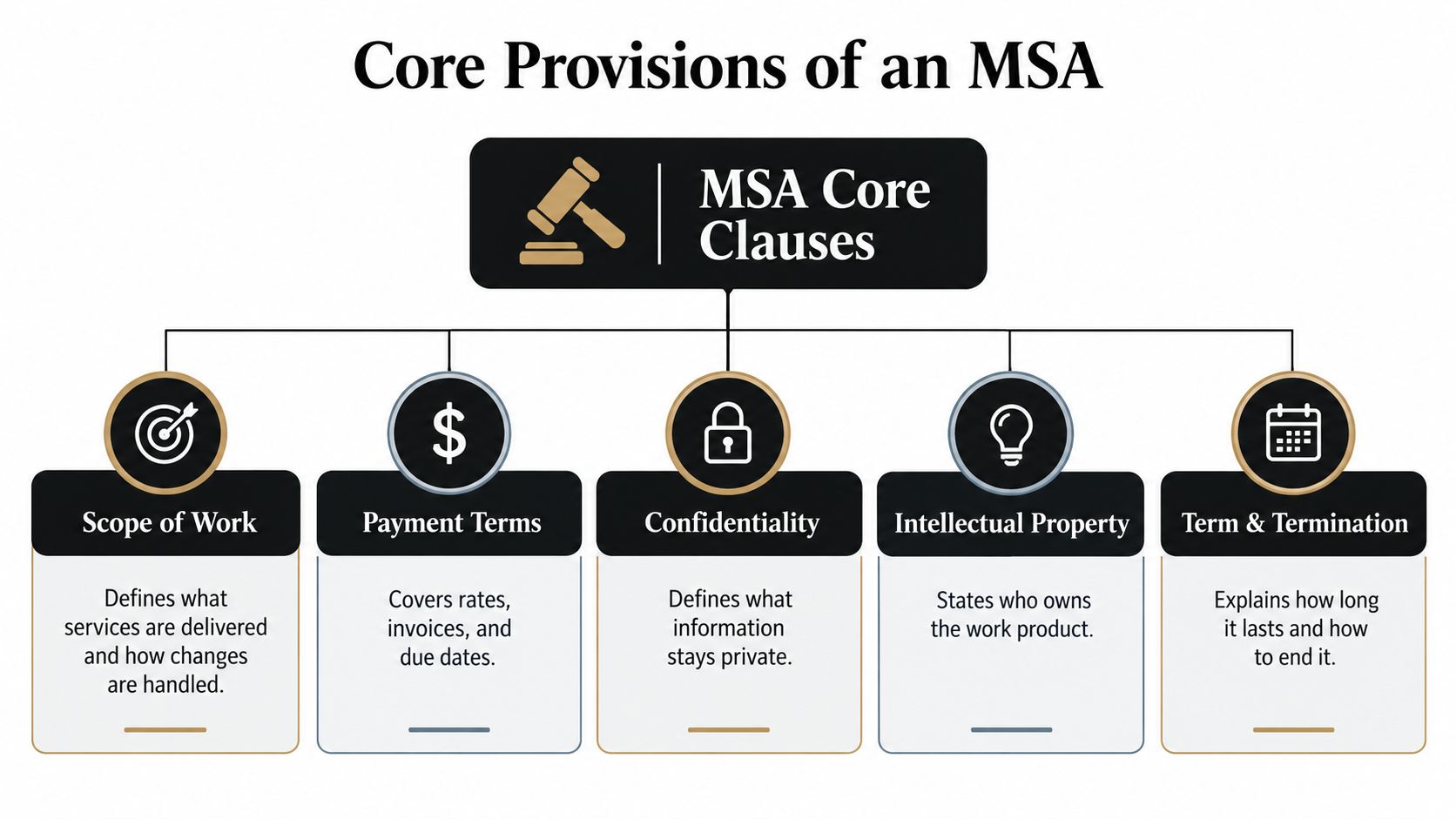
Thomson Reuters' explanation of master services agreements distinguishes reusable provisions covering payment, confidentiality, intellectual property, warranties, data protection, service levels, indemnities, liability limits, disputes, and termination from the project details assigned to SOWs.
Translate the Clauses Into Decisions
- Scope and ordering. Define the permitted services and how authorized representatives approve projects. Don't let routine project communications become an undefined commitment to buy more work.
- Payment. Address invoice requirements, due dates, expenses, disputed charges, and suspension rights. Your accounting team should know how to challenge an invoice without accidentally triggering a service interruption.
- Confidentiality and data protection. Identify protected information, permitted uses, disclosures, and required safeguards. Treat privacy obligations separately when personal data is involved.
- Intellectual property. Distinguish the provider's existing tools, newly created deliverables, third-party materials, and open-source components. Specify the customer's ownership or license rights and whether payment affects their transfer.
- Warranties and service levels. State the promised performance and the remedy for nonconforming services. A promise without a usable correction process gives the founder little operational guidance.
- Indemnities, liability, and insurance. Read these together. Their interaction matters more than whether each clause appears somewhere in the document.
- Disputes, governing law, and termination. Decide where disputes will be handled, which law applies, how parties give notice, and what happens to active projects when the relationship ends.
Decide Which Document Controls
A document-precedence clause should resolve conflicts among the MSA, SOWs, purchase orders, and incorporated policies. Consider requiring an SOW to identify any permitted override expressly, rather than allowing inconsistent project language to rewrite negotiated protections.
Published online terms, such as the terms of service for truelabel, are another type of document to identify during review. Don't assume they apply, or that they don't, without checking the incorporation language.
Drafting tip: Clarity is non-negotiable. The commercial outcome, including payment timing, ownership structure, and remedies, should reflect the actual deal rather than an assumption that every clause is standard.
Why the Statement of Work Carries Most of the Real Risk
A well-negotiated MSA won't rescue an SOW that promises a website redesign without defining the pages, functionality, content responsibilities, or completion standard. The provider may think revisions are extra. The customer may think they're included. Neither interpretation supplies a reliable project plan.
Canada's guidance on service agreements describes the master agreement as an overarching framework for common service and management terms. The practical lesson is that the umbrella document isn't a substitute for defining the actual assignment.
MSA Versus SOW at a Glance
| Decision Area | Governed by the MSA | Governed by the SOW |
|---|---|---|
| Work authorization | Approval process and signing authority | Specific authorized assignment |
| Deliverables | General obligations and reusable standards | Outputs, exclusions, and specifications |
| Acceptance | Baseline procedure and remedies | Tests, reviewer, and acceptance deadline |
| Payment | Invoice rules and dispute procedures | Project fees, milestones, and expenses |
| Responsibilities | Standing duties of each party | Named owners, dependencies, and required inputs |
| Changes | Required approval mechanism | Project-specific fee and schedule impacts |
| Risk allocation | Ownership, indemnities, and liability rules | Expressly approved project exceptions |
This responsibility matrix should also identify the human owner of each decision. A founder, finance lead, technical reviewer, and project manager may have different authority. State who can approve spending and who can confirm technical acceptance.
A public professional-services MSA from Snoqualmie expressly describes SOW content including implementation phases, customer and vendor responsibilities, training, task fees, acceptance plans, assumptions, risks, and schedules. That's a useful model of operational specificity.
Make Completion Observable
Every SOW should spell out deliverables, acceptance criteria, schedule, pricing, and change-control rules, supported by dependencies and assigned responsibilities. For software work, use a software development agreement template as a discussion starting point, then tailor the specifications and acceptance process to the actual build.
Tip: Ask someone who didn't negotiate the project to read the SOW. Can they determine what must be delivered, who reviews it, and when another payment becomes due? If not, revise it before signature.
Don't confuse brevity with efficiency. A short SOW is useful only when it gives both teams enough detail to perform without renegotiating expectations through email.
Liability, Indemnity, and Insurance Clauses Explained
The difficult liability question is practical: if the provider's mistake disrupts your business, what can you recover, from whom, and under which procedure? A founder should evaluate those answers against the service's actual risks, not just the contract value.
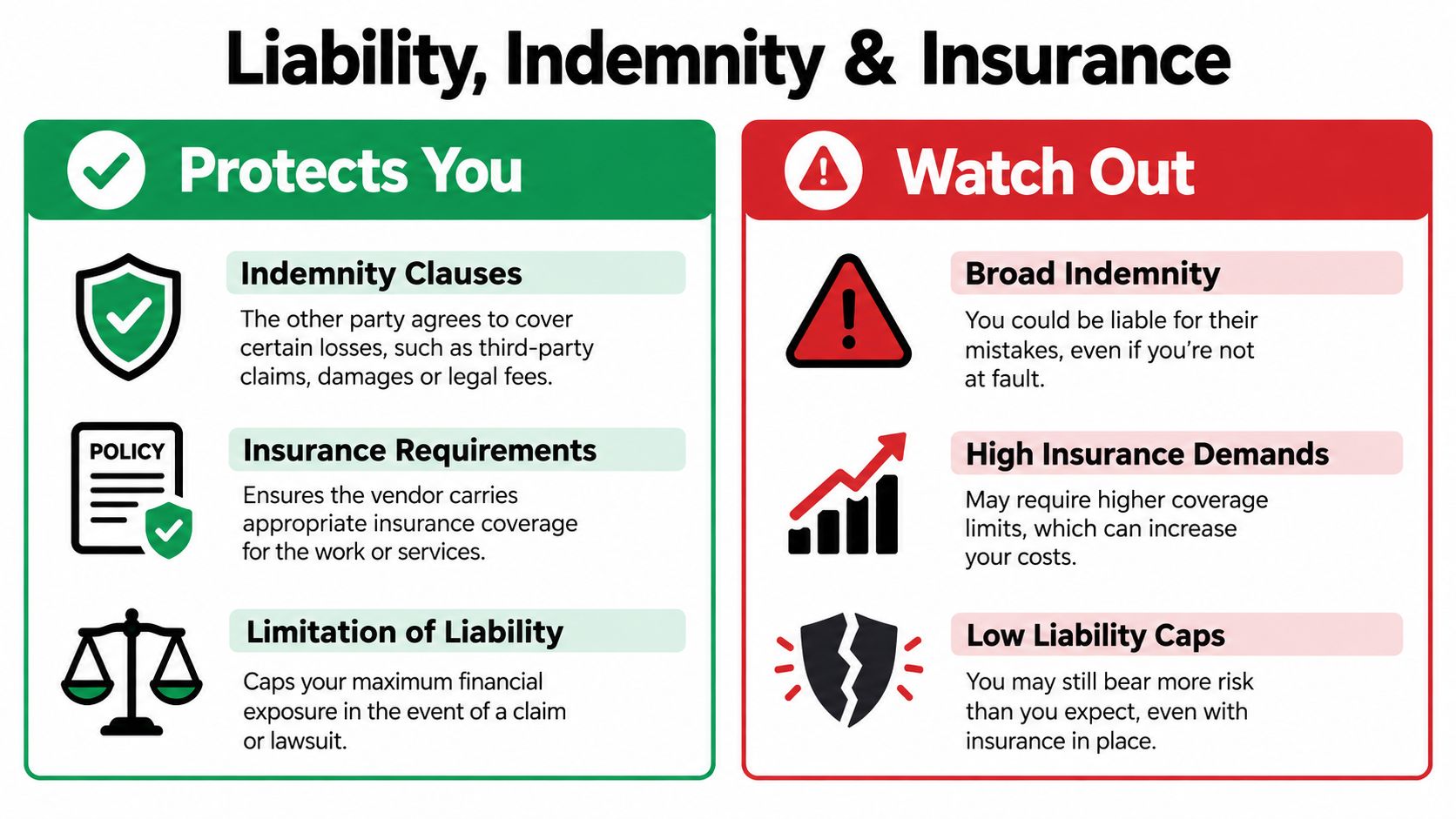
Indemnity addresses specified claims or losses. Limitation of liability restricts exposure. Insurance requirements address available coverage. None should be evaluated in isolation.
Distinguish Claims From Losses
A third-party claim comes from someone outside the contracting relationship, such as an intellectual-property owner alleging infringement. A direct loss arises between the customer and provider. Whether the indemnity covers either category depends on its wording.
The public services and materials MSA from Michigan State University provides a useful reference for examining indemnity, insurance, and liability together. A fee-based cap may be commercially predictable yet inadequate for sensitive-data losses, intentional misconduct, gross negligence, unpaid fees, IP infringement, or injunctive relief.
For a closer explanation of the terminology, review this legal definition of indemnification. Then examine the contract's triggers: negligence, breach, regulatory violations, subcontractor conduct, or another specified event.
Negotiate Exposure That Fits the Work
- Control the defense. Address prompt notice, defense authority, cooperation, and settlement consent. Don't allow a settlement to impose obligations on your business without your approval.
- Test the cap. Consider whether an early-project incident would leave a fee-based limit too small to address the likely loss. Negotiate a separate cap or exception where justified.
- Use uncapped exposure selectively. Don't demand unlimited liability for every mistake. Identify categories where the consequences justify it, then assess bargaining power and the provider's ability to meet the obligation.
- Match insurance to services. Consider appropriate cyber and professional-liability coverage. Have the coverage reviewed against the promised protection rather than treating evidence of insurance as a substitute for contract remedies.
A liability cap can protect your business when you're the provider and restrict your recovery when you're the customer. Review it from both positions.
Tip: Ask counsel to map a realistic failure against the indemnity, damages exclusions, cap, and insurance. That exercise exposes gaps more clearly than negotiating each clause separately.
When a Startup Actually Needs an MSA
An MSA makes sense when you expect to reuse the relationship, not because a vendor has one ready to sign. The right amount of contract infrastructure depends on the work ahead and the risks you're taking today.
For a South Florida agency with recurring clients, consistent terms can support repeat engagements. For a family-owned company buying a single defined deliverable, a complete standalone agreement may be easier to administer.

Choose Based on the Relationship
| Situation | Practical Approach |
|---|---|
| Recurring marketing, design, or consulting projects | Consider an MSA with a repeatable SOW process |
| Software implementation followed by support or enhancements | Build a framework that accommodates distinct phases |
| Cloud or managed services with changing requirements | Evaluate an MSA alongside service levels and privacy terms |
| Fractional operations support across assignments | Define continuing authority and project-specific responsibilities |
| A single deliverable with no expected follow-on work | Consider a standalone service agreement |
| An early proof of concept with an untested provider | Keep the commitment narrow and preserve an exit |
These are decision criteria, not rules that every startup must follow. A small pilot involving sensitive customer data may deserve substantial legal protections even if the commercial commitment is limited. Conversely, low-risk recurring work doesn't justify filling an MSA with obligations neither team can administer.
Avoid Paying for Flexibility You Can't Use
The trade-off is front-loaded negotiation against potential convenience later. If the provider relationship may end after the first assignment, don't accept restrictive renewal, exclusivity, or future purchase language merely to secure a reusable framework.
Before committing, ask your operations lead whether the business has a credible pipeline of related projects. Ask finance whether the pricing structure fits those projects, and ask counsel whether the framework assumes services or risks outside your plans.
Tip: Use the narrowest agreement that fully addresses the engagement. A standalone contract isn't less professional, and an MSA isn't automatically more protective. The useful document is the one your team can understand, execute, and manage.
Living Governance for Changing Data, AI, and Affiliates
The agreement you sign for design services may later govern customer analytics, AI-assisted content, or access by an affiliated business. Those changes deserve a review even if the vendor, project manager, and invoice format remain the same.
Post-signature governance means assigning someone to detect those changes and route them for approval. Don't rely on the original negotiation to answer questions the parties never considered.
Refresh Terms When the Work Changes
When personal data is involved, the UK Information Commissioner's Office's controller-processor contract guidance identifies required UK GDPR contract content, including processing details, documented instructions, confidentiality, security, subprocessors, assistance obligations, and end-of-contract handling. Whether those rules apply to your business requires a jurisdiction-specific assessment.
Use each new SOW to check what data will be shared, where it will be processed, and which subcontractors will receive access. Pair contractual requirements with data security best practices that your technical team can implement.
- AI tools. Require disclosure or approval of relevant uses. Address whether customer inputs or deliverables may be used for training, and how the provider must handle restricted information.
- Affiliates. Identify which entities may order services, who pays, and whether one entity bears another's obligations. Don't treat a shared brand as adequate party identification.
- Amendments. Specify the approval method and maintain a record of exceptions. Limit project-specific departures to the relevant SOW unless the parties intentionally amend the framework.
- Exit obligations. Decide whether ending the MSA ends active SOWs, and assign responsibility for access removal, data return, deletion, and transition work.
Give Someone Ownership
Assign a contract owner and maintain the executed agreement, amendments, policies, and active SOWs together. For businesses evaluating cross-border administration, DilicheckRep's contract management guidance for non-EU firms is a supplementary resource to assess with counsel.
Operational rule: A new tool, data category, service location, or contracting entity should trigger a review, not an assumption that the original agreement covers it.
Red Flags in Vendor and Customer MSAs
A familiar-looking contract can still place unfamiliar risks on your business. Don't accept unfavorable language because the counterparty calls it standard. Focus your negotiation on provisions that affect ownership, recovery, cost, and exit.
Read for Structural Risk
- Vague IP assignment. Broad ownership language can leave uncertainty about reusable tools or customer usage rights. Ask counsel to identify the assigned deliverables and reserve or license other materials expressly.
- Blanket indemnification. An obligation covering every loss connected with the relationship can exceed the conduct your business controls. Request defined triggers, covered claim categories, and defense procedures.
- A cap paired with sweeping damages exclusions. Even a seemingly acceptable cap may offer little protection if the contract excludes the losses most relevant to the service. Ask counsel to align recoverable damages with the agreed risk categories.
- Automatic renewal and unilateral price changes. These terms can limit your practical ability to reject a new commercial arrangement. Request clear notice, a workable cancellation process, and limits on changes during committed work.
- Indefinite confidentiality without distinctions. Different information may warrant different treatment. Ask for clear exceptions and a survival structure suited to the information involved.
- Termination that preserves full project fees. A cancellation right may provide little economic relief if you still owe for unperformed services. Request payment language tied to completed work and specifically approved commitments.
Check the Exit Economics
The executed Massachusetts Optum MSA illustrates why termination and payment must be read together: it permits termination for convenience with at least 45 calendar days' prior written notice, unless a task order provides a shorter period, while preserving outstanding fees and costs. It also uses written change requests followed by executed change orders.
Tip: Ask the counterparty to explain the invoice you'd receive if you terminated mid-project. Then compare that explanation with the actual contract. If the language doesn't support the answer, request an edit before signing.
Before You Sign a Founder Action Plan
Review the MSA and the first SOW together. The framework establishes what the parties may do; the project document shows how they intend to use it. Reviewing only one leaves important interactions untested.
Start with a business discussion, not a redline. Have the people responsible for delivery, finance, technology, and customer relationships identify their obligations before counsel finalizes the language.
Before-Signing Checklist
- Confirm the parties and authority. Verify the contracting entities and who may approve SOWs, spending, acceptance, and changes.
- Collect incorporated documents. Obtain policies, service levels, privacy addenda, and other referenced terms.
- Validate the project. Confirm outputs, exclusions, dependencies, deadlines, acceptance tests, fees, and revision boundaries.
- Check ownership and access. Ensure your business receives the rights, files, credentials, and materials it needs to use the deliverables.
- Test the remedies. Review liability exceptions, indemnity procedures, insurance, and correction obligations against realistic failures.
- Map personal data. Identify processing purposes, subprocessors, transfers, incident procedures, and deletion responsibilities. Ask counsel which privacy regimes apply.
- Assign administration. Designate the contract owner and record notice requirements, amendment approvals, and renewal decisions.
Questions to Send the Counterparty
Use direct questions that require a concrete answer:
- Conflict question. Which document controls if the SOW or purchase order contradicts the MSA?
- Completion question. What evidence establishes acceptance, and who has authority to approve it?
- Change question. Can project staff commit either business to additional fees without a signed change order?
- Exit question. Which active obligations and charges remain after termination?
- Technology question. Will AI tools, subprocessors, or affiliates access our information, and what approval is required?
Final tip: Don't sign with a plan to resolve essential details later. Resolve the issues that affect money, ownership, data, and exit first. Then use the agreement as a repeatable operating process, with someone accountable for keeping it current.
Coto & Waddington, Attorneys at Law offers drafting, review, and negotiation of MSAs and SOWs for founders, agencies, consultants, and growing businesses. Bring your proposed agreement, first SOW, and incorporated terms to a consultation so the team can assess scope, payment, ownership, liability, and termination together. Visit Coto & Waddington, Attorneys at Law to schedule a consultation before signing or sending your next MSA.