A capitalization table, or cap table, is a company's structured record of who owns its equity, what type of interest each holder has, how much they hold, and which rights could change that ownership later. In a simple example, a company with 8 million fully diluted shares that issues 2 million new shares has 10 million shares after the round, and its original owners collectively hold 80%.
You might be preparing to hire your first employee, reviewing a term sheet, or trying to work out what a SAFE could mean for your stake. The cap table turns those questions into something you can inspect: a record of current ownership and a way to test what may happen next. The important part isn't just the percentage you own today. It's understanding how that percentage could change when the company raises money, grants options, or converts an investment.
Table of Contents
- A Cap Table Explained in Plain Terms
- A Sample Cap Table Line by Line
- Equity Types That Appear on the Table
- How Dilution Changes Ownership After a Round
- What the Cap Table Means for Founders, Employees and Investors
- Best Practices for Keeping Your Cap Table Accurate
- Review Your Cap Table Before Your Next Round
A Cap Table Explained in Plain Terms
Think of a cap table as a land registry for company ownership. A land registry records each plot, who owns it, and its boundaries. A cap table records each equity interest, who holds it, and the terms that may affect it. When ownership changes, the record needs updating.
The U.S. Securities and Exchange Commission's glossary describes a cap table as a record of equity holders and securities, with details such as security class, share count, purchase price, and transaction dates. In plain terms, it answers four questions:
- Who holds an interest? A founder, investor, employee, adviser, or another holder.
- What kind of interest is it? Common stock, preferred stock, options, or a convertible instrument.
- How much do they hold? A number of shares or units, usually shown alongside a percentage.
- What rights could change ownership or payouts? For example, an option may later become shares, or a preferred share may carry a right to payment ahead of common stock in a sale.
That's why a cap table is more than a shareholder list. It can include founders' common stock, investors' preferred stock, employee options, and a SAFE or note that hasn't converted into shares yet. Transaction details connect each entry to the legal document that created it.
Founders use the table to plan a raise. Investors check their stake and share class. Employees use it to understand their option grants, while lawyers review it during financing. Treat it as a working map of the company's capital structure, and update it whenever an equity transaction changes the map.
A Sample Cap Table Line by Line
Here's an illustrative startup with 10,000,000 fully diluted shares before a new financing. “Fully diluted” means the calculation includes shares that could exist if relevant options and other rights became shares, not just shares already issued.
| Holder | Security class | Shares | Percent fully diluted |
|---|---|---|---|
| Founder A | Common stock | 4,000,000 | 40% |
| Founder B | Common stock | 3,000,000 | 30% |
| Employee option pool (reserved) | Options | 1,000,000 | 10% |
| Seed investor | Preferred stock | 2,000,000 | 20% |
| Total | All classes | 10,000,000 | 100% |
Read a row from left to right. Founder A holds common stock, has 4,000,000 shares, and represents 40% of the fully diluted total. The percentage comes from dividing that row's shares by the total: 4,000,000 divided by 10,000,000.
The employee option pool is included even though no employee has exercised those options yet. It represents shares set aside for potential employee grants. The table makes clear that the pool is part of this ownership calculation, while the underlying rights aren't the same as shares already held by a shareholder.
Use the structure, not these figures. The numbers are illustrative, not a market benchmark. For your own table, include enough information to verify each entry, such as the holder's name, security class, share count, percentage basis, and any relevant transaction details.
As a basic check, add the share counts and percentages. Here, the rows total 10,000,000 shares and 100%. If your figures don't reconcile, check the formulas and supporting documents before relying on the table. A sound record lets a reader trace each line to a stock purchase agreement, option grant, board approval, or financing document.
Equity Types That Appear on the Table
The label beside an equity entry matters because each type can carry different rights. The SEC's guide to common startup securities recommends identifying each holder, security type, and number of shares or units. A name and percentage alone won't show what the holder owns or what could happen later.
| Instrument | Usually held by | What it gives the holder | How it appears on the table |
|---|---|---|---|
| Common stock | Founders and employees who exercised options | Ownership and voting rights; paid after preferred stock in a sale | Issued and outstanding shares |
| Preferred stock | Seed and venture investors | Often a liquidation preference and protective rights | Issued shares in a separate class |
| Stock options | Employees and advisers | Right to buy shares at a set exercise price | Reserved or granted; included in fully diluted calculations |
| Warrants | Lenders and some investors | Right to buy shares at a set price | Potential shares; included in fully diluted calculations |
| SAFE or convertible note | Early investors | Right to receive shares after a future conversion event | Tracked as an unconverted instrument until conversion |
Issued and outstanding shares are shares that have been issued and are currently held. Options and warrants are different: they give someone a right to buy shares, but they aren't shares until exercised. A company may still include those potential shares in a fully diluted calculation to show how ownership could change.
A SAFE or convertible note also isn't necessarily a share when it's first recorded. It's an investment instrument that may convert into shares under its terms. If you're sorting out how a SAFE works before adding one to the table, this guide to what a SAFE agreement is can help you understand the instrument.
Practical tip: Keep separate columns for shares issued, shares outstanding, options or warrants, and fully diluted shares. Founders should pay close attention to common stock and the employee option pool. Investors should inspect the preferred class and the terms that govern conversion and payment priority.
How Dilution Changes Ownership After a Round
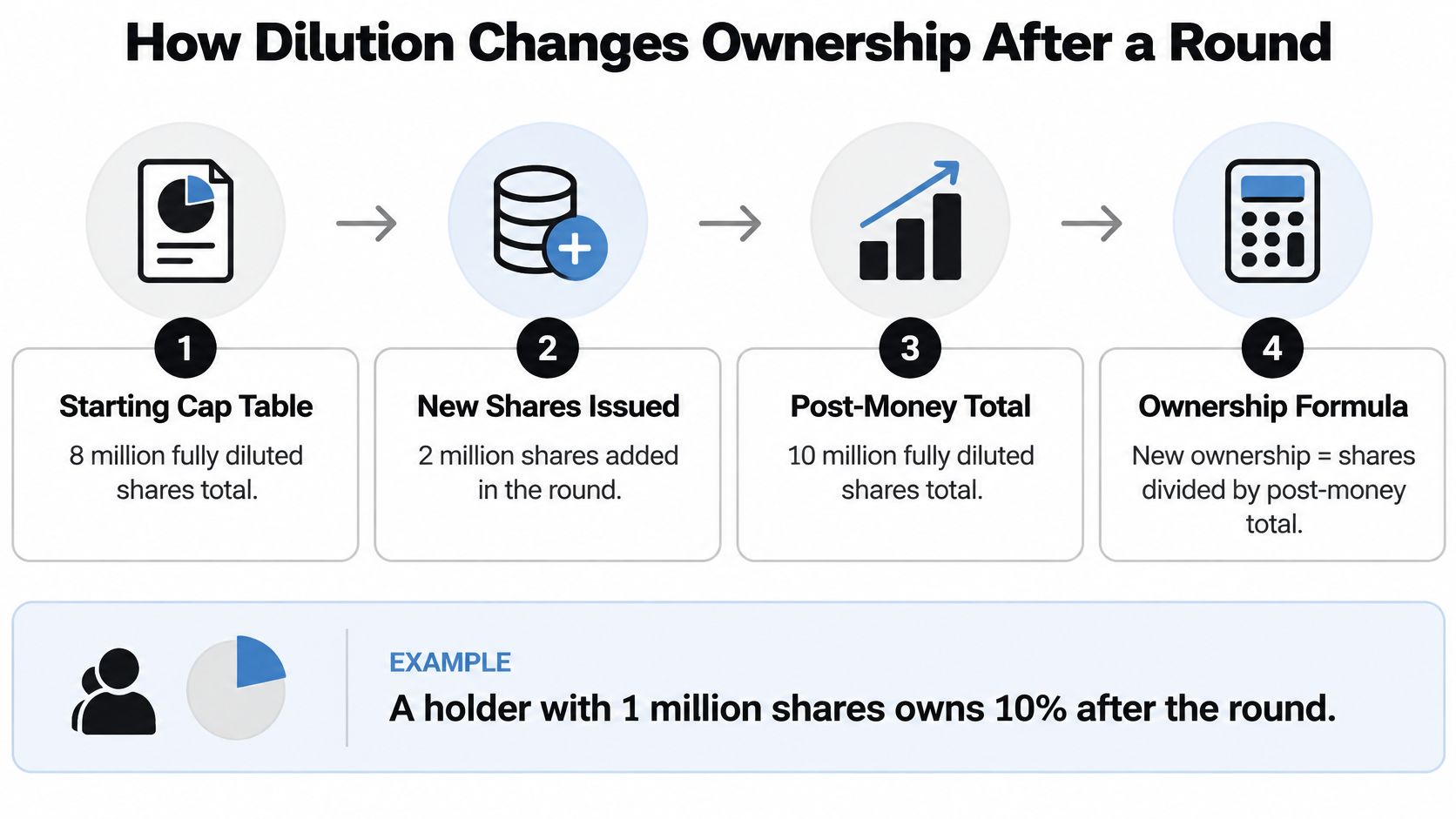
The basic formula is holder's shares divided by post-money shares = holder's new ownership percentage. “Post-money” here means the total share count after the new shares are added.
Start with a simple case. A company has 8 million fully diluted shares and issues 2 million new shares to an investor. The new total is 10 million, so the investor owns 20%. The original holders keep the same number of shares, but together their percentage falls from 100% to 80%. The SEC-hosted private-markets guide gives this example and notes that cap tables can also show round price and liquidation preferences.
Apply the same calculation to the sample company. It starts with 10,000,000 shares and issues 2,500,000 Series A shares, bringing the post-round total to 12,500,000. Existing holders' share counts stay the same, but each percentage is calculated against the larger total.
| Holder | Before round | After Series A |
|---|---|---|
| Founder A | 40% | 32% |
| Founder B | 30% | 24% |
| Employee option pool | 10% | 8% |
| Seed investor | 20% | 16% |
| Series A investor (2,500,000 new shares) | 0% | 20% |
| Total | 100% | 100% |
Founder A's post-round share is 4,000,000 divided by 12,500,000, or 32%. Run the same division for each holder, then confirm the percentages total 100%. The new investor's shares are added to the denominator, which is why existing percentages shrink.
Percentage ownership isn't the whole economic picture. Preferred stock may carry a liquidation preference, which can determine who receives sale proceeds first. The equity and debt insights from AmbitionCFO can help founders compare financing paths, while this explanation of preemptive rights covers a right that may let an existing investor participate in a future issuance.
Before agreeing to terms, compare the current table with a pro forma version that includes the round price, new shares, any option-pool increase, and investor preferences. Dilution is a normal part of financing, but you should understand the ownership and payout effects before signing.
What the Cap Table Means for Founders, Employees and Investors
Each person reads the same cap table with a different question in mind. A founder asks what the next financing might do to ownership. An employee wants to understand what an option grant represents. An investor checks both the stake and the rights attached to it.
For a founder, the current table is only a starting point. A published startup illustration shows founders moving from 75% before a Series A to 51% afterward, while an unconverted SAFE representing 15% becomes 12% preferred-stock ownership after conversion, and the employee option pool grows to 12%. These figures are illustrative, not a market average, but they show why a founder should model the pool increase and SAFE conversion before evaluating a proposed round.
An employee should ask how a grant fits into the fully diluted total and what happens to its percentage if the company issues more shares. Carta reported that the average equity grant for product and engineering roles fell approximately 15% from November 2022 to May 2023 in its startup compensation report. In a separate report, Carta said average equity issued to new hires declined 37% between November 2022 and September 2023, then rose 0.2% in January 2024 compared with September 2023 (Carta's H2 2023 report).
For context, Carta's 2023 data showed a median employee stock option pool of 13% to 20% of company equity. The median was 13.7% for companies valued at $10 million to $25 million, and 17.2% for companies valued at $500 million to $1 billion, according to this summary of private-company compensation trends. Those figures describe different company valuation groups, not a recommended pool size for every startup.

An investor checks the share class and any liquidation preference as well as the percentage. Founders and employees can also use a shareholder agreement guide to understand why rights tied to ownership matter. Each reader should leave with two questions: What percentage remains after the next round, and which rights travel with that stake?
Best Practices for Keeping Your Cap Table Accurate
Start by labeling every percentage calculation as issued and outstanding or fully diluted. The same holder can have different percentages under those two calculations because options, warrants, or other conversion rights may be included in one and excluded from the other. An SEC-filed capitalization table demonstrates the distinction by listing shares and warrants separately before combining them for a different ownership calculation.
- State when the option pool is counted. Specify whether it's measured before or after the investment, since that timing affects how dilution is allocated.
- Keep each type of potential share visible. Use separate lines for issued shares, reserved options, granted but unvested awards, warrants, and convertible securities so you can rebuild the fully diluted total.
- Connect every row to its source document. Keep the stock purchase agreement, board approval, option grant, or financing instrument that supports the entry.
- Check the authorized share count. Before a new grant is signed, confirm the proposed issuance fits within the share count allowed by the company's governing documents.

Make upkeep routine, not a task you do only on financing day. Recalculate the table after each transaction, including option exercises, and reconcile it against the share ledger regularly. If you find a mismatch, record it in a dated note and resolve it against the signed documents, so the ownership history remains clear.
A spreadsheet can display a percentage, but the signed record explains why that percentage belongs there.
Review Your Cap Table Before Your Next Round
This week, pull your current cap table and prepare a one-page pro forma for the financing you're considering. Gather every outstanding SAFE, convertible note, and option grant, along with any draft term sheet, so you can model the proposed round using the actual documents rather than memory.
If a row doesn't match its signed instrument, or a proposed grant could exceed the company's authorized share count, pause before anyone signs. Correct the record with counsel first. A fundraising readiness checklist for founders can help you organize the materials investors may ask to review.
Coto & Waddington, Attorneys at Law handles capital and growth work, including SAFE agreements, convertible notes, cap tables, founder equity structuring, and early-stage financing guidance. Its fundraising readiness services include cap table hygiene, SAFE and convertible note review, and due diligence preparation. Book a review before a priced round reaches active term-sheet negotiations, and send the current table, outstanding instruments, and draft terms ahead of the call.
For a pre-round review of your ownership and financing documents, Coto & Waddington, Attorneys at Law offers cap table hygiene, SAFE and convertible note review, and due diligence preparation. Contact the firm to discuss how its startup legal work can help you understand the proposed changes before you sign.