A cap table is the record of who owns a company, how many shares or units they hold, in which class, as of a given date. For example, founders holding 8 million shares alongside 2 million investor shares and a 1 million-share employee option pool own approximately 72.7% on a fully diluted basis.
You might be preparing an investor presentation, promising equity to an early employee, or comparing ownership figures with your co-founder. Suddenly, a simple question gets complicated: how much of the company do you own?
The answer depends on what you count, when you measure it, and which rights accompany the shares. A useful cap table helps you negotiate those details, not just record a percentage.
Table of Contents
- What a Cap Table Is and What It Shows
- The Data Points Every Cap Table Entry Needs
- Issued Versus Fully Diluted Ownership
- How Dilution Shrinks Ownership Round by Round
- How SAFEs and Option Pools Shift Ownership
- What a Cap Table Does Not Tell You
- Next Steps and Expert Review
What a Cap Table Is and What It Shows
Think of a capitalization table, usually shortened to cap table, as a land registry for company ownership. It identifies each owner, what they hold, and when their position changed. Unlike a simple ownership list, it also distinguishes interests that carry different economic rights, meaning different entitlements to the company's value.
The Florida Office of Financial Regulation's securities guide describes a record covering holders, security classes, ownership percentages, purchase prices, transaction dates, outstanding securities, and employee option reserves. Consider this worked example: founders hold 8 million common shares, investors hold 2 million preferred shares, and the company reserves 1 million shares for employee options.
Worked example: ownership snapshot on a fully diluted basis
| Holder | Security class | Shares | Fully diluted % |
|---|---|---|---|
| Founders | Common stock | 8,000,000 | 72.7% |
| Investors | Preferred stock | 2,000,000 | 18.2% |
| Employee option pool | Reserved options | 1,000,000 | 9.1% |
| Total | All classes | 11,000,000 | 100% |
Common stock is the basic ownership stock founders typically hold. Preferred stock carries negotiated rights, potentially including priority payments when the company is sold. A stock option gives its holder the right to buy shares at a specified price, while an option pool reserves shares for equity awards.
Read the share count before the percentage
To calculate a holder's percentage, divide that holder's shares by the total shares included in the calculation. The example's fully diluted view includes the employee reserve alongside existing stock, producing the percentages shown in the table. The arithmetic tells you how much ownership each position represents under that assumption, not who currently owns every reserved share.
That distinction gives the table two jobs. As a historical ledger, it records issuances, meaning transactions in which the company creates and distributes securities. As a planning tool, it helps founders test financing proposals, hiring awards, and ownership negotiations before accepting them.
First check: match every holder, security class, and share count to the signed documents supporting it. A tidy spreadsheet isn't enough if its entries don't reflect completed and properly documented transactions.
The Data Points Every Cap Table Entry Needs
Build your table around identifiable transactions, not remembered promises. The U.S. Securities and Exchange Commission's glossary defines a capitalization table by reference to equity-security holders and details including security class, quantity, purchase price, and transaction dates.
Use these fields so someone other than the founder can reconstruct each position:
- Holder name. Record the legal name of each founder, investor, employee, or advisor holding equity or a right to acquire it. Distinguish an individual from an investment entity.
- Security class or instrument. Identify common stock, preferred stock, options, or warrants. A warrant is a contractual right to purchase shares, often issued to an investor, lender, or business partner.
- Number of shares or units. Keep actual quantities, not just percentages. Percentages change when the total changes.
- Price paid per share or unit. Preserve the transaction price so the original investment can be reconciled. Don't assume it establishes the current value of every class.
- Acquisition and disposition dates. Record when the holder acquired the position and when any sale, transfer, or cancellation occurred.
- Status. Separate issued shares, outstanding awards, and unallocated reserves. A hiring reserve isn't an employee shareholder.
- Convertible terms. Track each SAFE, a Simple Agreement for Future Equity, and each convertible note, a loan that can become equity, separately. Include applicable valuation caps, discounts, and conversion conditions.
Match the format to your entity
A corporation generally records shares and stock classes. A limited liability company, or LLC, may instead record membership units or percentage interests governed by its operating agreement, the contract defining members' ownership and management arrangements.
Document test: Pick any holder and trace the entry to the relevant signed purchase agreement, approval, or option grant. Investigate any row you can't support rather than treating the spreadsheet as proof of ownership.
Issued Versus Fully Diluted Ownership
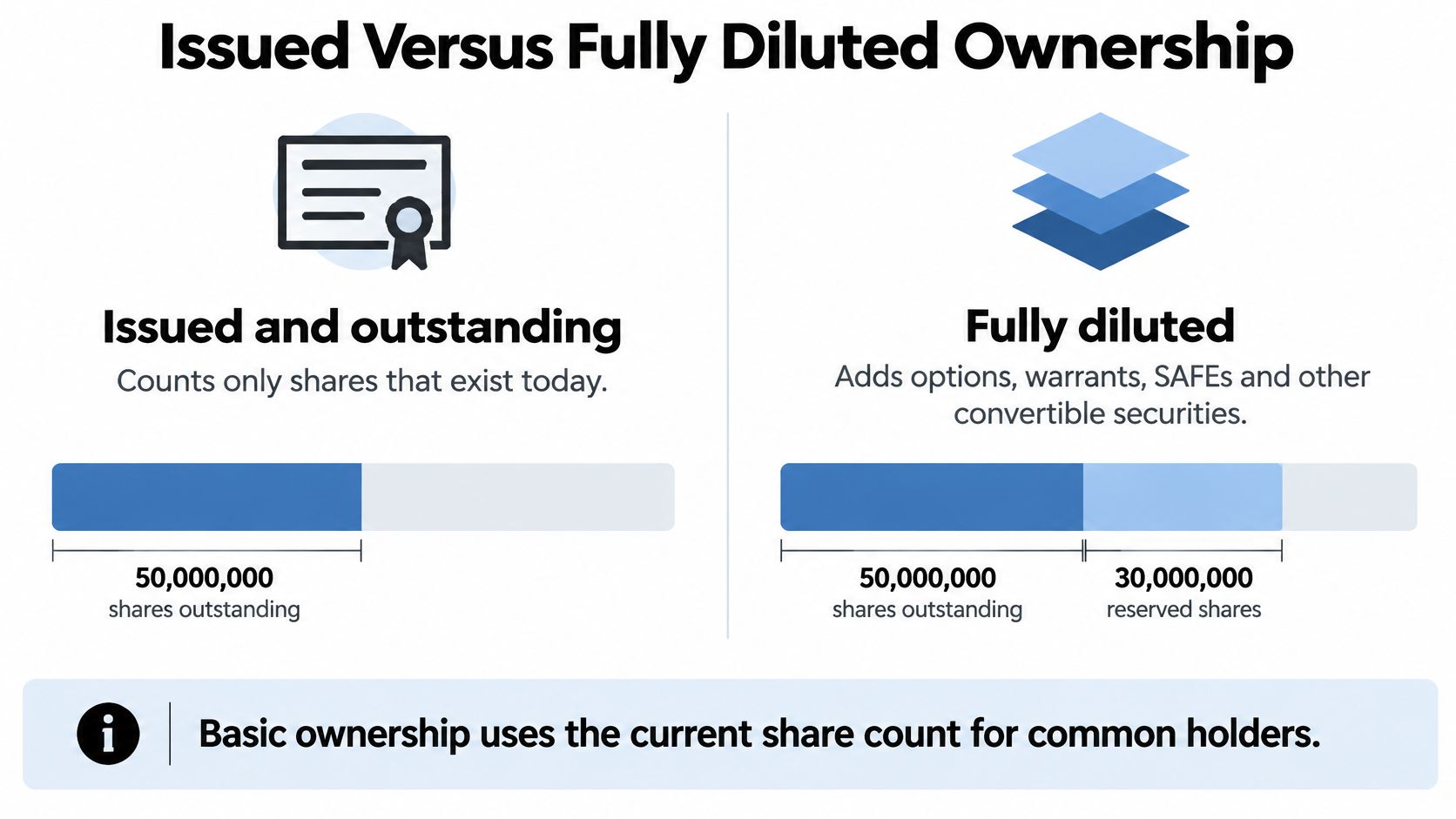
Issued and outstanding shares are shares that have been issued and remain held by shareholders, excluding treasury shares held by the company. Basic ownership, as used here, divides a holder's current shares by that outstanding total. The denominator is the total share count beneath the fraction, and choosing it changes the answer.
A fully diluted calculation adds potential shares under specified assumptions, including options, warrants, and convertible instruments. Carta's cap-table guide recommends maintaining both outstanding and fully diluted views when evaluating fundraising, employee grants, or an acquisition.
Same holders on two denominators
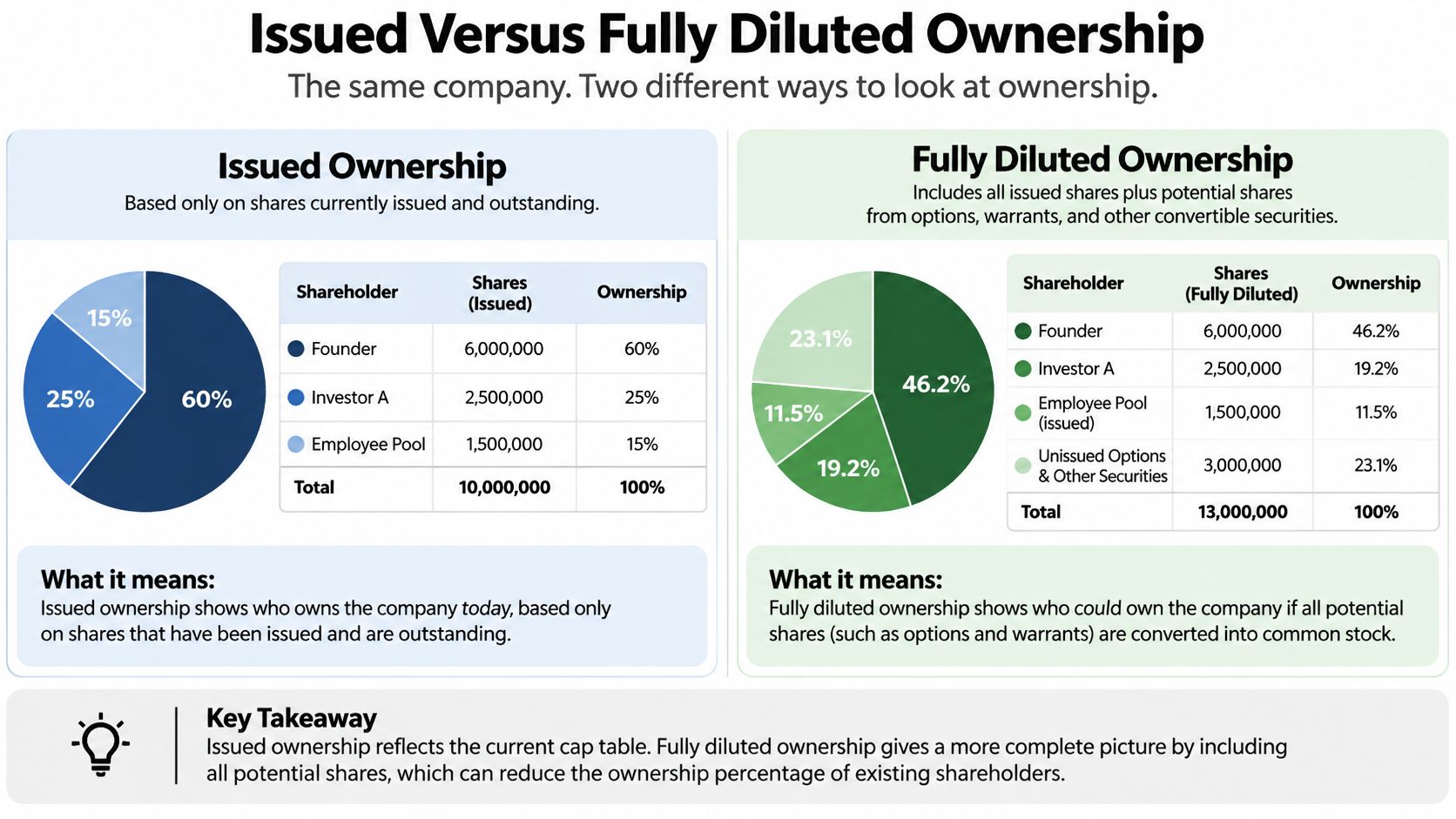
Using the worked example, the issued-share calculation is:
| Holder | Issued and outstanding basis |
|---|---|
| Founders | 80% |
| Investors | 20% |
| Employee option pool | Not counted |
| Total | 100% of 10,000,000 |
The founders' issued-share percentage is 80%, compared with 72.7% when the reserved pool enters the fully diluted calculation. These are different answers to different questions, not contradictory records.
Put the calculation beside the promise
One co-founder may quote the percentage of existing stock while another quotes the percentage after allowing for reserved equity. Neither figure is useful in a negotiation unless everyone agrees on the denominator and measurement date.
For an employee holding options, describe the modeled stake as shares under option divided by the fully diluted total. Explain separately that the exercise price, the amount the employee must pay to buy those shares, is a cost, not an ownership percentage.
A percentage without its denominator and measurement point is an incomplete offer.
Practical tip: add outstanding-basis and fully diluted percentage columns beside every holder. Use the fully diluted model for hiring discussions and acquisition planning, but write down which instruments and reserves it includes so nobody mistakes an assumption for an issued share.
How Dilution Shrinks Ownership Round by Round
Take a financing-only variation of the ownership example: founders hold all 10 million outstanding shares before an investor arrives. Dilution occurs when the company issues new shares and an existing holder's percentage falls, even though that holder hasn't sold anything. The founder's share count stays fixed. The denominator grows.
Two variables decide how far the percentage drops: how many shares the investor buys, and how many shares get reserved at the same time. Issuing 2.5 million new shares against 10 million founder shares leaves founders with 80%. Issuing 5 million leaves them with roughly 66.7%. The third scenario holds the investor's purchase fixed and changes only the pool.
Founder and investor ownership under three financing scenarios
| Scenario | New shares issued | Founders after | Investor after |
|---|---|---|---|
| Investor buys 2.5 million shares, no pool change | 2,500,000 | 80.0% | 20.0% |
| Investor buys 5 million shares, no pool change | 5,000,000 | 66.7% | 33.3% |
| Investor buys 2.5 million shares, 10% post-money pool added | 2,500,000 investor shares, plus approximately 1,388,889 reserved pool shares | 72.0% | 18.0% |
In the last scenario, about 1,388,889 reserved shares bring the pool to 10% of the post-transaction fully diluted total. Reserved pool shares aren't issued stock, yet they still enter this model's denominator. Because the investor's share count stays fixed, founders drop from 80% to 72% and the investor from 20% to 18%. A request for a bigger pool is effectively a request that existing holders fund future hiring out of their own percentages, which makes pool size a negotiated term alongside the check itself.
Repeated rounds multiply the effect
For a hypothetical founder starting with all the equity, retaining 80% after each of three rounds leaves 51.2%, calculated as 0.8 × 0.8 × 0.8, before additional pool changes. Dilution compounds the way interest does, in reverse. You multiply the retained portion each round rather than subtracting each round's dilution from the original percentage, so later rounds take a smaller absolute bite even when the deal terms stay the same.
For market context, Carta's dilution analysis found median seed-round dilution declined from 23.0% in the first quarter of 2019 to 20.1% in the first quarter of 2024, while median Series A dilution declined from 24.1% to 20.5% over the same period. Treat these figures as financing benchmarks rather than promises about your next round.
Negotiation tip: model each proposed issuance before a term sheet arrives so you can see which variable, the check size or the pool, is doing the damage. Review any preemptive rights for existing shareholders, which may let current holders purchase additional securities to help maintain their percentage. Exercising those rights requires new investment, so the right helps only holders prepared to write another check.
How SAFEs and Option Pools Shift Ownership
A post-money SAFE measures its cap-based ownership after accounting for SAFE funding under its contractual capitalization definition, but before later financing effects. A valuation cap sets a ceiling on the valuation used for the relevant conversion-price calculation; it isn't necessarily a statement of the company's current market value.
In Y Combinator's post-money SAFE example, a $500,000 SAFE at a $10 million cap represents 5%, while an additional $1 million SAFE at a $16 million cap represents 6.25%, totaling 11.25% before later financing effects.
SAFE ownership from post-money caps
| Instrument | Valuation cap | Ownership |
|---|---|---|
| $500,000 post-money SAFE | $10 million | 5% |
| $1,000,000 post-money SAFE | $16 million | 6.25% |
| Combined before later financing | Not applicable | 11.25% |
These percentages aren't permanent guarantees. Additional SAFE funding generally reduces the portion available to the pre-SAFE stockholders, often founders and early employees. When the applicable priced financing occurs, the SAFEs convert under their terms, and the new investment then dilutes the converted SAFE holders alongside existing shareholders.
For the contract fundamentals, review what a SAFE agreement is before entering an estimated conversion into your table. Founders considering instruments across jurisdictions may also find Founder Connects' comparison of convertible notes vs SAFE for UAE startups useful, while keeping local legal requirements separate from the ownership arithmetic.
Pool timing changes who bears the cost
A pro forma cap table is a forward-looking model of ownership after a proposed transaction. Carta's pro forma guide explains why an option-pool increase included before financing can change the pricing denominator and shift dilution toward existing holders.
Pre-money means before the new investment; post-money means after it. At a fixed pre-money valuation, adding pool shares to the pricing denominator lowers the price per share, so the investor receives more shares for the same investment. A pool expansion after the financing instead dilutes the new investor too.
Don't infer the result from valuation alone. Keep every SAFE on its own line and compare ownership at each transaction stage: pool refresh, conversion, and new-money issuance. The contract's capitalization definitions determine the final calculation.
What a Cap Table Does Not Tell You
A cap table can accurately reflect the legal ownership records and still leave a founder accepting a bad deal. Ownership percentage isn't the same as control or sale proceeds. Hustle Fund's investor guide to capitalization tables highlights why investors examine security rights and future ownership changes rather than relying on a static percentage.
Common and preferred shares may carry different voting rights. Board appointment rights and approval requirements can also give a holder influence that doesn't match their economic stake, so don't read a fully diluted percentage as a board-vote percentage.
Test the payout, not just the stake
A liquidation preference gives preferred holders priority over common holders in specified distributions. In a simplified hypothetical sale, assume preferred holders have a $10 million preference, only $5 million is available for shareholders, and no other competing claims apply. Preferred holders receive all the available proceeds, while a founder listed at 20% receives nothing.
Other negotiated terms also deserve their own checks:
- Participation rights. These may allow preferred holders to receive their preference and then share in remaining proceeds.
- Pro rata rights. These give an investor a contractual opportunity to participate in later financing.
- Protective provisions. These require specified investor consent for particular company decisions.
- Stacked SAFEs. Multiple outstanding instruments can create conversion outcomes that a single combined estimate obscures.
Read the governing documents alongside the table, including the shareholder agreement where applicable. Build a payment waterfall, a calculation showing who receives sale proceeds and in what order, at different hypothetical exit values.
Before signing: identify who gets paid first, who can block the transaction, and who absorbs the proposed pool increase.
Favorable headline dilution doesn't answer those questions. Negotiate the rights and the percentages together.
Next Steps and Expert Review
An accurate cap table needs a repeatable maintenance process. Choose a named person to maintain the working file, and distinguish completed transactions from proposed ones so nobody circulates a fundraising scenario as current ownership.
Whether you use Microsoft Excel, Google Sheets, or dedicated equity software, adopt these habits:
- Date-stamp saved versions and keep a change log. Record what changed, the supporting approval, and who authorized the issuance, grant, or conversion. Preserve prior versions rather than overwriting the only record of a transaction.
- Maintain complete option details. Record the grant date, exercise price, vesting schedule, and expiration. Vesting describes when an award is earned under its terms; it isn't the same as exercising the option and buying shares.
- Index the signed documents. Keep agreements and approvals in a controlled folder, with filenames identifying the holder and corresponding row. Make it possible for a reviewer to move directly from a table entry to its supporting records.
- Refresh before consequential conversations. Reconcile the file before a board meeting, equity offer letter, or financing call. Mark unresolved discrepancies clearly instead of filling gaps with assumptions.
Bring questions to the review
Separate recordkeeping problems from negotiation questions. A missing grant approval needs investigation; a proposed investor preference needs economic analysis. Putting both into an unexplained spreadsheet adjustment makes the file harder to trust.
Our capital and growth work includes cap tables, founder equity structuring, SAFE agreements, convertible notes, and early-stage financing guidance. A useful review starts with the ownership records and then tests the transaction you're considering.
Gather the signed issuance documents, build the table with the fields above, and list any unsupported entries. Book a review before the next financing conversation, while you still have room to clarify terms and compare alternatives.
We offer cap table hygiene, SAFE and convertible note review, and due diligence preparation to help you understand ownership before raising capital. Visit Coto & Waddington, Attorneys at Law to book a review of your records and proposed financing terms, with flat-fee, transparent pricing so you know costs upfront.