Ultra vires means a company acting beyond the purposes or powers stated in its constitutional documents, and in most modern deals the contract still holds. Since 1 October 2009, UK company law has refused to undo an act merely because the constitution didn't authorize it, and Florida confines a challenge to three defined proceedings rather than treating the contract as void.
So why do founders still treat a narrow purpose clause as a kill switch for the other side? If your articles say you write software and you sign a warehouse purchase, the instinct is that the seller can walk. That instinct mixes two different problems. One is whether the counterparty can enforce the paper. The other is whether directors and officers broke an internal rule.
Ultra vires law grew up to police both problems at once. Modern statutes in the markets South Florida founders use, including Florida and Delaware, split them. The deal usually stays alive. The people who skipped the charter, the board, or a consent right are the ones who can still be called to account.
Table of Contents
- What Ultra Vires Means in Plain Terms
- How the Doctrine Began and Why It Softened
- Separate Authority From Governance Before You Sign
- How Florida Law Limits Challenges to Corporate Acts
- How Delaware Limits Challenges to Corporate Acts
- Ultra Vires in Real Contracts and Deals
- Confirm Your Authority Before You Sign
What Ultra Vires Means in Plain Terms
Could a company sign a contract that its constitution does not authorize? Ultra vires means “beyond the powers.” The doctrine concerns acts outside a company's stated purposes or powers, but the result depends on the law governing the entity.
Founders often treat a narrow purpose clause like a lock on the company's contracts. The better analogy is a rulebook: it may limit what directors should do internally without automatically letting the company escape a deal with someone who acted in good faith. Keep two questions separate: can the counterparty enforce the contract, and can the company hold its directors to account?
| Regime | Can an act outside stated purpose be void? | Who can challenge it | Practical risk |
|---|---|---|---|
| Traditional common-law rule (historical) | Yes, the act could be void | Shareholders and the company | High uncertainty for counterparties |
| UK Companies Act 2006 | No, objects are unrestricted unless the articles restrict them | Directors bound by internal duties | Low for counterparties, director exposure remains |
| Florida (Fla. Stat. 607.0304) | Generally no, challenges limited to defined proceedings | Shareholders, the corporation, Attorney General | Mainly governance and fiduciary claims |
Under the traditional rule, an act beyond the company's stated objects could be void. Shareholders or the company could challenge it, leaving a supplier who had already delivered goods uncertain whether the contract bound the company. That is the risk modern rules seek to limit.
For UK companies, Companies Act 2006, section 39 provides that an act's validity cannot be challenged solely because the company lacked capacity under its constitution. Section 31 makes a company's objects unrestricted unless its articles specifically restrict them. Section 40 separately protects a person dealing with the company in good faith by treating directors' power to bind it as free of constitutional limits. A counterparty therefore does not have to investigate the objects clause, while directors remain subject to their internal duties.
Florida takes a similar approach to the contract's external validity. Under Florida Statutes § 607.0304, an act generally is not invalid merely because it exceeds a limitation in the articles. A shareholder, the corporation, or the Attorney General may raise the issue, but only through the proceedings the statute specifies. The restriction is on who may challenge the act and how, not a general rule that every unauthorized contract is void.
Where the exposure actually sits
For many modern deals, the contract remains in force while the internal consequences fall on directors or officers who disregarded the charter, a board threshold, or a fiduciary limit. A broad “any lawful business” purpose clause can reduce disputes about corporate objects. It does not itself satisfy signing authority, investor consent rights, or lender covenants.
Practical rule: Read the articles and the purpose clause before any significant signature.
How the Doctrine Began and Why It Softened
Picture a railway company in the joint-stock era. Its memorandum listed one job: build and run a railway. Subscribers bought shares on that promise. A supplier who sold rails could look at the same document and see that a railway contract was something the company was allowed to sign.
Then the directors bought a brewery. The purchase might have looked clever as a side business. Under the traditional rule it could be declared void, because brewing wasn't an object of the company. The brewery seller, and anyone who had extended credit against that deal, carried the loss. The company could keep the commercial upside of walking away.
The account of the doctrine in Current Legal Problems describes the two aims behind that harsh result. Constitutional objects protected shareholders by showing how invested capital could be used. They also protected people dealing with the company by identifying the transactions it was permitted to enter. In practice, an unauthorized act could be void, and that voidness created substantial commercial uncertainty for counterparties.
From a void contract to an internal breach
The United Kingdom cut that risk in stages. The Companies Act 1985 introduced provisions under which a company's act couldn't generally be challenged solely because the company lacked capacity under its memorandum. The Companies Act 2006 replaced and expanded that approach. The question moved. It stopped being "can a third party be held to this?" and became "did the directors break an internal duty?"
That shift is the historical lesson for founders. A purpose restriction that once threatened the other side is now, in major common-law markets, mostly a governance issue. The old ability to invalidate an ordinary commercial contract has been substantially curtailed.
The label still shows up. Older charters keep narrow object lists. Nonprofit and regulated entities still tie activity to a stated mission or a license. Authority disputes still turn on who was allowed to sign. Directors can breach duties or constitutional limits even when the third party can enforce the transaction. Ultra vires law in that narrower sense still reaches director accountability and shareholder remedies.
If your formation documents still use a short objects list copied from an old template, treat that list as a live constraint on management, not as a museum piece.
Separate Authority From Governance Before You Sign
Think of a posted speed limit. Driving over it breaks a rule, and the driver can be stopped and fined. The car doesn't vanish from the road, and the other drivers aren't automatically thrown out of their lanes.
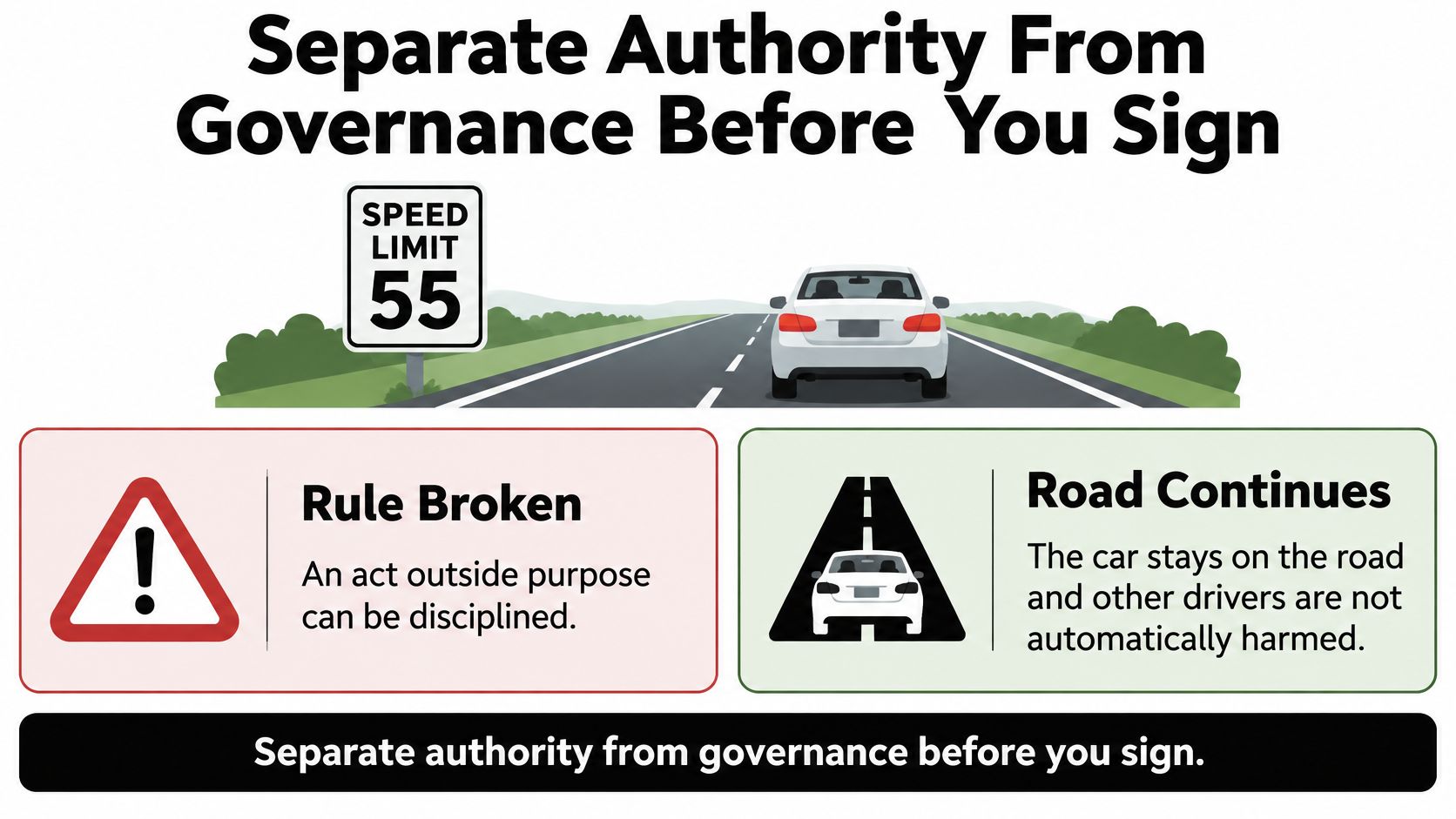
Two misconceptions cause most of the damage at signing. The first is that an unauthorized deal is automatically void. The second is that a broad "any lawful business" sentence removes every risk. Neither is right. A counterparty can still hold the company. You can still have an internal problem.
Courts and scholarship, as the discussion of objects clauses explains, have long tied these disputes to constitutive documents and to the authority of directors, not only to whether the deal was commercially sensible. Modern statutes may treat the company's act as valid against outsiders. They don't erase accountability when directors disregard constitutional limits.
Three questions, asked separately
Before anyone signs, separate three questions.
Capacity asks whether this entity could do this kind of act at all. Authority asks whether this board or these officers were allowed to approve it and to sign it. Governance asks whether the deal met fiduciary duties, financing covenants, and shareholder or member consent.
A reserved matter often lives in a shareholder agreement, a side letter, or a credit agreement, not in the articles. Approval thresholds usually turn on the dollar amount or on the asset, such as all intellectual property or a majority of assets. The person who signs needs a written delegation, not a job title. "CEO" on a signature block isn't a power of attorney.
| Check | What to confirm | Red flag |
|---|---|---|
| Governing documents | Purpose clause and limits in the articles, bylaws, or operating agreement | Purpose narrower than the deal |
| Approval threshold | Board or member consent for the amount or asset involved | No written resolution on file |
| Signatory authority | Who may sign, and the delegation in writing | Signer holds no written delegation |
| Investor and lender terms | Reserved matters and consent rights | Consent right not obtained before closing |
| Ratification path | Written board or member approval after signing | Approval not documented or dated |
Use that list as a closing checklist. Confirm entity capacity, signatory authority, required approvals, and restrictions in investor or lender documents as separate lines, not one vague "legal is fine."
If the deal is already signed
- Pause further performance so no new obligations accrue while you sort authority.
- Gather the articles or operating agreement, bylaws, and any investor or lender consent schedule.
- Ask the board or the members to ratify in a written consent that describes the contract.
- Record the vote, the date, and the reasons, including any conflict disclosure.
- Notify counterparties if a reserved consent was missed, and get that consent before you keep performing.
Nonprofit boards should document the statutory and constitutional basis for major grants, loans, and unrelated commercial activity. Delaware companies should confirm the charter purpose covers each new business line before that line generates contracts.
How Florida Law Limits Challenges to Corporate Acts
Florida's modern rule generally doesn't invalidate a corporate action just because the corporation exceeded a limitation in its articles or lacked authority for that transaction. Florida Statutes § 607.0304 channels the fight into defined proceedings. If you aren't in one of those proceedings, "they acted outside the articles" isn't a defense that voids the contract.
| Challenger | Remedy available | Key limit |
|---|---|---|
| Shareholder | Injunction against the act, discretionary and equitable | All affected parties before the court; damages exclude anticipated profits |
| Corporation | Claims against current or former officers, employees, or agents | Tied to fiduciary duty and whether authority was ignored |
| Attorney General | Dissolution or an injunction against unauthorized business | Public enforcement, not routine deal disputes |
What each route can and can't do
A shareholder injunction is discretionary and equitable. The court may enjoin or set aside the act only when all affected parties are before the court. It may award damages for losses caused by the injunction, and those damages exclude anticipated profits. A shareholder who is angry about a missed resolution can't erase the other side's contract and then claim the profits the deal might have produced.
The corporation's route points inward. It may pursue current or former officers, employees, or agents. That is a claim about authorization and duty, not a gift to the counterparty.
The Attorney General may seek dissolution or an injunction against unauthorized business. That is public enforcement. It isn't the tool a vendor uses when a startup disputes an invoice.
What that means on a real financing or license
Say a Miami software startup signs a three-year licensing deal. The CEO signs alone. The bylaws require board approval above a set dollar amount, and nobody prepared a consent. The licensee can still enforce the license against the company. The officers who ignored the approval rule, a purpose limit, or a fiduciary duty are the people exposed to an internal claim.
The record that prevents the fight is ordinary paperwork. A board resolution naming the licensee, the term, and the dollar cap. A shareholder consent if the articles or an investor right require it. A delegated-authority matrix showing who may sign licenses, and up to what amount. A short conflict note if a director had a stake in the licensee. Those documents don't make a bad deal good. They show who authorized it, which is what Florida's statute litigates.
Keep that packet with the signed agreement, not in someone's inbox.
How Delaware Limits Challenges to Corporate Acts
Can a company escape a contract because its charter did not list the activity? Delaware's corporate statute says an act is not invalid merely because the corporation lacked the power to perform it. That limit matters: lack of corporate power is available only in defined proceedings, not as a general defense for anyone who later dislikes the deal.
Three challengers have different routes.
A stockholder may ask a court to enjoin the act. The remedy is equitable and discretionary, so an objection raised before performance is more likely to have practical effect. Once goods have shipped and money has changed hands, unwinding the bargain becomes less likely.
The corporation may pursue current or former directors, officers, employees, or agents. This is an internal claim about authority and duty, not a counterparty's automatic right to cancel a contract. When stockholders bring the claim in the company's name, it may proceed as a derivative suit.
The Attorney General may seek dissolution or an injunction against unauthorized business. That is public enforcement, not a routine remedy for a founder or supplier in a closing dispute.
A service line the charter doesn't name
Suppose a Delaware corporation's charter names “software development and related services” as its purpose. Its founders add on-site equipment installation and sign a supplier contract for tools and vans. If the supplier dealt with an officer in the ordinary way, the company may still be bound. A mismatch with the purpose clause does not automatically give either side a way out.
The company's contract obligation and its directors' internal exposure are separate questions. Directors who proceed without board action, or without stockholder consent required by the charter or a voting agreement, may face questions about their process. That does not itself undo the supplier's contract.
Before signing, compare the proposed business line with the purpose clause and check the required approvals. Record the decision in the minute book. If the clause is too narrow, amend the charter before proceeding rather than treating the change as optional.
Ultra Vires in Real Contracts and Deals
Three deals show how the split works once signatures are on the page.
A South Florida startup signs a services agreement after counsel reviews and revises the master agreement, including clear termination clauses. The vendor then fails to deliver. Because the paper was reviewed before signing, the company enforces the contract, ends it, and recovers its costs without litigation. The purpose clause never became the issue. The termination clause did. Clean authority and a readable exit beat a later fight about objects.
A manager signs an equipment lease that sits outside the company's stated purpose and never checks who is allowed to bind the company. The lessor reasonably believes the manager has power. Apparent authority can hold the company to the lease even though the purpose line was missed. The manager still faces questions from the board. A written, dated approval after the fact can ratify the lease if the board still wants the equipment. That approval should name the lessor, the term, and the monthly cost, in the same way the pre-signing checks name a signer and a threshold.
A nonprofit member learns of an unusual grant that looks inconsistent with the charitable purpose. Under the District of Columbia nonprofit corporation statute, corporate action generally can't be challenged merely because the nonprofit lacked power, but a member, director, or member of a designated body may bring a proceeding to enjoin the act. Asking a court to stop the grant before the money leaves is a different request from suing for damages after the transfer. Timing is the whole remedy.
One test for any signature
Apply three questions to the next contract, including a stock purchase agreement.
- Who signed: Does that person hold a written delegation for this kind of deal?
- What the documents allow: Does the purpose clause, and any reserved-matter list, cover this transaction?
- Who approved: Is there a dated board or member consent for the amount and the asset?
If any answer is no, fix the record before performance continues. Don't wait for the other side to discover the gap.
Confirm Your Authority Before You Sign
Ordinary contracts rarely fail because a purpose clause was imperfect. The exposure that lasts is internal, and it lands on directors and officers. Good documents are the protection: a purpose clause you have read, thresholds you can point to, and a signer who holds a written delegation.
Pull the articles or operating agreement before the next material deal. List every approval threshold. Confirm who signs, and under what writing. Then have counsel review the packet, not only the commercial term sheet.
Coto & Waddington, Attorneys at Law helps founders form Florida and Delaware entities, draft the contracts those entities sign, and build the approval structure that matches the deal. Michael S. Waddington, an adjunct professor at Florida International University College of Law, is part of the broader teaching tradition behind that practical approach to corporate duties.
This article is informational only. It isn't legal advice, and reading it doesn't create an attorney-client relationship. That relationship forms only with a signed agreement.
Before the next signature, have someone compare the contract with your charter, your consent rights, and your signing authority. Coto & Waddington, Attorneys at Law works with South Florida startups and small businesses on formation, contracts, and the board process that keeps a valid deal from becoming an internal claim. Visit Coto & Waddington, Attorneys at Law and sort the authority questions before you sign.