You've formed your company, opened a bank account, and started paying yourself. Then your tax preparer asks whether you filed the S corp election form, and you realize that choosing a business structure and choosing its federal tax treatment aren't the same task.
Form 2553 is the election, not a substitute for checking eligibility. Before you send it, confirm who owns the business, whether its ownership rights fit S corporation rules, and which effective date you want. If the deadline has already passed, the next step isn't mailing the form late. It's determining whether you qualify for relief and whether your records support the request.
Table of Contents
- Check Eligibility Before You File Form 2553
- S Corp Election Deadlines by Start Date
- How to Complete and Sign Form 2553
- What to Do If Your Election Is Late
- Common Filing Mistakes and How to Fix Them
- Decide Whether to File Your Election This Year
Check Eligibility Before You File Form 2553
Say you own a Florida LLC and want S corporation tax treatment. Before filing, you invite an outside investor to buy an interest through their investment company. That ownership decision can prevent the election from working, even if you complete every field correctly.
The IRS's S corporation eligibility guidance generally limits an S corporation to 100 shareholders, permits individuals, estates, certain trusts, and specified tax-exempt organizations, and generally excludes partnerships, corporations, and nonresident aliens. The business must also be domestic and must not be an excluded corporation type, such as certain financial institutions, insurance companies, or domestic international sales corporations.

Check every owner, not just the founder
Who can and cannot hold S corporation stock
| Shareholder type | Allowed | What to check |
|---|---|---|
| Individual U.S. citizen or resident | Yes | Confirm U.S. tax residency status |
| Estate | Yes | Applies after an owner dies while holding shares |
| Certain trusts | Yes, if qualifying | Review grantor trust, QSST, or ESBT qualification |
| Specified tax-exempt organization | Yes, in limited categories | Confirm the organization belongs to an allowed category |
| Partnership | No | Adding one ends eligibility |
| Corporation | No | Includes an LLC taxed as a corporation |
| Nonresident alien | No | Review foreign co-founder and investor cases carefully |
Use the table against the actual ownership documents, not a founder's description of the arrangement. A family LLC isn't interchangeable with the family members who own it. An investor who signs personally but later transfers the interest to an entity creates a different eligibility question.
Likewise, “foreign co-founder” doesn't automatically mean an ineligible owner. U.S. tax residency matters, so don't decide eligibility from citizenship, a mailing address, or where someone currently works.
Separate LLC classification from ownership eligibility
A single-owner LLC can remain an LLC under state law while seeking S corporation tax treatment. Corporate tax classification must support that treatment, but a separate Form 8832 isn't automatically required before Form 2553. Check whether the election itself establishes the necessary classification or whether a separate classification filing is needed for the intended timing.
Also review the economic rights in the operating agreement or shareholder agreement. S corporations generally permit one class of stock, so preferred returns or unequal distribution rights can conflict with the election. Founders comparing an existing corporation's options should also consider the broader consequences of a C corporation to S corporation conversion, rather than treating it as an administrative name change.
Practical rule: Review the cap table before accepting money or issuing equity, not after the new owner signs.
Run this yes-or-no checklist this week:
- Eligible business: Is the entity domestic and outside the excluded business categories?
- Eligible owners: Have you checked every current and proposed holder?
- Compatible economics: Do the governing documents avoid conflicting preferred rights?
- Documented classification: Can your preparer explain how corporate tax classification will take effect?
- Planned changes: Have you reviewed employee equity, trusts, and anticipated investors?
An uncertain answer is a reason to pause and review, not to guess on the form.
S Corp Election Deadlines by Start Date
A company formed in December may need to make its S election before the new tax year begins. The deadline depends on the first day of the tax year for which the business wants S status, not the date it filed its formation documents.
Under the IRS Instructions for Form 2553, an eligible business generally files by 2 months and 15 days after the tax year begins, or during the tax year before the election takes effect. For a calendar-year business seeking S status from January 1, the ordinary deadline is March 15.
Match the deadline to the intended effective date
The table shows the ordinary filing-window calculation. Weekend and legal-holiday rules may change the applicable deadline, so check the date for the relevant year.
Form 2553 due dates by S status start date
| Scenario | Tax year begins | Form 2553 due |
|---|---|---|
| Calendar-year company, S status from January 1, 2026 | January 1, 2026 | March 15, 2026, nominal deadline, subject to the weekend rule |
| Calendar-year company, S status from January 1, 2027 | January 1, 2027 | March 15, 2027, the ordinary deadline for the effective year |
| Fiscal year starting July 1, 2026 | July 1, 2026 | September 15, 2026, assuming a permitted fiscal year |
| Missed the deadline for 2026 S status | January 1, 2026 | Late-election relief available only if the IRS relief conditions are met |
March 15, 2026, falls on a Sunday. Apply the weekend rule when determining the actual filing deadline rather than treating the nominal date as the final day to submit.
A fiscal-year election also depends on whether the business is permitted to use that tax year. Entering a fiscal-year date on Form 2553 does not establish that the year qualifies.
For a new corporation, determine when its first tax year begins. Relevant facts include when it first has shareholders, acquires assets, or starts doing business. The date a founder downloaded formation documents or first discussed the business does not, by itself, set the tax year.
Build time for signatures and corrections
Work backward from the intended effective date. Leave time to resolve missing signatures or inconsistent records before submitting the form.
- Calendar the filing window: Confirm the tax year start date and any weekend or legal-holiday adjustment.
- Set an advance reminder: Schedule a checkpoint a month before the ordinary deadline.
- Finish early: Allow several weeks to address unavailable shareholders, inconsistent records, or missing information.
- Assign responsibility: Identify who will submit the signed form and retain proof of filing.
If the deadline passes, the election generally takes effect for the following tax year unless the business qualifies for IRS late-election relief. A requested earlier effective date alone does not make the filing timely.
An accepted election generally continues until terminated or revoked. IRS consent is generally required to elect again during the five tax years following termination or revocation, so keep records of ownership changes and decisions about the company's tax status.
How to Complete and Sign Form 2553
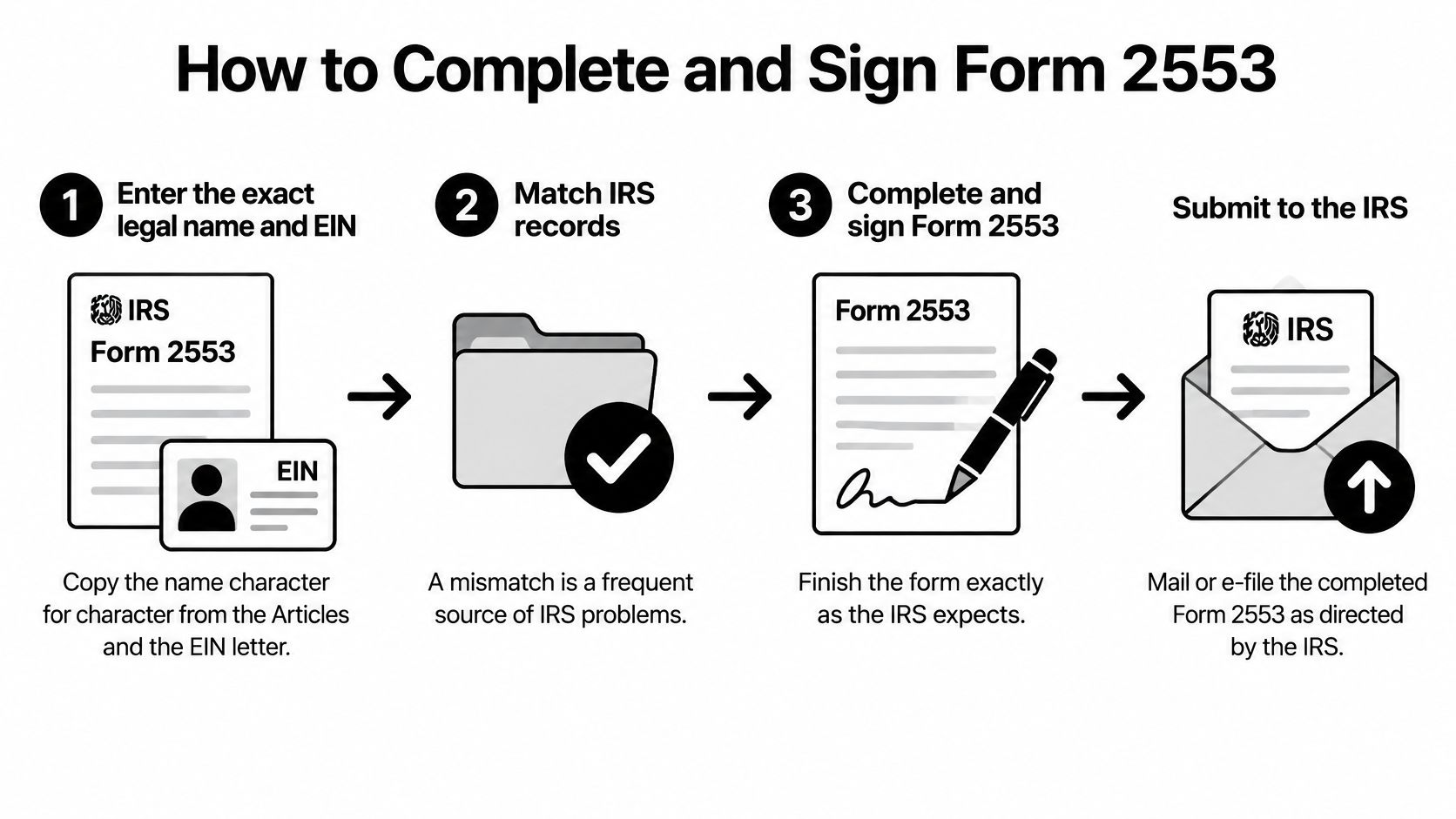
A mismatch between Form 2553 and the company's legal records can delay processing or undermine the election. Gather the current IRS Form 2553, EIN confirmation, formation documents, ownership ledger, and governing agreement before filling it out.
Complete the identifying and ownership information
Enter the exact legal name and EIN. Match the name on the formation documents to the EIN confirmation, including the entity suffix. Resolve any disagreement between those records before filing.
Confirm the address and formation state. Provide the business mailing address and the correct jurisdiction of formation. Handle any address change with the IRS separately; Form 2553 does not update every account record.
Enter the intended effective date. Use the first day of the tax year for which the corporation seeks S treatment. Confirm that the date fits the applicable filing rules and the company's planned tax treatment.
Separate formation date from operating history. Enter the incorporation or organization date in the field that requests it, and select the intended tax year end. Keep records of when shareholders, assets, and operations began, since those facts may affect the initial-year election.
Match shareholder details to the ownership records. Provide each required shareholder's address, tax identification number, ownership information, acquisition date, and tax year. Reconcile transfers recorded in agreements with the ownership ledger before completing the entries.
Collect signatures and preserve submission evidence
Obtain consent from every required shareholder. Check joint ownership and community-property interests to determine whether a spouse's consent is required, even if the spouse is not listed in company records. One owner's signature does not automatically represent every beneficial owner.
Have an authorized officer sign and date the form. Confirm the signer's authority and complete the officer signature block separately from the shareholder consents. Signing as an owner does not replace the officer signature.
Submit according to the IRS's current routing instructions. For a mailed form, verify the destination and retain proof of mailing and delivery. For a faxed form, verify the current IRS fax routing instructions and keep the transmission record. Retain the complete signed submission, not just a draft.
Florida formation is a separate state process. Florida corporation filing requirements establish the entity through state filings; they do not show that the IRS received Form 2553. For fax submissions, addressing a fax cover page for IRS can help organize the cover sheet, but follow the IRS routing instructions for the filing.
Give the preparer the complete packet early enough to review it and obtain missing signatures. Before submission, compare the signed form with the reviewed draft, then record who sent it, when it was sent, and where the filing evidence is stored.
What to Do If Your Election Is Late
A late form isn't always too late. But late-election relief isn't a general extension, and it doesn't turn an otherwise ineligible business into an eligible S corporation.
The IRS late-election instructions describe relief conditions that include intended S treatment, otherwise valid eligibility, reasonable cause, diligent correction, consistent reporting, and generally filing within 3 years and 75 days of the intended effective date. Check the applicable relief route rather than assuming that being within the time window is enough.

Build an evidence file before submitting
The IRS guidance on filing-status changes explains procedures involving a reasonable-cause statement, the appropriate relief annotation, and coordinated corporate return filings. Follow the procedure that matches your circumstances, especially if the IRS has already issued an invalid-election notice.
Confirm the problem is a late election. Establish the intended effective date, what was submitted, and whether the business qualified throughout the relevant period. An ownership defect requires a different analysis from a forgotten filing.
Write a factual reasonable-cause statement. Explain who was responsible, which process failed, when the omission was discovered, and what happened next. Support the timeline with engagement correspondence, emails, meeting records, or contemporaneous tax-preparation documents.
Use the applicable relief annotation. Where appropriate, mark the form “Filed Pursuant to Rev. Proc. 2013-30.” The notation identifies the requested procedure; it doesn't replace the explanation or other requirements.
Coordinate the corporate returns. For the applicable attachment route, submit the election with the initial corporate S return and file required delinquent returns consistently. If responding to an IRS notice, follow that notice's prescribed submission procedure instead.
Identify everyone whose consent is required. Review shareholders throughout the relevant period, including former owners. A current ownership list may omit someone whose signature matters to the relief request.
Check whether prior reporting contradicts the request
Say the owners intended S treatment, but their preparer filed partnership returns and the owners reported partnership income. That isn't merely a missing attachment. The preparer must evaluate whether those filings prevent the requested relief and which entity or shareholder returns may need correction.
Gather bank statements, payroll filings, distribution records, shareholder agreements, filed returns, and IRS correspondence. Build a year-by-year reconciliation showing how the company and each shareholder reported the business.
Amending a return isn't automatically a cure. Determine whether corrections satisfy the relevant procedure before filing amendments that may create additional inconsistencies.
Relief checkpoint: A well-written explanation can support reasonable cause. It cannot erase an ineligible shareholder or prove consistent reporting when the filed returns say otherwise.
If the standard relief conditions aren't met, don't repeatedly send the same late form. Get a procedure-specific assessment of whether another remedy exists or whether prospective treatment is the practical option. Act promptly after discovering the omission, and preserve the discovery date in the file.
Common Filing Mistakes and How to Fix Them
A missing shareholder consent can prevent acceptance even when the rest of the form is correct. Start the final review with signatures, then compare identifying information, dates, classification, ownership, and reporting.
There's no sound basis for promising that every error produces the same outcome. Some defects cause correspondence, some prevent the requested effective date, and some reveal that the business wasn't eligible in the first place.
Match each error to the right correction
Common Form 2553 mistakes, their effects and fixes
| Mistake | What it causes | Fix |
|---|---|---|
| Missing shareholder consent | Form 2553 cannot be accepted | Collect every required signature, including a community-property spouse where applicable |
| Name or EIN does not match IRS records | Correspondence and delays | Compare the Articles and EIN letter, then resolve discrepancies |
| Effective date set to the wrong tax year | Requested treatment may not begin when intended and can start a year late | Recalculate the filing window from the intended start date |
| LLC skipped corporate classification | Election may not take effect as intended | Check whether Form 8832 is needed or classification accompanies the S election |
| Ineligible owner added before filing | Eligibility lost | Review the actual holder before issuing or transferring interests |
| Payroll and returns still treated as partnership | Inconsistent reporting and IRS notices | Coordinate payroll, bookkeeping, and the corporate S return with the intended treatment |
The LLC classification issue deserves particular care. IRS Revenue Procedure 2004-48 recognizes relief situations involving failures to make both corporate-classification and S elections. That history underscores the distinction between classification and S status, but it doesn't mean every LLC must file separate elections or that an older procedure is the correct current remedy.
Ask a precise question: What establishes corporate classification on the effective date we're requesting? The answer should identify the applicable filing or deemed election, not just say that LLCs can elect S treatment.
Review the surrounding documents too
Tax-form accuracy won't fix an operating agreement that promises incompatible economic rights. Nor will it resolve a dispute about whether a founder ever transferred their interest.
Common do-it-yourself issues include missing IP assignments, unclear ownership, wrong entity selection, and policy gaps that surface during fundraising or audits. Those problems matter because the tax election should match the company the founders created, not the company they intended to document later.
Keep a compact filing-control sheet with:
- Signature status: Every required signer, capacity, and completion date.
- Document versions: The final election, supporting statements, and attachments.
- Submission evidence: Mailing or fax confirmation and the destination used.
- Return review: Confirmation that the first corporate S return matches the intended election.
Date errors are particularly avoidable. Recalculate the window independently before submission, and don't confuse a requested effective date with evidence that the IRS accepted it. Preserve subsequent IRS correspondence alongside the original filing packet.
Decide Whether to File Your Election This Year
File yourself only when ownership is simple, stable, and clearly eligible. If classification, ownership rights, or prior reporting is uncertain, get a review before submitting.
A single-owner LLC or corporation with no planned ownership changes and an open filing window may have a manageable filing task. You still need accurate records, every required signature, a deliberate effective date, and reliable submission evidence. Simplicity reduces the number of questions; it doesn't eliminate the need to answer them.
Choose based on the next ownership decision
Foreign owners, entity investors, venture financing, employee equity, and a missed deadline all justify closer review. Each can change eligibility, documentation, or the procedure needed to obtain the intended treatment. A founder weighing the underlying structure can use the LLC versus S corporation comparison for small businesses to separate legal-entity choices from tax classification.
For a new Florida business, we guide founders through the options and implement the structure that fits. Our formation work includes LLC, S-Corp, and C-Corp setup through Sunbiz and the IRS, formation documents, operating agreements or bylaws, and EIN registration, with Florida versus Delaware comparisons and 83(b) guidance where relevant.
Finish these actions this week
- Run the eligibility check: Compare the ownership table with current holders, pending transfers, and planned investors.
- Collect the signatures: Confirm both shareholder consents and the authorized officer's signature are complete.
- Confirm the filing timeline: Match the effective date to the applicable deadline and decide whether ordinary filing or relief is required.
Don't elect solely because another founder says it saved them taxes. Compare the potential benefit with payroll administration, tax-return work, and restrictions on future ownership. The right election fits both the current business and the financing plan.
Coto & Waddington, Attorneys at Law can review your ownership structure and filing timeline so your S corporation election matches your company's documents and growth plans. Visit Coto & Waddington, Attorneys at Law to arrange an eligibility and timeline review, bringing your cap table, governing agreement, EIN letter, and any prior returns or IRS notices. For a calendar-year election, book before March 1 so there's time to complete the review ahead of the ordinary March 15 deadline.