You send the intro email. A supplier finally agrees to speak with your startup. Or an advisor opens the door to the investor you've been trying to reach for months. Everybody is friendly on the first call. Then the second call happens without you. A week later, the deal keeps moving. Your role disappears.
That problem shows up constantly in startup work. Founders trade on relationships before they have much influence anywhere else. A contact list, a warm introduction, a channel partner, a manufacturer, a strategic advisor. Those are real assets. They just don't look like assets until someone tries to take them off your hands.
A non circumvention clause is the contract version of putting a fence around that introduction. It tells the other side they can't go around you, directly or indirectly, to capture the value of a relationship you created.
For South Florida businesses, the issue gets sharper fast. Many startups here operate across Florida, Delaware entities, Latin American counterparties, remote contractors, and bilingual deal flow. A one-page template pulled from the internet may look protective, but in practice it can fail where it matters most. Courts don't enforce vibes. They enforce language.
The trade-off is simple. If the clause is too soft, it won't stop a bypass. If it's too broad, it may not survive a challenge. The best drafting protects the deal without choking ordinary business activity.
The Critical Introduction You Need to Protect
A founder spends months building a relationship with a specialty manufacturer. She isn't ready to place a large order yet, so she brings in a distribution contact who can aggregate demand and make the deal commercially viable. The intro works. Product samples move. Pricing gets discussed. Then the distributor and manufacturer keep talking without her.
At that point, the founder usually says one of two things. Either, "But they knew I made the introduction," or, "We had an NDA."
Neither point solves the core problem.
Knowing who made the intro isn't the same as agreeing not to bypass that person. And an NDA protects information, not the economic value of the relationship itself. If the parties can legally continue the relationship without misusing confidential information, the person who created the opportunity may still get cut out.
This is why intermediaries, consultants, deal finders, agencies, and founders need to think about protection before the introduction happens. Once the parties are already speaking directly, your negotiating power usually drops.
Business owners often focus on who owns the idea. In these disputes, the better question is who owns the lane to the deal.
In Florida startup practice, this issue comes up in familiar settings:
- Investor introductions: An advisor introduces a startup to capital sources, then gets sidelined when diligence begins.
- Supplier sourcing: A business shares a hard-won vendor relationship, only to see the counterparty order direct.
- Joint ventures: One side contributes the key contact network, while the other side tries to continue the relationship alone.
- Referral arrangements: A consultant opens the door, but the parties rewrite the economics after the consultant is out of the room.
The clause isn't about punishing success. It's about preserving fairness in the exact moment a relationship starts creating value.
What Is a Non Circumvention Clause
A non circumvention clause is a promise that the receiving party won't use an introduction, business relationship, or transaction opportunity to go around the person who provided it.
Think of it as a broker's shield. An NDA says, "Don't misuse what I told you." A non circumvention clause says, "Don't use who I introduced you to in a way that cuts me out."

What it protects
The clause usually protects one of three things.
- Introduced contacts: Suppliers, investors, customers, lenders, distributors, or strategic partners.
- Transaction pathways: The ability to stay involved in a deal or receive agreed compensation if the deal closes.
- Relationship value: The commercial advantage created by your network and timing.
A simple way to explain it to founders is this. Your NDA protects the recipe. Your non circumvention clause protects the dinner invitation list.
What it is not
A non circumvention clause is often confused with other contract tools. They overlap, but they don't do the same job.
| Agreement | Main purpose | Core risk addressed |
|---|---|---|
| NDA | Protects confidential information | Disclosure or misuse of sensitive information |
| Non circumvention clause | Protects introductions and deal access | Being bypassed in a transaction |
| Non-compete | Restricts competitive activity | Direct competition in a defined market or role |
That distinction matters in real negotiations. If you only use an NDA, the other side may still argue they didn't disclose anything improper. They decided to work together. That's exactly the gap the non circumvention clause is supposed to close.
Why it exists in modern contracts
The phrase has older legal roots than many business owners realize. Non-circumvention clauses trace their roots to 1980s US laws against circumventing cable encryption, evolving through trade agreements like NAFTA (1994) and the Digital Millennium Copyright Act (1998) into modern business protections for intermediaries, as discussed in this historical analysis from UCL.
Today, the business version is common where access matters more than hard assets. That includes consulting, equipment deals, e-commerce partnerships, brokerage, and startup introductions.
When it should be mutual
Not every deal needs a one-way restriction. If both sides are sharing contacts, pipelines, and introductions, a mutual clause often makes more sense.
Use a unilateral clause when one party is clearly the introducer. Use a mutual version when both parties are bringing relationships to the table and both need protection.
A good non circumvention clause doesn't try to control the whole market. It controls one specific route through the market.
That is why the best clauses feel narrow on paper but powerful in practice.
Anatomy of an Ironclad Non Circumvention Clause
Most failed non circumvention clauses fail for boring reasons. The parties are unclear. The scope is fuzzy. The duration is unrealistic. The definition of an introduction is left to memory and argument.

Protected parties must be identifiable
Start with who is protected and against whom.
If the clause says "contacts," that isn't enough. It should identify whether protected relationships include named parties, affiliates, introduced entities, or people disclosed during the term. If you're the introducer, you want a record of who was introduced and when. If you're the receiving party, you want guardrails so the clause doesn't later expand to every person the introducer has ever met.
A cleaner structure looks like this in practice:
- Named parties: The signer and the counterparty.
- Protected contacts: People or entities introduced during a defined period.
- Related persons: Agents, affiliates, subsidiaries, or anyone acting on behalf of a party if that coverage is needed.
Founders often under-draft in this area. They prohibit direct contact, but forget indirect contact through a friend, contractor, affiliate, or side entity.
Scope wins or loses the dispute
The scope tells the court what conduct is banned.
That means the clause should state whether the party may not:
- Contact directly: Calling, emailing, or negotiating with the introduced contact.
- Act indirectly: Using another person or entity to make the approach.
- Close parallel deals: Restructuring the transaction to avoid paying the original intermediary.
- Solicit around the introducer: Trying to extract the same opportunity through a related channel.
If you leave that vague, you create a story problem for a future judge. Judges don't like writing contracts for parties after the fact.
For founders who want a broader contract framework, this guide on how to write a business contract is a useful companion because the same rule applies across business agreements. Specific language performs better than generalized promises.
Duration has to be defensible
The term has to match the deal cycle. Industry standards recommend non-circumvention clauses with durations of 1 to 5 years, and courts are more likely to enforce a reasonable 3-year term than an excessive 10-year one, according to Hyperstart's discussion of non-circumvention clause duration.
That doesn't mean every startup should ask for three years. It means you should be ready to explain why your requested term is commercially reasonable.
A practical approach:
| Deal type | Typical drafting instinct | Real risk |
|---|---|---|
| Simple referral | Shorter term may work | Too short can let the parties wait you out |
| Supplier or distribution intro | Mid-range term often fits | Term should reflect how long the relationship takes to mature |
| Strategic partnership | Longer term may be justified | Too long can look like a trade restraint |
Define the trigger event
A surprising number of disputes turn on one question. What counts as the introduction?
Was it a name drop on a Zoom call? An email thread? A WhatsApp message? A conference dinner? A data room list?
Define it. Good drafting often ties the protection to one or more of these:
- Written identification of the contact
- A direct meeting arranged by the introducer
- A transaction opportunity disclosed during the agreement term
- A documented exchange showing the parties were connected through the introducer
Practical rule: If you can't later prove the introduction happened, your clause may still exist, but your leverage drops fast.
Remedies should match the business risk
An ironclad clause doesn't just say "don't do this." It says what happens if someone does it. That can include payment obligations, injunctive relief, fee recovery if allowed, and survival language after termination.
The strongest clauses are boringly precise. They read less like a warning and more like a machine. If event X happens, consequence Y follows.
Sample Non Circumvention Clause Language
Templates are useful for learning. They're dangerous when copied without context. A founder's referral arrangement shouldn't read like a multinational trading contract, and a strategic partnership shouldn't rely on a one-line internet form.
Unilateral sample for a finder or introducer
Use this format when one party is introducing a contact and wants to prevent a bypass.
Sample unilateral clause
Recipient acknowledges that Introducer may disclose or facilitate introductions to certain business contacts, including prospective customers, suppliers, investors, lenders, or strategic partners. During the term of this Agreement and for the stated survival period, Recipient shall not, directly or indirectly, contact, negotiate with, transact with, or otherwise seek to do business with any such introduced contact for the purpose of avoiding Introducer's participation or agreed compensation. Recipient shall not use any affiliate, agent, contractor, or third party to accomplish conduct prohibited by this section. This restriction does not apply to contacts with whom Recipient had a demonstrable pre-existing relationship before the introduction, provided that such relationship is documented in writing before or promptly after the introduction is made.
Why this works:
- It identifies the recipient and introducer.
- It covers direct and indirect circumvention.
- It includes a pre-existing relationship carve-out.
- It ties the restriction to avoiding participation or compensation, which helps show the legitimate business purpose.
What to customize:
- The exact categories of contacts.
- The way a pre-existing relationship must be documented.
- Whether the protection covers one transaction or an entire defined relationship.
Mutual sample for a joint venture or collaboration
Use a mutual structure when both sides are sharing opportunities and neither wants to be undercut.
Sample mutual clause
Each party acknowledges that, in connection with the contemplated collaboration, it may disclose to the other certain contacts, opportunities, business relationships, or transaction pathways of independent value. Except as expressly authorized in writing, neither party shall, during the term of this Agreement or any survival period, directly or indirectly circumvent the other by engaging with, soliciting, contracting with, or pursuing transactions with any introduced contact or opportunity in a manner that excludes the introducing party from the contemplated role, economics, or participation. For clarity, circumvention includes conduct through affiliates, representatives, intermediaries, and related entities. This section does not restrict dealings that are unrelated to the introduced opportunity or that arise from documented pre-existing relationships identified by the relevant party.
This version is broader, but still anchored to introduced opportunities rather than the entire universe of possible business.
Annotation matters as much as wording
The key phrases are the ones parties often skim past:
- "Directly or indirectly" closes the affiliate loophole.
- "Expressly authorized in writing" avoids later arguments about informal consent.
- "Documented pre-existing relationships" prevents overreach.
- "Contemplated role, economics, or participation" helps tie the clause to a business purpose.
A good sample is a starting point. The work involves fitting it to the deal in front of you.
Enforceability Challenges and Legal Remedies
A non circumvention clause is only useful if you can enforce it when the other side gets tempted to go around you. That's where many generic forms break down.
Florida and Delaware are both important startup jurisdictions, but they aren't interchangeable in how business owners should think about contract risk. Delaware is often viewed as contract-friendly, especially when experienced parties negotiate clear terms. Florida can also enforce these clauses, but courts will still look hard at whether the restriction is specific, reasonable, and tied to a legitimate business purpose rather than acting like a disguised restraint on trade.

Why these clauses fail
The most common failure point is vagueness. If the agreement doesn't make clear what conduct is prohibited, who the protected contacts are, or what business activity is covered, the clause may become expensive decoration.
That practical risk shows up in the data. Real-world enforceability of non-circumvention agreements in U.S. federal courts shows a 60-70% success rate, but this can drop to 45% in cross-border disputes, according to Fynk's review of enforceability trends. For South Florida companies dealing with overseas manufacturers, LATAM distributors, or foreign investors, that drop matters.
Problems usually come from one or more of these drafting choices:
- Overbroad coverage: The clause tries to lock up every possible future interaction.
- Undefined introductions: Nobody can later prove what contact was covered.
- Weak jurisdiction planning: The parties never thought through where the dispute would be fought.
- Misaligned documents: The NCA says one thing, the NDA or referral agreement says another.
Florida and Delaware create different practical questions
For a Florida business, the issue often isn't whether a clause sounds tough. It's whether it sounds fair and precise enough to survive scrutiny. If the language reads like a blanket ban on doing business, a court may resist it.
For a Delaware entity, especially in venture-backed or investor-facing deals, the focus is often on contract clarity and deal sophistication. Delaware judges generally expect the parties to say what they mean. If they do, that can help. If they don't, Delaware won't fix sloppy drafting for them.
Cross-border deals complicate both states. If your startup uses AI-assisted procurement tools, global marketplaces, or software-driven introductions, your contracts should also fit the compliance picture around data handling and automated decision systems. Founders looking at this overlap may find Ai Governance Law useful as a separate resource on governance issues that increasingly sit next to commercial contracting.
What remedies actually help
When a breach happens, you usually care about two categories of relief.
| Remedy | What it does | Best use |
|---|---|---|
| Injunctive relief | Seeks to stop the bypass or ongoing deal conduct | Useful when you catch the problem early |
| Monetary damages | Seeks payment for lost fees, commissions, or deal value | Useful after the transaction has already moved forward |
In practice, you also need evidence. Save intro emails, meeting invites, WhatsApp confirmations, draft term sheets, CRM notes, and redlined contracts. Without a paper trail, the legal claim becomes harder.
If you're trying to understand where a lawyer fits into this process before a dispute starts, this overview of what a business attorney does is a practical primer.
Courts rarely rescue a party from an unclear clause when the dispute could have been prevented with better definitions on the front end.
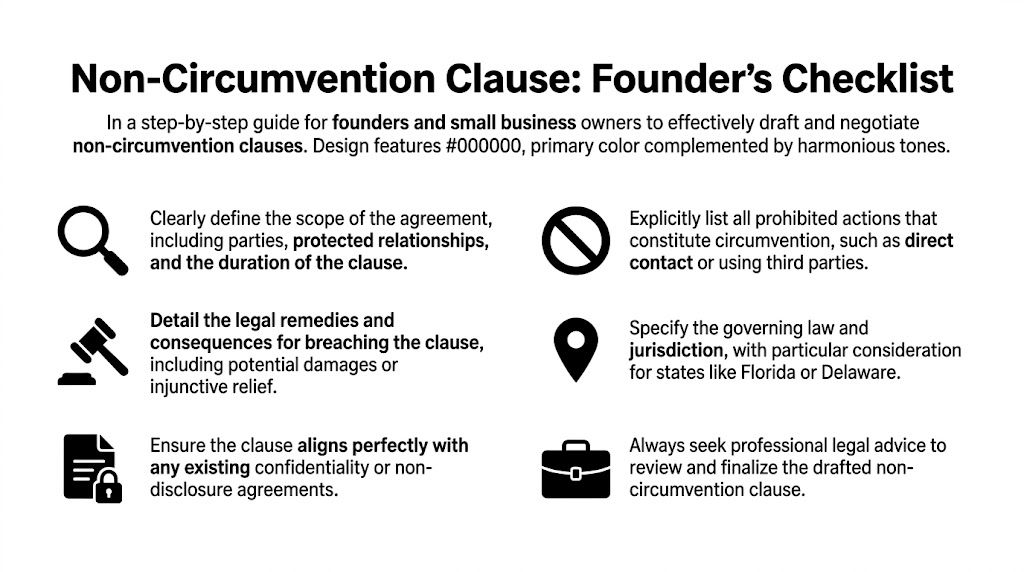
Drafting and Negotiation Checklist for Founders
Founders often negotiate these clauses too casually at the exact moment they should slow down. The right approach isn't to demand the harshest language on the page. It's to ask for terms that a court can understand and a business can follow.
What to lock down before you sign
A precise clause performs far better than a dramatic one. Clauses with precisely defined scopes, detailing prohibited conduct and carving out pre-existing relationships, have an 85% uphold rate in court, compared to 45% for vague, broad language, as summarized by LegalVision's discussion of non-circumvention drafting.
Use that as your drafting lens. Specific beats broad.
- Define the introduction process: Decide how a protected introduction happens. Email? Named schedule? Shared CRM list? Meeting arranged by the introducer? Pick one or more methods and write them in.
- List prohibited workarounds: Don't stop at direct contact. Include use of affiliates, contractors, referral partners, side entities, and anyone acting on a party's behalf.
- Write the carve-outs carefully: If the other side already knew the contact, state how they prove it. Screenshots after the dispute starts aren't enough.
- Match the clause to the economics: If the deal is a referral, tie the clause to referral compensation. If it's a strategic collaboration, tie it to role and participation.
Negotiation points founders often miss
Some provisions deserve more attention than they get.
A common one is survival. If the agreement terminates next month, do the restrictions end too, even though the deal pipeline is just opening? Another is governing law and venue. In a South Florida deal involving a Delaware entity and an overseas supplier, someone needs to think through where enforcement would happen.
This is also where contract alignment matters. Your non circumvention clause shouldn't fight your NDA, consulting agreement, or independent contractor agreement. If you're already using confidentiality protections, this guide to a Florida nondisclosure agreement lawyer for NDAs, confidentiality, and trade secret protection is a useful reference point because these documents usually need to work together.
Red flags in the other side's paper
If you receive the first draft, watch for these issues:
- "Any business relationship" language: Too broad. It can become unenforceable or trigger needless argument.
- No carve-out for existing contacts: That's an invitation to a future facts fight.
- No remedy section: If there are no consequences, the clause loses deterrent value.
- Silence on indirect conduct: The easiest bypass is often one step removed from the signer.
Founders who are still in the early stage of starting your own business often underestimate how quickly relationship risk becomes contract risk. The earlier you build good paper habits, the less likely you are to rely on memory and trust alone.
The best founder negotiation move is often the simplest one. Ask, "How would we prove this later if we disagreed?"
If the other side can't answer that cleanly, the drafting isn't done.
Frequently Asked Questions
Does an informal introduction count
It can, but only if your agreement defines it broadly enough and you can prove it happened.
An introduction made by text message, social media DM, conference chat, or group email may still qualify if the clause covers informal methods or references written or documented introductions generally. The practical problem is proof. A loose conversation is much harder to enforce than a scheduled introduction email that clearly identifies the parties and purpose.
For that reason, founders should document introductions in a repeatable way. A follow-up email is often the cheapest legal protection in the room.
Can a non circumvention clause cover employees or former team members
Sometimes, but it depends on what you're trying to stop.
If the concern is that a former employee will use introduced contacts to route around the company, the clause can be written to address introduced relationships and post-employment conduct in a limited, business-focused way. But if the language starts looking like a broad employment restriction, you may be drifting into a different legal category with different enforceability issues.
The safer approach is to separate concepts. Use employment documents for employee duties, confidentiality obligations, and return-of-property rules. Use the non circumvention clause to protect identified relationships and defined transactions.
What are typical penalties for breach
The answer depends on the clause, the deal, and the jurisdiction. One common approach is liquidated damages. For breaches, liquidated damages clauses specifying 10-25% of the total transaction value provide strong deterrence and have been shown in U.S. courts to help recover an average of 70% of lost commissions, as reflected in Law Insider's discussion of non-circumvention clause remedies.
That doesn't mean every deal should use the same formula. A penalty that looks reasonable in a commission-based brokerage arrangement may look excessive in a startup collaboration. The amount has to be adjusted so it functions as a fair estimate of harm rather than an unenforceable punishment.
Should I combine it with an NDA
Often, yes.
The two provisions solve different problems, and many deals need both. If you are sharing confidential pricing, supplier terms, product plans, investor materials, or strategic information while also making introductions, pairing the protections usually makes sense.
A combined agreement can work well if it's drafted carefully. The risk is internal inconsistency. If the confidentiality section defines protected information one way and the non circumvention section defines protected contacts another way, the contract can create ambiguity instead of clarity.
What should I do before I make the introduction
Do these things first:
- Get the agreement signed: Not "we'll sign after the first call."
- Define the contact or category: The more concrete the better.
- Confirm compensation or participation: Don't assume everyone shares the same expectation.
- Create a paper trail: Email the introduction, save the acceptance, keep the meeting records.
Most non circumvention disputes don't start with bad intent. They start with momentum. Two parties begin talking, the opportunity grows, and the introducer becomes inconvenient. The contract is there to prevent convenience from becoming theft.
If you're about to make a key introduction, share a supplier relationship, or negotiate a referral or partnership agreement, don't rely on a recycled template. Coto & Waddington, Attorneys at Law helps South Florida founders and businesses draft practical, enforceable contracts that protect real deals in Florida, Delaware, and cross-border settings.