A non-circumvention agreement is the legal handshake that says, “no backdoor deals.” It’s a contract designed to stop one party from cutting you out of a deal after you’ve made a valuable introduction.
Think of it as the ultimate protection for your professional network. You connect two parties, and this agreement ensures you don’t get bypassed when they decide to work together.
What Is a Non Circumvention Agreement

Imagine you’re a South Florida founder who just introduced your new software to a major distributor you’ve cultivated a relationship with for years. Without a non-circumvention agreement (NCA), what’s stopping that distributor from dealing directly with your development partner and leaving you with nothing? This is the legal shield that protects your role in the middle.
An NCA legally binds the parties you introduce, preventing them from secretly cutting a deal behind your back. This is absolutely critical for consultants, brokers, and startups whose most valuable asset is often their network.
The Core Purpose of an NCA
At its heart, a non-circumvention agreement is about fairness. It makes sure that if you create an opportunity by bringing people together, you remain part of the final transaction and get whatever compensation you’re owed. It’s a common-sense protection in many business scenarios:
- Introducing a manufacturer to a new distributor.
- Connecting a startup with a potential investor.
- Facilitating a joint venture between two companies.
- Brokering a deal for a client.
These agreements are becoming standard practice, not just in Florida but globally. A 2023 survey showed that 68% of cross-border deals involving intermediaries now include NCAs. That’s a huge jump from 52% in 2019, driven by an increase in global partnerships. Breaking one can lead to serious penalties, from paying out lost commissions to handing over gross revenue from the secret deal. You can find out more about the increasing importance of these agreements in global trade.
Founder's Tip: An NCA isn’t about showing distrust; it’s about professional clarity. It sets clear rules from the start, protecting your hard-won relationships and future revenue.
A Quick Breakdown
To give you a clearer picture, this table breaks down the fundamental components of a non-circumvention agreement and what they mean for your business.
Non Circumvention Agreement at a Glance
| Component | Description for Founders | Common Scenario |
|---|---|---|
| Relationship Protection | Safeguards your role as the introducer, broker, or middleman. | You introduce a client to a contractor and want to guarantee you get your referral fee. |
| Defined Scope | Clearly specifies which parties and business opportunities are covered. | The agreement only applies to introductions related to your new tech project. |
| Exclusivity Window | Sets a specific timeframe (e.g., 2-3 years) for the agreement. | The parties cannot bypass you for a set period after the introduction is made. |
Understanding these pieces helps you see why a well-drafted agreement is so important. One of the biggest mistakes we see is vague language—it’s the fastest way to make an NCA unenforceable in court. Always define the "protected parties" and "confidential contacts" with absolute precision.
Pro Tip: Before you make that valuable business introduction, pause. The single most important step you can take is ensuring you have a signed, enforceable non-circumvention agreement in place.
Are you preparing to make a valuable business introduction? Contact Coto & Waddington today to create a clear, enforceable agreement that safeguards your business relationships and secures your role in the deal.
Key Clauses Every Founder Must Understand
A non-circumvention agreement is far more than a formality—it’s the legal shield protecting your most valuable business introductions. Its strength, however, depends entirely on how well it’s drafted. Founders often treat these as simple handshake agreements on paper, but a weak or vague clause creates loopholes that can render the entire document worthless.
Think of it this way: a poorly defined agreement is like leaving the back door of your business wide open. The core clauses are the locks. Let's break down the essential components that every founder needs to get right to ensure their connections and future revenues are secure.
Defining the Protected Parties
The first thing you must do is explicitly name every single individual and entity covered by the agreement. This “Protected Parties” clause is where many agreements fail. It’s not enough to just name the two companies involved. You have to include their employees, officers, directors, and even affiliates or subsidiaries.
Why is this so critical? Imagine you introduce Company A to Company B. If your agreement only names the companies, an ambitious executive from Company A could simply resign, start a new LLC, and deal directly with Company B. They’d argue their new company isn’t bound by the original agreement. By exhaustively defining all associated individuals and entities, you close this common—and very costly—loophole.
Pro Tip: Make sure the agreement specifies that it binds not just the signing companies but also their agents, successors, and assigns. This prevents circumvention through a simple corporate restructuring or a key employee jumping ship.
The Scope of the Agreement
Next up is the “Scope” clause. This is where you define the specific business opportunity or transaction you're protecting. This is arguably the most important clause and where a judge's scrutiny will be highest. An overly broad scope, like "any and all future business," is a massive red flag for courts. They often see it as an unreasonable restraint on trade and will refuse to enforce it.
Your goal is precision. You must clearly outline the specific transaction or relationship the agreement protects. For instance, instead of "any software development deals," you would specify "the joint venture to develop and market the 'Project Phoenix' mobile application."
This precision accomplishes two things:
- It makes the agreement far more likely to be upheld by a court.
- It gives all parties clear boundaries, which reduces the chance of accidental breaches and future fights.
Key Insight: A narrowly defined scope is a feature, not a bug. It proves to a court that you are protecting a specific, legitimate business interest, not trying to unfairly lock someone out of the market. A judge in South Florida will look much more favorably on an agreement tied to a single, identifiable deal.
Setting a Reasonable Duration
Every non-circumvention agreement must have an expiration date. The “Duration” or “Term” clause sets the time limit for the restrictions. An indefinite term is almost always unenforceable because courts see it as an unfair burden. The duration must be reasonable and directly tied to the business context.
So, what’s considered "reasonable"?
- Standard Deals: For most introductions and broker arrangements, a term of 2 to 3 years is standard. This gives a deal enough time to develop without being overly restrictive.
- Complex Ventures: For more intricate projects like international supply chains or multi-stage acquisitions, a longer period of up to 5 years might be justifiable if you can show why it's necessary.
Pro Tip: When negotiating the duration, think about the typical sales cycle in your industry and the nature of the specific relationship. Your goal is to protect the value of your introduction for a realistic timeframe. Pushing for a term that’s too long is a common mistake that can backfire, leading a court to void the clause entirely.
Negotiating these clauses can feel intimidating, but remember that clarity is your best friend. A well-drafted agreement protects everyone involved by setting clear expectations from day one.
Don't leave your most valuable connections unprotected. Schedule a consultation with the experts at Coto & Waddington to draft a non-circumvention agreement that safeguards your business and its future revenue streams.
NCA vs. NDA vs. Non-Compete: Which Do You Need?
Founders often get three critical agreements mixed up: the non-circumvention agreement (NCA), the non-disclosure agreement (NDA), and the non-compete. This confusion is understandable, but using the wrong legal tool for the job can leave your most valuable business assets completely unprotected.
Think of it this way: each agreement acts as a different type of protection for a different part of your business. One protects your secrets, another protects your market share, and the last one protects your relationships. Getting it right is not just a legal formality—it's a core part of your risk management strategy.
Your Legal Toolbox Explained
Let's unpack what each of these agreements actually does. Imagine you’re building your company from the ground up here in South Florida. You'll need specific tools to guard different assets.
Non-Disclosure Agreement (NDA): The Vault. An NDA is all about protecting your confidential information. It creates a legal "vault" around your trade secrets, proprietary software, financials, and customer data. You use an NDA when you need to show your cards to a potential investor, partner, or key employee, ensuring they can't leak what you've shared.
Non-Compete Agreement: The Fence. A non-compete is designed to prevent a former employee, partner, or seller of a business from turning into your direct competitor. It builds a legal "fence" around your territory, stopping them from taking the insider knowledge they gained from you and opening up a rival shop across the street in Coral Gables or Fort Lauderdale.
Non-Circumvention Agreement (NCA): The Gatekeeper. An NCA is fundamentally about protecting your valuable introductions and relationships. It acts as a gatekeeper for your network. You deploy it when you introduce two parties—say, a supplier and a distributor—to prevent them from making a deal behind your back and cutting you out of your hard-earned commission or role.
This decision tree helps visualize the key elements that make a non-circumvention agreement enforceable, especially in the eyes of a court.
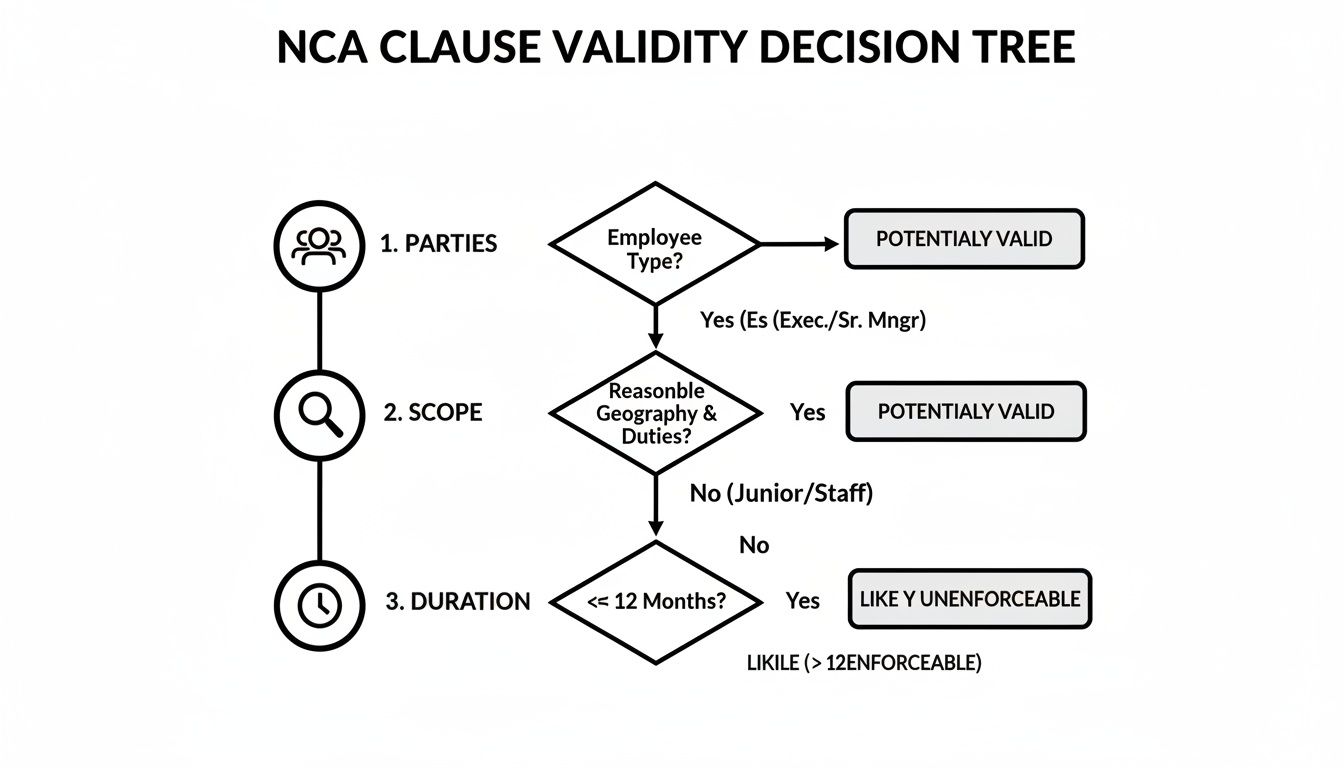
As the graphic shows, a vague or overly broad NCA is a weak one. Courts scrutinize whether the protected parties, scope, and duration are clearly and reasonably defined.
NCA vs. NDA vs. Non-Compete: Choosing the Right Protection
Understanding the purpose of each agreement is the first step. The next is knowing exactly when to use them. Here’s a side-by-side breakdown to clarify their roles.
| Agreement Type | Primary Purpose | Protects What? | Common Use Case |
|---|---|---|---|
| Non-Circumvention Agreement (NCA) | Prevents being bypassed in a deal | Your role and compensation in an introduction | Introducing a manufacturer to a distributor and ensuring you receive your commission. |
| Non-Disclosure Agreement (NDA) | Prevents the sharing of secret information | Confidential data, trade secrets, and IP | Sharing your app's source code with a potential investor. |
| Non-Compete Agreement | Prevents someone from becoming a direct rival | Your market position and customer base | An employee leaving your Miami marketing firm cannot start their own agency in the same city for a year. |
In our practice, we regularly see founders use an NDA when they really needed an NCA, leaving their commission or finder’s fee completely exposed. These agreements are not interchangeable—they solve different problems.
For a deeper look at how NDAs are handled under state law, check out our guide on Florida non-disclosure agreement law.
A Practical Scenario for a Miami Startup
Let's put this into a real-world context for a tech startup based in Miami's burgeoning tech scene.
Imagine you've developed a groundbreaking logistics algorithm. Your next moves are to secure funding and find a distribution partner to scale.
The Investor Meeting: Before you pitch a Brickell-based VC firm, you have them sign an NDA. This is non-negotiable. It protects the "what"—your algorithm's secret sauce, your user data, and your financial projections.
The Strategic Introduction: The investor loves your idea and wants to introduce you to a massive logistics company in Broward County. To protect their own future stake and ensure they aren't cut out of a potential partnership they facilitated, an NCA is signed by all parties. This protects the "who."
The Key Hire: You bring on a lead developer who will have the keys to the kingdom—access to your entire codebase and business strategy. Their employment contract includes a carefully drafted non-compete to prevent them from quitting six months later and building a copycat product for a rival. This protects your "where" in the market.
Founder's Tip: These agreements often work in layers. An NDA protects your information, an NCA protects your connections, and a non-compete protects your market position. Together, they form a comprehensive shield for your business.
Remember, a vague agreement is an unenforceable one. Be painfully specific about what’s being protected, who is involved, and for how long. Using the wrong tool for the risk is a common and expensive mistake we see founders make all the time.
Are you using the right legal tools to protect your startup? Contact Coto & Waddington for a strategic review of your agreements to ensure all your assets—information, connections, and market share—are fully protected.
How to Ensure Your NCA Is Legally Enforceable

Just because you have a signed non-circumvention agreement doesn’t mean you’re automatically protected. If that agreement is ever challenged, courts in jurisdictions like Florida and Delaware will put it under a microscope, scrutinizing every clause for “reasonableness.”
If your terms are too vague, stretch on for too long, or cover too much ground, a judge can—and often will—throw the entire contract out. That leaves you completely exposed, with no legal recourse for the exact situation you tried to prevent.
Think of it like building a fortress wall. If the stones are poorly fitted or the perimeter is undefined, it provides no real defense. To make sure your NCA stands strong, you need to build it with precision, keeping in mind what a court will be looking for.
Define the Scope with Surgical Precision
The most common reason we see non-circumvention agreements fail in court is an overly broad scope. You can't just forbid a partner from doing “any and all business” with someone you introduced them to. This is a massive red flag for judges, who tend to see it as an unfair attempt to restrain free trade.
Instead, your agreement must be tied to a specific, identifiable business opportunity. What was the purpose of the introduction? Anchor the non-circumvention clause to that purpose.
- Weak: "Party A agrees not to work with Party B on any future software projects."
- Strong: "Party A agrees not to engage with Party B for the purpose of developing, marketing, or selling the 'Project Alpha' logistics platform or any derivative products."
Pro Tip: This kind of detail shows a court you’re protecting a legitimate interest tied to a particular deal, not just trying to hamstring a competitor.
Set a Realistic Timeframe
Every non-circumvention agreement must have a clear expiration date. An indefinite or "perpetual" agreement is almost guaranteed to be unenforceable. The duration of your NCA should realistically reflect how long a deal in your industry typically takes to develop and close.
Key Insight: A typical, enforceable timeframe for a non-circumvention agreement is between 1 to 5 years. Anything longer than that will need a very strong justification, like a highly complex, multi-phase international joint venture. Pushing for an excessively long term is a classic mistake that can backfire, causing a court to invalidate the entire clause.
A well-drafted NCA is crucial in supply agreements and joint ventures, where a bypass can completely erode your margins. This is especially true in industries where intermediaries can be undercut by 15-25% if a direct deal is struck.
Identify Remedies for a Breach
What happens if someone ignores the agreement and cuts you out anyway? A strong NCA doesn't leave this to chance. It spells out the consequences ahead of time in a section often called “Remedies.” This is your playbook for legal action.
Your agreement should clearly state that if a breach occurs, you are entitled to specific forms of relief:
- Injunctive Relief: This is a court order that immediately forces the other party to stop the prohibited activity. It’s the legal equivalent of hitting the emergency brake.
- Monetary Damages: This is your financial compensation. It could be calculated as the lost profits from the deal, the commission you were owed, or other fees you would have earned.
- Attorney's Fees: This is critical. A "prevailing party" clause states that the losing side of a legal dispute must pay the winner's legal costs. It removes a huge financial barrier to enforcing your rights.
Protecting your introductions is a fundamental part of securing your business’s value, and it goes hand-in-hand with protecting your other assets. For a broader look at asset protection, see our guide on how to protect intellectual property.
Is your non-circumvention agreement strong enough to hold up in court? Don't wait for a broken deal to find out. Contact Coto & Waddington for a professional review and ensure your valuable business relationships are truly protected.
Drafting and Negotiating Tips for Founders
When you’re a founder, treating a non-circumvention agreement as just another piece of legal paperwork is a mistake. Think of it as a strategic tool to protect your most valuable asset: your network. Getting the details right during drafting and negotiation isn’t about being difficult; it’s about setting clear rules of the road to prevent disputes before they ever start.
The goal is to draft an agreement that is both protective and enforceable. We’ve seen far too many founders use vague or overly aggressive terms that get thrown out in court. A well-crafted non-circumvention agreement is precise, fair, and builds trust by showing you value your business relationships.
Drafting Dos and Don'ts
When you sit down to write one of these, clarity is everything. Ambiguity is the enemy that can cost you dearly down the line. You're building a precise legal fence around a specific opportunity, so every word counts.
Essential Drafting "Dos":
- Do Be Hyper-Specific: Clearly define all protected parties, including their affiliates and successors. Don’t just say "any future deals"—name the exact business opportunity, like "the joint venture for the distribution of Product X in the South American market."
- Do Include a Fee Recovery Clause: Always add a provision stating that if you have to sue to enforce the agreement, the party in breach must cover your legal fees. This makes protecting your rights financially realistic.
- Do Define "Circumvention": Explicitly list what actions are off-limits. This includes things like initiating contact, negotiating terms, or closing a deal with a protected party without your involvement.
Critical Drafting "Don'ts":
- Don't Use Vague Language: Avoid generic terms like "business contacts" or "related projects." Name the specific people and companies involved. If a court can’t tell who or what you’re protecting, it won’t enforce the agreement.
- Don't Forget the Term: Every non-circumvention agreement needs a reasonable and clearly defined duration. A term between 1-3 years is standard and generally considered enforceable.
- Don't Skip the Governing Law: Specify which state’s laws will apply, especially if the parties are in different locations. For businesses operating here, this is almost always Florida.
Negotiation Tips for Founders
Negotiation isn’t a battle; it’s a collaboration to define the rules of engagement. Your objective is to secure strong protections without killing the deal or coming across as unreasonable.
Founder's Tip: A well-negotiated non-circumvention agreement is a sign of professionalism, not distrust. It shows that you value your introductions and expect your partners to do the same, establishing a foundation of mutual respect from the start.
Here are a few practical tips for the negotiation table:
- Justify the Duration: If you need a term longer than the standard 2-3 years, be ready to explain why. For instance, a complex international supply chain deal with a long sales cycle might justify a 5-year term.
- Clarify the Scope Together: Walk through the “scope” clause line-by-line with the other party. Make sure you both have the exact same understanding of what transaction is being protected to avoid messy "he said, she said" arguments later.
- Propose Mutual Terms: Offering a mutual non-circumvention clause, where both parties agree not to cut each other out, often feels more balanced and makes the other side much more willing to sign.
While these tips provide a solid starting point, every business deal has its own unique risks and opportunities. For a deeper dive into creating solid legal documents, check out our guide on how to write a business contract.
Are you ready to draft an NCA that protects your hard-earned business relationships? Contact Coto & Waddington to ensure your agreement is clear, enforceable, and aligned with your strategic goals.
Frequently Asked Questions About NCAs
Founders have a lot of questions when it comes to non-circumvention agreements. Getting straight answers is the only way to use these contracts to actually protect your business introductions. Here are the most common questions we hear from entrepreneurs in South Florida and across the state.
Can I Use an Online Template?
Using a generic template you find online is one of the biggest and most common mistakes a founder can make. These one-size-fits-all documents are not designed for your specific business deal, your industry, or the legal standards of your jurisdiction, like Florida.
We see it all the time in our practice: courts dismiss agreements that are too vague or overly broad. A cheap template you download is almost guaranteed to contain language that won't hold up, leaving you completely exposed when a deal goes sideways.
Pro Tip: Instead of starting with a template, just write down the key facts of your deal. Who are you introducing? What specific opportunity is this for? How are you supposed to get paid? This list is the perfect starting point for a productive conversation with your lawyer.
What Happens if Someone Violates the NCA?
If a party violates a valid non-circumvention agreement, you can take legal action to recover what you’ve lost. This usually means suing for the commission, fee, or profits that were stolen from you when you were cut out of the deal.
Pro Tip: A well-drafted agreement will also include a clause requiring the party who broke the contract to pay your legal fees. This is a critical provision, as it makes enforcing your rights financially realistic. Often, the first step is to have your attorney send a formal cease-and-desist letter, which can resolve the issue without a full-blown lawsuit. The key is to act quickly and decisively.
How Long Should an NCA Last?
For a non-circumvention agreement to be enforceable, its duration must be "reasonable." For most business introductions—like connecting a client to a new vendor—a period of 1 to 3 years is standard and typically upheld by Florida courts.
For more complex or long-term relationships, like an international joint venture or a multi-stage M&A deal, a term of up to 5 years might be justifiable. Anything indefinite or excessively long is a huge red flag. Courts will almost certainly strike it down as an unfair restraint on trade.
Pro Tip: Your goal is to define a time frame that genuinely protects the value of your introduction. Tying the duration to the typical sales cycle in your industry is a great way to strengthen its reasonableness.
Do I Really Need an NCA if I Trust My Partner?
Yes, absolutely. A non-circumvention agreement isn’t about distrust—it's about professional clarity and smart risk management. Business is unpredictable. People change jobs, companies get acquired, and verbal promises are easily forgotten or misremembered.
Pro Tip: A written agreement forces everyone to get on the same page from day one. It’s like business insurance for your professional relationships. Having a clear agreement in place not only protects your interests but can also prevent the kind of misunderstandings that ruin a good partnership. It shows you're a serious professional, not a skeptic.
Protecting your business opportunities and professional network is too important to leave to verbal agreements or shaky templates. As a founder-focused law firm, Coto & Waddington, Attorneys at Law provides clear, strategic legal counsel to help you draft enforceable agreements that safeguard your interests. Secure your network and your revenue by visiting us at https://cotowaddington.com to schedule a consultation.